
Ch 7 Selecting a Life Partner Cohabitation The

Ch. 7 Selecting a Life Partner

Cohabitation: The Best Way to Select? • Who Cohabits? • Patterns of Cohabitation • Cohabitation Compared to Marriage • Cohabitation as a Preparation for Marriage 7 -2

Cohabiting Couples: • Twice as likely to be interracial • Compared to married women, cohabiting women are more likely to earn more and be several years older than their partner • Relatively short-term • Cohabitors pool their finances to a lesser extent • Less likely to say they are happy with their relationships • Find their relationships less fair • Higher incidence of depression • Place greater importance on sexual frequency • Have more sex outside the relationship
Children’s Outcomes • 38% of cohabiting heterosexual households contain children under age 18. • Having a child while cohabiting does not necessarily increase a couple’s odds of staying together, but marrying before the baby is born does increase union stability. • Instability with cohabitation is related to problematic outcomes for children. • Cohabiting parents spend less on their children’s education than do marrieds. • Adolescents are more likely to experience earlier premarital intercourse, higher rates of school suspension, and antisocial and delinquent behaviors. • Compared to single-parent homes, children do benefit economically.
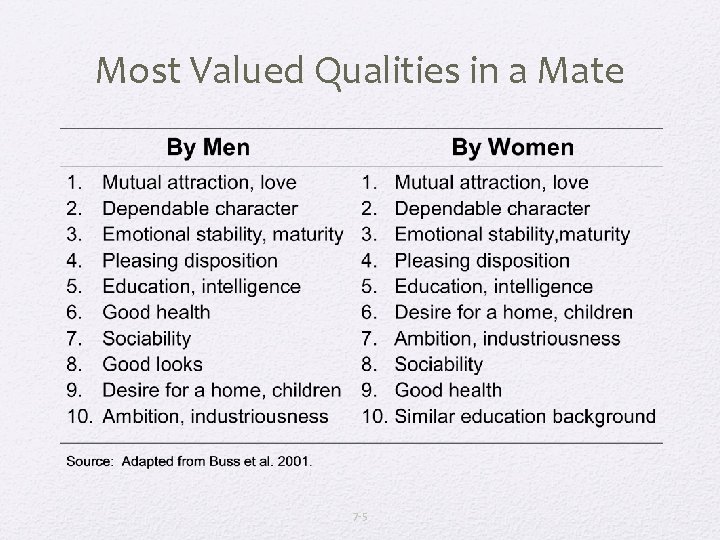
Most Valued Qualities in a Mate 7 -5

Life Partner Selection as a Filtering Process 7 -6
Free-choice Culture • The United States is an example of a free-choice culture: • People choose their own mates, although typically they seek parents’ and other family members’ support for their decision.
Arranged Marriages • Not uncommon in the less Westernized parts of Europe, Asia, and Africa. • Couples in arranged marriages are expected to develop a loving relationship after the marriage. • A study that compared marital satisfaction among arranged marriages in India to those more freely chosen in the United States found no differences in marital satisfaction between the two groups. • What are some advantages of arranged marriage? • Some disadvantages?
Types of Marriage • Homogamy — Marriage between two people who are similar in social and demographic characteristics, such as age, race, ethnicity, and religion • Heterogamy — Marriage between two people who are dissimilar in some social and demographic characteristics (race, age, education, religion, or social class. ) • Hypergamy — Marriage with someone who is from a higher socioeconomic background 7 -9
Reasons for Homogamy • People tend to marry people of similar race, age, education, religious background, and social class. • Geographic availability: (propinquity or proximity) geographic segregation, which can result from either discrimination or strong community ties, contributes to homogamous marriages • Social pressure: cultural values encourage marrying someone who is socially similar to ourselves
Heterogamy: Interfaith Marriages in the U. S. • Between 30 -40% of Jewish, Catholic, Mormon, Muslim, and a higher percentage of Protestant adults and children live in interfaith or interdenominational households • One study found strong religious beliefs are associated with less couple conflict. • Shared religiosity gave them a commitment to permanence, coupled with a willingness to forgive the spouse when conflicts emerged.
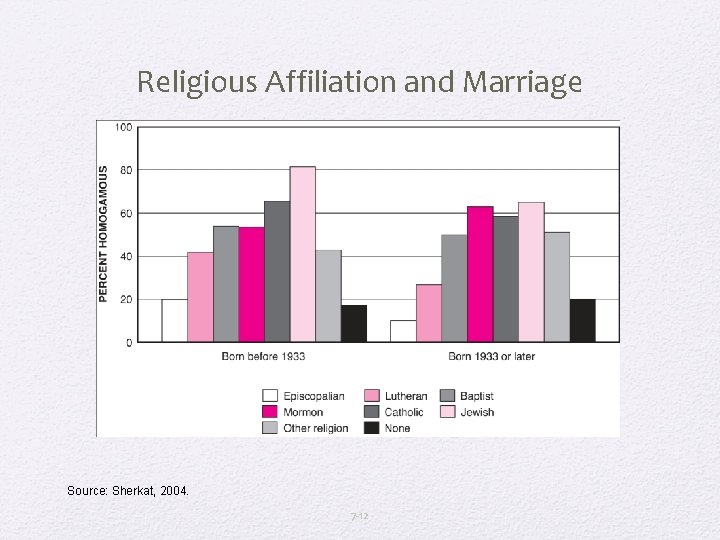
Religious Affiliation and Marriage Source: Sherkat, 2004. 7 -12
Heterogamy: Interracial/Interethnic Marriages in the U. S. • Interracial marriages include unions between partners of the white, black, Asian, or Native American races with a spouse outside their own race. • Unions between Hispanics and others, as well as between Asian/Pacific Islander or Hispanic ethnic groups are interethnic marriages. • In June 1967, the U. S. Supreme Court declared that interracial marriages are legally valid in all states.
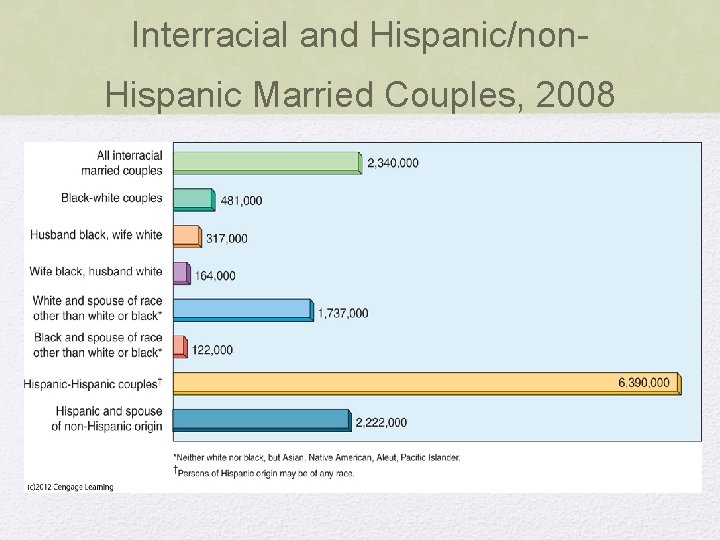
Interracial and Hispanic/non. Hispanic Married Couples, 2008
Interracial/Interethnic Heterogamy and Human Values • One study found higher relationship satisfaction compared to same-race couples. • Regardless of differences in race or ethnicity, common values and lifestyles contribute to relationship stability. • Polls show Americans becoming less disapproving of interracial dating and marriage.
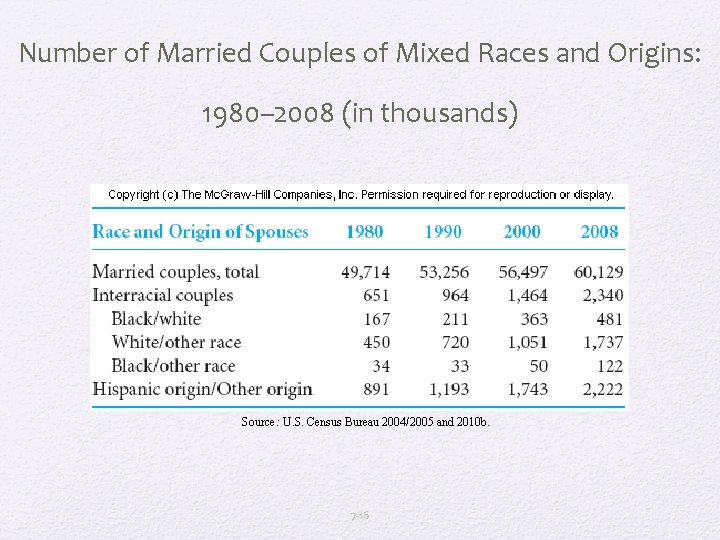
Number of Married Couples of Mixed Races and Origins: 1980– 2008 (in thousands) Source: U. S. Census Bureau 2004/2005 and 2010 b. 7 -16
What Characteristics Are Important to You? • Age • Ethnic Background • Race • Religion • Education • Personality • Attraction • Physical Characteristics (height, weight, hair color, etc. ) • Any others? 7 -17
Why Assortative Mating? -Assortative mating refers to marriage between two people who are similar on one or more characteristics. -Assortative mating stresses the fact that mate selection is nonrandom. • Propinquity • Attraction • Family Traditions and Pressures 7 -18

Predictors of Marital Satisfaction • Timing • Equity • Communication • PREPARE: A Multifactor Approach 7 -19
- Slides: 19