Poetry Terms Alliteration The repetition of sounds in



- Slides: 47
Poetry Terms
Alliteration: The repetition of sounds in a group of words as in “Peter Piper Picked a Peck of Pickled Peppers. ”
Allusion: A reference to a person, place, or thing--often literary, mythological, or historical. The infinitive of allusion is to allude. e. g. Romeo alludes to the mythological figure Diana in the balcony scene.
Assonance: The repetition of vowel sounds as in “And so, all the night-tide, I lie down by the side Of my darling, my life and my bride. --Edgar Allan Poe, Annabel Lee
Atmosphere: The overall feeling of a work, which is related to tone and mood.
Blank verse: Unrhymed lines of poetry usually in iambic pentameter. Plenty of modern poetry is written in blank verse.
Consonance: The repetition of consonant sounds as in “The fair breeze blew, the white foam flew, The furrow followed free; ” --The Rime of the Ancient Mariner
Couplets: A pair of rhyming lines in a poem often set off from the rest of the poem. Shakespeare’s sonnets all end in couplets.
Diction 1)Word choice. 2) The author’s choice of words. An author has the option of choosing any word from our language, why does he/she choose to use certain words and not others? In order to create a certain tone.
Elegy: A poem mourning the dead.
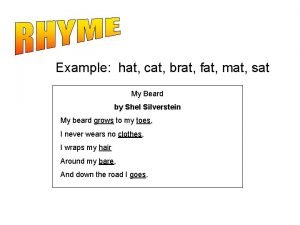
End rhyme: Rhyming words that are at the ends of their respective lines—what we typically think of as normal rhyme.
Epic: A long poem narrating the adventures of a heroic figure e. g. Homer’s The Odyssey.
Figurative Language: Whenever you describe something by comparing it with something else, you are using figurative language. Any language that goes beyond the literal meaning of words in order to furnish new effects or fresh insights into an idea or a subject. e. g. Whenever you call something “cool, ” you’re not talking about its temperature but referring to some other quality it possesses.
Free Verse: Poetry with no set meter (rhythm) or rhyme scheme.
Iambic pentameter: Ten-syllable lines in which every other syllable is stressed. -’ e. g. “With eyes like stars upon the brave night air. ”
Imagery: The use of description that helps the reader imagine how something looks, sounds, feels, smells, or tastes. Most of the time, it refers to appearance. e. g. “Tita was so sensitive to onions, any time they were being chopped, they say she would just cry and cry; when she was still in my great-grandmother’s belly her sobs were so loud that even Nacha, the cook, who was half-deaf, could hear them easily. ” --Like Water for Chocolate
Internal rhyme: A rhyme that occurs within one line such as “He’s King of the Swing. ”
Lyric: A type of poetry that expresses the poet’s emotions. It often tells some sort of brief story, engaging the reader in the experience.
Metaphor: A comparison of two unlike things using any form of the verb “to be”–-i. e. am, are, is, was, were. Ex: “This chair is a rock, ” or “I am an island. ”
Meter: The pattern of stressed and unstressed syllables in the lines of a poem.
Mood: The feeling created in the reader by a literary work or passage. The mood may be suggested by the writer's choice of words, by events in the work, or by the physical setting.
Myth: A legend that embodies the beliefs of people and offers some explanation for natural and social phenomena.
Onomatopoeia: The use of words that sound like what they mean such as “buzz, ” “bang, ” or “tic-tock. ”
Personification: Giving inanimate objects human characteristics. e. g. “The wind howled through the night. ”
Prose: Writing organized into sentences and paragraphs that is not poetry. e. g. Novels and short stories are examples of prose.
Quatrain: A four-line stanza.
Simile: Comparing two unlike things using “like” or “as. ” e. g. “I’m as hungry as a pig, ” or “Your eyes are like stars that brighten my night. ”
Sonnet: A fourteen-line poem written in iambic pentameter. Different kinds of sonnets have different rhyme schemes. The most notable are Shakespeare’s Sonnets which employ the abab, cdcd, efef, gg rhyme scheme.
Stanza: A major subdivision in a poem. A stanza of two lines is called a couplet; a stanza of three lines is called a tercet; a stanza of four lines is called a quatrain.
Symbolism: The use of one thing to represent another. Something that stands for something else. e. g. A dove is a symbol of peace.
Theme: The central idea of a work.
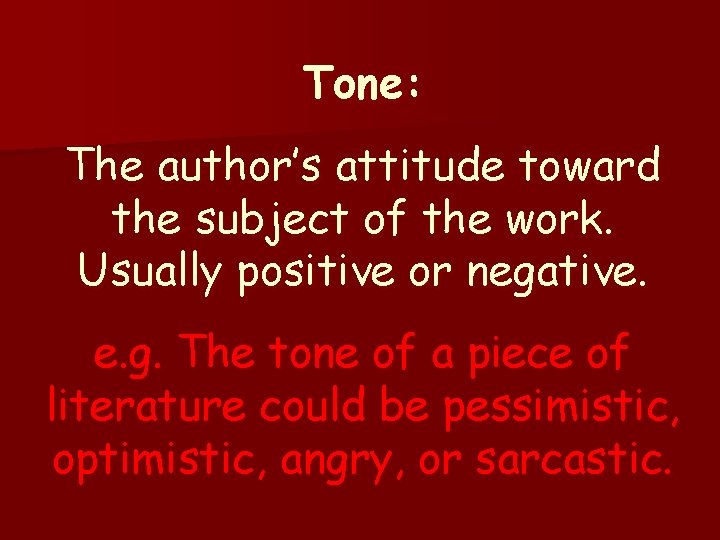
Tone: The author’s attitude toward the subject of the work. Usually positive or negative. e. g. The tone of a piece of literature could be pessimistic, optimistic, angry, or sarcastic.
Voice: The authorial presence in a piece of literature whether in the first, second, or third person.
OTHER FORMS OF POETRY
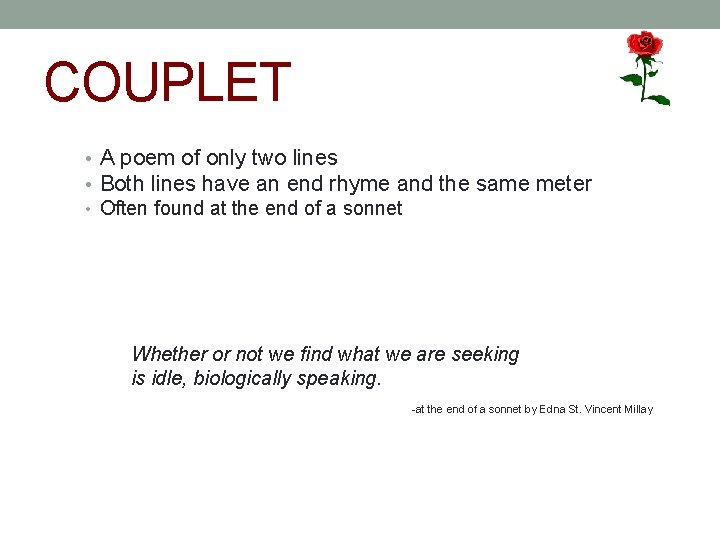
COUPLET • A poem of only two lines • Both lines have an end rhyme and the same meter • Often found at the end of a sonnet Whether or not we find what we are seeking is idle, biologically speaking. -at the end of a sonnet by Edna St. Vincent Millay
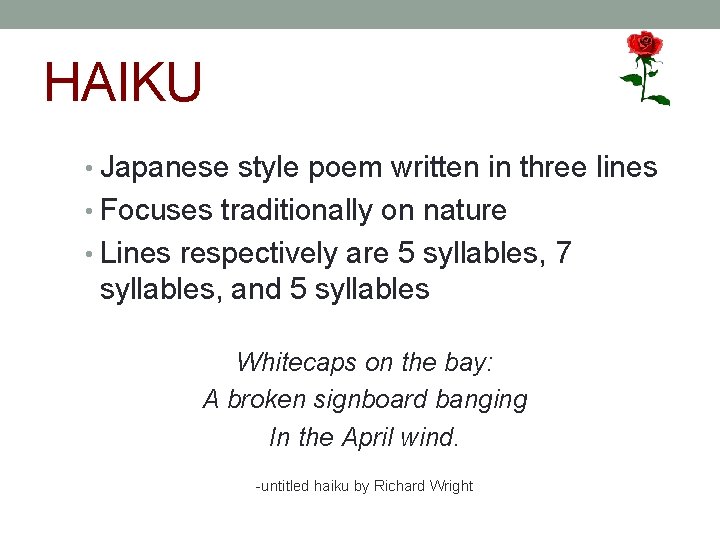
HAIKU • Japanese style poem written in three lines • Focuses traditionally on nature • Lines respectively are 5 syllables, 7 syllables, and 5 syllables Whitecaps on the bay: A broken signboard banging In the April wind. -untitled haiku by Richard Wright
QUATRAIN • Stanza or short poem containing four lines • Lines 2 and 4 must rhyme, while lines 1 and 3 may or may not rhyme • Variations in rhyming patterns (abab, abcb) O, my luve's like a red, red rose, That's newly sprung in June: O, my luve's like the melodie That's sweetly played in tune. -from “A Red, Red Rose” by Robert Burns A B C B
CINQUAIN • Stanza or short poem containing five lines • 1 word, 2 words, 3 words, 4 words, 1 word • Patterns and syllables are changing!
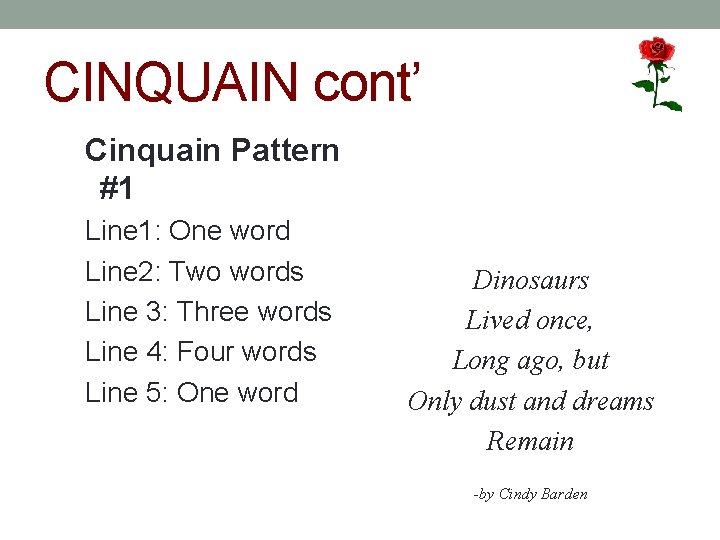
CINQUAIN cont’ Cinquain Pattern #1 Line 1: One word Line 2: Two words Line 3: Three words Line 4: Four words Line 5: One word Dinosaurs Lived once, Long ago, but Only dust and dreams Remain -by Cindy Barden
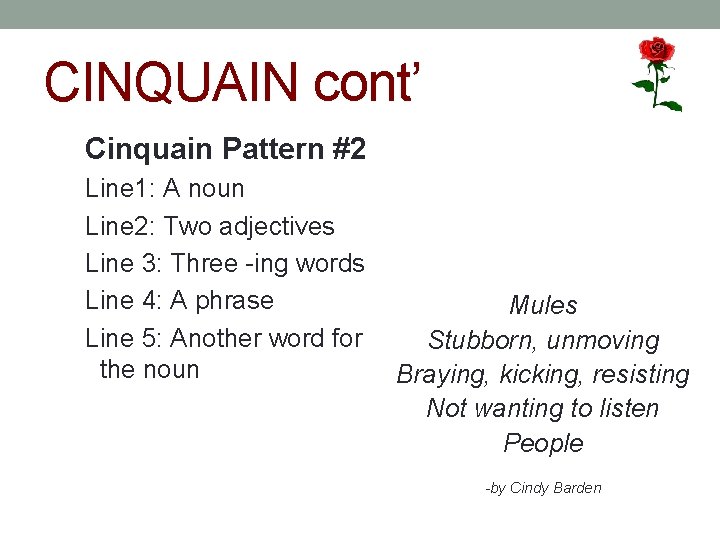
CINQUAIN cont’ Cinquain Pattern #2 Line 1: A noun Line 2: Two adjectives Line 3: Three -ing words Line 4: A phrase Line 5: Another word for the noun Mules Stubborn, unmoving Braying, kicking, resisting Not wanting to listen People -by Cindy Barden
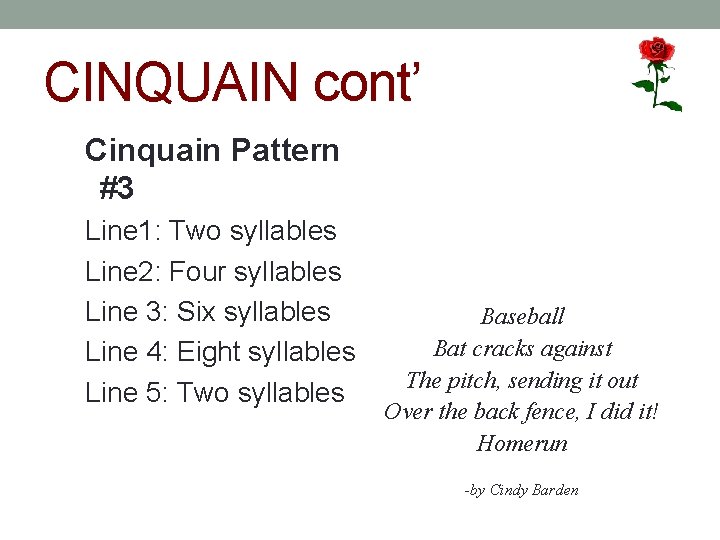
CINQUAIN cont’ Cinquain Pattern #3 Line 1: Two syllables Line 2: Four syllables Line 3: Six syllables Line 4: Eight syllables Line 5: Two syllables Baseball Bat cracks against The pitch, sending it out Over the back fence, I did it! Homerun -by Cindy Barden
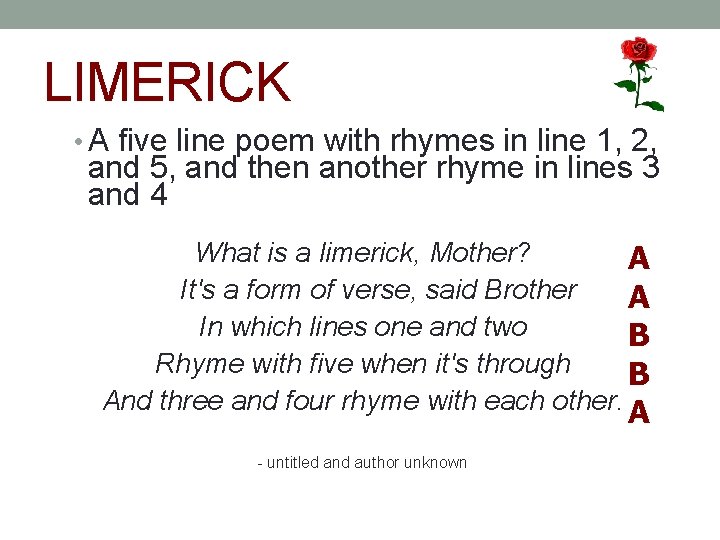
LIMERICK • A five line poem with rhymes in line 1, 2, and 5, and then another rhyme in lines 3 and 4 What is a limerick, Mother? A It's a form of verse, said Brother A In which lines one and two B Rhyme with five when it's through B And three and four rhyme with each other. A - untitled and author unknown
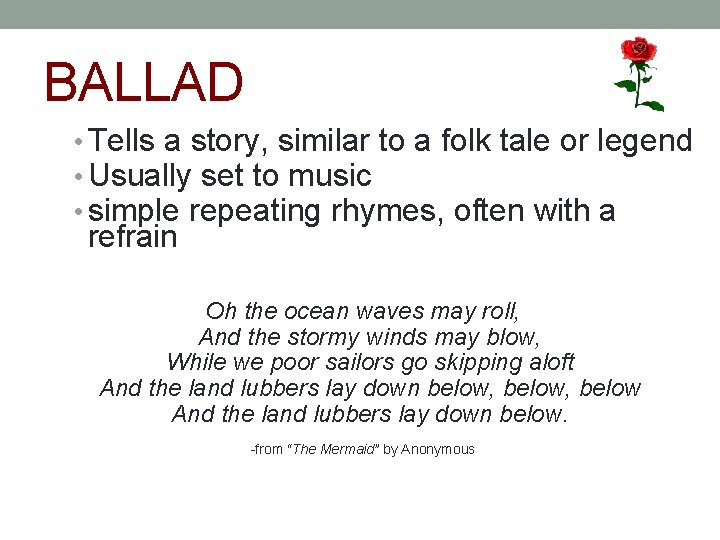
BALLAD • Tells a story, similar to a folk tale or legend • Usually set to music • simple repeating rhymes, often with a refrain Oh the ocean waves may roll, And the stormy winds may blow, While we poor sailors go skipping aloft And the land lubbers lay down below, below And the land lubbers lay down below. -from “The Mermaid” by Anonymous
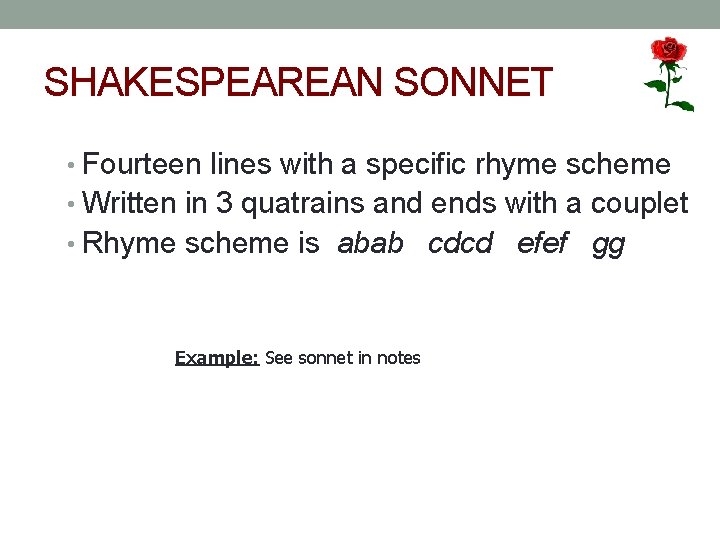
SHAKESPEAREAN SONNET • Fourteen lines with a specific rhyme scheme • Written in 3 quatrains and ends with a couplet • Rhyme scheme is abab cdcd efef gg Example: See sonnet in notes
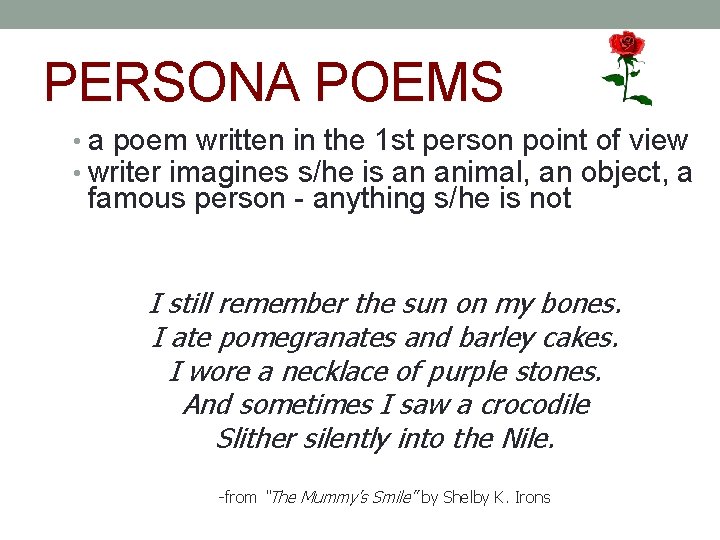
PERSONA POEMS • a poem written in the 1 st person point of view • writer imagines s/he is an animal, an object, a famous person - anything s/he is not I still remember the sun on my bones. I ate pomegranates and barley cakes. I wore a necklace of purple stones. And sometimes I saw a crocodile Slither silently into the Nile. -from “The Mummy’s Smile” by Shelby K. Irons
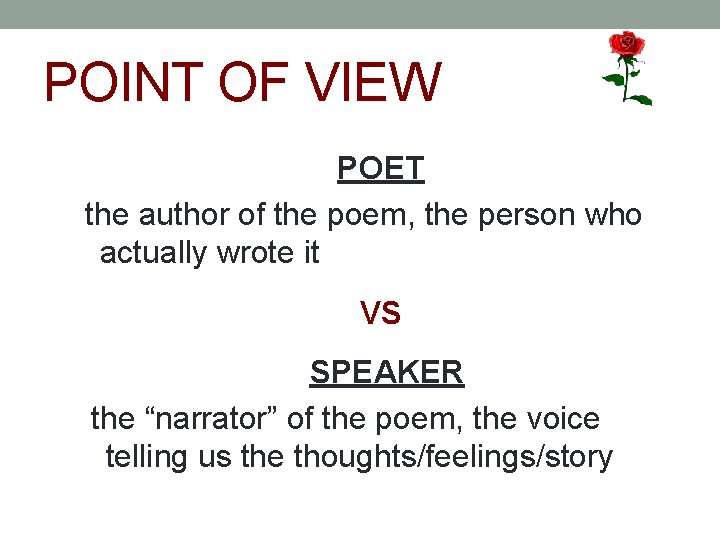
POINT OF VIEW POET the author of the poem, the person who actually wrote it VS SPEAKER the “narrator” of the poem, the voice telling us the thoughts/feelings/story