Phytoremediation An Innovative Treatment Technology Lecture11 DR AHMAD

- Slides: 18
Phytoremediation: An Innovative Treatment Technology Lecture-11 DR AHMAD A SHAHID
Phytoremediation: n Phytoremediation is an emerging technology which uses plants and their associated rhizospheric microorganisms to remove, degrade, or contain chemical contaminants located in the soil, sediments, groundwater, surface water, and even the atmosphere.
n Plant species are selected for phytoremediation based on their potential to evapotranspirate groundwater, the degradative enzymes they produce, their growth rates and yield, the depth of their root zone, and their ability to bioaccumulate contaminants
n n n Phytoremediation -- work at sites that are well suited for plant growth. means that the concentration of pollutants cannot be toxic to the plants the pollution cannot be so deep in the soils or groundwater that plant roots cannot reach it. As a result, phytoremediation may be a good strategy for sites conducive to plant growth with shallow contamination, it may be a good secondary or tertiary phase in a treatment train for highly polluted sites, or it may not be a viable option for a site.
n plants can be used to treat most classes of contaminants, including petroleum hydrocarbons, chlorinated solvents, pesticides, metals, radionuclides, explosives, and excess nutrients.
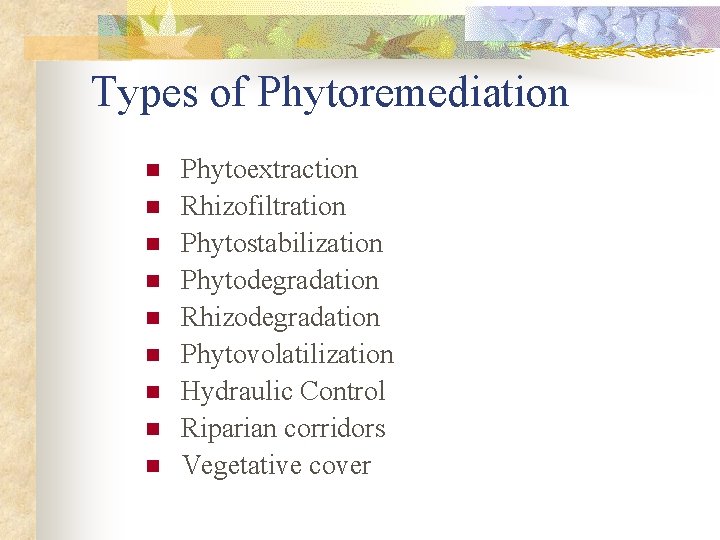
Types of Phytoremediation n n n n Phytoextraction Rhizofiltration Phytostabilization Phytodegradation Rhizodegradation Phytovolatilization Hydraulic Control Riparian corridors Vegetative cover
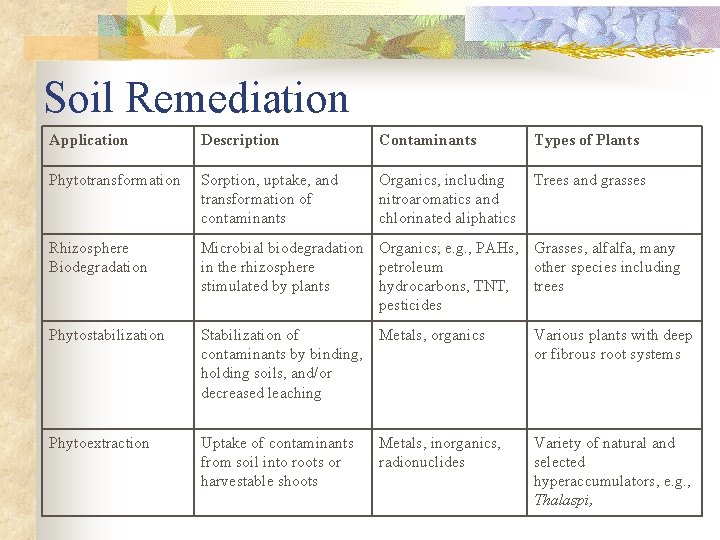
Soil Remediation Application Description Contaminants Types of Plants Phytotransformation Sorption, uptake, and transformation of contaminants Organics, including nitroaromatics and chlorinated aliphatics Trees and grasses Rhizosphere Biodegradation Microbial biodegradation Organics; e. g. , PAHs, Grasses, alfalfa, many in the rhizosphere petroleum other species including stimulated by plants hydrocarbons, TNT, trees pesticides Phytostabilization Stabilization of Metals, organics contaminants by binding, holding soils, and/or decreased leaching Various plants with deep or fibrous root systems Phytoextraction Uptake of contaminants from soil into roots or harvestable shoots Variety of natural and selected hyperaccumulators, e. g. , Thalaspi, Metals, inorganics, radionuclides
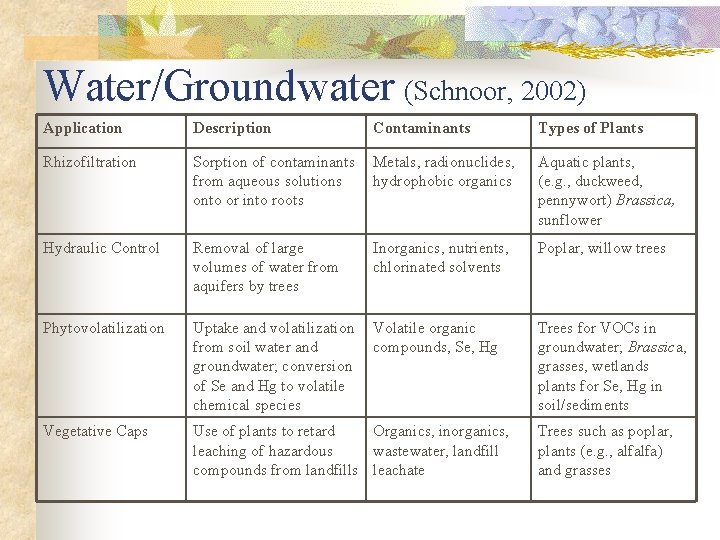
Water/Groundwater (Schnoor, 2002) Application Description Contaminants Rhizofiltration Sorption of contaminants Metals, radionuclides, from aqueous solutions hydrophobic organics onto or into roots Aquatic plants, (e. g. , duckweed, pennywort) Brassica, sunflower Hydraulic Control Removal of large volumes of water from aquifers by trees Poplar, willow trees Phytovolatilization Uptake and volatilization Volatile organic from soil water and compounds, Se, Hg groundwater; conversion of Se and Hg to volatile chemical species Trees for VOCs in groundwater; Brassica, grasses, wetlands plants for Se, Hg in soil/sediments Vegetative Caps Use of plants to retard Organics, inorganics, leaching of hazardous wastewater, landfill compounds from landfills leachate Trees such as poplar, plants (e. g. , alfalfa) and grasses Inorganics, nutrients, chlorinated solvents Types of Plants
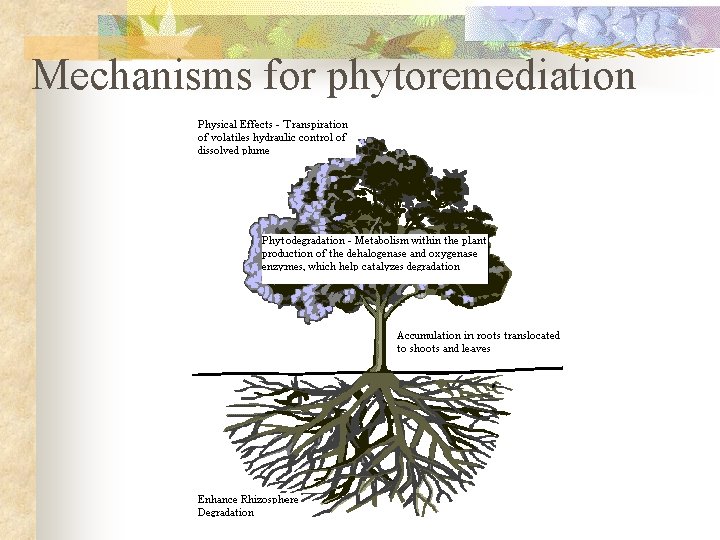
Mechanisms for phytoremediation
Technology Selection and Design n Treatability n n n conduct treatability studies prior to design to assure that the phytoremediation system will achieve desired results treatability studies provide the design information such as toxicity, transformation data and fate of the contaminant(s) in the plant system. Site Conditions n n sites with low to moderate soil contamination over large areas, sites with large volumes of groundwater with low levels of contamination that have to be cleaned to low (strict) standards
Technology Selection and Design (cont’d) n Contaminant Considerations n Type of Contaminants n Inorganic or Organics compounds n Contaminant Concentrations n cannot be phytotoxic or cause unacceptable impacts on plant health or yield. n preliminary laboratory or field plot screening study will be needed to determine
Technology Selection and Design (cont’d) n Plant Considerations n Plant Selection n Plant species should have the appropriate characteristics for growth under site conditions n Growth Rate n A fast growth rate will minimize the time required to reach a large biomass n A large root mass and large biomass increase the rate of remediation
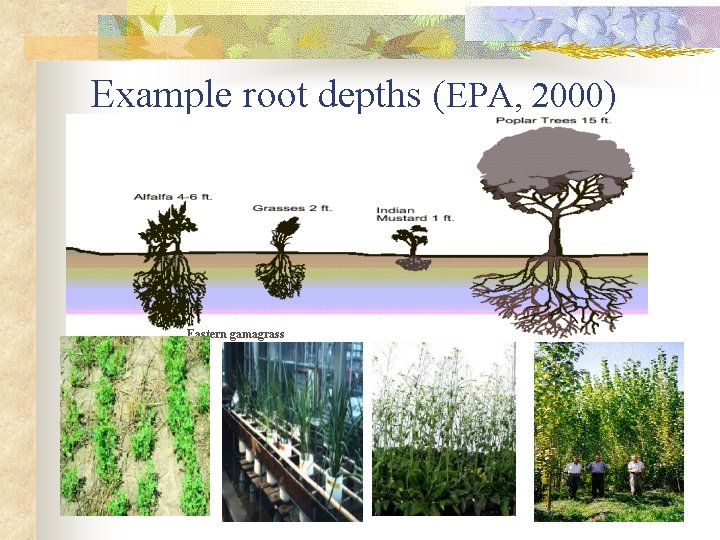
Technology Selection and Design (cont’d) n Plant Considerations n Root Type n A fibrous root system has numerous fine roots spread throughout the soil and will provide maximum contact with the soil due to the high surface area of the roots. n Root Depth n most nonwoody plant : 1 or 2 feet n tree roots : less than 10 or 20 feet
Example root depths (EPA, 2000) Eastern gamagrass
Technology Selection and Design (cont’d) n n n Contaminant Uptake Rate and Clean-up Time Irregation, Agronomic Inputs and Maintenance Disposal Considerations
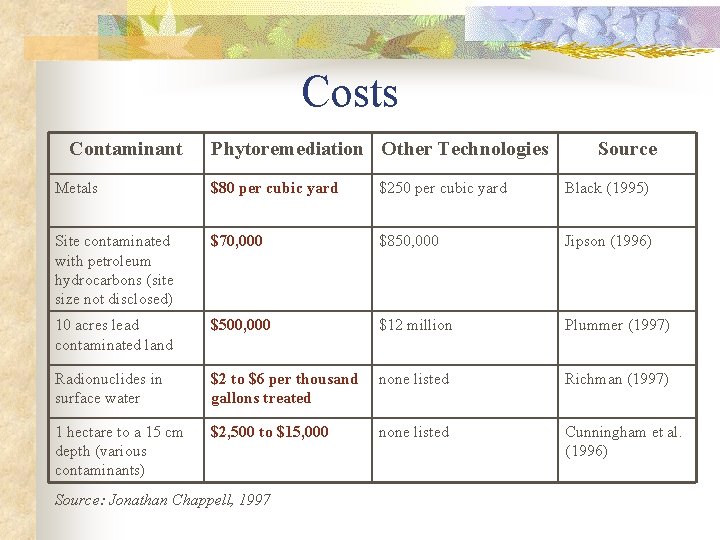
Costs Contaminant Phytoremediation Other Technologies Source Metals $80 per cubic yard $250 per cubic yard Black (1995) Site contaminated with petroleum hydrocarbons (site size not disclosed) $70, 000 $850, 000 Jipson (1996) 10 acres lead contaminated land $500, 000 $12 million Plummer (1997) Radionuclides in surface water $2 to $6 per thousand gallons treated none listed Richman (1997) 1 hectare to a 15 cm depth (various contaminants) $2, 500 to $15, 000 none listed Cunningham et al. (1996) Source: Jonathan Chappell, 1997
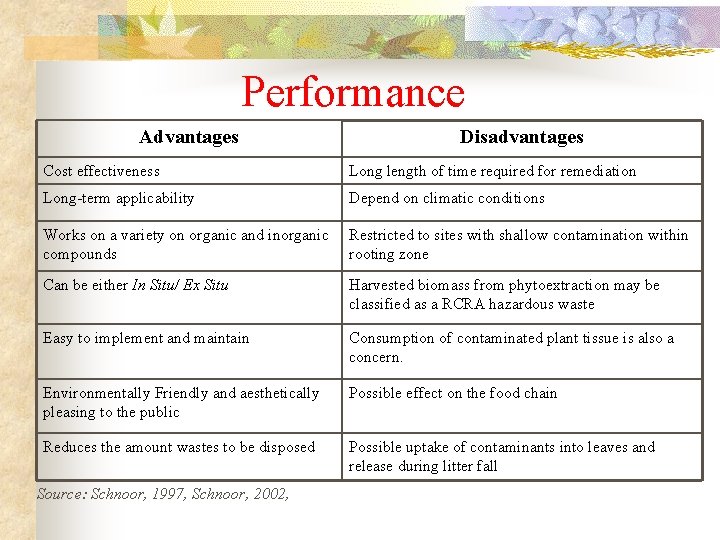
Performance Advantages Disadvantages Cost effectiveness Long length of time required for remediation Long-term applicability Depend on climatic conditions Works on a variety on organic and inorganic compounds Restricted to sites with shallow contamination within rooting zone Can be either In Situ/ Ex Situ Harvested biomass from phytoextraction may be classified as a RCRA hazardous waste Easy to implement and maintain Consumption of contaminated plant tissue is also a concern. Environmentally Friendly and aesthetically pleasing to the public Possible effect on the food chain Reduces the amount wastes to be disposed Possible uptake of contaminants into leaves and release during litter fall Source: Schnoor, 1997, Schnoor, 2002,
n Thank you