Physics Friction and Normal Forces Equations Fs UsN




- Slides: 15
Physics Friction and Normal Forces
Equations � Fs= (Us)N � F=-k(Delta x) � F=ma � W=mg
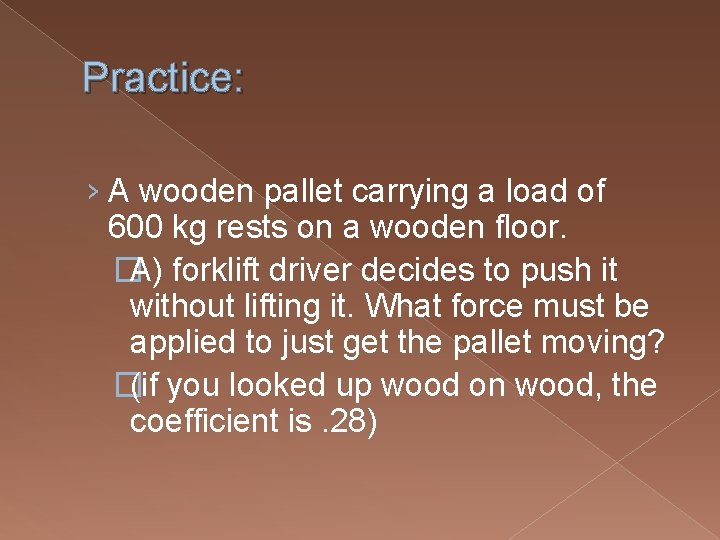
Practice: › A wooden pallet carrying a load of 600 kg rests on a wooden floor. �A) forklift driver decides to push it without lifting it. What force must be applied to just get the pallet moving? �(if you looked up wood on wood, the coefficient is. 28)
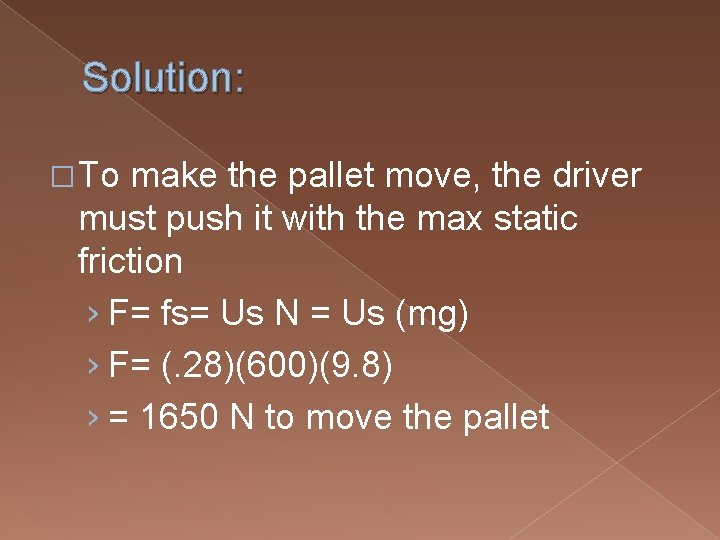
Solution: � To make the pallet move, the driver must push it with the max static friction › F= fs= Us N = Us (mg) › F= (. 28)(600)(9. 8) › = 1650 N to move the pallet
Part B. �After a bit of time, the pallet begins to slide. How fast is the pallet moving after 0. 5 seconds of sliding under the same force you calculated in part a? � (Uk in the chart now equals. 17)
Solution: � Fk = (Uk)(mg) ›. 17(600)(9. 8) = 1000 N › Forklift is still pushing with 1650 › So the net force in the x direction = 1650 – 1000 = 650 N Use f=ma 650= 600(a) A= 1. 08 m/s^2 Now we use our kinematic equations Vf=vi + at Vf= 0 +(1. 08)(. 5)=. 54 m/s
Part C. �If the forklift stops pushing, how far does the pallet slide before coming to a stop?
Solution: The net force is now the kinetic force (-1000) � Use f=ma again � -1000=600(a) a= -1. 67 m/s 2 � � Then use kinematic equation of › › Vf^2 = vi ^2 + 2 a delta x 0^2 =. 54 ^2 + 2(-1. 67)(delta x) 0=. 2916+-3. 34 X=. 087 meters
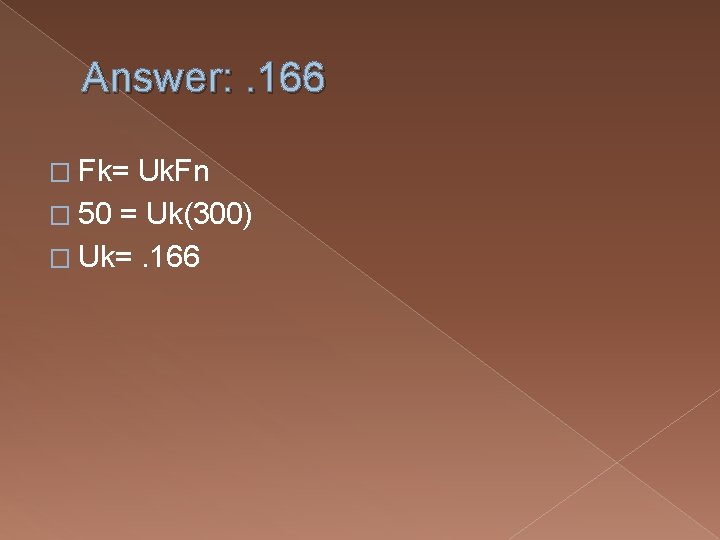
A sled of 300 N is moved at a constant speed over a horizonal floor by a force of 50 N parallel to the floor � Determine the coefficient of kinetic friction Us
Answer: . 166 � Fk= Uk. Fn � 50 = Uk(300) � Uk=. 166
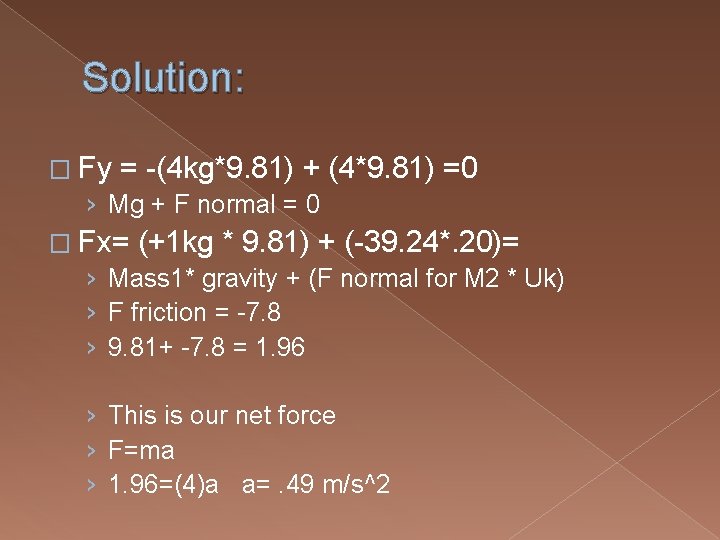
Suppose a 1 kg mass is attached to a 4 kg block on the table � If the coefficient of kinetic friction is. 20, what is the acceleration of the block?
Solution: � Fy = -(4 kg*9. 81) + (4*9. 81) =0 › Mg + F normal = 0 � Fx= (+1 kg * 9. 81) + (-39. 24*. 20)= › Mass 1* gravity + (F normal for M 2 * Uk) › F friction = -7. 8 › 9. 81+ -7. 8 = 1. 96 › This is our net force › F=ma › 1. 96=(4)a a=. 49 m/s^2
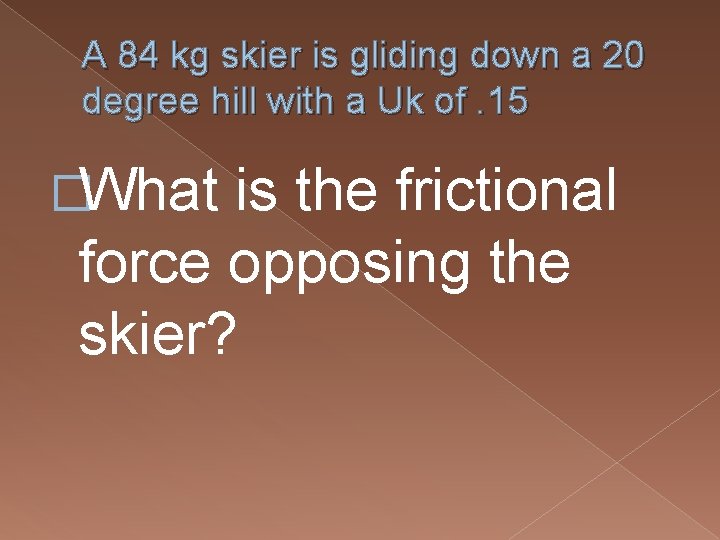
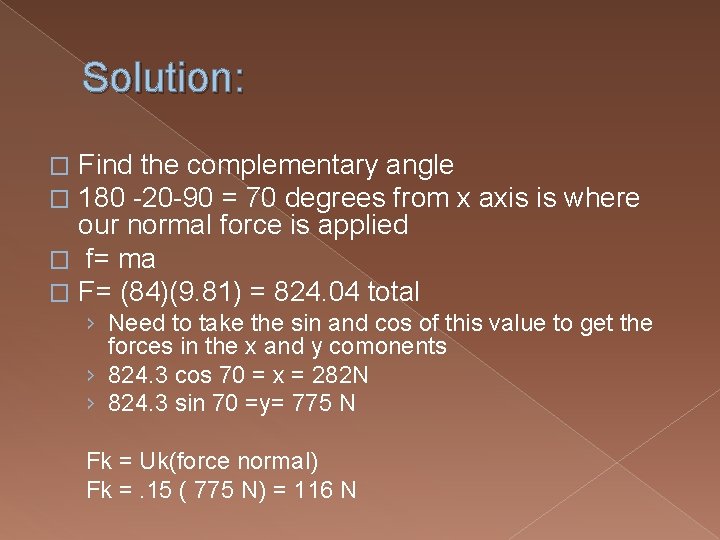
A 84 kg skier is gliding down a 20 degree hill with a Uk of. 15 �What is the frictional force opposing the skier?
Solution: Find the complementary angle 180 -20 -90 = 70 degrees from x axis is where our normal force is applied � f= ma � F= (84)(9. 81) = 824. 04 total � � › Need to take the sin and cos of this value to get the forces in the x and y comonents › 824. 3 cos 70 = x = 282 N › 824. 3 sin 70 =y= 775 N Fk = Uk(force normal) Fk =. 15 ( 775 N) = 116 N
Now calculate the acceleration of the skier � Take the forces in the x direction and find the net force � 282 + (– 116) = 166 N forward � F=ma � 166 N = 84 kg(a) � A= 1. 97 m/s^s