PHY 151 Lecture 7 A 7 1 7
- Slides: 38
PHY 151: Lecture 7 A • • • 7. 1 7. 2 7. 3 7. 4 7. 5 System and Environments Work Done by a Constant Force Scalar Product of Two Vectors Work Done by a Varying Force Kinetic Energy and the Work-Energy Theorem
PHY 151: Lecture 7 A Energy of a System 7. 1 System and Environment
Introduction to Energy • A variety of problems can be solved with Newton’s Laws and associated principles • Some problems that could theoretically be solved with Newton’s Laws are very difficult in practice – These problems can be made easier with other techniques • The concept of energy is one of the most important topics in science and engineering • Every physical process that occurs in the Universe involves energy and energy transfers or transformations • Energy is not easily defined
Analysis Model • The new approach will involve changing from a particle model to a system model • These analysis models will be formally introduced in the next lecture • In this chapter, systems are introduced along with three ways to store energy in a system
Systems • A system is a small portion of the Universe – We will ignore the details of the rest of the Universe • A critical skill is to identify the system – The first step to take in solving a problem • A valid system: – – May be a single object or particle May be a collection of objects or particles May be a region of space May vary with time in size and shape
Problem Solving Notes • Identify the need for a system approach • Identify the particular system • Also identify a system boundary – An imaginary surface that divides the Universe into the system and the environment • Not necessarily coinciding with a real surface • The environment surrounds the system
System Example • A force applied to an object in empty space – System is the object – Its surface is the system boundary – The force is an influence on the system from its environment that acts across the system boundary
PHY 151: Lecture 7 A Energy of a System 7. 2 Work Done by a Constant Force
Work - 1 • The work, W, done on a system by an agent exerting a constant force on the system is the product of the magnitude F of the force, the magnitude Dr of the displacement of the point of application of the force, and cos q, where q is the angle between the force and the displacement vector – The meaning of the term work is distinctly different in physics than in everyday meaning – Work is done by some part of the environment that is interacting directly with the system – Work is done on the system
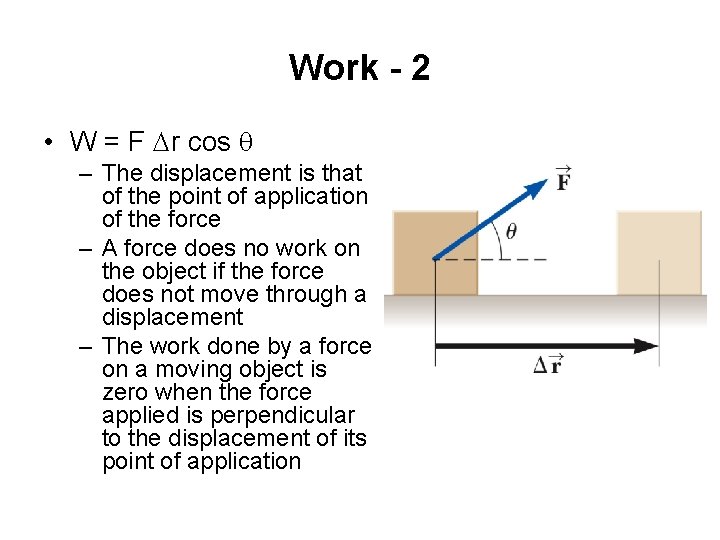
Work - 2 • W = F Dr cos q – The displacement is that of the point of application of the force – A force does no work on the object if the force does not move through a displacement – The work done by a force on a moving object is zero when the force applied is perpendicular to the displacement of its point of application
Displacement in the Work Equation • The displacement is that of the point of application of the force • If the force is applied to a rigid object that can be modeled as a particle, the displacement is the same as that of the particle • For a deformable system, the displacement of the object generally is not the same as the displacement associated with the forces applied
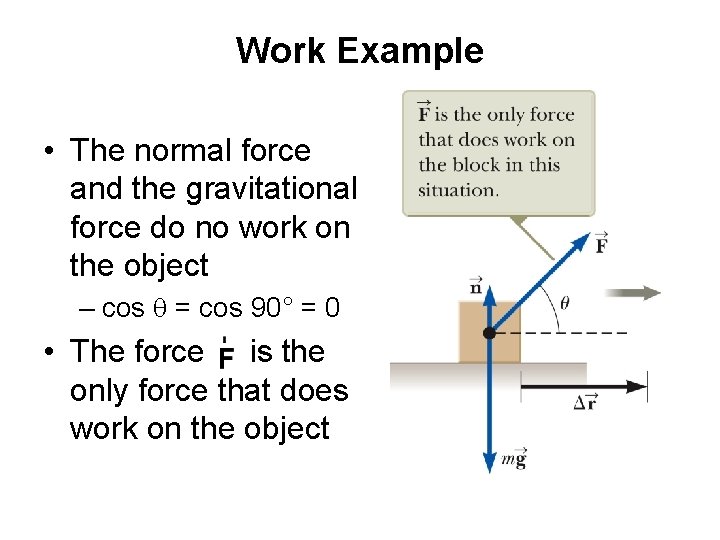
Work Example • The normal force and the gravitational force do no work on the object – cos q = cos 90° = 0 • The force is the only force that does work on the object
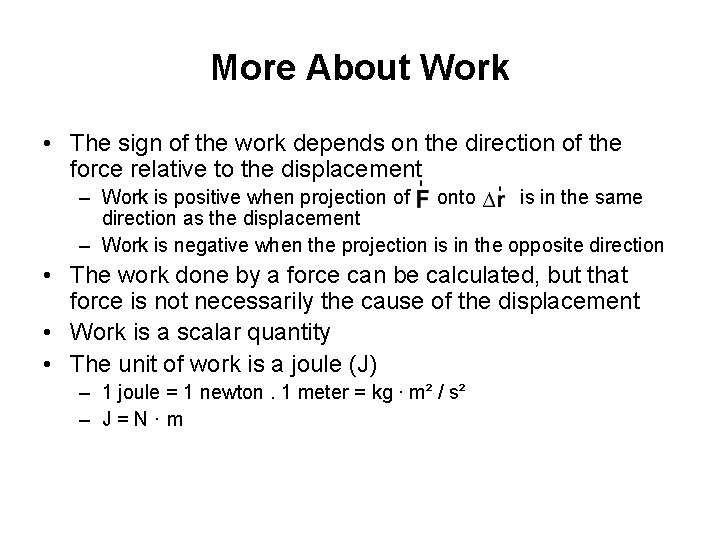
More About Work • The sign of the work depends on the direction of the force relative to the displacement – Work is positive when projection of onto is in the same direction as the displacement – Work is negative when the projection is in the opposite direction • The work done by a force can be calculated, but that force is not necessarily the cause of the displacement • Work is a scalar quantity • The unit of work is a joule (J) – 1 joule = 1 newton. 1 meter = kg ∙ m² / s² – J=N·m
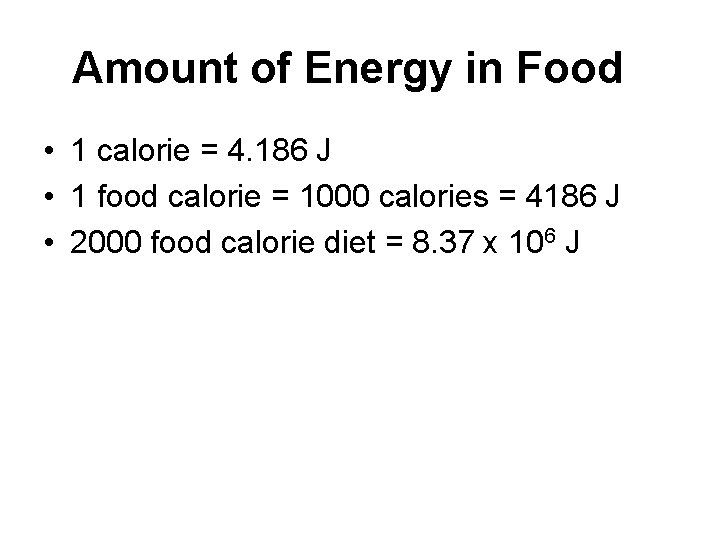
Amount of Energy in Food • 1 calorie = 4. 186 J • 1 food calorie = 1000 calories = 4186 J • 2000 food calorie diet = 8. 37 x 106 J
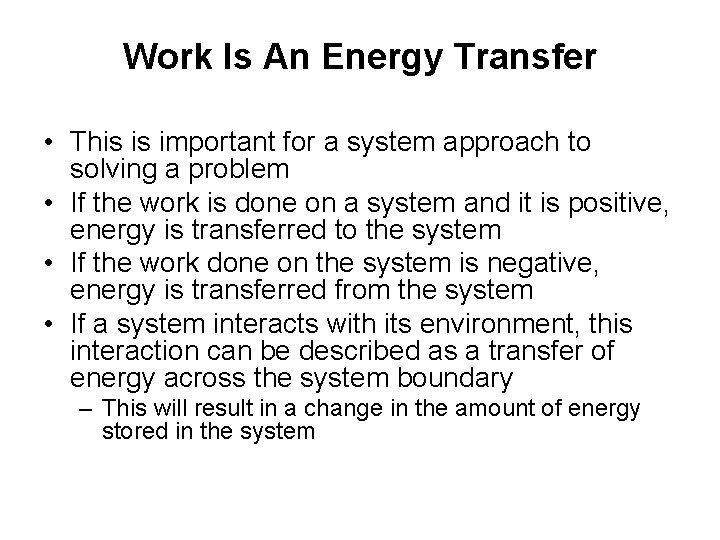
Work Is An Energy Transfer • This is important for a system approach to solving a problem • If the work is done on a system and it is positive, energy is transferred to the system • If the work done on the system is negative, energy is transferred from the system • If a system interacts with its environment, this interaction can be described as a transfer of energy across the system boundary – This will result in a change in the amount of energy stored in the system
PHY 151: Lecture 7 A Energy of a System 7. 3 Scalar Product of Two Vectors
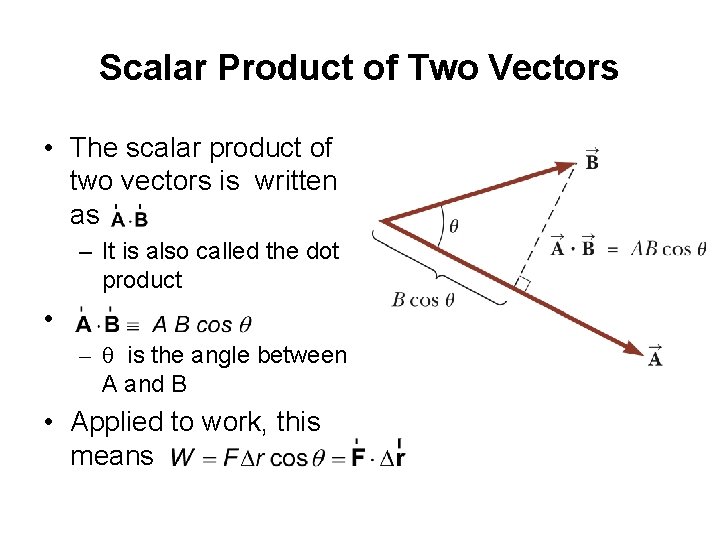
Scalar Product of Two Vectors • The scalar product of two vectors is written as – It is also called the dot product • – q is the angle between A and B • Applied to work, this means
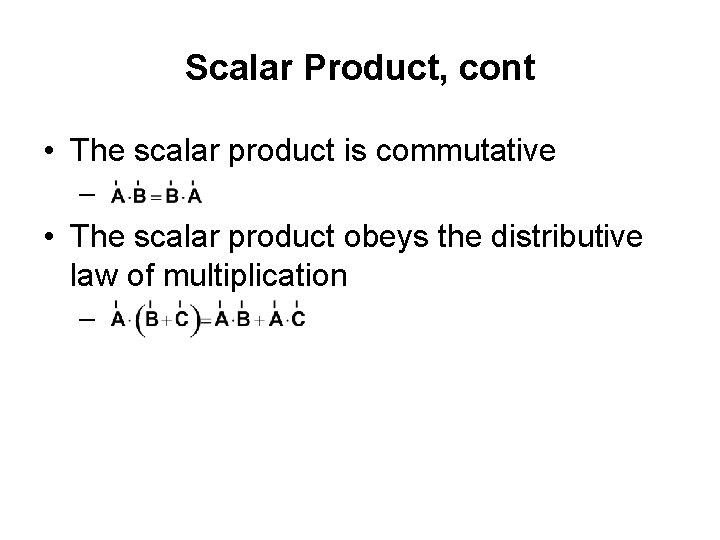
Scalar Product, cont • The scalar product is commutative – • The scalar product obeys the distributive law of multiplication –
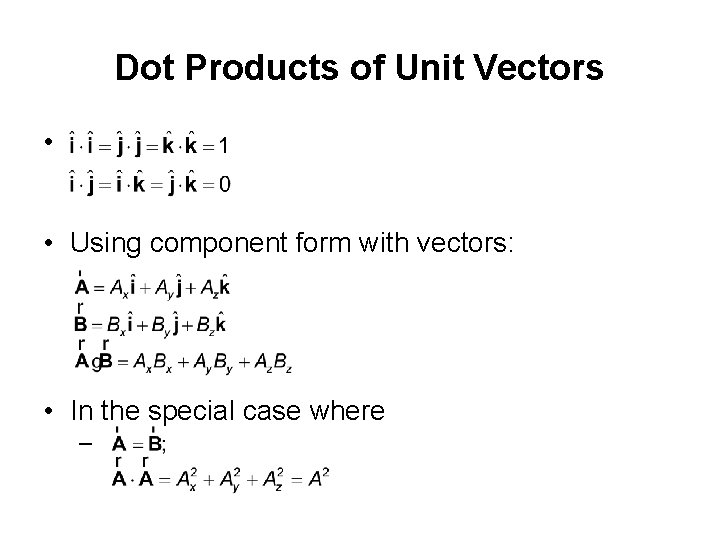
Dot Products of Unit Vectors • • Using component form with vectors: • In the special case where –
PHY 151: Lecture 7 A Energy of a System 7. 4 Work Done by a Varying Force
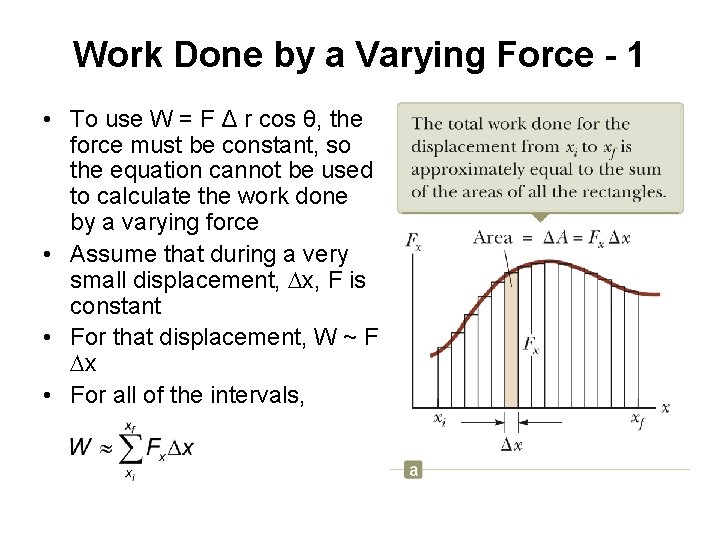
Work Done by a Varying Force - 1 • To use W = F Δ r cos θ, the force must be constant, so the equation cannot be used to calculate the work done by a varying force • Assume that during a very small displacement, Dx, F is constant • For that displacement, W ~ F Dx • For all of the intervals,
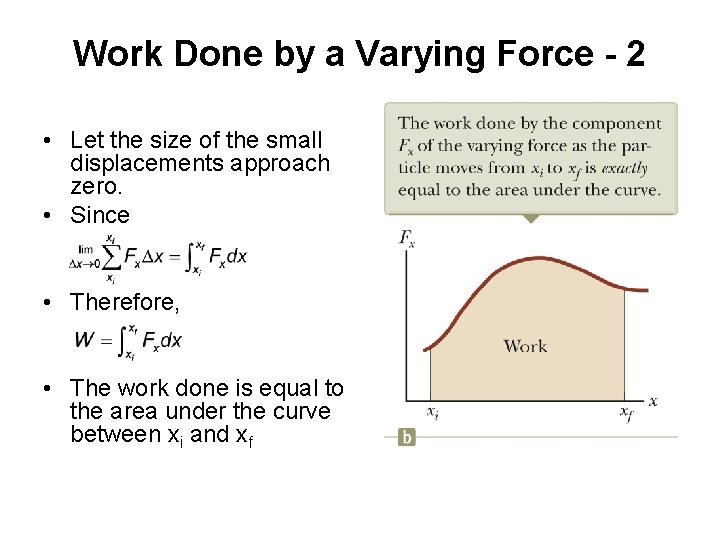
Work Done by a Varying Force - 2 • Let the size of the small displacements approach zero. • Since • Therefore, • The work done is equal to the area under the curve between xi and xf
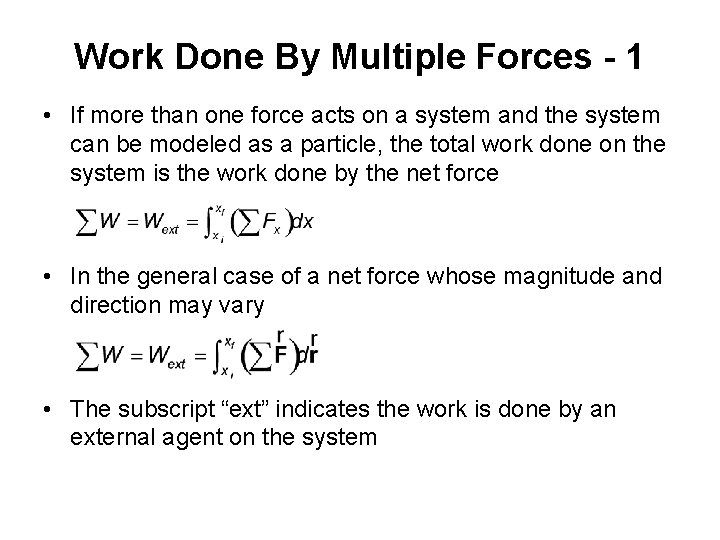
Work Done By Multiple Forces - 1 • If more than one force acts on a system and the system can be modeled as a particle, the total work done on the system is the work done by the net force • In the general case of a net force whose magnitude and direction may vary • The subscript “ext” indicates the work is done by an external agent on the system
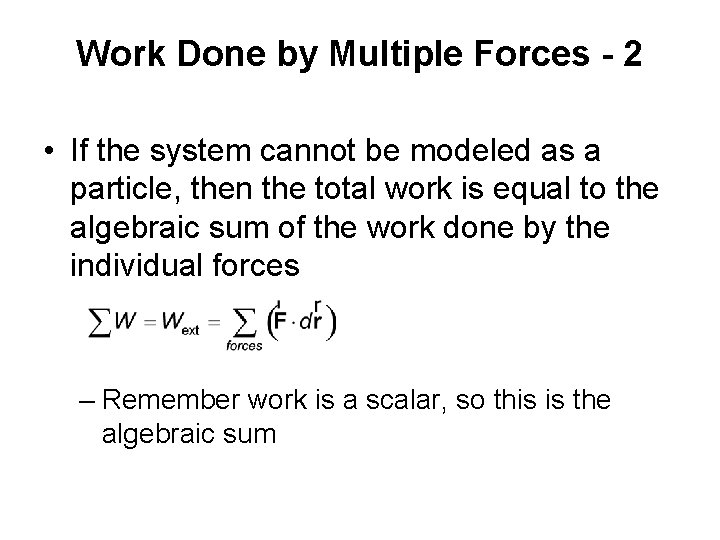
Work Done by Multiple Forces - 2 • If the system cannot be modeled as a particle, then the total work is equal to the algebraic sum of the work done by the individual forces – Remember work is a scalar, so this is the algebraic sum
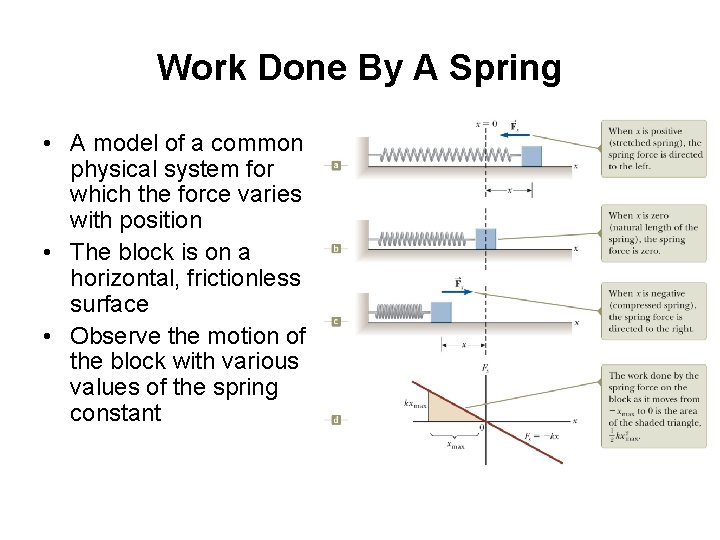
Work Done By A Spring • A model of a common physical system for which the force varies with position • The block is on a horizontal, frictionless surface • Observe the motion of the block with various values of the spring constant
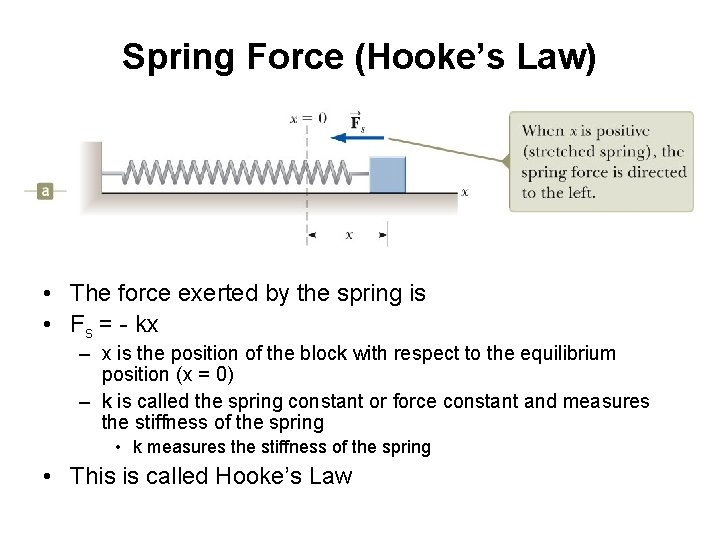
Spring Force (Hooke’s Law) • The force exerted by the spring is • Fs = - kx – x is the position of the block with respect to the equilibrium position (x = 0) – k is called the spring constant or force constant and measures the stiffness of the spring • k measures the stiffness of the spring • This is called Hooke’s Law
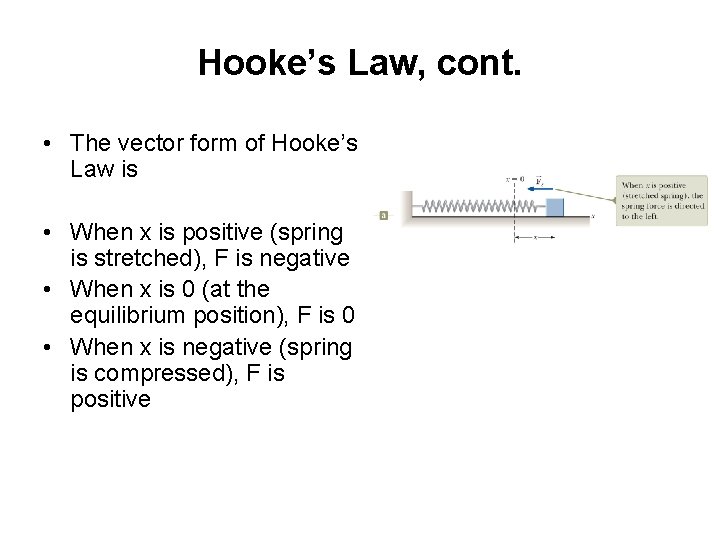
Hooke’s Law, cont. • The vector form of Hooke’s Law is • When x is positive (spring is stretched), F is negative • When x is 0 (at the equilibrium position), F is 0 • When x is negative (spring is compressed), F is positive
Hooke’s Law, final • The force exerted by the spring is always directed opposite to the displacement from equilibrium • The spring force is sometimes called the restoring force • If the block is released it will oscillate back and forth between –x and x
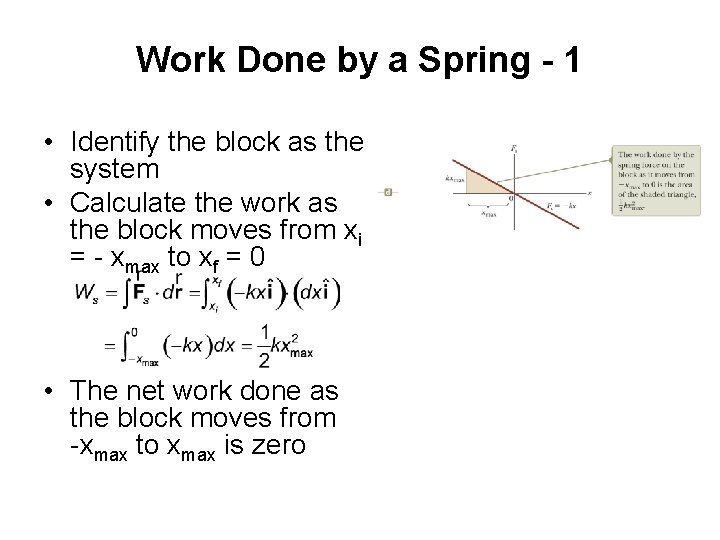
Work Done by a Spring - 1 • Identify the block as the system • Calculate the work as the block moves from xi = - xmax to xf = 0 • The net work done as the block moves from -xmax to xmax is zero
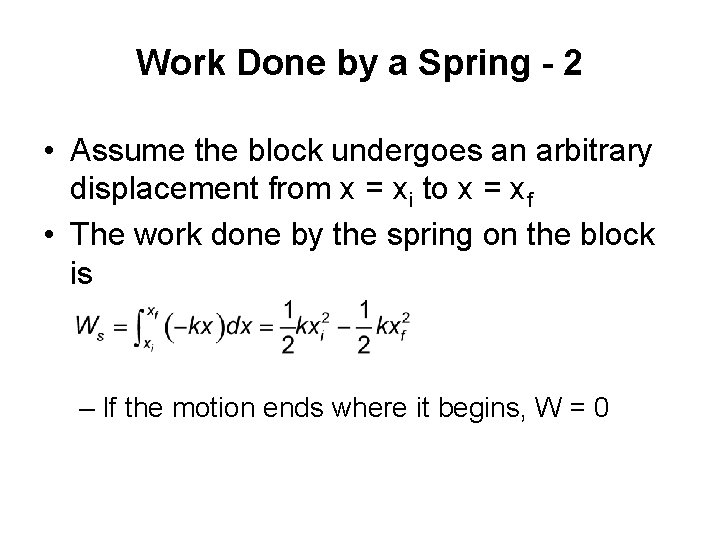
Work Done by a Spring - 2 • Assume the block undergoes an arbitrary displacement from x = xi to x = xf • The work done by the spring on the block is – If the motion ends where it begins, W = 0
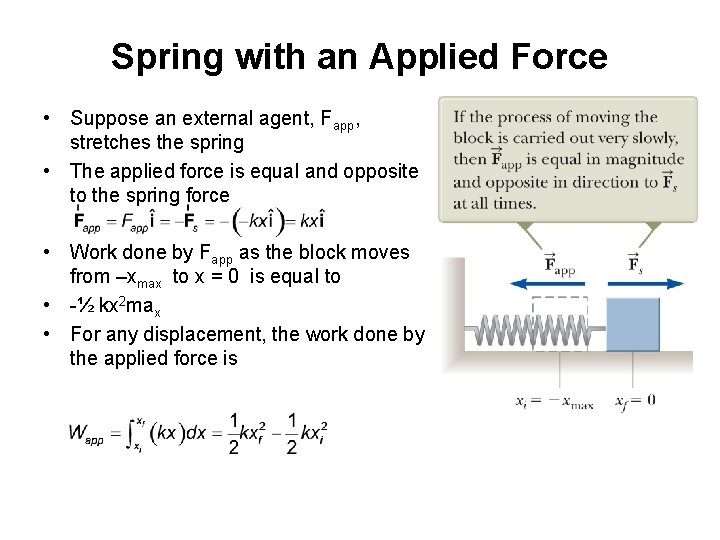
Spring with an Applied Force • Suppose an external agent, Fapp, stretches the spring • The applied force is equal and opposite to the spring force • Work done by Fapp as the block moves from –xmax to x = 0 is equal to • -½ kx 2 max • For any displacement, the work done by the applied force is
PHY 151: Lecture 7 A Energy of a System 7. 5 Kinetic Energy and The Work-Kinetic Energy Theorem
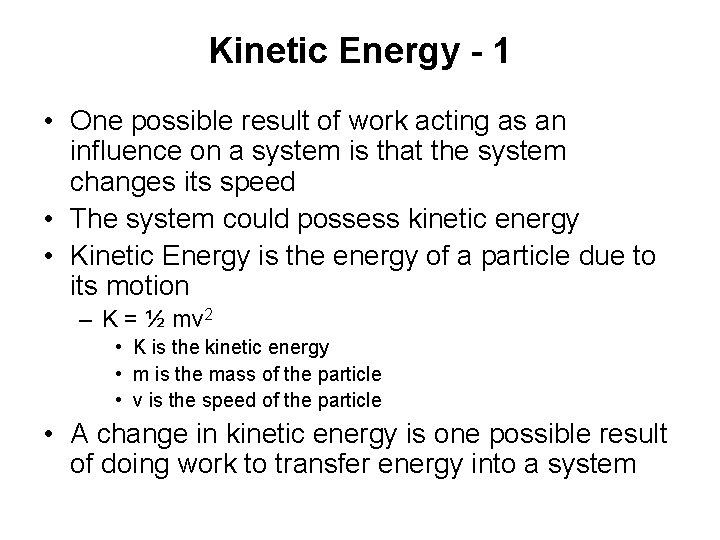
Kinetic Energy - 1 • One possible result of work acting as an influence on a system is that the system changes its speed • The system could possess kinetic energy • Kinetic Energy is the energy of a particle due to its motion – K = ½ mv 2 • K is the kinetic energy • m is the mass of the particle • v is the speed of the particle • A change in kinetic energy is one possible result of doing work to transfer energy into a system
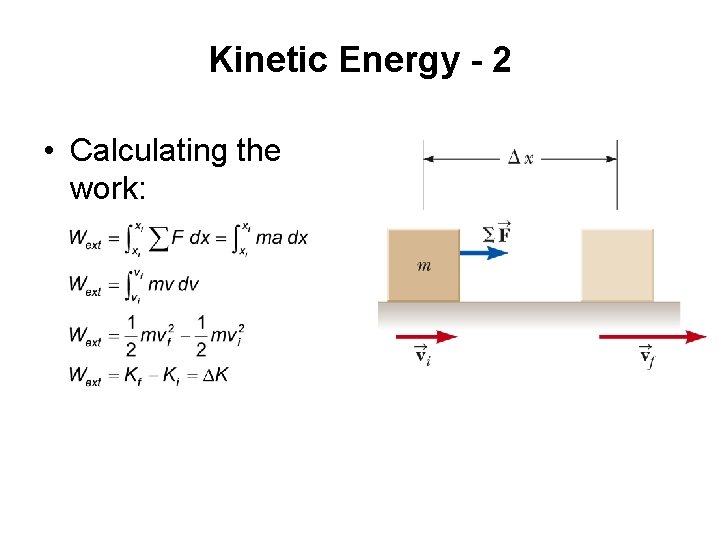
Kinetic Energy - 2 • Calculating the work:
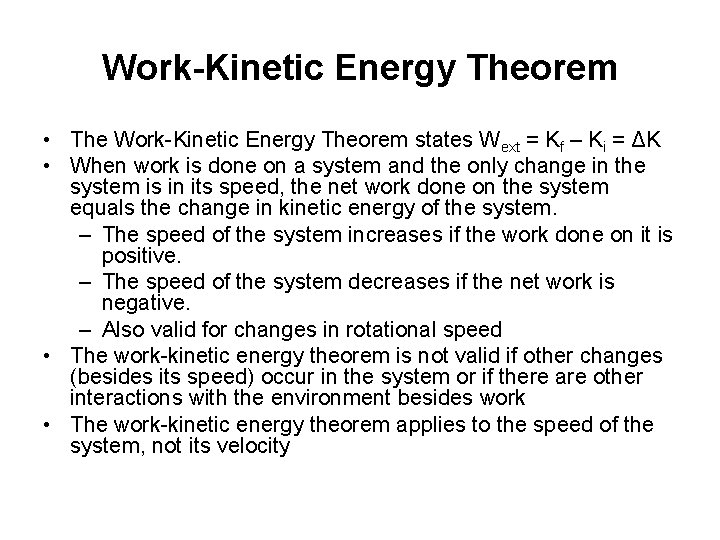
Work-Kinetic Energy Theorem • The Work-Kinetic Energy Theorem states Wext = Kf – Ki = ΔK • When work is done on a system and the only change in the system is in its speed, the net work done on the system equals the change in kinetic energy of the system. – The speed of the system increases if the work done on it is positive. – The speed of the system decreases if the net work is negative. – Also valid for changes in rotational speed • The work-kinetic energy theorem is not valid if other changes (besides its speed) occur in the system or if there are other interactions with the environment besides work • The work-kinetic energy theorem applies to the speed of the system, not its velocity
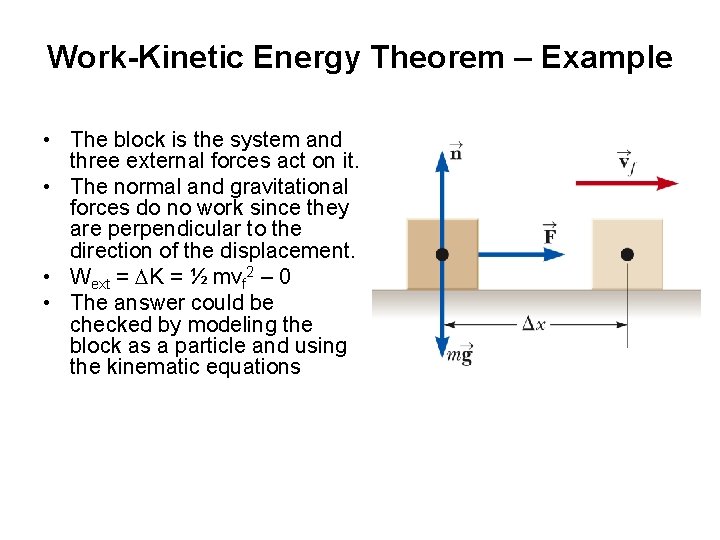
Work-Kinetic Energy Theorem – Example • The block is the system and three external forces act on it. • The normal and gravitational forces do no work since they are perpendicular to the direction of the displacement. • Wext = DK = ½ mvf 2 – 0 • The answer could be checked by modeling the block as a particle and using the kinematic equations
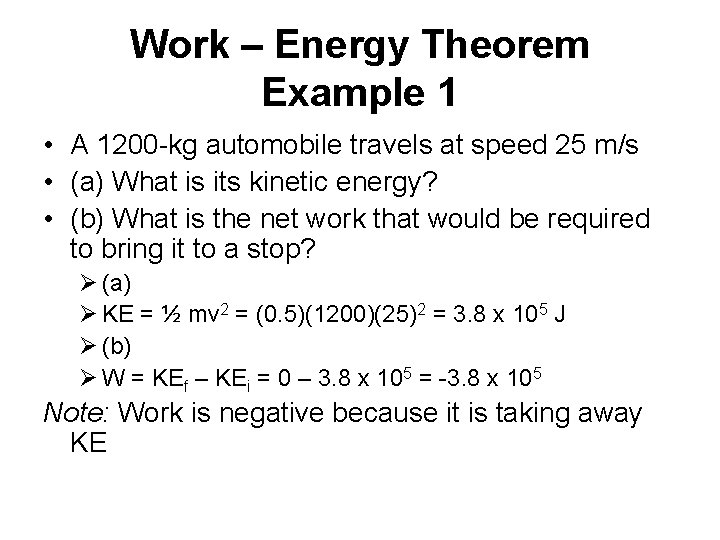
Work – Energy Theorem Example 1 • A 1200 -kg automobile travels at speed 25 m/s • (a) What is its kinetic energy? • (b) What is the net work that would be required to bring it to a stop? Ø (a) Ø KE = ½ mv 2 = (0. 5)(1200)(25)2 = 3. 8 x 10⁵ J Ø (b) Ø W = KEf – KEi = 0 – 3. 8 x 105 = -3. 8 x 10⁵ Note: Work is negative because it is taking away KE
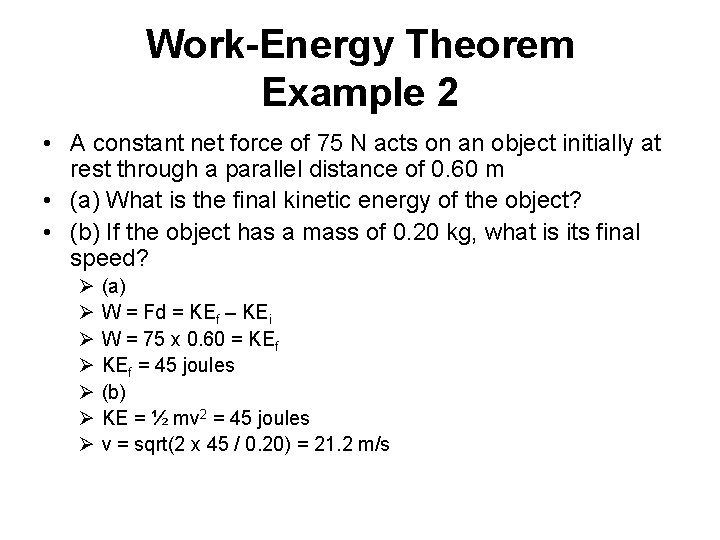
Work-Energy Theorem Example 2 • A constant net force of 75 N acts on an object initially at rest through a parallel distance of 0. 60 m • (a) What is the final kinetic energy of the object? • (b) If the object has a mass of 0. 20 kg, what is its final speed? Ø Ø Ø Ø (a) W = Fd = KEf – KEi W = 75 x 0. 60 = KEf = 45 joules (b) KE = ½ mv 2 = 45 joules v = sqrt(2 x 45 / 0. 20) = 21. 2 m/s