PHY 113 C General Physics I 11 AM
- Slides: 37
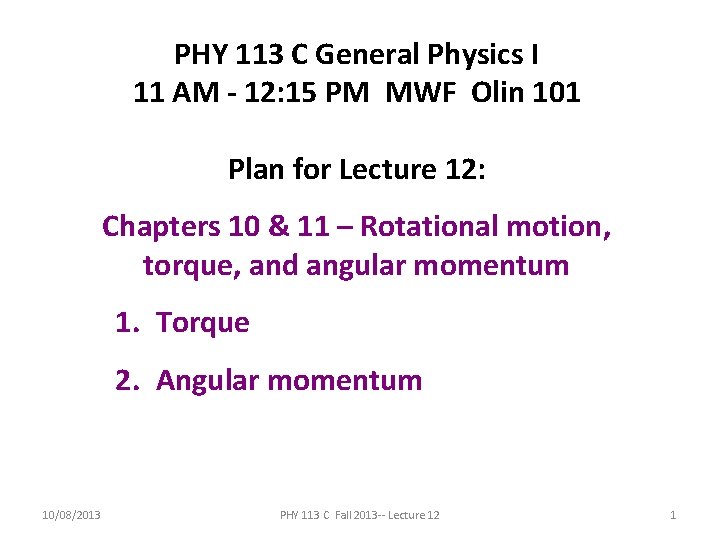
PHY 113 C General Physics I 11 AM - 12: 15 PM MWF Olin 101 Plan for Lecture 12: Chapters 10 & 11 – Rotational motion, torque, and angular momentum 1. Torque 2. Angular momentum 10/08/2013 PHY 113 C Fall 2013 -- Lecture 12 1
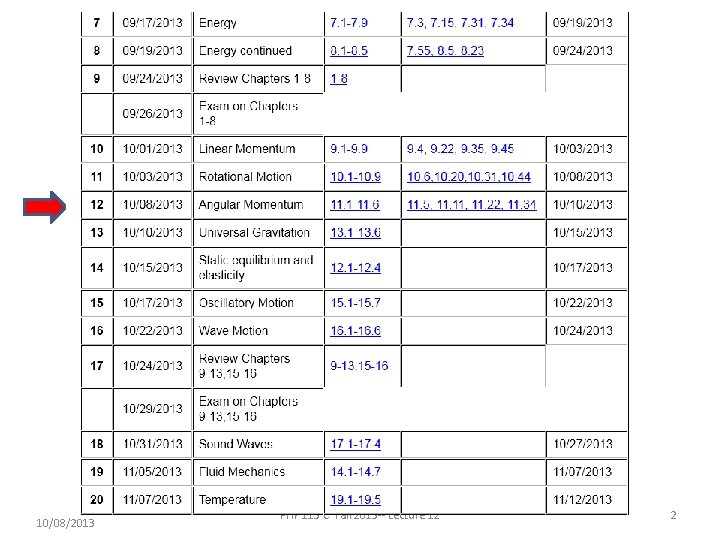
10/08/2013 PHY 113 C Fall 2013 -- Lecture 12 2
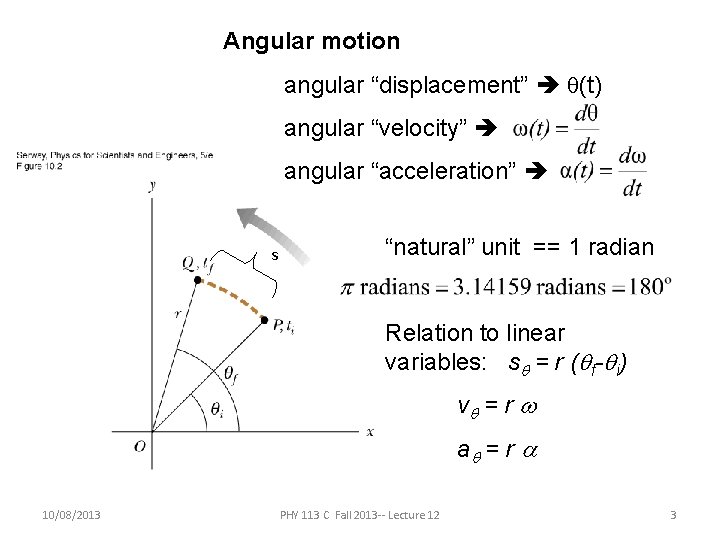
Angular motion angular “displacement” q(t) angular “velocity” angular “acceleration” s “natural” unit == 1 radian Relation to linear variables: sq = r (qf-qi) vq = r w aq = r a 10/08/2013 PHY 113 C Fall 2013 -- Lecture 12 3
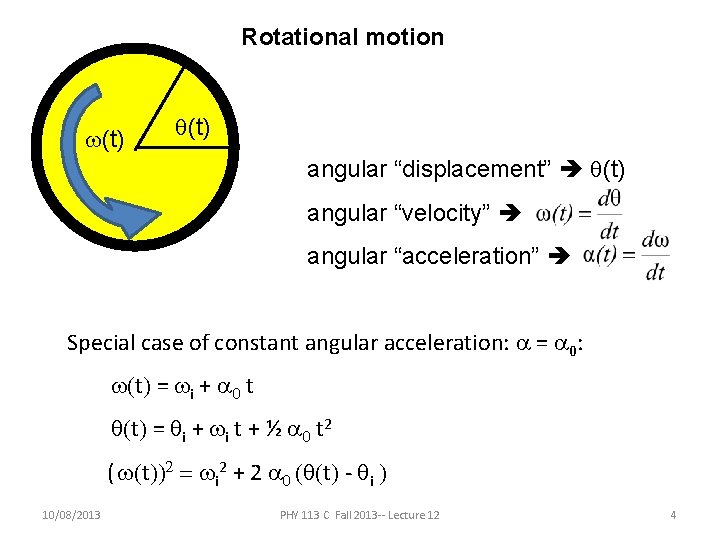
Rotational motion w(t) q(t) angular “displacement” q(t) angular “velocity” angular “acceleration” Special case of constant angular acceleration: a = a 0: w(t) = wi + a 0 t q(t) = qi + wi t + ½ a 0 t 2 ( w(t))2 = wi 2 + 2 a 0 (q(t) - qi ) 10/08/2013 PHY 113 C Fall 2013 -- Lecture 12 4
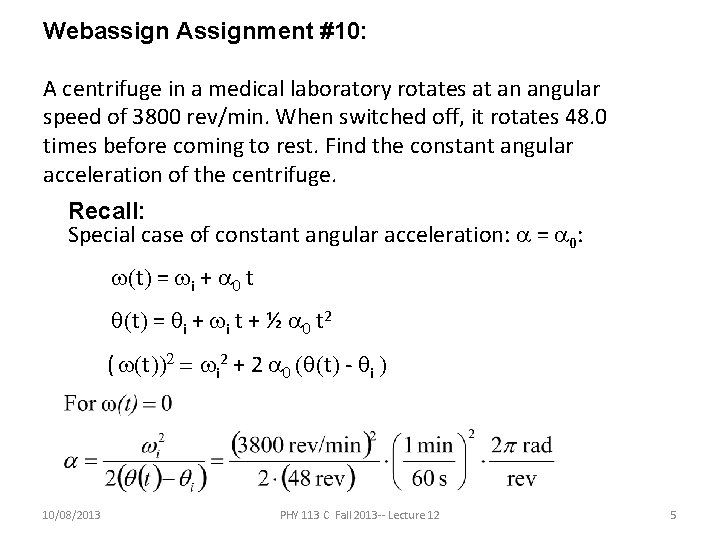
Webassign Assignment #10: A centrifuge in a medical laboratory rotates at an angular speed of 3800 rev/min. When switched off, it rotates 48. 0 times before coming to rest. Find the constant angular acceleration of the centrifuge. Recall: Special case of constant angular acceleration: a = a 0: w(t) = wi + a 0 t q(t) = qi + wi t + ½ a 0 t 2 ( w(t))2 = wi 2 + 2 a 0 (q(t) - qi ) 10/08/2013 PHY 113 C Fall 2013 -- Lecture 12 5
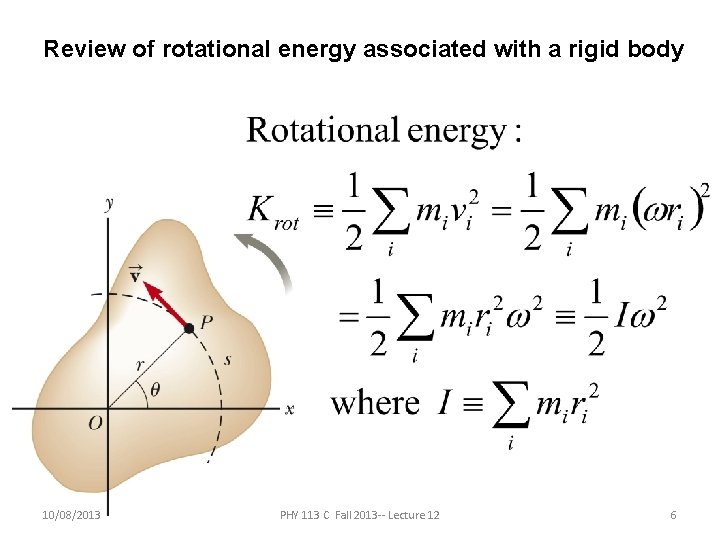
Review of rotational energy associated with a rigid body 10/08/2013 PHY 113 C Fall 2013 -- Lecture 12 6
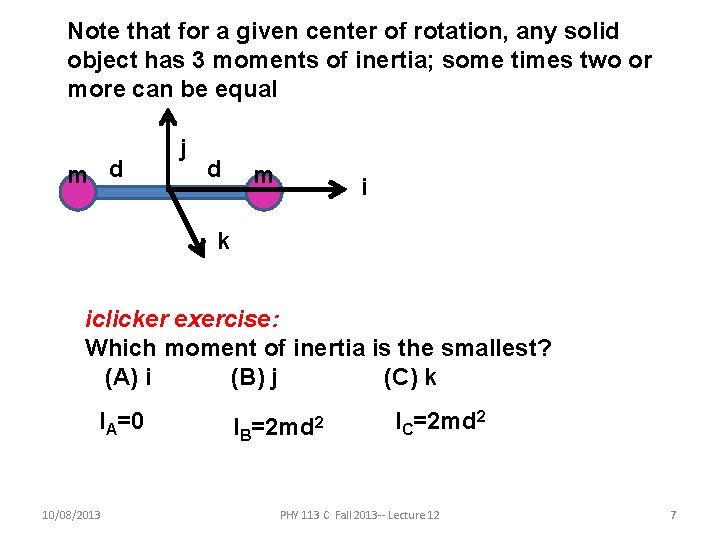
Note that for a given center of rotation, any solid object has 3 moments of inertia; some times two or more can be equal m d j d m i k iclicker exercise: Which moment of inertia is the smallest? (A) i (B) j (C) k IA=0 10/08/2013 IB=2 md 2 IC=2 md 2 PHY 113 C Fall 2013 -- Lecture 12 7
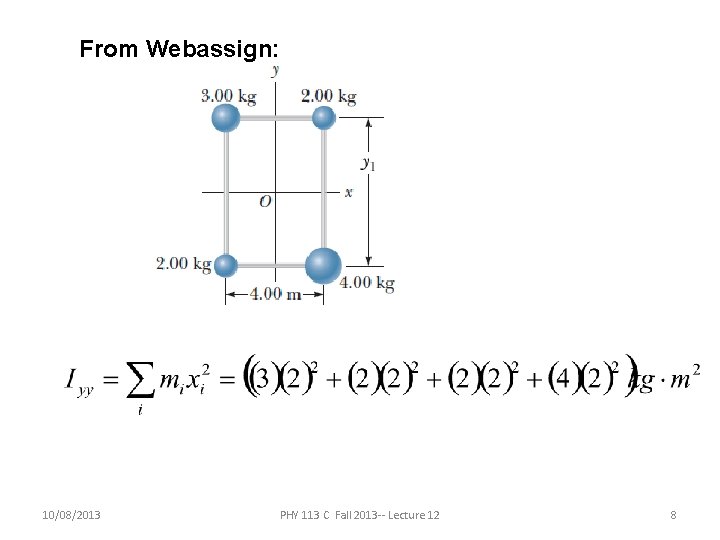
From Webassign: 10/08/2013 PHY 113 C Fall 2013 -- Lecture 12 8
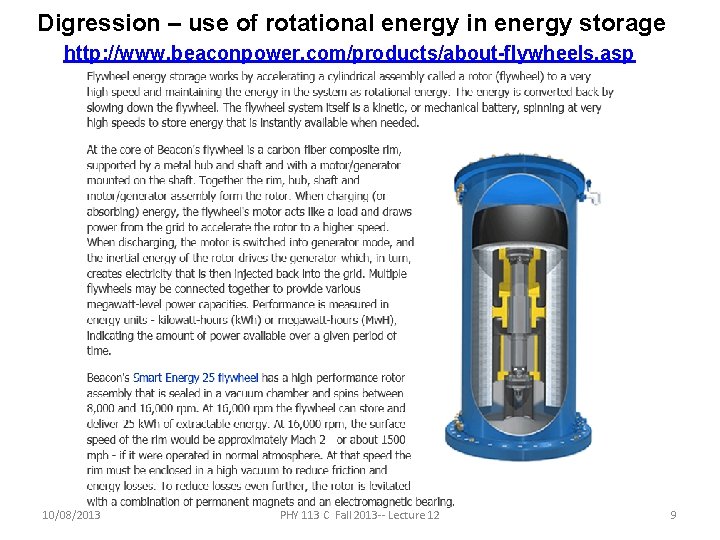
Digression – use of rotational energy in energy storage http: //www. beaconpower. com/products/about-flywheels. asp 10/08/2013 PHY 113 C Fall 2013 -- Lecture 12 9
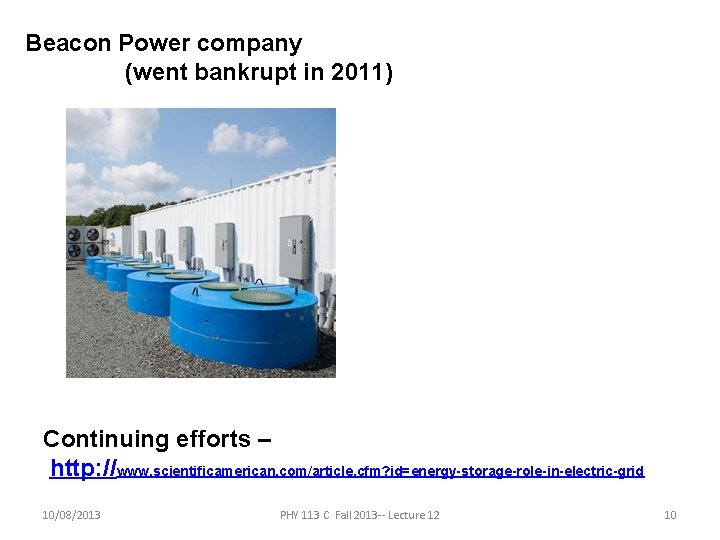
Beacon Power company (went bankrupt in 2011) Continuing efforts – http: //www. scientificamerican. com/article. cfm? id=energy-storage-role-in-electric-grid 10/08/2013 PHY 113 C Fall 2013 -- Lecture 12 10
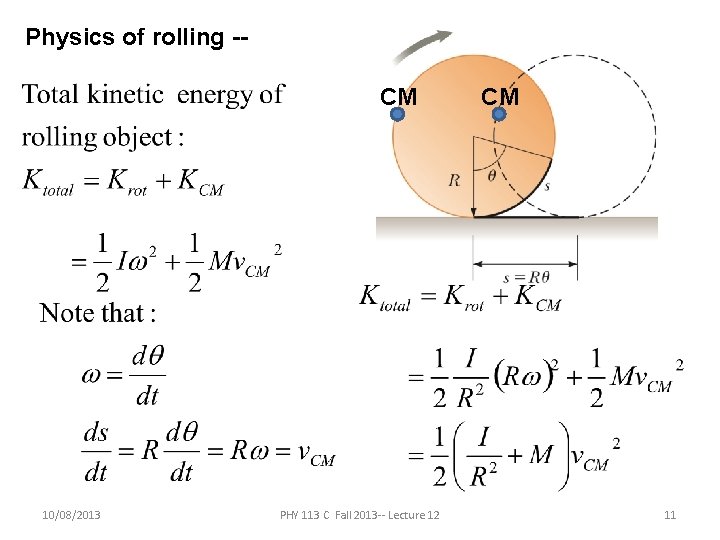
Physics of rolling -CM 10/08/2013 PHY 113 C Fall 2013 -- Lecture 12 CM 11
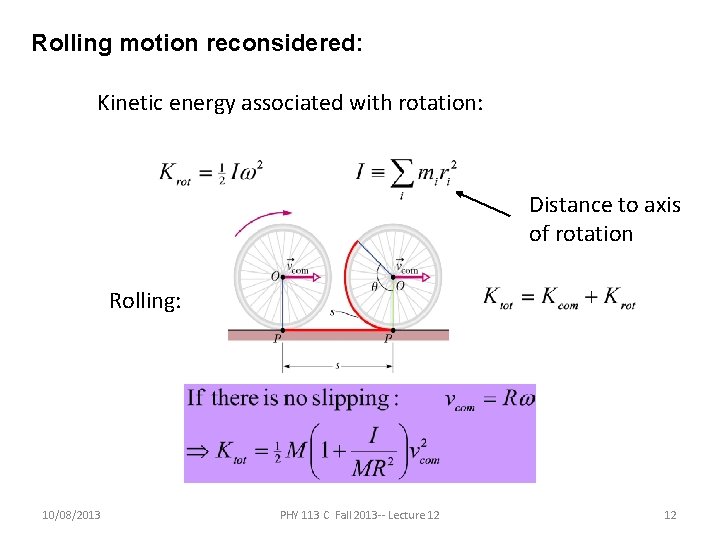
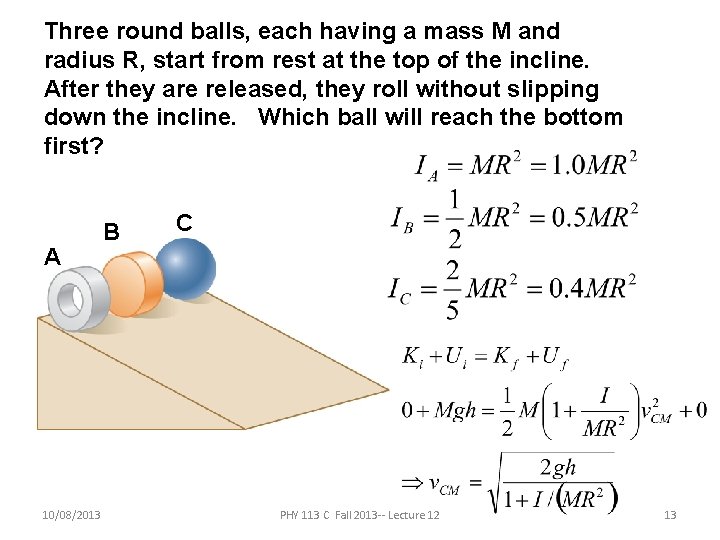
Rolling motion reconsidered: Kinetic energy associated with rotation: Distance to axis of rotation Rolling: 10/08/2013 PHY 113 C Fall 2013 -- Lecture 12 12
Three round balls, each having a mass M and radius R, start from rest at the top of the incline. After they are released, they roll without slipping down the incline. Which ball will reach the bottom first? A 10/08/2013 B C PHY 113 C Fall 2013 -- Lecture 12 13
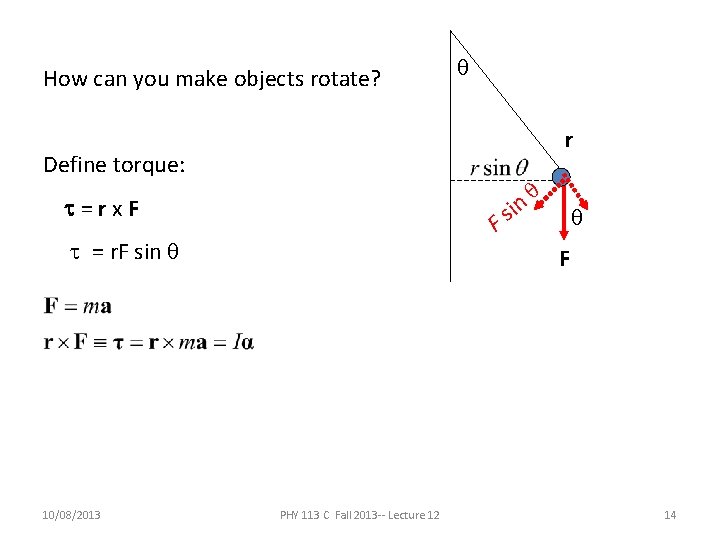
How can you make objects rotate? q r Define torque: t=rx. F F t = r. F sin q 10/08/2013 sin q q F PHY 113 C Fall 2013 -- Lecture 12 14
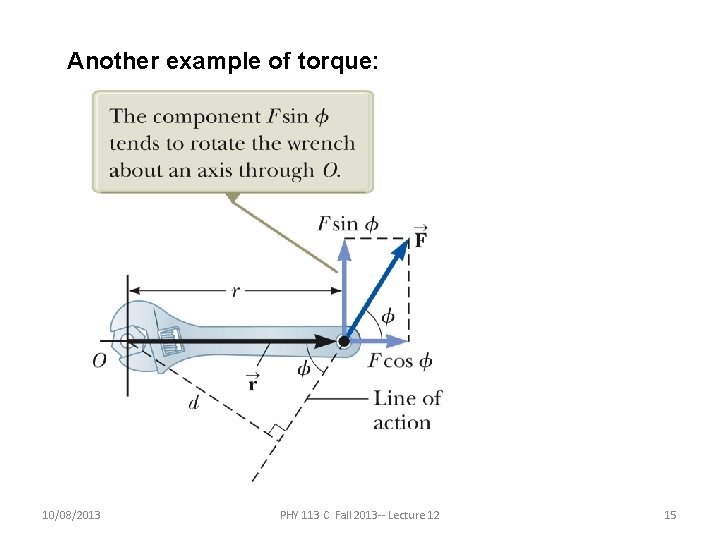
Another example of torque: 10/08/2013 PHY 113 C Fall 2013 -- Lecture 12 15
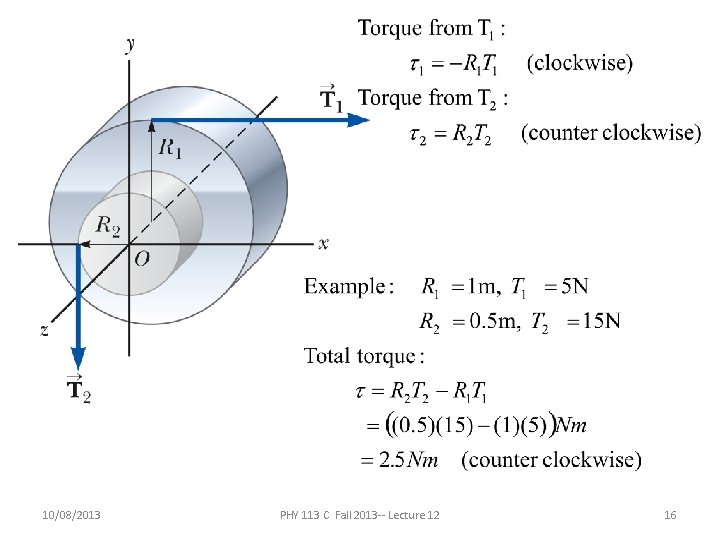
10/08/2013 PHY 113 C Fall 2013 -- Lecture 12 16
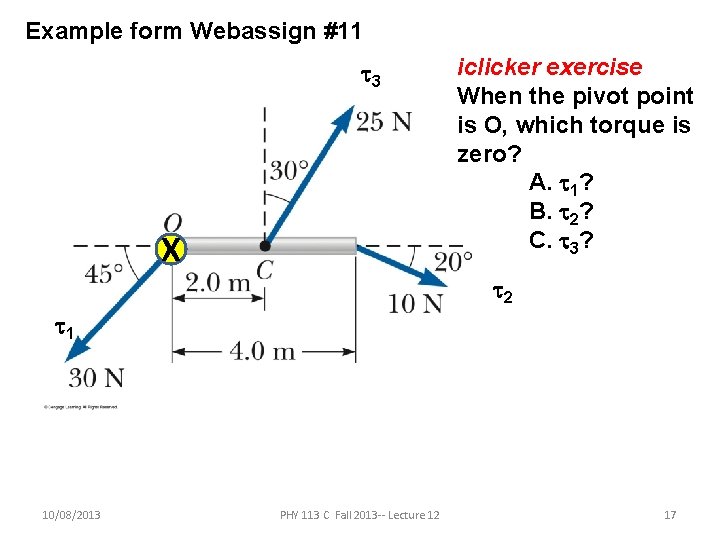
Example form Webassign #11 t 3 X iclicker exercise When the pivot point is O, which torque is zero? A. t 1? B. t 2? C. t 3? t 2 t 1 10/08/2013 PHY 113 C Fall 2013 -- Lecture 12 17
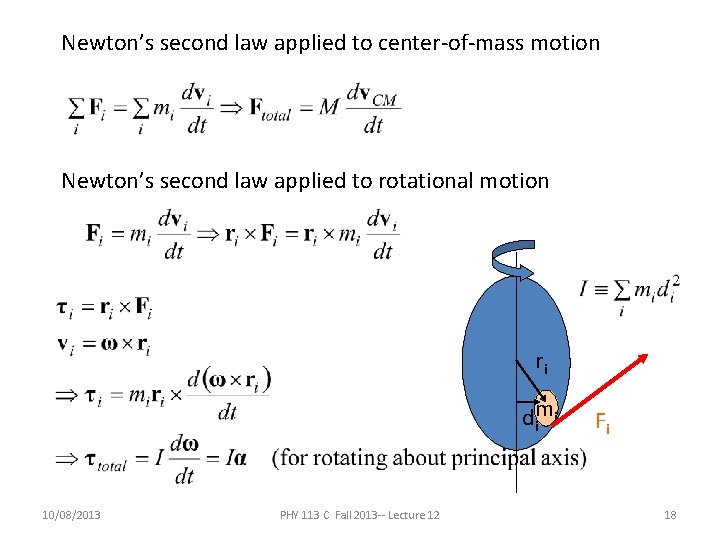
Newton’s second law applied to center-of-mass motion Newton’s second law applied to rotational motion ri dimi 10/08/2013 PHY 113 C Fall 2013 -- Lecture 12 Fi 18
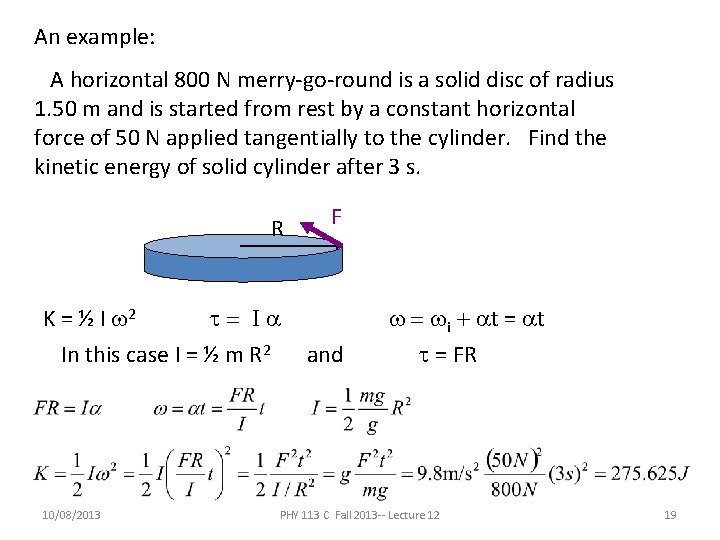
An example: A horizontal 800 N merry-go-round is a solid disc of radius 1. 50 m and is started from rest by a constant horizontal force of 50 N applied tangentially to the cylinder. Find the kinetic energy of solid cylinder after 3 s. R K = ½ I w 2 t= Ia In this case I = ½ m R 2 10/08/2013 F and w = wi + at = at t = FR PHY 113 C Fall 2013 -- Lecture 12 19
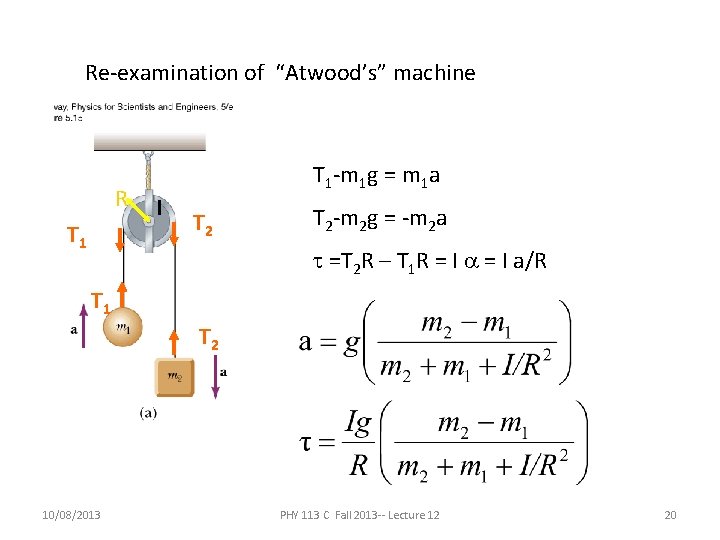
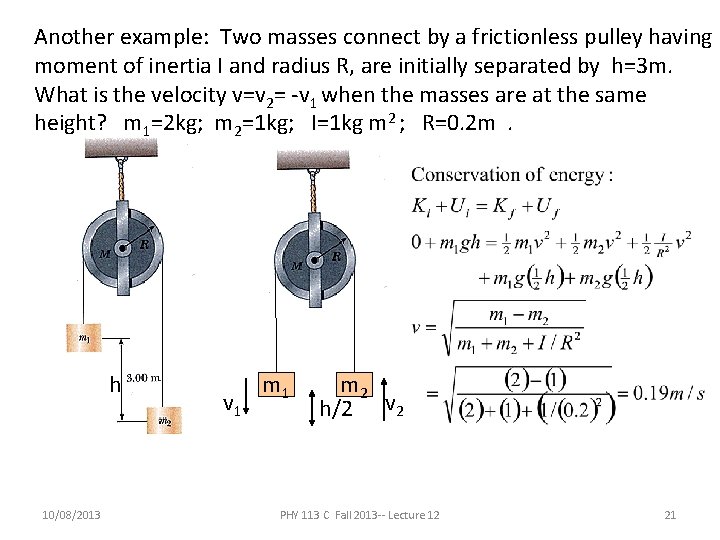
Re-examination of “Atwood’s” machine R T 1 -m 1 g = m 1 a I T 2 -m 2 g = -m 2 a t =T 2 R – T 1 R = I a/R T 1 T 2 10/08/2013 PHY 113 C Fall 2013 -- Lecture 12 20
Another example: Two masses connect by a frictionless pulley having moment of inertia I and radius R, are initially separated by h=3 m. What is the velocity v=v 2= -v 1 when the masses are at the same height? m 1=2 kg; m 2=1 kg; I=1 kg m 2 ; R=0. 2 m. h 10/08/2013 v 1 m 2 h/2 v 2 PHY 113 C Fall 2013 -- Lecture 12 21
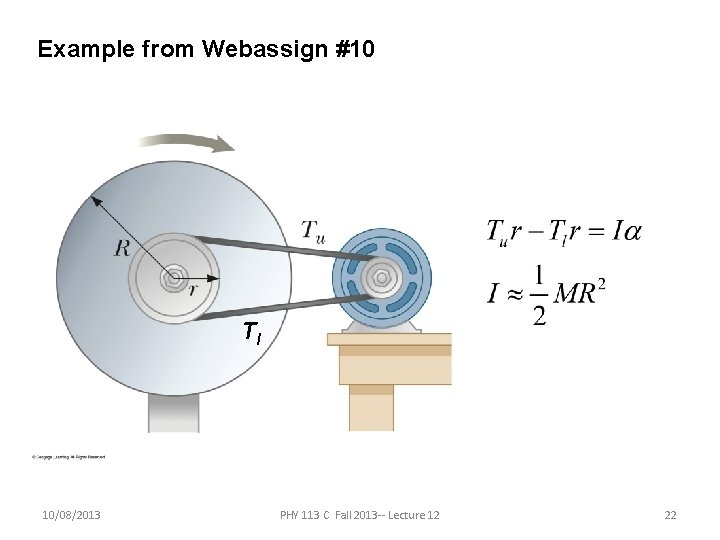
Example from Webassign #10 Tl 10/08/2013 PHY 113 C Fall 2013 -- Lecture 12 22
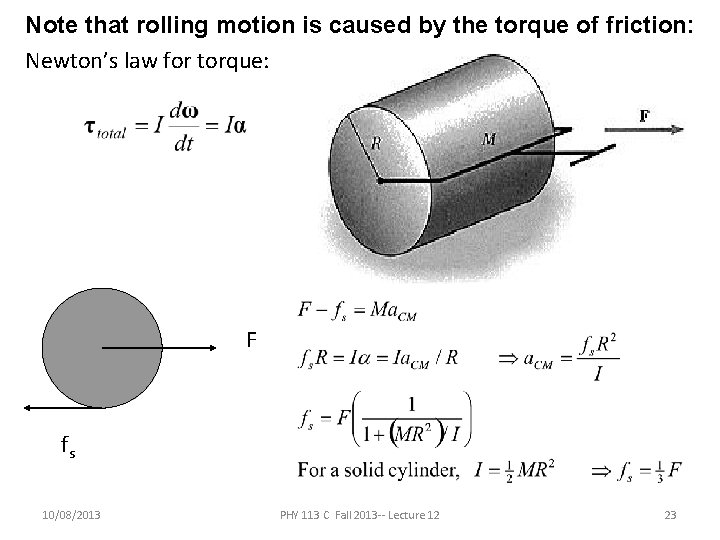
Note that rolling motion is caused by the torque of friction: Newton’s law for torque: F fs 10/08/2013 PHY 113 C Fall 2013 -- Lecture 12 23
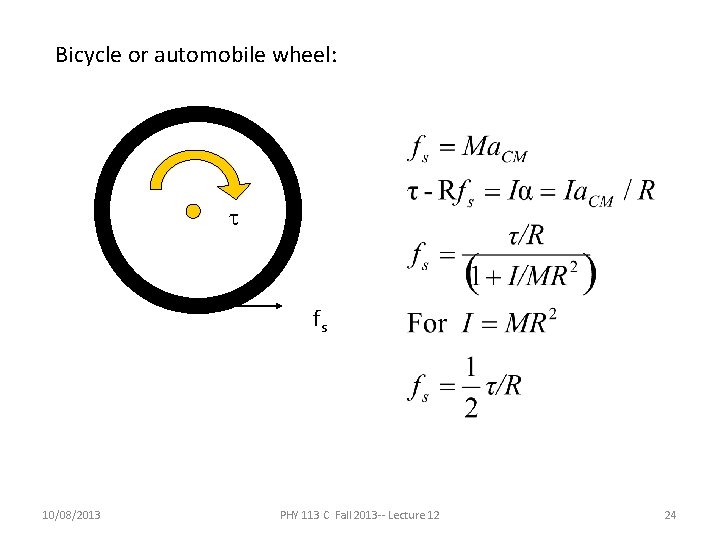
Bicycle or automobile wheel: t fs 10/08/2013 PHY 113 C Fall 2013 -- Lecture 12 24
iclicker exercise: What happens when the bicycle skids? A. Too much torque is applied B. Too little torque is applied C. The coefficient of kinetic friction is too small D. The coefficient of static friction is too small E. More than one of these 10/08/2013 PHY 113 C Fall 2013 -- Lecture 12 25
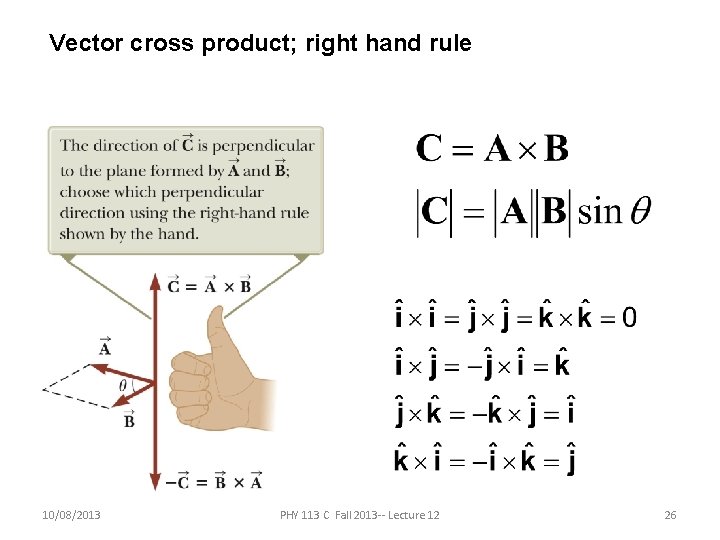
Vector cross product; right hand rule 10/08/2013 PHY 113 C Fall 2013 -- Lecture 12 26
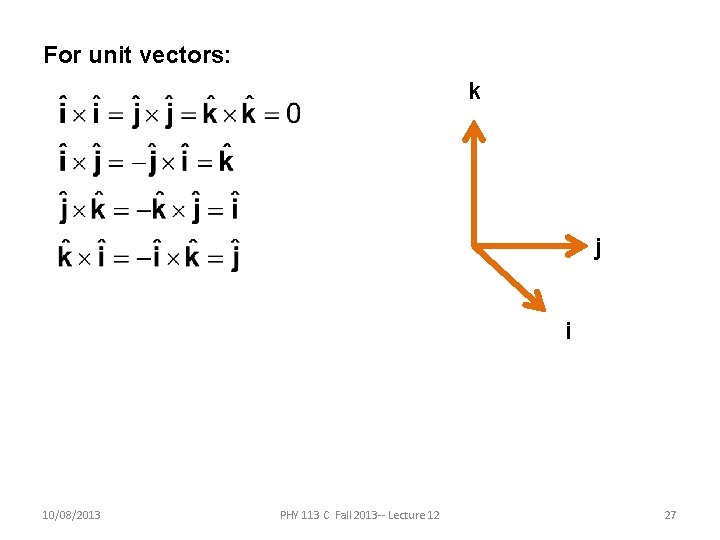
For unit vectors: k j i 10/08/2013 PHY 113 C Fall 2013 -- Lecture 12 27
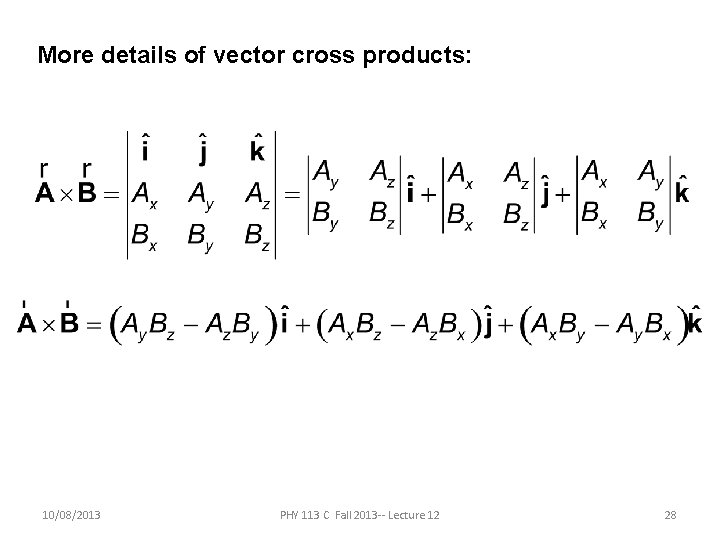
More details of vector cross products: 10/08/2013 PHY 113 C Fall 2013 -- Lecture 12 28
iclicker exercise: What is the point of vector products A. To terrify physics students B. To exercise your right hand C. To define an axial vector D. To keep track of the direction of rotation 10/08/2013 PHY 113 C Fall 2013 -- Lecture 12 29
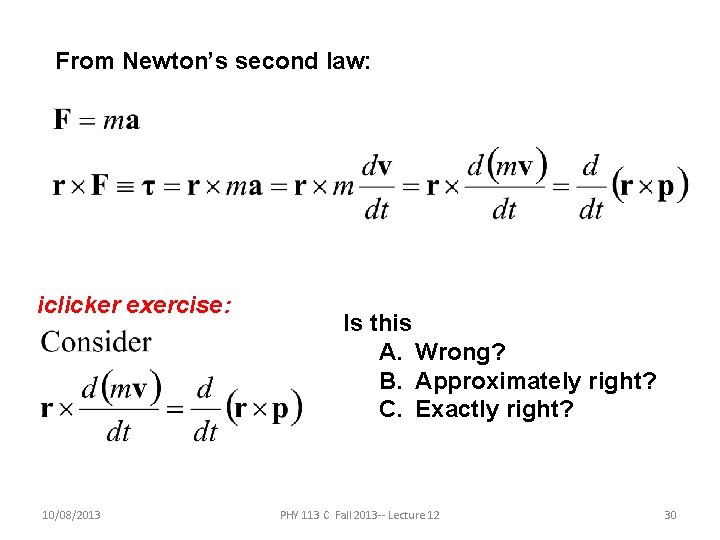
From Newton’s second law: iclicker exercise: 10/08/2013 Is this A. Wrong? B. Approximately right? C. Exactly right? PHY 113 C Fall 2013 -- Lecture 12 30
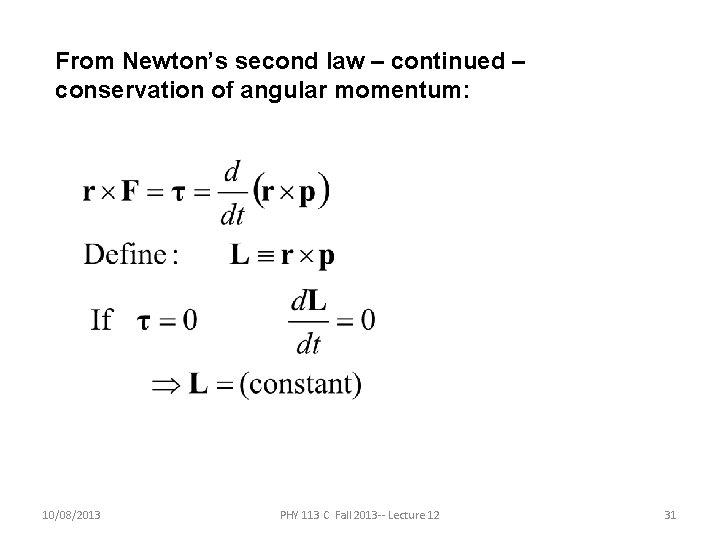
From Newton’s second law – continued – conservation of angular momentum: 10/08/2013 PHY 113 C Fall 2013 -- Lecture 12 31
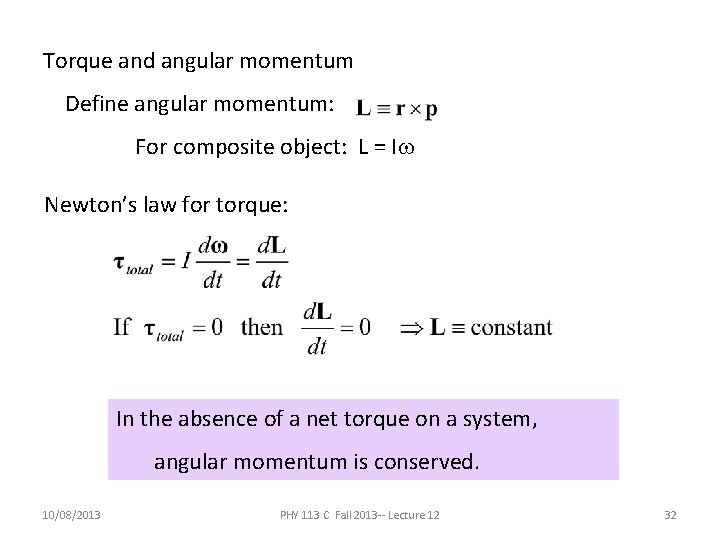
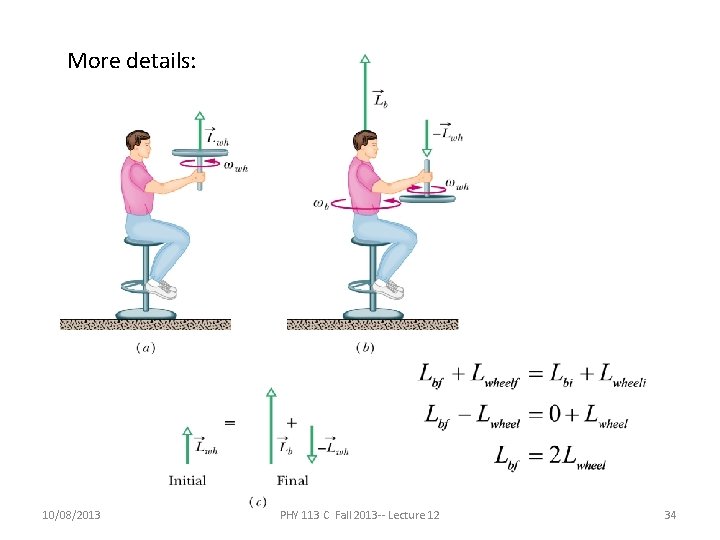
Torque and angular momentum Define angular momentum: For composite object: L = Iw Newton’s law for torque: In the absence of a net torque on a system, angular momentum is conserved. 10/08/2013 PHY 113 C Fall 2013 -- Lecture 12 32
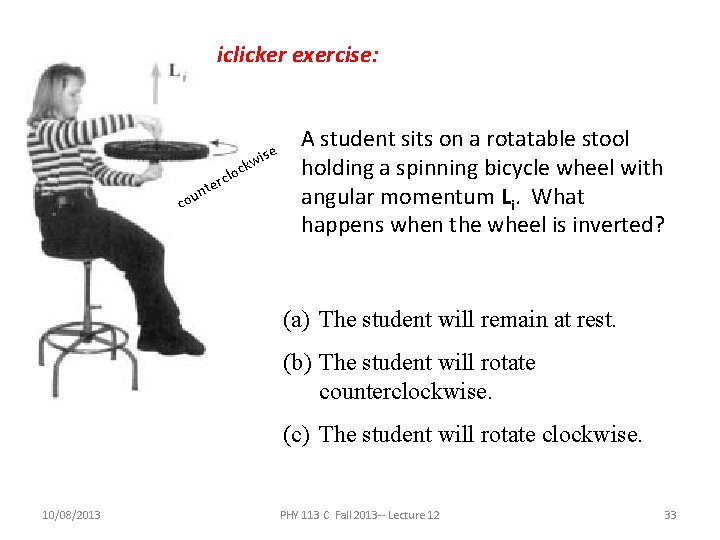
iclicker exercise: e wis nt ck o l c er cou A student sits on a rotatable stool holding a spinning bicycle wheel with angular momentum Li. What happens when the wheel is inverted? (a) The student will remain at rest. (b) The student will rotate counterclockwise. (c) The student will rotate clockwise. 10/08/2013 PHY 113 C Fall 2013 -- Lecture 12 33
More details: 10/08/2013 PHY 113 C Fall 2013 -- Lecture 12 34
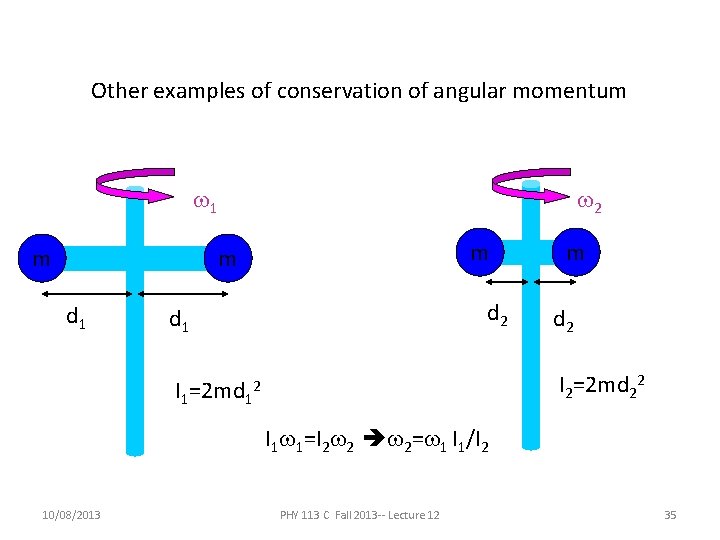
Other examples of conservation of angular momentum w 1 m w 2 m m d 1 d 2 d 1 m d 2 I 2=2 md 22 I 1=2 md 12 I 1 w 1=I 2 w 2 w 2=w 1 I 1/I 2 10/08/2013 PHY 113 C Fall 2013 -- Lecture 12 35
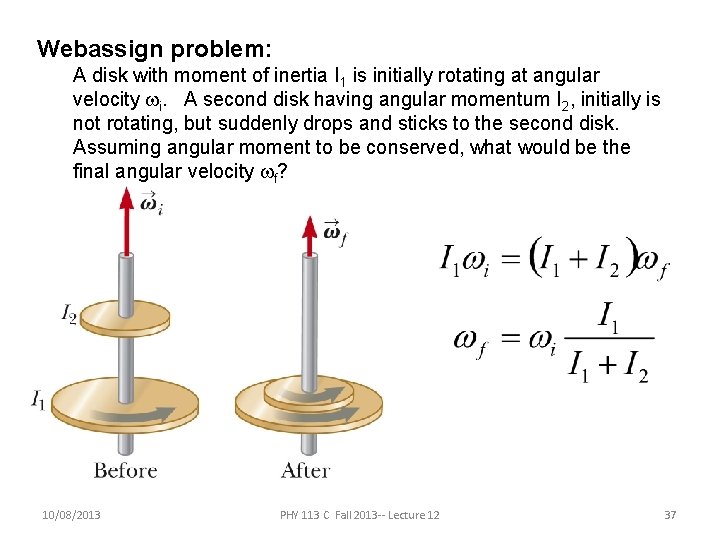
Webassign problem: A disk with moment of inertia I 1 is initially rotating at angular velocity wi. A second disk having angular momentum I 2, initially is not rotating, but suddenly drops and sticks to the second disk. Assuming angular moment to be conserved, what would be the final angular velocity wf? 10/08/2013 PHY 113 C Fall 2013 -- Lecture 12 37
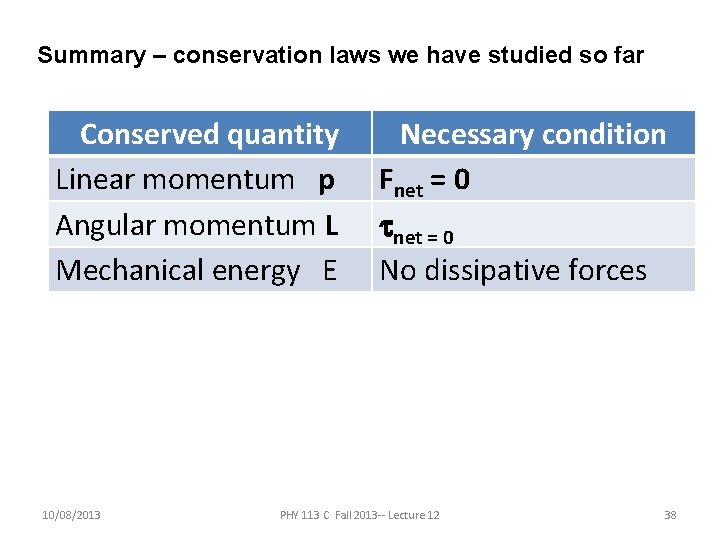
Summary – conservation laws we have studied so far Conserved quantity Linear momentum p Angular momentum L Mechanical energy E 10/08/2013 Necessary condition Fnet = 0 tnet = 0 No dissipative forces PHY 113 C Fall 2013 -- Lecture 12 38