pgd Tue 7 10 am School of Entrepreneurship





- Slides: 55
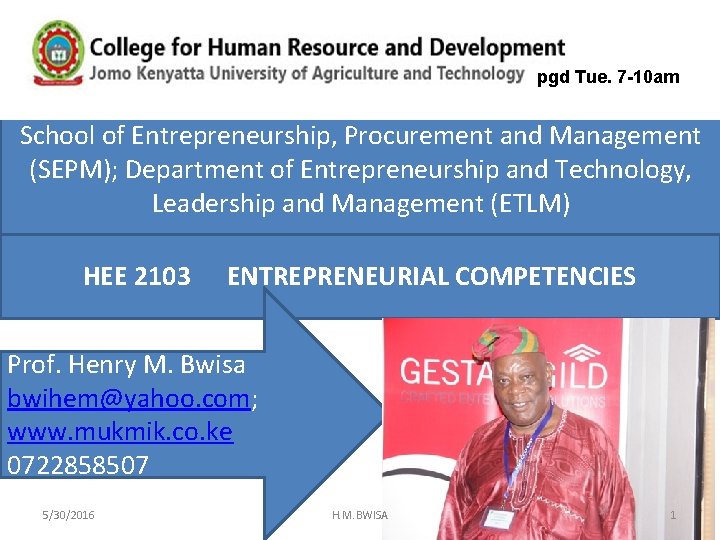
pgd Tue. 7 -10 am School of Entrepreneurship, Procurement and Management (SEPM); Department of Entrepreneurship and Technology, Leadership and Management (ETLM) HEE 2103 ENTREPRENEURIAL COMPETENCIES Prof. Henry M. Bwisa bwihem@yahoo. com; www. mukmik. co. ke 0722858507 5/30/2016 H. M. BWISA 1
Disclaimer • Some materials used in compiling these notes were obtained from a number of internet sources. This was done in full recognition of copyright and plagiarism rules and regulations and the aspects which allow for fair use including teaching purposes.
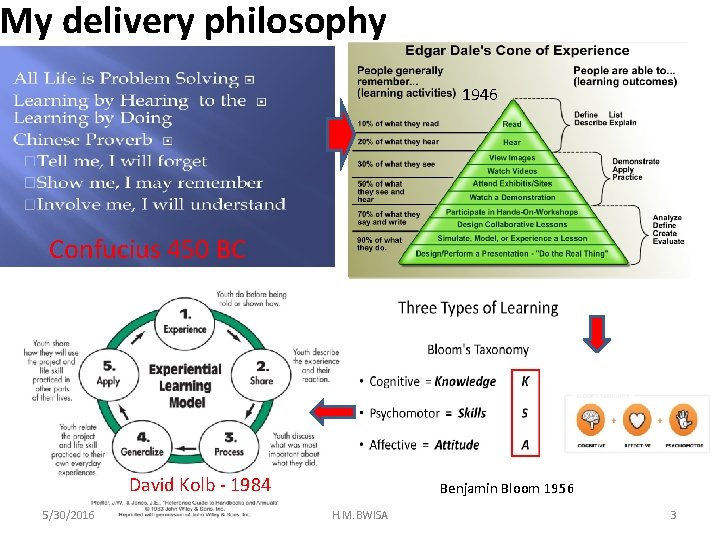
My delivery philosophy 1946 Confucius 450 BC David Kolb - 1984 5/30/2016 Benjamin Bloom 1956 H. M. BWISA 3
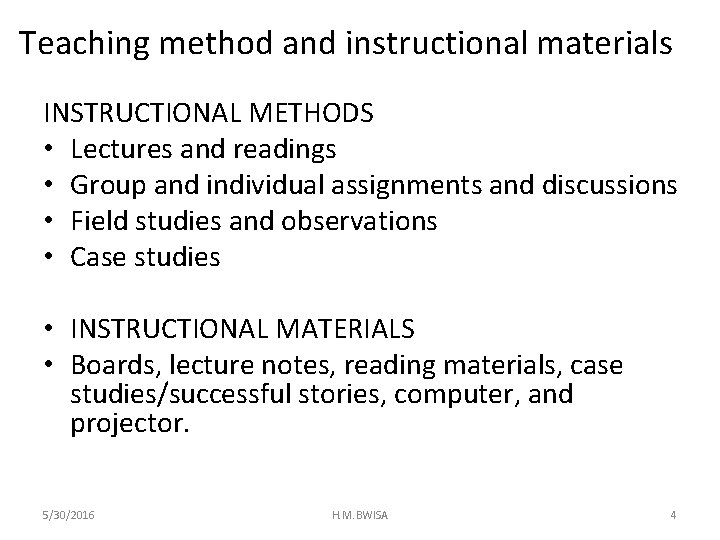
Teaching method and instructional materials INSTRUCTIONAL METHODS • Lectures and readings • Group and individual assignments and discussions • Field studies and observations • Case studies • INSTRUCTIONAL MATERIALS • Boards, lecture notes, reading materials, case studies/successful stories, computer, and projector. 5/30/2016 H. M. BWISA 4
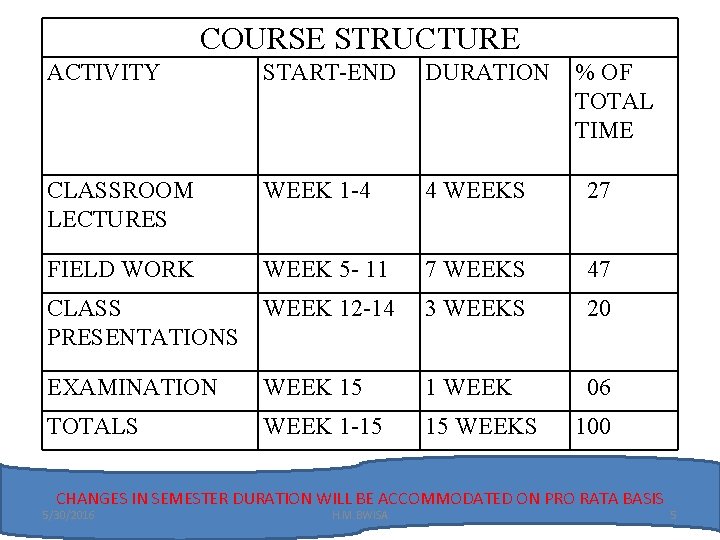
COURSE STRUCTURE ACTIVITY START-END DURATION % OF TOTAL TIME CLASSROOM LECTURES WEEK 1 -4 4 WEEKS 27 FIELD WORK WEEK 5 - 11 7 WEEKS 47 CLASS PRESENTATIONS WEEK 12 -14 3 WEEKS 20 EXAMINATION WEEK 15 1 WEEK 06 TOTALS WEEK 1 -15 15 WEEKS 100 CHANGES IN SEMESTER DURATION WILL BE ACCOMMODATED ON PRO RATA BASIS 5/30/2016 H. M. BWISA 5
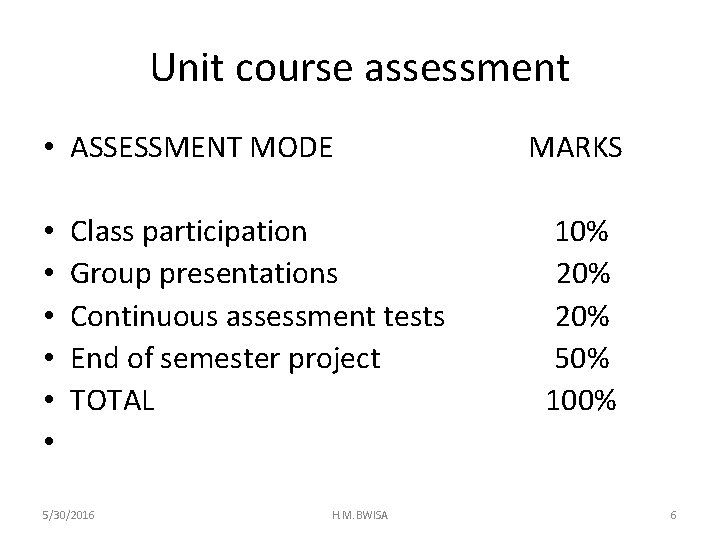
Unit course assessment • ASSESSMENT MODE MARKS • • • Class participation 10% Group presentations 20% Continuous assessment tests 20% End of semester project 50% TOTAL 100% 5/30/2016 H. M. BWISA 6
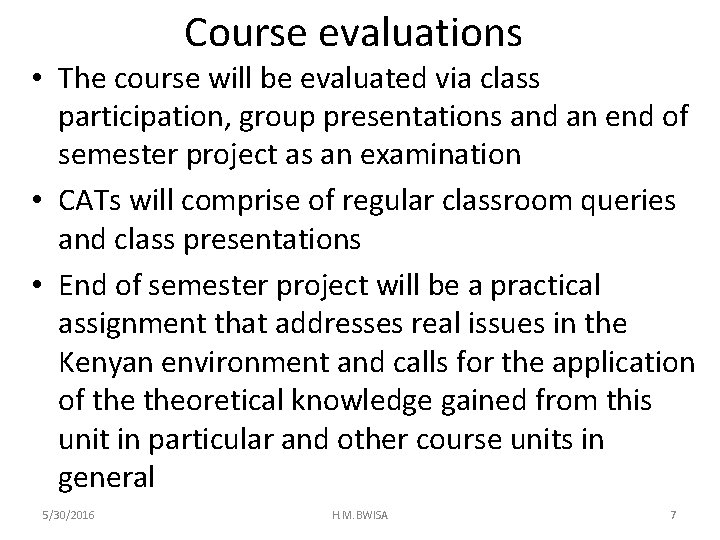
Course evaluations • The course will be evaluated via class participation, group presentations and an end of semester project as an examination • CATs will comprise of regular classroom queries and class presentations • End of semester project will be a practical assignment that addresses real issues in the Kenyan environment and calls for the application of theoretical knowledge gained from this unit in particular and other course units in general 5/30/2016 H. M. BWISA 7
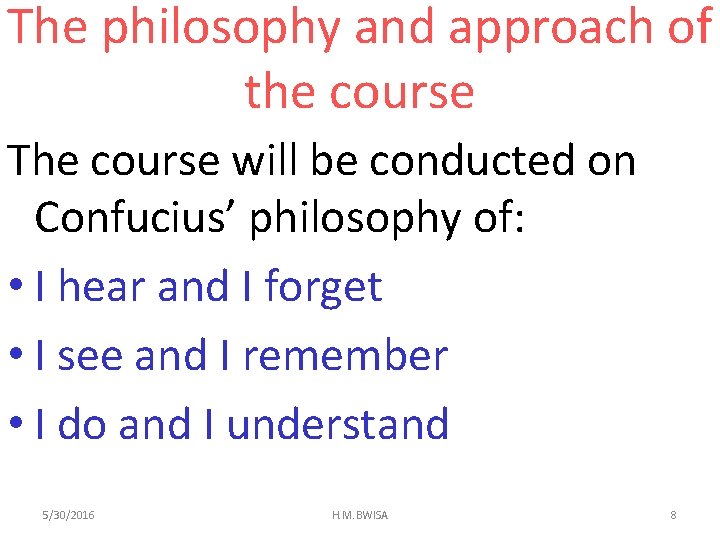
The philosophy and approach of the course The course will be conducted on Confucius’ philosophy of: • I hear and I forget • I see and I remember • I do and I understand 5/30/2016 H. M. BWISA 8
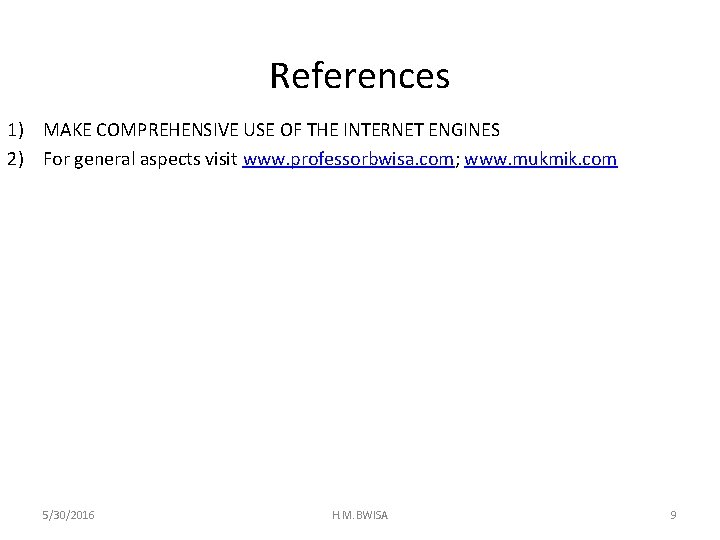
References 1) MAKE COMPREHENSIVE USE OF THE INTERNET ENGINES 2) For general aspects visit www. professorbwisa. com; www. mukmik. com 5/30/2016 H. M. BWISA 9
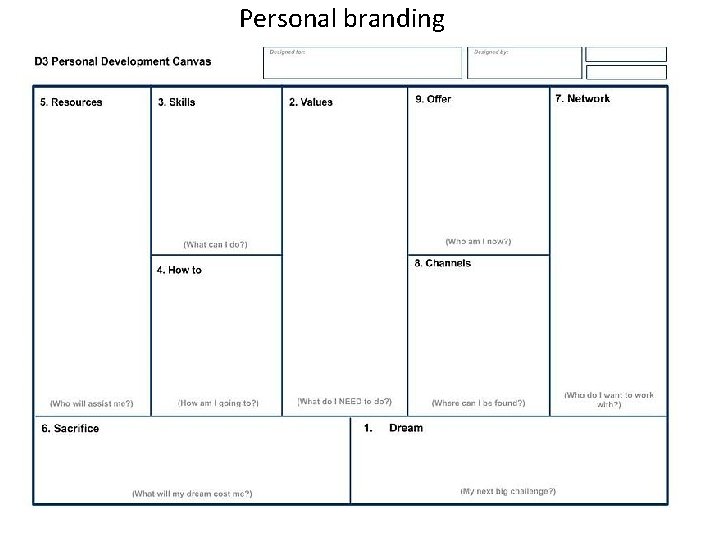
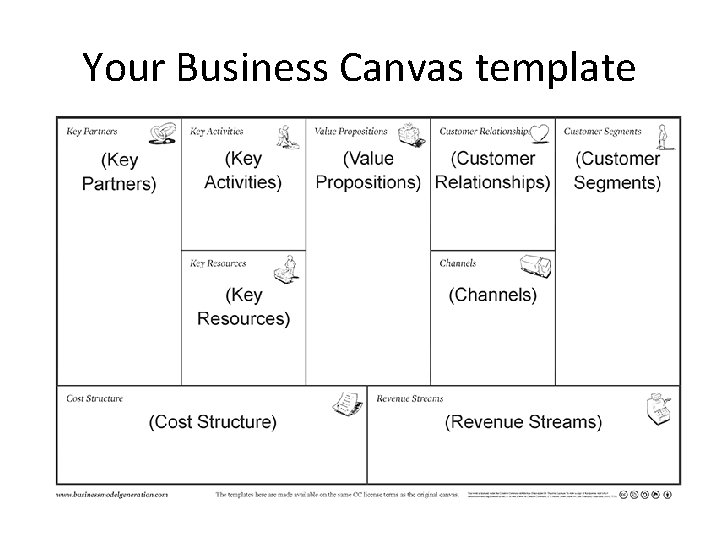
CAT AND EXAMINATION ASSIGNMENTS CAT • • In a group of not more than three: 1. Select a well-known entrepreneur. 2. Research the background, skills, and experiences of the entrepreneur. 3. Answer the following questions: a) What education and work experience does the entrepreneur have? b) What skills did the entrepreneur possess and how did they develop those skills? c) Describe the entrepreneur’s personality traits. How did they help or hinder? d) Was the entrepreneur a solo founder, or did they have a partner or a team of founders? How did this help or hinder them? EXAMINATION Brand yourself as an entrepreneur, identify a business you want to start and present its canvas.
Personal branding
Your Business Canvas template
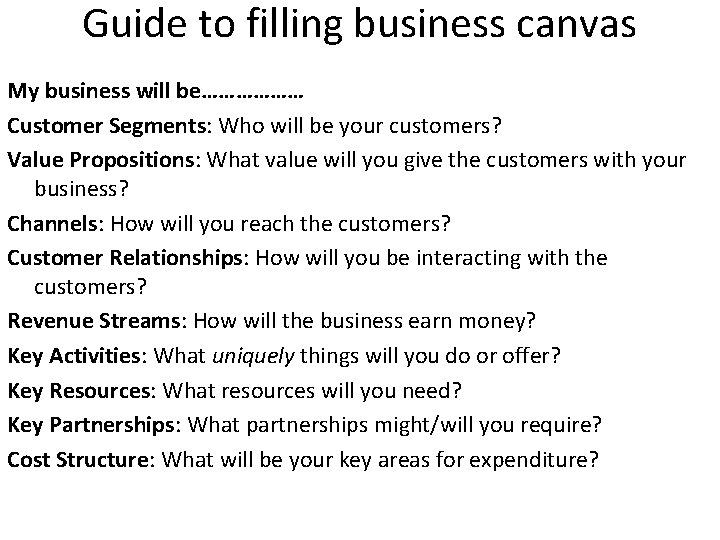
Guide to filling business canvas My business will be……………… Customer Segments: Who will be your customers? Value Propositions: What value will you give the customers with your business? Channels: How will you reach the customers? Customer Relationships: How will you be interacting with the customers? Revenue Streams: How will the business earn money? Key Activities: What uniquely things will you do or offer? Key Resources: What resources will you need? Key Partnerships: What partnerships might/will you require? Cost Structure: What will be your key areas for expenditure?
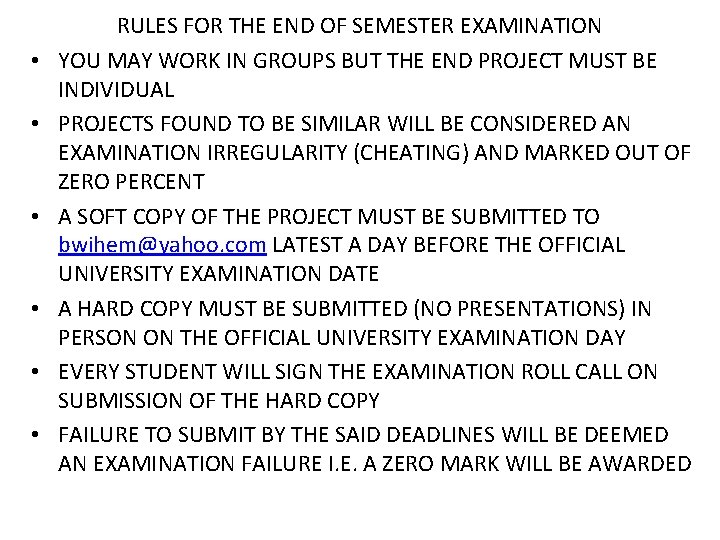
• • • RULES FOR THE END OF SEMESTER EXAMINATION YOU MAY WORK IN GROUPS BUT THE END PROJECT MUST BE INDIVIDUAL PROJECTS FOUND TO BE SIMILAR WILL BE CONSIDERED AN EXAMINATION IRREGULARITY (CHEATING) AND MARKED OUT OF ZERO PERCENT A SOFT COPY OF THE PROJECT MUST BE SUBMITTED TO bwihem@yahoo. com LATEST A DAY BEFORE THE OFFICIAL UNIVERSITY EXAMINATION DATE A HARD COPY MUST BE SUBMITTED (NO PRESENTATIONS) IN PERSON ON THE OFFICIAL UNIVERSITY EXAMINATION DAY EVERY STUDENT WILL SIGN THE EXAMINATION ROLL CALL ON SUBMISSION OF THE HARD COPY FAILURE TO SUBMIT BY THE SAID DEADLINES WILL BE DEEMED AN EXAMINATION FAILURE I. E. A ZERO MARK WILL BE AWARDED
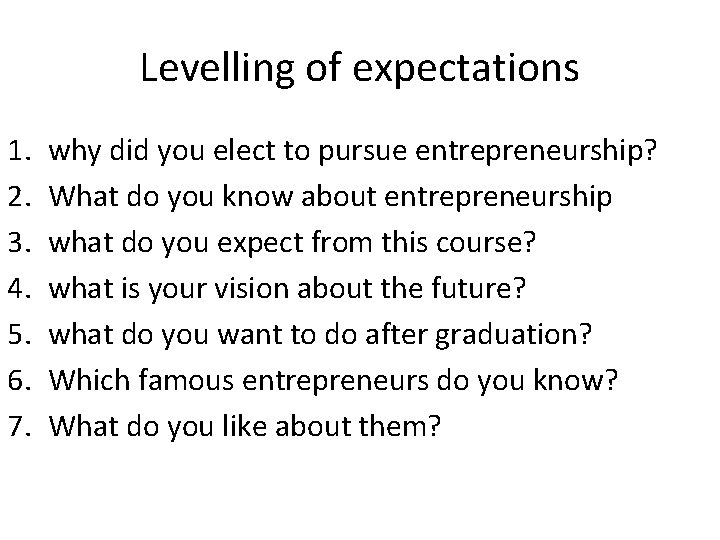
Levelling of expectations 1. 2. 3. 4. 5. 6. 7. why did you elect to pursue entrepreneurship? What do you know about entrepreneurship what do you expect from this course? what is your vision about the future? what do you want to do after graduation? Which famous entrepreneurs do you know? What do you like about them?
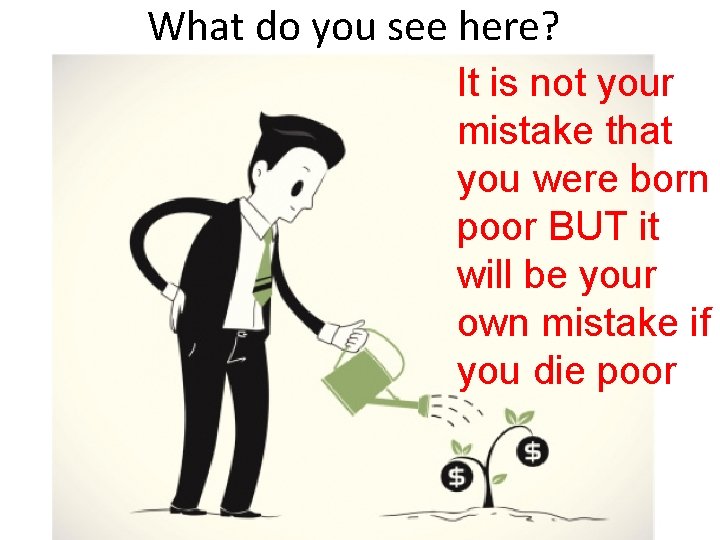
What do you see here? It is not your mistake that you were born poor BUT it will be your own mistake if you die poor
What I will do to those who care about becoming entrepreneurship • Capstone project • Learn as you earn – LAYE
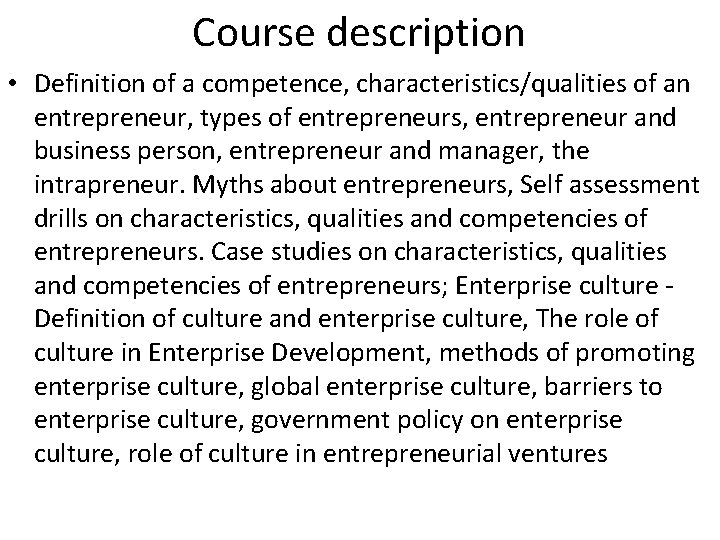
Course description • Definition of a competence, characteristics/qualities of an entrepreneur, types of entrepreneurs, entrepreneur and business person, entrepreneur and manager, the intrapreneur. Myths about entrepreneurs, Self assessment drills on characteristics, qualities and competencies of entrepreneurs. Case studies on characteristics, qualities and competencies of entrepreneurs; Enterprise culture - Definition of culture and enterprise culture, The role of culture in Enterprise Development, methods of promoting enterprise culture, global enterprise culture, barriers to enterprise culture, government policy on enterprise culture, role of culture in entrepreneurial ventures
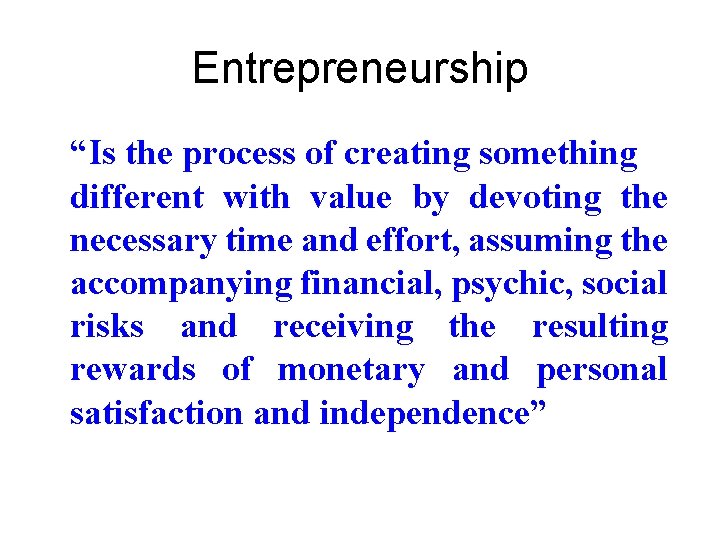
Entrepreneurship “Is the process of creating something different with value by devoting the necessary time and effort, assuming the accompanying financial, psychic, social risks and receiving the resulting rewards of monetary and personal satisfaction and independence”
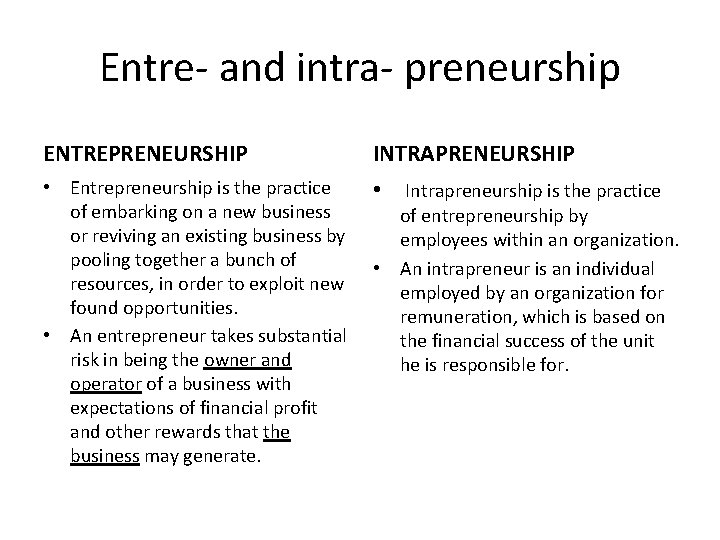
Entre- and intra- preneurship ENTREPRENEURSHIP INTRAPRENEURSHIP • Entrepreneurship is the practice of embarking on a new business or reviving an existing business by pooling together a bunch of resources, in order to exploit new found opportunities. • An entrepreneur takes substantial risk in being the owner and operator of a business with expectations of financial profit and other rewards that the business may generate. • Intrapreneurship is the practice of entrepreneurship by employees within an organization. • An intrapreneur is an individual employed by an organization for remuneration, which is based on the financial success of the unit he is responsible for.
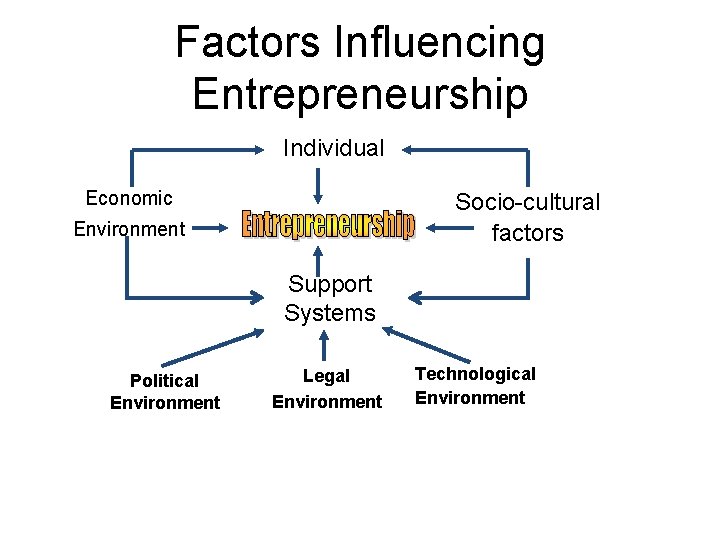
Factors Influencing Entrepreneurship Individual Economic Socio-cultural factors Environment Support Systems Political Environment Legal Environment Technological Environment
What is entrepreneurship? Ø Entrepreneurship – Strategic thinking and risk-taking behavior that results in the creation of new opportunities for individuals and/or organizations. Ø Entrepreneurs – Risk-taking individuals who take actions to pursue opportunities and situations others may fail to recognize or may view as problems or threats. Management - Chapter 6 22
What is entrepreneurship? Ø Entrepreneurs are … – Founders of businesses that become large-scale enterprises. – People who: • Buy a local franchise outlet • Open a small retail shop • Operate a self-employed service business – People who introduce a new product or operational change in an existing organization. Management - Chapter 6 23
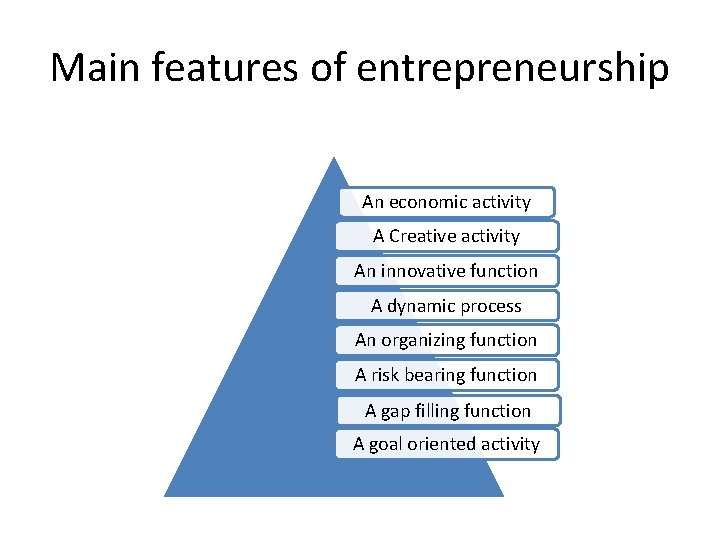
Main features of entrepreneurship An economic activity A Creative activity An innovative function A dynamic process An organizing function A risk bearing function A gap filling function A goal oriented activity
Entrepreneurs • Are those with the skills and capabilities to see and evaluate business opportunities. They are individuals who can strategically identify products or services needed by the community, and have the capacity to deliver them at the right place.
Entrepreneur Are the agent of economic change; they organize, manage, and assume risk of a business. Some of the good qualities of entrepreneur are: opportunity-seeker, risk-taker, goalsetter, excellent planner, confident, problem-solver, hardworking, persistent and committed.
Entrepreneurship On the other hand, is not just a simple business activity but a strategic process of innovation and new product creation. Basically, entrepreneurship is both an art and science of converting business ideas into marketable products or services to improve the quality of living.
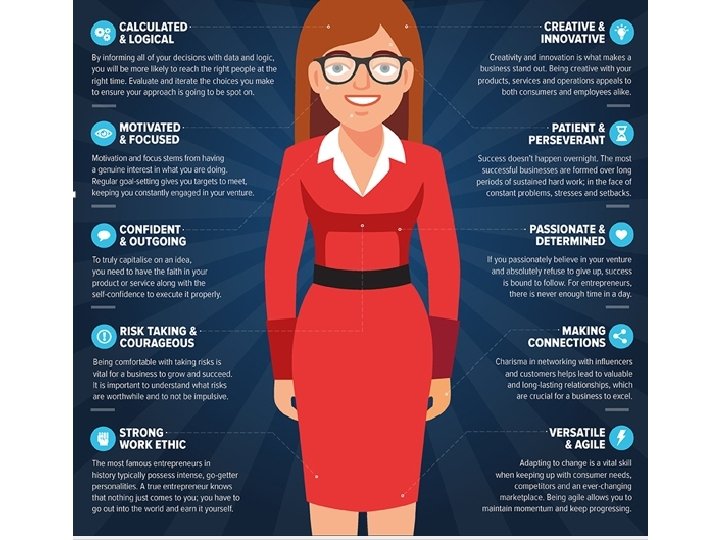
Assessment of Personal Entrepreneurial Competencies (PECs and Skills Entrepreneurial competencies refer to the important characteristics that should be possessed by an individual in order to perform entrepreneurial function effectively.
Few important characteristics /traits/ attributes of good entrepreneur: Hardworking: this means working diligently and being consistent about it. Hardworking people keep improving their performance to produce good products and/or provide good services.
Confident: Entrepreneurs have self-reliance in one’s ability and judgment. They exhibit selfconfident to cope with the risk of operating their own business.
Disciplined: Successful entrepreneurs always stick to the plan and fight the temptation to do what is unimportant.
Committed: Good entrepreneurs assume full responsibility over their business. They give full commitment and solid dedication to make the business successful.
Ability to accept change: Nothing is permanent but is change. Change occurs frequently. When you own a business, you should cope with a thrive on changes. Capitalize on positive changes to make your own business grow.
Creative: An entrepreneur should be creative and innovative to stay in the business in order to have an edge over the other competitors.
Has the initiative: An entrepreneur takes the initiative. You must put yourself in a position where you are responsible for the failure or success of your business
Profit-oriented: An entrepreneur enters the world of business to generate profit or additional income. The business shall become your bread and butter. Therefore, you must see to it that the business can generate income
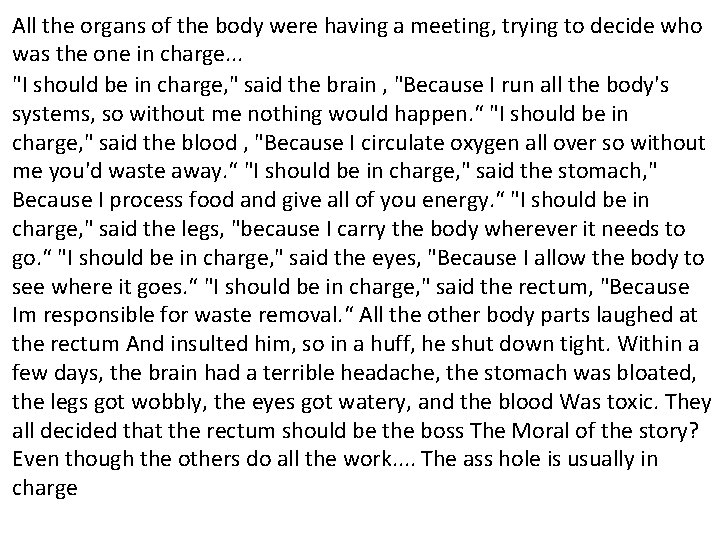
All the organs of the body were having a meeting, trying to decide who was the one in charge. . . "I should be in charge, " said the brain , "Because I run all the body's systems, so without me nothing would happen. “ "I should be in charge, " said the blood , "Because I circulate oxygen all over so without me you'd waste away. “ "I should be in charge, " said the stomach, " Because I process food and give all of you energy. “ "I should be in charge, " said the legs, "because I carry the body wherever it needs to go. “ "I should be in charge, " said the eyes, "Because I allow the body to see where it goes. “ "I should be in charge, " said the rectum, "Because Im responsible for waste removal. “ All the other body parts laughed at the rectum And insulted him, so in a huff, he shut down tight. Within a few days, the brain had a terrible headache, the stomach was bloated, the legs got wobbly, the eyes got watery, and the blood Was toxic. They all decided that the rectum should be the boss The Moral of the story? Even though the others do all the work. . The ass hole is usually in charge
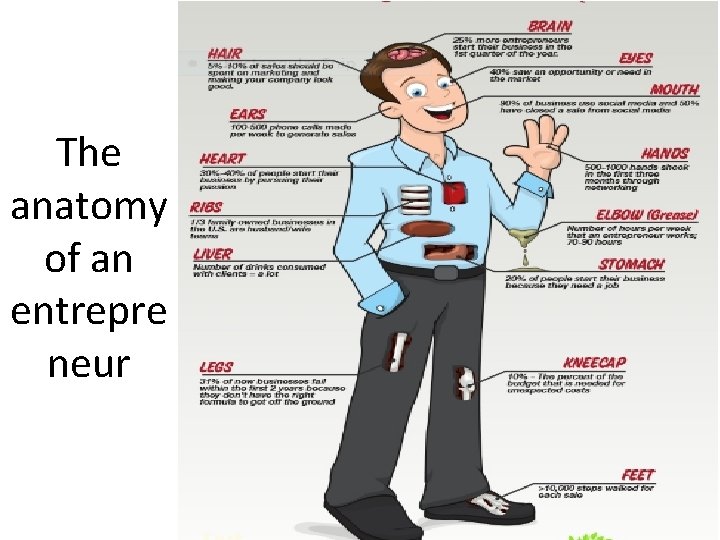
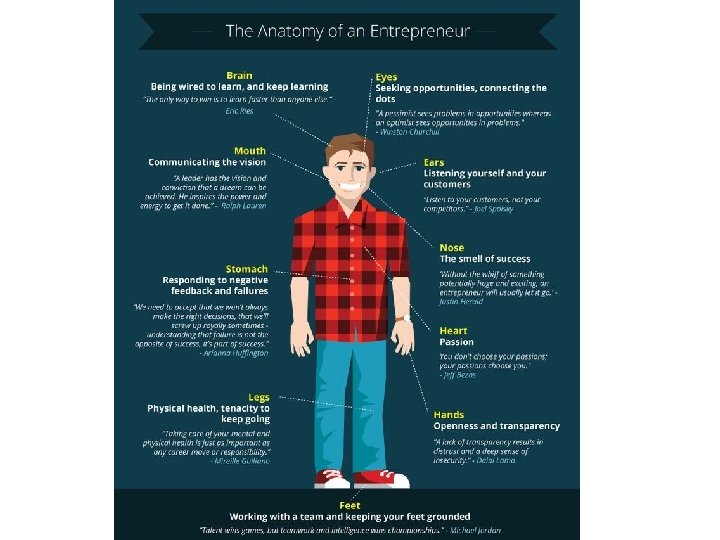
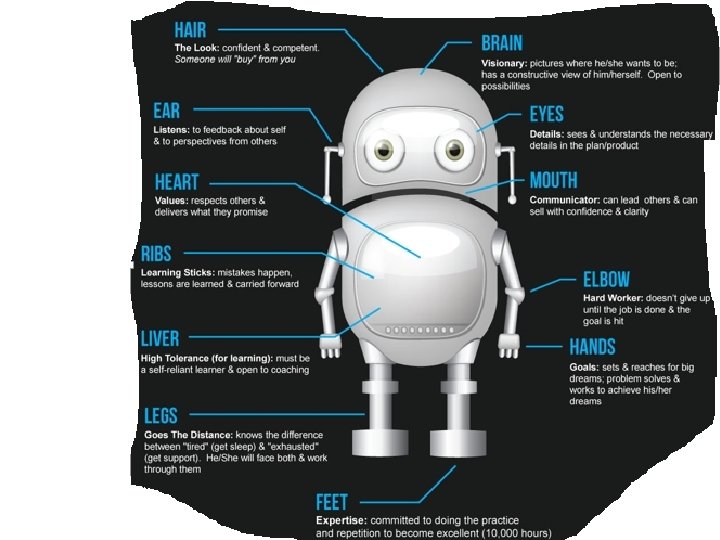
The anatomy of an entrepre neur
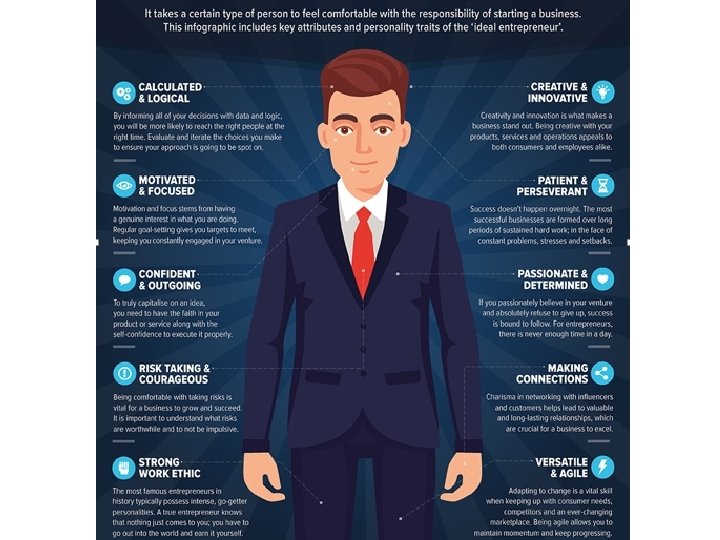
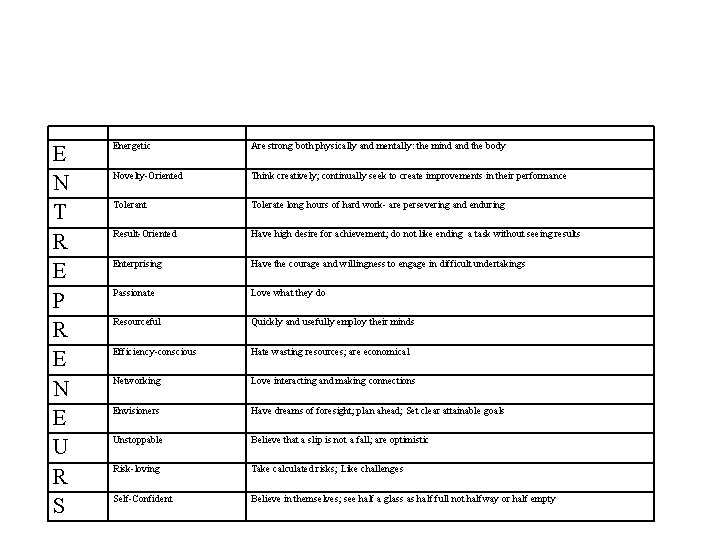
E N T R E P R E N E U R S Energetic Are strong both physically and mentally: the mind and the body Novelty-Oriented Think creatively; continually seek to create improvements in their performance Tolerant Tolerate long hours of hard work- are persevering and enduring Result-Oriented Have high desire for achievement; do not like ending a task without seeing results Enterprising Have the courage and willingness to engage in difficult undertakings Passionate Love what they do Resourceful Quickly and usefully employ their minds Efficiency-conscious Hate wasting resources; are economical Networking Love interacting and making connections Envisioners Have dreams of foresight; plan ahead; Set clear attainable goals Unstoppable Believe that a slip is not a fall; are optimistic Risk-loving Take calculated risks; Like challenges Self-Confident Believe in themselves; see half a glass as half full not halfway or half empty
TYPES OF ENTREPRENEURS
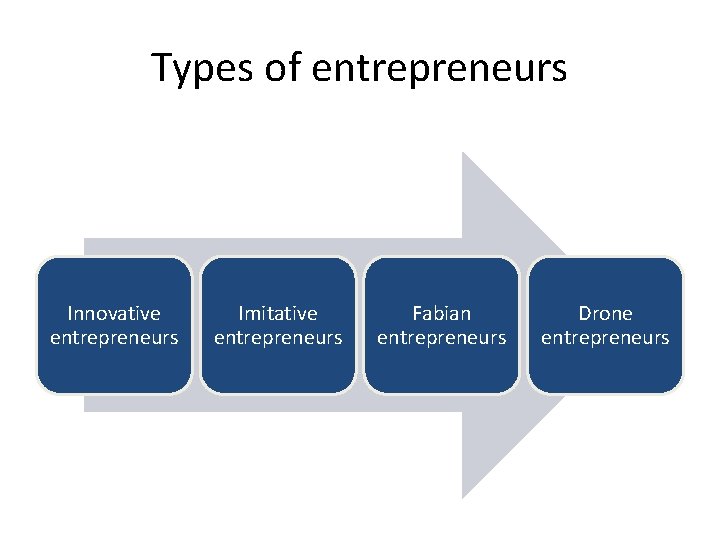
Types of entrepreneurs Innovative entrepreneurs Imitative entrepreneurs Fabian entrepreneurs Drone entrepreneurs
Types of entrepreneurs Innovators: Introduce new product or service or initiate a new system in the economy or the environment. Example: Hennery Ford wanted to replace the petrol fuel or the diesel engine with the Kerosene fuel system. Imitators: They iterate a certain feature or innovation in a particular product to make it more appealing and have a competitive edge over the current market. e. Fabian Entrepreneurs: They are very skeptic about taking a step unless and until they are definite, it would not be a loss. They only imitate if they see fit and have a clear and broad picture of things. They are do not prefer to take risk, Drone Entrepreneurs: They are stubborn to the changes, even if they have to bear a
• An entrepreneur is the owner of the enterprise but a manager is just an employee in the enterprise of the entrepreneur. • The main motive of an entrepreneur is to start a venture by setting up an enterprise. But the main aim of a manager is to render services to an entrepreneur.
• An entrepreneur and a manager differ in their standing, an entrepreneur is the owner of the organization and he bears all the risk and uncertainties involved in running an organization • Where as a manager is an employee and does not accept any risk.
• An entrepreneur and a manager differ in their objectives. Entrepreneur’s objective is to innovate and create and he acts as a change agent • Where as a manager’s objective is to supervise and create routines. He implements the entrepreneur’s plans and ideas.
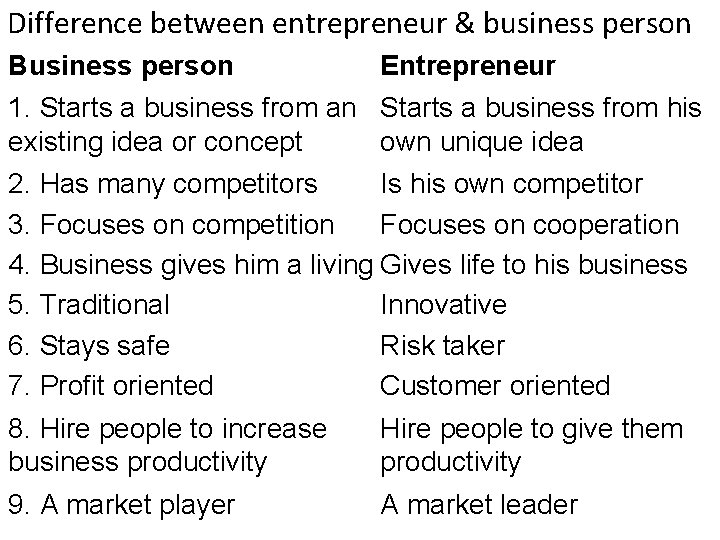
Difference between entrepreneur & business person Business person Entrepreneur 1. Starts a business from an Starts a business from his existing idea or concept own unique idea 2. Has many competitors Is his own competitor 3. Focuses on competition Focuses on cooperation 4. Business gives him a living Gives life to his business 5. Traditional Innovative 6. Stays safe Risk taker 7. Profit oriented Customer oriented 8. Hire people to increase business productivity Hire people to give them productivity 9. A market player A market leader
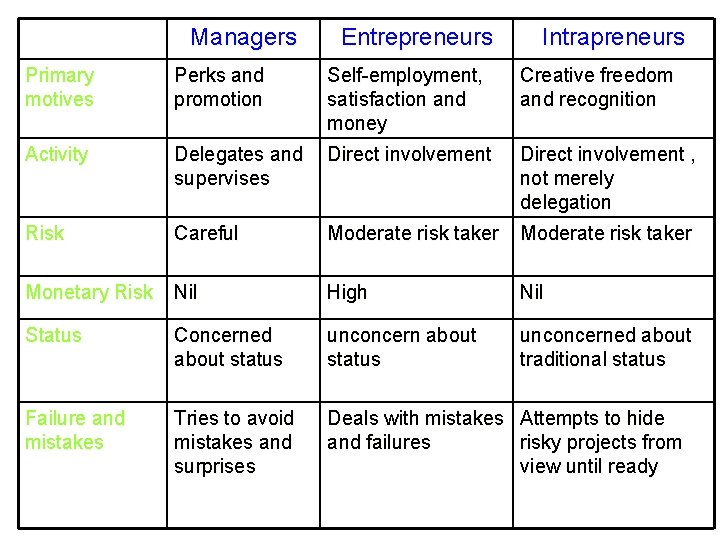
Managers Entrepreneurs Intrapreneurs Self-employment, satisfaction and money Creative freedom and recognition Primary motives Perks and promotion Activity Delegates and Direct involvement supervises Direct involvement , not merely delegation Risk Careful Moderate risk taker Monetary Risk Nil High Nil Status Concerned about status unconcerned about traditional status Failure and mistakes Tries to avoid mistakes and surprises Deals with mistakes Attempts to hide and failures risky projects from view until ready
ENTREPRENEURIAL CULTURE • “An entrepreneurial culture consists of a group of individuals who have suppressed individual interests in an effort to achieve group success because group success will advance their individual interests. "
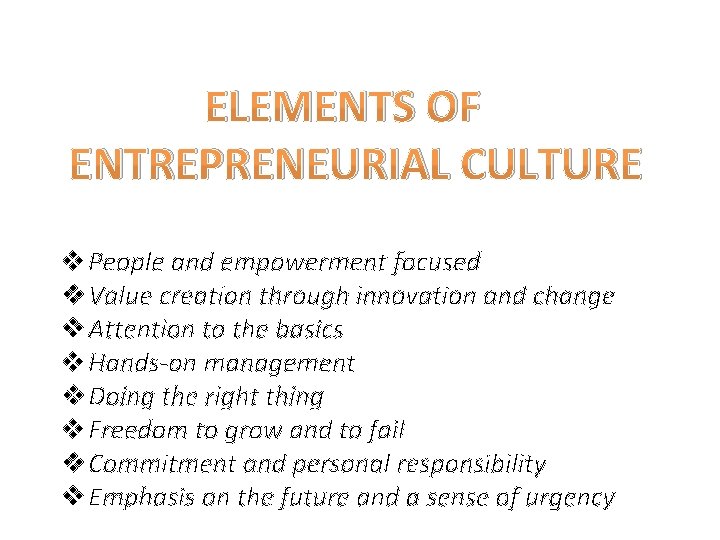
ELEMENTS OF ENTREPRENEURIAL CULTURE v People and empowerment focused v Value creation through innovation and change v Attention to the basics v Hands-on management v Doing the right thing v Freedom to grow and to fail v Commitment and personal responsibility v Emphasis on the future and a sense of urgency