Personality Review Game Define personality n Our pattern

- Slides: 28
Personality Review Game
Define personality. n Our pattern of feeling, thinking and acting. (thoughts, emotions and behavior)
Freud n According to Freud, what is the ultimate influence in shaping personality? v. Psychosexual stages
Freudian Theory n In Freudian theory, what is the essential conflict that resides in each individual? ØInternal desires vs. societal expectations
Psychoanalysis n Explain the fundamental objective of Freud’s psychoanalysis. q. Gain insight into one’s emotions / behavior by probing the unconscious.
Freud n Is Freud’s theory considered continuous or discontinuous? Explain your response. o Discontinuous: Freud believed the psychosexual stages were separate and distinct. (IOW, one ends before the next begins. )
Freudian Theory n Freud’s theory on personality is considered deterministic. What exactly is meant by this? – Freud argued that one’s personality was permanently established during childhood through psychosexual conflict.
Freud’s States of Consciousness n Identify Freud’s three states of consciousness and provide an example of each. o Conscious: any given current thought o Preconscious: memories, stored knowledge that can be accessed at any time o Unconscious: repressed thoughts: unacceptable urges, violent motives
n How did Freud believe one could access a patient’s unconscious thoughts? Identify three. o Hypnosis, free association, dream analysis
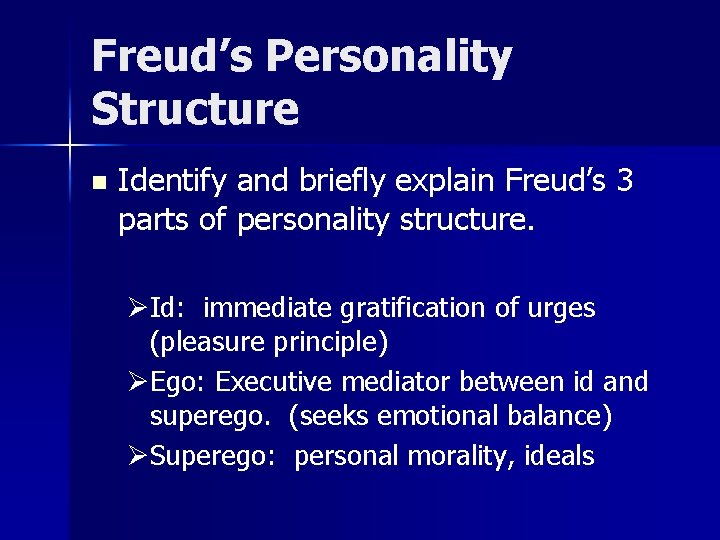
Freud’s Personality Structure n Identify and briefly explain Freud’s 3 parts of personality structure. ØId: immediate gratification of urges (pleasure principle) ØEgo: Executive mediator between id and superego. (seeks emotional balance) ØSuperego: personal morality, ideals
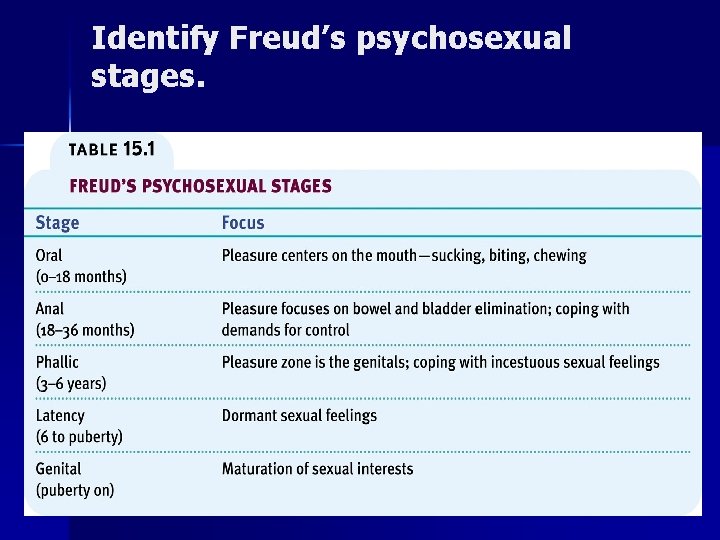
Identify Freud’s psychosexual stages.
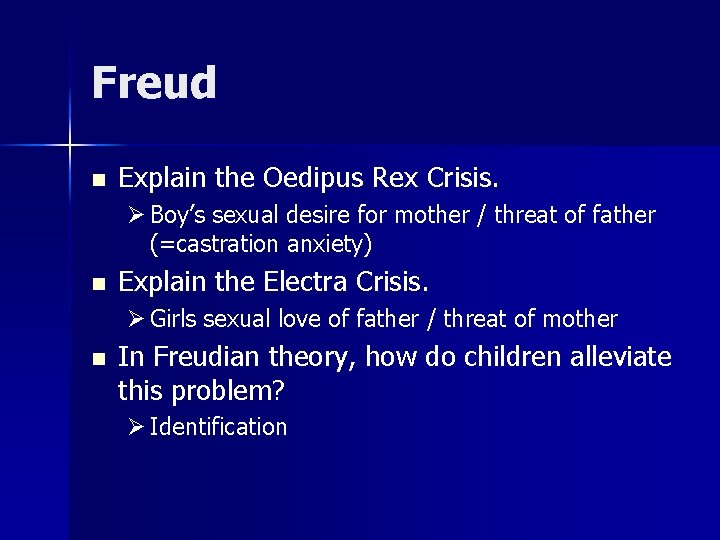
Freud n Explain the Oedipus Rex Crisis. Ø Boy’s sexual desire for mother / threat of father (=castration anxiety) n Explain the Electra Crisis. Ø Girls sexual love of father / threat of mother n In Freudian theory, how do children alleviate this problem? Ø Identification
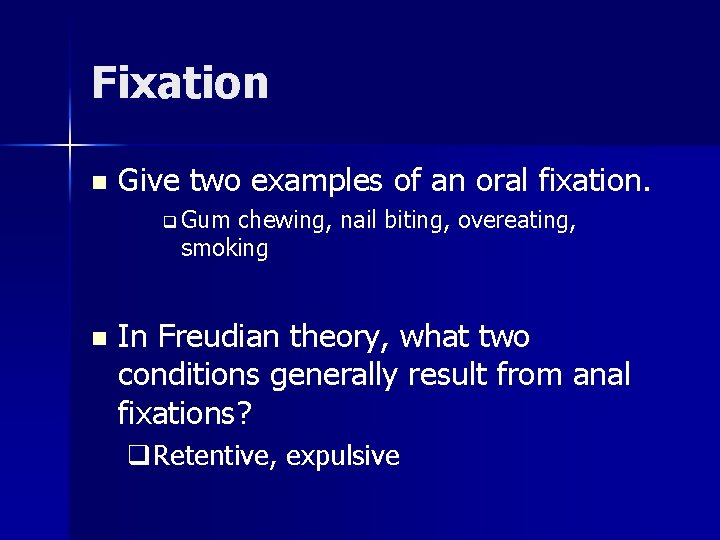
Fixation n Give two examples of an oral fixation. q Gum chewing, nail biting, overeating, smoking n In Freudian theory, what two conditions generally result from anal fixations? q. Retentive, expulsive
Defense Mechanisms Provide an example for each of the following Freudian defense mechanisms. A. B. C. D. Repression Regression Reaction Formation Rationalization E. F. G. Displacement Sublimation Projection
Freud n Identify any two contemporary criticisms of Freudian theory. q. No empirical evidence, no predictive value, gender discriminatory n Identify any two lasting legacies of Freudian theory in the field of psychology. q. Children as sexual, unconscious, early experiences in shaping behavior
Psychodynamic theory n Identify the two specific factors that comprise the unconscious in Jungian theory. Ø Personal unconscious, collective unconscious n Alfred Adler argued that this was the most influential issue in shaping the child. Ø Social issues Who is associated with the inferiority complex? Alfred Adler Who is associated with archetypes and complexes? Carl Jung
Projective Tests n What are Projective tests designed to do? ØProbe the unconscious through interpreting random visuals n What Projective test has been the most commonly used assessment of the unconscious? ØRorschach Inkblot Test
Humanistic Psychology n Briefly explain Humanistic perspective in psychology and provide two specific characteristics. q. Man is innately good / innate need to fulfill potential q. Anyone has potential for actualization at any time q. Free will = 3 rd Force q. Subjective experience and feelings q. Self-concept / self esteem q. Focus on health, life of fulfillment
Maslow n What characteristics are associated with Maslow’s Self-Actualization? q. Completely knowing, accepting oneself q. Open, spontaneous, loving, caring, problem centered…
Carl Rogers n According to Roger’s humanistic theory, what three environmental factors are critical for attaining a positive self-concept during childhood? q. Genuineness, acceptance, empathy
Personality Inventories n Identify any three personality inventories. q. Myers-Briggs, Eyesenck, MMPI
Personality Inventories n The Eyesenck Personality Questionnaire proposes that all people can be assesses on the basis of what two traits? q. Stable, unstable, extravert, introvert n Which inventory is traditionally used to assess mental illness? q. MMPI
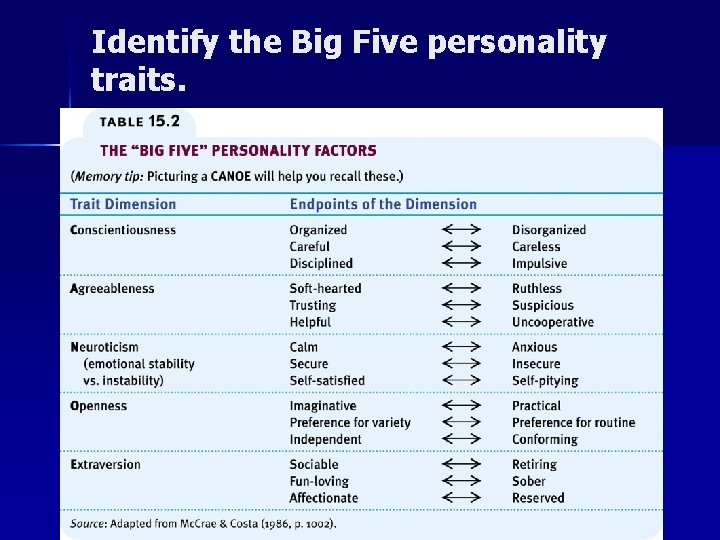
Identify the Big Five personality traits.
Social-Cognitive n According to the social-cognitive perspective, personality is largely determined by the interaction of what two factors? ØEnvironment and cognition
Albert Bandura n Albert Bandura theorized that personality was the product of what three interactive forces? q. Environment, traits, behavior
Albert Bandura n Explain the significance of the following in relation to personality: q. Reciprocal determinism q. Self-efficacy
Locus of Control n Contrast the internal and external locus of control and explain how they impact our personality.
Personal Construct n Explain the Relationship: n Personal construct – view of world - personality