Performance Improvement Risk Management and EHR Colleen A

- Slides: 31
Performance Improvement, Risk Management and EHR Colleen A. Hayes, MHS, RN CAPT, USPHS Cherokee Indian Hospital
EHR Can Become an AWESOME CHANGE ! Where the most trivial of things can become deadly projectiles
Decreasing the emotional impact of change Communication with providers and patients about any impending change will decrease the number of issues demanding attention during the change. Without communication about every important aspect of the change, expect to hear more from everyone who is affected by the change.
EHR and the Hospital Strategic Plan • EHR implementation concurrent with a number of efforts being undertaken for performance improvement (continuity model, changes in staffing, etc. ) • Change to EHR occurs within an entire system – impacts both clinical and financial indicators
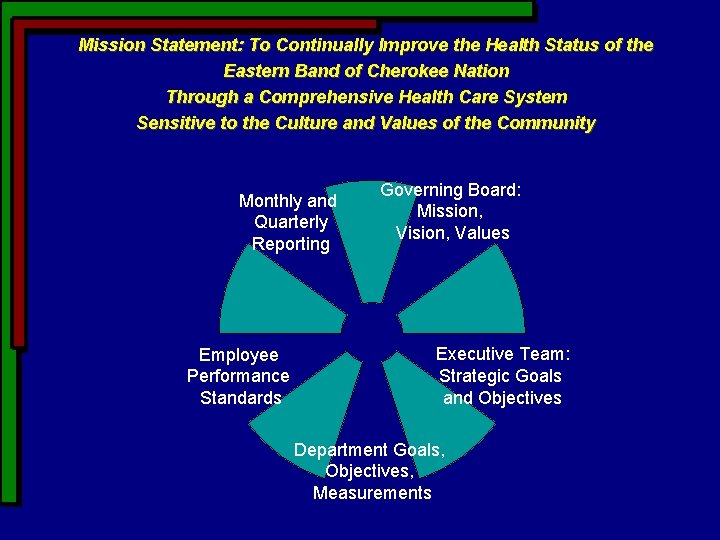
Mission Statement: To Continually Improve the Health Status of the Eastern Band of Cherokee Nation Through a Comprehensive Health Care System Sensitive to the Culture and Values of the Community Monthly and Quarterly Reporting Employee Performance Standards Governing Board: Mission, Vision, Values Executive Team: Strategic Goals and Objectives Department Goals, Objectives, Measurements
Implementation Work Plan and Communication • Timeline - IT, training, clinical readiness • Tasks and assignments • Staff training: identification of needs and levels of training • Process changes
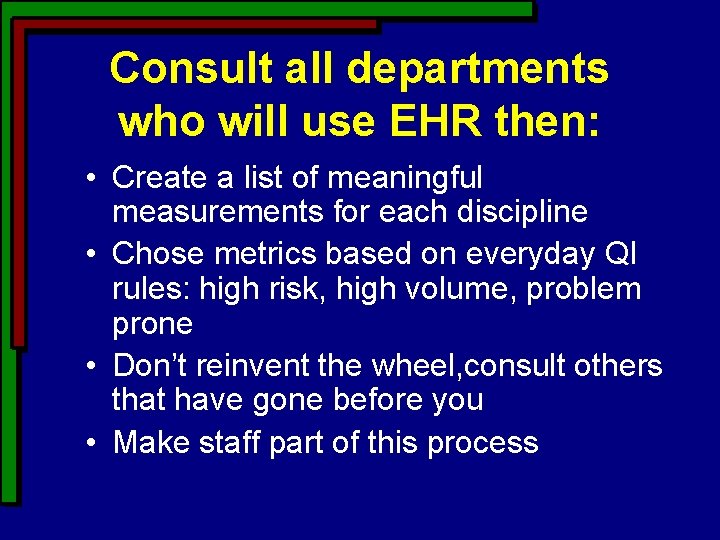
Consult all departments who will use EHR then: • Create a list of meaningful measurements for each discipline • Chose metrics based on everyday QI rules: high risk, high volume, problem prone • Don’t reinvent the wheel, consult others that have gone before you • Make staff part of this process
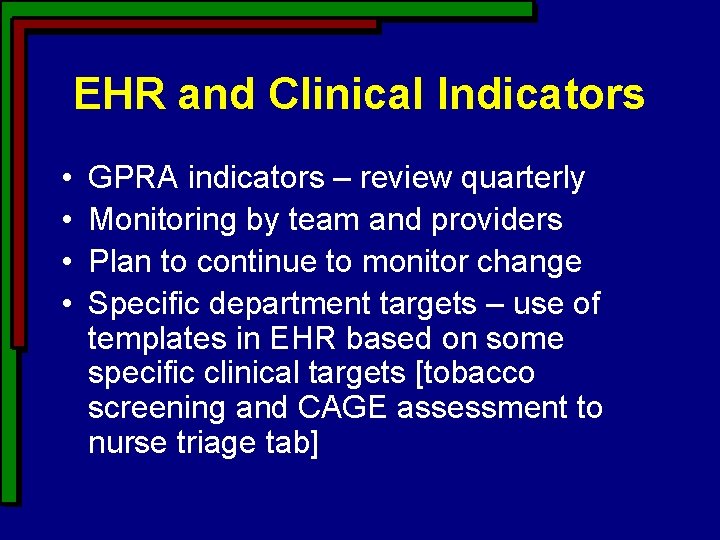
EHR and Clinical Indicators • • GPRA indicators – review quarterly Monitoring by team and providers Plan to continue to monitor change Specific department targets – use of templates in EHR based on some specific clinical targets [tobacco screening and CAGE assessment to nurse triage tab]
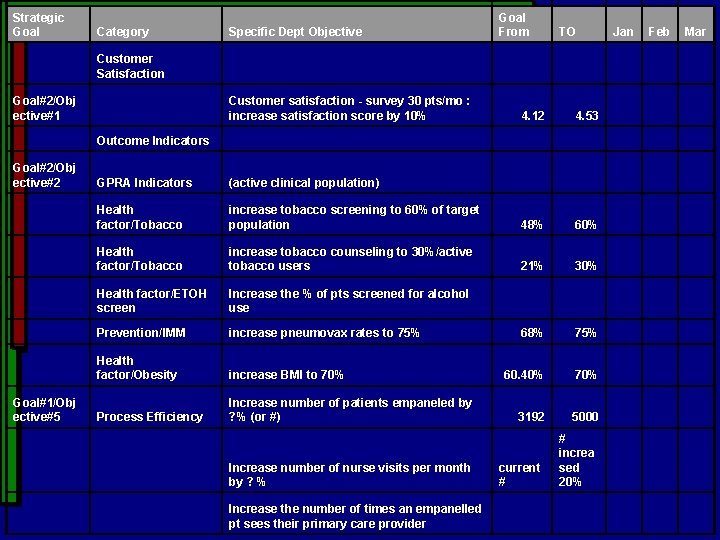
Strategic Goal Category Specific Dept Objective Goal From TO Jan Feb Mar Customer Satisfaction Goal#2/Obj ective#1 Customer satisfaction - survey 30 pts/mo : increase satisfaction score by 10% Outcome Indicators Goal#2/Obj ective#2 GPRA Indicators (active clinical population) Health factor/Tobacco increase tobacco screening to 60% of target population 48% 60% Health factor/Tobacco increase tobacco counseling to 30%/active tobacco users 21% 30% Health factor/ETOH screen Increase the % of pts screened for alcohol use Prevention/IMM increase pneumovax rates to 75% Health factor/Obesity increase BMI to 70% Process Efficiency Increase number of patients empaneled by ? % (or #) Goal#1/Obj ective#5 Increase number of nurse visits per month by ? % Increase the number of times an empanelled pt sees their primary care provider 4. 12 4. 53 68% 75% 60. 40% 70% 3192 5000 current # # increa sed 20%
Provider Scorecards • Specific feedback to providers and teams re: progress toward goals set by the OPD team • Accountability/input toward process improvements
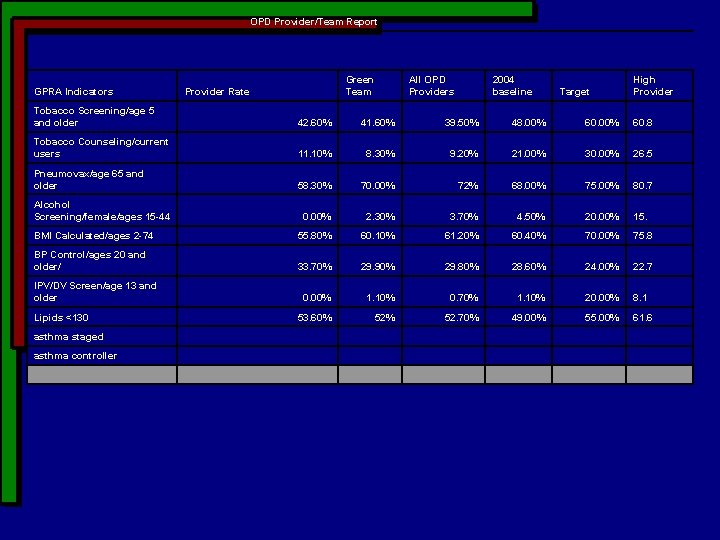
OPD Provider/Team Report GPRA Indicators Green Team Provider Rate All OPD Providers 2004 baseline Target High Provider Tobacco Screening/age 5 and older 42. 60% 41. 60% 39. 50% 48. 00% 60. 8 Tobacco Counseling/current users 11. 10% 8. 30% 9. 20% 21. 00% 30. 00% 26. 5 Pneumovax/age 65 and older 58. 30% 70. 00% 72% 68. 00% 75. 00% 80. 7 0. 00% 2. 30% 3. 70% 4. 50% 20. 00% 15. BMI Calculated/ages 2 -74 55. 80% 60. 10% 61. 20% 60. 40% 70. 00% 75. 8 BP Control/ages 20 and older/ 33. 70% 29. 90% 29. 80% 28. 60% 24. 00% 22. 7 0. 00% 1. 10% 0. 70% 1. 10% 20. 00% 8. 1 53. 60% 52. 70% 49. 00% 55. 00% 61. 6 Alcohol Screening/female/ages 15 -44 IPV/DV Screen/age 13 and older Lipids <130 asthma staged asthma controller
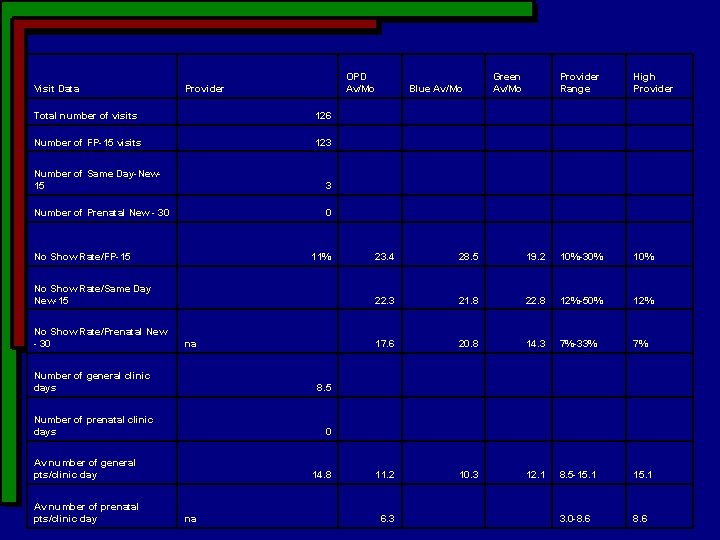
Visit Data Provider OPD Av/Mo Blue Av/Mo Green Av/Mo Provider Range High Provider Total number of visits 126 Number of FP-15 visits 123 Number of Same Day-New 15 3 Number of Prenatal New - 30 0 No Show Rate/FP-15 11% 23. 4 28. 5 19. 2 10%-30% 10% No Show Rate/Same Day New-15 22. 3 21. 8 22. 8 12%-50% 12% No Show Rate/Prenatal New - 30 na 17. 6 20. 8 14. 3 7%-33% 7% Number of general clinic days Number of prenatal clinic days Av number of general pts/clinic day Av number of prenatal pts/clinic day 8. 5 0 8. 5 -15. 1 3. 0 -8. 6 14. 8 na 11. 2 6. 3 10. 3 12. 1
Clinical Outcomes Comparison of EHR using clinic to a Non-EHR using clinic
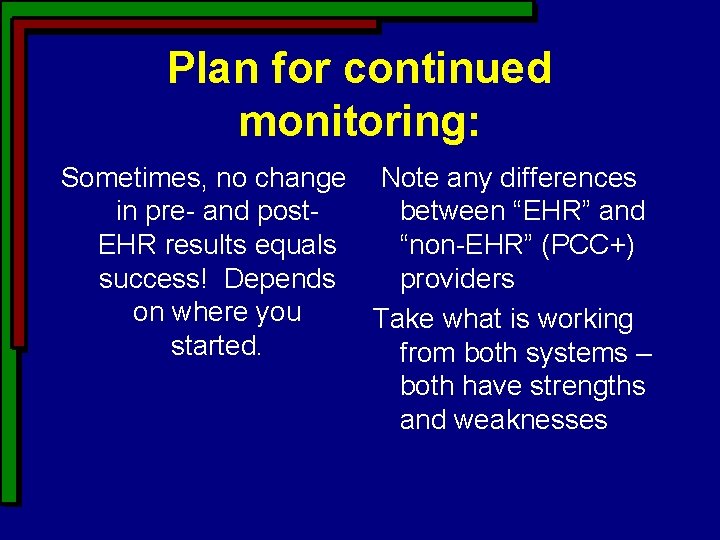
Plan for continued monitoring: Sometimes, no change Note any differences in pre- and postbetween “EHR” and EHR results equals “non-EHR” (PCC+) success! Depends providers on where you Take what is working started. from both systems – both have strengths and weaknesses
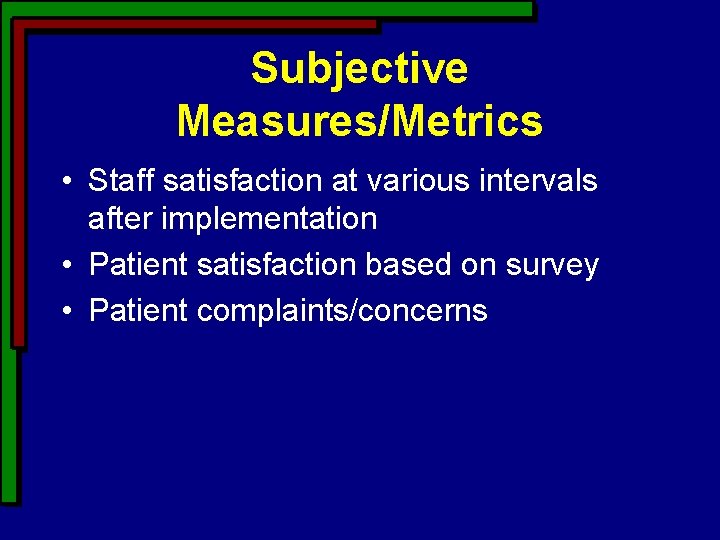
Subjective Measures/Metrics • Staff satisfaction at various intervals after implementation • Patient satisfaction based on survey • Patient complaints/concerns
Objective Metrics • Provider productivity – expect a dip, and plan for this in your staffing - changes to provide schedules • Medication errors – don’t expect improvement until all “old” errors have had time to surface. • Compliance with health maintenance reminders (smoking, various cancer screens, etc. ) – smoking and CAGE screen moved to nurse triage tab
Productivity • Scheduling Changes • One patient per hour – gradually increase number of pts per hour
Medication Processes • • Medication Ordering difficulties/risks Med errors Process Changes Problems with patients with “long med lists” – difficulty in PCC+ transition to EHR
Objective Metrics • Error reports in PCC-expect an increase – Coding – takes time to build the tools and convince providers to use them. – Missing E&M codes – Missing POVs, Providers, Multiple providers – Data Entry backlog-expect it to increase • Billing backlog-due to data entry backlog – Changes in revenue – patience……
Risk Management
RM issues During EHR Implementation • Be aware that weirdness can happen in the beginning until you figure it out. Monitor ALL your processes and pay attention to ALL end users. This is how you discover problems and fix them • Weekly EHR meetings greatly facilitated identification of ongoing issues/risks/problem areas – attendance by all parties (clinical, med records, PI/RM, IT, etc. )
Every time a person is asked to change their role or a make a change in a process, there are inherent risks. We must quickly identify and eliminate these risks in order to protect patients. Here are examples of the good, the bad and the ugly from EHR. Here are examples of “the good, the bad and the ugly” from EHR
The Good
Good Stuff: EHR helps to manage risk by: • Virtually eliminating legibility problems and transcription errors • Increasing the likelihood that information will get into the Medical Record, i. e. significant medical advice (JCAHO and GPRA targets).
Good, continued • Allowing up to the minute information to be accessed from any computer in the clinic, and some computers outside the clinic by private network as well. • Using templates to help decrease opportunity for omissions/errors
Bad • Dragging labs and vitals into the note and forgetting to address a wildly abnormal value • Documenting your treatment in the note and prescribing something totally different w/o an addendum
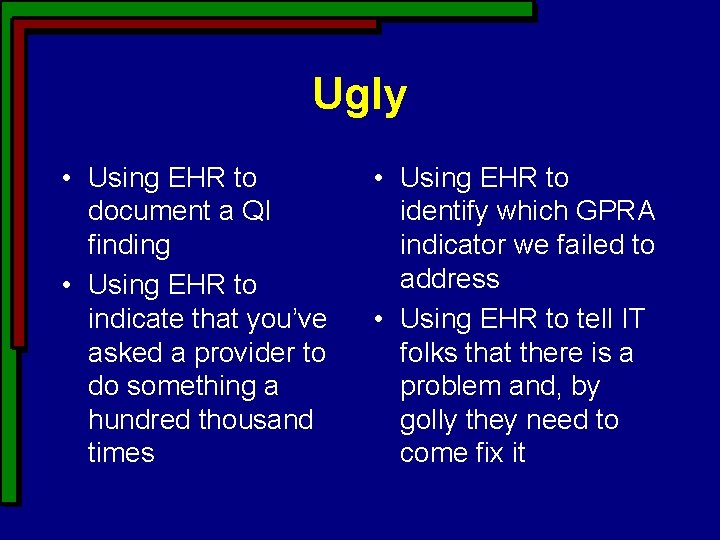
Ugly • Using EHR to document a QI finding • Using EHR to indicate that you’ve asked a provider to do something a hundred thousand times • Using EHR to identify which GPRA indicator we failed to address • Using EHR to tell IT folks that there is a problem and, by golly they need to come fix it
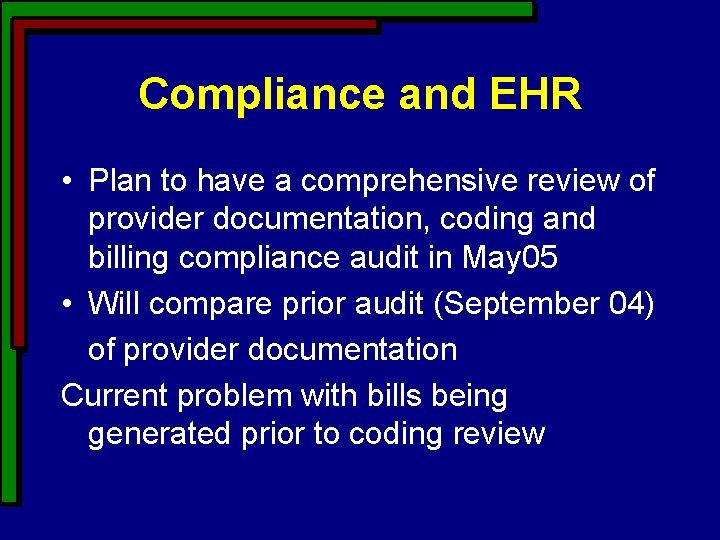
Compliance and EHR • Plan to have a comprehensive review of provider documentation, coding and billing compliance audit in May 05 • Will compare prior audit (September 04) of provider documentation Current problem with bills being generated prior to coding review
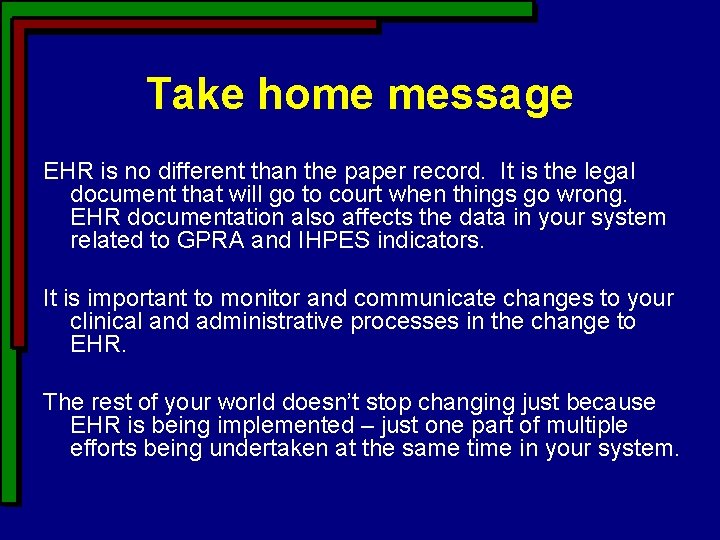
Take home message EHR is no different than the paper record. It is the legal document that will go to court when things go wrong. EHR documentation also affects the data in your system related to GPRA and IHPES indicators. It is important to monitor and communicate changes to your clinical and administrative processes in the change to EHR. The rest of your world doesn’t stop changing just because EHR is being implemented – just one part of multiple efforts being undertaken at the same time in your system.
Evaluations Log in to Survey. Monkey