Patterns Equations and Graphs Unit 1 Lesson 9
- Slides: 15
Patterns, Equations, and Graphs Unit 1 Lesson 9
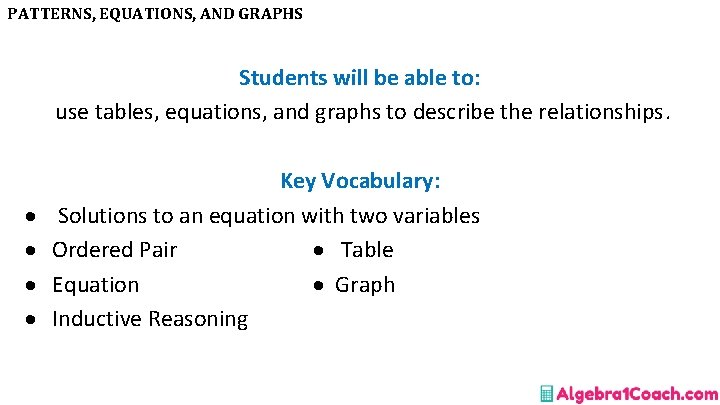
PATTERNS, EQUATIONS, AND GRAPHS Students will be able to: use tables, equations, and graphs to describe the relationships. Key Vocabulary: Solutions to an equation with two variables Ordered Pair Table Equation Graph Inductive Reasoning
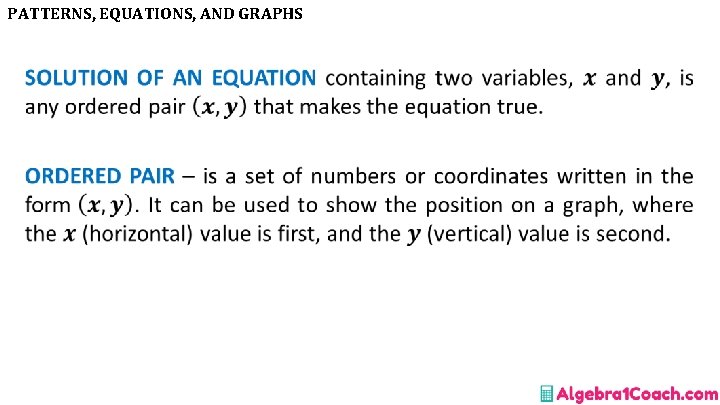
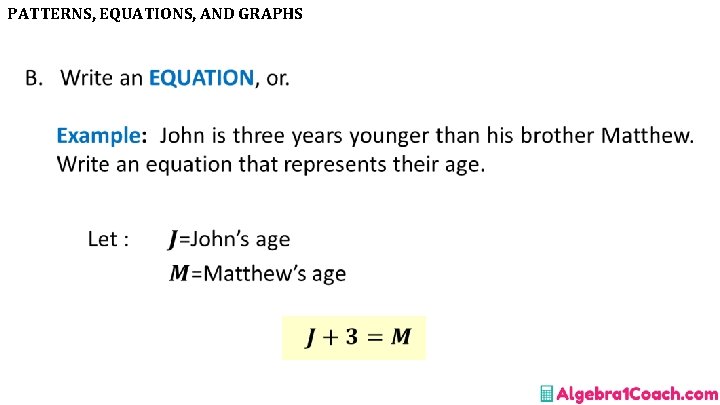
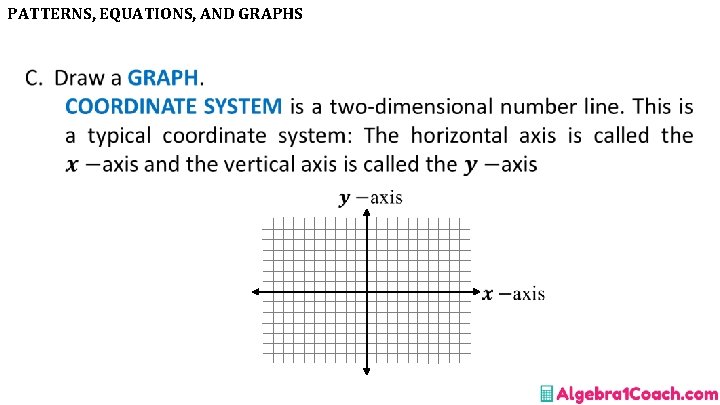
PATTERNS, EQUATIONS, AND GRAPHS •
PATTERNS, EQUATIONS, AND GRAPHS •
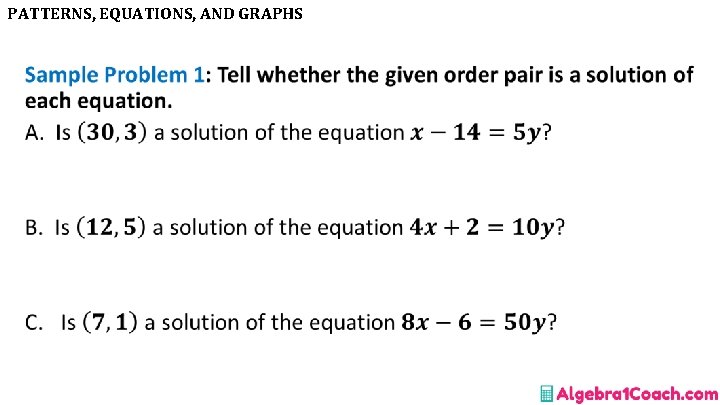
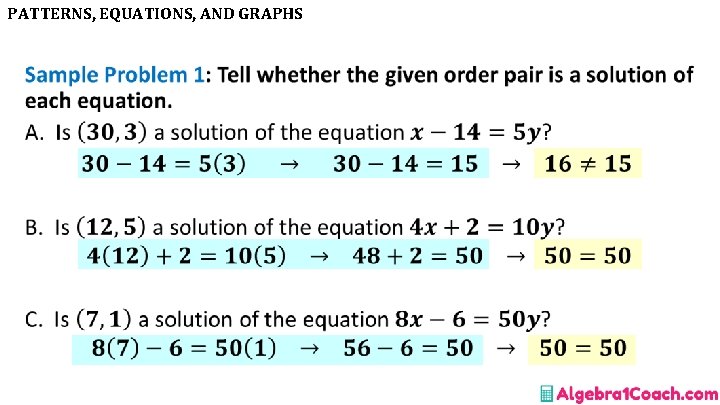
PATTERNS, EQUATIONS, AND GRAPHS •
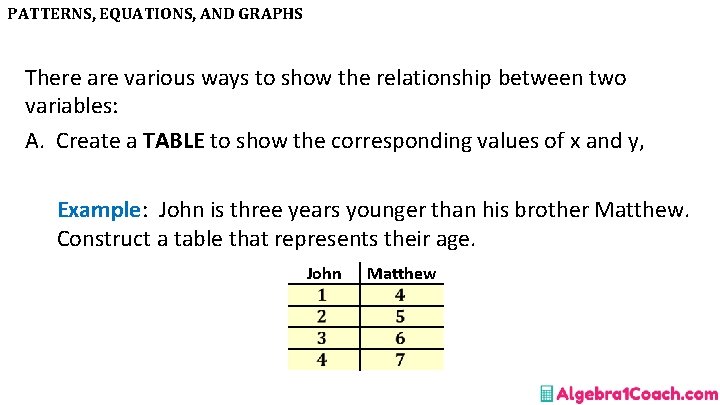
PATTERNS, EQUATIONS, AND GRAPHS There are various ways to show the relationship between two variables: A. Create a TABLE to show the corresponding values of x and y, Example: John is three years younger than his brother Matthew. Construct a table that represents their age. John Matthew
PATTERNS, EQUATIONS, AND GRAPHS •
PATTERNS, EQUATIONS, AND GRAPHS •
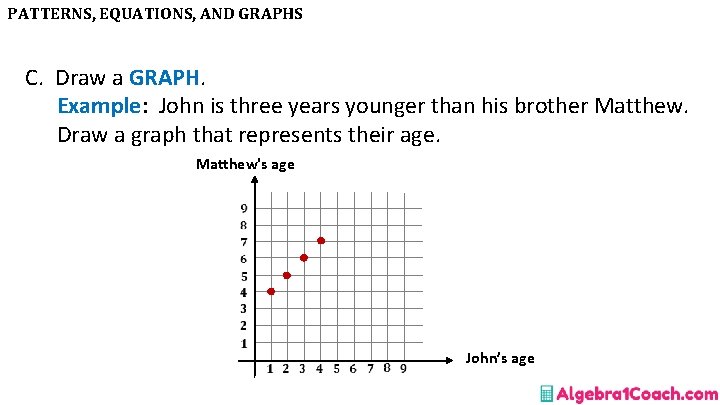
PATTERNS, EQUATIONS, AND GRAPHS C. Draw a GRAPH. Example: John is three years younger than his brother Matthew. Draw a graph that represents their age. Matthew's age John’s age
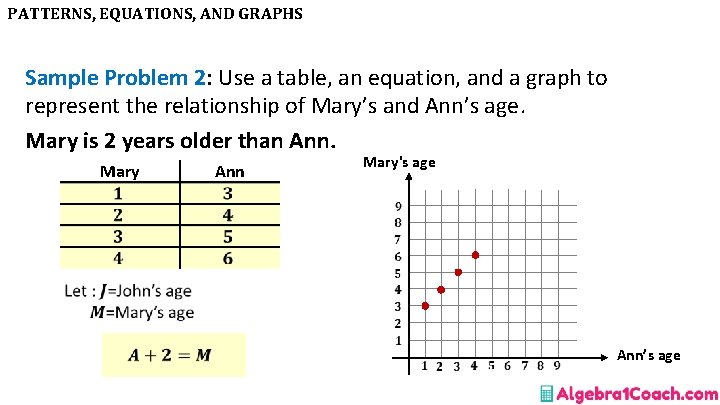
PATTERNS, EQUATIONS, AND GRAPHS Sample Problem 2: Use a table, an equation, and a graph to represent the relationship of Mary’s and Ann’s age. Mary is 2 years older than Ann.
PATTERNS, EQUATIONS, AND GRAPHS Sample Problem 2: Use a table, an equation, and a graph to represent the relationship of Mary’s and Ann’s age. Mary is 2 years older than Ann. Mary Ann Mary's age Ann’s age
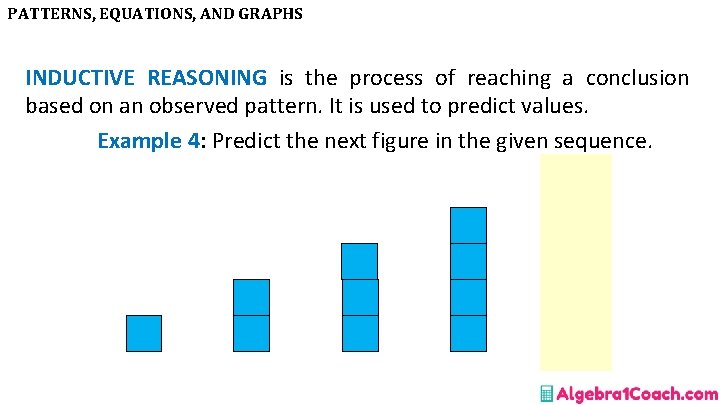
PATTERNS, EQUATIONS, AND GRAPHS INDUCTIVE REASONING is the process of reaching a conclusion based on an observed pattern. It is used to predict values. Example 4: Predict the next figure in the given sequence.
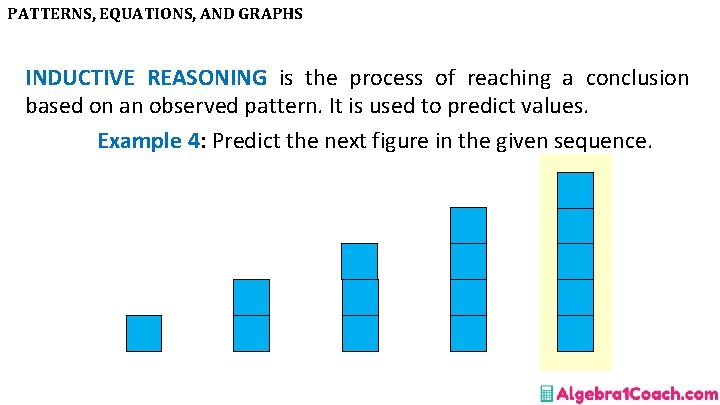
PATTERNS, EQUATIONS, AND GRAPHS INDUCTIVE REASONING is the process of reaching a conclusion based on an observed pattern. It is used to predict values. Example 4: Predict the next figure in the given sequence.
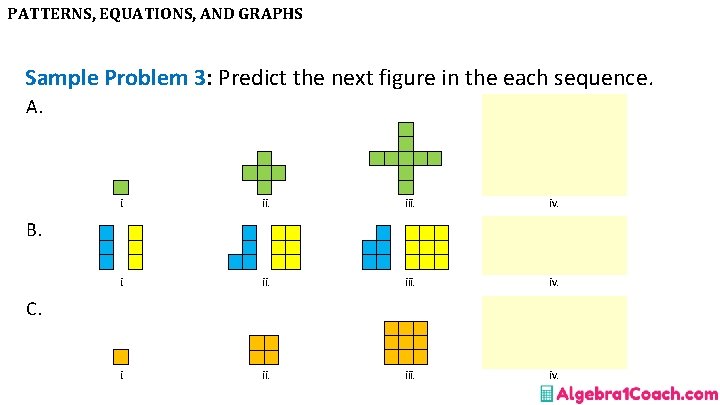
PATTERNS, EQUATIONS, AND GRAPHS Sample Problem 3: Predict the next figure in the each sequence. A. i. iii. iv. B. C.
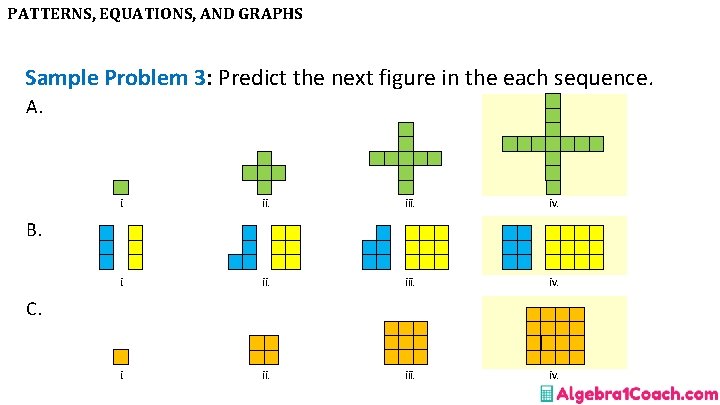
PATTERNS, EQUATIONS, AND GRAPHS Sample Problem 3: Predict the next figure in the each sequence. A. i. iii. iv. B. C.