PART 1 FUNDAMENTALS Chapter 1 5 Time and







- Slides: 57
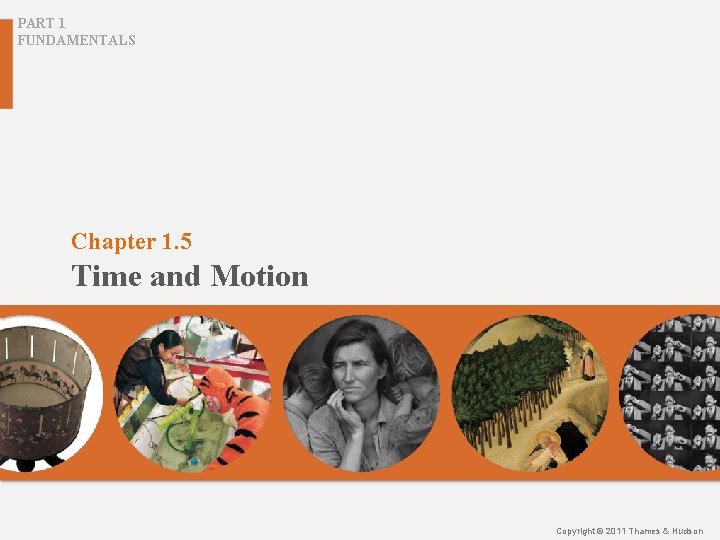
PART 1 FUNDAMENTALS Chapter 1. 5 Time and Motion Copyright © 2011 Thames & Hudson
Chapter 1. 5 Time and Motion PART 1 FUNDAMENTALS Introduction § Time and motion are closely linked elements in art § Most of the traditional art media are inherently motionless and timeless § Artists who work in static media have found imaginative ways to indicate the passage of time and the appearance of motion § New technology and media have evolved that allow artists to capture and express time and motion Gateways to Art: Understanding the Visual Arts, Debra J. De. Witte, Ralph M. Larmann, M. Kathryn Shields
Chapter 1. 5 Time and Motion PART 1 FUNDAMENTALS Time § Since events necessarily take place over time, any artwork that deals with events must show time goes by § Artists find ways to depict the passage of time and to remind us of its influence on our lives Gateways to Art: Understanding the Visual Arts, Debra J. De. Witte, Ralph M. Larmann, M. Kathryn Shields
Chapter 1. 5 Time and Motion PART 1 FUNDAMENTALS Interactive Exercises: Time Click to start the interactive exercises Gateways to Art: Understanding the Visual Arts, Debra J. De. Witte, Ralph M. Larmann, M. M. Kathryn Shields
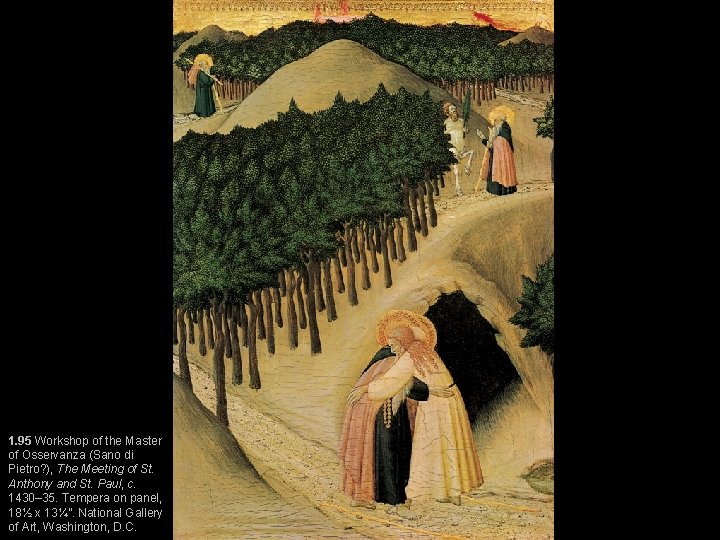
Chapter 1. 5 Time and Motion PART 1 FUNDAMENTALS The Passage of Time § Artists often seek to tell a story Gateways to Art: Understanding the Visual Arts, Debra J. De. Witte, Ralph M. Larmann, M. Kathryn Shields
1. 95 Workshop of the Master of Osservanza (Sano di Pietro? ), The Meeting of St. Anthony and St. Paul, c. 1430– 35. Tempera on panel, 18½ x 13¼”. National Gallery of Art, Washington, D. C.
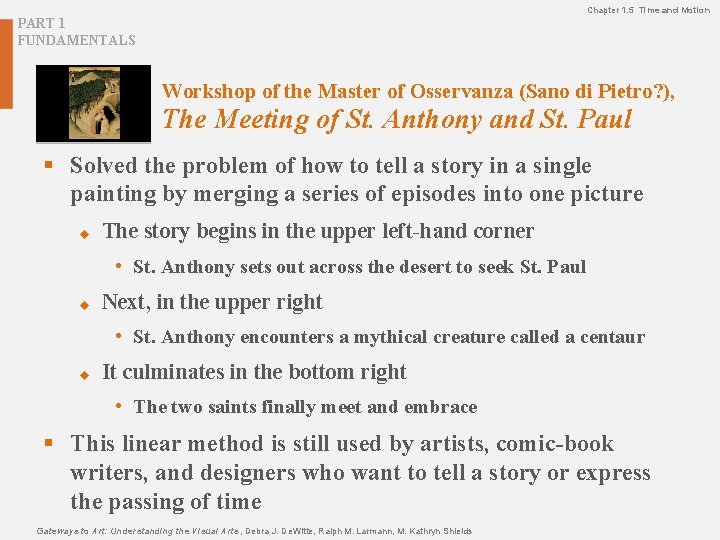
Chapter 1. 5 Time and Motion PART 1 FUNDAMENTALS Workshop of the Master of Osservanza (Sano di Pietro? ), The Meeting of St. Anthony and St. Paul § Solved the problem of how to tell a story in a single painting by merging a series of episodes into one picture u The story begins in the upper left-hand corner • St. Anthony sets out across the desert to seek St. Paul u Next, in the upper right • St. Anthony encounters a mythical creature called a centaur u It culminates in the bottom right • The two saints finally meet and embrace § This linear method is still used by artists, comic-book writers, and designers who want to tell a story or express the passing of time Gateways to Art: Understanding the Visual Arts, Debra J. De. Witte, Ralph M. Larmann, M. Kathryn Shields
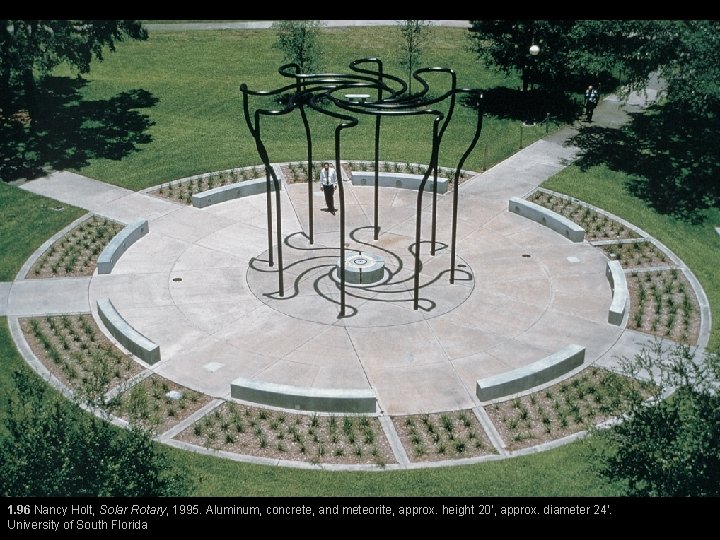
1. 96 Nancy Holt, Solar Rotary, 1995. Aluminum, concrete, and meteorite, approx. height 20’, approx. diameter 24’. University of South Florida
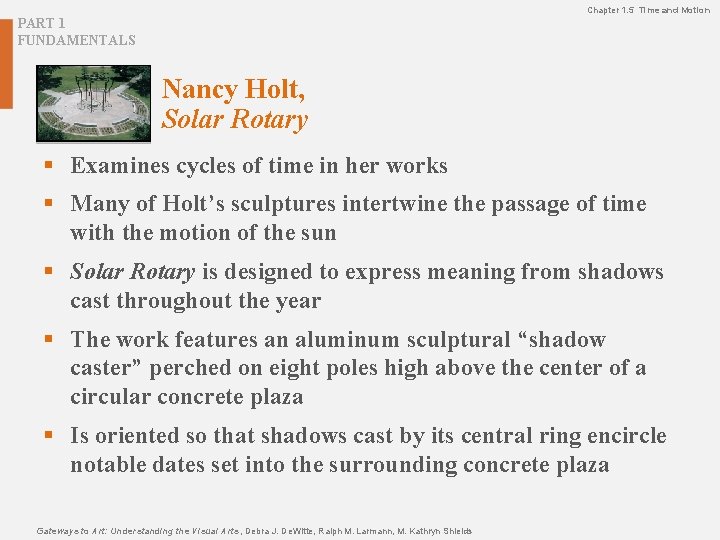
Chapter 1. 5 Time and Motion PART 1 FUNDAMENTALS Nancy Holt, Solar Rotary § Examines cycles of time in her works § Many of Holt’s sculptures intertwine the passage of time with the motion of the sun § Solar Rotary is designed to express meaning from shadows cast throughout the year § The work features an aluminum sculptural “shadow caster” perched on eight poles high above the center of a circular concrete plaza § Is oriented so that shadows cast by its central ring encircle notable dates set into the surrounding concrete plaza Gateways to Art: Understanding the Visual Arts, Debra J. De. Witte, Ralph M. Larmann, M. Kathryn Shields
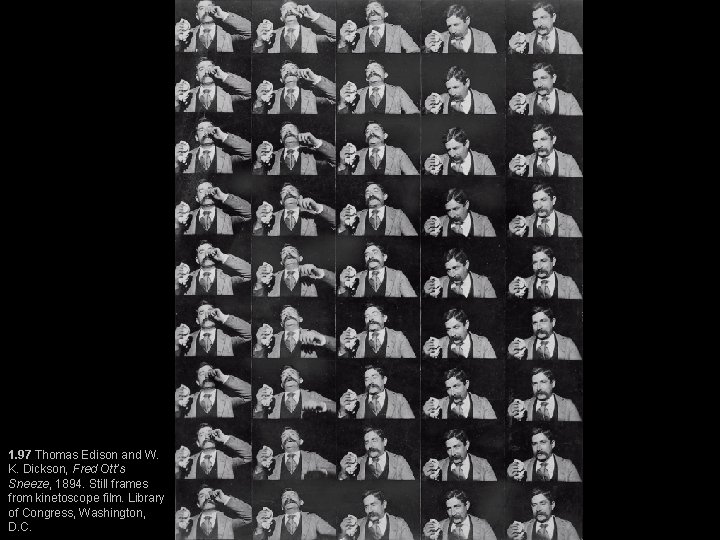
Chapter 1. 5 Time and Motion PART 1 FUNDAMENTALS The Attributes of Time § Time-based arts, such as film, embody six basic attributes of time: duration, tempo, intensity, scope, setting, and chronology Gateways to Art: Understanding the Visual Arts, Debra J. De. Witte, Ralph M. Larmann, M. Kathryn Shields
1. 97 Thomas Edison and W. K. Dickson, Fred Ott’s Sneeze, 1894. Still frames from kinetoscope film. Library of Congress, Washington, D. C.
Chapter 1. 5 Time and Motion PART 1 FUNDAMENTALS Thomas Edison and W. K. Dickson, Fred Ott’s Sneeze § The duration, or length, of this film is 5 seconds § The tempo, or speed, is 16 frames per second § The intensity is high because the activity is sudden and strong § Has a limited scope because it is confined to a simple activity § The setting is Thomas Edison’s studio § The chronology can be seen in the still frames Gateways to Art: Understanding the Visual Arts, Debra J. De. Witte, Ralph M. Larmann, M. Kathryn Shields
Chapter 1. 5 Time and Motion PART 1 FUNDAMENTALS Motion § Motion occurs when an object changes location or position § Because this process occurs as time passes, motion is directly linked to time § To communicate motion without actually making anything move, artists can choose to imply time or, alternatively, create the illusion of time Gateways to Art: Understanding the Visual Arts, Debra J. De. Witte, Ralph M. Larmann, M. Kathryn Shields
Chapter 1. 5 Time and Motion PART 1 FUNDAMENTALS Interactive Exercises: Motion Click to start the interactive exercises Gateways to Art: Understanding the Visual Arts, Debra J. De. Witte, Ralph M. Larmann, M. M. Kathryn Shields
Chapter 1. 5 Time and Motion PART 1 FUNDAMENTALS Implied Motion § Motion is implied when we do not actually see the motion happening, but visual clues tell us that it is a key aspect of the work Gateways to Art: Understanding the Visual Arts, Debra J. De. Witte, Ralph M. Larmann, M. Kathryn Shields
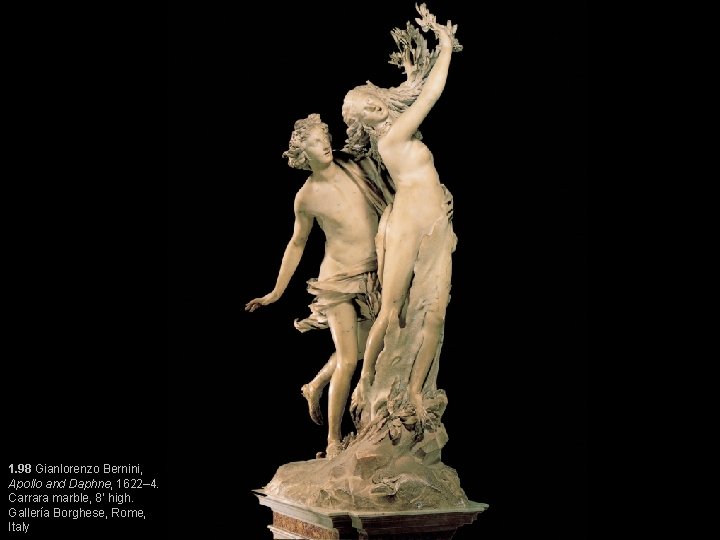
1. 98 Gianlorenzo Bernini, Apollo and Daphne, 1622– 4. Carrara marble, 8’ high. Gallería Borghese, Rome, Italy
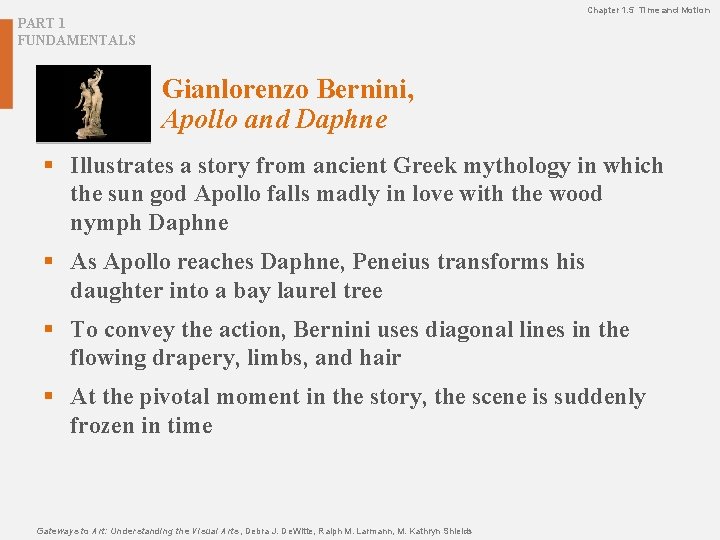
Chapter 1. 5 Time and Motion PART 1 FUNDAMENTALS Gianlorenzo Bernini, Apollo and Daphne § Illustrates a story from ancient Greek mythology in which the sun god Apollo falls madly in love with the wood nymph Daphne § As Apollo reaches Daphne, Peneius transforms his daughter into a bay laurel tree § To convey the action, Bernini uses diagonal lines in the flowing drapery, limbs, and hair § At the pivotal moment in the story, the scene is suddenly frozen in time Gateways to Art: Understanding the Visual Arts, Debra J. De. Witte, Ralph M. Larmann, M. Kathryn Shields
Chapter 1. 5 Time and Motion PART 1 FUNDAMENTALS Video: Gianlorenzo Bernini: The Ecstasy of St. Teresa Click to launch the video Gateways to Art: Understanding the Visual Arts, Debra J. De. Witte, Ralph M. Larmann, M. Kathryn Shields
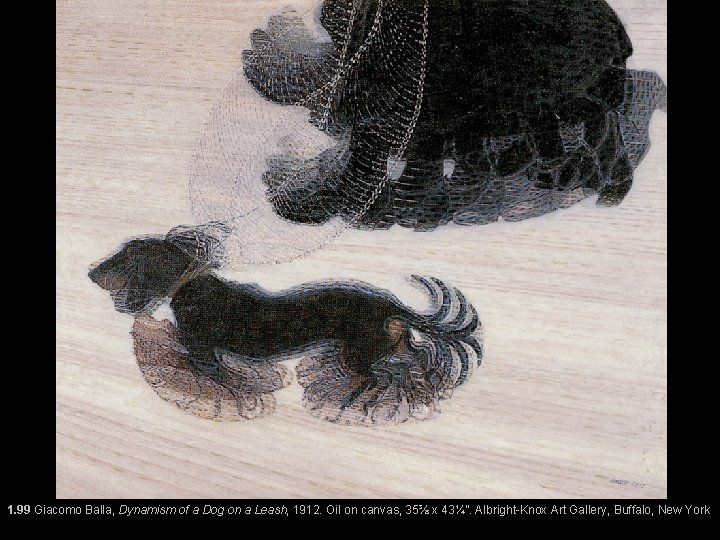
1. 99 Giacomo Balla, Dynamism of a Dog on a Leash, 1912. Oil on canvas, 35⅜ x 43¼”. Albright-Knox Art Gallery, Buffalo, New York
Chapter 1. 5 Time and Motion PART 1 FUNDAMENTALS Giacomo Balla, Dynamism of a Dog on a Leash § Balla paints a series of repeating marks to give the impression that we are seeing motion as it happens § He paints the dog’s tail in eight or nine different positions to communicate movement § The composition gives viewers a sense of ongoing forward motion even though the paint on the canvas is perfectly still Gateways to Art: Understanding the Visual Arts, Debra J. De. Witte, Ralph M. Larmann, M. Kathryn Shields
Chapter 1. 5 Time and Motion PART 1 FUNDAMENTALS Illusion of Motion § When artists imply motion, we do not actually see it occurring § Artists can also communicate the idea of motion by creating an illusion of it § Artists create this illusion through visual tricks that deceive our eyes into believing there is motion as time passes, even though no actual motion occurs Gateways to Art: Understanding the Visual Arts, Debra J. De. Witte, Ralph M. Larmann, M. Kathryn Shields
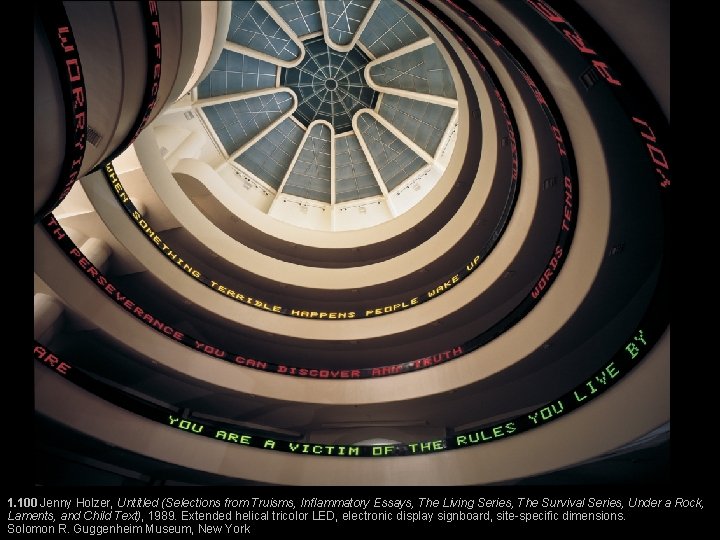
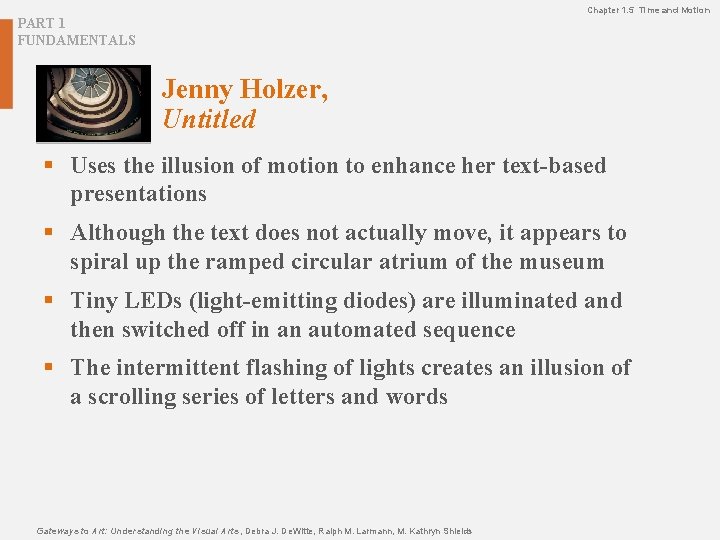
1. 100 Jenny Holzer, Untitled (Selections from Truisms, Inflammatory Essays, The Living Series, The Survival Series, Under a Rock, Laments, and Child Text), 1989. Extended helical tricolor LED, electronic display signboard, site-specific dimensions. Solomon R. Guggenheim Museum, New York
Chapter 1. 5 Time and Motion PART 1 FUNDAMENTALS Jenny Holzer, Untitled § Uses the illusion of motion to enhance her text-based presentations § Although the text does not actually move, it appears to spiral up the ramped circular atrium of the museum § Tiny LEDs (light-emitting diodes) are illuminated and then switched off in an automated sequence § The intermittent flashing of lights creates an illusion of a scrolling series of letters and words Gateways to Art: Understanding the Visual Arts, Debra J. De. Witte, Ralph M. Larmann, M. Kathryn Shields
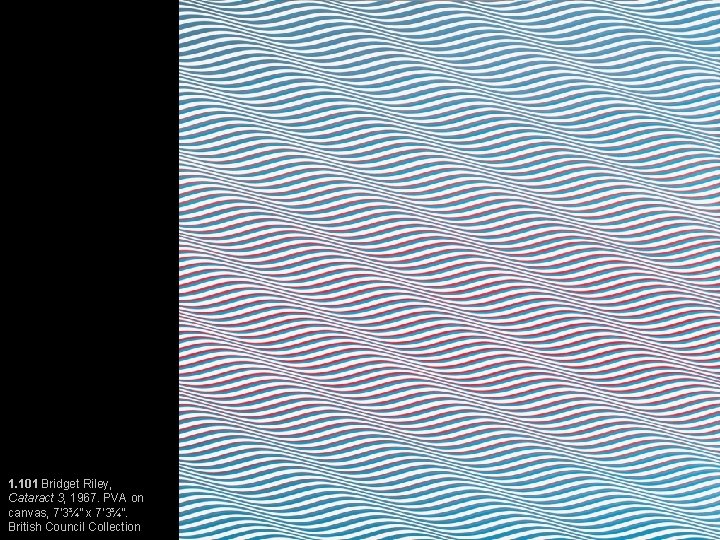
1. 101 Bridget Riley, Cataract 3, 1967. PVA on canvas, 7’ 3¾” x 7’ 3¾”. British Council Collection
Chapter 1. 5 Time and Motion PART 1 FUNDAMENTALS Bridget Riley, Cataract 3 § During the 1960 s, painters experimented with discordant positive–negative relationships § There is a noticeable sense of movement when we look at Cataract 3 § It appears there is an overall vibrating motion § Riley understands that the natural oscillation of the eye, combined with the passage of time, makes us feel a sense of motion Gateways to Art: Understanding the Visual Arts, Debra J. De. Witte, Ralph M. Larmann, M. Kathryn Shields
Chapter 1. 5 Time and Motion PART 1 FUNDAMENTALS Stroboscopic Motion § When we see two or more repeated images in quick succession, they tend visually to fuse together Gateways to Art: Understanding the Visual Arts, Debra J. De. Witte, Ralph M. Larmann, M. Kathryn Shields
Chapter 1. 5 Time and Motion PART 1 FUNDAMENTALS Interactive Exercises: Stroboscopic Motion Click to start the interactive exercises Gateways to Art: Understanding the Visual Arts, Debra J. De. Witte, Ralph M. Larmann, M. M. Kathryn Shields
Chapter 1. 5 Time and Motion PART 1 FUNDAMENTALS Video: Animation Click to launch the video Gateways to Art: Understanding the Visual Arts, Debra J. De. Witte, Ralph M. Larmann, M. Kathryn Shields
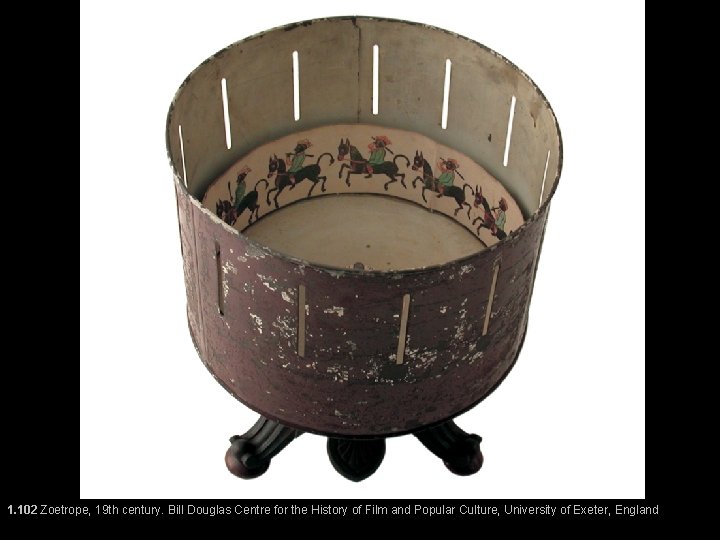
1. 102 Zoetrope, 19 th century. Bill Douglas Centre for the History of Film and Popular Culture, University of Exeter, England
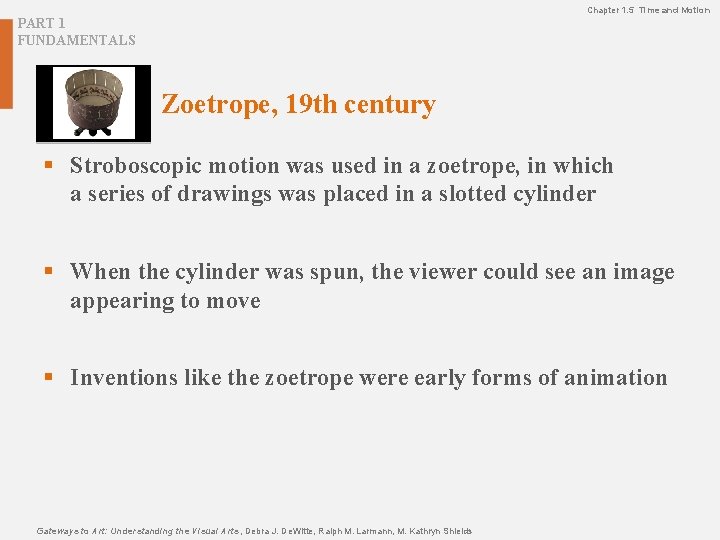
Chapter 1. 5 Time and Motion PART 1 FUNDAMENTALS Zoetrope, 19 th century § Stroboscopic motion was used in a zoetrope, in which a series of drawings was placed in a slotted cylinder § When the cylinder was spun, the viewer could see an image appearing to move § Inventions like the zoetrope were early forms of animation Gateways to Art: Understanding the Visual Arts, Debra J. De. Witte, Ralph M. Larmann, M. Kathryn Shields
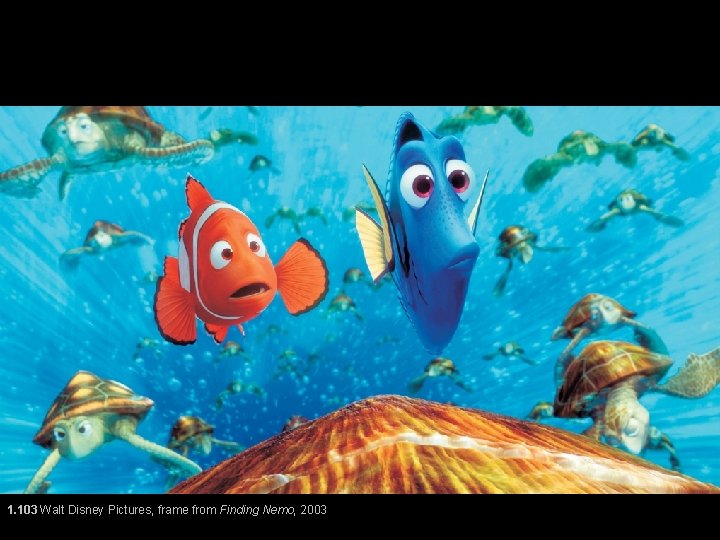
1. 103 Walt Disney Pictures, frame from Finding Nemo, 2003
Chapter 1. 5 Time and Motion PART 1 FUNDAMENTALS Walt Disney Pictures, frame from Finding Nemo § The movie is compiled from individual frames that were computer-generated using 3 -D modeling software § The animator can make changes to the images and then produce all the individual frames in a sequence that the computer plays in rapid succession § This succession of images is combined with other scenes and eventually committed to film or digital media Gateways to Art: Understanding the Visual Arts, Debra J. De. Witte, Ralph M. Larmann, M. Kathryn Shields
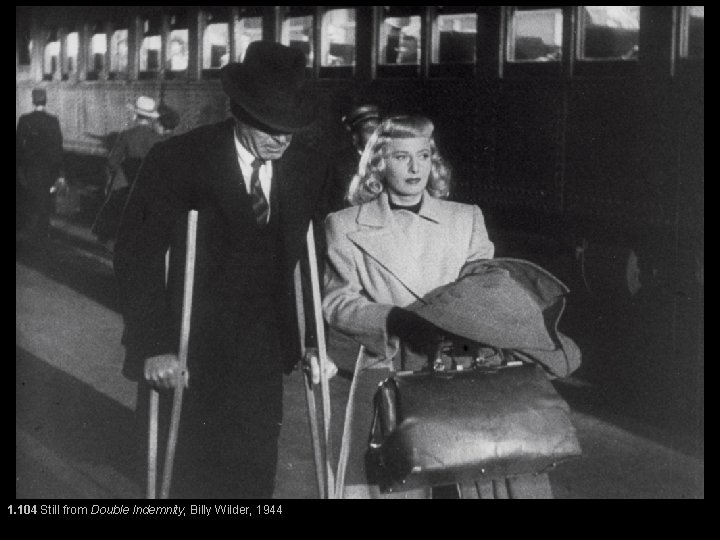
1. 104 Still from Double Indemnity, Billy Wilder, 1944
Chapter 1. 5 Time and Motion PART 1 FUNDAMENTALS Still from Billy Wilder, Double Indemnity § “Movie” is an abbreviation of “moving picture” § Double Indemnity was one of the first films that used sharply contrasting modeling, angled shadows, and lighting effects to create a sense of emptiness § The shadows create a sense of tension and foreboding by getting us to focus on each of the couple’s deliberate movements Gateways to Art: Understanding the Visual Arts, Debra J. De. Witte, Ralph M. Larmann, M. Kathryn Shields
Chapter 1. 5 Time and Motion PART 1 FUNDAMENTALS Actual Motion § We perceive actual motion when something really changes over time u Performance art is theatrical; the artist’s intention is not to create an art object, but an experience that can exist only in one place and time in history • Performance art emerged as a specific form of visual art during the twentieth century • Joseph Beuys incorporated everyday objects, such as animals, fat, machinery, and sticks into his Actions, a series of self-performed situations in which the artist would interact with these things in a defined space and time u Kinetic art plays out the passage of time through an art object, usually a sculpture, which moves Gateways to Art: Understanding the Visual Arts, Debra J. De. Witte, Ralph M. Larmann, M. Kathryn Shields
Chapter 1. 5 Time and Motion PART 1 FUNDAMENTALS Interactive Exercises: Actual Motion Click to start the interactive exercises Gateways to Art: Understanding the Visual Arts, Debra J. De. Witte, Ralph M. Larmann, M. M. Kathryn Shields
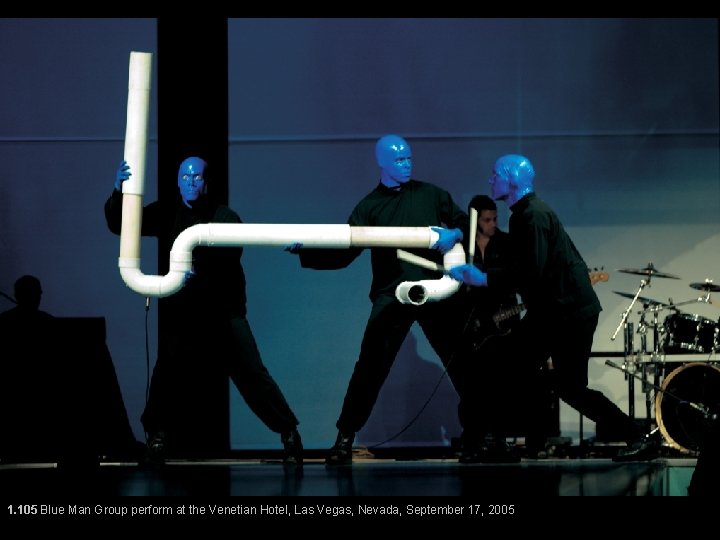
1. 105 Blue Man Group perform at the Venetian Hotel, Las Vegas, Nevada, September 17, 2005
Chapter 1. 5 Time and Motion PART 1 FUNDAMENTALS Blue Man Group § From the 1980 s the Blue Man Group performed in ways that integrated humor and music for passersby on the streets of New York § They used sound and mime, relying on bodily movements to communicate ideas without speech Gateways to Art: Understanding the Visual Arts, Debra J. De. Witte, Ralph M. Larmann, M. Kathryn Shields
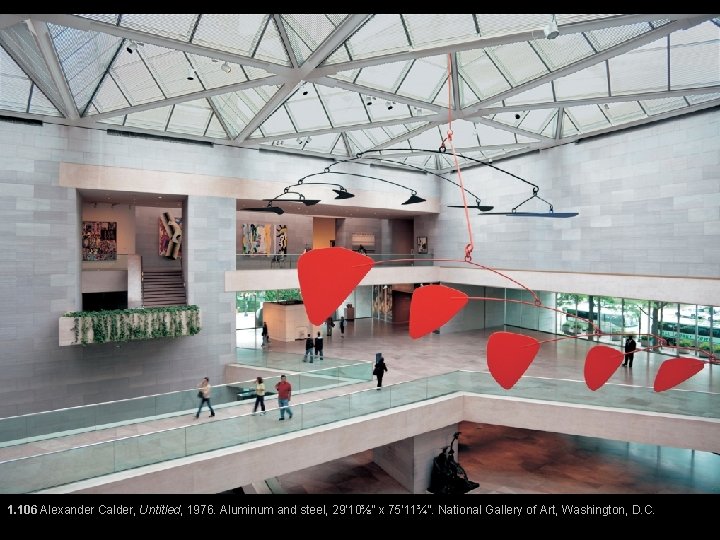
1. 106 Alexander Calder, Untitled, 1976. Aluminum and steel, 29’ 10⅜” x 75’ 11¾”. National Gallery of Art, Washington, D. C.
Chapter 1. 5 Time and Motion PART 1 FUNDAMENTALS Alexander Calder, Untitled § Kinetic sculpture has evolved during the twentieth century and is a notable example of art that moves § Alexander Calder invented the mobile § The mobile relies on air currents to power its movement § Untitled uses a small motor, powering counterbalanced abstract elements that move independently of each other § The result is a constantly changing visual form Gateways to Art: Understanding the Visual Arts, Debra J. De. Witte, Ralph M. Larmann, M. Kathryn Shields
Chapter 1. 5 Time and Motion PART 1 FUNDAMENTALS Time and Motion in Photography § The work of a photographer is deeply concerned with motion and time § Photographers move around their subject, choosing the right focus for the shot and putting the camera in the best position to capture the image they seek § A photograph freezes a moment in time Gateways to Art: Understanding the Visual Arts, Debra J. De. Witte, Ralph M. Larmann, M. Kathryn Shields
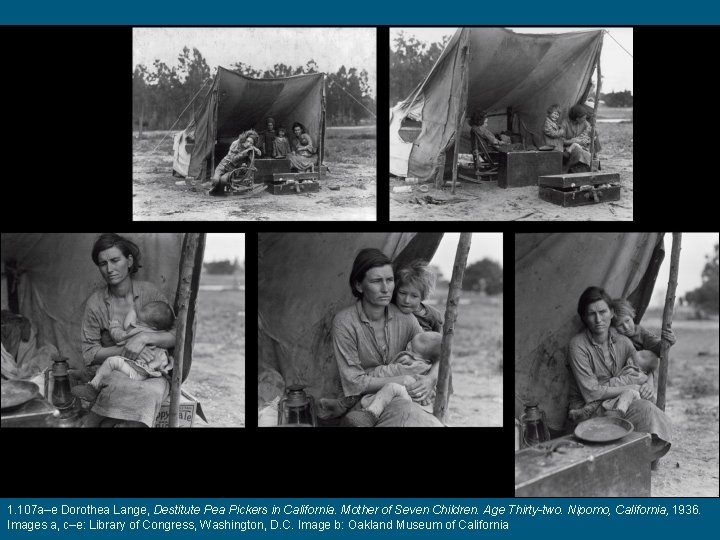
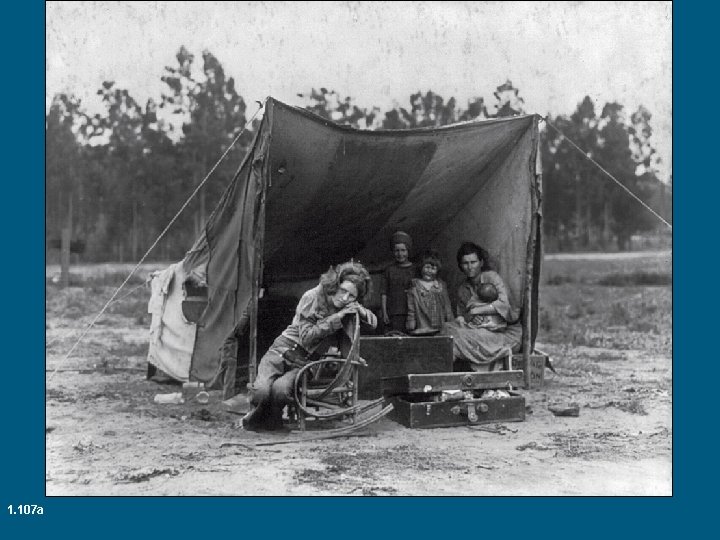
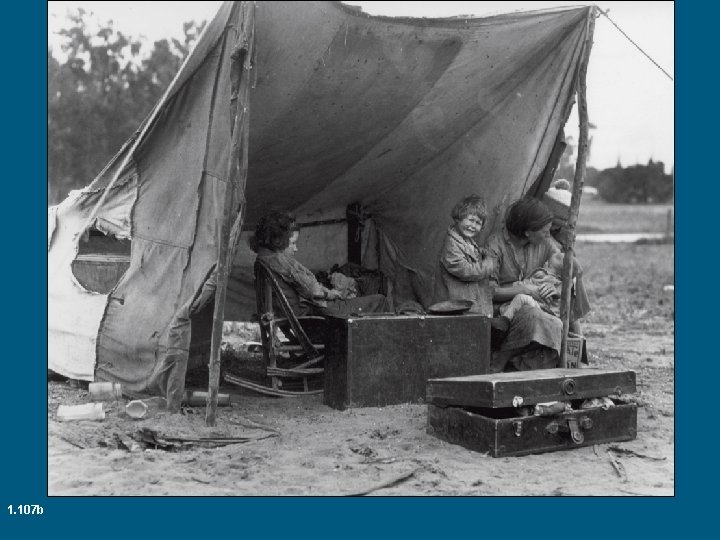
1. 107 a–e Dorothea Lange, Destitute Pea Pickers in California. Mother of Seven Children. Age Thirty-two. Nipomo, California, 1936. Images a, c–e: Library of Congress, Washington, D. C. Image b: Oakland Museum of California
1. 107 a
1. 107 b
1. 107 c
1. 107 d
1. 107 e
1. 107 f Dorothea Lange, Migrant Mother, 1936. Library of Congress, Washington, D. C.
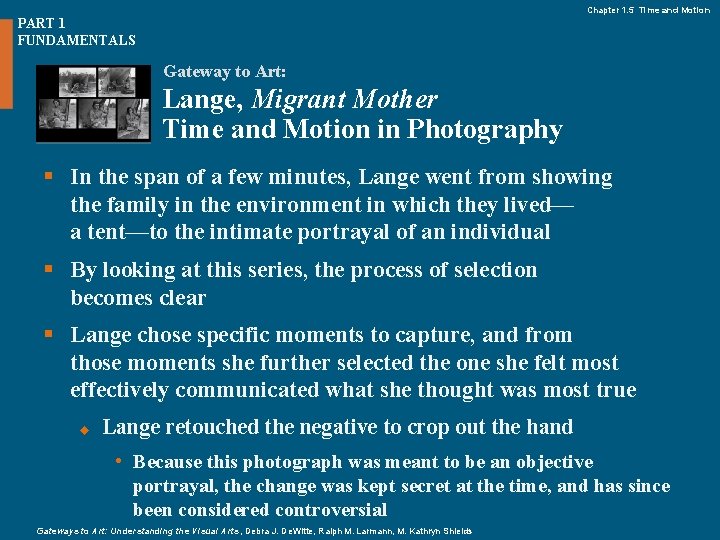
Chapter 1. 5 Time and Motion PART 1 FUNDAMENTALS Gateway to Art: Lange, Migrant Mother Time and Motion in Photography § In the span of a few minutes, Lange went from showing the family in the environment in which they lived— a tent—to the intimate portrayal of an individual § By looking at this series, the process of selection becomes clear § Lange chose specific moments to capture, and from those moments she further selected the one she felt most effectively communicated what she thought was most true u Lange retouched the negative to crop out the hand • Because this photograph was meant to be an objective portrayal, the change was kept secret at the time, and has since been considered controversial Gateways to Art: Understanding the Visual Arts, Debra J. De. Witte, Ralph M. Larmann, M. Kathryn Shields
Chapter 1. 5 Time and Motion PART 1 FUNDAMENTALS Natural Processes and the Passage of Time § Some artists use biology and organic materials to create their artwork § Organic materials grow and degrade with the passage of time, so work by “bioartists” is always changing Gateways to Art: Understanding the Visual Arts, Debra J. De. Witte, Ralph M. Larmann, M. Kathryn Shields
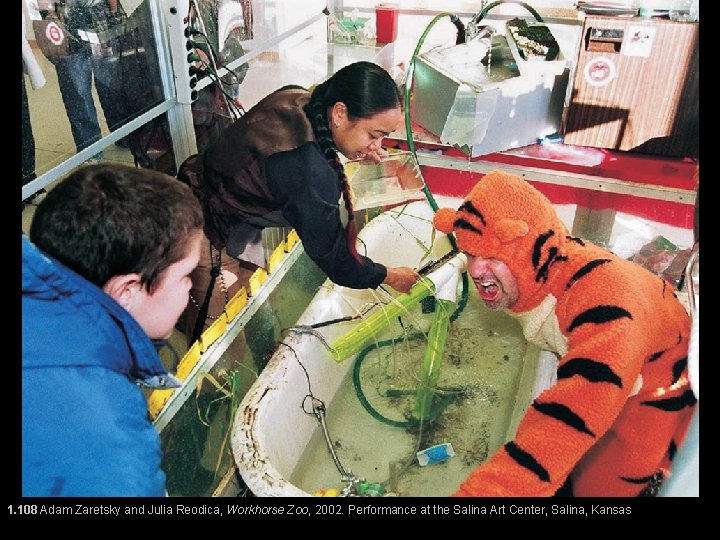
1. 108 Adam Zaretsky and Julia Reodica, Workhorse Zoo, 2002. Performance at the Salina Art Center, Salina, Kansas
Chapter 1. 5 Time and Motion PART 1 FUNDAMENTALS Adam Zaretsky and Julia Reodica, Workhorse Zoo § Have “grown” and performed works that include living things § The artists’ intention was to draw attention to the pros and cons of animal research Gateways to Art: Understanding the Visual Arts, Debra J. De. Witte, Ralph M. Larmann, M. Kathryn Shields
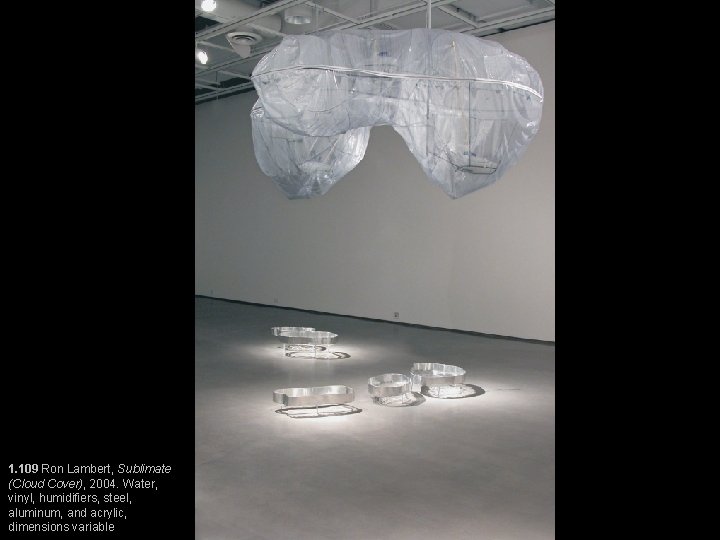
1. 109 Ron Lambert, Sublimate (Cloud Cover), 2004. Water, vinyl, humidifiers, steel, aluminum, and acrylic, dimensions variable
Chapter 1. 5 Time and Motion PART 1 FUNDAMENTALS Ron Lambert, Sublimate (Cloud Cover) § He created a large transparent plastic environment in which water endlessly evaporates and condenses § Shows how the rhythms of nature become a measure of natural time Gateways to Art: Understanding the Visual Arts, Debra J. De. Witte, Ralph M. Larmann, M. Kathryn Shields
Chapter 1. 5 Time and Motion PART 1 FUNDAMENTALS Conclusion § Artists have been able to incorporate the passage of time and movement into their works using a variety of modern media § Through film and video, we can appreciate the motion of life and have come to experience time in new ways § Television, movies, the Internet, and a multitude of other technologies use movement as an important visual element Gateways to Art: Understanding the Visual Arts, Debra J. De. Witte, Ralph M. Larmann, M. Kathryn Shields
Chapter 1. 5 Time and Motion PART 1 FUNDAMENTALS This concludes the Power. Point slide set for Chapter 1. 5 Gateways to Art: Understanding the Visual Arts By Debra J. De. Witte, Ralph M. Larmann, M. Kathryn Shields Copyright © 2011 Thames & Hudson Power. Points developed by Creative. Myndz Multimedia Studios
Chapter 1. 5 Time and Motion PART 1 FUNDAMENTALS Picture Credits for Chapter 1. 5 1. 96 1. 97 1. 98 1. 99 National Gallery of Art, Washington, D. C. , Samuel H. Kress Collection, 1939. 1. 293 Photo University of South Florida. © Nancy Holt/DACS, London/VAGA, New York 2011 Library of Congress, Washington, D. C. Prints & Photographs Division, LC-USZ 62 -536 Galleria Borghese, Rome Albright-Knox Art Gallery, Buffalo, New York, Bequest of A. Conger Goodyear and Gift of George F. Goodyear, 1964. © DACS 2011 1. 100 Solomon R. Guggenheim Museum, New York, Partial gift of the artist, 1989, 89. 3626. Photo David Heald © Solomon R. Guggenheim Foundation, New York. © ARS, NY and DACS, London 2011 1. 101 Copyright Bridget Riley, 2011. All rights reserved 1. 102 Courtesy the Bill Douglas Centre for the History of Cinema and Popular Culture, University of Exeter 1. 103 Disney Enterprises/Album/akg-images 1. 104 Double Indemnity, © Paramount Pictures 1. 105 © Blaine Harrington III/Alamy 1. 106 Photo © B. O’Kane/Alamy. © 2011 Calder Foundation, New York/DACS, London 1. 107 a Library of Congress, Washington, D. C. Prints & Photographs Division, � FSA/OWI Collection, LC-USZ 62 -58355 1. 107 b © The Dorothea Lange Collection, Oakland Museum of California, City of Oakland. Gift of Paul S. Taylor 1. 107 c Library of Congress, Washington, D. C. Prints & Photographs Division, FSA/OWI Collection, LC-USF 34 -9097 -C 1. 107 d Library of Congress, Washington, D. C. Prints & Photographs Division, FSA/OWI Collection, LC-USF 34 -9093 -C 1. 107 e Library of Congress, Washington, D. C. Prints & Photographs Division, FSA/OWI Collection, LC-USF 34 -9095 1. 107 f Library of Congress, Washington, D. C. Prints & Photographs Division, FSA/OWI Collection, LC-DIG-fsa-8 b 29516 1. 108 Courtesy the artists 1. 109 © the artist. Courtesy Catherine Person Gallery, Seattle, WA Power. Points developed by Creative. Myndz Multimedia Studios