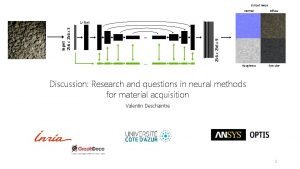
Output maps Normal Diffuse Roughness Specular 256 x

- Slides: 10
Output maps Normal Diffuse Roughness Specular . . . 256 x 9 Input 256 x 3 U-Net Discussion: Research and questions in neural methods for material acquisition Valentin Deschaintre 1
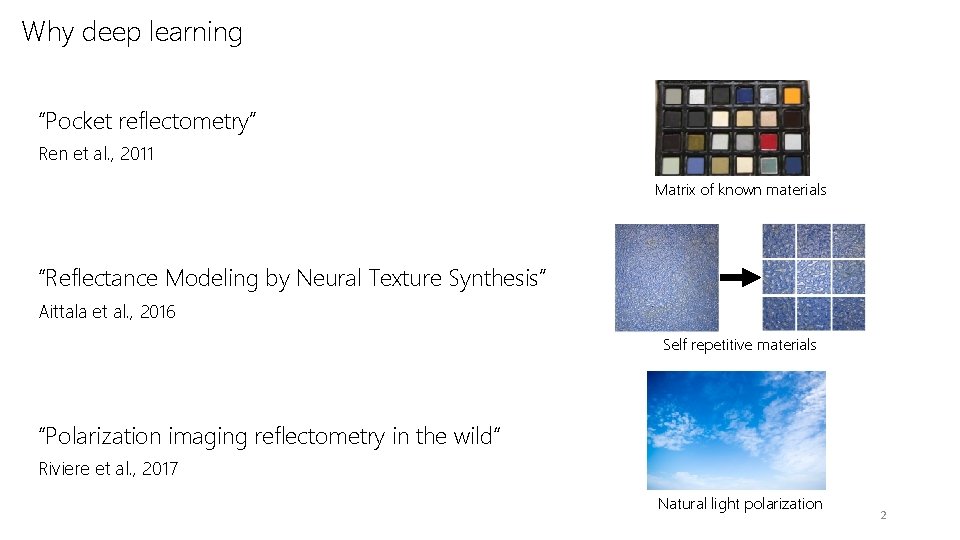
Why deep learning “Pocket reflectometry” Ren et al. , 2011 Matrix of known materials “Reflectance Modeling by Neural Texture Synthesis” Aittala et al. , 2016 Self repetitive materials “Polarization imaging reflectometry in the wild“ Riviere et al. , 2017 Natural light polarization 2
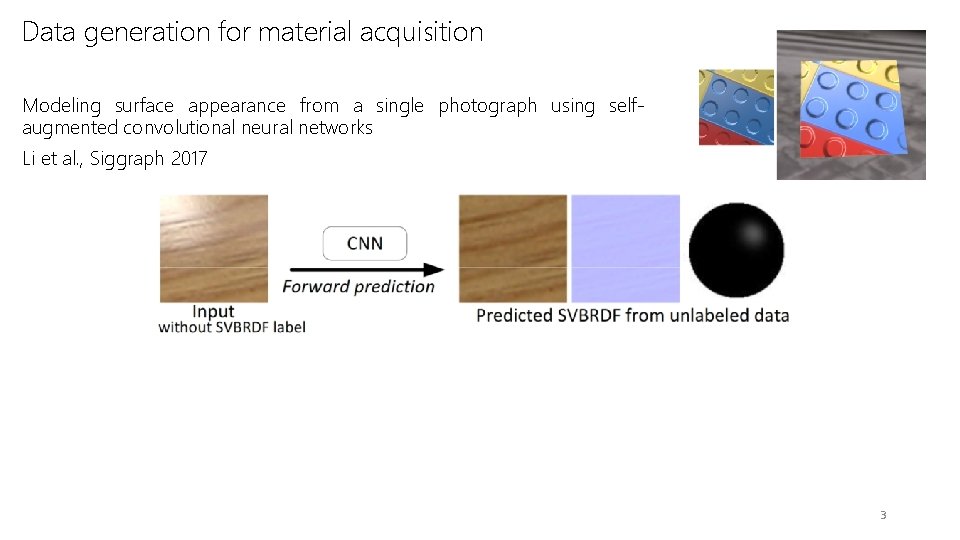
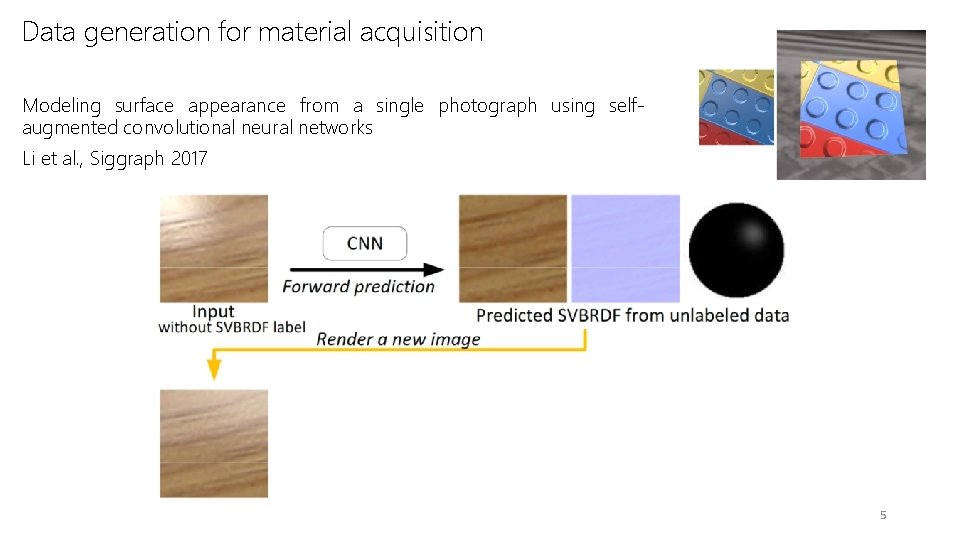
Data generation for material acquisition Modeling surface appearance from a single photograph using selfaugmented convolutional neural networks Li et al. , Siggraph 2017 3
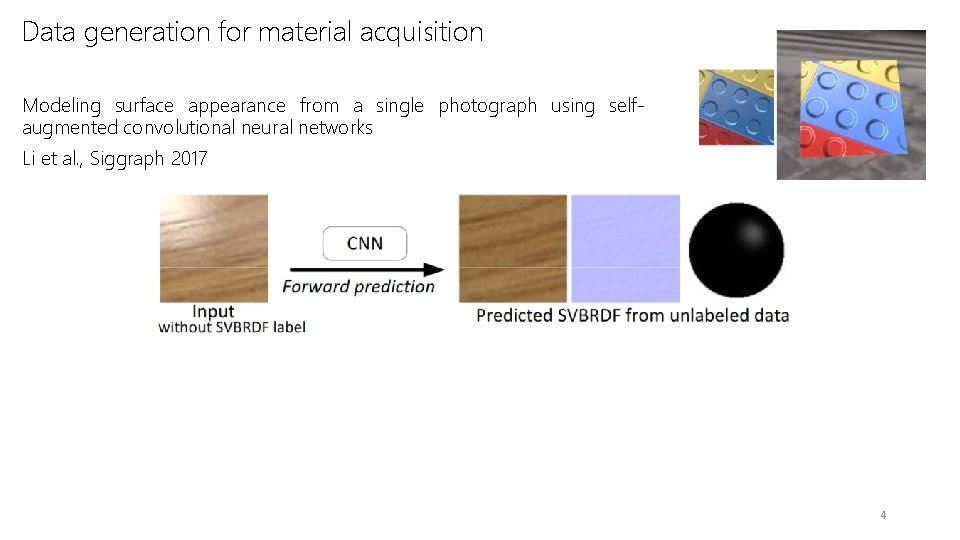
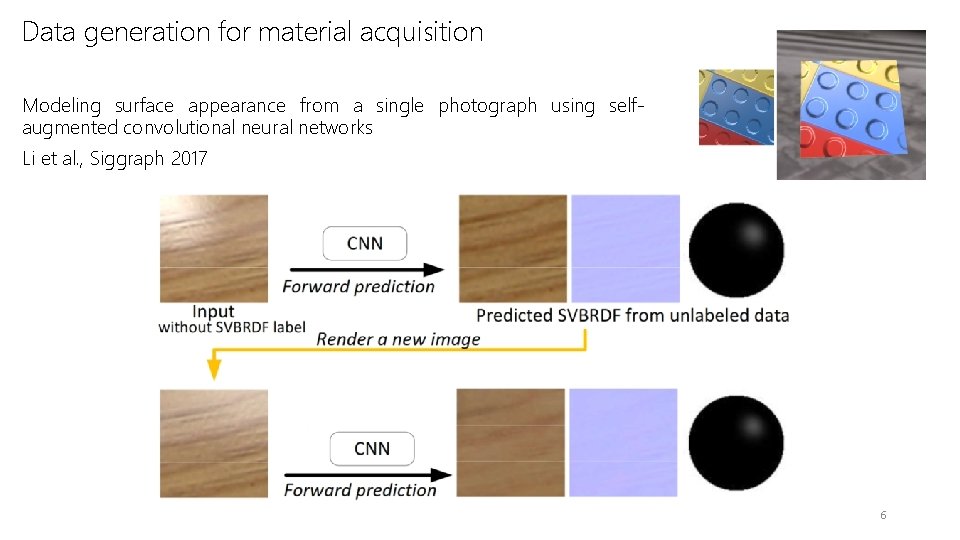
Data generation for material acquisition Modeling surface appearance from a single photograph using selfaugmented convolutional neural networks Li et al. , Siggraph 2017 4
Data generation for material acquisition Modeling surface appearance from a single photograph using selfaugmented convolutional neural networks Li et al. , Siggraph 2017 5
Data generation for material acquisition Modeling surface appearance from a single photograph using selfaugmented convolutional neural networks Li et al. , Siggraph 2017 6
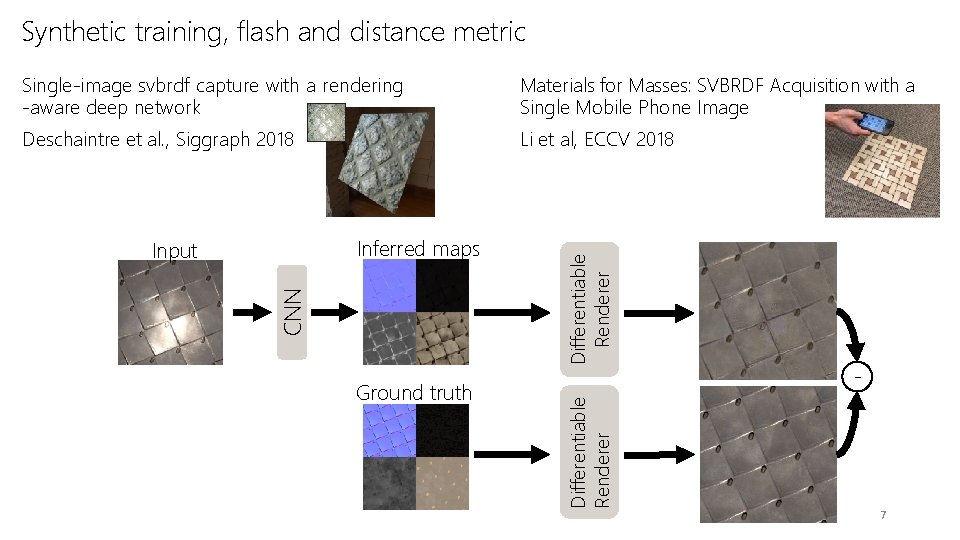
Synthetic training, flash and distance metric Materials for Masses: SVBRDF Acquisition with a Single Mobile Phone Image Deschaintre et al. , Siggraph 2018 Li et al, ECCV 2018 CNN Ground truth Differentiable Renderer Inferred maps Input Differentiable Renderer Single-image svbrdf capture with a rendering -aware deep network - 7
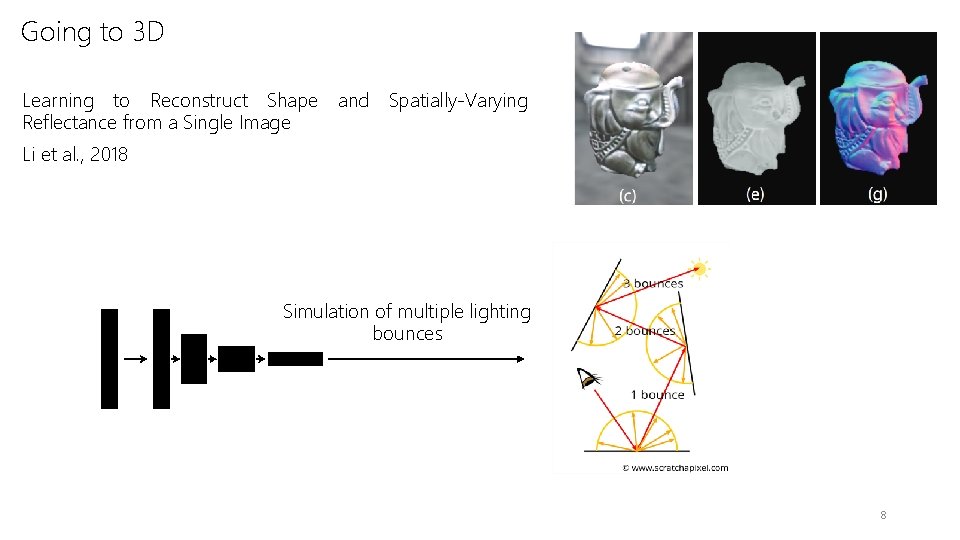
Going to 3 D Learning to Reconstruct Shape and Spatially-Varying Reflectance from a Single Image Li et al. , 2018 Simulation of multiple lighting bounces 8
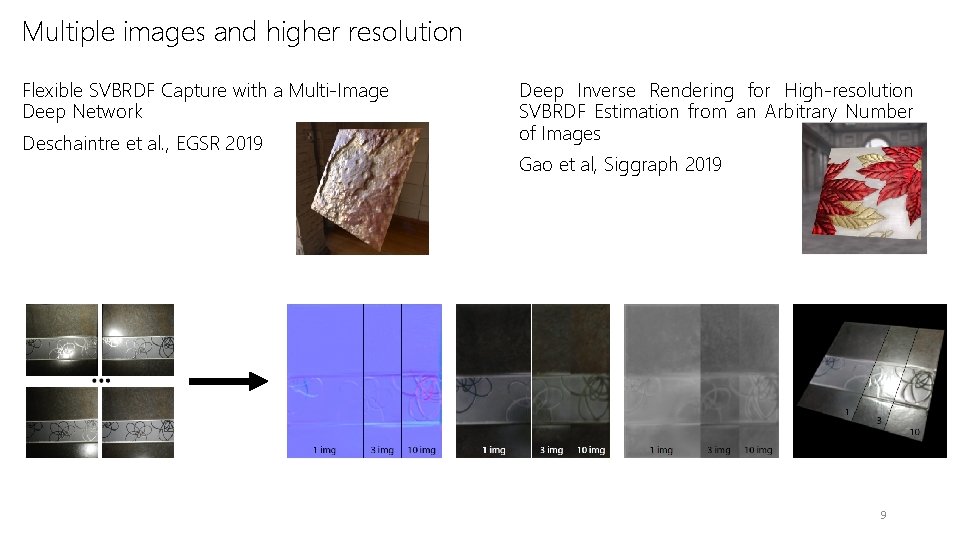
Multiple images and higher resolution Flexible SVBRDF Capture with a Multi-Image Deep Network Deschaintre et al. , EGSR 2019 Deep Inverse Rendering for High-resolution SVBRDF Estimation from an Arbitrary Number of Images Gao et al, Siggraph 2019 9
Summary and future work What we have: What’s next? • Neural material acquisition • Meaningful metric (Lagunas et al. 19, Gao et al. 19) • Rendering loss • Differentiable rendering (Azinović et al. 19) • 3 D objects • Scale (Mazlov et al. 19) • Multiple image aggregation • Real data (Merzbach et al. 19) • Uncalibrated results What do you think ? 10