Origins of the 1001 Nights The Nights had



- Slides: 27
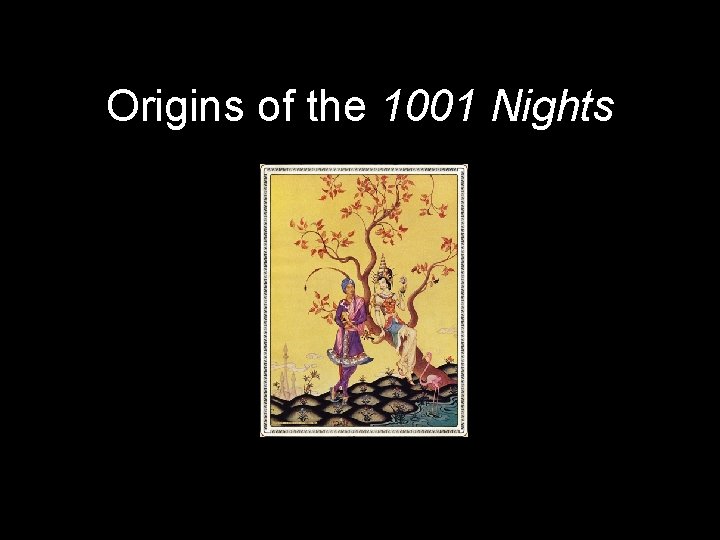
Origins of the 1001 Nights
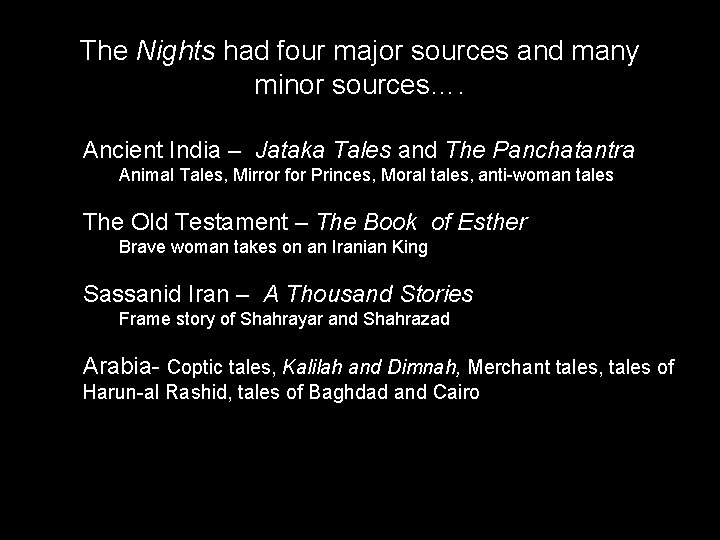
The Nights had four major sources and many minor sources…. Ancient India – Jataka Tales and The Panchatantra Animal Tales, Mirror for Princes, Moral tales, anti-woman tales The Old Testament – The Book of Esther Brave woman takes on an Iranian King Sassanid Iran – A Thousand Stories Frame story of Shahrayar and Shahrazad Arabia- Coptic tales, Kalilah and Dimnah, Merchant tales, tales of Harun-al Rashid, tales of Baghdad and Cairo
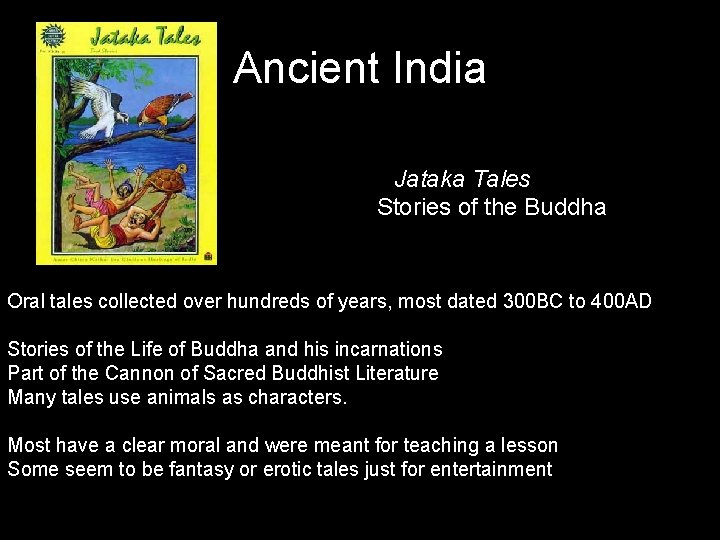
Ancient India Jataka Tales Stories of the Buddha Oral tales collected over hundreds of years, most dated 300 BC to 400 AD Stories of the Life of Buddha and his incarnations Part of the Cannon of Sacred Buddhist Literature Many tales use animals as characters. Most have a clear moral and were meant for teaching a lesson Some seem to be fantasy or erotic tales just for entertainment
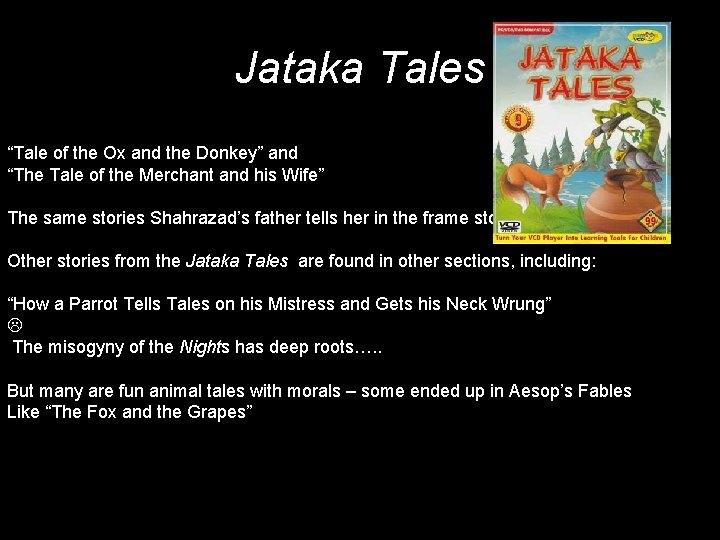
Jataka Tales “Tale of the Ox and the Donkey” and “The Tale of the Merchant and his Wife” The same stories Shahrazad’s father tells her in the frame story! Other stories from the Jataka Tales are found in other sections, including: “How a Parrot Tells Tales on his Mistress and Gets his Neck Wrung” The misogyny of the Nights has deep roots…. . But many are fun animal tales with morals – some ended up in Aesop’s Fables Like “The Fox and the Grapes”
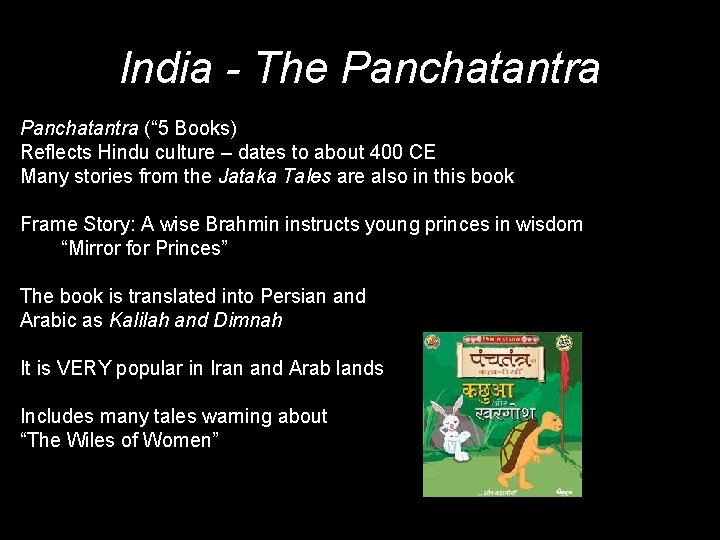
India - The Panchatantra (“ 5 Books) Reflects Hindu culture – dates to about 400 CE Many stories from the Jataka Tales are also in this book Frame Story: A wise Brahmin instructs young princes in wisdom “Mirror for Princes” The book is translated into Persian and Arabic as Kalilah and Dimnah It is VERY popular in Iran and Arab lands Includes many tales warning about “The Wiles of Women”
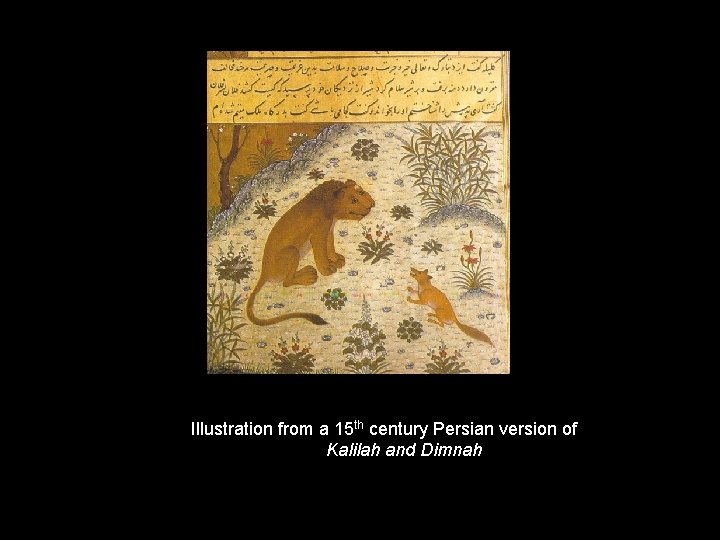
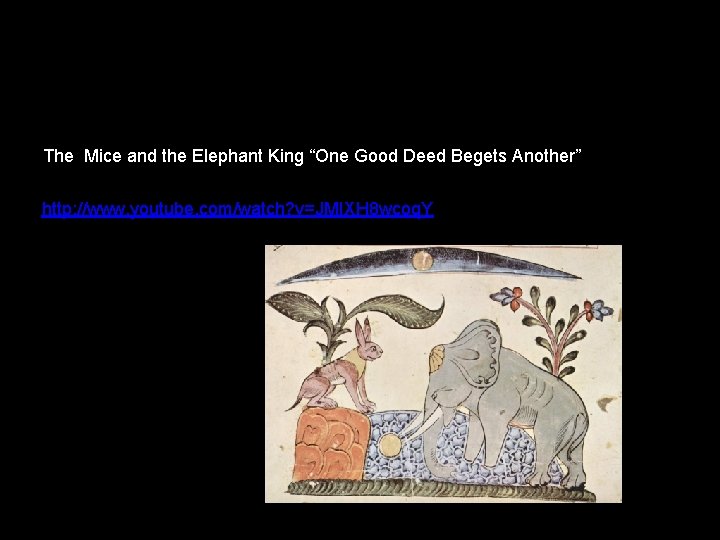
Illustration from a 15 th century Persian version of Kalilah and Dimnah
The Mice and the Elephant King “One Good Deed Begets Another” http: //www. youtube. com/watch? v=JMIXH 8 wcoq. Y
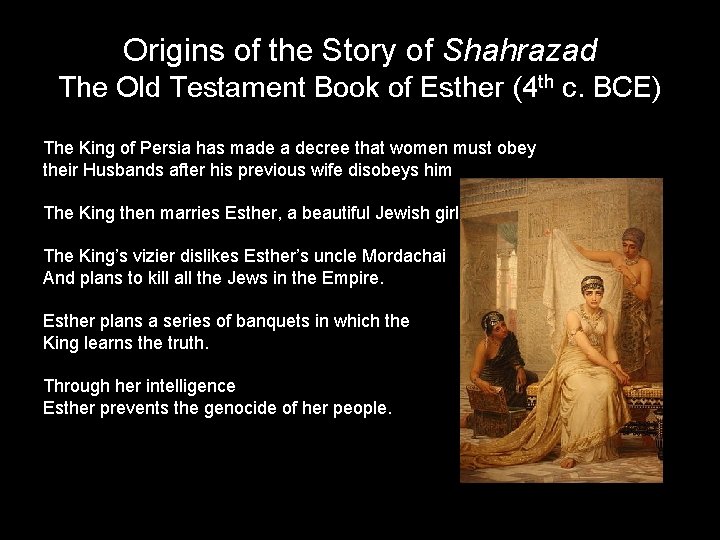
Origins of the Story of Shahrazad The Old Testament Book of Esther (4 th c. BCE) The King of Persia has made a decree that women must obey their Husbands after his previous wife disobeys him The King then marries Esther, a beautiful Jewish girl. The King’s vizier dislikes Esther’s uncle Mordachai And plans to kill all the Jews in the Empire. Esther plans a series of banquets in which the King learns the truth. Through her intelligence Esther prevents the genocide of her people.
Hazar Afsaneh – A Thousand Stories Sassanian Persia (Iran) Hazar Afsaneh was a book from Sassanid Persian, probably 5 th-century CE It starts with the following frame story: One of the Kings used to marry a woman and Kill her the next day. Then he married a noble Woman of great intelligence called Shahrazad. When she came to him she would begin a story, But leave off at the end of the night. This Went on for a thousand nights, after which The King granted her life.
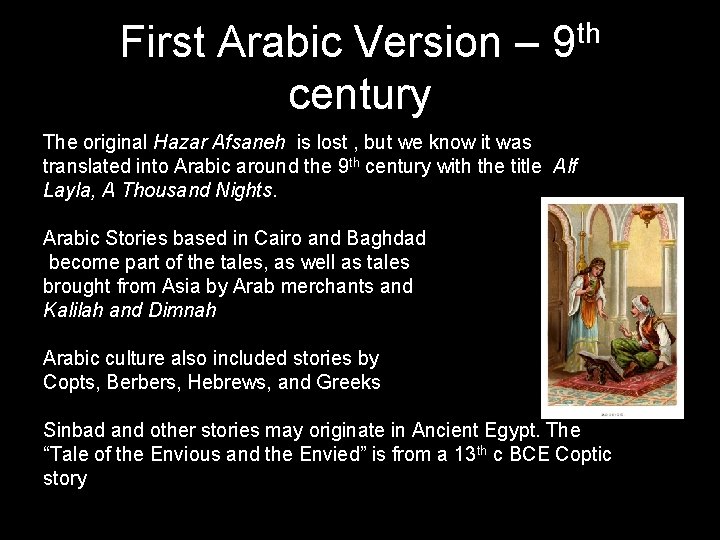
First Arabic Version – century th 9 The original Hazar Afsaneh is lost , but we know it was translated into Arabic around the 9 th century with the title Alf Layla, A Thousand Nights. Arabic Stories based in Cairo and Baghdad become part of the tales, as well as tales brought from Asia by Arab merchants and Kalilah and Dimnah Arabic culture also included stories by Copts, Berbers, Hebrews, and Greeks Sinbad and other stories may originate in Ancient Egypt. The “Tale of the Envious and the Envied” is from a 13 th c BCE Coptic story
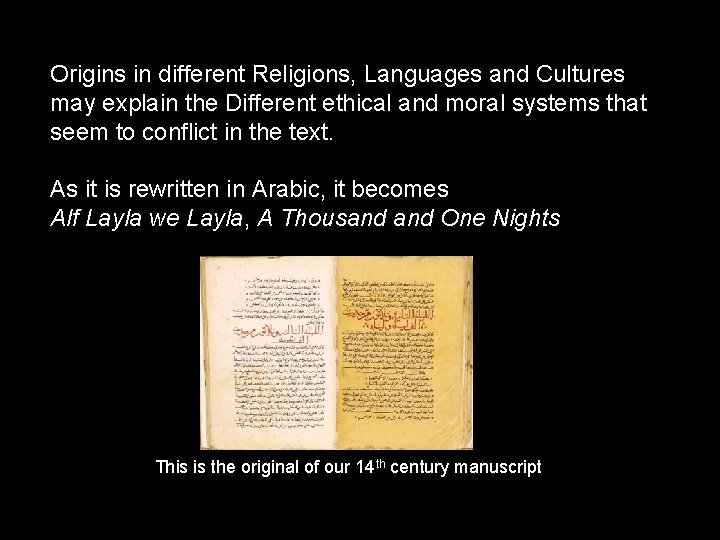
Origins in different Religions, Languages and Cultures may explain the Different ethical and moral systems that seem to conflict in the text. As it is rewritten in Arabic, it becomes Alf Layla we Layla, A Thousand One Nights This is the original of our 14 th century manuscript
Islam Another factor is the role of Islamic culture and ethics, which would Have influenced our 14 th century author….
A Brief Look at Islam
ﺍﻹﺳﻼﻡ The word “Islam” comes from the Arabic root s-l-m meaning “surrender, ” “submission, ” and ”peace” The greeting “Salam” “Peace” comes from the same root “Muslim” comes from the same root and means “one who submits to God”
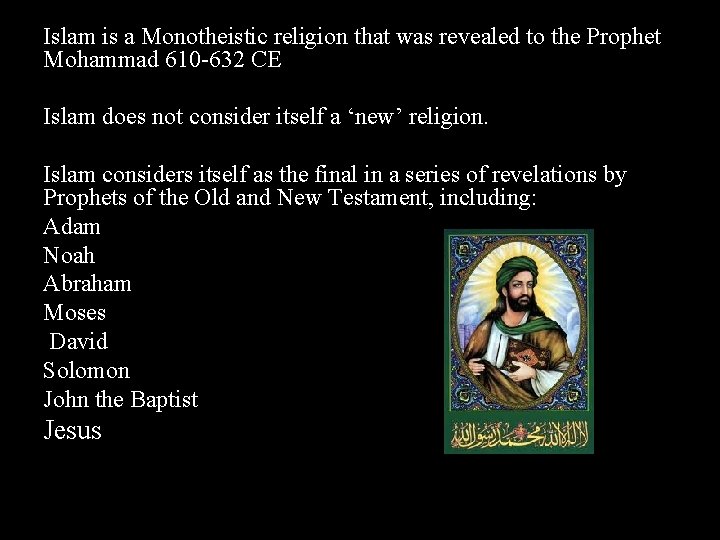
Islam is a Monotheistic religion that was revealed to the Prophet Mohammad 610 -632 CE Islam does not consider itself a ‘new’ religion. Islam considers itself as the final in a series of revelations by Prophets of the Old and New Testament, including: Adam Noah Abraham Moses David Solomon John the Baptist Jesus
Tawheed - Oneness The fundamental concept of Islam is Tawheed – The Oneness of God The “He is God, one, eternal. He does not beget, nor is he begotten, and there is none like unto him” ( Qur’an 112: 1 -4) “No vision can grasp Him, but his grasp is all vision, He is above all comprehension, yet is aquainted with all things” (Qur’an 6: 103)
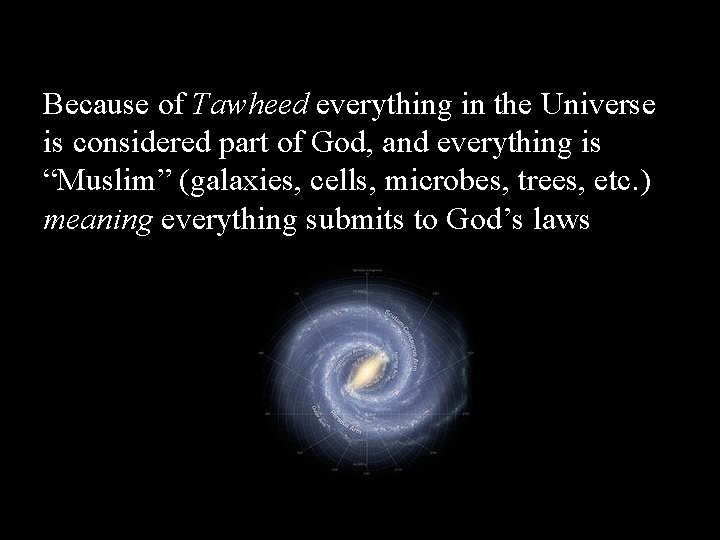
Because of Tawheed everything in the Universe is considered part of God, and everything is “Muslim” (galaxies, cells, microbes, trees, etc. ) meaning everything submits to God’s laws
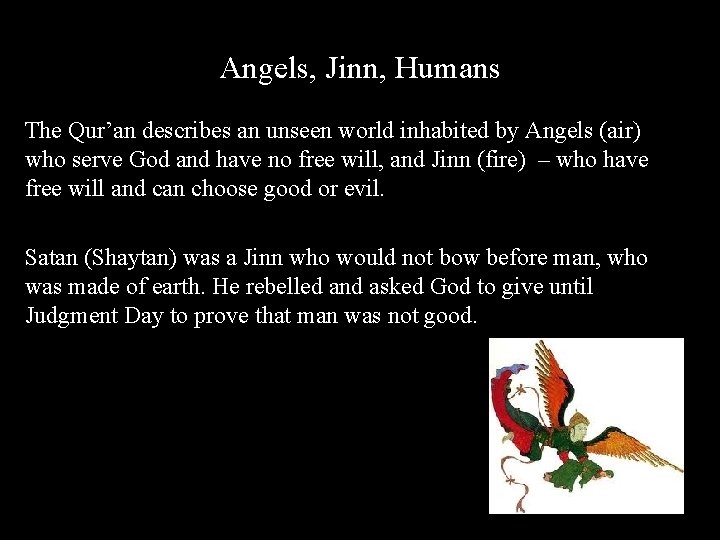
Angels, Jinn, Humans The Qur’an describes an unseen world inhabited by Angels (air) who serve God and have no free will, and Jinn (fire) – who have free will and can choose good or evil. Satan (Shaytan) was a Jinn who would not bow before man, who was made of earth. He rebelled and asked God to give until Judgment Day to prove that man was not good.
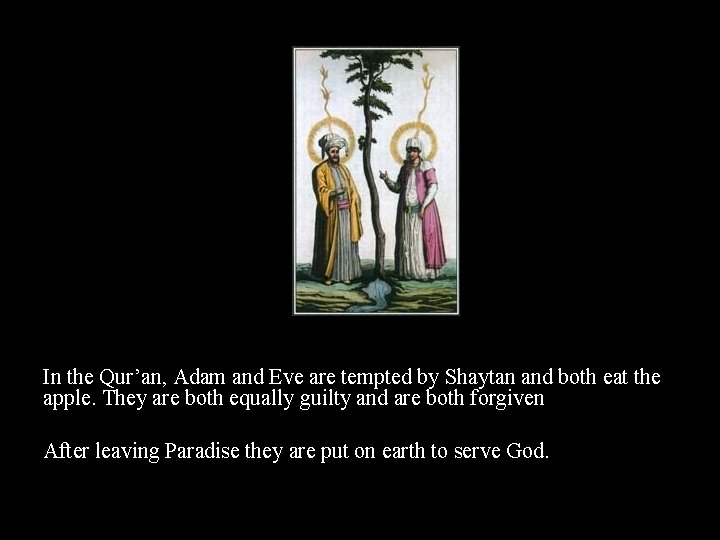
In the Qur’an, Adam and Eve are tempted by Shaytan and both eat the apple. They are both equally guilty and are both forgiven After leaving Paradise they are put on earth to serve God.
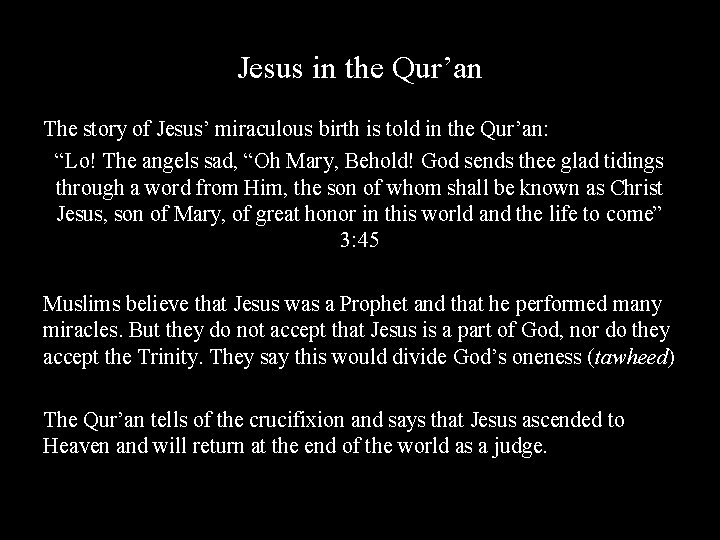
Jesus in the Qur’an The story of Jesus’ miraculous birth is told in the Qur’an: “Lo! The angels sad, “Oh Mary, Behold! God sends thee glad tidings through a word from Him, the son of whom shall be known as Christ Jesus, son of Mary, of great honor in this world and the life to come” 3: 45 Muslims believe that Jesus was a Prophet and that he performed many miracles. But they do not accept that Jesus is a part of God, nor do they accept the Trinity. They say this would divide God’s oneness (tawheed) The Qur’an tells of the crucifixion and says that Jesus ascended to Heaven and will return at the end of the world as a judge.
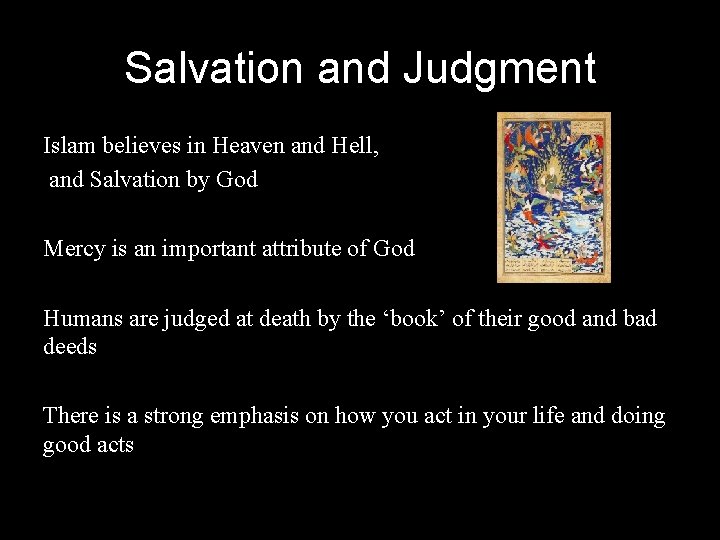
Salvation and Judgment Islam believes in Heaven and Hell, and Salvation by God Mercy is an important attribute of God Humans are judged at death by the ‘book’ of their good and bad deeds There is a strong emphasis on how you act in your life and doing good acts
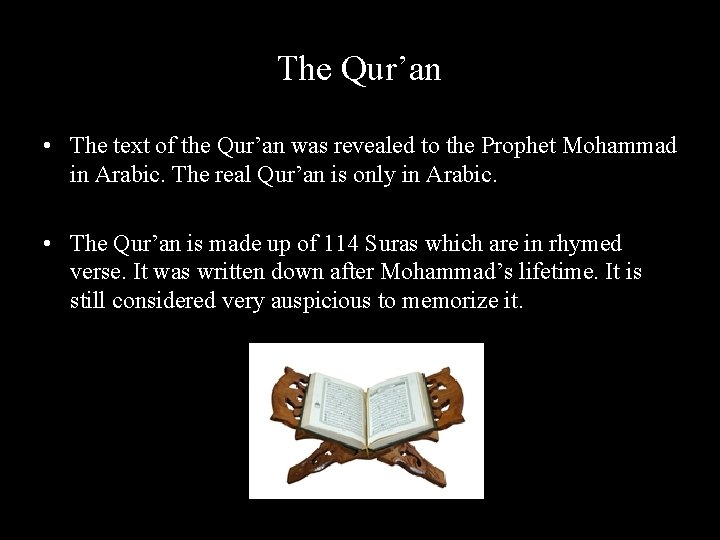
The Qur’an • The text of the Qur’an was revealed to the Prophet Mohammad in Arabic. The real Qur’an is only in Arabic. • The Qur’an is made up of 114 Suras which are in rhymed verse. It was written down after Mohammad’s lifetime. It is still considered very auspicious to memorize it.
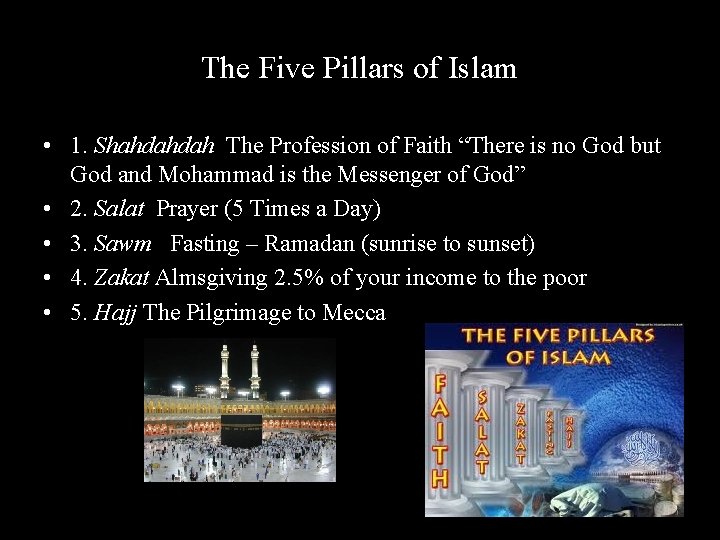
The Five Pillars of Islam • 1. Shahdahdah The Profession of Faith “There is no God but God and Mohammad is the Messenger of God” • 2. Salat Prayer (5 Times a Day) • 3. Sawm Fasting – Ramadan (sunrise to sunset) • 4. Zakat Almsgiving 2. 5% of your income to the poor • 5. Hajj The Pilgrimage to Mecca