
IF CURRICULUM CHANGE IS THE ANSWER WHAT WAS




- Slides: 40
IF CURRICULUM CHANGE IS THE ANSWER, WHAT WAS THE QUESTION? PETER LILJEDAHL SIMON FRASER UNIVERSITY
Organization of the Day • INTRODUCTION – Mathematical Activities • BREAK – Group Activity – Plenary – Discussion • LUNCH – – Q and A ARPDC Tour Group Activity and Discussion Q and A • CLOSING REMARKS
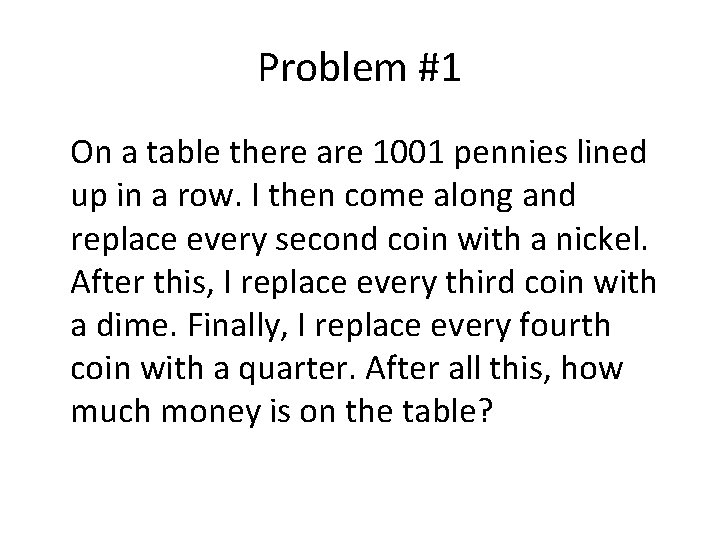
Problem #1 On a table there are 1001 pennies lined up in a row. I then come along and replace every second coin with a nickel. After this, I replace every third coin with a dime. Finally, I replace every fourth coin with a quarter. After all this, how much money is on the table?
Relation to Curriculum ? ? ?
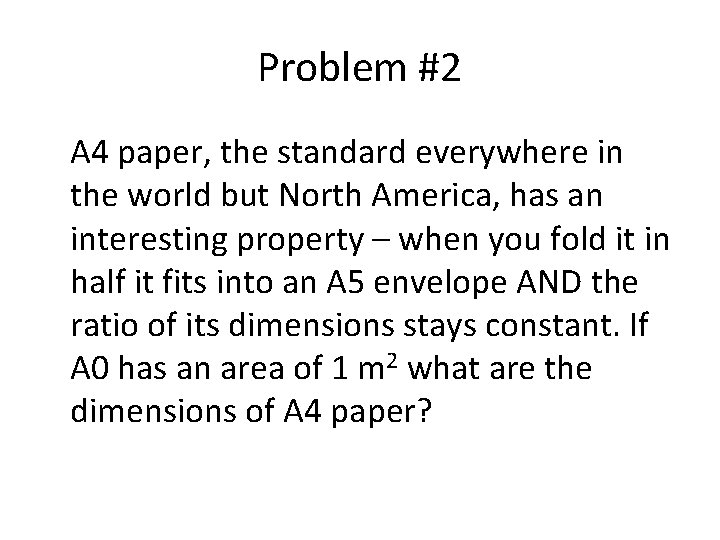
Problem #2 A 4 paper, the standard everywhere in the world but North America, has an interesting property – when you fold it in half it fits into an A 5 envelope AND the ratio of its dimensions stays constant. If A 0 has an area of 1 m 2 what are the dimensions of A 4 paper?
Relation to Curriculum Math 20 -2 Number and Logic – solve problems that involve operations on radical expressions with numerical and variable radicands (limited to square roots).
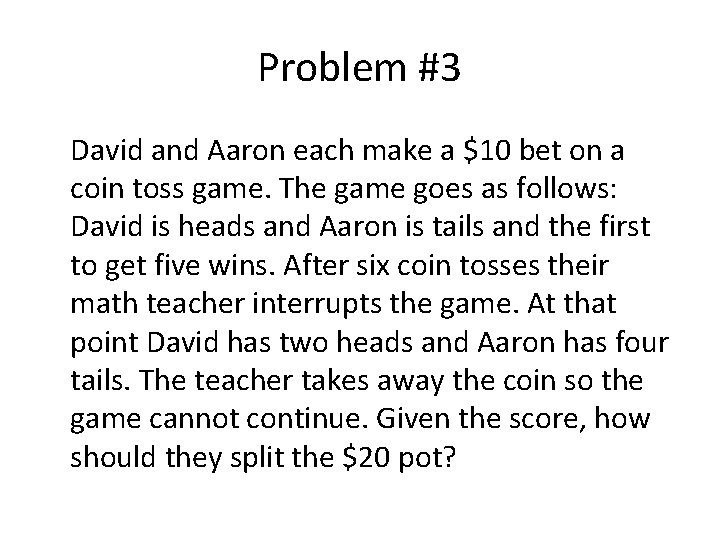
Problem #3 David and Aaron each make a $10 bet on a coin toss game. The game goes as follows: David is heads and Aaron is tails and the first to get five wins. After six coin tosses their math teacher interrupts the game. At that point David has two heads and Aaron has four tails. The teacher takes away the coin so the game cannot continue. Given the score, how should they split the $20 pot?
Relation to Curriculum Math 30 -2 Probability – Solve problems that involve the probability of mutually exclusive and non-mutually exclusively events
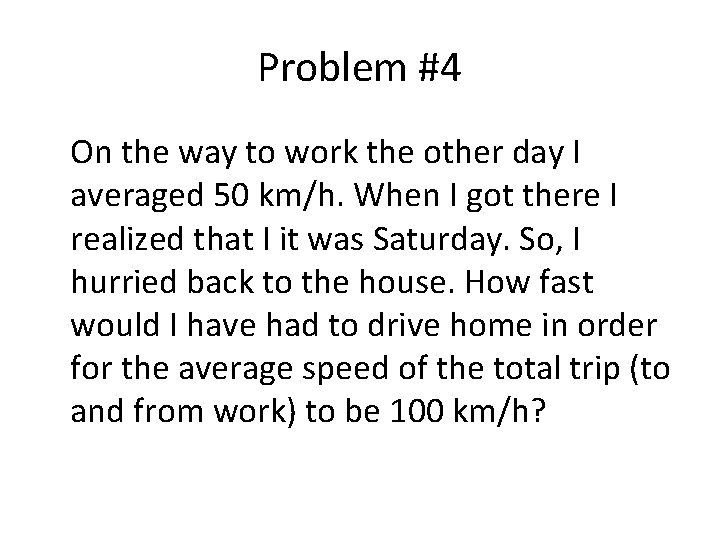
Problem #4 On the way to work the other day I averaged 50 km/h. When I got there I realized that I it was Saturday. So, I hurried back to the house. How fast would I have had to drive home in order for the average speed of the total trip (to and from work) to be 100 km/h?
Relation to Curriculum Math 20 -2 Measurement – Solve problems that involve the application of rates.
BREAK 10 minutes
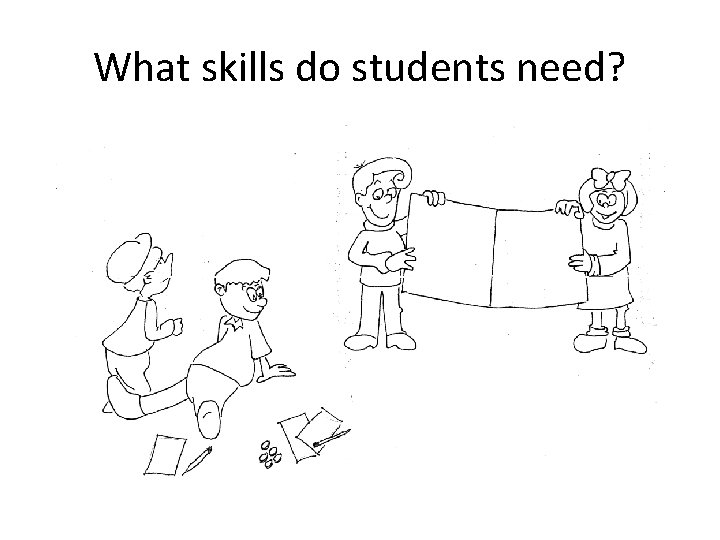
What skills do students need?
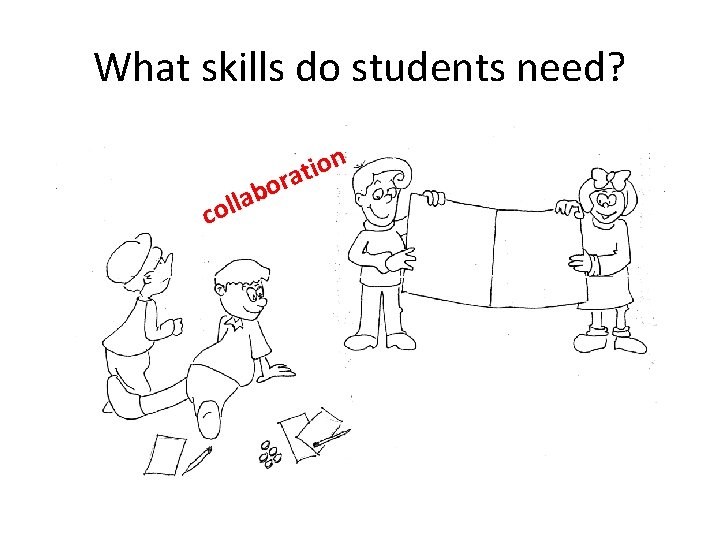
What skills do students need? o b a l col n o i rat
Skills • • collaboration communication perseverance risk taking motivation curiosity autonomy problem solving
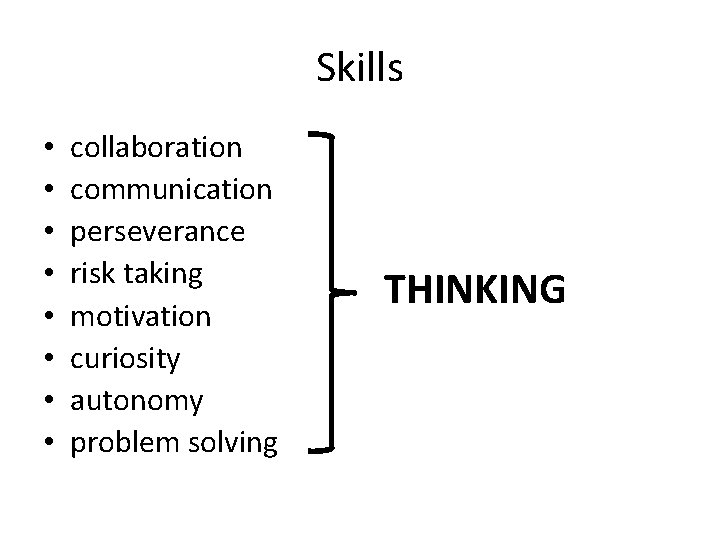
Skills • • collaboration communication perseverance risk taking motivation curiosity autonomy problem solving THINKING
Students Don’t THINK! • industry • post-secondary institutions • teachers
Students Don’t THINK! • industry • post-secondary institutions • teachers STUDENTING!
Students NOT Thinking has led to. . . • • NCTM movement and AUS and UK equivalents numeracy movements Singapore math 21 st century learning movement both sides of the math wars back to basics movement curriculum revisions
Curriculum Revisions • AFFECTIVE DOMAIN Students with positive attitudes toward learning mathematics are likely to be motivated and prepared to learn, to participate willingly in classroom activities, to persist in challenging situations and to engage in reflective practices (pg. 2).
Curriculum Revisions • AFFECTIVE DOMAIN • GOALS FOR STUDENTS The main goals of mathematics education are to prepare students to: • • • solve problems communicate and reason mathematically make connections between mathematics and its applications become mathematically literate appreciate and value mathematics make informed decisions as contributors to society (pg. 2)
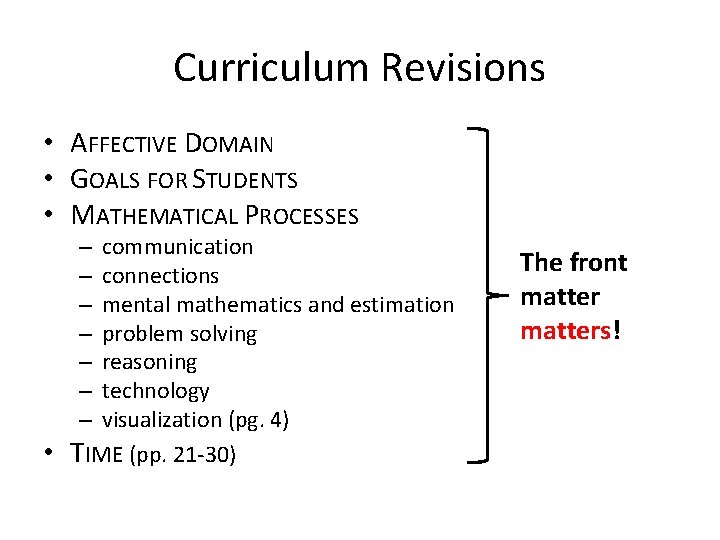
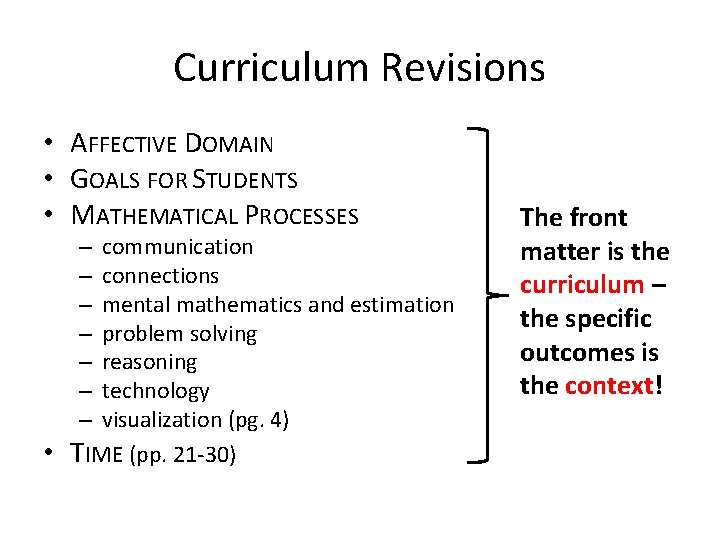
Curriculum Revisions • AFFECTIVE DOMAIN • GOALS FOR STUDENTS • MATHEMATICAL PROCESSES • – communication – connections – mental mathematics and estimation – problem solving – reasoning – technology – visualization (pg. 4) TIME (pp. 21 -30)
Curriculum Revisions • AFFECTIVE DOMAIN • GOALS FOR STUDENTS • MATHEMATICAL PROCESSES • – communication – connections – mental mathematics and estimation – problem solving – reasoning – technology – visualization (pg. 4) TIME (pp. 21 -30) The front matters!
Curriculum Revisions • AFFECTIVE DOMAIN • GOALS FOR STUDENTS • MATHEMATICAL PROCESSES • – communication – connections – mental mathematics and estimation – problem solving – reasoning – technology – visualization (pg. 4) TIME (pp. 21 -30) The front matter is the curriculum – the specific outcomes is the context!
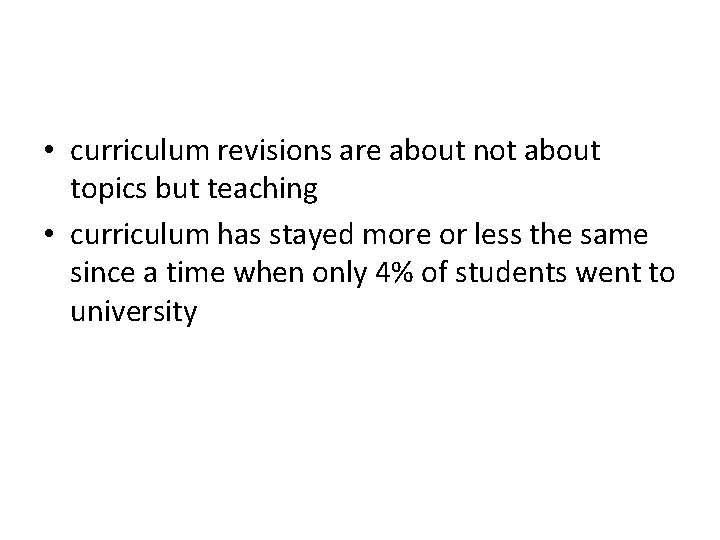
• curriculum revisions are about not about topics but teaching • curriculum has stayed more or less the same since a time when only 4% of students went to university
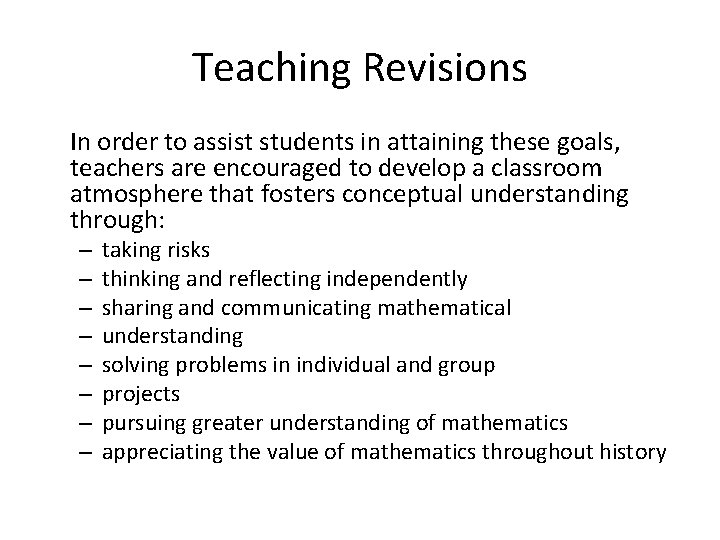
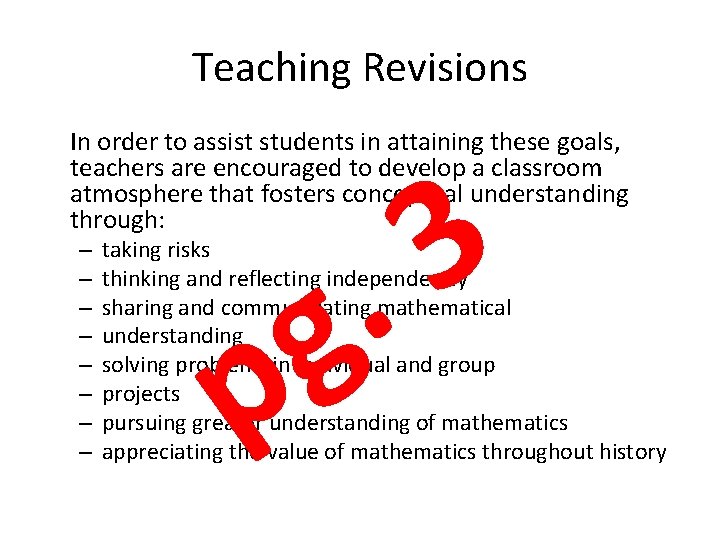
Teaching Revisions In order to assist students in attaining these goals, teachers are encouraged to develop a classroom atmosphere that fosters conceptual understanding through: – – – – taking risks thinking and reflecting independently sharing and communicating mathematical understanding solving problems in individual and group projects pursuing greater understanding of mathematics appreciating the value of mathematics throughout history
Teaching Revisions In order to assist students in attaining these goals, teachers are encouraged to develop a classroom atmosphere that fosters conceptual understanding through: – – – – 3. taking risks thinking and reflecting independently sharing and communicating mathematical understanding solving problems in individual and group projects pursuing greater understanding of mathematics appreciating the value of mathematics throughout history g p
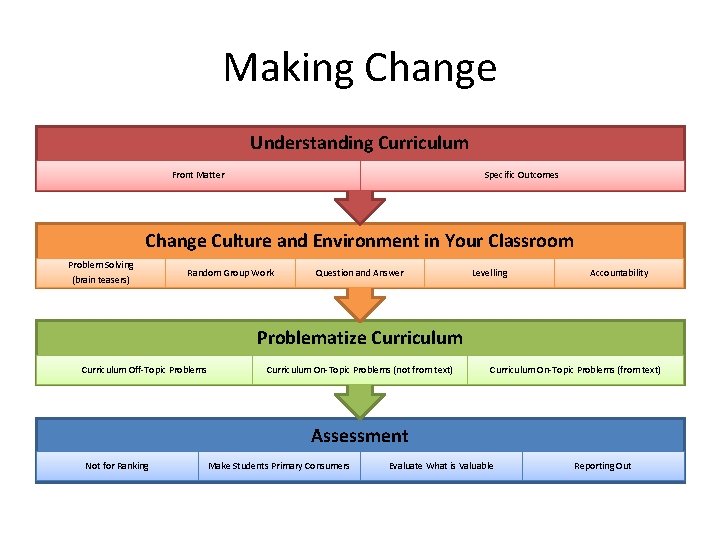
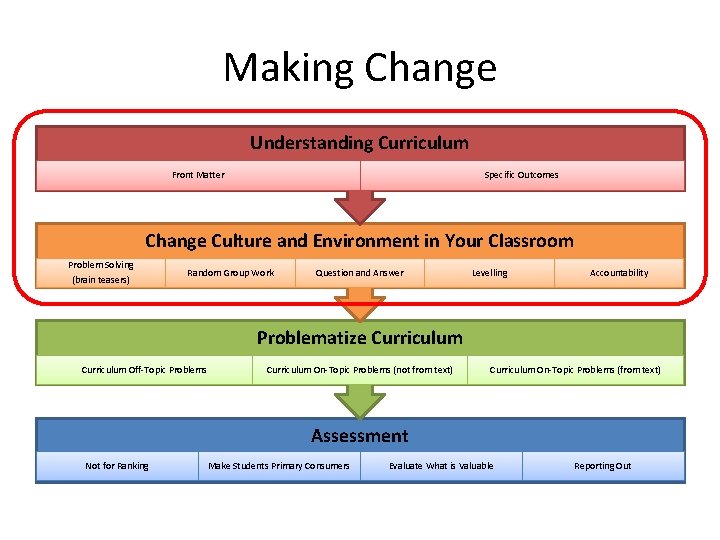
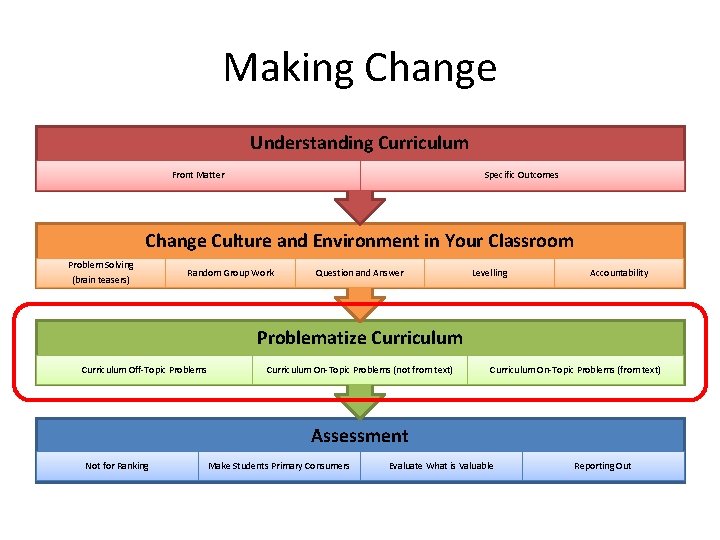
Making Change Understanding Curriculum Front Matter Specific Outcomes Change Culture and Environment in Your Classroom Problem Solving (brain teasers) Random Group Work Question and Answer Levelling Accountability Problematize Curriculum Off-Topic Problems Curriculum On-Topic Problems (not from text) Curriculum On-Topic Problems (from text) Assessment Not for Ranking Make Students Primary Consumers Evaluate What is Valuable Reporting Out
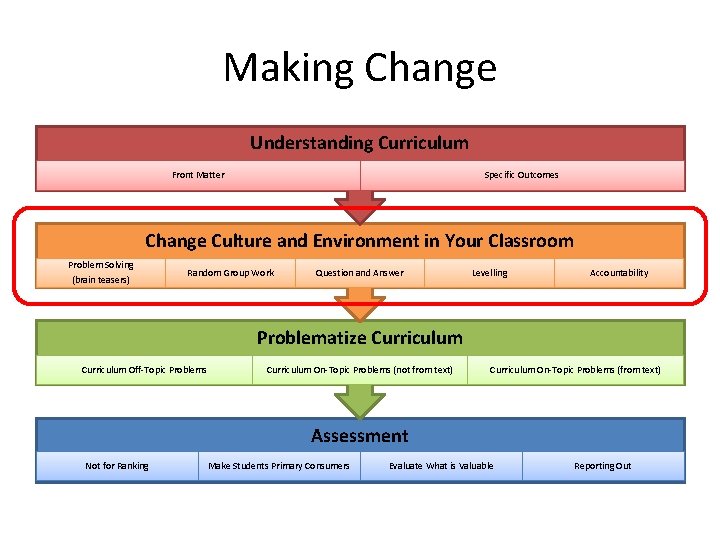
Making Change Understanding Curriculum Front Matter Specific Outcomes Change Culture and Environment in Your Classroom Problem Solving (brain teasers) Random Group Work Question and Answer Levelling Accountability Problematize Curriculum Off-Topic Problems Curriculum On-Topic Problems (not from text) Curriculum On-Topic Problems (from text) Assessment Not for Ranking Make Students Primary Consumers Evaluate What is Valuable Reporting Out
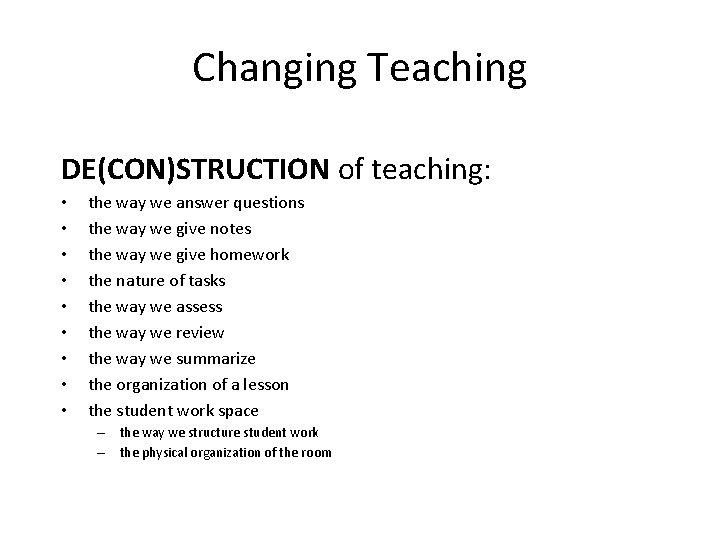
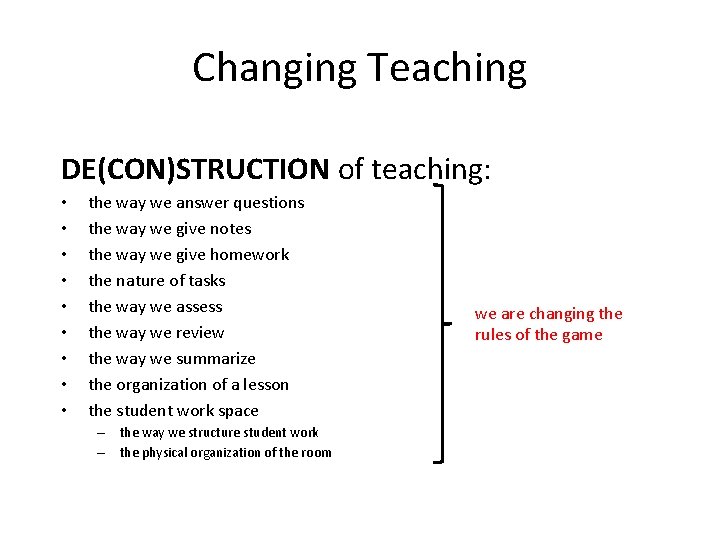
Changing Teaching DE(CON)STRUCTION of teaching: • • • the way we answer questions the way we give notes the way we give homework the nature of tasks the way we assess the way we review the way we summarize the organization of a lesson the student work space – the way we structure student work – the physical organization of the room
Changing Teaching DE(CON)STRUCTION of teaching: • • • the way we answer questions the way we give notes the way we give homework the nature of tasks the way we assess the way we review the way we summarize the organization of a lesson the student work space – the way we structure student work – the physical organization of the room we are changing the rules of the game
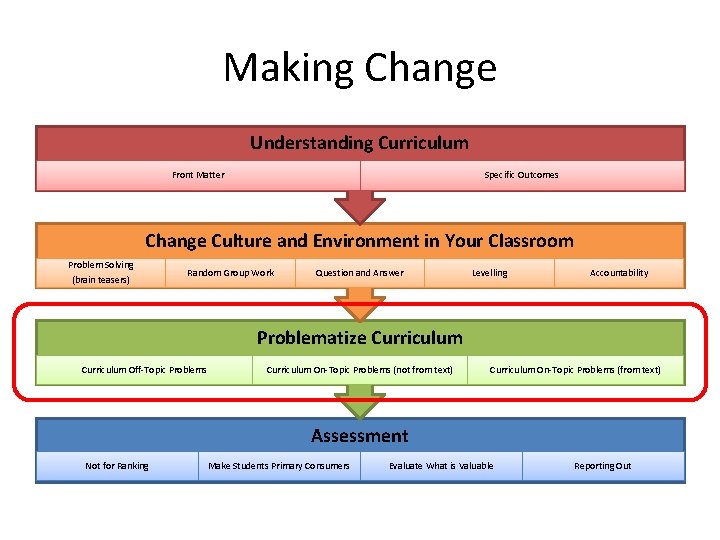
Making Change Understanding Curriculum Front Matter Specific Outcomes Change Culture and Environment in Your Classroom Problem Solving (brain teasers) Random Group Work Question and Answer Levelling Accountability Problematize Curriculum Off-Topic Problems Curriculum On-Topic Problems (not from text) Curriculum On-Topic Problems (from text) Assessment Not for Ranking Make Students Primary Consumers Evaluate What is Valuable Reporting Out
LUNCH BREAK 40 minutes
QUESTION and ANSWER
Making Change Understanding Curriculum Front Matter Specific Outcomes Change Culture and Environment in Your Classroom Problem Solving (brain teasers) Random Group Work Question and Answer Levelling Accountability Problematize Curriculum Off-Topic Problems Curriculum On-Topic Problems (not from text) Curriculum On-Topic Problems (from text) Assessment Not for Ranking Make Students Primary Consumers Evaluate What is Valuable Reporting Out
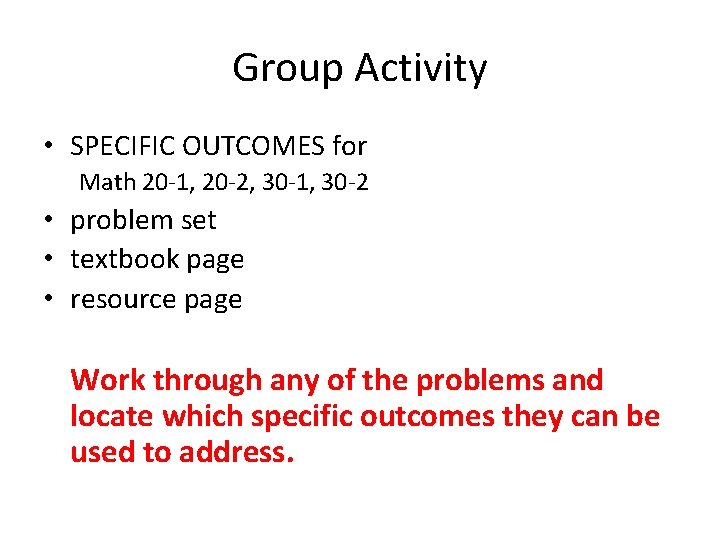
Group Activity • SPECIFIC OUTCOMES for Math 20 -1, 20 -2, 30 -1, 30 -2 • problem set • textbook page • resource page Work through any of the problems and locate which specific outcomes they can be used to address.
Making Change Understanding Curriculum Front Matter Specific Outcomes Change Culture and Environment in Your Classroom Problem Solving (brain teasers) Random Group Work Question and Answer Levelling Accountability Problematize Curriculum Off-Topic Problems Curriculum On-Topic Problems (not from text) Curriculum On-Topic Problems (from text) Assessment Not for Ranking Make Students Primary Consumers Evaluate What is Valuable Reporting Out
QUESTION and ANSWER
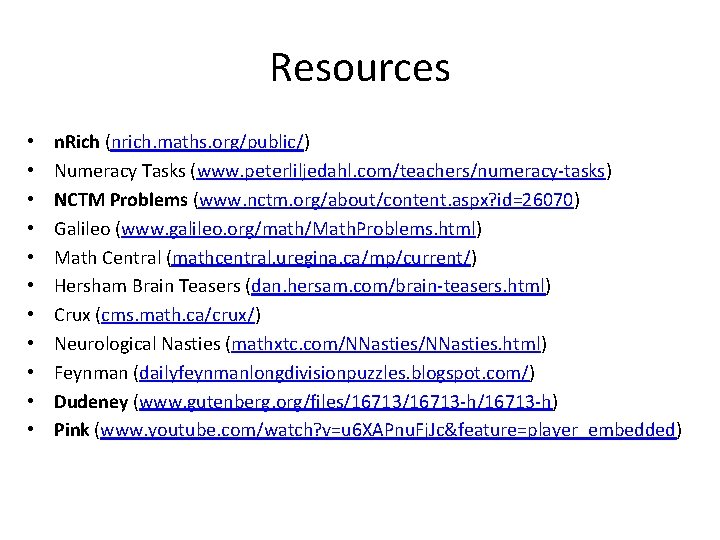
Resources • • • n. Rich (nrich. maths. org/public/) Numeracy Tasks (www. peterliljedahl. com/teachers/numeracy-tasks) NCTM Problems (www. nctm. org/about/content. aspx? id=26070) Galileo (www. galileo. org/math/Math. Problems. html) Math Central (mathcentral. uregina. ca/mp/current/) Hersham Brain Teasers (dan. hersam. com/brain-teasers. html) Crux (cms. math. ca/crux/) Neurological Nasties (mathxtc. com/NNasties. html) Feynman (dailyfeynmanlongdivisionpuzzles. blogspot. com/) Dudeney (www. gutenberg. org/files/16713 -h/16713 -h) Pink (www. youtube. com/watch? v=u 6 XAPnu. Fj. Jc&feature=player_embedded)
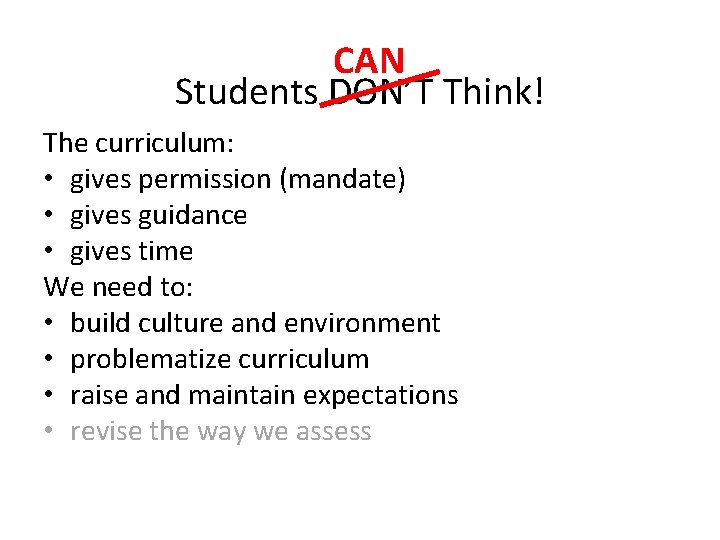
CAN Students DON’T Think! The curriculum: • gives permission (mandate) • gives guidance • gives time We need to: • build culture and environment • problematize curriculum • raise and maintain expectations • revise the way we assess
Thank You liljedahl@sfu. ca www. peterliljedahl. com