OORJA SYSTEMS CONSULTANTS PRESENT WASTE PLASTIC PYROLYSIS A
- Slides: 16
OORJA SYSTEMS & CONSULTANTS PRESENT WASTE PLASTIC PYROLYSIS A NEW CONCEPT IN ENVIRONMENT FRIENDLY WASTE MANAGEMENT
INTRODUCTION • A marvel of polymer chemistry, plastics has become an indispensable part of our daily life. Although plastics are a newer discovery, they have become a part of everyday consumer life and its production and consumption have increased drastically. Plastic have molded the modern world and transformed the quality of life. There is no human activity where plastics do not play a key role from clothing to shelter, from transportation to communication and from entertainment to health care. Plastics have become an indispensable part in today’s world. Due to their light‐ weight, durability, energy efficiency, coupled with a faster rate of production and design flexibility, these plastics are employed in entire gamut of industrial and domestic areas. . • Plastics are non‐biodegradable polymers mostly containing carbon, hydrogen, and few other elements such as chlorine, nitrogen etc. Due to its non‐biodegradable nature, the plastic waste contributes significantly to the problem of Municipal Waste Management. • Bureau of Indian Standards Guidelines for Waste Plastic Recycling ‐ IS 14534: 1998. Bureau of Indian Standards has issued guidelines for waste plastic recycling in 1998. As per directive of Bureau of Indian Standards in the article 5. 1. 3 it lists plastic pyrolysis as – Tertiary Recycling involves production of basic chemicals and fuels from plastic waste/scrap as part of municipal waste stream or as segregated waste. Pyrolysis and Hydrolysis are examples of these processes.
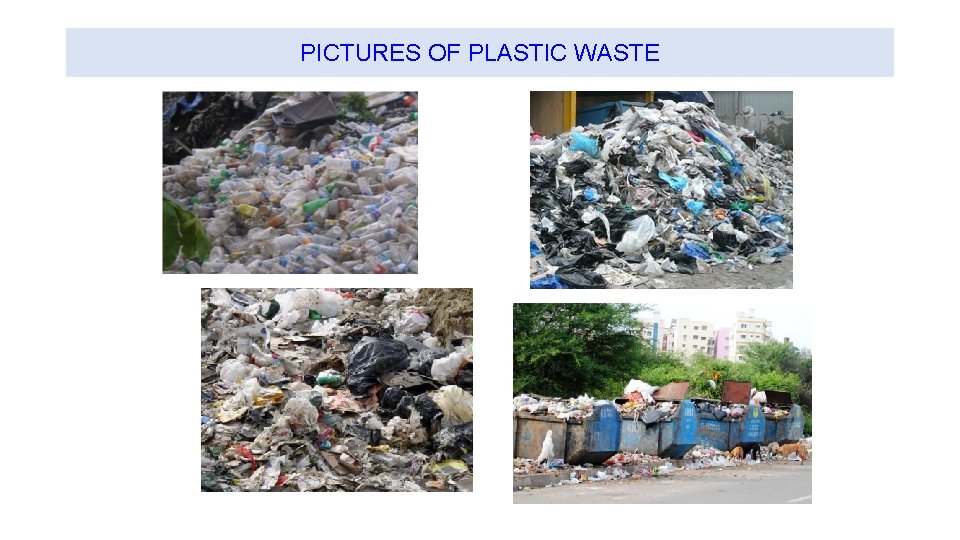
PICTURES OF PLASTIC WASTE
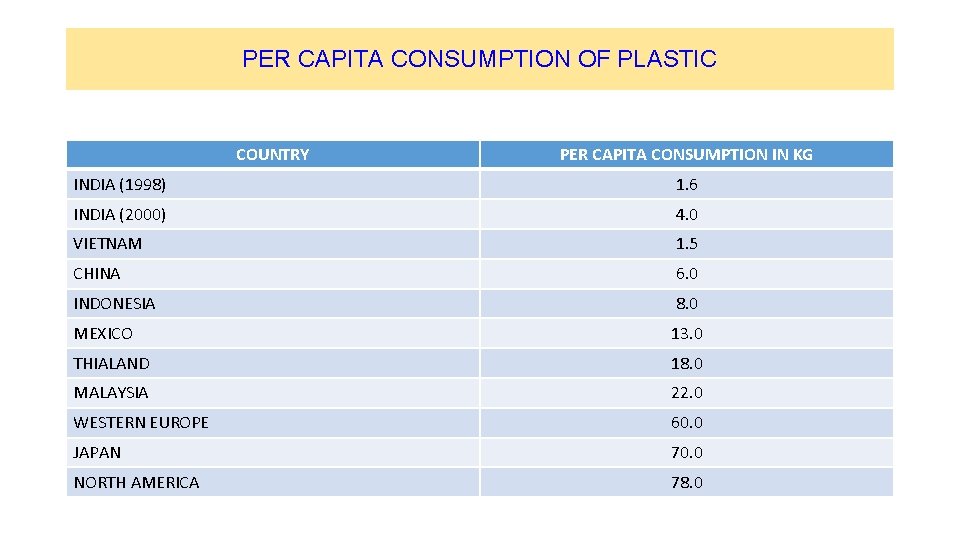
PER CAPITA CONSUMPTION OF PLASTIC COUNTRY PER CAPITA CONSUMPTION IN KG INDIA (1998) 1. 6 INDIA (2000) 4. 0 VIETNAM 1. 5 CHINA 6. 0 INDONESIA 8. 0 MEXICO 13. 0 THIALAND 18. 0 MALAYSIA 22. 0 WESTERN EUROPE 60. 0 JAPAN 70. 0 NORTH AMERICA 78. 0
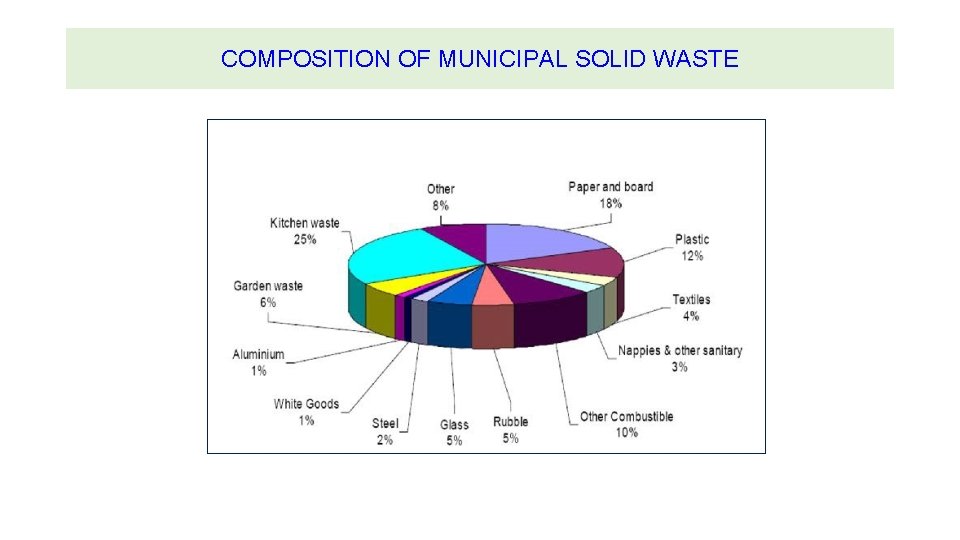
COMPOSITION OF MUNICIPAL SOLID WASTE
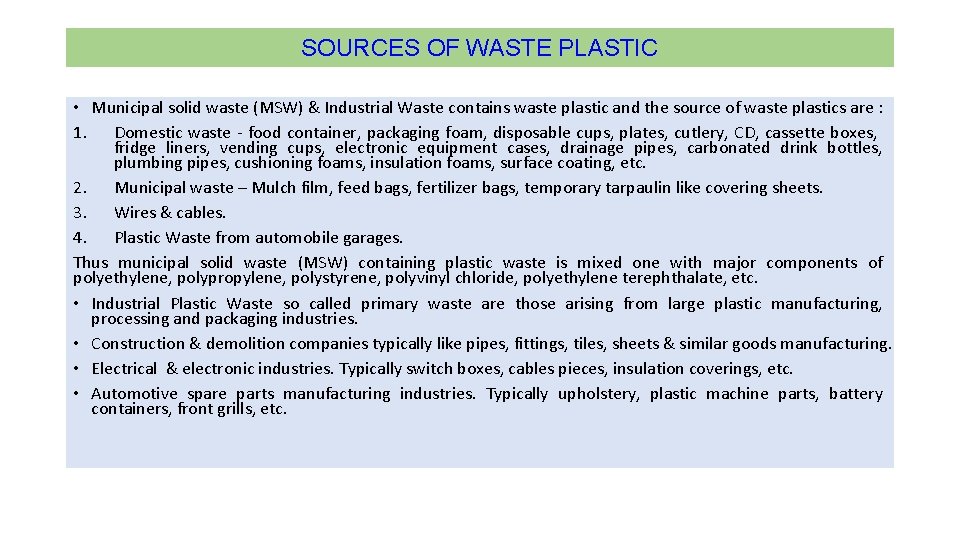
SOURCES OF WASTE PLASTIC • Municipal solid waste (MSW) & Industrial Waste contains waste plastic and the source of waste plastics are : 1. Domestic waste ‐ food container, packaging foam, disposable cups, plates, cutlery, CD, cassette boxes, fridge liners, vending cups, electronic equipment cases, drainage pipes, carbonated drink bottles, plumbing pipes, cushioning foams, insulation foams, surface coating, etc. 2. Municipal waste – Mulch film, feed bags, fertilizer bags, temporary tarpaulin like covering sheets. 3. Wires & cables. 4. Plastic Waste from automobile garages. Thus municipal solid waste (MSW) containing plastic waste is mixed one with major components of polyethylene, polypropylene, polystyrene, polyvinyl chloride, polyethylene terephthalate, etc. • Industrial Plastic Waste so called primary waste are those arising from large plastic manufacturing, processing and packaging industries. • Construction & demolition companies typically like pipes, fittings, tiles, sheets & similar goods manufacturing. • Electrical & electronic industries. Typically switch boxes, cables pieces, insulation coverings, etc. • Automotive spare parts manufacturing industries. Typically upholstery, plastic machine parts, battery containers, front grills, etc.
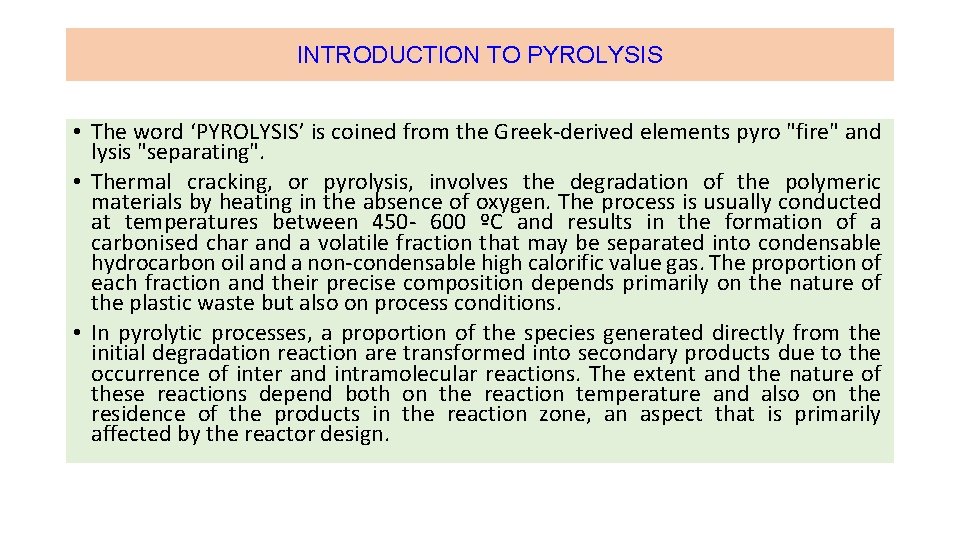
INTRODUCTION TO PYROLYSIS • The word ‘PYROLYSIS’ is coined from the Greek‐derived elements pyro "fire" and lysis "separating". • Thermal cracking, or pyrolysis, involves the degradation of the polymeric materials by heating in the absence of oxygen. The process is usually conducted at temperatures between 450‐ 600 ºC and results in the formation of a carbonised char and a volatile fraction that may be separated into condensable hydrocarbon oil and a non‐condensable high calorific value gas. The proportion of each fraction and their precise composition depends primarily on the nature of the plastic waste but also on process conditions. • In pyrolytic processes, a proportion of the species generated directly from the initial degradation reaction are transformed into secondary products due to the occurrence of inter and intramolecular reactions. The extent and the nature of these reactions depend both on the reaction temperature and also on the residence of the products in the reaction zone, an aspect that is primarily affected by the reactor design.
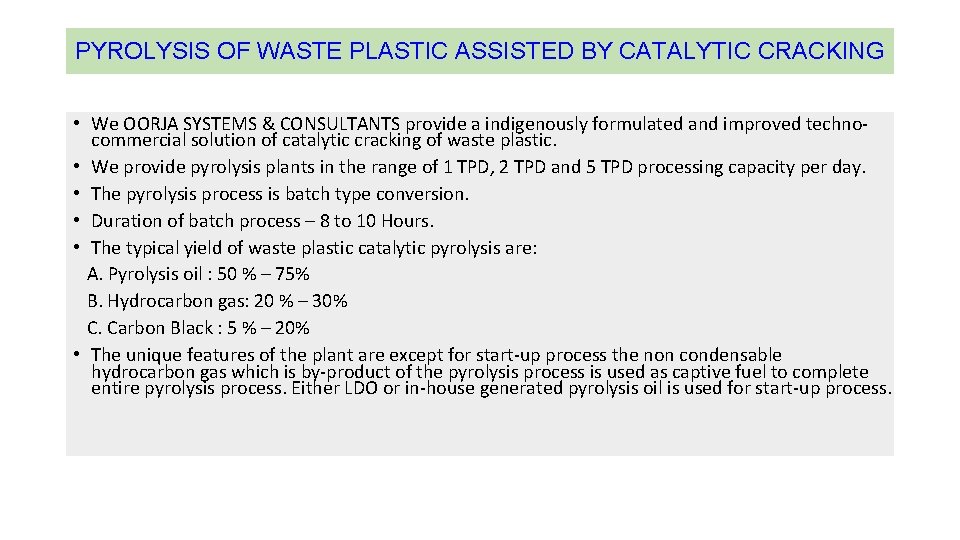
PYROLYSIS OF WASTE PLASTIC ASSISTED BY CATALYTIC CRACKING • We OORJA SYSTEMS & CONSULTANTS provide a indigenously formulated and improved techno‐ commercial solution of catalytic cracking of waste plastic. • We provide pyrolysis plants in the range of 1 TPD, 2 TPD and 5 TPD processing capacity per day. • The pyrolysis process is batch type conversion. • Duration of batch process – 8 to 10 Hours. • The typical yield of waste plastic catalytic pyrolysis are: A. Pyrolysis oil : 50 % – 75% B. Hydrocarbon gas: 20 % – 30% C. Carbon Black : 5 % – 20% • The unique features of the plant are except for start‐up process the non condensable hydrocarbon gas which is by‐product of the pyrolysis process is used as captive fuel to complete entire pyrolysis process. Either LDO or in‐house generated pyrolysis oil is used for start‐up process.
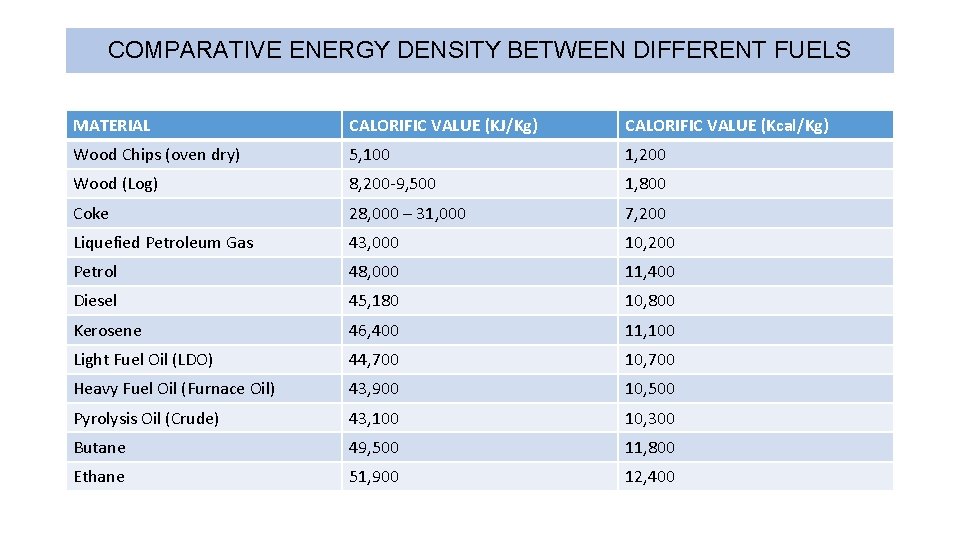
COMPARATIVE ENERGY DENSITY BETWEEN DIFFERENT FUELS MATERIAL CALORIFIC VALUE (KJ/Kg) CALORIFIC VALUE (Kcal/Kg) Wood Chips (oven dry) 5, 100 1, 200 Wood (Log) 8, 200‐ 9, 500 1, 800 Coke 28, 000 – 31, 000 7, 200 Liquefied Petroleum Gas 43, 000 10, 200 Petrol 48, 000 11, 400 Diesel 45, 180 10, 800 Kerosene 46, 400 11, 100 Light Fuel Oil (LDO) 44, 700 10, 700 Heavy Fuel Oil (Furnace Oil) 43, 900 10, 500 Pyrolysis Oil (Crude) 43, 100 10, 300 Butane 49, 500 11, 800 Ethane 51, 900 12, 400
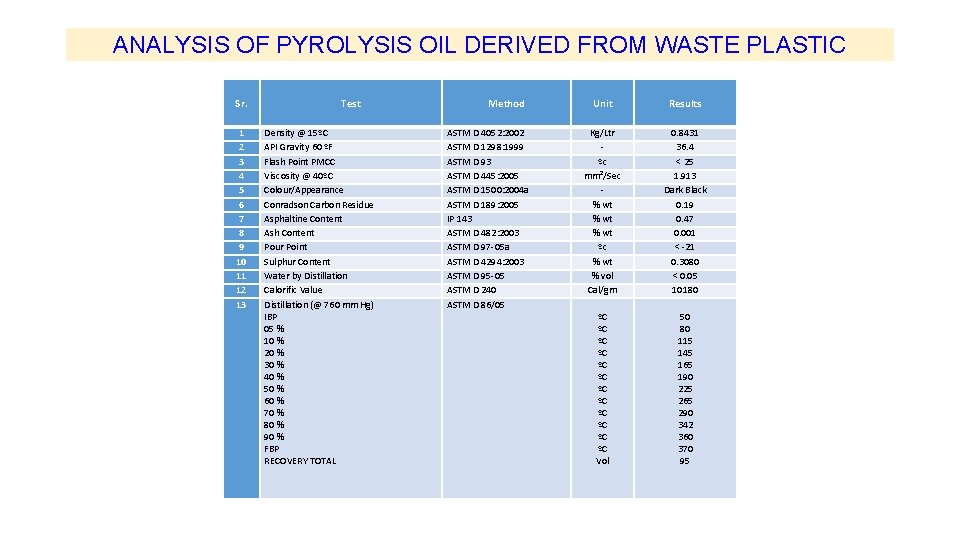
ANALYSIS OF PYROLYSIS OIL DERIVED FROM WASTE PLASTIC Sr. 1 2 3 4 5 6 7 8 9 10 11 12 13 Test Density @ 15ºC API Gravity 60 ºF Flash Point PMCC Viscosity @ 40ºC Colour/Appearance Conradson Carbon Residue Asphaltine Content Ash Content Pour Point Sulphur Content Water by Distillation Calorific Value Distillation (@ 760 mm Hg) IBP 05 % 10 % 20 % 30 % 40 % 50 % 60 % 70 % 80 % 90 % FBP RECOVERY TOTAL Method ASTM D 4052: 2002 ASTM D 1298: 1999 ASTM D 93 ASTM D 445: 2005 ASTM D 1500: 2004 a ASTM D 189: 2005 IP 143 ASTM D 482: 2003 ASTM D 97‐ 05 a ASTM D 4294: 2003 ASTM D 95‐ 05 ASTM D 240 ASTM D 86/05 Unit Results Kg/Ltr ‐ ºc mm²/Sec ‐ % wt ºc % wt % vol Cal/gm ºC ºC ºC Vol 0. 8431 36. 4 < 25 1. 913 Dark Black 0. 19 0. 47 0. 001 < ‐ 21 0. 3080 < 0. 05 10180 50 80 115 145 165 190 225 265 290 342 360 370 95
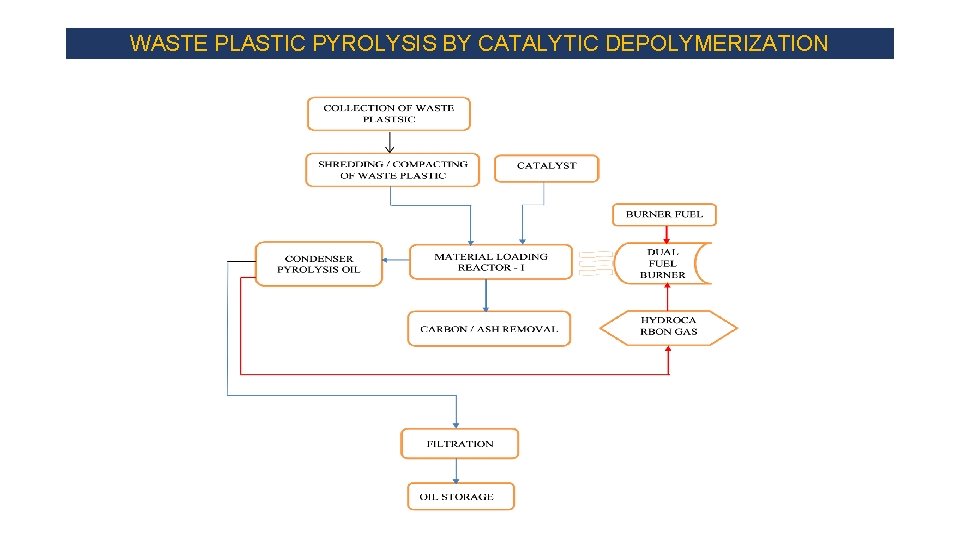
WASTE PLASTIC PYROLYSIS BY CATALYTIC DEPOLYMERIZATION
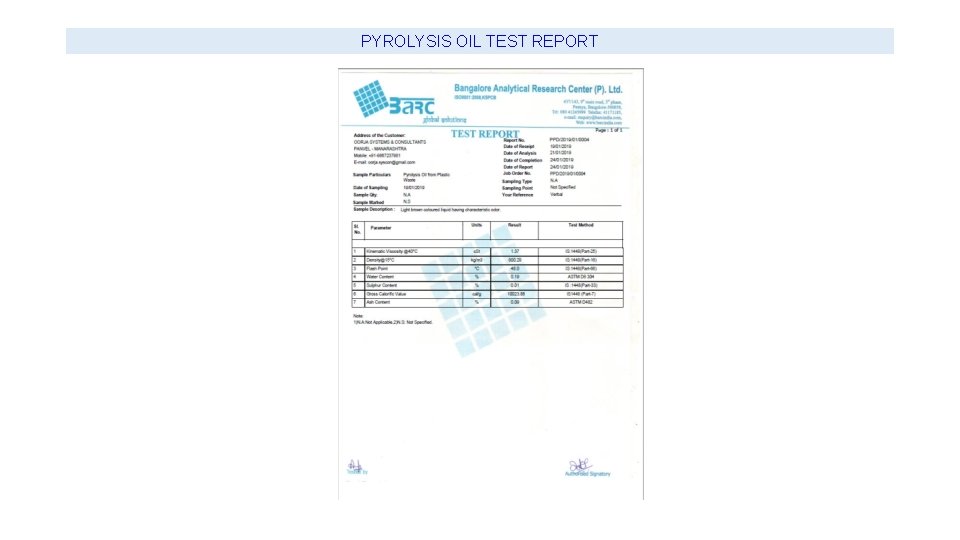
PYROLYSIS OIL TEST REPORT
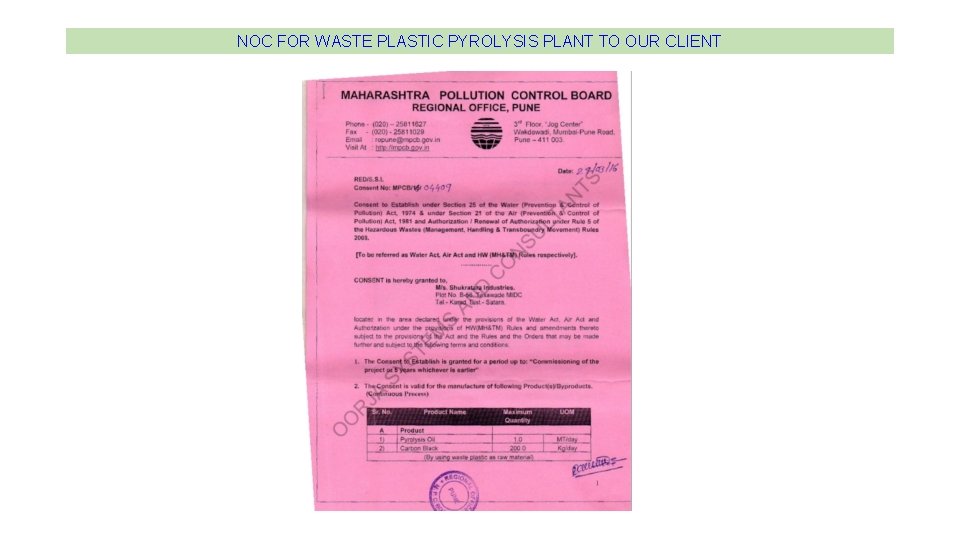
NOC FOR WASTE PLASTIC PYROLYSIS PLANT TO OUR CLIENT
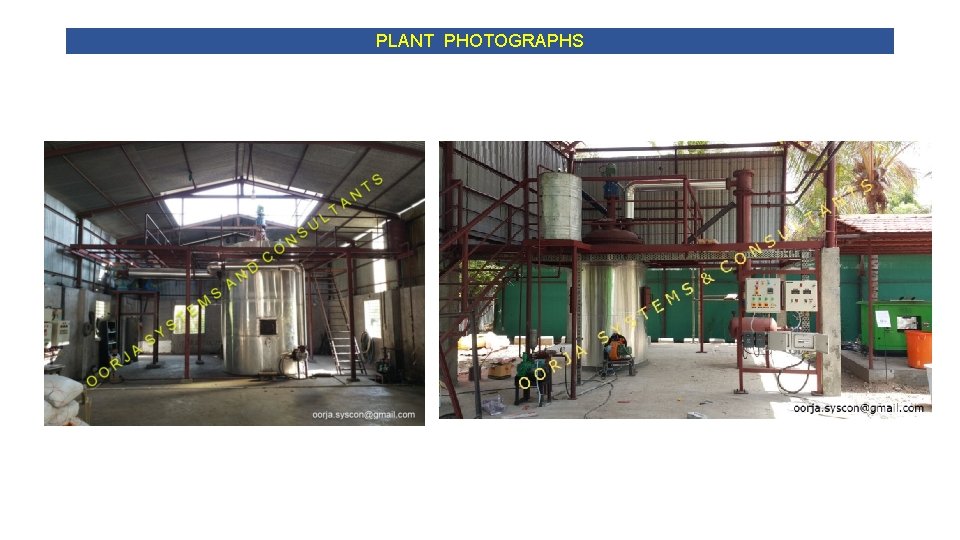
PLANT PHOTOGRAPHS
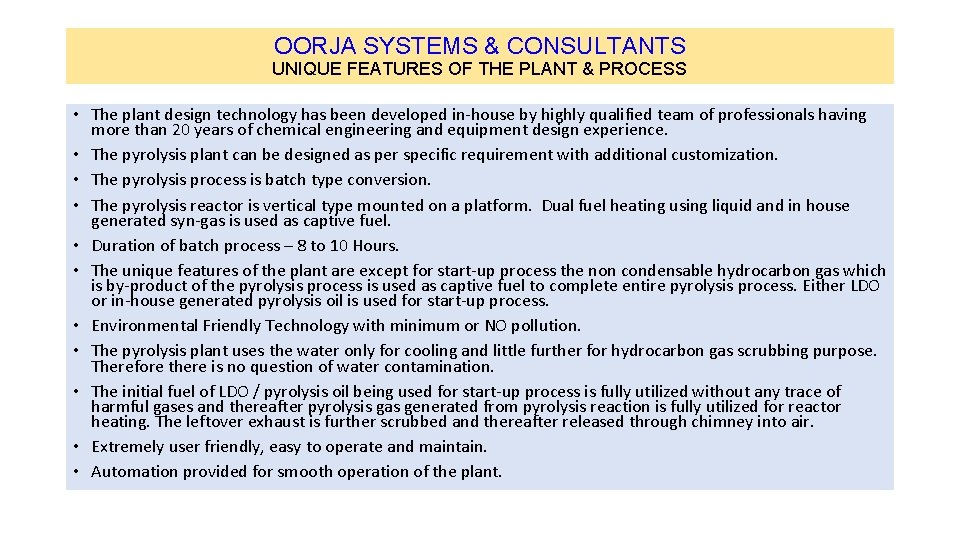
OORJA SYSTEMS & CONSULTANTS UNIQUE FEATURES OF THE PLANT & PROCESS • The plant design technology has been developed in‐house by highly qualified team of professionals having more than 20 years of chemical engineering and equipment design experience. • The pyrolysis plant can be designed as per specific requirement with additional customization. • The pyrolysis process is batch type conversion. • The pyrolysis reactor is vertical type mounted on a platform. Dual fuel heating using liquid and in house generated syn‐gas is used as captive fuel. • Duration of batch process – 8 to 10 Hours. • The unique features of the plant are except for start‐up process the non condensable hydrocarbon gas which is by‐product of the pyrolysis process is used as captive fuel to complete entire pyrolysis process. Either LDO or in‐house generated pyrolysis oil is used for start‐up process. • Environmental Friendly Technology with minimum or NO pollution. • The pyrolysis plant uses the water only for cooling and little further for hydrocarbon gas scrubbing purpose. Therefore there is no question of water contamination. • The initial fuel of LDO / pyrolysis oil being used for start‐up process is fully utilized without any trace of harmful gases and thereafter pyrolysis gas generated from pyrolysis reaction is fully utilized for reactor heating. The leftover exhaust is further scrubbed and thereafter released through chimney into air. • Extremely user friendly, easy to operate and maintain. • Automation provided for smooth operation of the plant.
THANKS FOR WATCHING THIS PRESENTATION CONTACT US FOR FURTHER INFORMATION AND TURNKEY SOLUTIONS GIRISH SHASTRY OORJA SYSTEMS AND CONSULTANTS Email: oorja. syscon@gmail. com, oorja. syscon@hotmail. com Mobile: +91 -9867237981 Visit us @ : http: //www. oorjasyscon. com