
Zurich Julia Users Group Meetup 2 Stamford Consultants


- Slides: 24
Zurich Julia Users Group Meetup 2 @Stamford Consultants – Meeting Room 2 nd Floor 26 th June 2014
Agenda • 18: 00 – Arrival and warm-up • Pizzas / drinks • 18: 45 Pre-Session • Introduction / Julia. Con • A short overview of the performance of Julia compared to MATLAB and R (Dominik) • 19: 30 Session 1 on general aspects - comparison with R, Python etc. , and Julia's relation w. r. t. Data Science (Malcolm) • 20: 30 Session 2 one on more specific topics such as Big Data, No. SQL and parallelization (Malcolm)
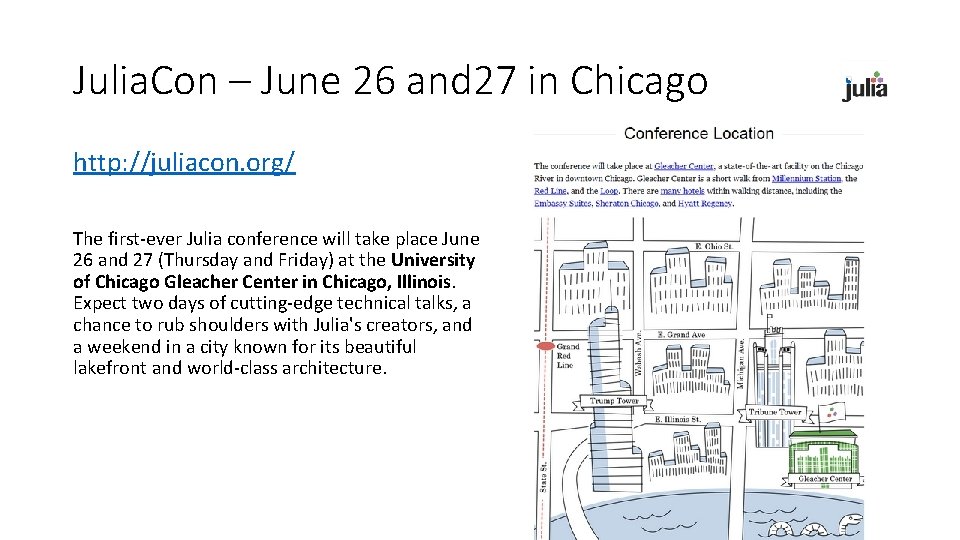
Julia. Con – June 26 and 27 in Chicago http: //juliacon. org/ The first-ever Julia conference will take place June 26 and 27 (Thursday and Friday) at the University of Chicago Gleacher Center in Chicago, Illinois. Expect two days of cutting-edge technical talks, a chance to rub shoulders with Julia's creators, and a weekend in a city known for its beautiful lakefront and world-class architecture.
Julia Resources The Julia Language Julia (programming language) - Wikipedia, the free encyclopedia Julia Documentation — Julia Language 0. 2. 0 documentation The Julia Manual — Julia Language 0. 2. 0 documentation The Julia Standard Library — Julia Language 0. 2. 1 documentation Available Packages — Julia Language 0. 2. 0 documentation Noteworthy Differences from other Languages — Julia Language 0. 2. 1 documentation Julia Downloads The Julia Blog Julia Publications Using Julia in the classroom Julia. Con 2014: June 26 -27, Chicago, IL. juliabloggers. com - A Julia Language Blog Aggregator Learn julia in Y Minutes julia-dev - Google Groups julia-users - Google Groups (99+) julia-stats – Google Groups (16) julia-opt – Google Groups Lesezeichen verwalten
Julia - Performance Compared to MATLAB, R , (and bit to Python)
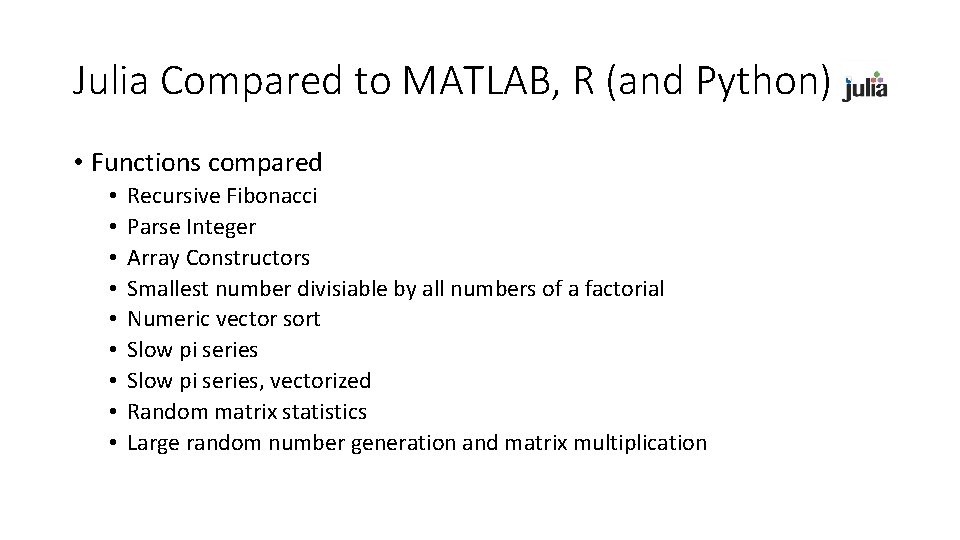
Julia Compared to MATLAB, R (and Python) • Functions compared • • • Recursive Fibonacci Parse Integer Array Constructors Smallest number divisiable by all numbers of a factorial Numeric vector sort Slow pi series, vectorized Random matrix statistics Large random number generation and matrix multiplication
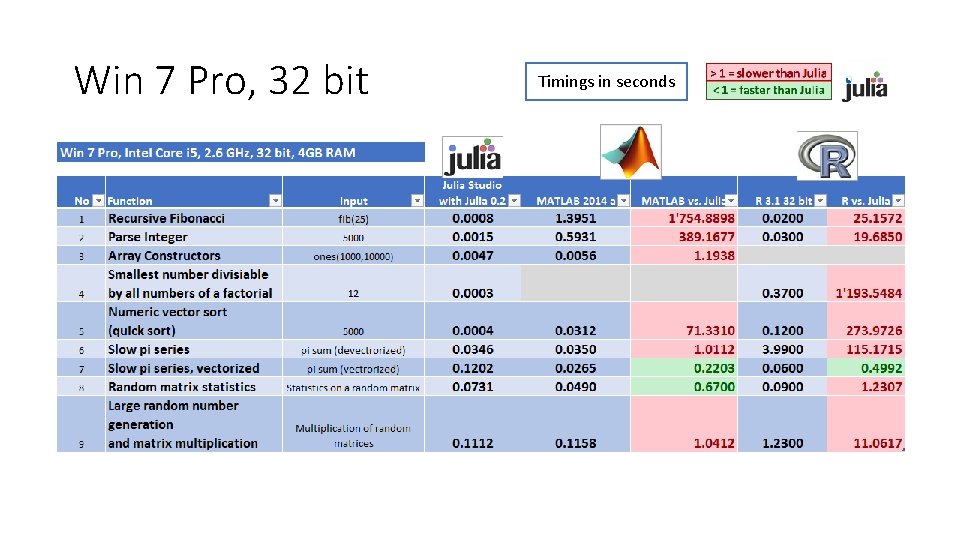
Win 7 Pro, 32 bit Timings in seconds
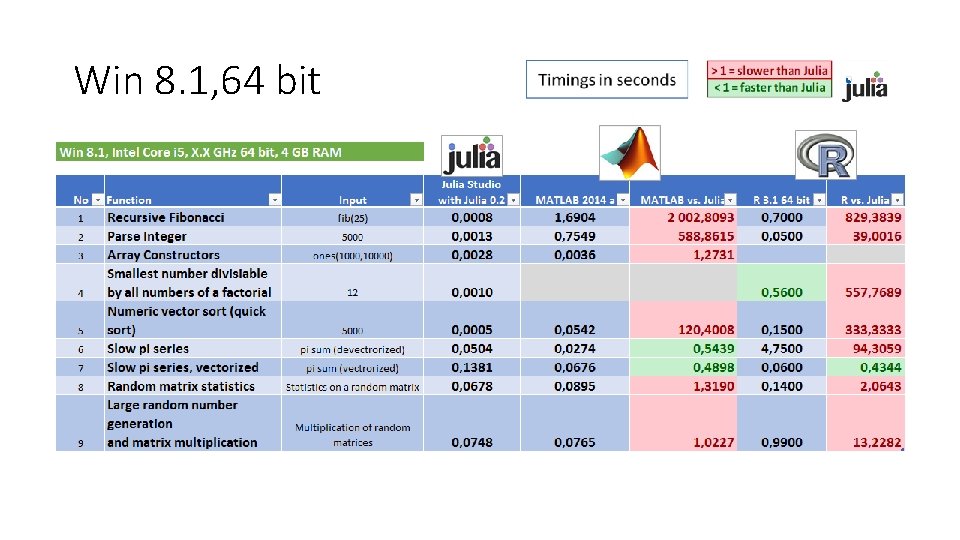
Win 8. 1, 64 bit
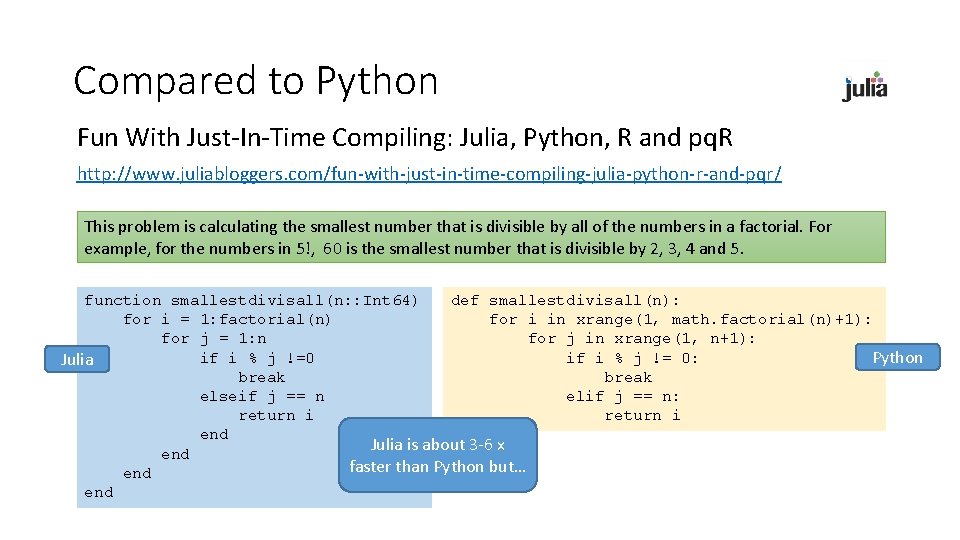
Compared to Python Fun With Just-In-Time Compiling: Julia, Python, R and pq. R http: //www. juliabloggers. com/fun-with-just-in-time-compiling-julia-python-r-and-pqr/ This problem is calculating the smallest number that is divisible by all of the numbers in a factorial. For example, for the numbers in 5!, 60 is the smallest number that is divisible by 2, 3, 4 and 5. function smallestdivisall(n: : Int 64) def smallestdivisall(n): for i = 1: factorial(n) for i in xrange(1, math. factorial(n)+1): for j = 1: n for j in xrange(1, n+1): if i % j !=0 if i % j != 0: Python Julia break elseif j == n elif j == n: return i end Julia is about 3 -6 x end faster than Python but… end
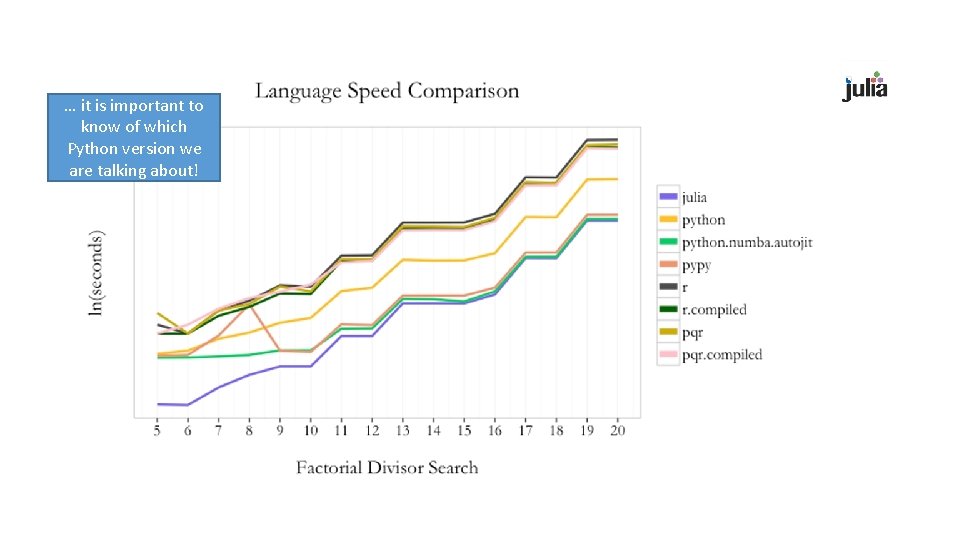
… it is important to know of which Python version we are talking about!
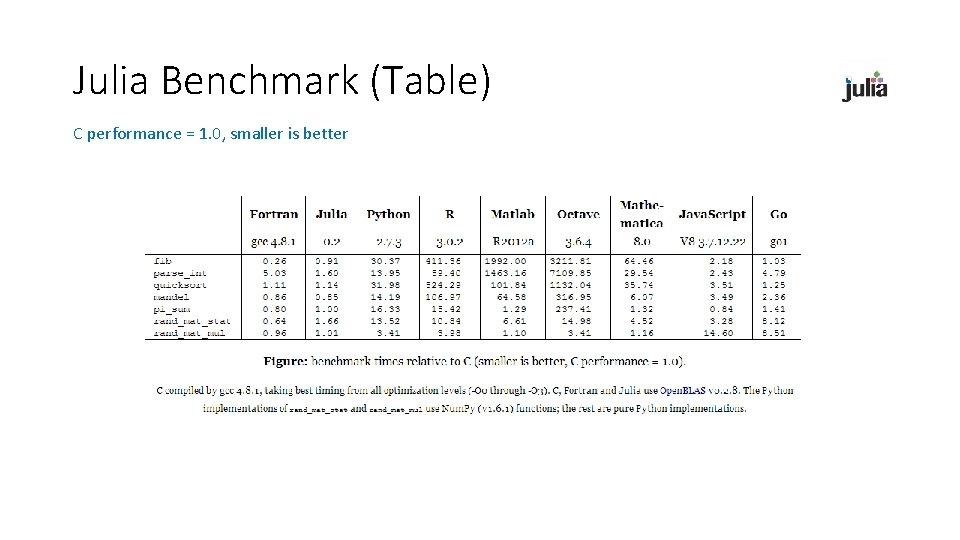
Julia Benchmark (Table) C performance = 1. 0, smaller is better
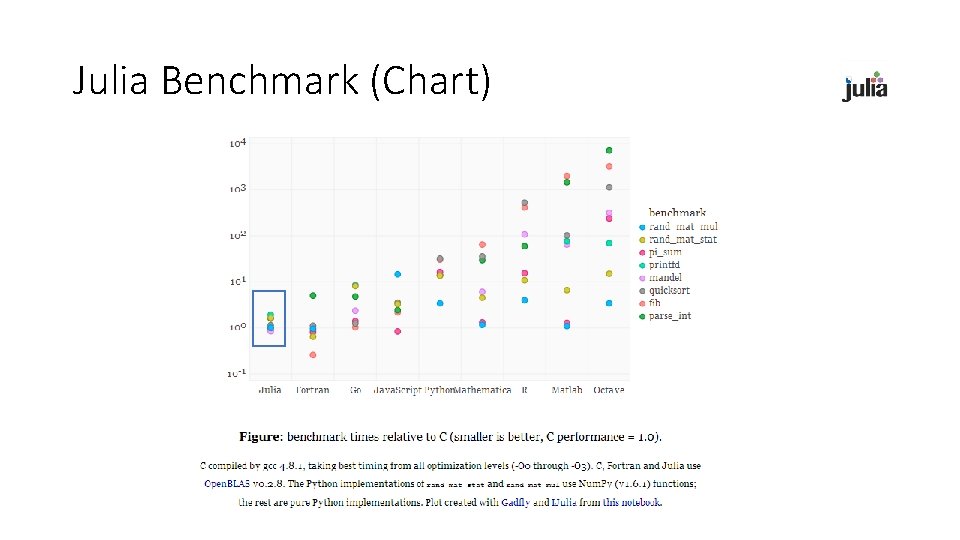
Julia Benchmark (Chart)
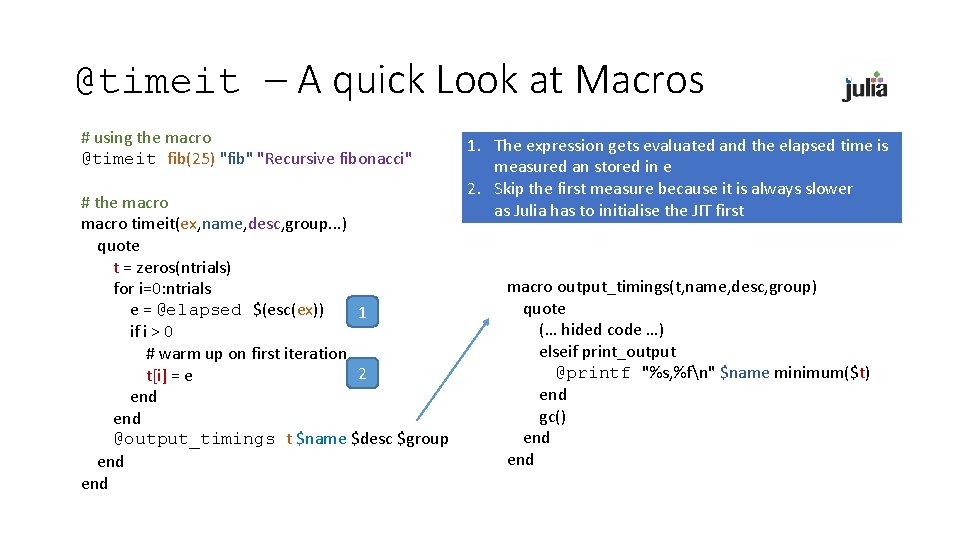
@timeit – A quick Look at Macros # using the macro @timeit fib(25) "fib" "Recursive fibonacci" # the macro timeit(ex, name, desc, group. . . ) quote t = zeros(ntrials) for i=0: ntrials e = @elapsed $(esc(ex)) 1 if i > 0 # warm up on first iteration 2 t[i] = e end @output_timings t $name $desc $group end 1. The expression gets evaluated and the elapsed time is measured an stored in e 2. Skip the first measure because it is always slower as Julia has to initialise the JIT first macro output_timings(t, name, desc, group) quote (… hided code …) elseif print_output @printf "%s, %fn" $name minimum($t) end gc() end
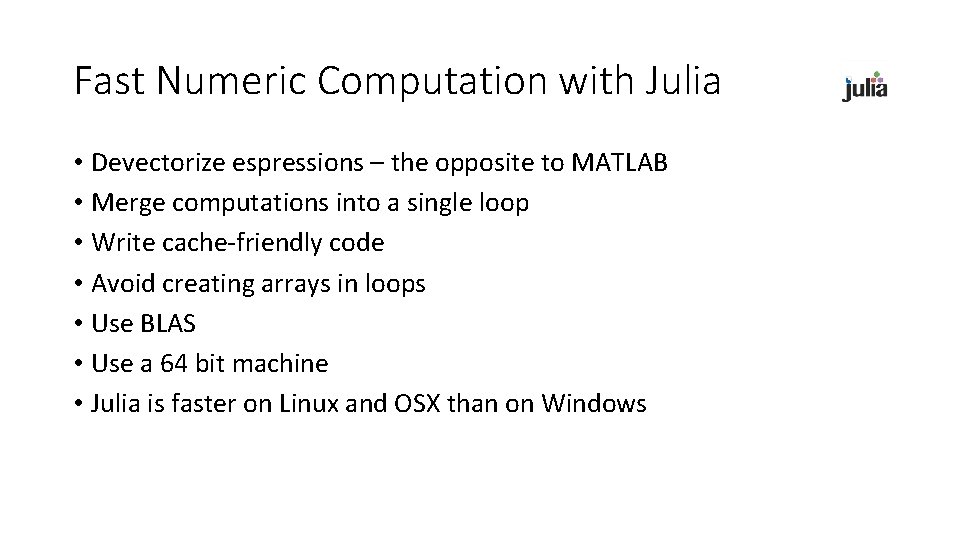
Fast Numeric Computation with Julia • Devectorize espressions – the opposite to MATLAB • Merge computations into a single loop • Write cache-friendly code • Avoid creating arrays in loops • Use BLAS • Use a 64 bit machine • Julia is faster on Linux and OSX than on Windows
Invitation: NLP++ Community • NLP++ • A programming language for Natural Language Processing • Based on C++ • Much easier to learn and understand than C++ • Visual. Text: An NLP++ IDE • NLP++ Community (http: //dev. nlpcloud. net/) • Growing the number of NLP++ developers • Sharing tips & tricks • Improve our analyzers • If enough interest exists: New Meet. Up Group for NLP++ in Zurich!
Start with Julia
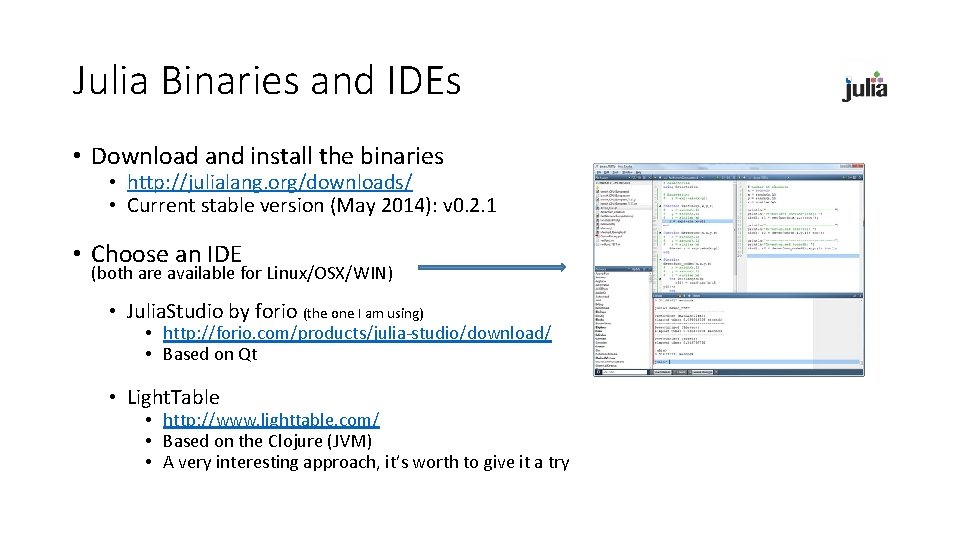
Julia Binaries and IDEs • Download and install the binaries • http: //julialang. org/downloads/ • Current stable version (May 2014): v 0. 2. 1 • Choose an IDE (both are available for Linux/OSX/WIN) • Julia. Studio by forio (the one I am using) • http: //forio. com/products/julia-studio/download/ • Based on Qt • Light. Table • http: //www. lighttable. com/ • Based on the Clojure (JVM) • A very interesting approach, it’s worth to give it a try
Julia Docs The Julia Manual: http: //docs. julialang. org/en/release-0. 2/manual/ The Julia Standard Library: http: //docs. julialang. org/en/release-0. 2/stdlib/ Available Packages: http: //docs. julialang. org/en/release-0. 2/packages/packagelist/
Julia Community Google Groups • • julia-users julia-dev julia-stats julia-opt Very friendly and no question is too basic. We use Git. Hub to track our source code and for tracking and discussing issues and commits. There is also a list of packages for Julia, many of which are also hosted on and developed using Git. Hub.
Let’s Start with Julia • Vectors, Matrices, Arrays • Simple Calculations • Functions • Devectorization • Types http: //learnxinyminutes. com/docs/julia/
Where does Julia come from?
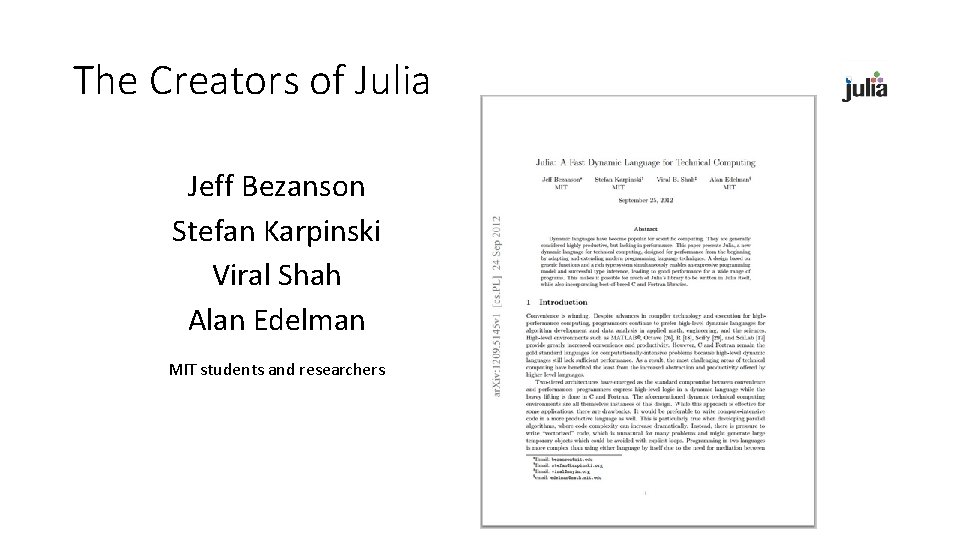
The Creators of Julia Jeff Bezanson Stefan Karpinski Viral Shah Alan Edelman MIT students and researchers
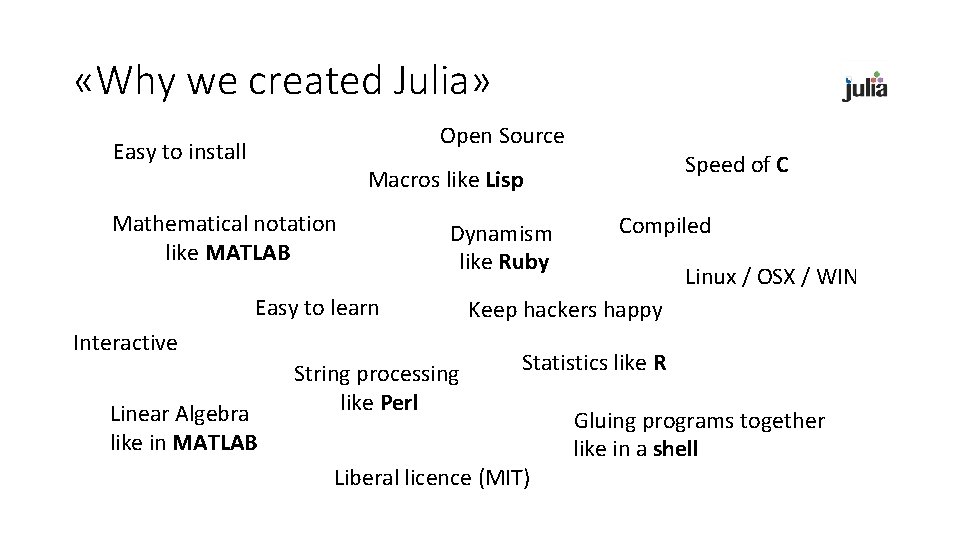
«Why we created Julia» Open Source Easy to install Speed of C Macros like Lisp Mathematical notation like MATLAB Dynamism like Ruby Easy to learn Interactive Linear Algebra like in MATLAB String processing like Perl Compiled Linux / OSX / WIN Keep hackers happy Statistics like R Liberal licence (MIT) Gluing programs together like in a shell
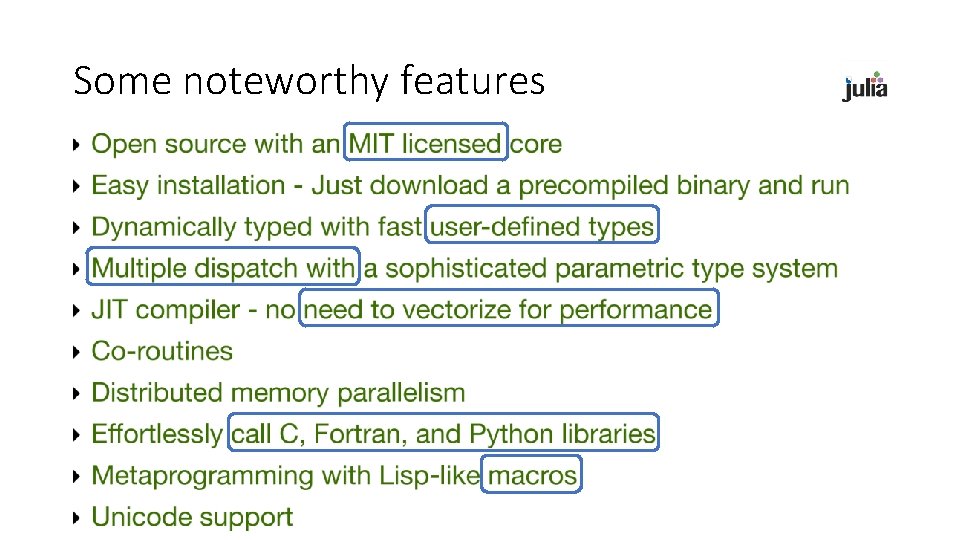
Some noteworthy features