NSW Energy Savings Scheme Gas technologies for industry
- Slides: 14
NSW Energy Savings Scheme Gas technologies for industry in NSW’s Energy Savings Scheme Jeremy Tarbox, OEH
Summary • Introduction to the ESS – History of ESS – Deemed and Project-based Methods – Gas in the ESS • Developing new Gas Efficiency Deemed activities – Gas Efficiency Funding program – Load Utilisation Factor and operating hours in industry • High Efficiency Appliances for Business (HEAB) case studies: – Steam boiler and water heater replacements – Oxygen trim and burner installation – Economiser installation – TDS control and heat recovery installation GAS TECHNOLOGIES FOR INDUSTRY IN ESS 2
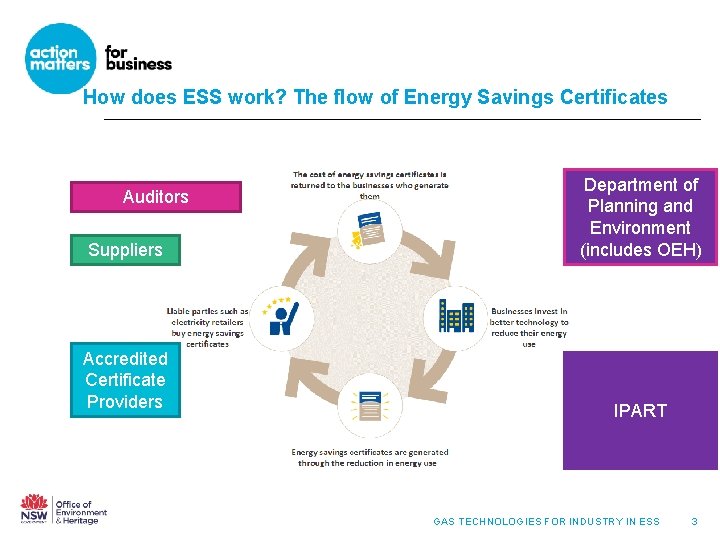
How does ESS work? The flow of Energy Savings Certificates Auditors Suppliers Accredited Certificate Providers Department of Planning and Environment (includes OEH) IPART GAS TECHNOLOGIES FOR INDUSTRY IN ESS 3
Energy Savings Scheme history and 2015 Review • ESS history – Commenced in 2009, covers commercial, industrial, residential sectors – ESS is main NSW policy to achieve energy savings • Estimated 17, 000 GWh savings worth ~$2. 6 billion in bill savings to 2025 • 43 million ESCs expected to be created to 2025 • Schemes around Australia: also Vic, SA, ACT. • 2015 ESS Review – ESS extended until 2025 • existing technologies will be updated; new technologies included. – Gas savings included (E. g. natural gas and LPG) – Fuel switching between electricity and gas allowed in some cases GAS TECHNOLOGIES FOR INDUSTRY IN ESS 4
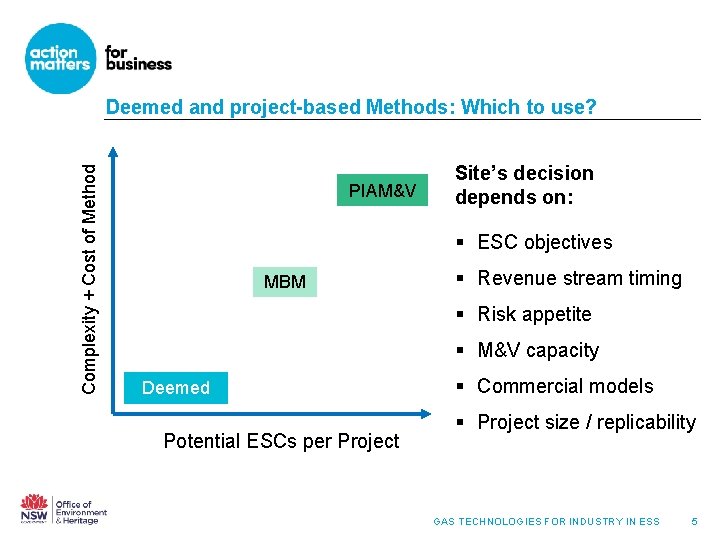
Complexity + Cost of Method Deemed and project-based Methods: Which to use? PIAM&V Site’s decision depends on: § ESC objectives MBM § Revenue stream timing § Risk appetite § M&V capacity Deemed Potential ESCs per Project § Commercial models § Project size / replicability GAS TECHNOLOGIES FOR INDUSTRY IN ESS 5
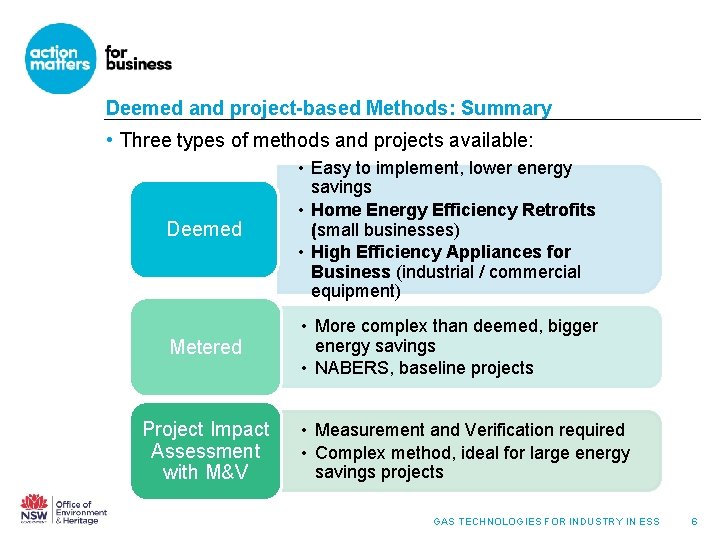
Deemed and project-based Methods: Summary • Three types of methods and projects available: Deemed • Easy to implement, lower energy savings • Home Energy Efficiency Retrofits (small businesses) • High Efficiency Appliances for Business (industrial / commercial equipment) Metered • More complex than deemed, bigger energy savings • NABERS, baseline projects Project Impact Assessment with M&V • Measurement and Verification required • Complex method, ideal for large energy savings projects GAS TECHNOLOGIES FOR INDUSTRY IN ESS 6
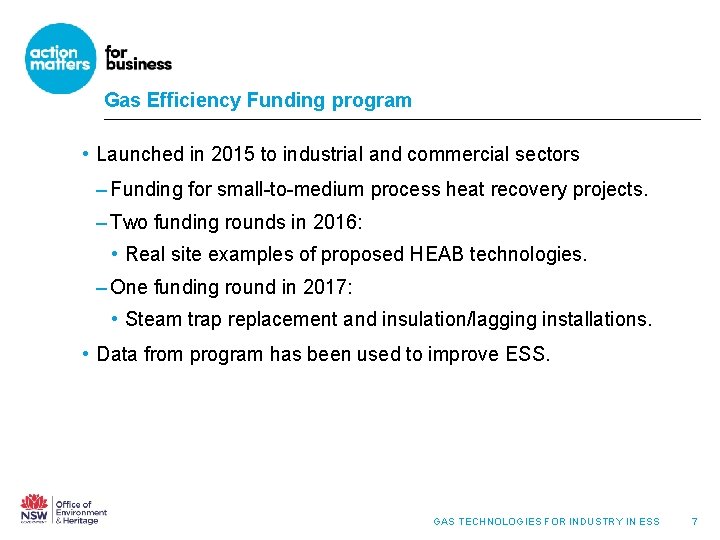
Gas Efficiency Funding program • Launched in 2015 to industrial and commercial sectors – Funding for small-to-medium process heat recovery projects. – Two funding rounds in 2016: • Real site examples of proposed HEAB technologies. – One funding round in 2017: • Steam trap replacement and insulation/lagging installations. • Data from program has been used to improve ESS. GAS TECHNOLOGIES FOR INDUSTRY IN ESS 7
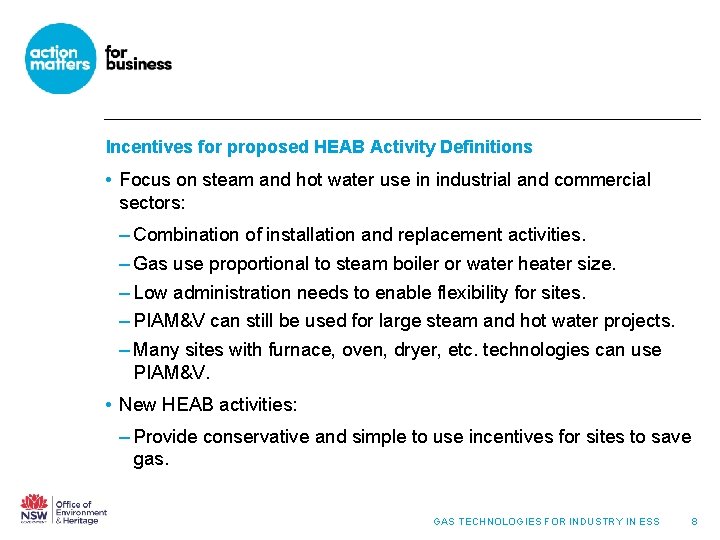
Incentives for proposed HEAB Activity Definitions • Focus on steam and hot water use in industrial and commercial sectors: – Combination of installation and replacement activities. – Gas use proportional to steam boiler or water heater size. – Low administration needs to enable flexibility for sites. – PIAM&V can still be used for large steam and hot water projects. – Many sites with furnace, oven, dryer, etc. technologies can use PIAM&V. • New HEAB activities: – Provide conservative and simple to use incentives for sites to save gas. GAS TECHNOLOGIES FOR INDUSTRY IN ESS 8
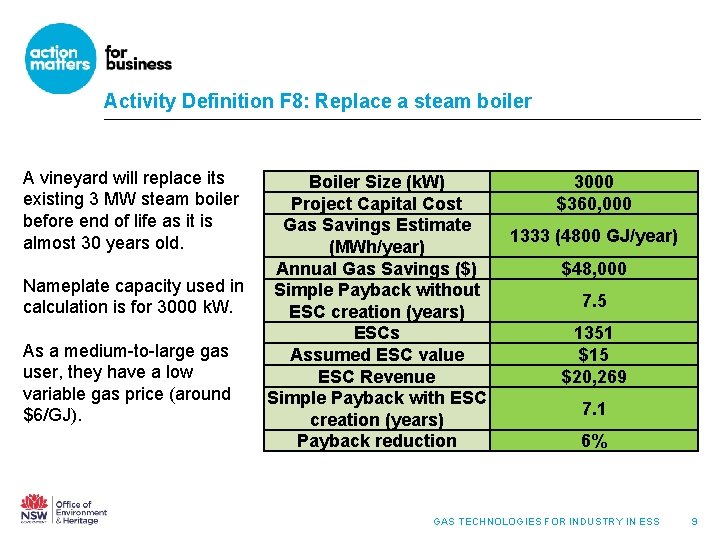
Activity Definition F 8: Replace a steam boiler A vineyard will replace its existing 3 MW steam boiler before end of life as it is almost 30 years old. Nameplate capacity used in calculation is for 3000 k. W. As a medium-to-large gas user, they have a low variable gas price (around $6/GJ). Boiler Size (k. W) Project Capital Cost Gas Savings Estimate (MWh/year) Annual Gas Savings ($) Simple Payback without ESC creation (years) ESCs Assumed ESC value ESC Revenue Simple Payback with ESC creation (years) Payback reduction 3000 $360, 000 1333 (4800 GJ/year) $48, 000 7. 5 1351 $15 $20, 269 7. 1 6% GAS TECHNOLOGIES FOR INDUSTRY IN ESS 9
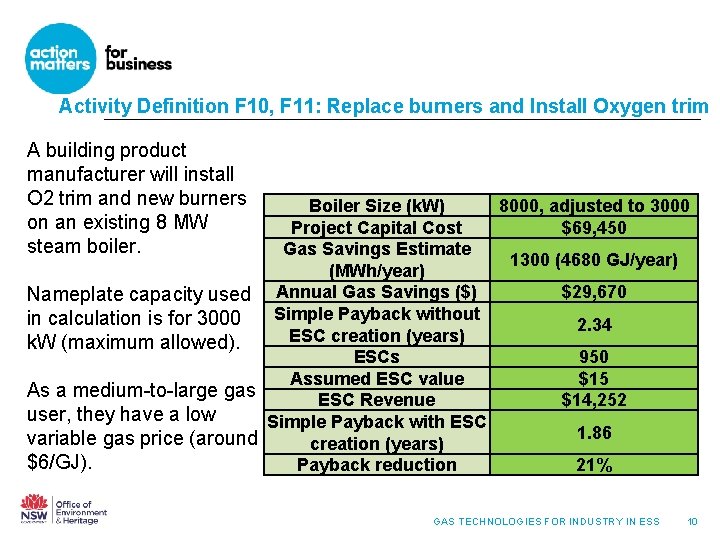
Activity Definition F 10, F 11: Replace burners and Install Oxygen trim A building product manufacturer will install O 2 trim and new burners on an existing 8 MW steam boiler. Boiler Size (k. W) 8000, adjusted to 3000 Project Capital Cost $69, 450 Gas Savings Estimate 1300 (4680 GJ/year) (MWh/year) $29, 670 Nameplate capacity used Annual Gas Savings ($) Simple Payback without in calculation is for 3000 2. 34 ESC creation (years) k. W (maximum allowed). ESCs 950 Assumed ESC value $15 As a medium-to-large gas ESC Revenue $14, 252 user, they have a low Simple Payback with ESC 1. 86 variable gas price (around creation (years) $6/GJ). Payback reduction 21% GAS TECHNOLOGIES FOR INDUSTRY IN ESS 10
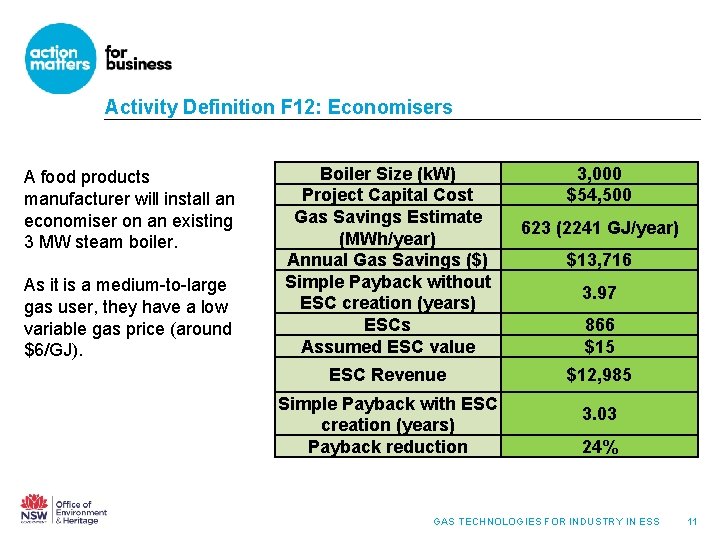
Activity Definition F 12: Economisers A food products manufacturer will install an economiser on an existing 3 MW steam boiler. As it is a medium-to-large gas user, they have a low variable gas price (around $6/GJ). Boiler Size (k. W) Project Capital Cost Gas Savings Estimate (MWh/year) Annual Gas Savings ($) Simple Payback without ESC creation (years) ESCs Assumed ESC value ESC Revenue Simple Payback with ESC creation (years) Payback reduction 3, 000 $54, 500 623 (2241 GJ/year) $13, 716 3. 97 866 $15 $12, 985 3. 03 24% GAS TECHNOLOGIES FOR INDUSTRY IN ESS 11
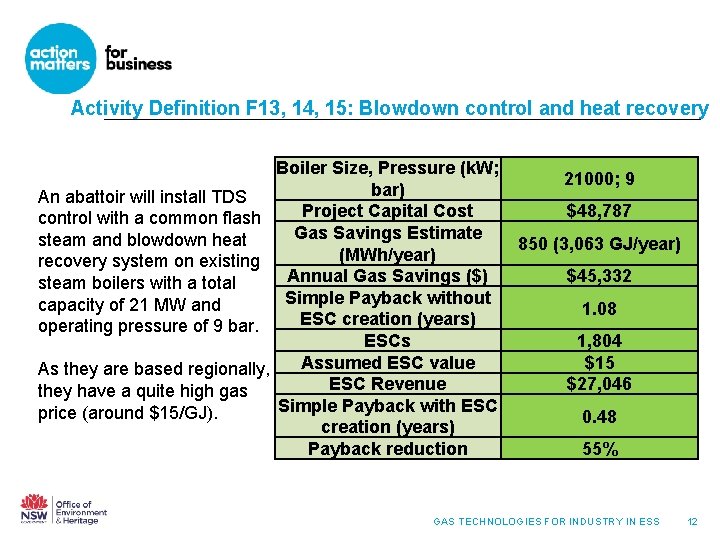
Activity Definition F 13, 14, 15: Blowdown control and heat recovery An abattoir will install TDS control with a common flash steam and blowdown heat recovery system on existing steam boilers with a total capacity of 21 MW and operating pressure of 9 bar. As they are based regionally, they have a quite high gas price (around $15/GJ). Boiler Size, Pressure (k. W; bar) Project Capital Cost Gas Savings Estimate (MWh/year) Annual Gas Savings ($) Simple Payback without ESC creation (years) ESCs Assumed ESC value ESC Revenue Simple Payback with ESC creation (years) Payback reduction 21000; 9 $48, 787 850 (3, 063 GJ/year) $45, 332 1. 08 1, 804 $15 $27, 046 0. 48 55% GAS TECHNOLOGIES FOR INDUSTRY IN ESS 12
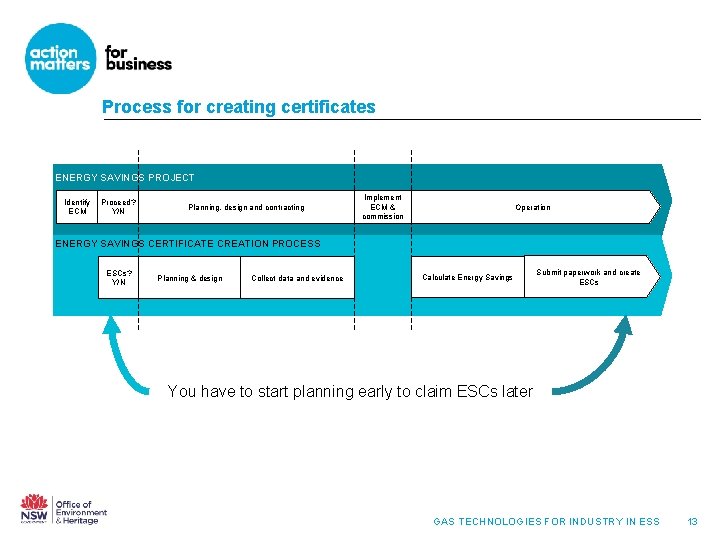
Process for creating certificates ENERGY SAVINGS PROJECT Identify ECM Proceed? Y/N Planning, design and contracting Implement ECM & commission Operation ENERGY SAVINGS CERTIFICATE CREATION PROCESS ESCs? Y/N Planning & design Collect data and evidence Calculate Energy Savings Submit paperwork and create ESCs You have to start planning early to claim ESCs later GAS TECHNOLOGIES FOR INDUSTRY IN ESS 13
Where to next? ESS Website http: //www. ess. nsw. gov. au/Home ACP Directory http: //acpdirectory. environment. nsw. gov. au/ OEH Website http: //www. environment. nsw. gov. au/business/energy -savings-scheme. htm GAS TECHNOLOGIES FOR INDUSTRY IN ESS 14