New Measures in the Medicare Health Outcomes Survey
- Slides: 12
New Measures in the Medicare Health Outcomes Survey – Preventive Care and Vulnerability Judy Ng, Sarah Scholle, Lok Wong April 9, 2008
Agenda • • • Purpose Quality measures HOS study population Defining vulnerability status Results Implications NEW MEASURES IN THE MEDICARE HEALTH OUTCOMES SURVEY 2
Purpose Examine whether receipt of preventive counseling or care for prevalent conditions in elderly Medicare managed care enrollees varies by vulnerable status NEW MEASURES IN THE MEDICARE HEALTH OUTCOMES SURVEY 3
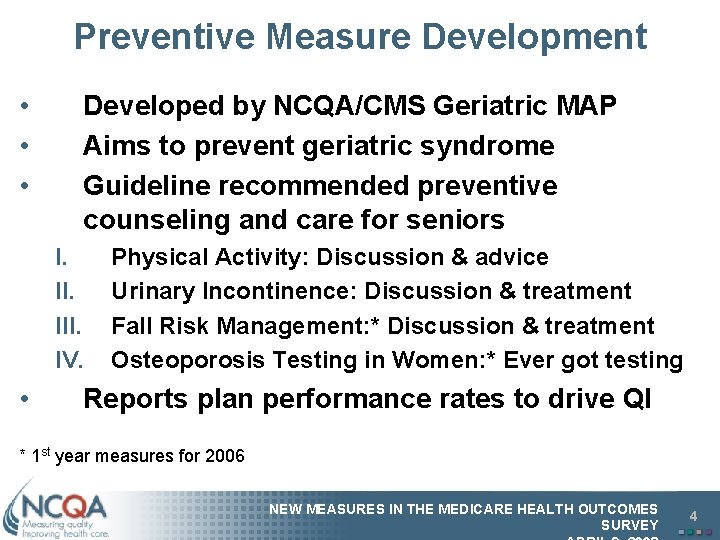
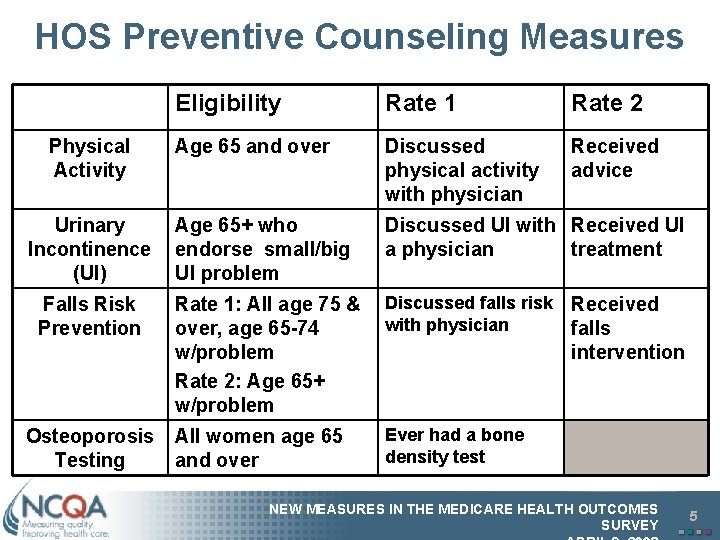
Preventive Measure Development • • • Developed by NCQA/CMS Geriatric MAP Aims to prevent geriatric syndrome Guideline recommended preventive counseling and care for seniors I. III. IV. • Physical Activity: Discussion & advice Urinary Incontinence: Discussion & treatment Fall Risk Management: * Discussion & treatment Osteoporosis Testing in Women: * Ever got testing Reports plan performance rates to drive QI * 1 st year measures for 2006 NEW MEASURES IN THE MEDICARE HEALTH OUTCOMES SURVEY 4
HOS Preventive Counseling Measures Eligibility Rate 1 Rate 2 Age 65 and over Discussed physical activity with physician Received advice Urinary Incontinence (UI) Age 65+ who endorse small/big UI problem Discussed UI with Received UI a physician treatment Falls Risk Prevention Rate 1: All age 75 & over, age 65 -74 w/problem Rate 2: Age 65+ w/problem Discussed falls risk with physician All women age 65 and over Ever had a bone density test Physical Activity Osteoporosis Testing Received falls intervention NEW MEASURES IN THE MEDICARE HEALTH OUTCOMES SURVEY 5
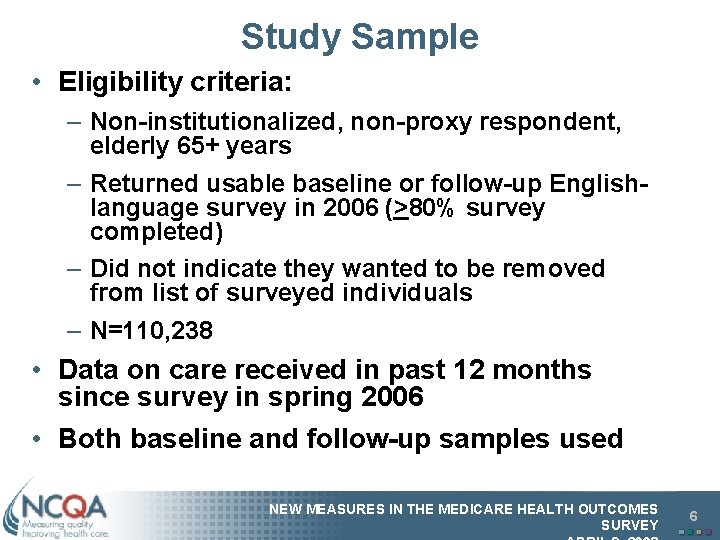
Study Sample • Eligibility criteria: – Non-institutionalized, non-proxy respondent, elderly 65+ years – Returned usable baseline or follow-up Englishlanguage survey in 2006 (>80% survey completed) – Did not indicate they wanted to be removed from list of surveyed individuals – N=110, 238 • Data on care received in past 12 months since survey in spring 2006 • Both baseline and follow-up samples used NEW MEASURES IN THE MEDICARE HEALTH OUTCOMES SURVEY 6
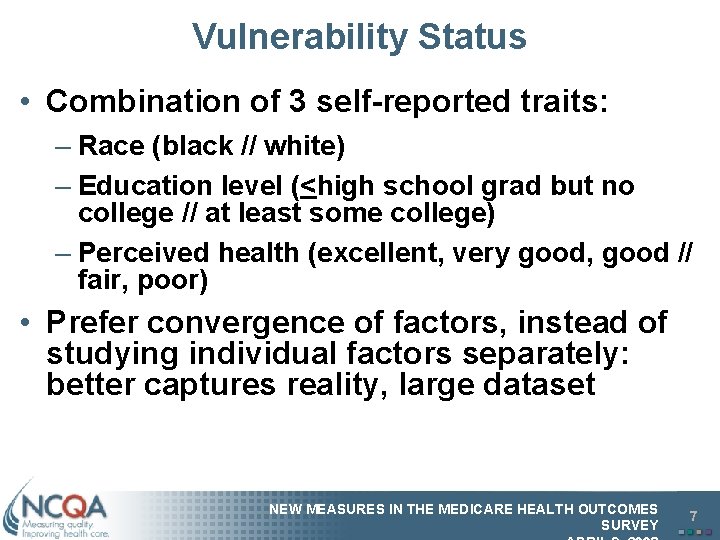
Vulnerability Status • Combination of 3 self-reported traits: – Race (black // white) – Education level (<high school grad but no college // at least some college) – Perceived health (excellent, very good, good // fair, poor) • Prefer convergence of factors, instead of studying individual factors separately: better captures reality, large dataset NEW MEASURES IN THE MEDICARE HEALTH OUTCOMES SURVEY 7
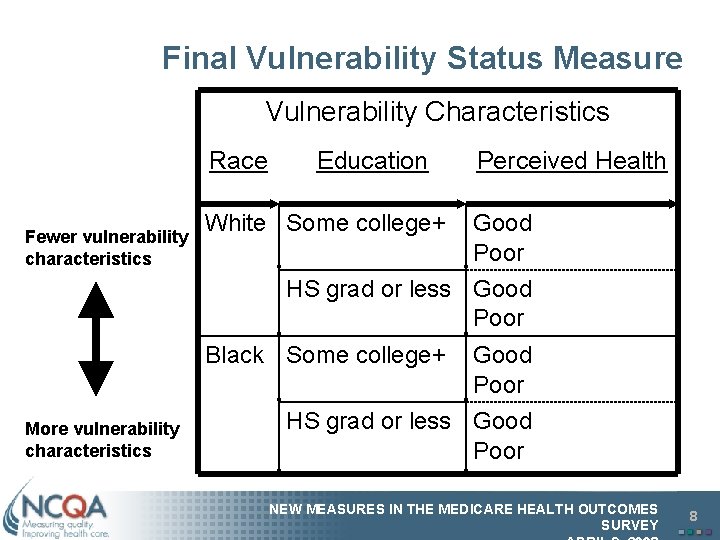
Final Vulnerability Status Measure Vulnerability Characteristics Race Fewer vulnerability characteristics Education White Some college+ Perceived Health Good Poor HS grad or less Good Poor Black Some college+ More vulnerability characteristics Good Poor HS grad or less Good Poor NEW MEASURES IN THE MEDICARE HEALTH OUTCOMES SURVEY 8
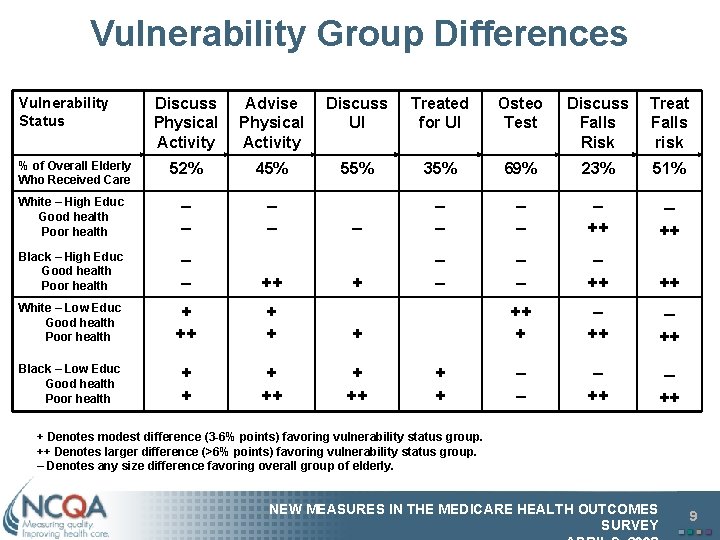
Vulnerability Group Differences Vulnerability Status Discuss Physical Activity Advise Physical Activity Discuss UI Treated for UI Osteo Test Discuss Falls Risk Treat Falls risk 52% 45% 55% 35% 69% 23% 51% White – High Educ Good health Poor health – – – – ++ Black – High Educ Good health Poor health – – ++ + – – – ++ ++ White – Low Educ Good health Poor health + ++ + – ++ Black – Low Educ Good health Poor health + ++ – – – ++ % of Overall Elderly Who Received Care + + – ++ + Denotes modest difference (3 -6% points) favoring vulnerability status group. ++ Denotes larger difference (>6% points) favoring vulnerability status group. – Denotes any size difference favoring overall group of elderly. NEW MEASURES IN THE MEDICARE HEALTH OUTCOMES SURVEY 9
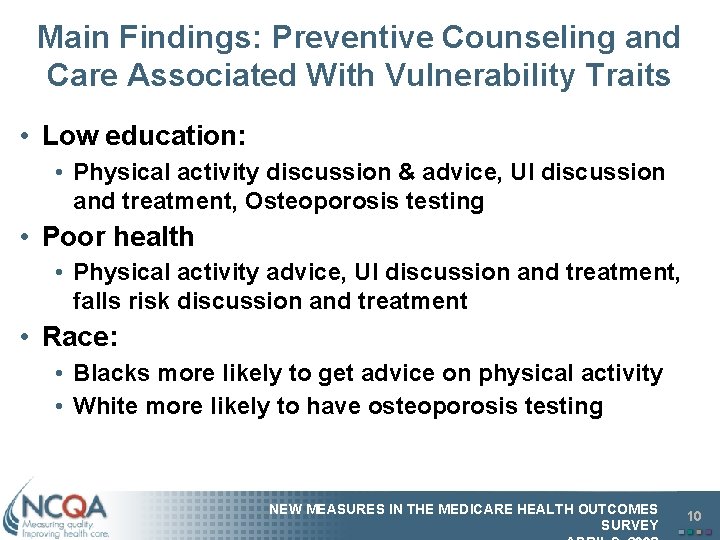
Main Findings: Preventive Counseling and Care Associated With Vulnerability Traits • Low education: • Physical activity discussion & advice, UI discussion and treatment, Osteoporosis testing • Poor health • Physical activity advice, UI discussion and treatment, falls risk discussion and treatment • Race: • Blacks more likely to get advice on physical activity • White more likely to have osteoporosis testing NEW MEASURES IN THE MEDICARE HEALTH OUTCOMES SURVEY 10
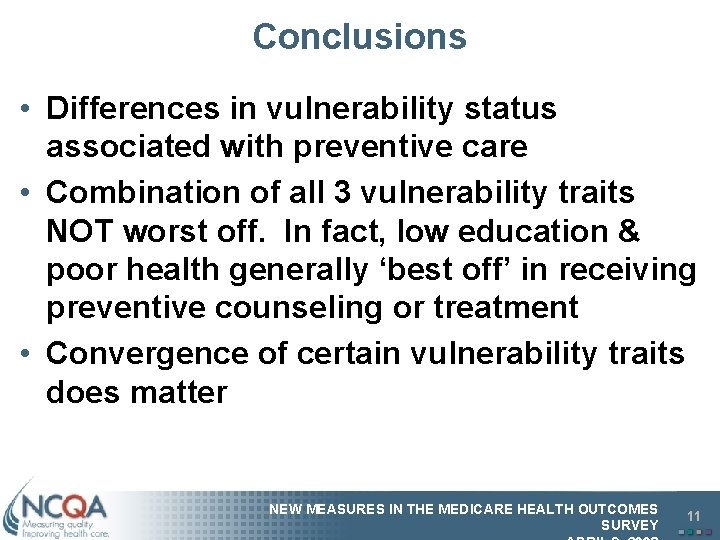
Conclusions • Differences in vulnerability status associated with preventive care • Combination of all 3 vulnerability traits NOT worst off. In fact, low education & poor health generally ‘best off’ in receiving preventive counseling or treatment • Convergence of certain vulnerability traits does matter NEW MEASURES IN THE MEDICARE HEALTH OUTCOMES SURVEY 11
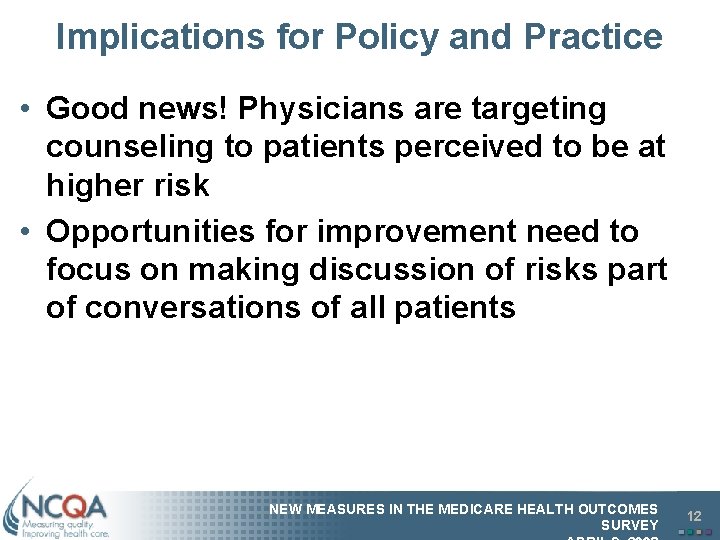
Implications for Policy and Practice • Good news! Physicians are targeting counseling to patients perceived to be at higher risk • Opportunities for improvement need to focus on making discussion of risks part of conversations of all patients NEW MEASURES IN THE MEDICARE HEALTH OUTCOMES SURVEY 12