Network Information Flow in Network of Queues 1
- Slides: 19
Network Information Flow in Network of Queues 1 Phillipa Gill, Zongpeng Li, 2 Anirban Mahanti, Jingxiang Luo, and Carey Williamson Department of Computer Science University of Calgary 1 Now at University of Toronto. 2 Now at IIT Delhi, India. IEEE/ACM MASCOTS 2008 1
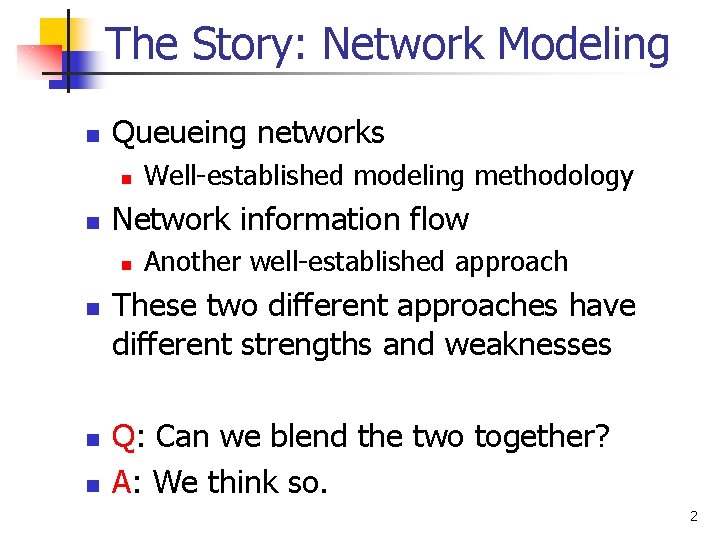
The Story: Network Modeling n Queueing networks n n Network information flow n n Well-established modeling methodology Another well-established approach These two different approaches have different strengths and weaknesses Q: Can we blend the two together? A: We think so. 2
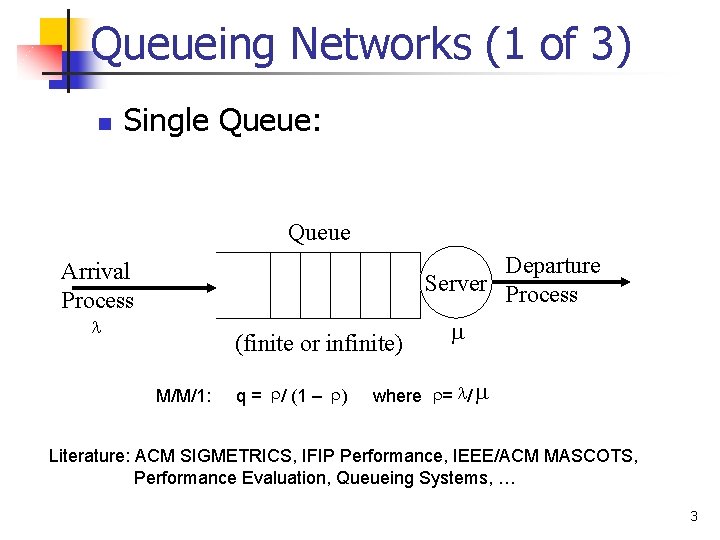
Queueing Networks (1 of 3) n Single Queue: Queue Departure Server Process Arrival Process (finite or infinite) M/M/1: q = / (1 – ) where = / Literature: ACM SIGMETRICS, IFIP Performance, IEEE/ACM MASCOTS, Performance Evaluation, Queueing Systems, … 3
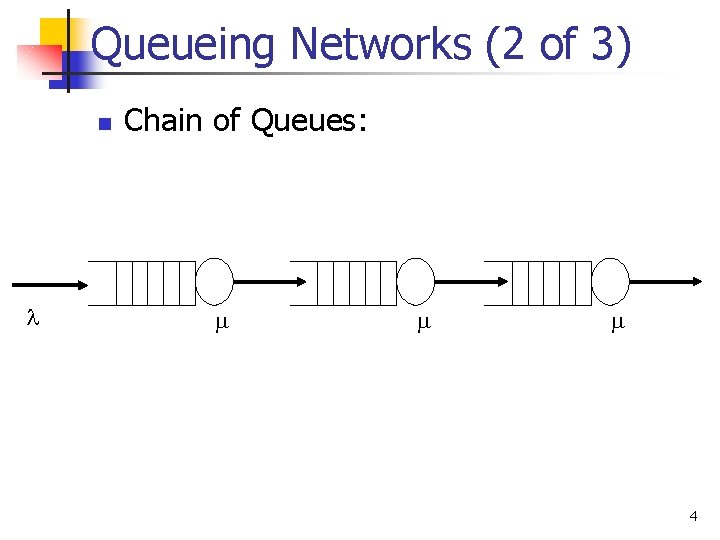
Queueing Networks (2 of 3) n Chain of Queues: 4
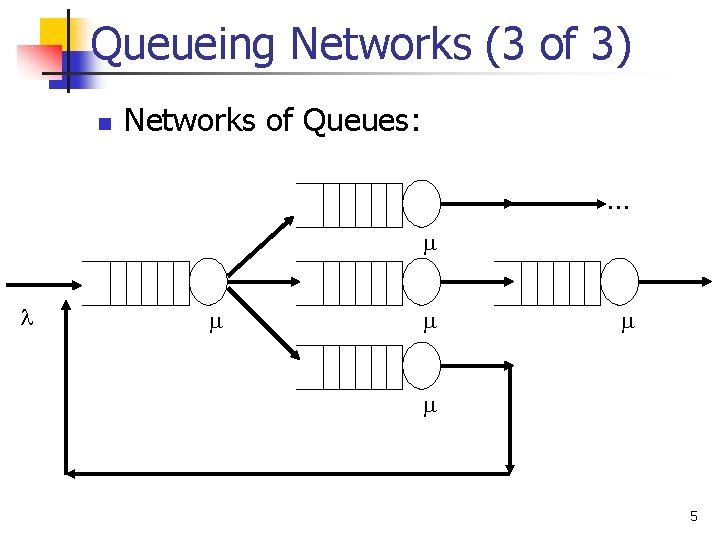
Queueing Networks (3 of 3) n Networks of Queues: . . . 5
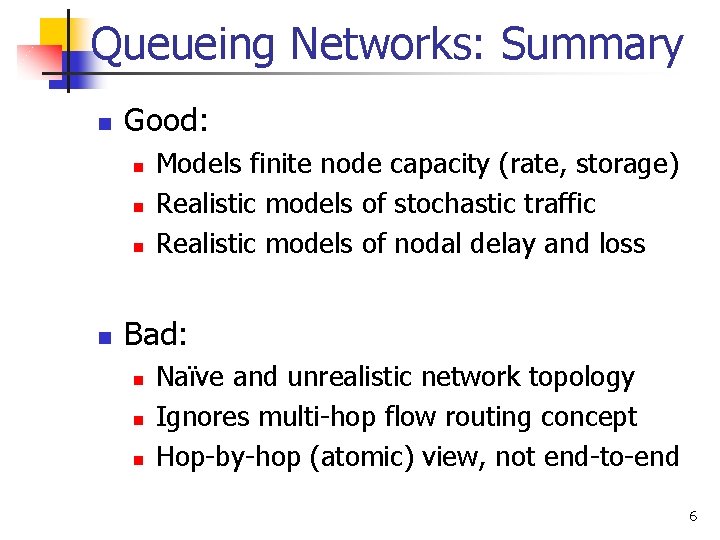
Queueing Networks: Summary n Good: n n Models finite node capacity (rate, storage) Realistic models of stochastic traffic Realistic models of nodal delay and loss Bad: n n n Naïve and unrealistic network topology Ignores multi-hop flow routing concept Hop-by-hop (atomic) view, not end-to-end 6
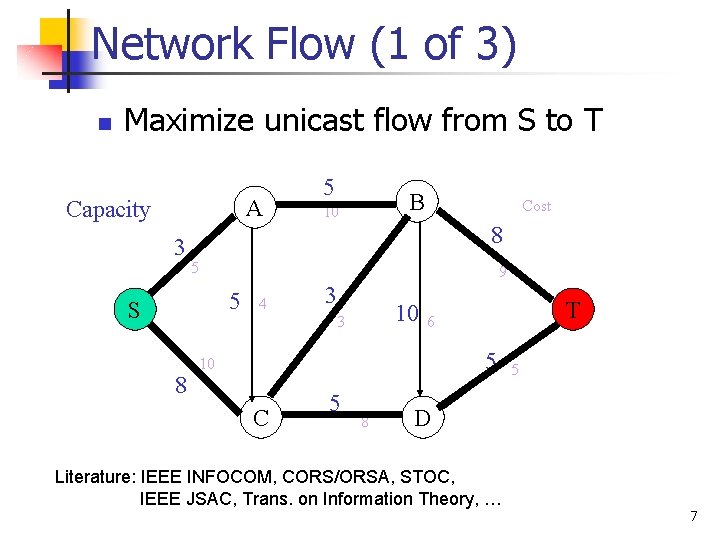
Network Flow (1 of 3) n Maximize unicast flow from S to T A Capacity 3 B 10 Cost 8 5 9 5 S 8 5 4 3 10 3 T 6 5 10 C 5 8 5 D Literature: IEEE INFOCOM, CORS/ORSA, STOC, IEEE JSAC, Trans. on Information Theory, … 7
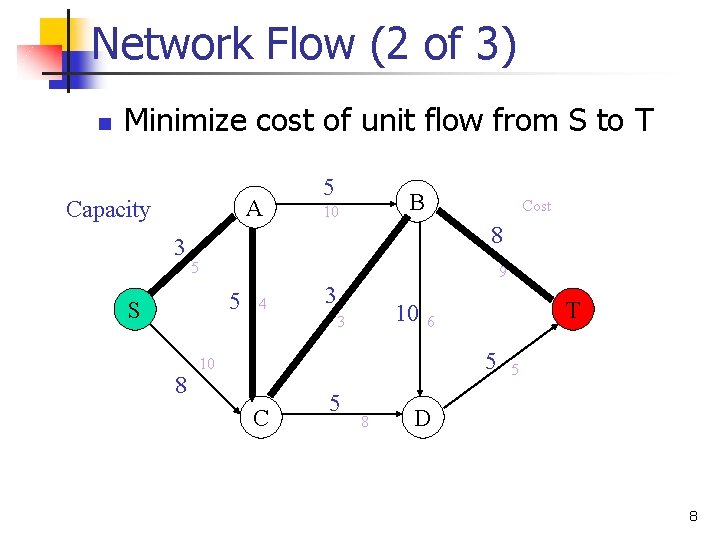
Network Flow (2 of 3) n Minimize cost of unit flow from S to T A Capacity 3 B 10 Cost 8 5 9 5 S 8 5 4 3 10 3 T 6 5 10 C 5 8 5 D 8
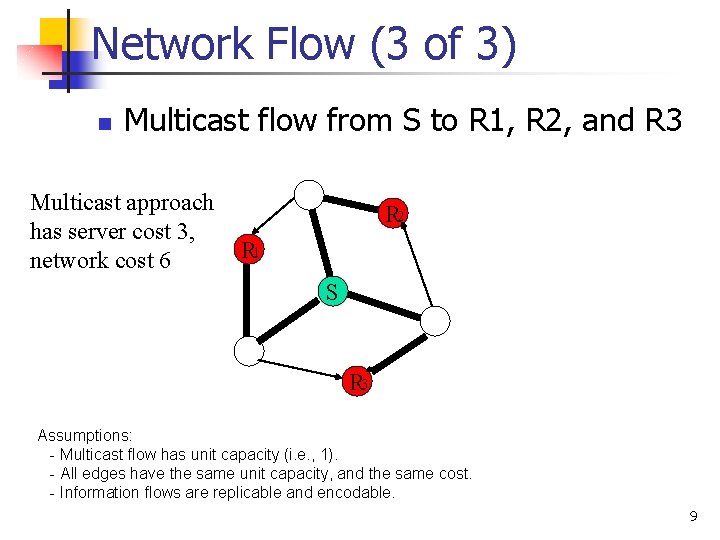
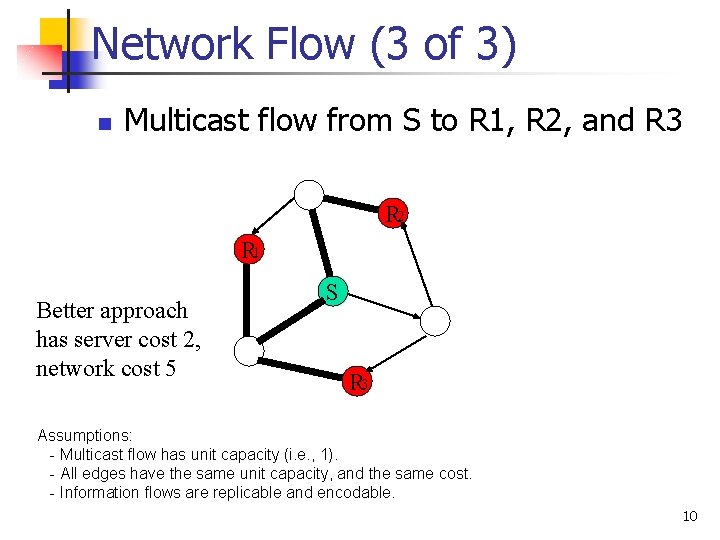
Network Flow (3 of 3) n Multicast flow from S to R 1, R 2, and R 3 Multicast approach has server cost 3, network cost 6 R 2 R 1 S R 3 Assumptions: - Multicast flow has unit capacity (i. e. , 1). - All edges have the same unit capacity, and the same cost. - Information flows are replicable and encodable. 9
Network Flow (3 of 3) n Multicast flow from S to R 1, R 2, and R 3 R 2 R 1 Better approach has server cost 2, network cost 5 S R 3 Assumptions: - Multicast flow has unit capacity (i. e. , 1). - All edges have the same unit capacity, and the same cost. - Information flows are replicable and encodable. 10
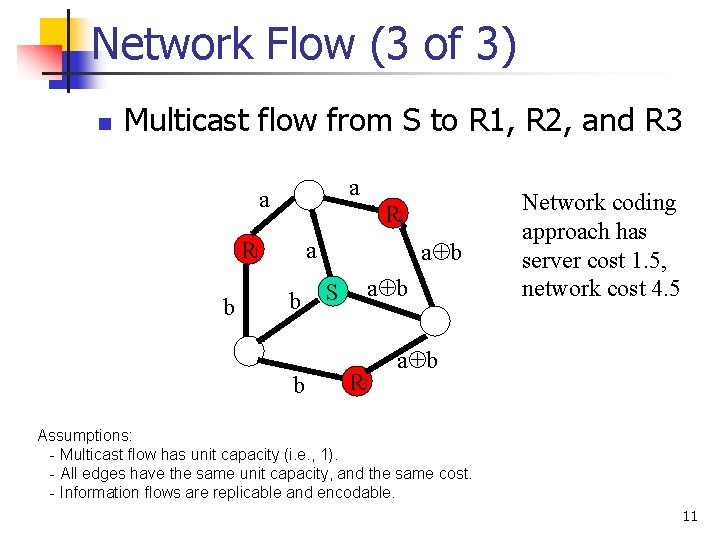
Network Flow (3 of 3) n Multicast flow from S to R 1, R 2, and R 3 a a R 2 R 1 b a b S a b R 3 Network coding approach has server cost 1. 5, network cost 4. 5 a b Assumptions: - Multicast flow has unit capacity (i. e. , 1). - All edges have the same unit capacity, and the same cost. - Information flows are replicable and encodable. 11
Network Flow: Summary n Good: n n Properly reflects network topology Captures the multi-hop flow routing aspect Can exploit benefits of network coding Bad: n n n Implicitly assumes nodes are very powerful Ignores nodal processing delay Ignores queueing delay and loss 12
Research Questions n Can we combine the two approaches, so that we get the best of both worlds? n n n Non-trivial network topologies Multi-hop routing Stochastic traffic Nodal processing, queuing delay, loss. . . Does such an approach lead to new, interesting, and different insights, compared to classic network information flow or queueing network models? 13
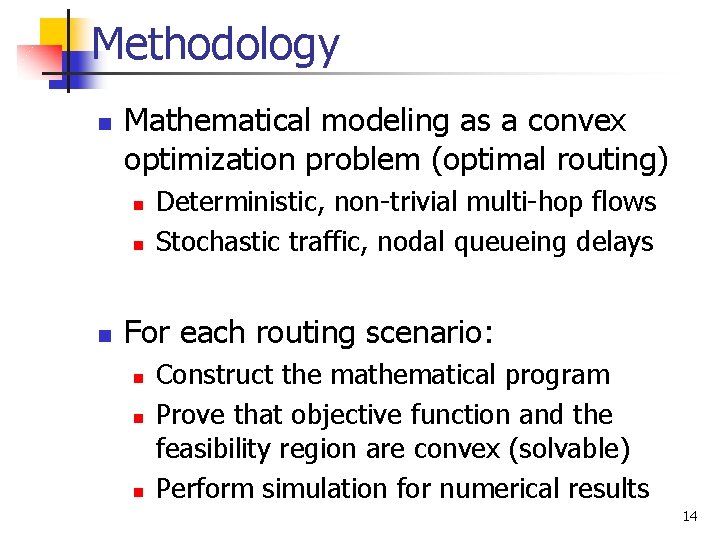
Methodology n Mathematical modeling as a convex optimization problem (optimal routing) n n n Deterministic, non-trivial multi-hop flows Stochastic traffic, nodal queueing delays For each routing scenario: n n n Construct the mathematical program Prove that objective function and the feasibility region are convex (solvable) Perform simulation for numerical results 14
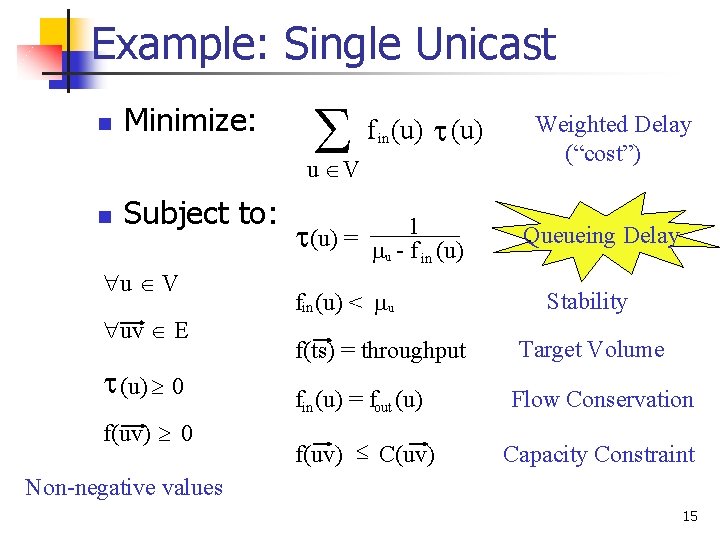
Example: Single Unicast n Minimize: f in (u) u V n Subject to: u V uv E (u) 0 f(uv) 0 (u) = 1 u - f in (u) fin (u) < u f(ts) = throughput Weighted Delay (“cost”) Queueing Delay Stability Target Volume fin (u) = fout (u) Flow Conservation f(uv) C(uv) Capacity Constraint Non-negative values 15
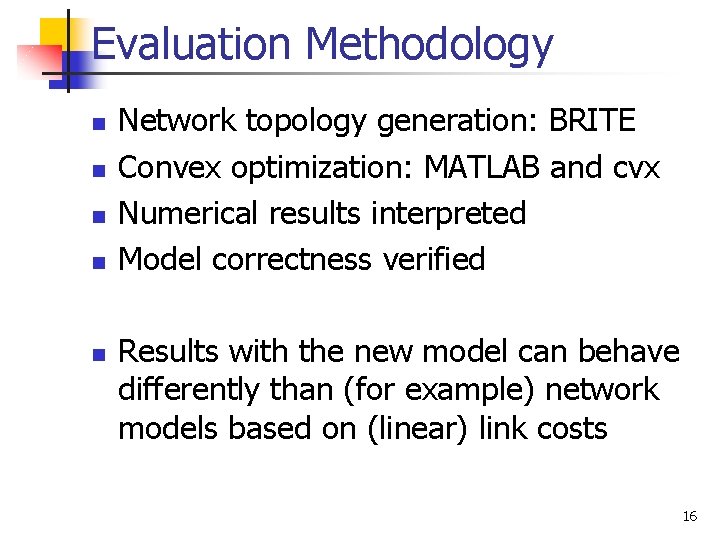
Evaluation Methodology n n n Network topology generation: BRITE Convex optimization: MATLAB and cvx Numerical results interpreted Model correctness verified Results with the new model can behave differently than (for example) network models based on (linear) link costs 16
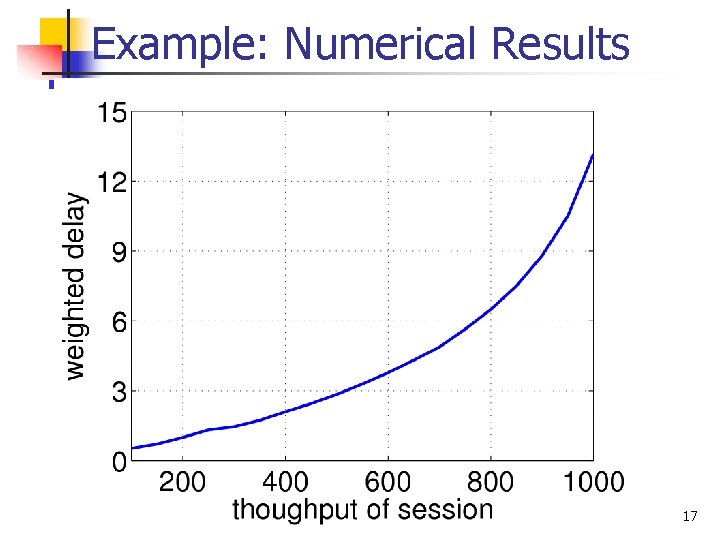
Example: Numerical Results 17
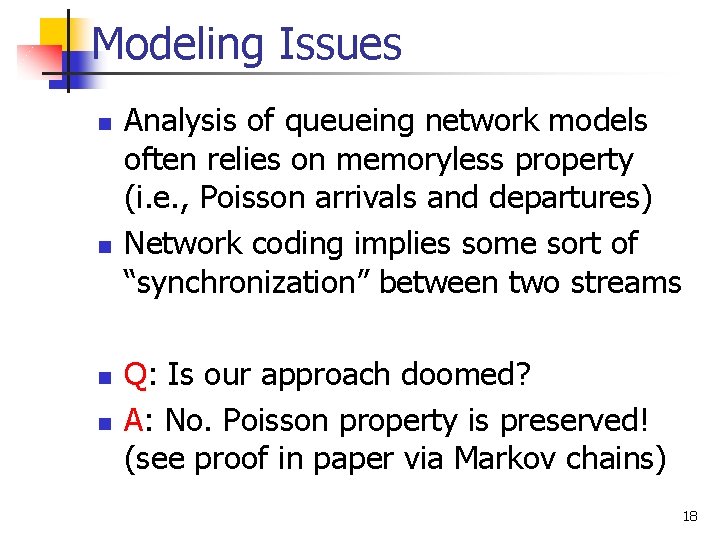
Modeling Issues n n Analysis of queueing network models often relies on memoryless property (i. e. , Poisson arrivals and departures) Network coding implies some sort of “synchronization” between two streams Q: Is our approach doomed? A: No. Poisson property is preserved! (see proof in paper via Markov chains) 18
Summary and Conclusions n n We proposed a new approach to network modeling, which combines classic network information flow with queueing networks Preliminary results with this model look very promising n n n Memoryless property preserved New insights on optimal routing Ending of the story is yet to be written! 19