National Institute for Occupational Safety and Health Hearing




- Slides: 47
National Institute for Occupational Safety and Health Hearing Conservation Program Best Practices Bryan Beamer, Ph. D, PE, CSP Research Engineer – Noise and Bioacoustics. Team NRASP Annual Safety Conference 2019 DEC 4 2019
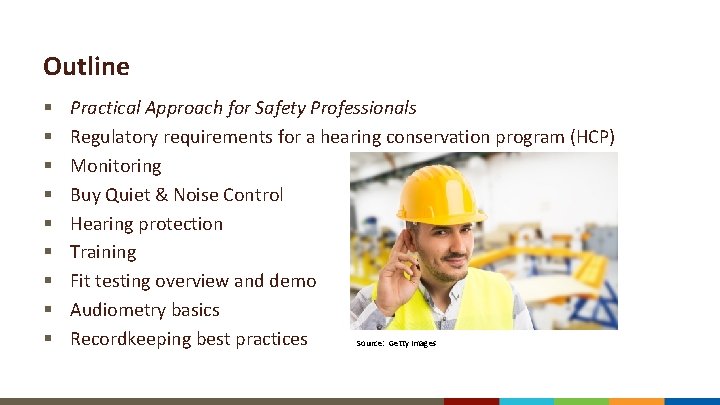
Outline § § § § § Practical Approach for Safety Professionals Regulatory requirements for a hearing conservation program (HCP) Monitoring Buy Quiet & Noise Control Hearing protection Training Fit testing overview and demo Audiometry basics Recordkeeping best practices Source: Getty Images
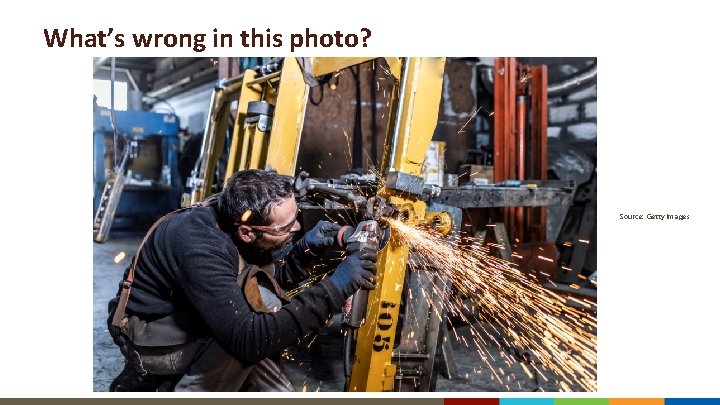
What’s wrong in this photo? Source: Getty Images
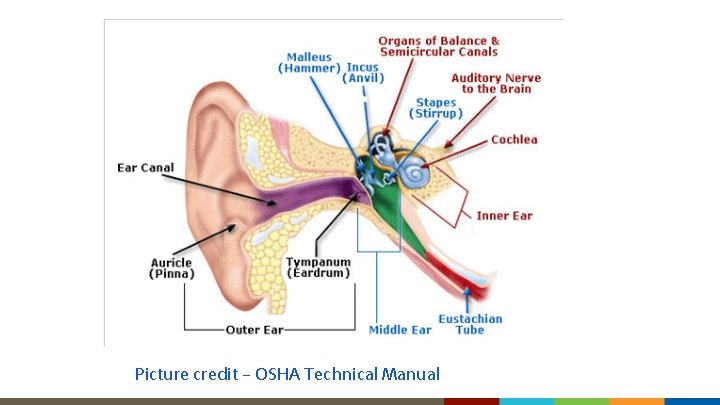
Picture credit – OSHA Technical Manual
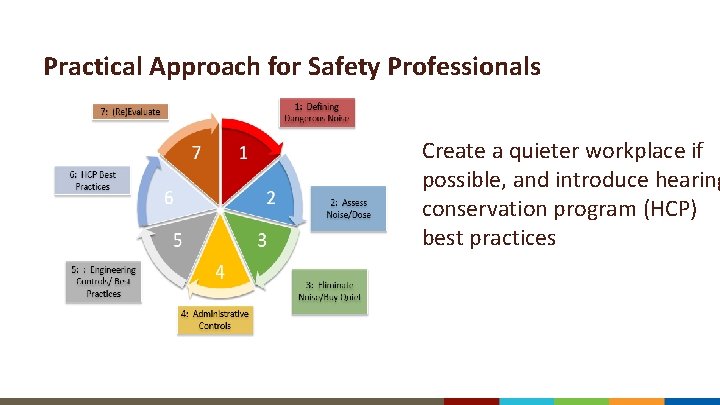
Practical Approach for Safety Professionals Create a quieter workplace if possible, and introduce hearing conservation program (HCP) best practices
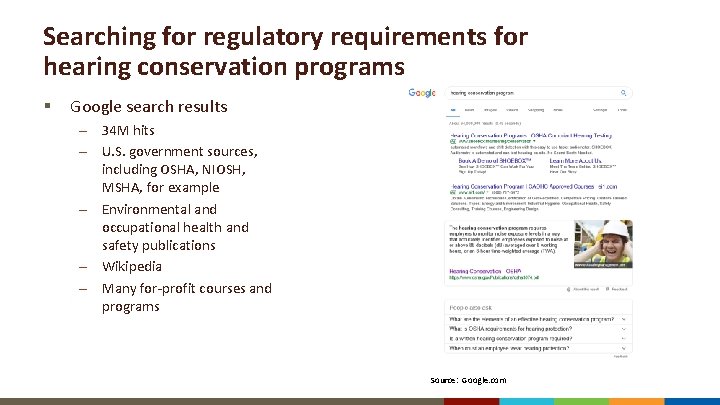
Searching for regulatory requirements for hearing conservation programs § Google search results – 34 M hits – U. S. government sources, including OSHA, NIOSH, MSHA, for example – Environmental and occupational health and safety publications – Wikipedia – Many for-profit courses and programs Source: Google. com
Regulatory requirements for hearing conservation programs § OSHA Regulation – 29 CFR 1910. 95 - Occupational noise exposure – 29 CFR 1910. 95(c)- Hearing conservation programs § OSHA - Hearing Conservation – – – Monitoring Audiometric testing and audiograms Hearing protection Training Recordkeeping https: //www. osha. gov/Publications/o sha 3074. pdf
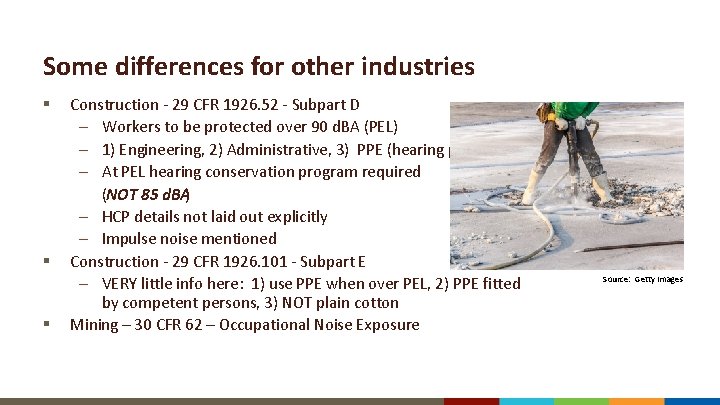
Some differences for other industries § § § Construction - 29 CFR 1926. 52 - Subpart D – Workers to be protected over 90 d. BA (PEL) – 1) Engineering, 2) Administrative, 3) PPE (hearing protection) – At PEL hearing conservation program required (NOT 85 d. BA) – HCP details not laid out explicitly – Impulse noise mentioned Construction - 29 CFR 1926. 101 - Subpart E – VERY little info here: 1) use PPE when over PEL, 2) PPE fitted by competent persons, 3) NOT plain cotton Mining – 30 CFR 62 – Occupational Noise Exposure Source: Getty Images
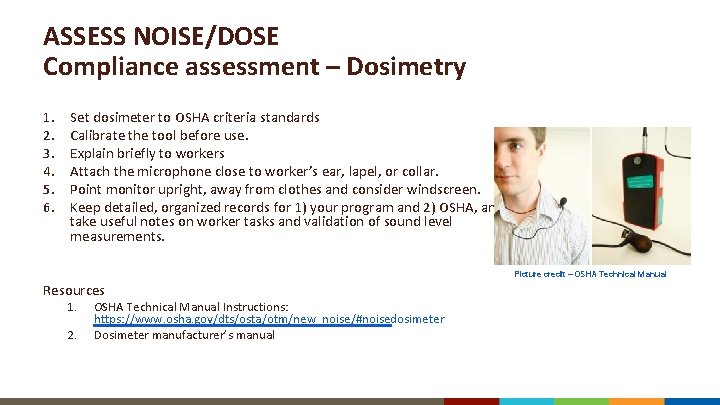
ASSESS NOISE/DOSE Compliance assessment – Dosimetry 1. 2. 3. 4. 5. 6. Set dosimeter to OSHA criteria standards Calibrate the tool before use. Explain briefly to workers Attach the microphone close to worker’s ear, lapel, or collar. Point monitor upright, away from clothes and consider windscreen. Keep detailed, organized records for 1) your program and 2) OSHA, and take useful notes on worker tasks and validation of sound level measurements. Picture credit – OSHA Technical Manual Resources 1. 2. OSHA Technical Manual Instructions: https: //www. osha. gov/dts/osta/otm/new_noise/#noisedosimeter Dosimeter manufacturer’s manual
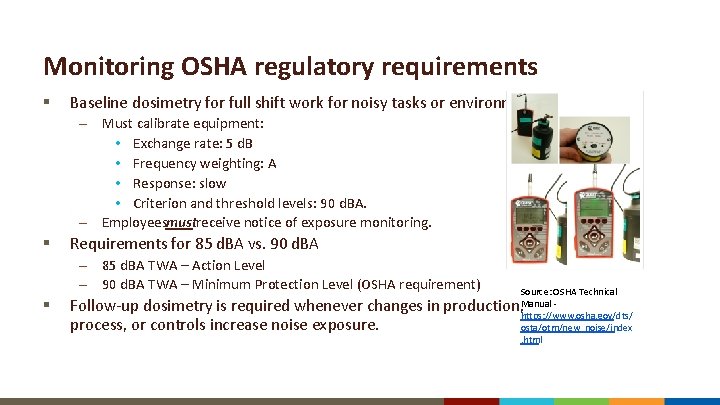
Monitoring OSHA regulatory requirements § Baseline dosimetry for full shift work for noisy tasks or environments – Must calibrate equipment: • Exchange rate: 5 d. B • Frequency weighting: A • Response: slow • Criterion and threshold levels: 90 d. BA. – Employeesmustreceive notice of exposure monitoring. § Requirements for 85 d. BA vs. 90 d. BA – 85 d. BA TWA – Action Level – 90 d. BA TWA – Minimum Protection Level (OSHA requirement) § Source: OSHA Technical Manual https: //www. osha. gov/dts/ osta/otm/new_noise/index. html Follow-up dosimetry is required whenever changes in production, process, or controls increase noise exposure.
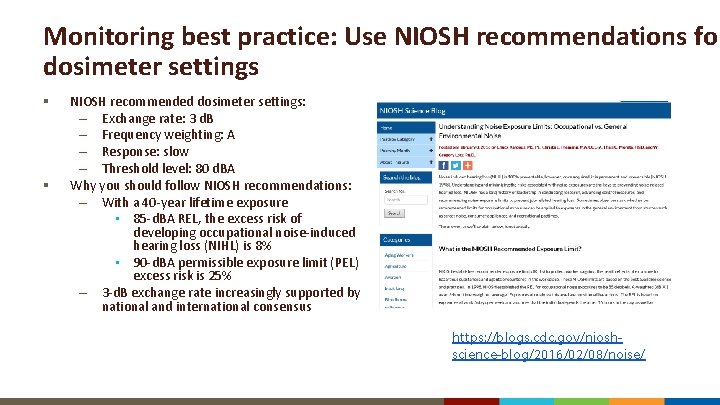
Monitoring best practice: Use NIOSH recommendations for dosimeter settings § § NIOSH recommended dosimeter settings: – Exchange rate: 3 d. B – Frequency weighting: A – Response: slow – Threshold level: 80 d. BA Why you should follow NIOSH recommendations: – With a 40 -year lifetime exposure • 85 -d. BA REL, the excess risk of developing occupational noise-induced hearing loss (NIHL) is 8% • 90 -d. BA permissible exposure limit (PEL) excess risk is 25% – 3 -d. B exchange rate increasingly supported by national and international consensus https: //blogs. cdc. gov/nioshscience-blog/2016/02/08/noise/
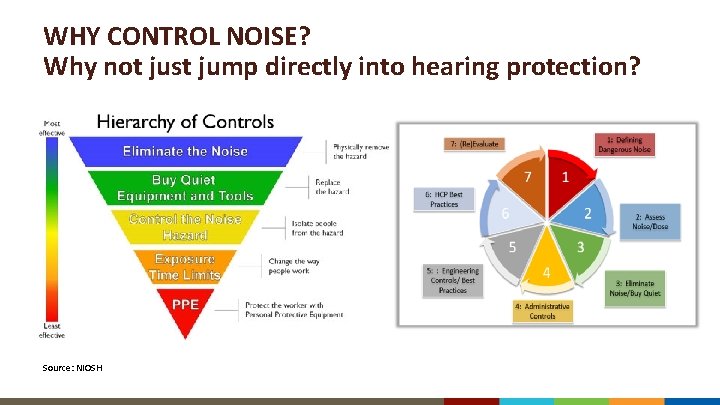
WHY CONTROL NOISE? Why not just jump directly into hearing protection? Source: NIOSH
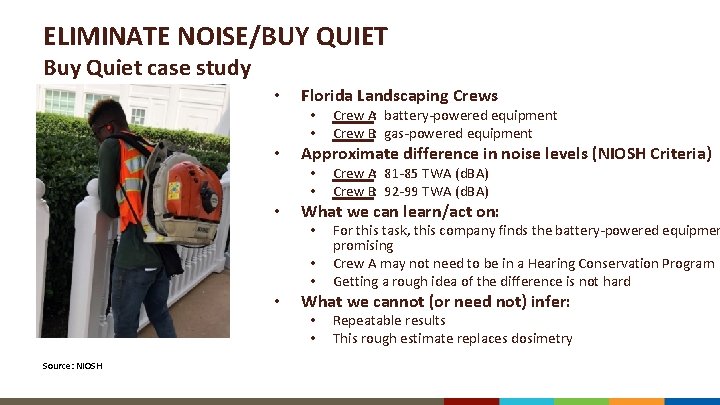
ELIMINATE NOISE/BUY QUIET Buy Quiet case study • Florida Landscaping Crews • • • Approximate difference in noise levels (NIOSH Criteria) • • • For this task, this company finds the battery-powered equipmen promising Crew A may not need to be in a Hearing Conservation Program Getting a rough idea of the difference is not hard What we cannot (or need not) infer: • • Source: NIOSH Crew A: 81 -85 TWA (d. BA) Crew B: 92 -99 TWA (d. BA) What we can learn/act on: • • Crew A: battery-powered equipment Crew B: gas-powered equipment Repeatable results This rough estimate replaces dosimetry
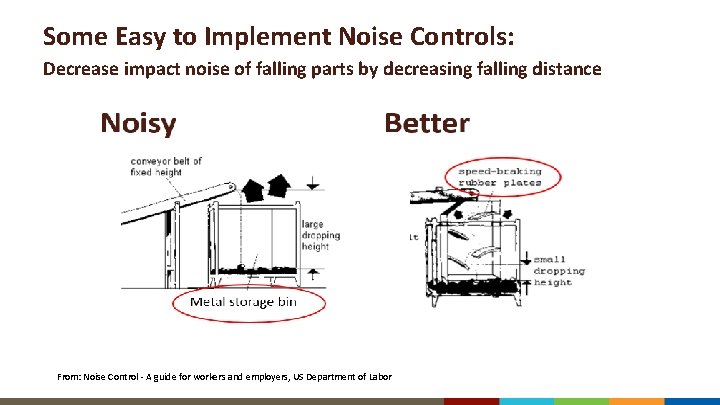
Some Easy to Implement Noise Controls: Decrease impact noise of falling parts by decreasing falling distance From: Noise Control - A guide for workers and employers, US Department of Labor
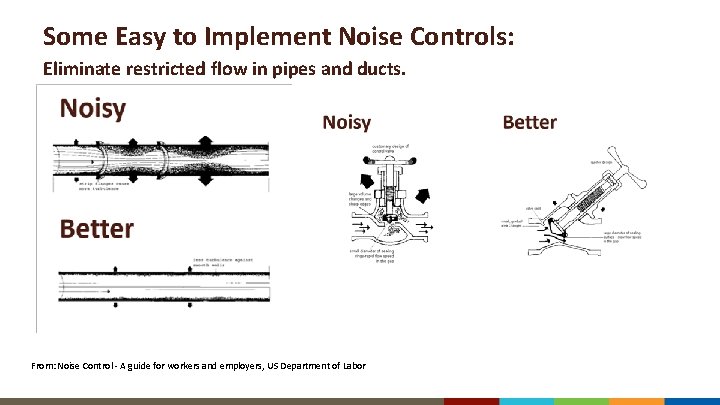
Some Easy to Implement Noise Controls: Eliminate restricted flow in pipes and ducts. From: Noise Control - A guide for workers and employers, US Department of Labor
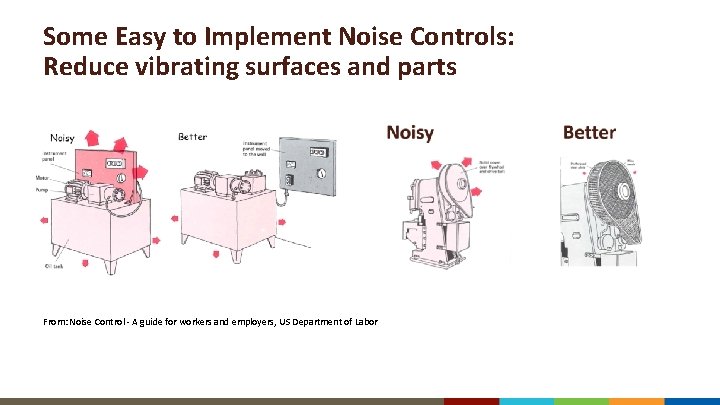
Some Easy to Implement Noise Controls: Reduce vibrating surfaces and parts From: Noise Control - A guide for workers and employers, US Department of Labor
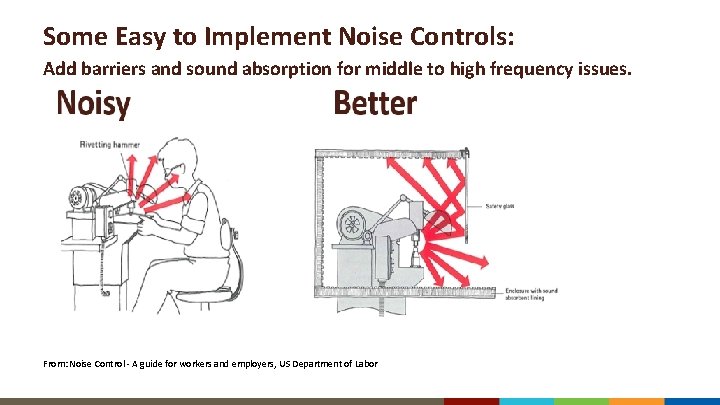
Some Easy to Implement Noise Controls: Add barriers and sound absorption for middle to high frequency issues. From: Noise Control - A guide for workers and employers, US Department of Labor
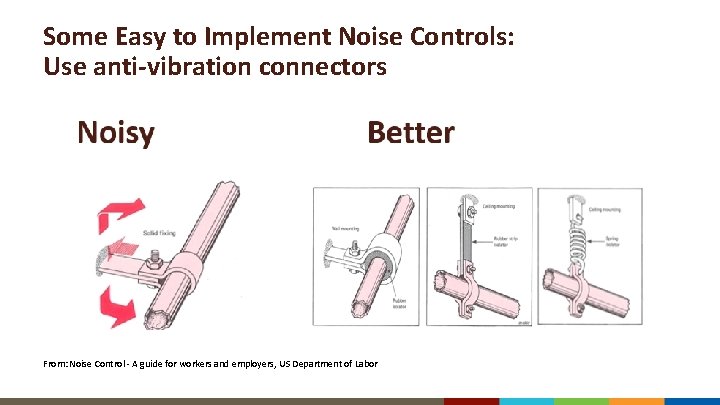
Some Easy to Implement Noise Controls: Use anti-vibration connectors From: Noise Control - A guide for workers and employers, US Department of Labor
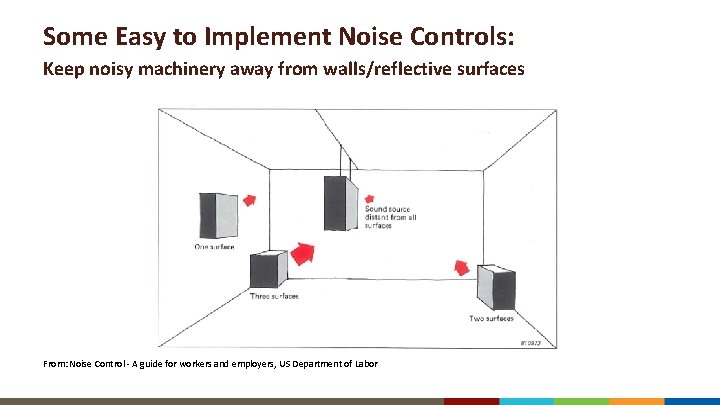
Some Easy to Implement Noise Controls: Keep noisy machinery away from walls/reflective surfaces From: Noise Control - A guide for workers and employers, US Department of Labor
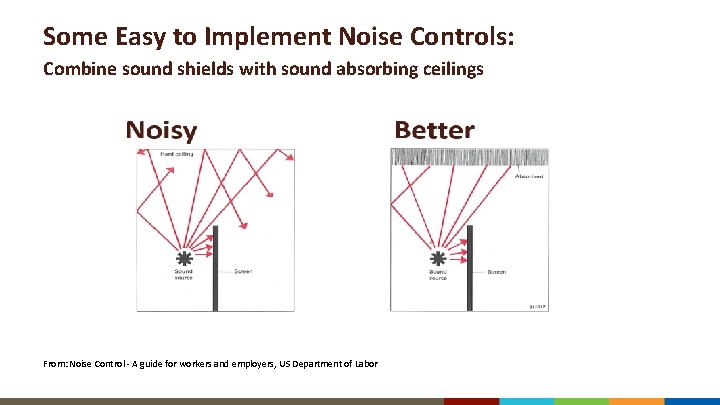
Some Easy to Implement Noise Controls: Combine sound shields with sound absorbing ceilings From: Noise Control - A guide for workers and employers, US Department of Labor
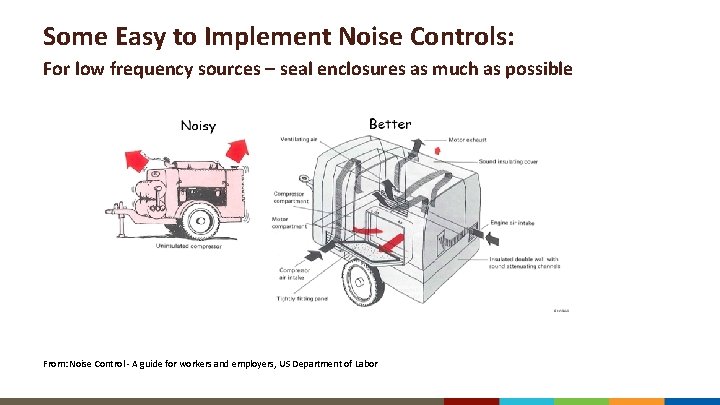
Some Easy to Implement Noise Controls: For low frequency sources – seal enclosures as much as possible From: Noise Control - A guide for workers and employers, US Department of Labor
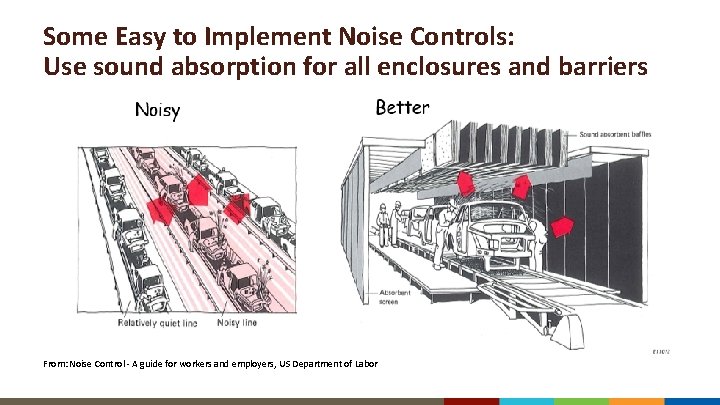
Some Easy to Implement Noise Controls: Use sound absorption for all enclosures and barriers From: Noise Control - A guide for workers and employers, US Department of Labor
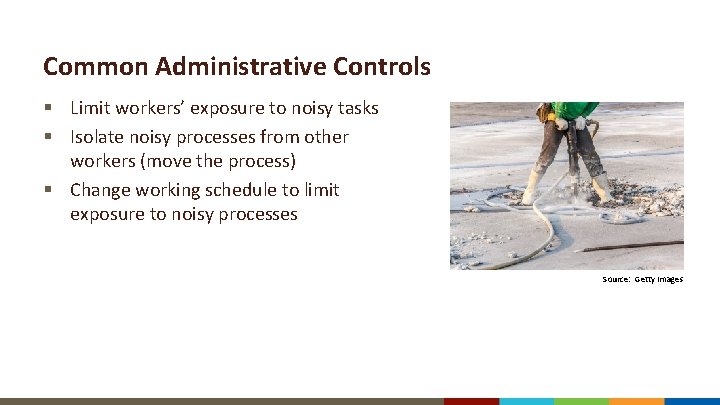
Common Administrative Controls § Limit workers’ exposure to noisy tasks § Isolate noisy processes from other workers (move the process) § Change working schedule to limit exposure to noisy processes Source: Getty Images
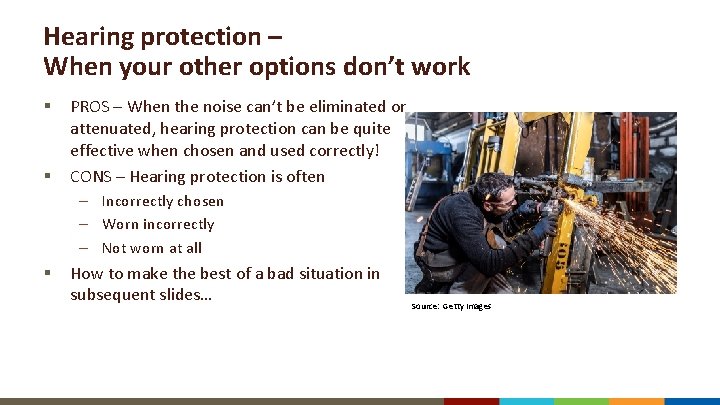
Hearing protection – When your other options don’t work § § PROS – When the noise can’t be eliminated or attenuated, hearing protection can be quite effective when chosen and used correctly! CONS – Hearing protection is often – Incorrectly chosen – Worn incorrectly – Not worn at all § How to make the best of a bad situation in subsequent slides… Source: Getty Images
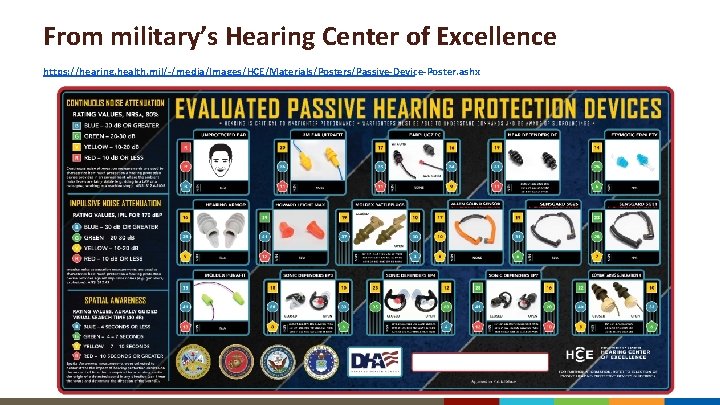
From military’s Hearing Center of Excellence https: //hearing. health. mil/-/media/Images/HCE/Materials/Posters/Passive-Device-Poster. ashx
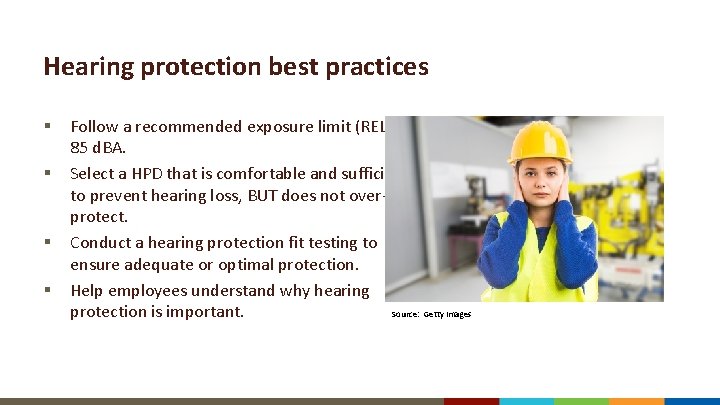
Hearing protection best practices § § Follow a recommended exposure limit (REL) of 85 d. BA. Select a HPD that is comfortable and sufficient to prevent hearing loss, BUT does not overprotect. Conduct a hearing protection fit testing to ensure adequate or optimal protection. Help employees understand why hearing Source: Getty Images protection is important.
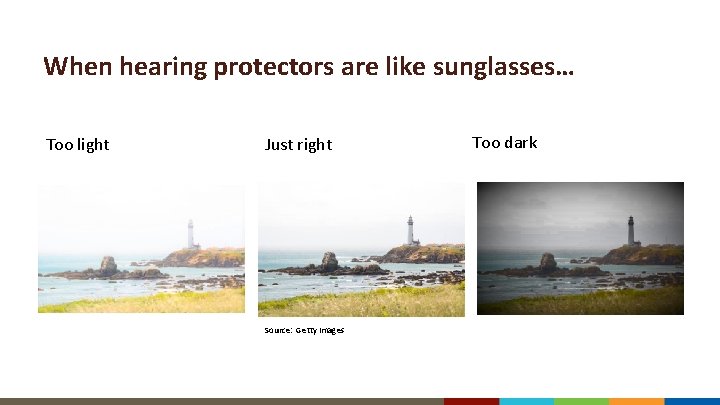
When hearing protectors are like sunglasses… Too light Just right Source: Getty Images Too dark
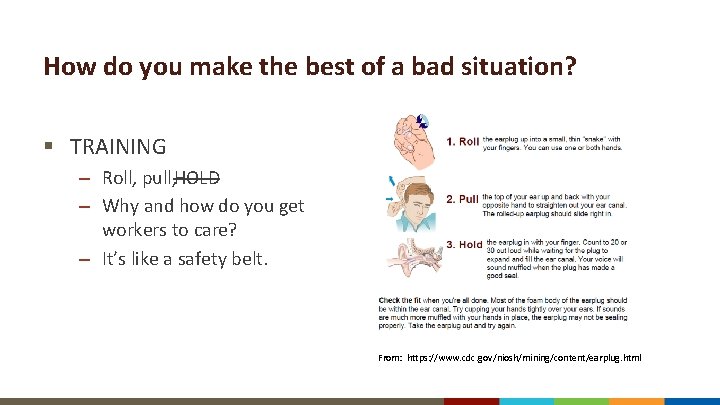
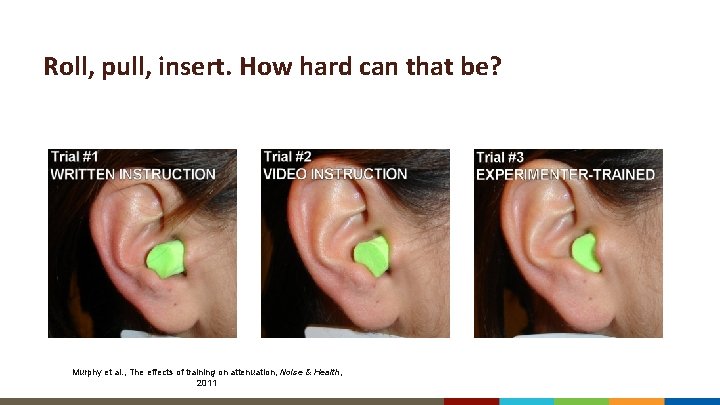
How do you make the best of a bad situation? § TRAINING – Roll, pull, HOLD – Why and how do you get workers to care? – It’s like a safety belt. From: https: //www. cdc. gov/niosh/mining/content/earplug. html
Roll, pull, insert. How hard can that be? Murphy et al. , The effects of training on attenuation, Noise & Health, 2011
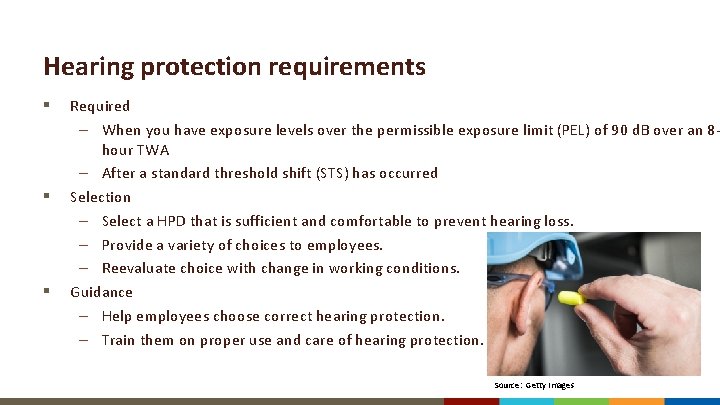
Hearing protection requirements § § § Required – When you have exposure levels over the permissible exposure limit (PEL) of 90 d. B over an 8 hour TWA – After a standard threshold shift (STS) has occurred Selection – Select a HPD that is sufficient and comfortable to prevent hearing loss. – Provide a variety of choices to employees. – Reevaluate choice with change in working conditions. Guidance – Help employees choose correct hearing protection. – Train them on proper use and care of hearing protection. Source: Getty Images
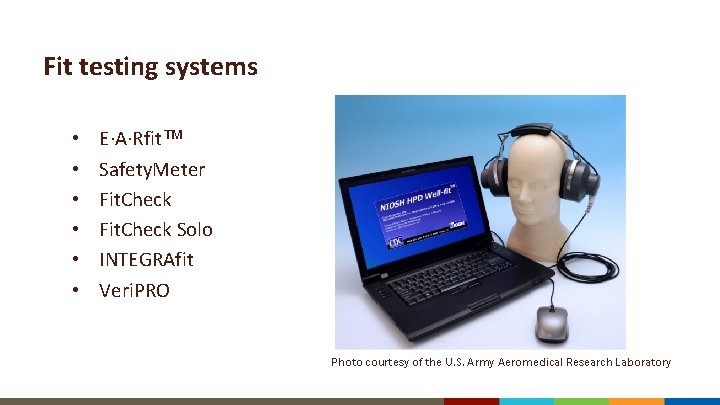
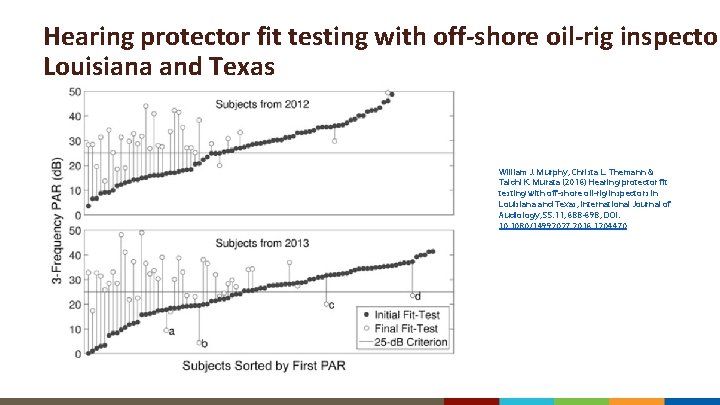
Fit testing basics • • • Hearing protector fit-test systems show much protection an individual has when using a particular hearing protector Use a system that interfaces with a computer and over-ear headphones to measure the amoun of protection offered by in-ear hearing protection devices such as earplugs. Hearing protector fit testing generates a Personal Attenuation Rating (PAR), which estimates worker noise exposure when subtracted from the measured noise.
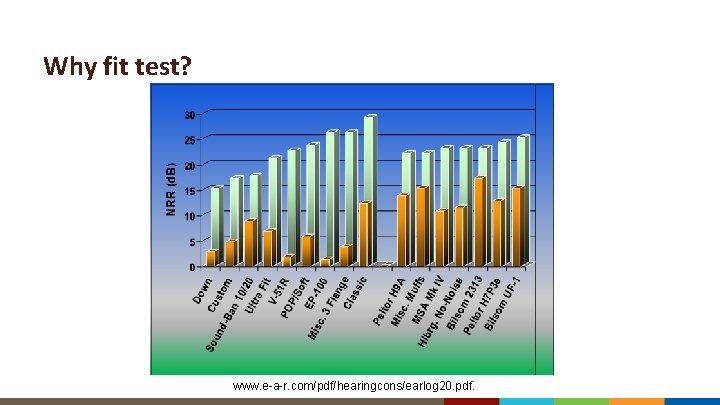
Why fit test? www. e-a-r. com/pdf/hearingcons/earlog 20. pdf.
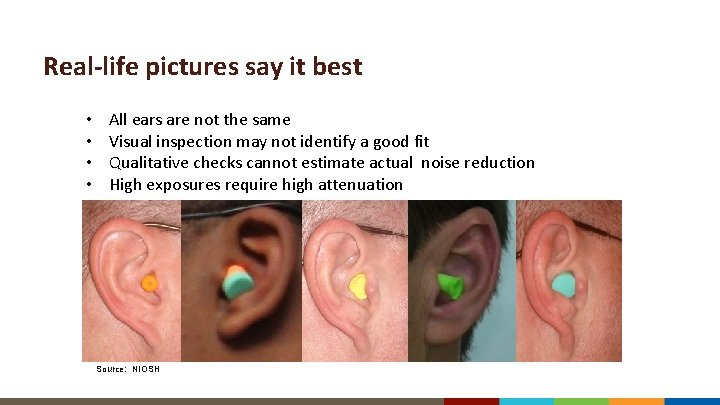
Real-life pictures say it best • • All ears are not the same Visual inspection may not identify a good fit Qualitative checks cannot estimate actual noise reduction High exposures require high attenuation Source: NIOSH
Fit testing procedure 1. Measure noise exposure in each work area, ideally using a personal dosimetry. 2. Ensure the appropriate software has been installed on a computer compatible with t chosen fit testing system 3. Create a selection of various hearing protection devices, including the those the employee favors or uses primarily. 4. Conduct baseline test without earplugs, similar to an audiogram 5. Have the employee insert earplugs without instruction and perform fit test, this is sim to a short audiogram and takes less than 5 minutes 6. If the calculated exposure with PAR is still >80 d. BA, teach the employee correct insertion techniques and conduct the test a second time 7. Repeat test with various HPDs until the PAR indicates adequate or optimal protection
Fit testing DEMO
Fit testing systems • • • E·A·Rfit TM Safety. Meter Fit. Check Solo INTEGRAfit Veri. PRO Photo courtesy of the U. S. Army Aeromedical Research Laboratory
Hearing protector fit testing with off-shore oil-rig inspector Louisiana and Texas William J. Murphy, Christa L. Themann & Taichi K. Murata (2016) Hearing protector fit testing with off-shore oil-rig inspectors in Louisiana and Texas, International Journal of Audiology, 55: 11, 688 -698, DOI: 10. 1080/14992027. 2016. 1204470
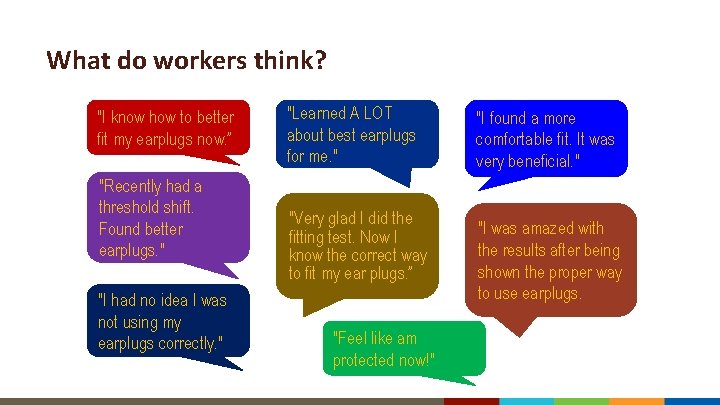
What do workers think? "I know how to better fit my earplugs now. ” "Recently had a threshold shift. Found better earplugs. " "I had no idea I was not using my earplugs correctly. " "Learned A LOT about best earplugs for me. " "Very glad I did the fitting test. Now I know the correct way to fit my ear plugs. ” "Feel like am protected now!" "I found a more comfortable fit. It was very beneficial. " "I was amazed with the results after being shown the proper way to use earplugs.
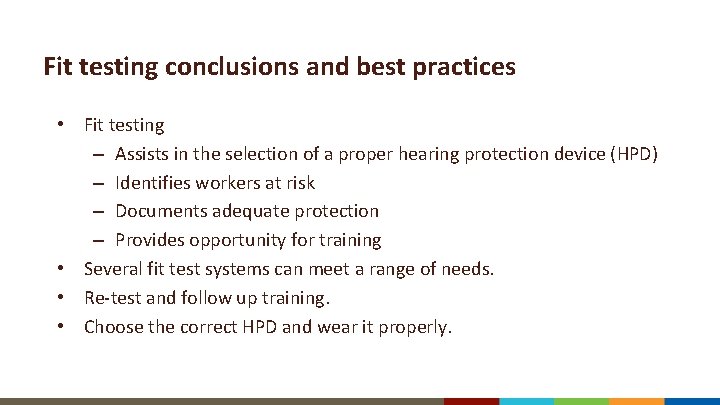
Fit testing conclusions and best practices • Fit testing – Assists in the selection of a proper hearing protection device (HPD) – Identifies workers at risk – Documents adequate protection – Provides opportunity for training • Several fit test systems can meet a range of needs. • Re-test and follow up training. • Choose the correct HPD and wear it properly.
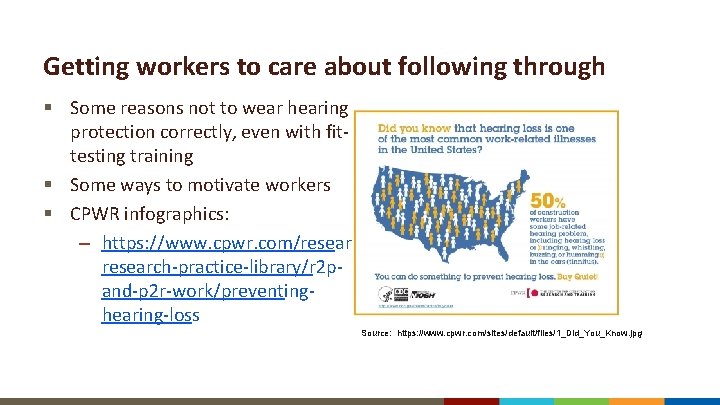
Getting workers to care about following through § Some reasons not to wear hearing protection correctly, even with fittesting training § Some ways to motivate workers § CPWR infographics: – https: //www. cpwr. com/research/ research-practice-library/r 2 pand-p 2 r-work/preventinghearing-loss Source: https: //www. cpwr. com/sites/default/files/1_Did_You_Know. jpg
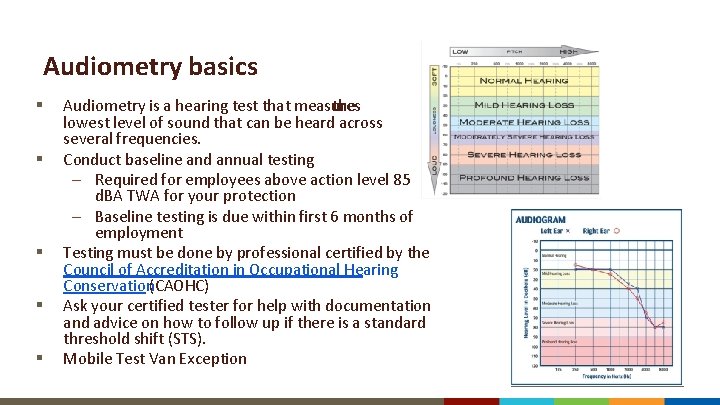
Audiometry basics § § § Audiometry is a hearing test that measures the lowest level of sound that can be heard across several frequencies. Conduct baseline and annual testing – Required for employees above action level 85 d. BA TWA for your protection – Baseline testing is due within first 6 months of employment Testing must be done by professional certified by the Council of Accreditation in Occupational Hearing Conservation(CAOHC) Ask your certified tester for help with documentation and advice on how to follow up if there is a standard threshold shift (STS). Mobile Test Van Exception
Recordkeeping basics and best practices § § Cost Records – Audiometry – Training – Personal protective equipment (PPE) – Accidents caused by situational awareness issues – Hearing loss claims – Fit testing program Keep other mandatory records, such as …. Prepare for or expect an OSHA site visit from a Certified Occupational Safety and Health Official (COSHO) Follow OSHA recordkeeping best practices
Hearing conservation program best practices • • • Source: Getty Images • • • Provide a hearing conservation program as one part of the overal goal of protecting workers from noise Protect workers from noise levels above 85 d. BA. Require fit testing as a key part of a successful hearing conservation program. Use fit-testing as a one-on-one training opportunity. Get people to care to improve training outcomes. Consult a Certified Occupational Hearing Conservationist when needed.
Useful resources • • • OSHA Hearing Conservation Landing Page – https: //www. osha. gov/SLTC/noisehearingconservation/hearingprograms. html OSHA Hearing Conservation Manual – https: //www. osha. gov/Publications/osha 3074. pdf OSHA Occupational Noise Exposure – Construction – https: //www. osha. gov/SLTC/noisehearingconservation/construction. html NIOSH Page - Hearing Loss Prevention Programs – https: //www. cdc. gov/niosh/topics/noise/preventhearingloss/hearlosspreventprograms. html NIOSH Presentation A– Model Hearing Conservation Program – https: //www. cdc. gov/niosh/mining/userfiles/workshops/hlp 1/03 -byrneconservationprograms. pdf
Useful resources continued § § Landscape Management. The – Scoop on Hearing Conservation Programs – https: //www. landscapemanagement. net/web-extra-the-inside-scoop-on-hearingconservation-programs/ NIOSH blog on Hearing Protector Selection – https: //blogs. cdc. gov/niosh-science-blog/2018/10/24/hearing-protection/ NIOSH HPD Well-Fit™ – https: //blogs. cdc. gov/niosh-science-blog/2013/05/31/well-fit/ Best Practice Bulletin – Individual Fit Testing – https: //www. hearingconservation. org/assets/docs/Alliance. Recommendation. For. Fit. Te g_Final. pdf
THANK YOU!! Questions/Discussion as time permits Bryan Beamer, Ph. D, PE, CSP bbeamer@cdc. gov For more information, contact CDC 1 -800 -CDC-INFO (232 -4636) TTY: 1 -888 -232 -6348 www. cdc. gov The findings and conclusions in this report are those of the authors and do not necessarily represent the official position of the National Institute for Occupational Safety and Health, Centers for Disease Control and Prevention.
Feedback • Are you more aware of the importance of protecting workers from noise? • Are you better aware of OSHA regulatory requirements for noise exposure? • Will you use any of the best practices mentioned? If so which ones? • Are you likely to implement Hearing Protector Fit-Testing in your workplace? • What else would you like to have seen in this Source: Getty Images presentation that would help your fellow Safety Professionals?