Mr Shields Regents Chemistry U 03 L 07




- Slides: 18
& Mr. Shields Regents Chemistry U 03 L 07 1
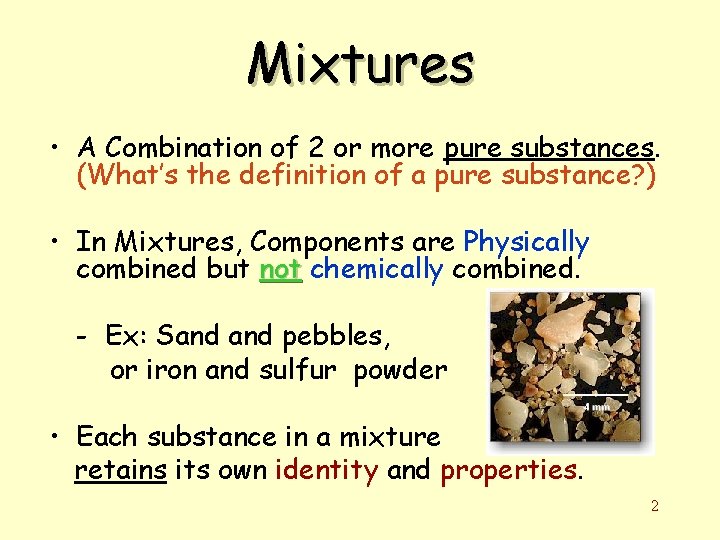
Mixtures • A Combination of 2 or more pure substances. (What’s the definition of a pure substance? ) • In Mixtures, Components are Physically combined but not chemically combined. - Ex: Sand pebbles, or iron and sulfur powder • Each substance in a mixture retains its own identity and properties. 2
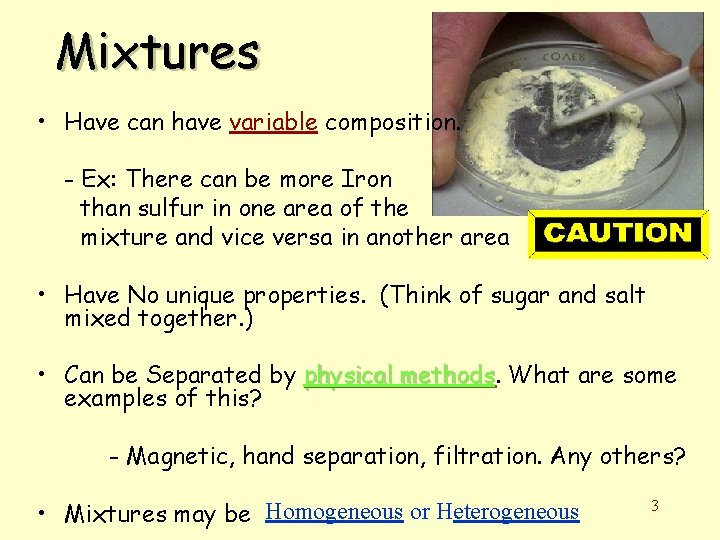
Mixtures • Have can have variable composition. - Ex: There can be more Iron than sulfur in one area of the mixture and vice versa in another area • Have No unique properties. (Think of sugar and salt mixed together. ) • Can be Separated by physical methods What are some examples of this? - Magnetic, hand separation, filtration. Any others? • Mixtures may be Homogeneous or Heterogeneous 3
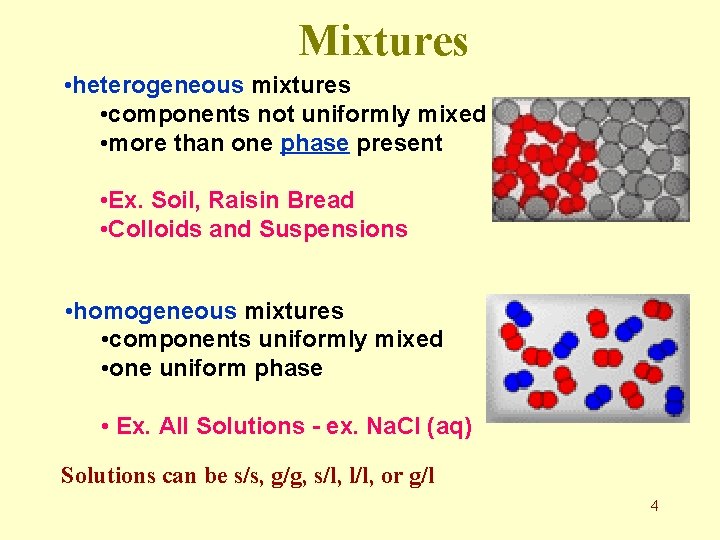
Mixtures • heterogeneous mixtures • components not uniformly mixed • more than one phase present • Ex. Soil, Raisin Bread • Colloids and Suspensions • homogeneous mixtures • components uniformly mixed • one uniform phase • Ex. All Solutions - ex. Na. Cl (aq) Solutions can be s/s, g/g, s/l, l/l, or g/l 4
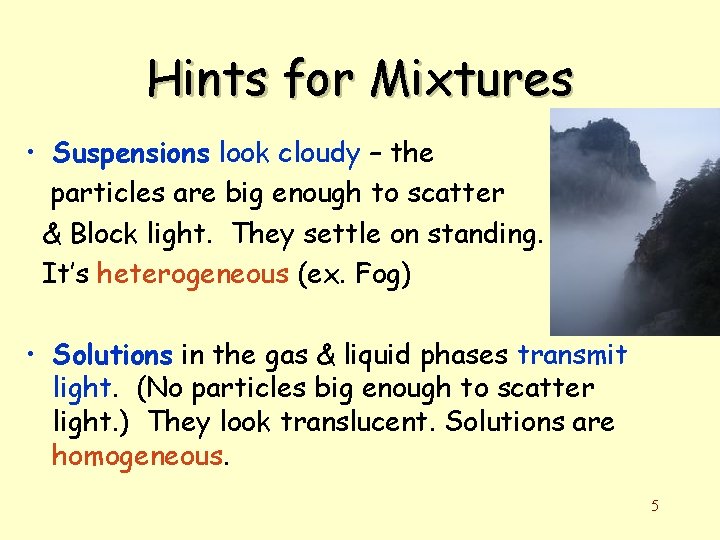
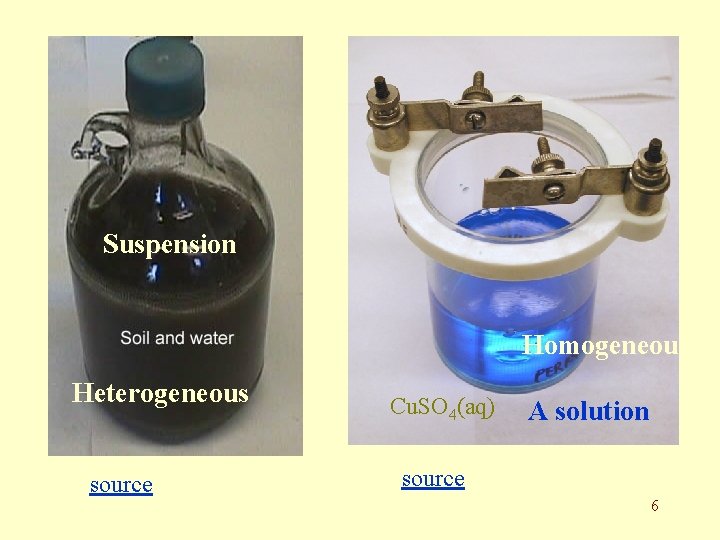
Hints for Mixtures • Suspensions look cloudy – the particles are big enough to scatter & Block light. They settle on standing. It’s heterogeneous (ex. Fog) • Solutions in the gas & liquid phases transmit light. (No particles big enough to scatter light. ) They look translucent. Solutions are homogeneous. 5
Suspension Homogeneous Heterogeneous source Cu. SO 4(aq) A solution source 6
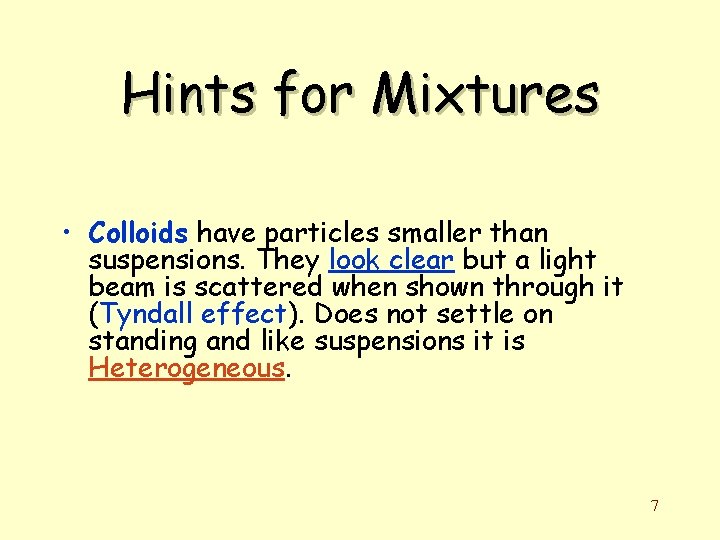
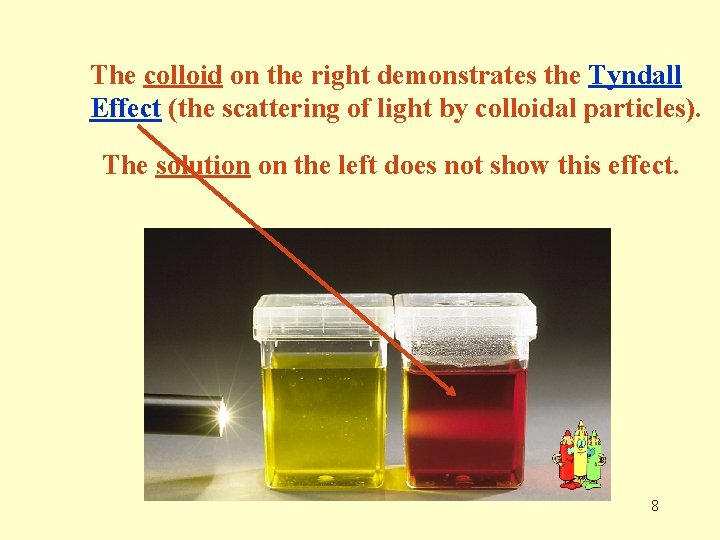
Hints for Mixtures • Colloids have particles smaller than suspensions. They look clear but a light beam is scattered when shown through it (Tyndall effect). Does not settle on standing and like suspensions it is Heterogeneous. 7
The colloid on the right demonstrates the Tyndall Effect (the scattering of light by colloidal particles). The solution on the left does not show this effect. 8
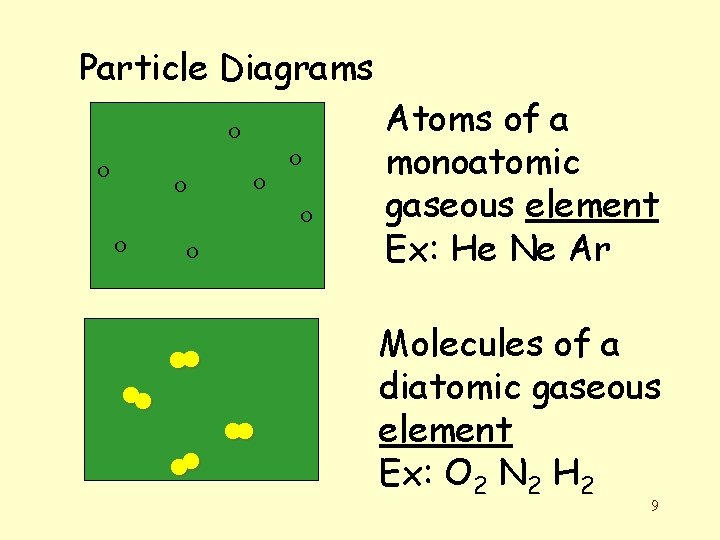
Particle Diagrams Atoms of a monoatomic gaseous element Ex: He Ne Ar Molecules of a diatomic gaseous element Ex: O 2 N 2 H 2 9
Particle Diagrams Molecules of a triatomic gaseous compound. Mixture: monoatomic element, diatomic element, triatomic compound. 10
Categories of Matter We now have defined all the major pieces of matter. Pure substances Homogeneous Mixtures Atoms Heterogeneous Mixtures Compounds Solutions Suspensions Colloids Now Let’s see how they fit together in a classification Scheme for matter 11
- Blood S, Ne, H Na. Cl, Fe 2 O 3 Solutions Soil, Colloids & Suspensions 12
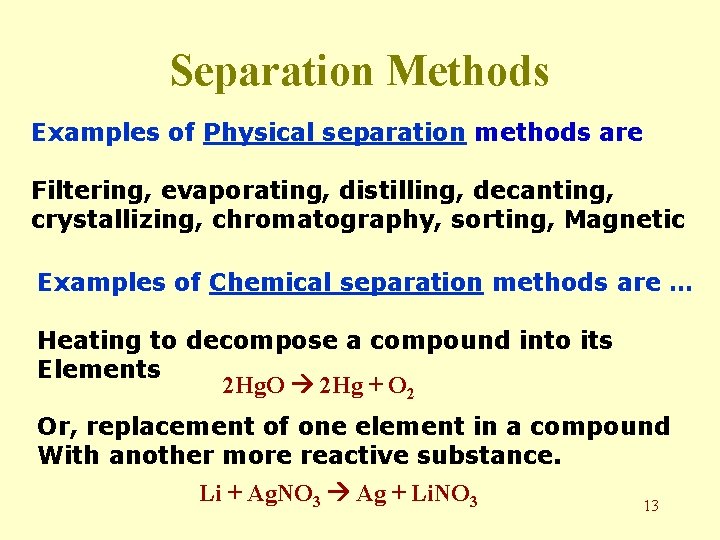
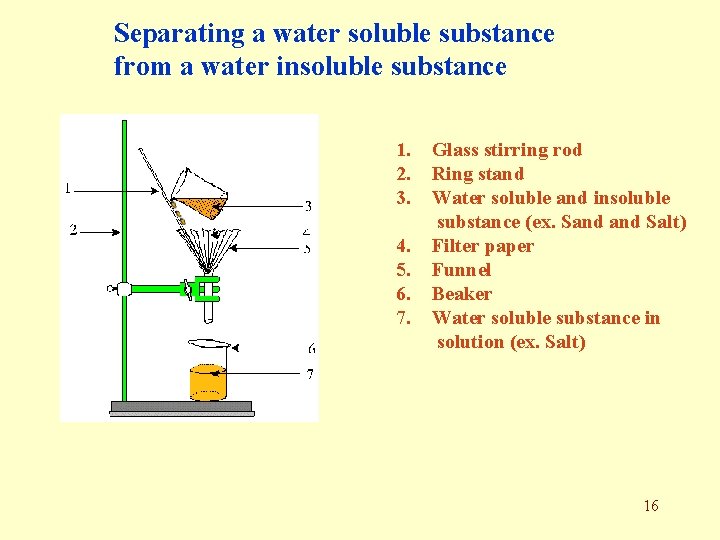
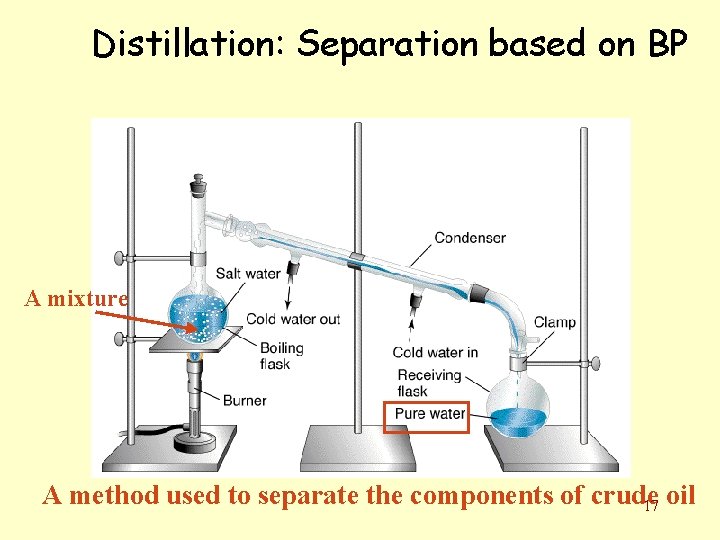
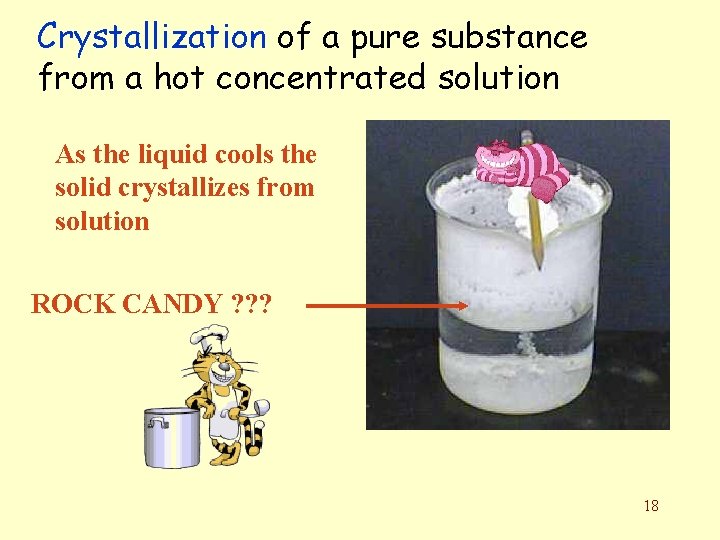
Separation Methods Examples of Physical separation methods are Filtering, evaporating, distilling, decanting, crystallizing, chromatography, sorting, Magnetic Examples of Chemical separation methods are … Heating to decompose a compound into its Elements 2 Hg. O 2 Hg + O 2 Or, replacement of one element in a compound With another more reactive substance. Li + Ag. NO 3 Ag + Li. NO 3 13
• Paper chromatography (PC) Separation of a mixture of colored dyes in Ink. • Stationary phase can be something such as filter paper • Mobile phase is the liquid solvent the paper is immersed in. It moves up the paper Liquid front by capillary action. Liquid 14
• Paper chromatography (PC) • Some components spend more time in the stationary phase than others. So, they don’t move as fast. • Components in the original mixture appear as separate spots spread out on the paper 15
Separating a water soluble substance from a water insoluble substance 1. 2. 3. 4. 5. 6. 7. Glass stirring rod Ring stand Water soluble and insoluble substance (ex. Sand Salt) Filter paper Funnel Beaker Water soluble substance in solution (ex. Salt) 16
Distillation: Separation based on BP A mixture A method used to separate the components of crude 17 oil
Crystallization of a pure substance from a hot concentrated solution As the liquid cools the solid crystallizes from solution ROCK CANDY ? ? ? 18