Moscow State Institute of International Relations MGIMOUniversity School
- Slides: 52
Moscow State Institute of International Relations (MGIMO-University) School of Government and International Affairs & Alexander Shishkin Department of Philosophy The Basics of Philosophy Part IV Theocentric Philosophy Lecture 10 Western Medieval Philosophy
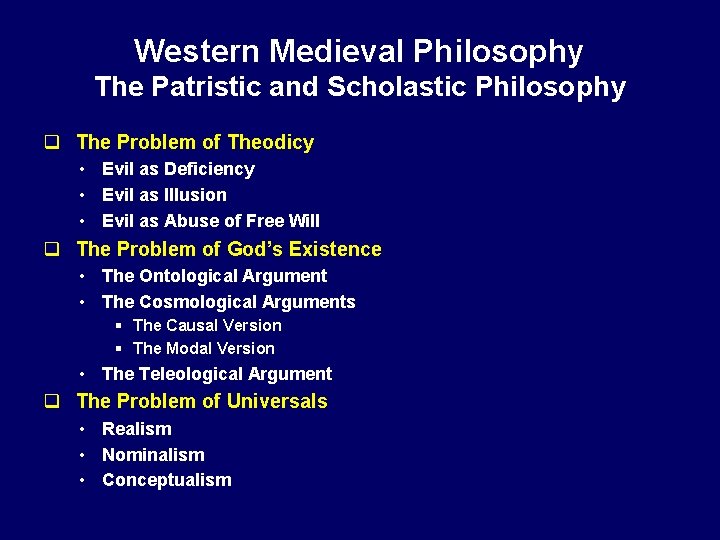
Western Medieval Philosophy The Patristic and Scholastic Philosophy q The Problem of Theodicy • Evil as Deficiency • Evil as Illusion • Evil as Abuse of Free Will q The Problem of God’s Existence • The Ontological Argument • The Cosmological Arguments § The Causal Version § The Modal Version • The Teleological Argument q The Problem of Universals • Realism • Nominalism • Conceptualism
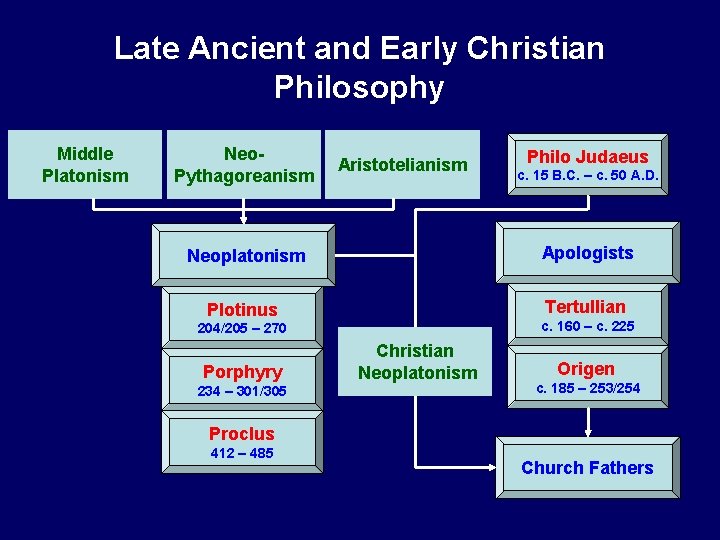
Late Ancient and Early Christian Philosophy Middle Platonism Neo. Pythagoreanism Aristotelianism Philo Judaeus c. 15 B. C. – c. 50 A. D. Neoplatonism Apologists Plotinus Tertullian c. 160 – c. 225 204/205 – 270 Porphyry 234 – 301/305 Christian Neoplatonism Origen c. 185 – 253/254 Proclus 412 – 485 Church Fathers
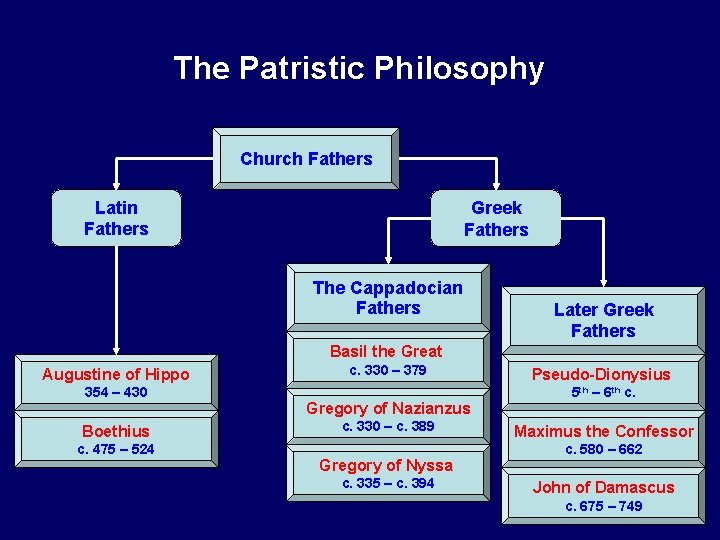
The Patristic Philosophy Church Fathers Greek Fathers Latin Fathers The Cappadocian Fathers Later Greek Fathers Basil the Great Augustine of Hippo 354 – 430 Boethius c. 475 – 524 c. 330 – 379 Gregory of Nazianzus c. 330 – c. 389 Gregory of Nyssa c. 335 – c. 394 Pseudo-Dionysius 5 th – 6 th c. Maximus the Confessor c. 580 – 662 John of Damascus c. 675 – 749
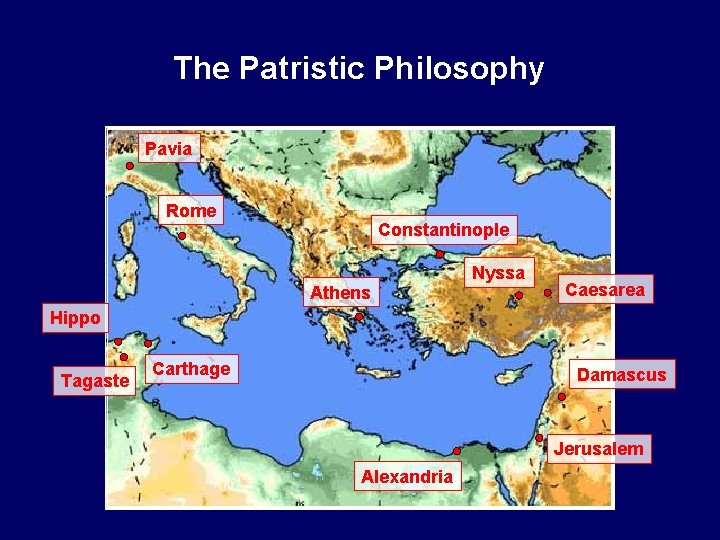
The Patristic Philosophy Pavia Rome Constantinople Athens Nyssa Caesarea Hippo Tagaste Carthage Damascus Jerusalem Alexandria
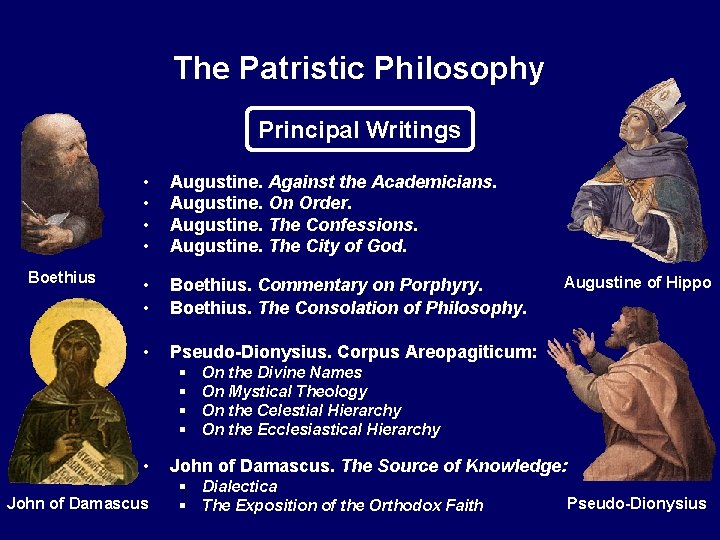
The Patristic Philosophy Principal Writings Boethius • • Augustine. Against the Academicians. Augustine. On Order. Augustine. The Confessions. Augustine. The City of God. • • Boethius. Commentary on Porphyry. Boethius. The Consolation of Philosophy. • Pseudo-Dionysius. Corpus Areopagiticum: § § • John of Damascus Augustine of Hippo On the Divine Names On Mystical Theology On the Celestial Hierarchy On the Ecclesiastical Hierarchy John of Damascus. The Source of Knowledge: § Dialectica § The Exposition of the Orthodox Faith Pseudo-Dionysius
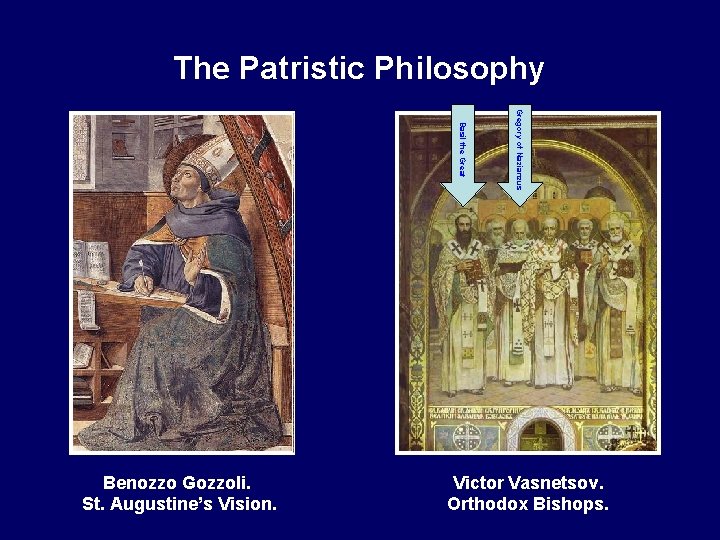
The Patristic Philosophy Gregory of Nazianzus Basil the Great Benozzo Gozzoli. St. Augustine’s Vision. Victor Vasnetsov. Orthodox Bishops.
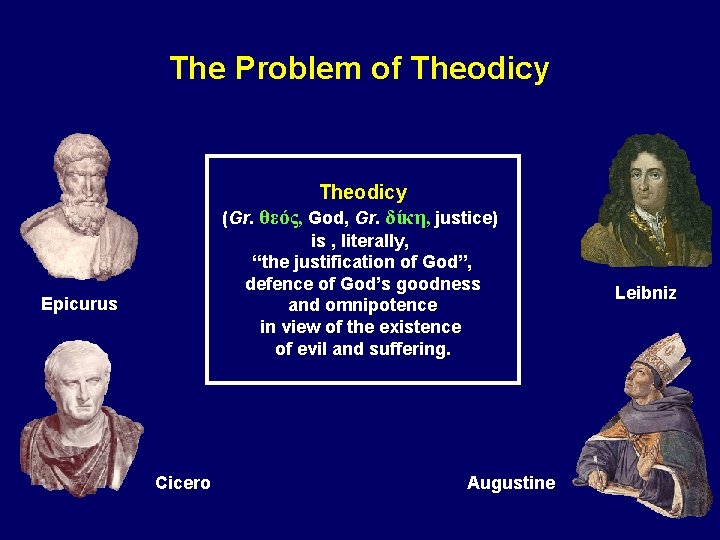
The Problem of Theodicy (Gr. θεός, God, Gr. δίκη, justice) is , literally, “the justification of God”, defence of God’s goodness and omnipotence in view of the existence of evil and suffering. Epicurus Cicero Augustine Leibniz
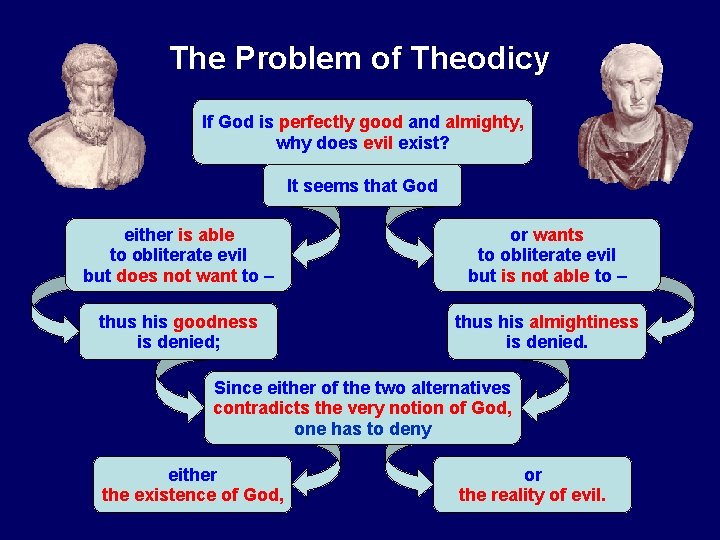
The Problem of Theodicy If God is perfectly good and almighty, why does evil exist? It seems that God either is able to obliterate evil but does not want to – or wants to obliterate evil but is not able to – thus his goodness is denied; thus his almightiness is denied. Since either of the two alternatives contradicts the very notion of God, one has to deny either the existence of God, or the reality of evil.
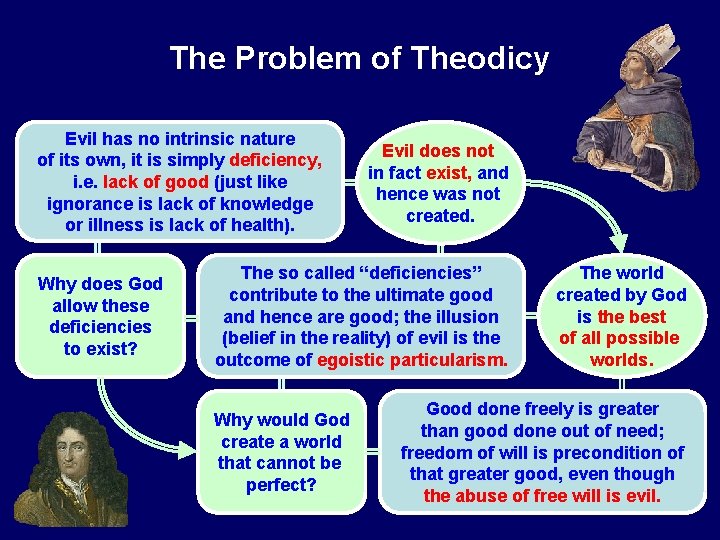
The Problem of Theodicy Evil has no intrinsic nature of its own, it is simply deficiency, i. e. lack of good (just like ignorance is lack of knowledge or illness is lack of health). Why does God allow these deficiencies to exist? Evil does not in fact exist, and hence was not created. The so called “deficiencies” contribute to the ultimate good and hence are good; the illusion (belief in the reality) of evil is the outcome of egoistic particularism. Why would God create a world that cannot be perfect? The world created by God is the best of all possible worlds. Good done freely is greater than good done out of need; freedom of will is precondition of that greater good, even though the abuse of free will is evil.
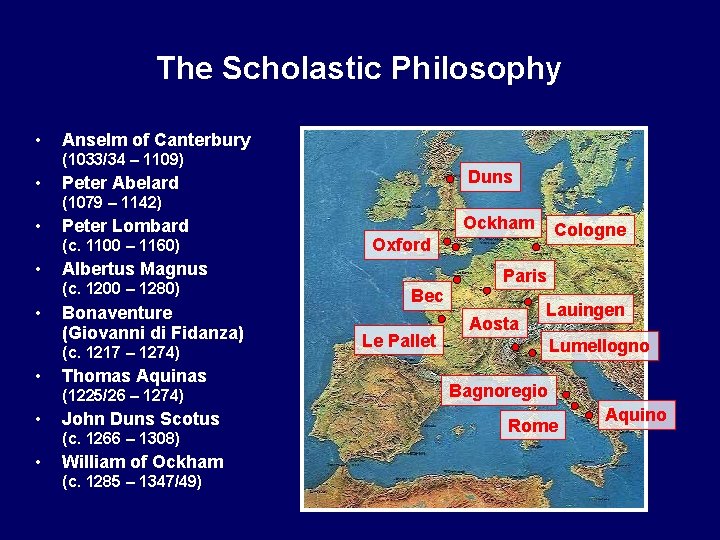
The Scholastic Philosophy • Anselm of Canterbury (1033/34 – 1109) • Duns Peter Abelard (1079 – 1142) • Peter Lombard (c. 1100 – 1160) • Bonaventure (Giovanni di Fidanza) (c. 1217 – 1274) • Thomas Aquinas (1225/26 – 1274) • John Duns Scotus (c. 1266 – 1308) • William of Ockham (c. 1285 – 1347/49) Cologne Oxford Albertus Magnus (c. 1200 – 1280) • Ockham Paris Bec Le Pallet Aosta Lauingen Lumellogno Bagnoregio Rome Aquino
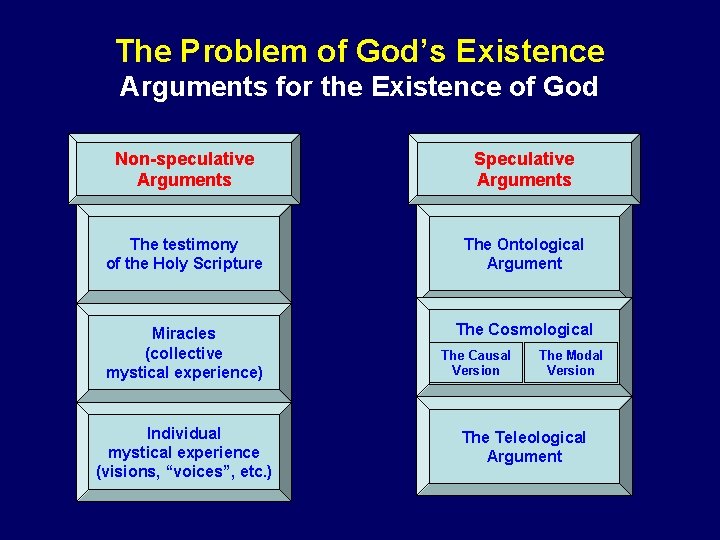
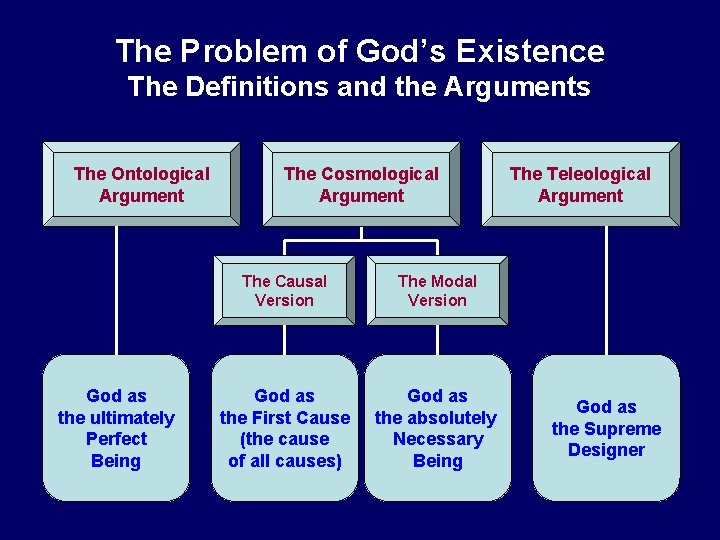
The Problem of God’s Existence Arguments for the Existence of God Non-speculative Arguments Speculative Arguments The testimony of the Holy Scripture The Ontological Argument Miracles (collective mystical experience) The Cosmological Individual mystical experience (visions, “voices”, etc. ) The Modal The Causal Argument Version The Teleological Argument
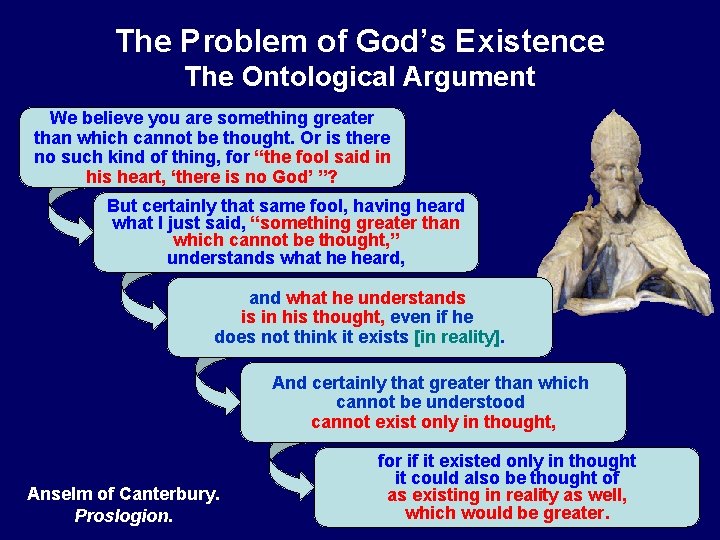
The Problem of God’s Existence The Ontological Argument We believe you are something greater than which cannot be thought. Or is there no such kind of thing, for “the fool said in his heart, ‘there is no God’ ”? But certainly that same fool, having heard what I just said, “something greater than which cannot be thought, ” understands what he heard, and what he understands is in his thought, even if he does not think it exists [in reality]. And certainly that greater than which cannot be understood cannot exist only in thought, Anselm of Canterbury. Proslogion. for if it existed only in thought it could also be thought of as existing in reality as well, which would be greater.
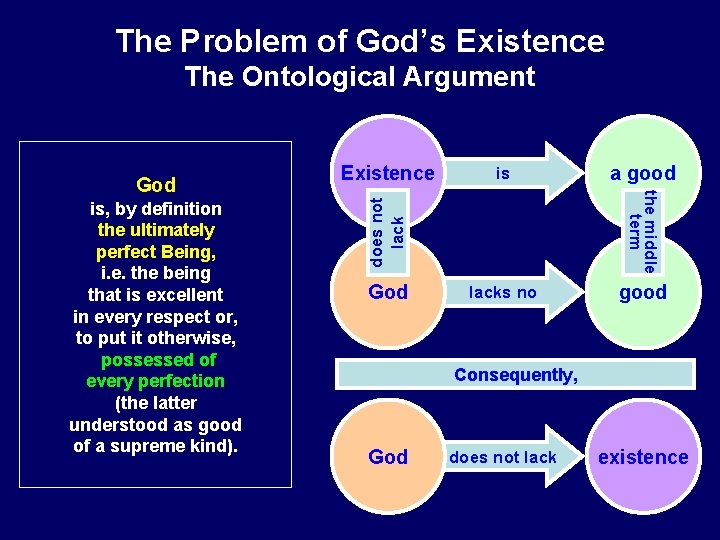
The Problem of God’s Existence The Ontological Argument a good lacks no good does not lack is, by definition the ultimately perfect Being, i. e. the being that is excellent in every respect or, to put it otherwise, possessed of every perfection (the latter understood as good of a supreme kind). is the middle term God Existence God Consequently, God does not lack existence
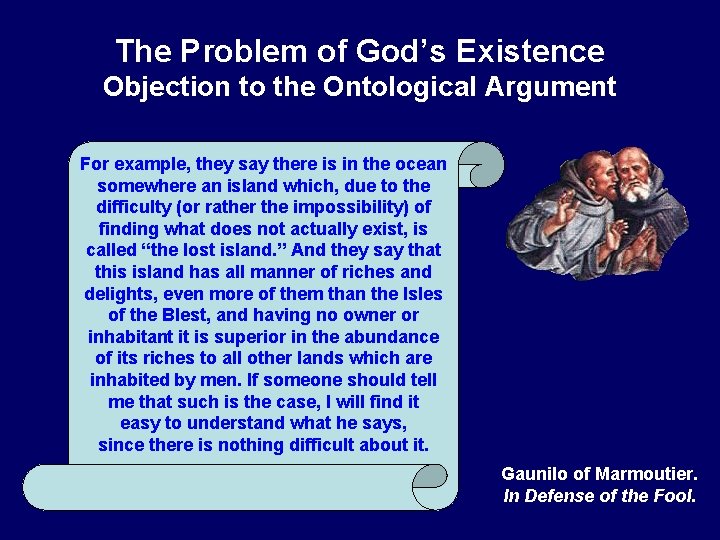
The Problem of God’s Existence Objection to the Ontological Argument For example, they say there is in the ocean somewhere an island which, due to the difficulty (or rather the impossibility) of finding what does not actually exist, is called “the lost island. ” And they say that this island has all manner of riches and delights, even more of them than the Isles of the Blest, and having no owner or inhabitant it is superior in the abundance of its riches to all other lands which are inhabited by men. If someone should tell me that such is the case, I will find it easy to understand what he says, since there is nothing difficult about it. Gaunilo of Marmoutier. In Defense of the Fool.
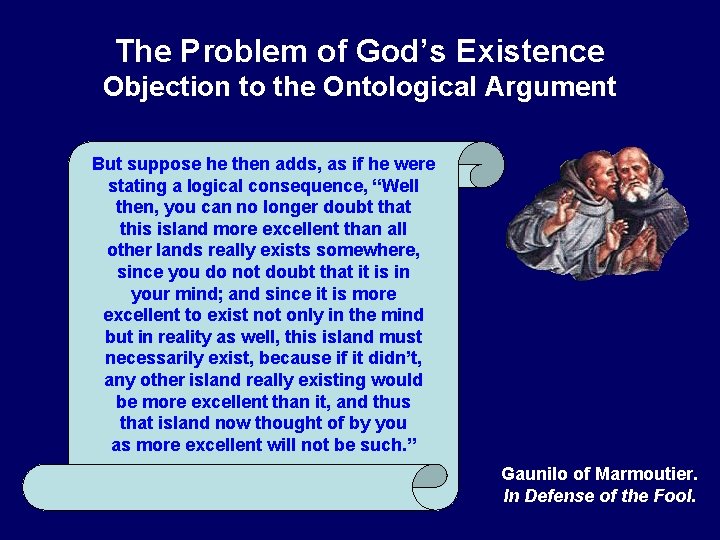
The Problem of God’s Existence Objection to the Ontological Argument But suppose he then adds, as if he were stating a logical consequence, “Well then, you can no longer doubt that this island more excellent than all other lands really exists somewhere, since you do not doubt that it is in your mind; and since it is more excellent to exist not only in the mind but in reality as well, this island must necessarily exist, because if it didn’t, any other island really existing would be more excellent than it, and thus that island now thought of by you as more excellent will not be such. ” Gaunilo of Marmoutier. In Defense of the Fool.
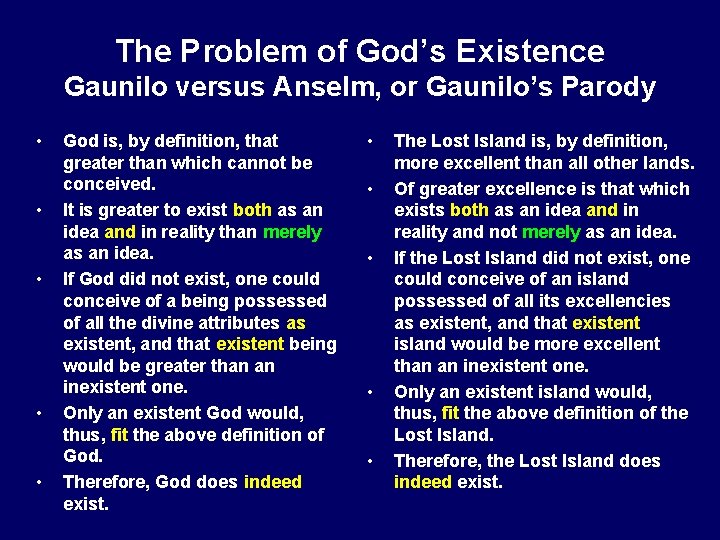
The Problem of God’s Existence Gaunilo versus Anselm, or Gaunilo’s Parody • • • God is, by definition, that greater than which cannot be conceived. It is greater to exist both as an idea and in reality than merely as an idea. If God did not exist, one could conceive of a being possessed of all the divine attributes as existent, and that existent being would be greater than an inexistent one. Only an existent God would, thus, fit the above definition of God. Therefore, God does indeed exist. • • • The Lost Island is, by definition, more excellent than all other lands. Of greater excellence is that which exists both as an idea and in reality and not merely as an idea. If the Lost Island did not exist, one could conceive of an island possessed of all its excellencies as existent, and that existent island would be more excellent than an inexistent one. Only an existent island would, thus, fit the above definition of the Lost Island. Therefore, the Lost Island does indeed exist.
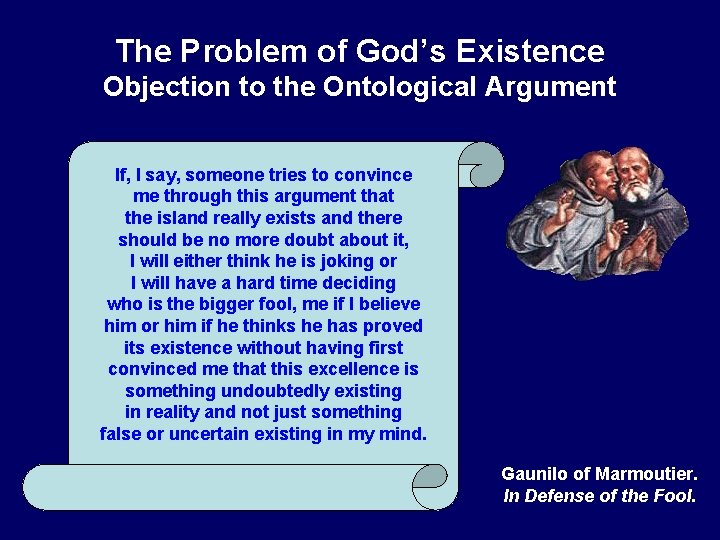
The Problem of God’s Existence Objection to the Ontological Argument If, I say, someone tries to convince me through this argument that the island really exists and there should be no more doubt about it, I will either think he is joking or I will have a hard time deciding who is the bigger fool, me if I believe him or him if he thinks he has proved its existence without having first convinced me that this excellence is something undoubtedly existing in reality and not just something false or uncertain existing in my mind. Gaunilo of Marmoutier. In Defense of the Fool.
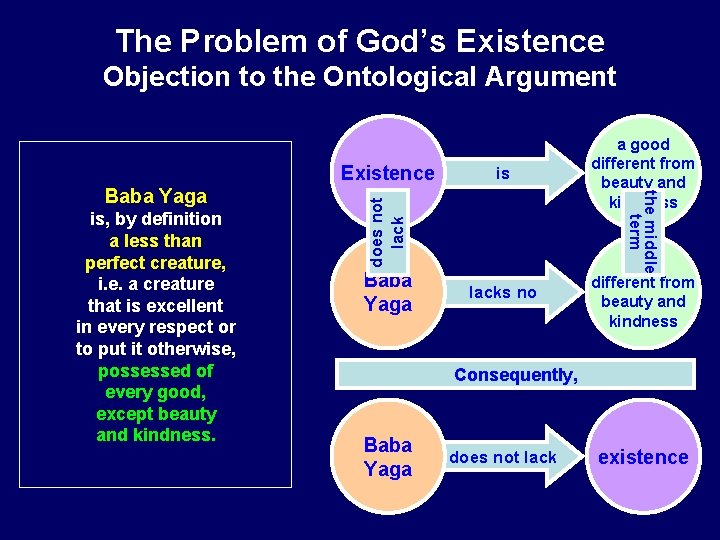
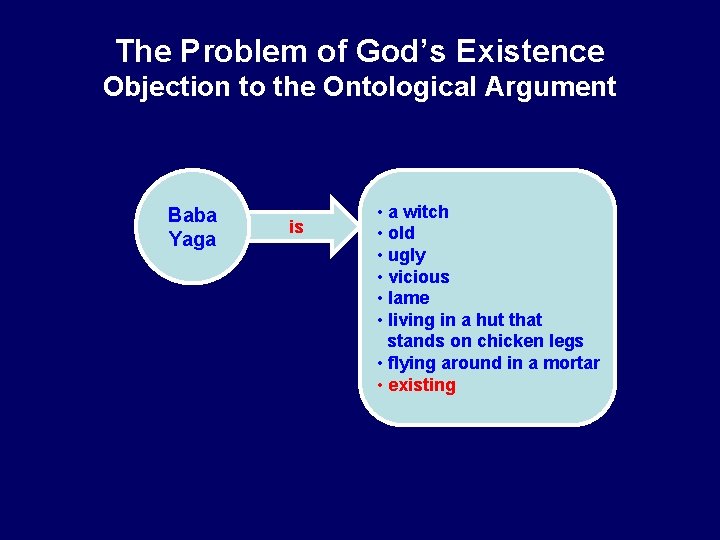
The Problem of God’s Existence Objection to the Ontological Argument is, by definition a less than perfect creature, i. e. a creature that is excellent in every respect or to put it otherwise, possessed of every good, except beauty and kindness. lacks no good different from beauty and kindness the middle term Baba Yaga is does not lack Existence a good different from beauty and kindness Baba Yaga Consequently, Baba Yaga does not lack existence
The Problem of God’s Existence Objection to the Ontological Argument Baba Yaga is • a witch • old • ugly • vicious • lame • living in a hut that stands on chicken legs • flying around in a mortar • existing
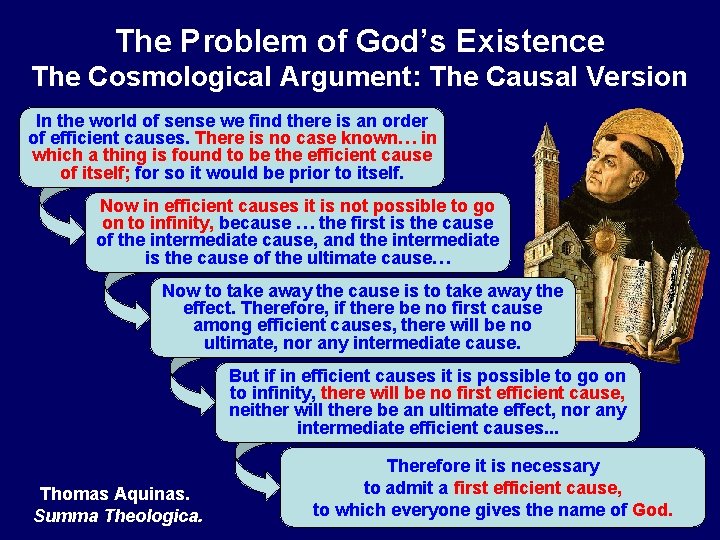
The Problem of God’s Existence The Cosmological Argument: The Causal Version In the world of sense we find there is an order of efficient causes. There is no case known… in which a thing is found to be the efficient cause of itself; for so it would be prior to itself. Now in efficient causes it is not possible to go on to infinity, because … the first is the cause of the intermediate cause, and the intermediate is the cause of the ultimate cause… Now to take away the cause is to take away the effect. Therefore, if there be no first cause among efficient causes, there will be no ultimate, nor any intermediate cause. But if in efficient causes it is possible to go on to infinity, there will be no first efficient cause, neither will there be an ultimate effect, nor any intermediate efficient causes. . . Thomas Aquinas. Summa Theologica. Therefore it is necessary to admit a first efficient cause, to which everyone gives the name of God.
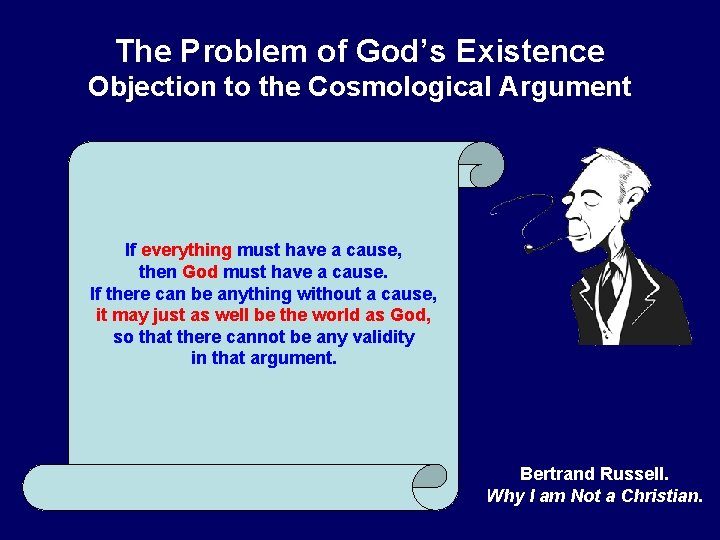
The Problem of God’s Existence Objection to the Cosmological Argument If everything must have a cause, then God must have a cause. If there can be anything without a cause, it may just as well be the world as God, so that there cannot be any validity in that argument. Bertrand Russell. Why I am Not a Christian.
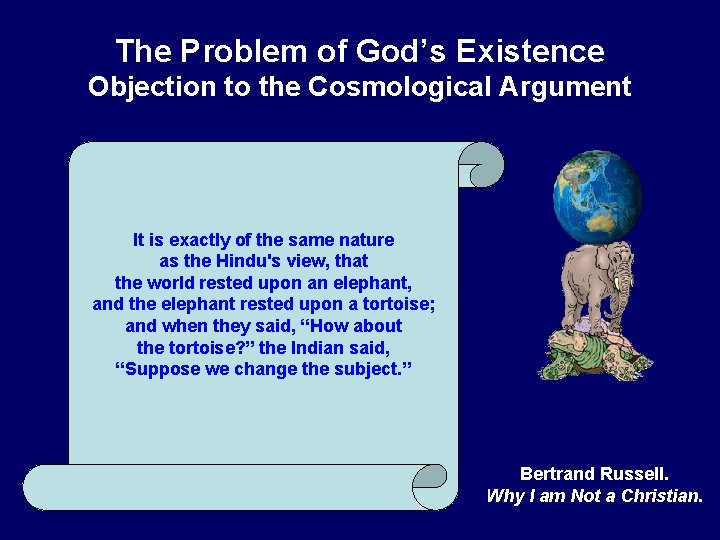
The Problem of God’s Existence Objection to the Cosmological Argument It is exactly of the same nature as the Hindu's view, that the world rested upon an elephant, and the elephant rested upon a tortoise; and when they said, “How about the tortoise? ” the Indian said, “Suppose we change the subject. ” Bertrand Russell. Why I am Not a Christian.
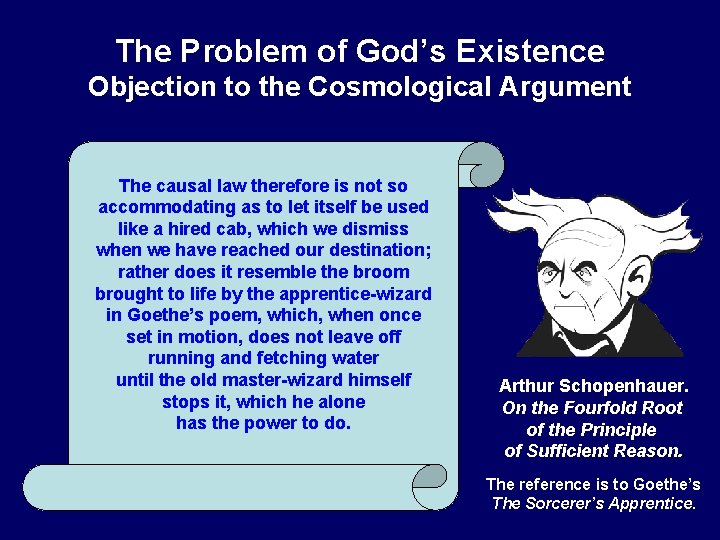
The Problem of God’s Existence Objection to the Cosmological Argument The causal law therefore is not so accommodating as to let itself be used like a hired cab, which we dismiss when we have reached our destination; rather does it resemble the broom brought to life by the apprentice-wizard in Goethe’s poem, which, when once set in motion, does not leave off running and fetching water until the old master-wizard himself stops it, which he alone has the power to do. Arthur Schopenhauer. On the Fourfold Root of the Principle of Sufficient Reason. The reference is to Goethe’s The Sorcerer’s Apprentice.
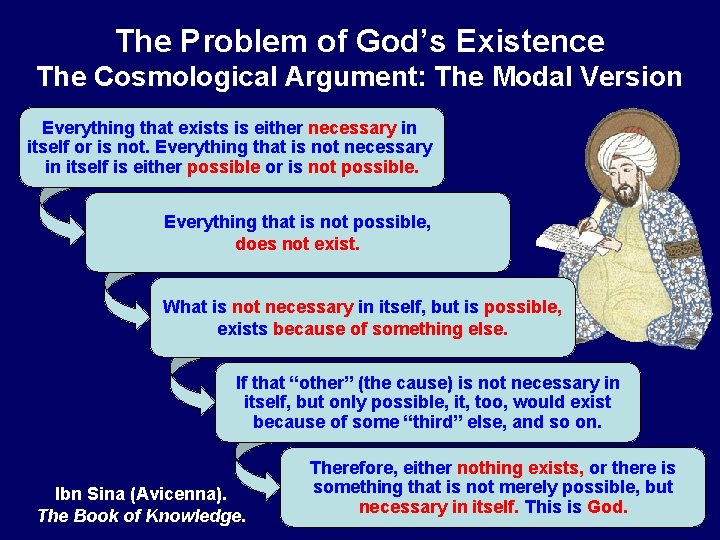
The Problem of God’s Existence The Cosmological Argument: The Modal Version Everything that exists is either necessary in itself or is not. Everything that is not necessary in itself is either possible or is not possible. Everything that is not possible, does not exist. What is not necessary in itself, but is possible, exists because of something else. If that “other” (the cause) is not necessary in itself, but only possible, it, too, would exist because of some “third” else, and so on. Ibn Sina (Avicenna). The Book of Knowledge. Therefore, either nothing exists, or there is something that is not merely possible, but necessary in itself. This is God.
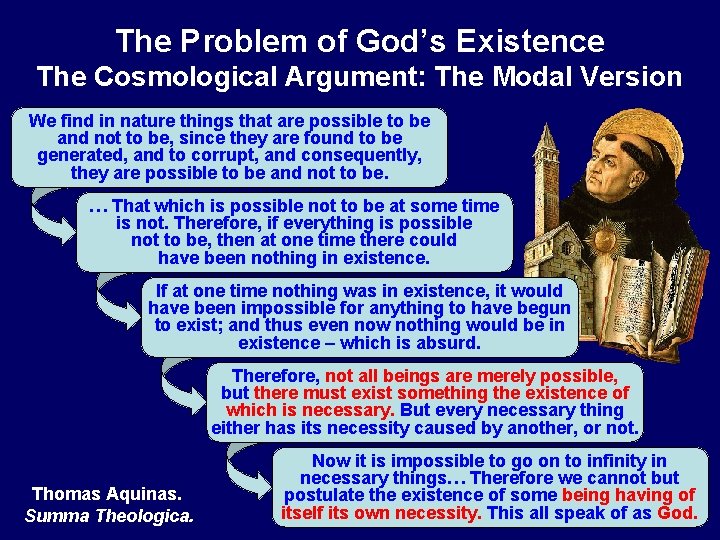
The Problem of God’s Existence The Cosmological Argument: The Modal Version We find in nature things that are possible to be and not to be, since they are found to be generated, and to corrupt, and consequently, they are possible to be and not to be. … That which is possible not to be at some time is not. Therefore, if everything is possible not to be, then at one time there could have been nothing in existence. If at one time nothing was in existence, it would have been impossible for anything to have begun to exist; and thus even now nothing would be in existence – which is absurd. Therefore, not all beings are merely possible, but there must exist something the existence of which is necessary. But every necessary thing either has its necessity caused by another, or not. Thomas Aquinas. Summa Theologica. Now it is impossible to go on to infinity in necessary things… Therefore we cannot but postulate the existence of some being having of itself its own necessity. This all speak of as God.
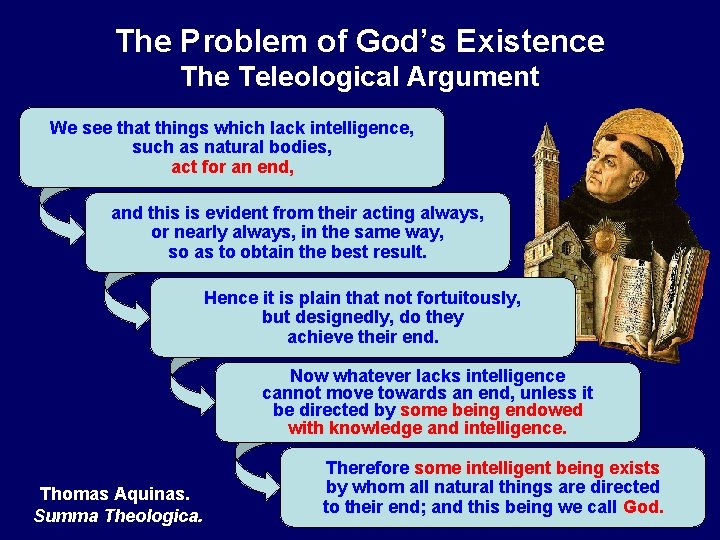
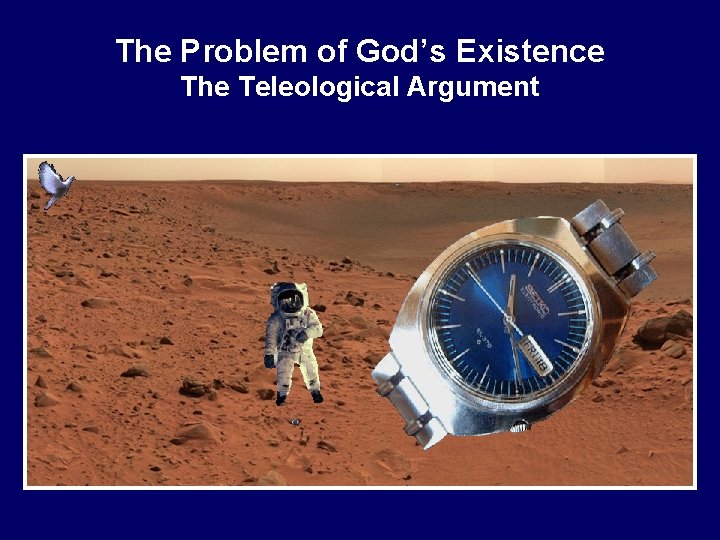
The Problem of God’s Existence The Teleological Argument We see that things which lack intelligence, such as natural bodies, act for an end, and this is evident from their acting always, or nearly always, in the same way, so as to obtain the best result. Hence it is plain that not fortuitously, but designedly, do they achieve their end. Now whatever lacks intelligence cannot move towards an end, unless it be directed by some being endowed with knowledge and intelligence. Thomas Aquinas. Summa Theologica. Therefore some intelligent being exists by whom all natural things are directed to their end; and this being we call God.
The Problem of God’s Existence The Teleological Argument
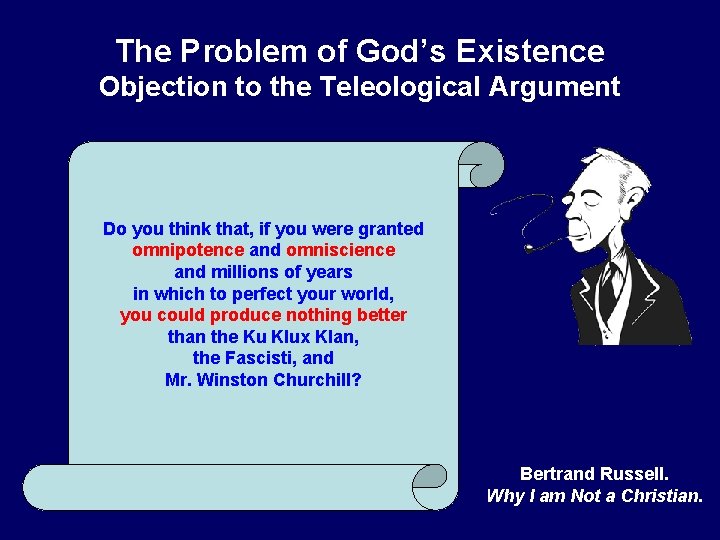
The Problem of God’s Existence Objection to the Teleological Argument Do you think that, if you were granted omnipotence and omniscience and millions of years in which to perfect your world, you could produce nothing better than the Ku Klux Klan, the Fascisti, and Mr. Winston Churchill? Bertrand Russell. Why I am Not a Christian.
The Problem of God’s Existence The Definitions and the Arguments The Ontological Argument God as the ultimately Perfect Being The Cosmological Argument The Causal Version The Modal Version God as the First Cause (the cause of all causes) God as the absolutely Necessary Being The Teleological Argument God as the Supreme Designer
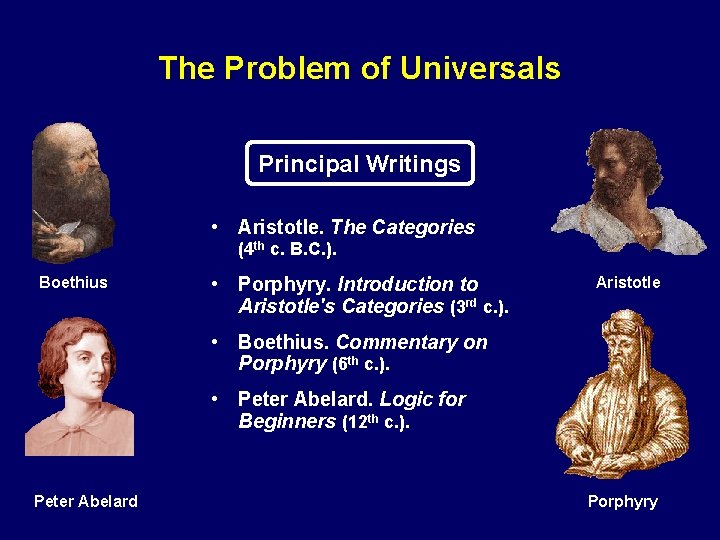
The Problem of Universals Principal Writings • Aristotle. The Categories (4 th c. B. C. ). Boethius • Porphyry. Introduction to Aristotle's Categories (3 rd c. ). Aristotle • Boethius. Commentary on Porphyry (6 th c. ). • Peter Abelard. Logic for Beginners (12 th c. ). Peter Abelard Porphyry
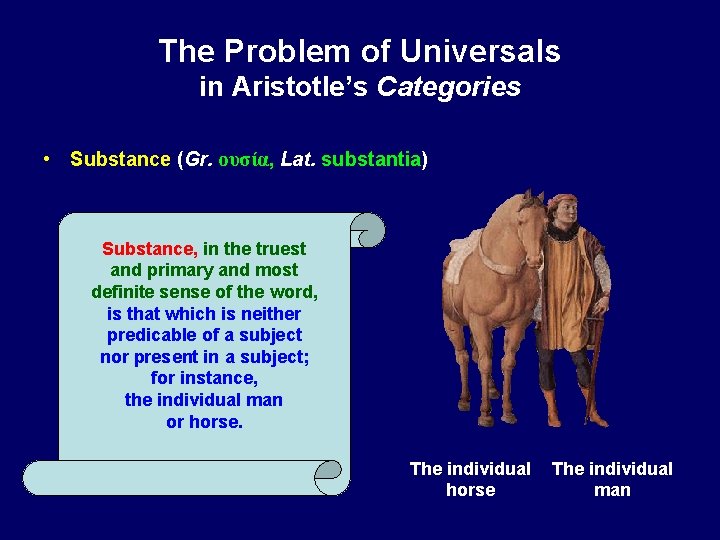
The Problem of Universals in Aristotle’s Categories • Substance (Gr. ουσία, Lat. substantia) Substance, in the truest and primary and most definite sense of the word, is that which is neither predicable of a subject nor present in a subject; for instance, the individual man or horse. The individual horse The individual man
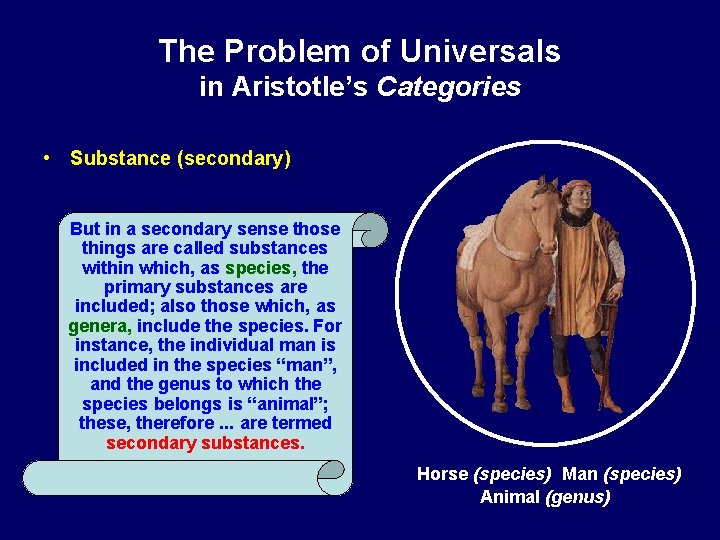
The Problem of Universals in Aristotle’s Categories • Substance (secondary) But in a secondary sense those things are called substances within which, as species, the primary substances are included; also those which, as genera, include the species. For instance, the individual man is included in the species “man”, and the genus to which the species belongs is “animal”; these, therefore. . . are termed secondary substances. Horse (species) Man (species) Animal (genus)
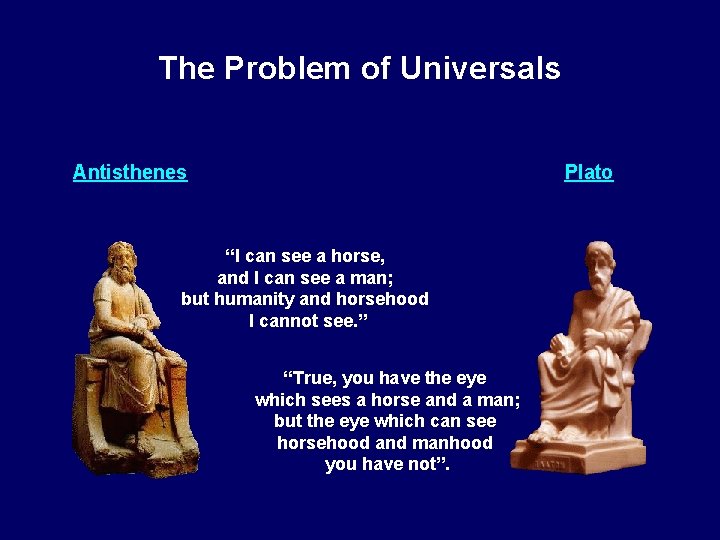
The Problem of Universals Antisthenes Plato “I can see a horse, and I can see a man; but humanity and horsehood I cannot see. ” “True, you have the eye which sees a horse and a man; but the eye which can see horsehood and manhood you have not”.
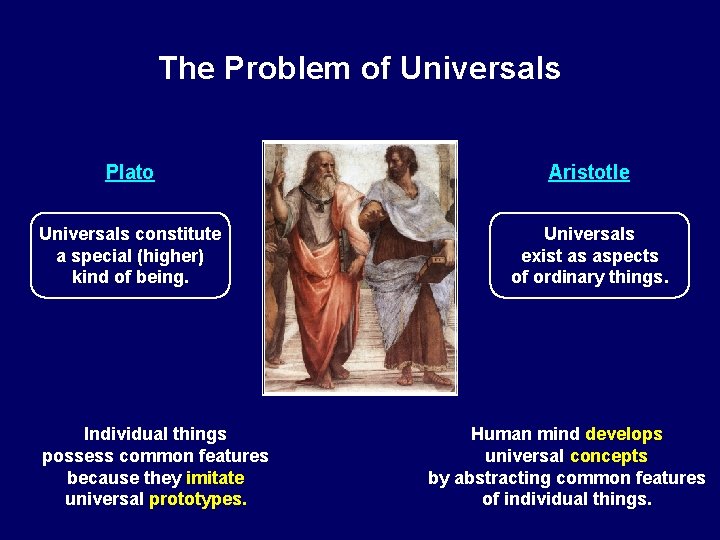
The Problem of Universals Plato Aristotle Universals constitute a special (higher) kind of being. Universals exist as aspects of ordinary things. Individual things possess common features because they imitate universal prototypes. Human mind develops universal concepts by abstracting common features of individual things.
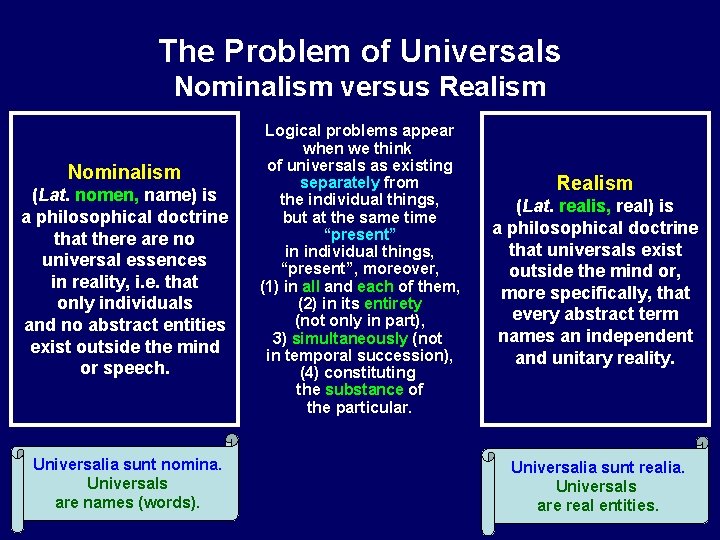
The Problem of Universals Nominalism versus Realism Nominalism (Lat. nomen, name) is a philosophical doctrine that there are no universal essences in reality, i. e. that only individuals and no abstract entities exist outside the mind or speech. Universalia sunt nomina. Universals are names (words). Logical problems appear when we think of universals as existing separately from the individual things, but at the same time “present” in individual things, “present”, moreover, (1) in all and each of them, (2) in its entirety (not only in part), 3) simultaneously (not in temporal succession), (4) constituting the substance of the particular. Realism (Lat. realis, real) is a philosophical doctrine that universals exist outside the mind or, more specifically, that every abstract term names an independent and unitary reality. Universalia sunt realia. Universals are real entities.
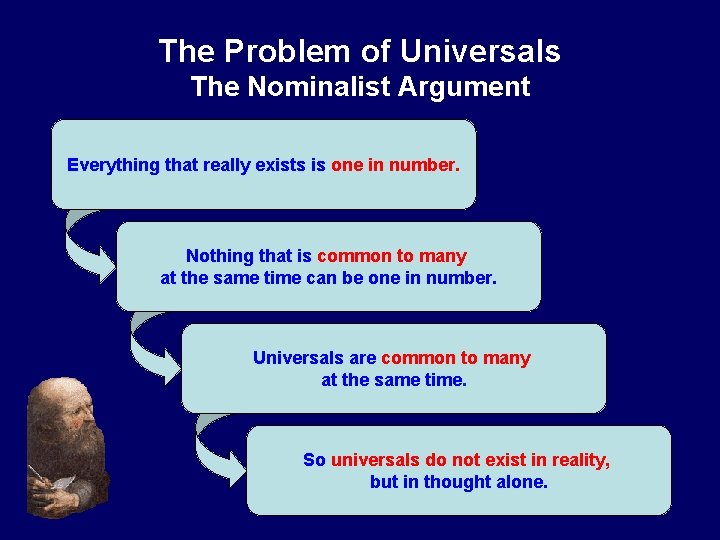
The Problem of Universals The Nominalist Argument Everything that really exists is one in number. Nothing that is common to many at the same time can be one in number. Universals are common to many at the same time. So universals do not exist in reality, but in thought alone.
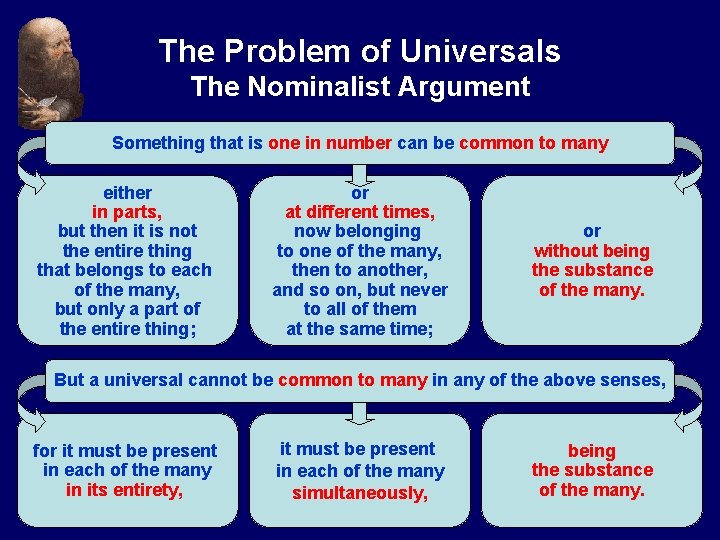
The Problem of Universals The Nominalist Argument Something that is one in number can be common to many either in parts, but then it is not the entire thing that belongs to each of the many, but only a part of the entire thing; or at different times, now belonging to one of the many, then to another, and so on, but never to all of them at the same time; or without being the substance of the many. But a universal cannot be common to many in any of the above senses, for it must be present in each of the many in its entirety, it must be present in each of the many simultaneously, being the substance of the many.
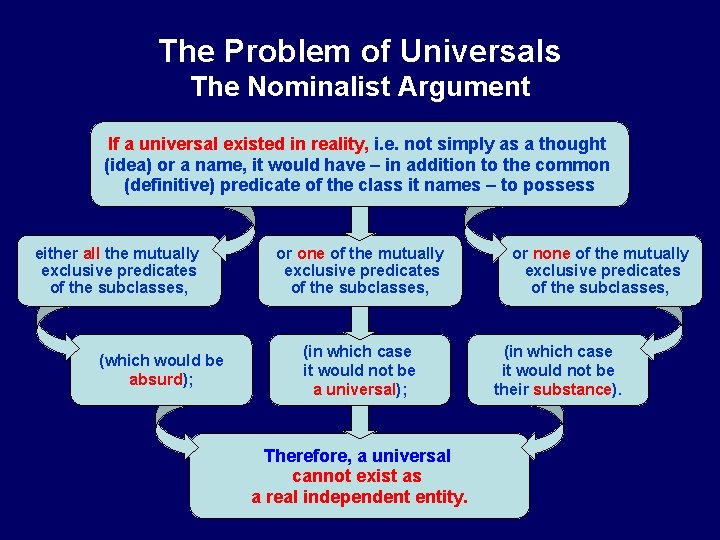
The Problem of Universals The Nominalist Argument If a universal existed in reality, i. e. not simply as a thought (idea) or a name, it would have – in addition to the common (definitive) predicate of the class it names – to possess either all the mutually exclusive predicates of the subclasses, (which would be absurd); or one of the mutually exclusive predicates of the subclasses, (in which case it would not be a universal); Therefore, a universal cannot exist as a real independent entity. or none of the mutually exclusive predicates of the subclasses, (in which case it would not be their substance).
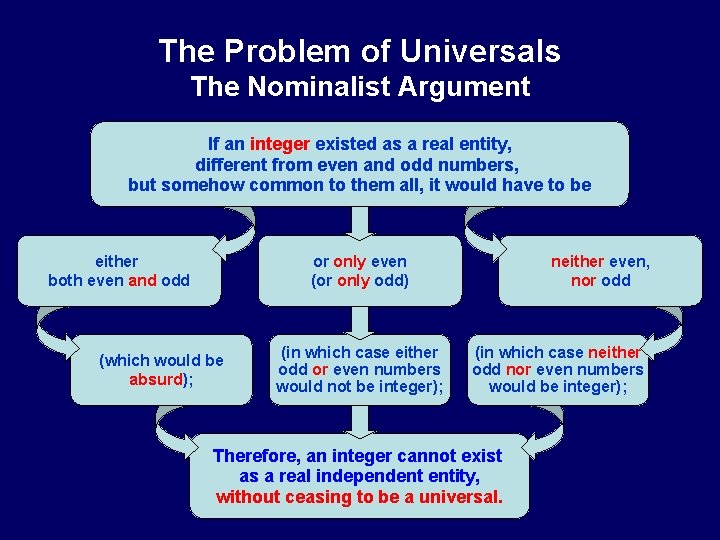
The Problem of Universals The Nominalist Argument If an integer existed as a real entity, different from even and odd numbers, but somehow common to them all, it would have to be either both even and odd or only even (or only odd) (which would be absurd); (in which case either odd or even numbers would not be integer); neither even, nor odd (in which case neither odd nor even numbers would be integer); Therefore, an integer cannot exist as a real independent entity, without ceasing to be a universal.
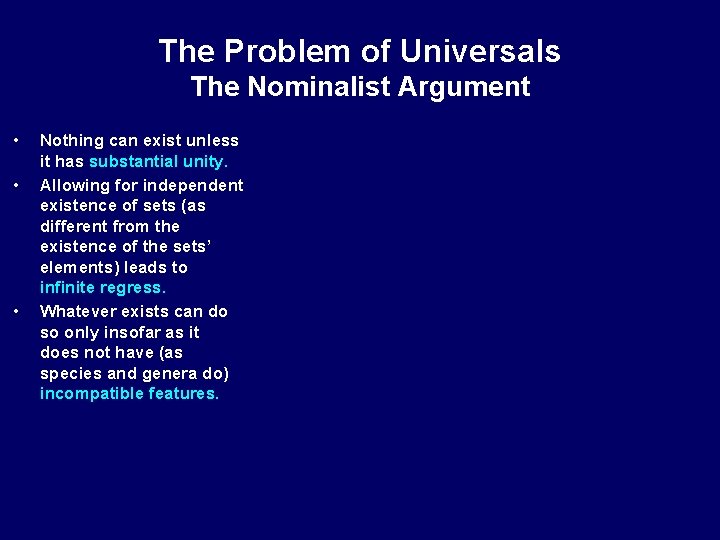
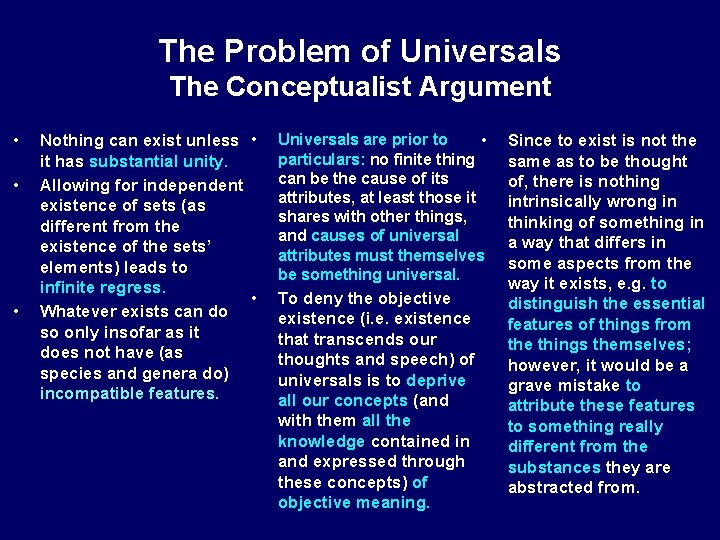
The Problem of Universals The Nominalist Argument • • • Nothing can exist unless it has substantial unity. Allowing for independent existence of sets (as different from the existence of the sets’ elements) leads to infinite regress. Whatever exists can do so only insofar as it does not have (as species and genera do) incompatible features.
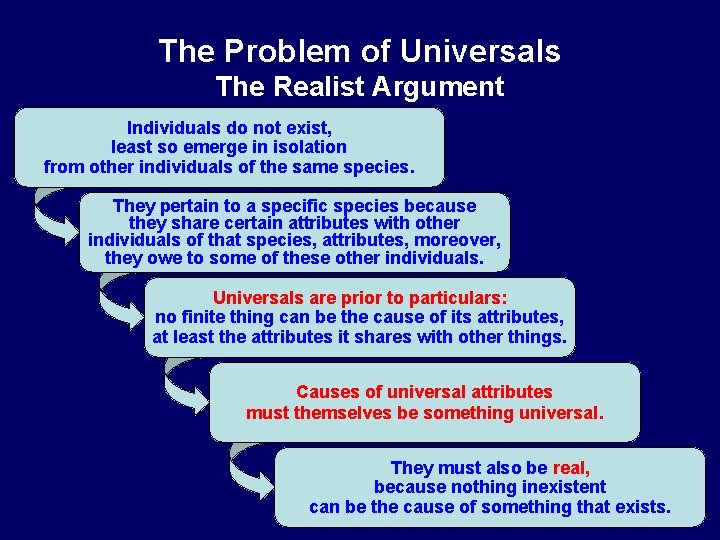
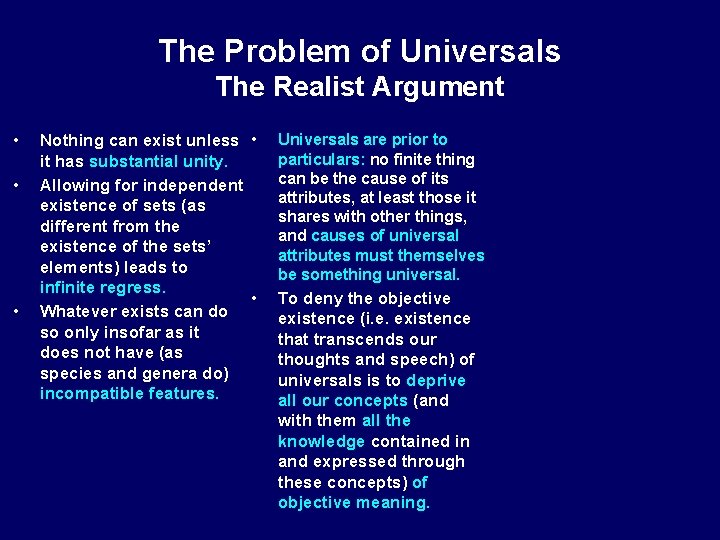
The Problem of Universals The Realist Argument Individuals do not exist, least so emerge in isolation from other individuals of the same species. They pertain to a specific species because they share certain attributes with other individuals of that species, attributes, moreover, they owe to some of these other individuals. Universals are prior to particulars: no finite thing can be the cause of its attributes, at least the attributes it shares with other things. Causes of universal attributes must themselves be something universal. They must also be real, because nothing inexistent can be the cause of something that exists.
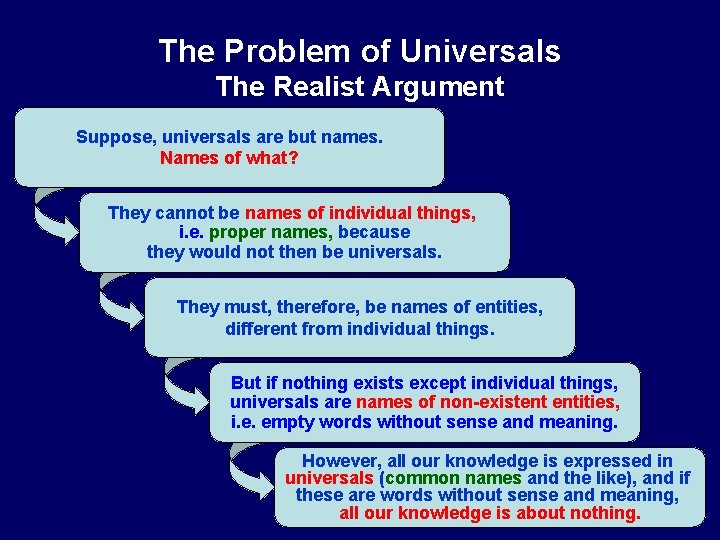
The Problem of Universals The Realist Argument Suppose, universals are but names. Names of what? They cannot be names of individual things, i. e. proper names, because they would not then be universals. They must, therefore, be names of entities, different from individual things. But if nothing exists except individual things, universals are names of non-existent entities, i. e. empty words without sense and meaning. However, all our knowledge is expressed in universals (common names and the like), and if these are words without sense and meaning, all our knowledge is about nothing.
The Problem of Universals The Realist Argument • • • Nothing can exist unless • it has substantial unity. Allowing for independent existence of sets (as different from the existence of the sets’ elements) leads to infinite regress. • Whatever exists can do so only insofar as it does not have (as species and genera do) incompatible features. Universals are prior to particulars: no finite thing can be the cause of its attributes, at least those it shares with other things, and causes of universal attributes must themselves be something universal. To deny the objective existence (i. e. existence that transcends our thoughts and speech) of universals is to deprive all our concepts (and with them all the knowledge contained in and expressed through these concepts) of objective meaning.
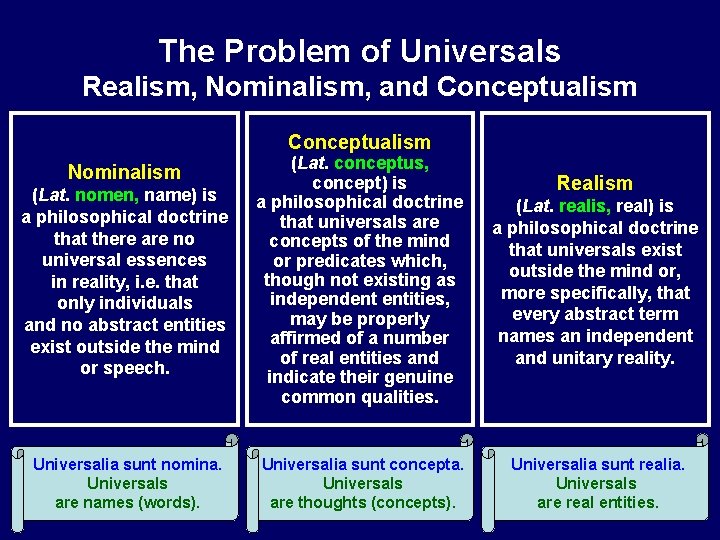
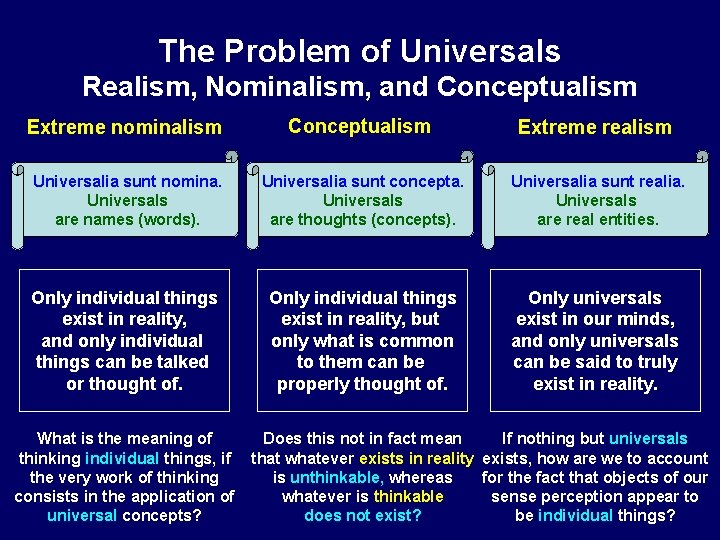
The Problem of Universals Realism, Nominalism, and Conceptualism (Lat. nomen, name) is a philosophical doctrine that there are no universal essences in reality, i. e. that only individuals and no abstract entities exist outside the mind or speech. (Lat. conceptus, concept) is a philosophical doctrine that universals are concepts of the mind or predicates which, though not existing as independent entities, may be properly affirmed of a number of real entities and indicate their genuine common qualities. (Lat. realis, real) is a philosophical doctrine that universals exist outside the mind or, more specifically, that every abstract term names an independent and unitary reality. Universalia sunt nomina. Universals are names (words). Universalia sunt concepta. Universals are thoughts (concepts). Universalia sunt realia. Universals are real entities. Nominalism Realism
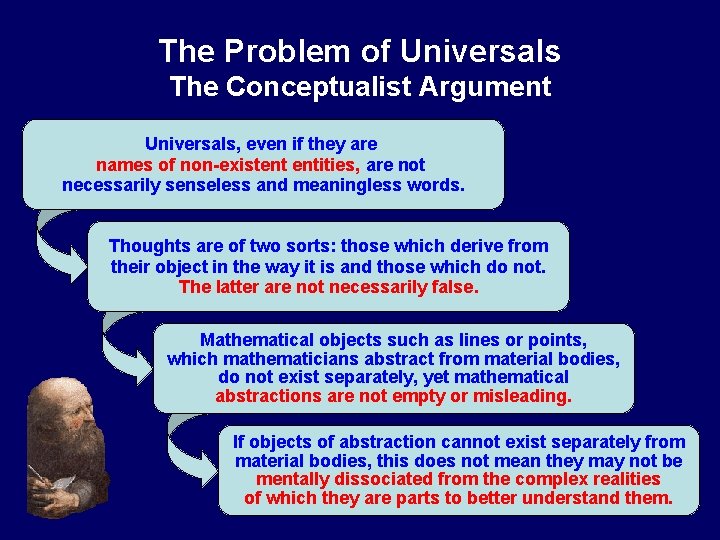
The Problem of Universals The Conceptualist Argument Universals, even if they are names of non-existent entities, are not necessarily senseless and meaningless words. Thoughts are of two sorts: those which derive from their object in the way it is and those which do not. The latter are not necessarily false. Mathematical objects such as lines or points, which mathematicians abstract from material bodies, do not exist separately, yet mathematical abstractions are not empty or misleading. If objects of abstraction cannot exist separately from material bodies, this does not mean they may not be mentally dissociated from the complex realities of which they are parts to better understand them.
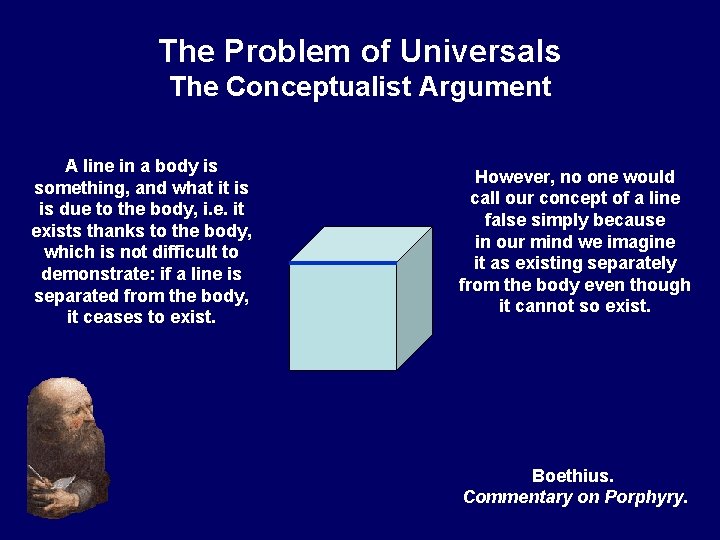
The Problem of Universals The Conceptualist Argument A line in a body is something, and what it is is due to the body, i. e. it exists thanks to the body, which is not difficult to demonstrate: if a line is separated from the body, it ceases to exist. However, no one would call our concept of a line false simply because in our mind we imagine it as existing separately from the body even though it cannot so exist. Boethius. Commentary on Porphyry.
The Problem of Universals The Conceptualist Argument • • • Nothing can exist unless • it has substantial unity. Allowing for independent existence of sets (as different from the existence of the sets’ elements) leads to infinite regress. • Whatever exists can do so only insofar as it does not have (as species and genera do) incompatible features. Universals are prior to • particulars: no finite thing can be the cause of its attributes, at least those it shares with other things, and causes of universal attributes must themselves be something universal. To deny the objective existence (i. e. existence that transcends our thoughts and speech) of universals is to deprive all our concepts (and with them all the knowledge contained in and expressed through these concepts) of objective meaning. Since to exist is not the same as to be thought of, there is nothing intrinsically wrong in thinking of something in a way that differs in some aspects from the way it exists, e. g. to distinguish the essential features of things from the things themselves; however, it would be a grave mistake to attribute these features to something really different from the substances they are abstracted from.
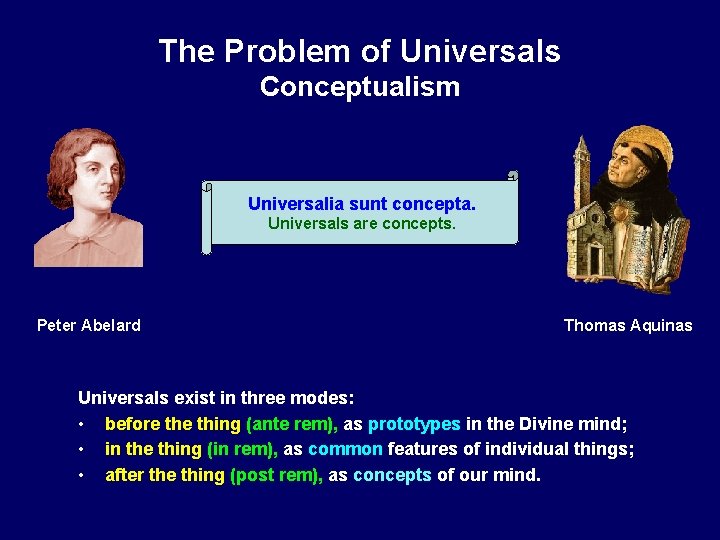
The Problem of Universals Conceptualism Universalia sunt concepta. Universals are concepts. Peter Abelard Thomas Aquinas Universals exist in three modes: • before thing (ante rem), as prototypes in the Divine mind; • in the thing (in rem), as common features of individual things; • after the thing (post rem), as concepts of our mind.
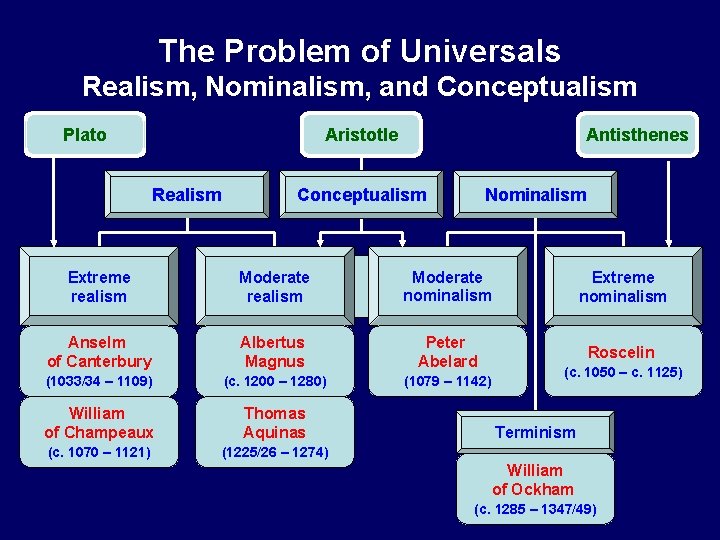
The Problem of Universals Realism, Nominalism, and Conceptualism Plato Aristotle Realism Antisthenes Conceptualism Nominalism Extreme realism Moderate nominalism Extreme nominalism Anselm of Canterbury Albertus Magnus Peter Abelard Roscelin (1033/34 – 1109) (c. 1200 – 1280) (1079 – 1142) William of Champeaux (c. 1070 – 1121) Thomas Aquinas (c. 1050 – c. 1125) Terminism (1225/26 – 1274) William of Ockham (c. 1285 – 1347/49)
The Problem of Universals Realism, Nominalism, and Conceptualism Extreme nominalism Conceptualism Extreme realism Universalia sunt nomina. Universals are names (words). Universalia sunt concepta. Universals are thoughts (concepts). Universalia sunt realia. Universals are real entities. Only individual things exist in reality, and only individual things can be talked or thought of. Only individual things exist in reality, but only what is common to them can be properly thought of. Only universals exist in our minds, and only universals can be said to truly exist in reality. What is the meaning of Does this not in fact mean If nothing but universals thinking individual things, if that whatever exists in reality exists, how are we to account the very work of thinking is unthinkable, whereas for the fact that objects of our consists in the application of whatever is thinkable sense perception appear to universal concepts? does not exist? be individual things?
Questions?