
International Institute of Christian Discipleship CR 03 Principles







- Slides: 191
International Institute of Christian Discipleship CR 03 Principles of Leadership and Church Growth General Conference of Seventh-day Adventists®
Chapter 1 A THEOLOGY OF CHURCH GROWTH
Genesis 3: 9 God comes seeking Adam and Eve. The rest of scripture is about the seeking God: through the prophets, Moses, and finally through Christ. God is the One who seeks. The phrase: “Where are you? ” is in the background of everything throughout the rest of Scripture.
Christianity is about God seeking people. Other religions are about people seeking God.
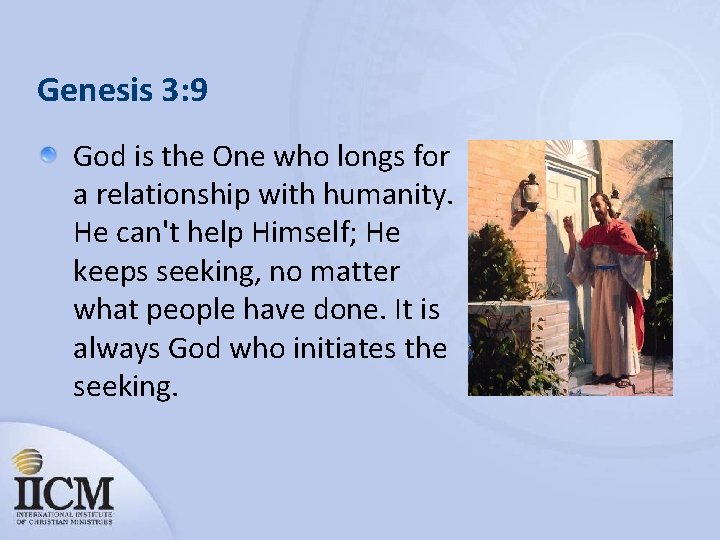
Genesis 3: 9 God is the One who longs for a relationship with humanity. He can't help Himself; He keeps seeking, no matter what people have done. It is always God who initiates the seeking.
Genesis 3: 9 If it is the nature of God to seek, what does this mean for church growth? Those who are called of God are called to be involved in God's mission — seeking.
Genesis 3: 9 It is God's seeking that is the foundation of church growth, because all of God's seeking is done through humans. The heart of church growth is the seeking heart of God.
Genesis 3: 9 The church does not seek because they are in need — shrinking in membership, can't pay bills — or because we want a large church. We seek because we can't help ourselves, just like God.
Doctrine of election is for the sake of the nations; we are chosen to give the message. We have an election to join Him in this seeking movement, which is the original function of Israel, of the Christian church, and of the SDA church.
When a church ceases to be an evangelistic agency involved in the mission of the seeking God, that church ceases to be the true church, because mission is at the heart of the seeking God.
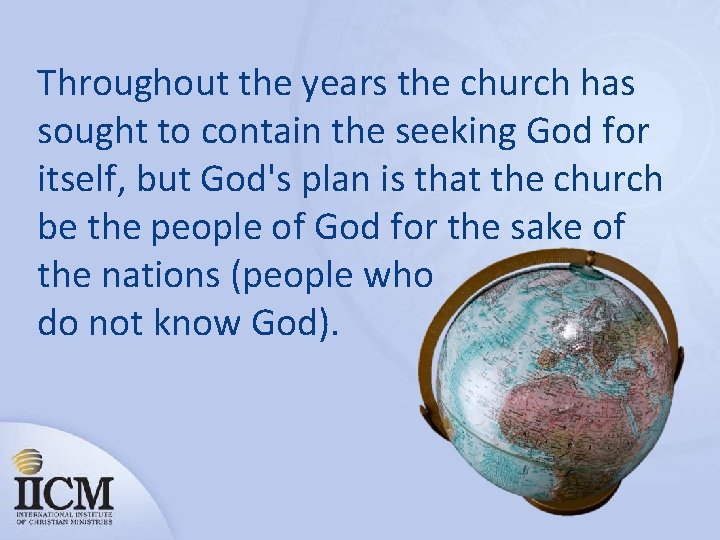
Throughout the years the church has sought to contain the seeking God for itself, but God's plan is that the church be the people of God for the sake of the nations (people who do not know God).
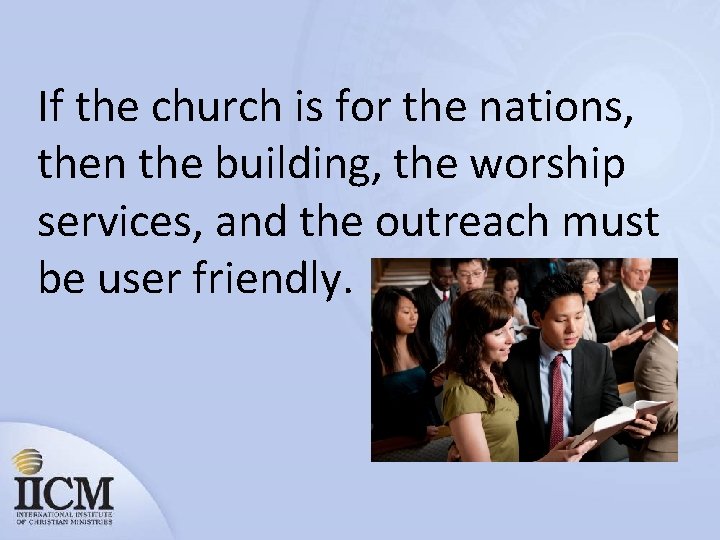
If the church is for the nations, then the building, the worship services, and the outreach must be user friendly.
The Lost Lamb, by Del Parson, © Del Parson We are the people of God for the sake of God's seeking heart.
Counter-culture approach If the boundary between the church and the world is high, then church growth is seen as a rescue mission. Work in the church is seen as quite different from work in the world. The result is that we train people so well for the work of the church, they can't fish anymore.
Culture-affirming approach No boundary at all between the church and the world. Can’t tell the world and the church apart. In terms of behavior, can't tell the difference between Christians and the world. In this cultural extreme, we feed the consumer church. In this church, as soon as people’s needs are no longer being met, they will go elsewhere.
Culture-affirming approach Church growth then becomes proselytism. People go to whoever fills their present needs. This approach feeds into normalism and secularism.
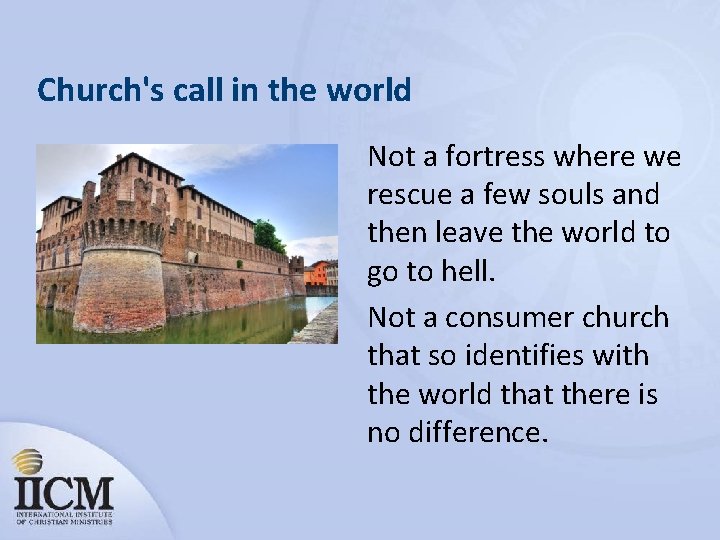
Church's call in the world Not a fortress where we rescue a few souls and then leave the world to go to hell. Not a consumer church that so identifies with the world that there is no difference.
Church's call in the world Church is called out of the world, redeemed, and then put back into the world to reach and transform the world. This is the heart of church growth.
When we believe that all cultures except our own are fallen, then when other cultures join us they will look like us.
The hardest thing for the church to do is to decide what is the essence of religion and what is cultural.
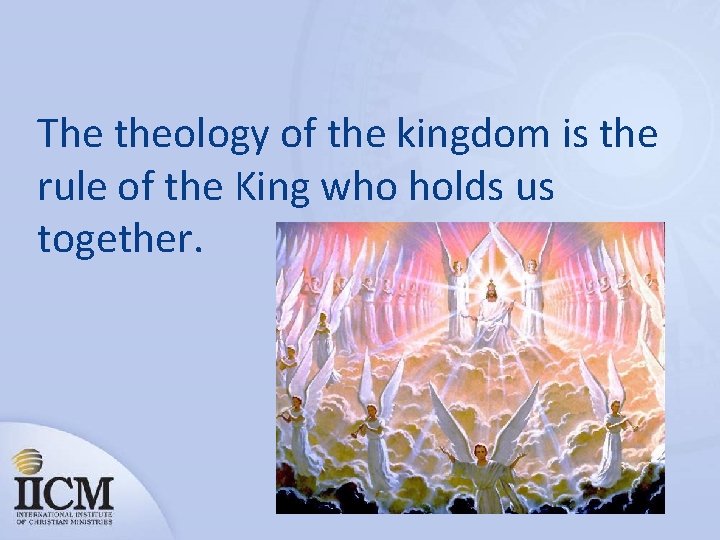
The theology of the kingdom is the rule of the King who holds us together.
We live in a fallen humanity on the way to unity. The more we point to unity, the closer we move to the King. All local congregations are only partial representations of the unity of the King; it is our collective unity.
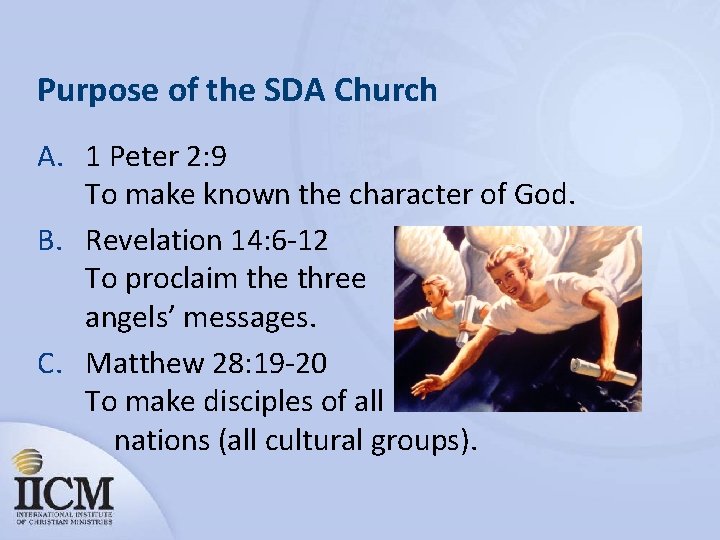
Purpose of the SDA Church A. 1 Peter 2: 9 To make known the character of God. B. Revelation 14: 6 -12 To proclaim the three angels’ messages. C. Matthew 28: 19 -20 To make disciples of all nations (all cultural groups).
Biblical numbering I Chronicles 21: 1 -8 Numbering condemned — for self-glorification. Numbers 1: 1 -4, 17 -19 Commanded by God. Acts 2: 41, 47 3000 in one day — others added daily.
Biblical numbering Acts 4: 4 5000 believed — church now 8, 120+. Acts 6: 7 Disciples multiplied — priests obedient. Acts 9: 35 Whole cities turned to Christ.
Biblical numbering Acts 11: 21 Great numbers believed. Acts 21: 20 Many thousands.
Implications of numbering Early church very much interested in statistics and growth, because of what numbers mean — souls saved in God's kingdom. Not numbers for sake of numbers, but souls saved.
What happened in Acts that made the church grow? 1. Church had an internal spiritual revival. Churches grow as they are spiritually revived. 2. There was a sense of the centrality of their mission. Reason for existence of church was proclamation of gospel. 3. Proclaimed gospel both publicly and privately.
Facts that should have hindered church growth in the book of Acts Growing Greek influence in society — secularization of society Formal religion (Jews) Strong materialistic influence by Rome Small church considered by many to be a sect
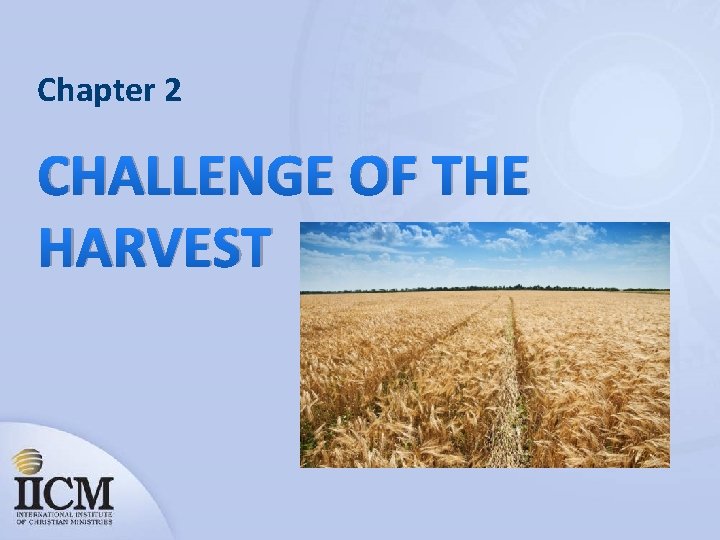
Chapter 2 CHALLENGE OF THE HARVEST
"Time is short. Workers for Christ are needed everywhere. There should be one hundred earnest, faithful laborers in home and foreign mission fields where now there is one. The highways and byways are yet unworked. " —Fundamentals of Education, p. 488
"We are not, as Christians, doing one twentieth the part that we might do in winning souls to Christ. There is a world to be warned, and every sincere Christian will be a guide and an example to others in faithfulness,
in cross-bearing, in prompt and vigorous action, in unswerving fidelity to the cause of truth, and in sacrifices and labors to promote the cause of God. ” —Christian Service, p. 12
WALK THE TALK 1 2 3 4 5 6 7 8 9 10
WALK THE TALK THE WALK 1 2 3 4 5 6 7 8 9 10
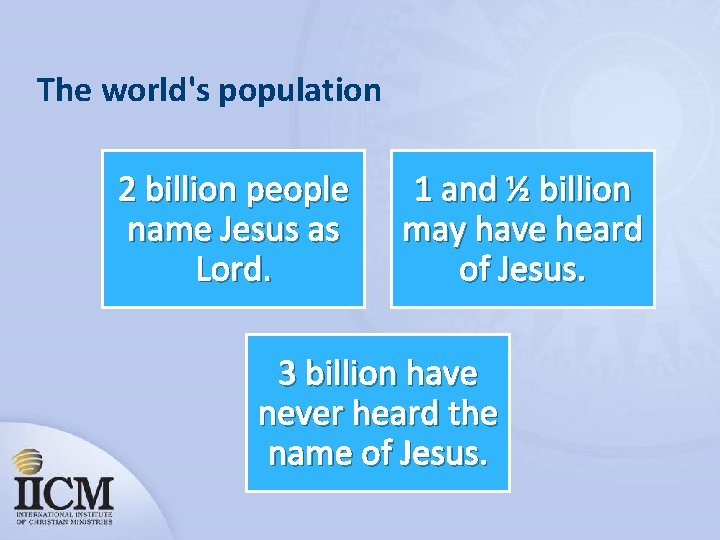
The world's population 2 billion people name Jesus as Lord. 1 and ½ billion may have heard of Jesus. 3 billion have never heard the name of Jesus.
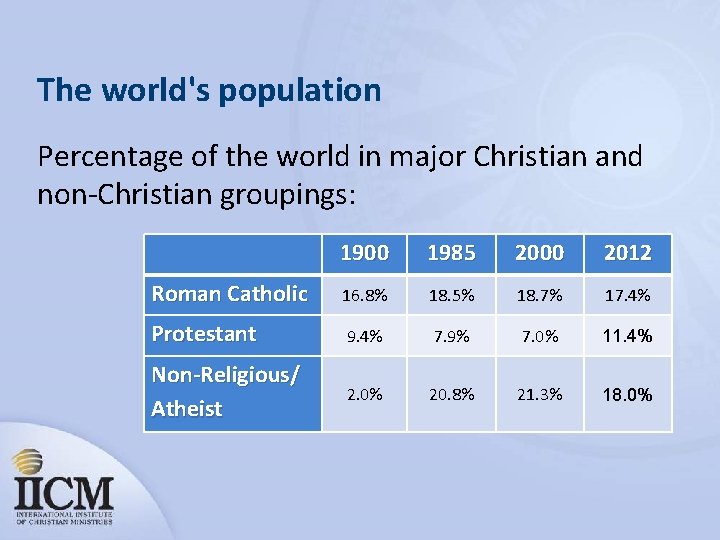
The world's population Percentage of the world in major Christian and non-Christian groupings: 1900 1985 2000 2012 Roman Catholic 16. 8% 18. 5% 18. 7% 17. 4% Protestant 9. 4% 7. 9% 7. 0% 11. 4% Non-Religious/ Atheist 2. 0% 20. 8% 21. 3% 18. 0%
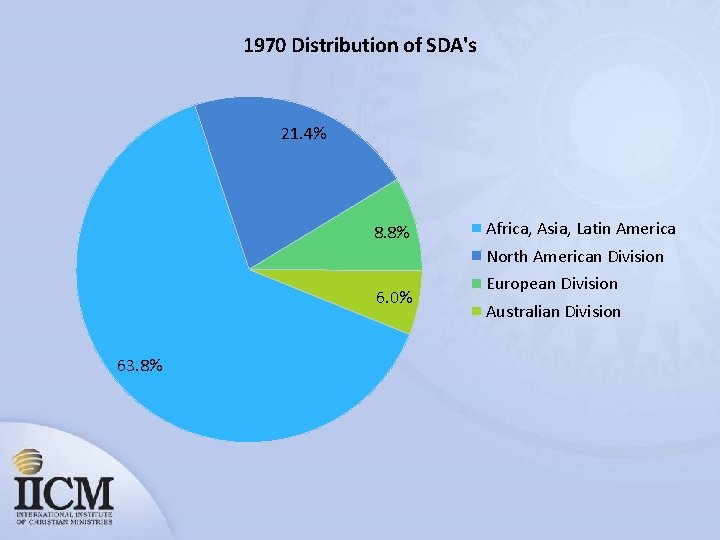
1970 Distribution of SDA's 21. 4% 8. 8% Africa, Asia, Latin America North American Division 6. 0% 63. 8% European Division Australian Division
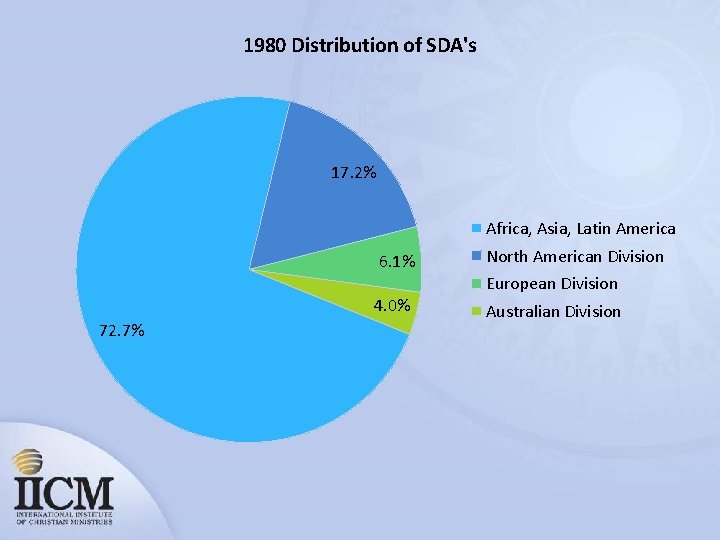
1980 Distribution of SDA's 17. 2% Africa, Asia, Latin America 6. 1% North American Division European Division 4. 0% 72. 7% Australian Division
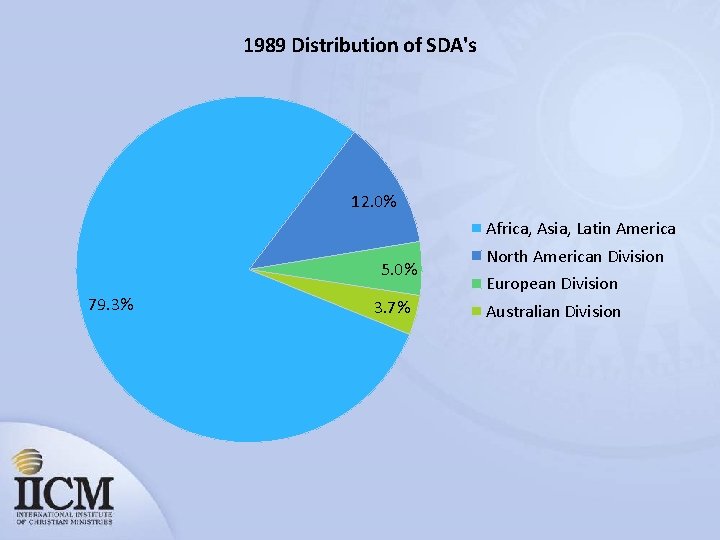
1989 Distribution of SDA's 12. 0% Africa, Asia, Latin America 5. 0% 79. 3% 3. 7% North American Division European Division Australian Division
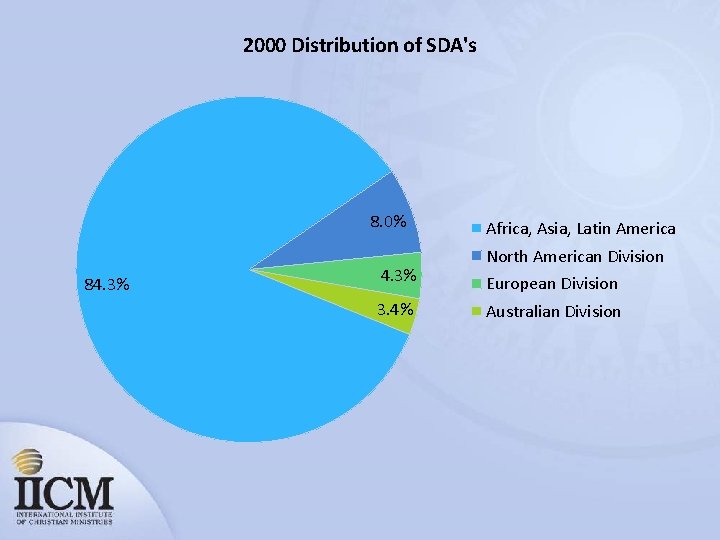
2000 Distribution of SDA's 8. 0% 84. 3% 3. 4% Africa, Asia, Latin America North American Division European Division Australian Division
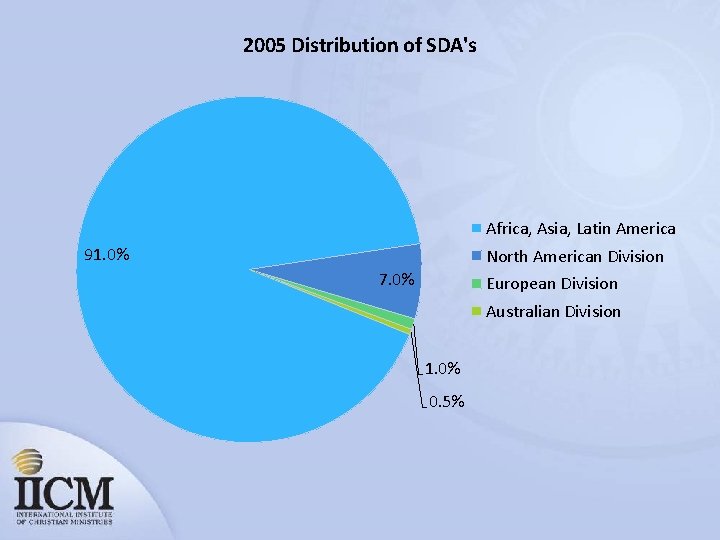
2005 Distribution of SDA's Africa, Asia, Latin America 91. 0% North American Division 7. 0% European Division Australian Division 1. 0% 0. 5%
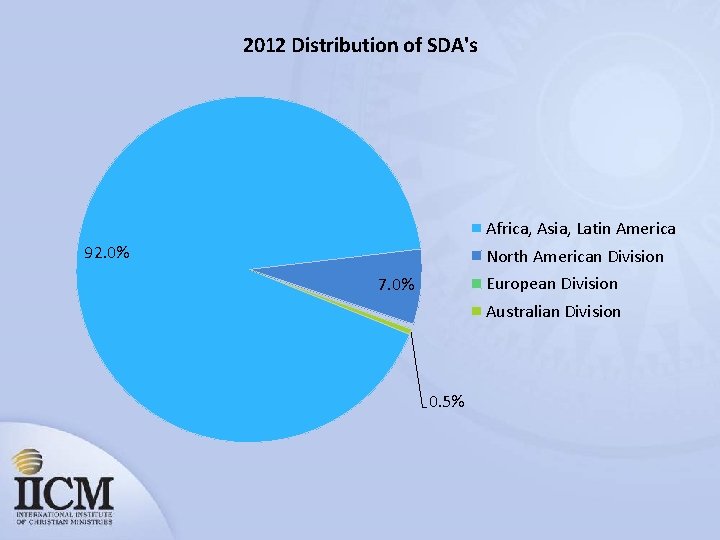
2012 Distribution of SDA's Africa, Asia, Latin America 92. 0% North American Division European Division 7. 0% Australian Division 0. 5%
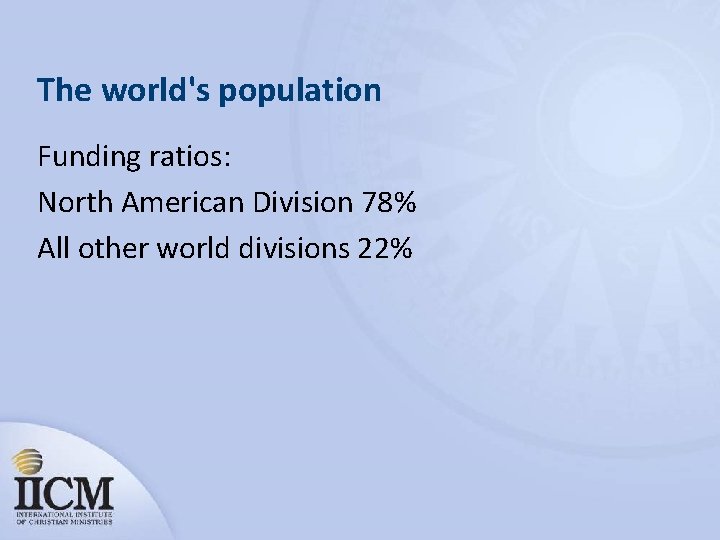
The world's population Funding ratios: North American Division 78% All other world divisions 22%
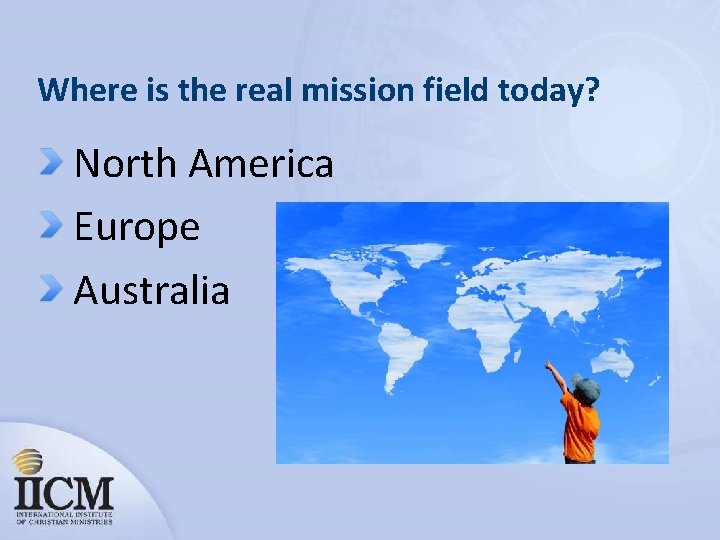
Where is the real mission field today? North America Europe Australia
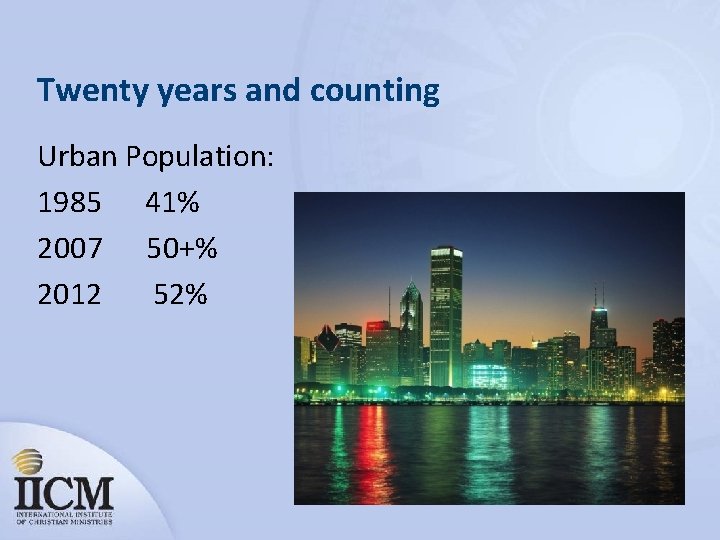
Twenty years and counting Urban Population: 1985 41% 2007 50+% 2012 52%
Twenty years and counting First identified: 1981 Deaths since 1981 to 2012 36 millions
Twenty years and counting World population: 1988 5. 1 billion 2007 6. 6 billion 2012 7. 06 billion
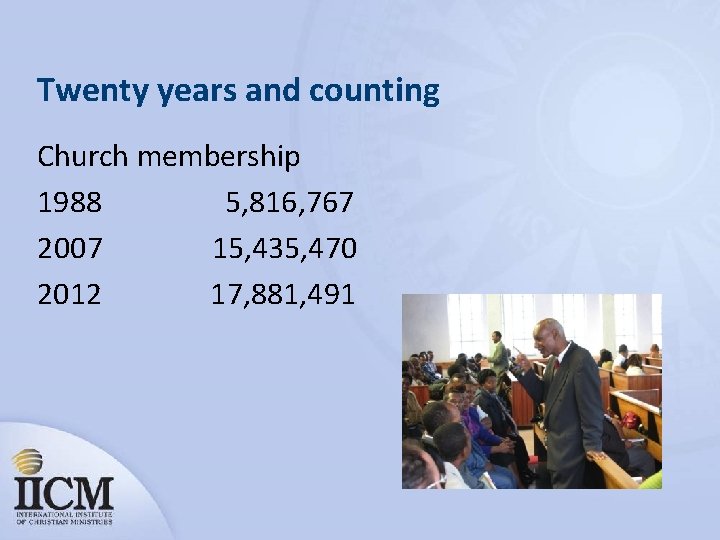
Twenty years and counting Church membership 1988 5, 816, 767 2007 15, 435, 470 2012 17, 881, 491
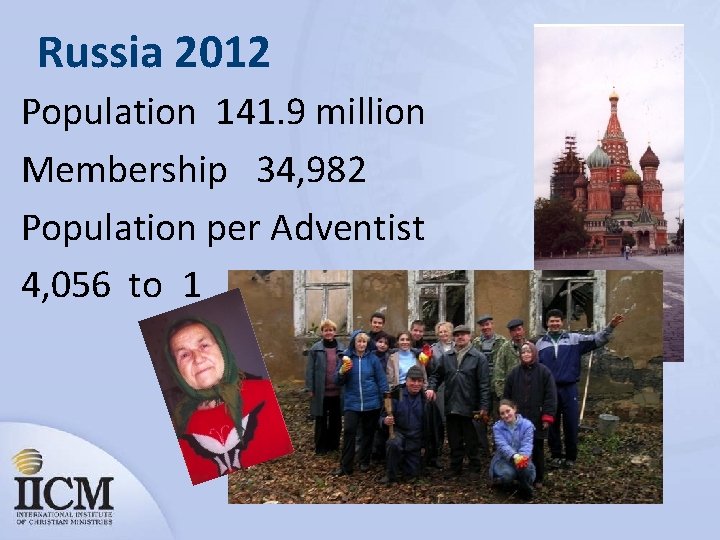
Russia 2012 Population 141. 9 million Membership 34, 982 Population per Adventist 4, 056 to 1
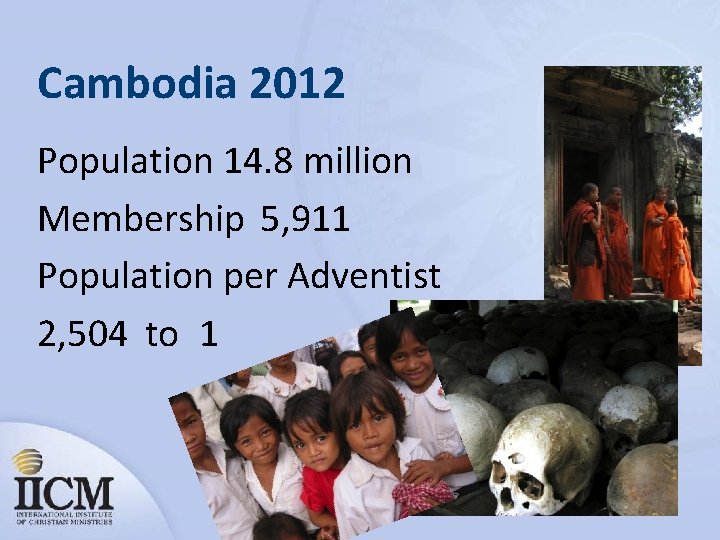
Cambodia 2012 Population 14. 8 million Membership 5, 911 Population per Adventist 2, 504 to 1
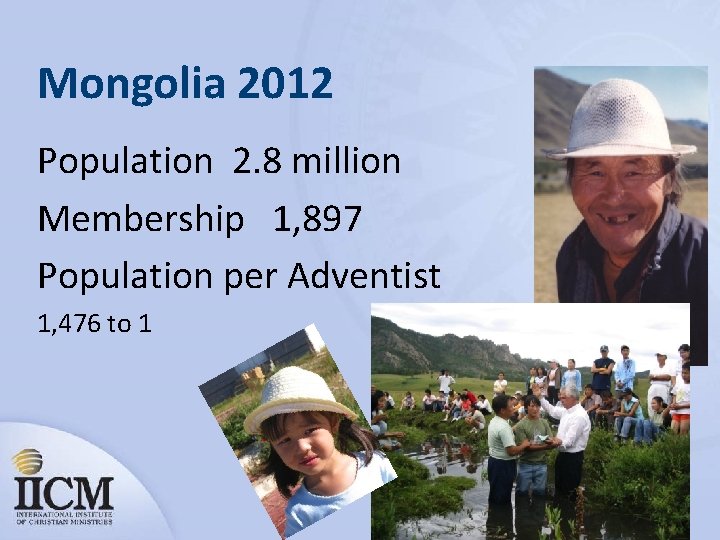
Mongolia 2012 Population 2. 8 million Membership 1, 897 Population per Adventist 1, 476 to 1
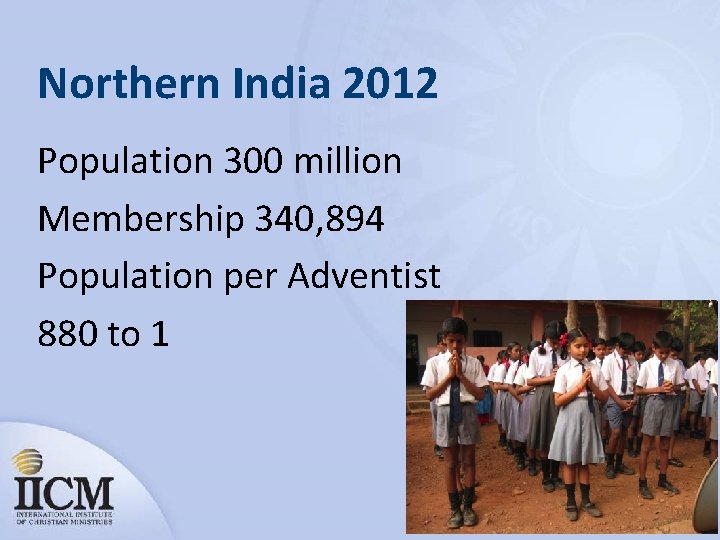
Northern India 2012 Population 300 million Membership 340, 894 Population per Adventist 880 to 1
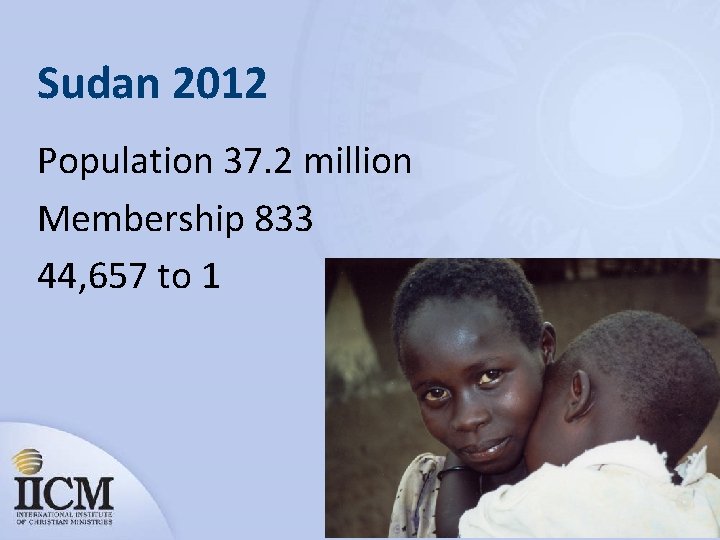
Sudan 2012 Population 37. 2 million Membership 833 44, 657 to 1
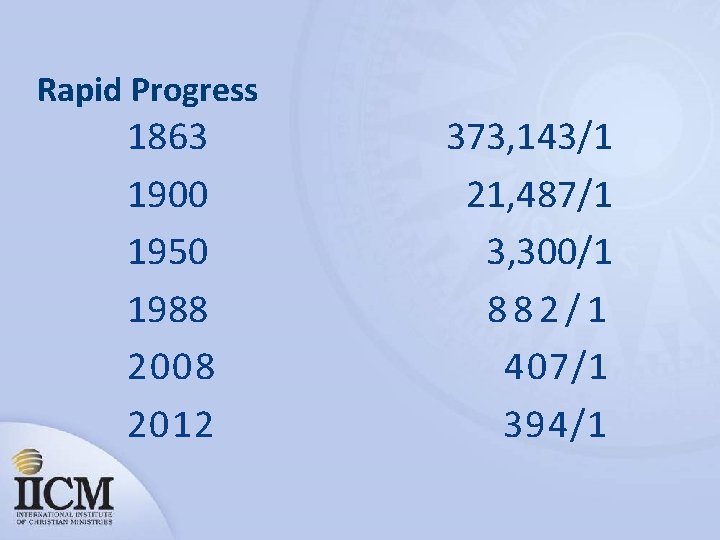
Rapid Progress 1863 1900 1950 1988 2008 2012 373, 143/1 21, 487/1 3, 300/1 882/1 407/1 394/1
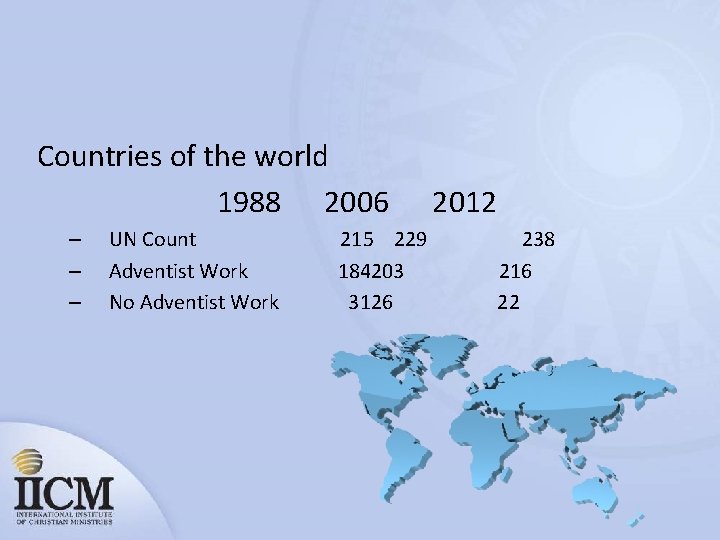
Countries of the world 1988 2006 – – – UN Count Adventist Work No Adventist Work 215 229 184203 3126 2012 238 216 22
What does it mean to: “Enter” a country “Finish” the work “Share” the message “Preach” the everlasting gospel
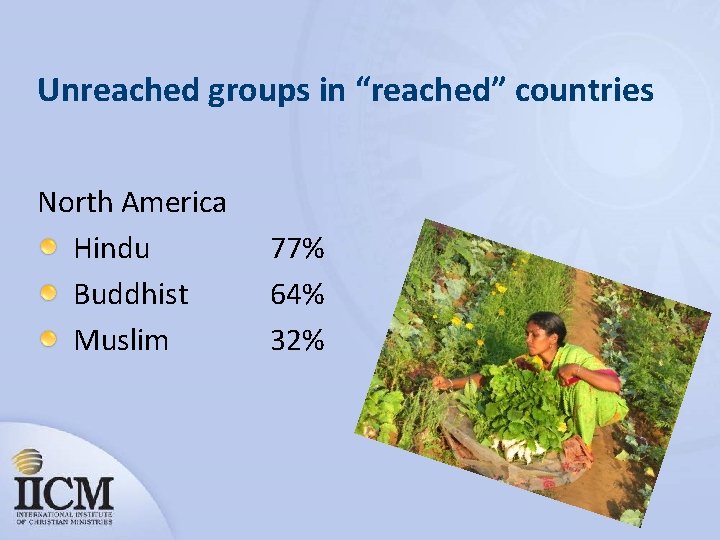
Unreached groups in “reached” countries North America Hindu Buddhist Muslim 77% 64% 32%
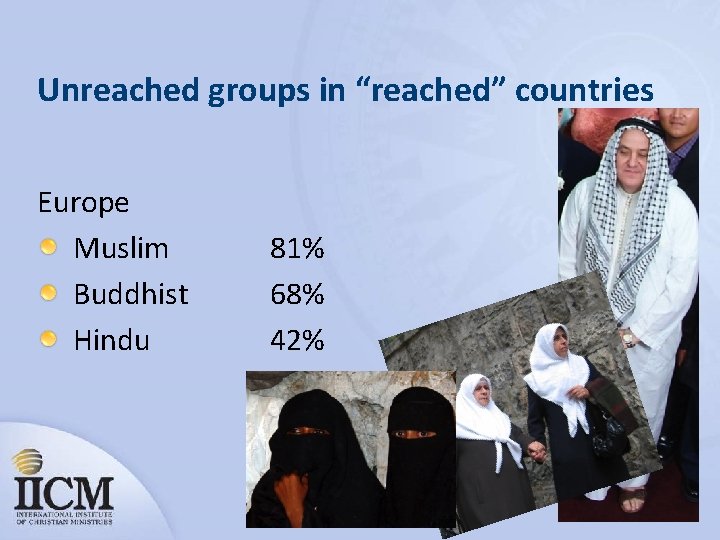
Unreached groups in “reached” countries Europe Muslim Buddhist Hindu 81% 68% 42%
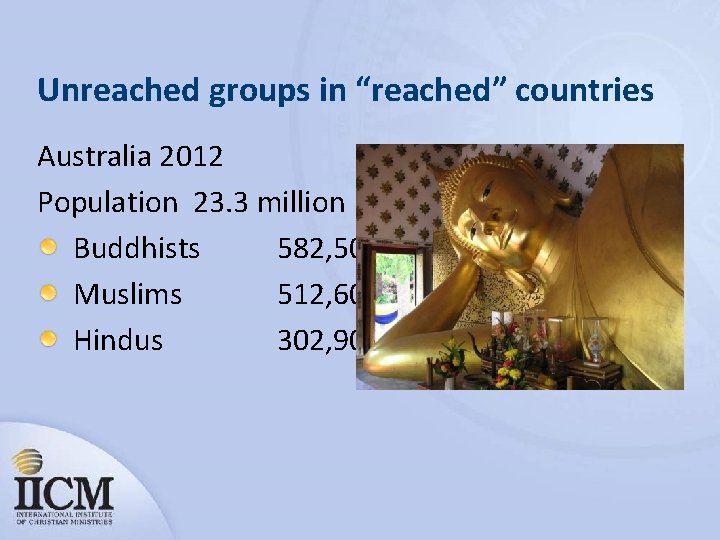
Unreached groups in “reached” countries Australia 2012 Population 23. 3 million Buddhists 582, 500 Muslims 512, 600 Hindus 302, 900
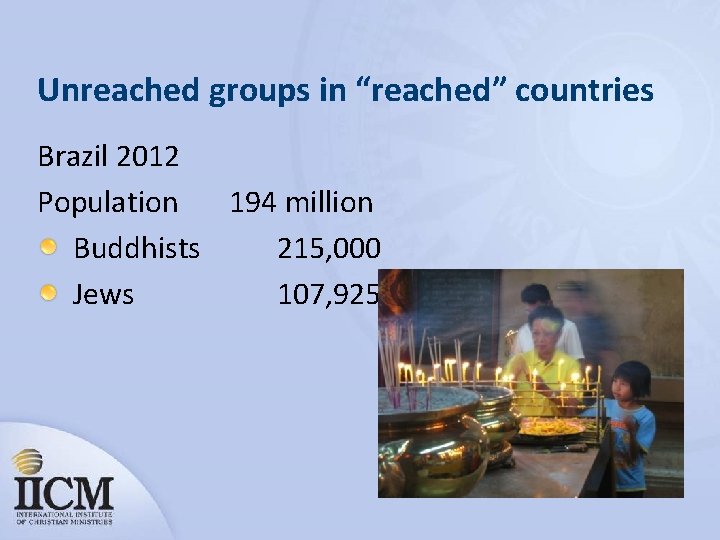
Unreached groups in “reached” countries Brazil 2012 Population 194 million Buddhists 215, 000 Jews 107, 925
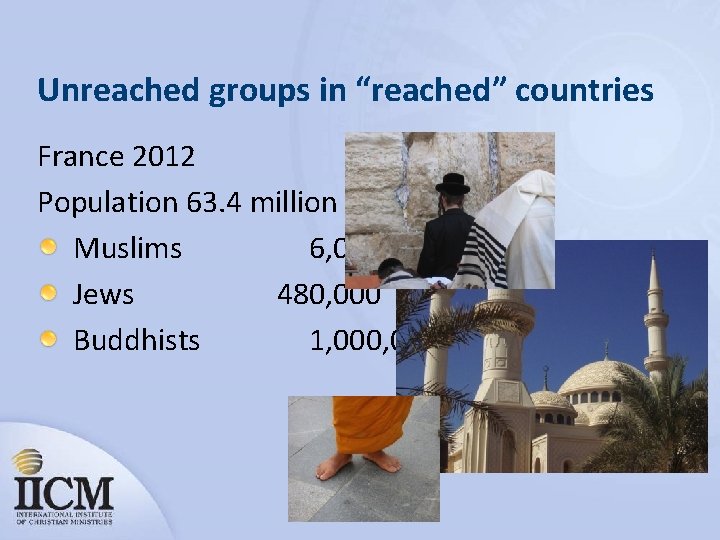
Unreached groups in “reached” countries France 2012 Population 63. 4 million Muslims 6, 000 Jews 480, 000 Buddhists 1, 000
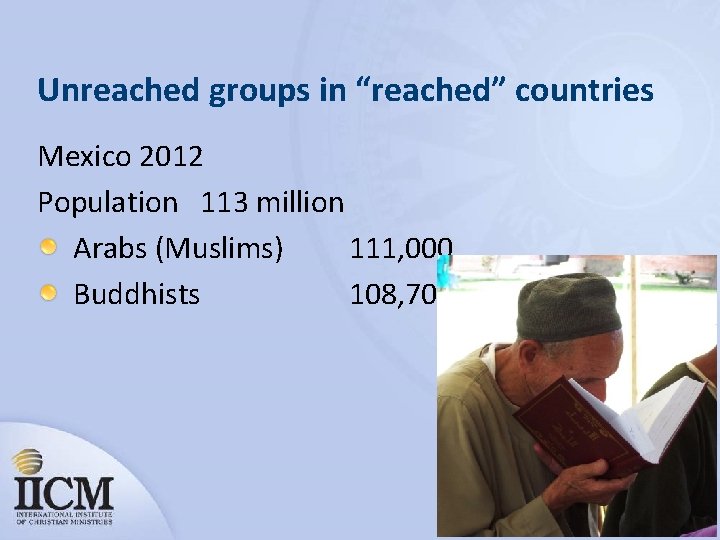
Unreached groups in “reached” countries Mexico 2012 Population 113 million Arabs (Muslims) 111, 000 Buddhists 108, 701
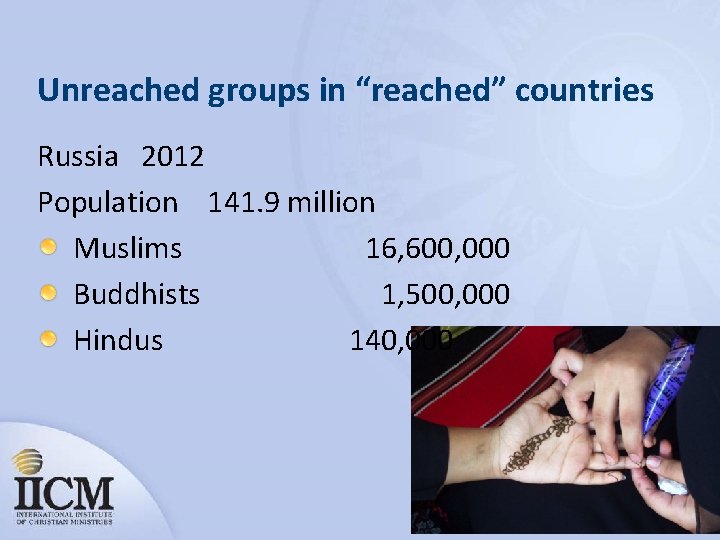
Unreached groups in “reached” countries Russia 2012 Population 141. 9 million Muslims 16, 600, 000 Buddhists 1, 500, 000 Hindus 140, 000
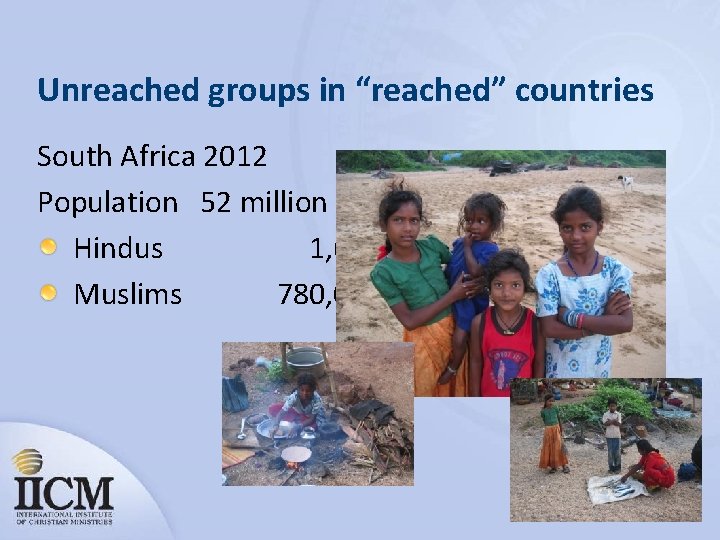
Unreached groups in “reached” countries South Africa 2012 Population 52 million Hindus 1, 684, 283 Muslims 780, 000
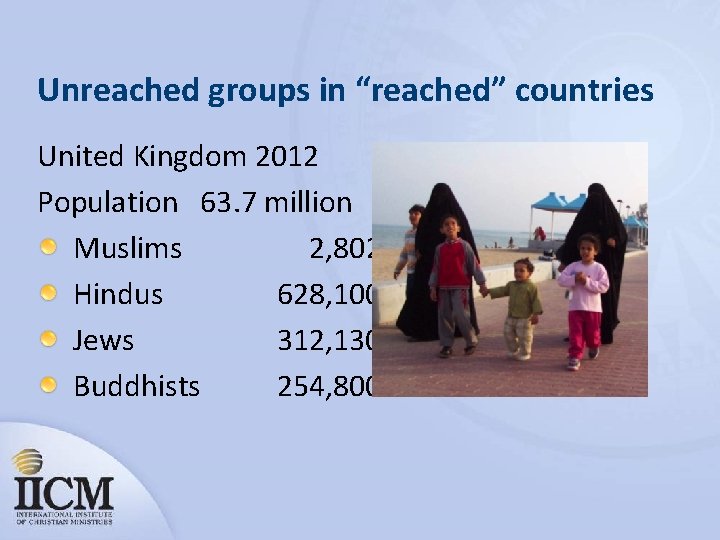
Unreached groups in “reached” countries United Kingdom 2012 Population 63. 7 million Muslims 2, 800 Hindus 628, 100 Jews 312, 130 Buddhists 254, 800
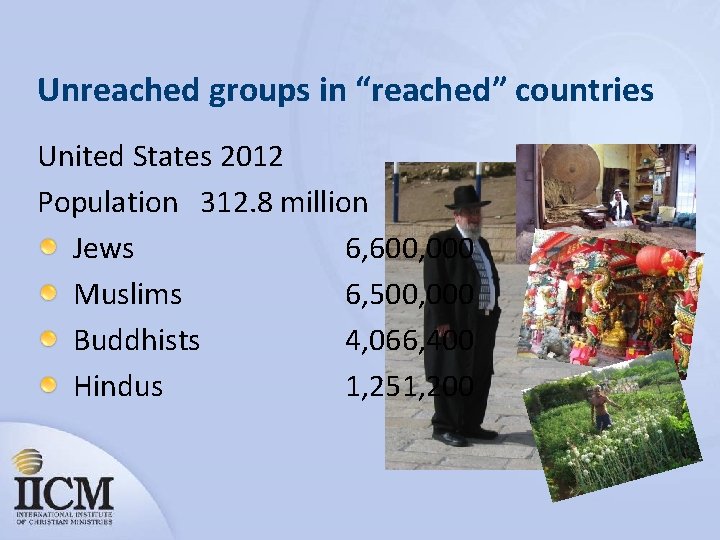
Unreached groups in “reached” countries United States 2012 Population 312. 8 million Jews 6, 600, 000 Muslims 6, 500, 000 Buddhists 4, 066, 400 Hindus 1, 251, 200
Jeremiah 12: 5 (NIV) “If you have raced with men on foot and they have worn you out, how can you compete with horses? If you stumble in a safe country, how will you manage in the thickets by the Jordan? ”
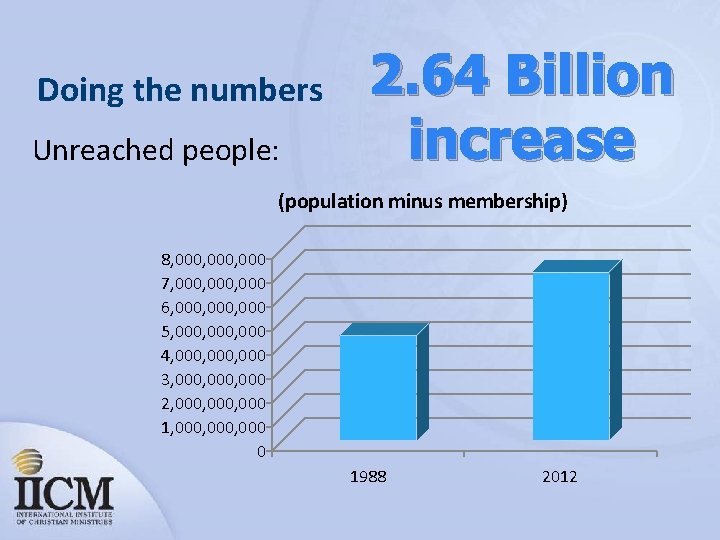
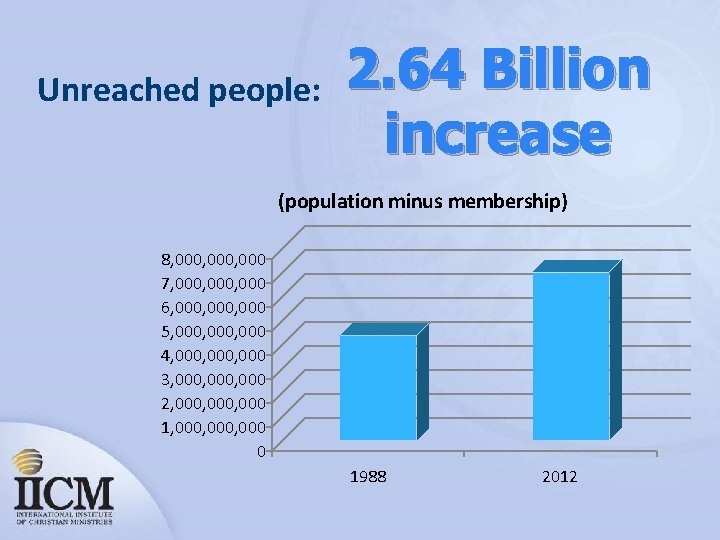
Doing the numbers Unreached people: 2. 64 Billion increase (population minus membership) 8, 000, 000 7, 000, 000 6, 000, 000 5, 000, 000 4, 000, 000 3, 000, 000 2, 000, 000 1, 000, 000 0 1988 2012
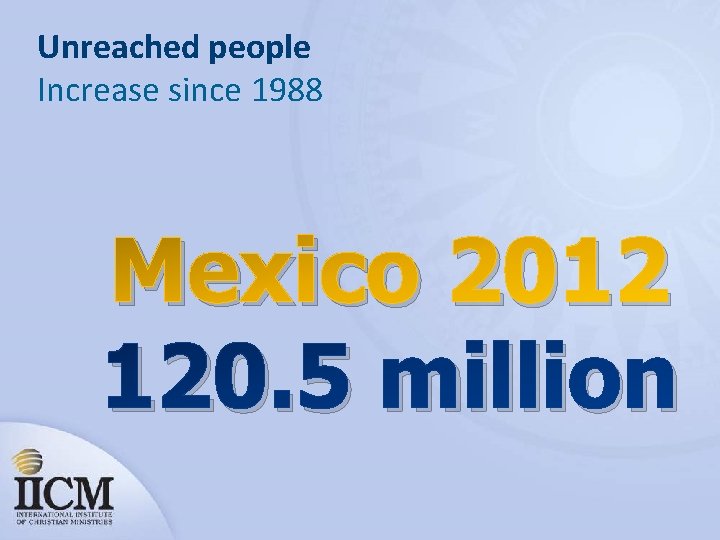
Unreached people Increase since 1988 Mexico 2012 120. 5 million
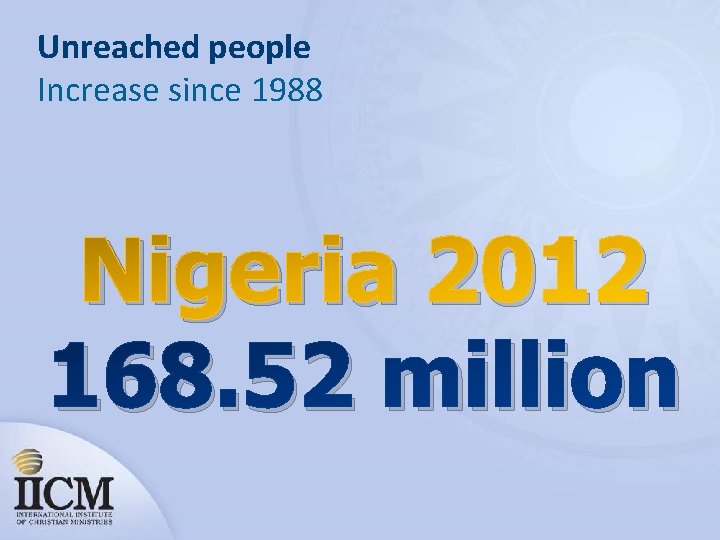
Unreached people Increase since 1988 Nigeria 2012 168. 52 million
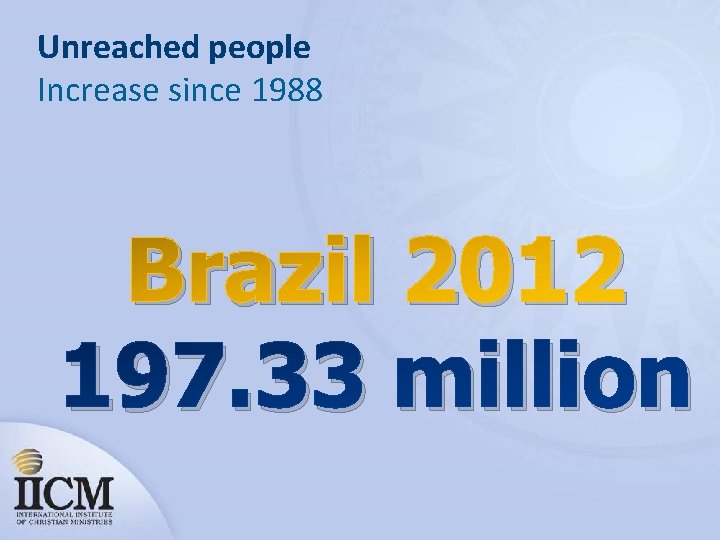
Unreached people Increase since 1988 Brazil 2012 197. 33 million
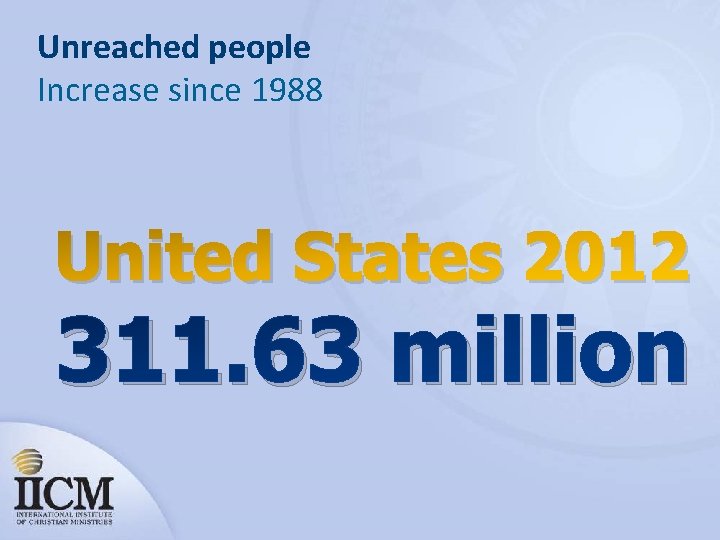
Unreached people Increase since 1988 United States 2012 311. 63 million
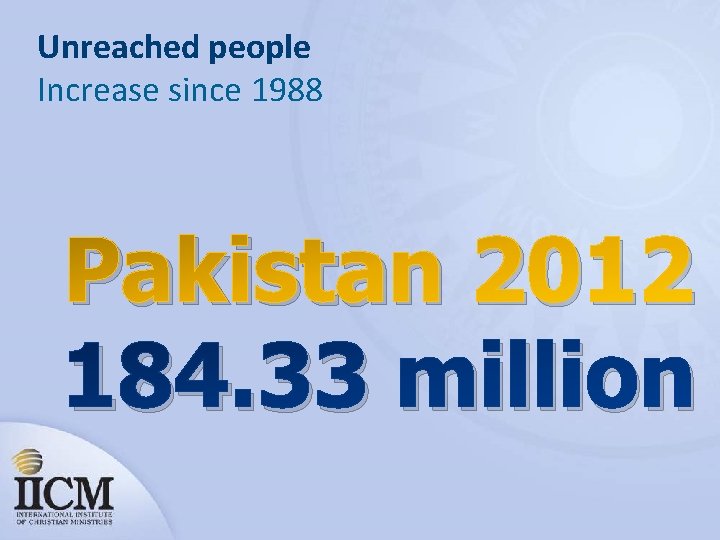
Unreached people Increase since 1988 Pakistan 2012 184. 33 million
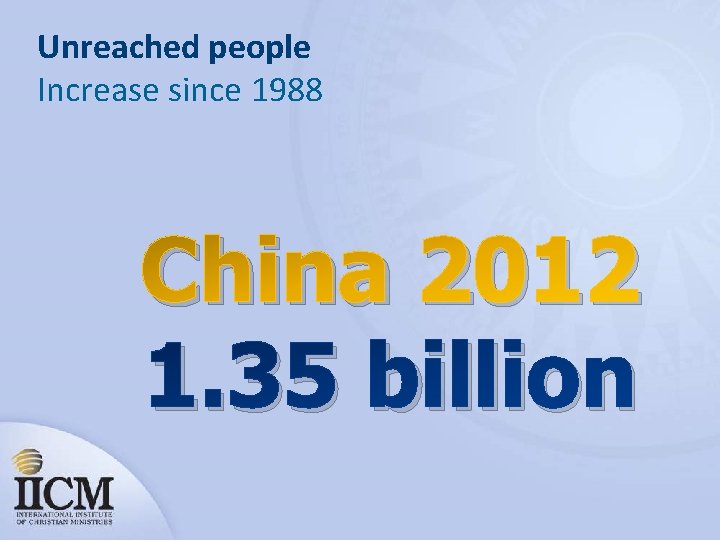
Unreached people Increase since 1988 China 2012 1. 35 billion
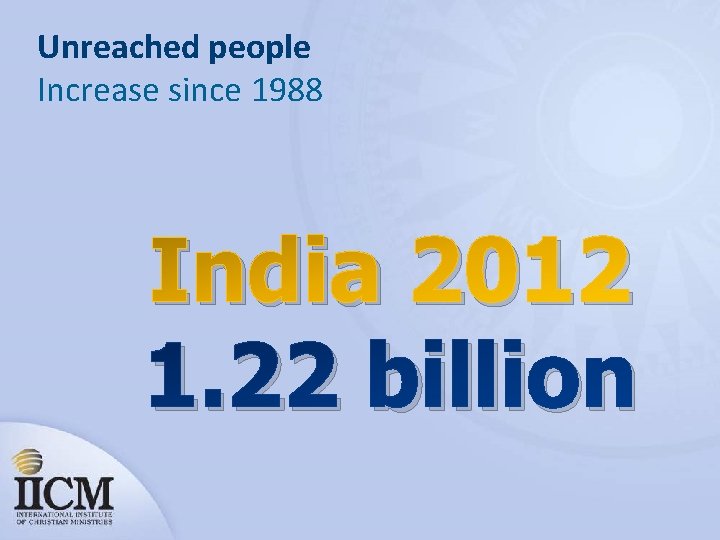
Unreached people Increase since 1988 India 2012 1. 22 billion
Unreached people: 2. 64 Billion increase (population minus membership) 8, 000, 000 7, 000, 000 6, 000, 000 5, 000, 000 4, 000, 000 3, 000, 000 2, 000, 000 1, 000, 000 0 1988 2012
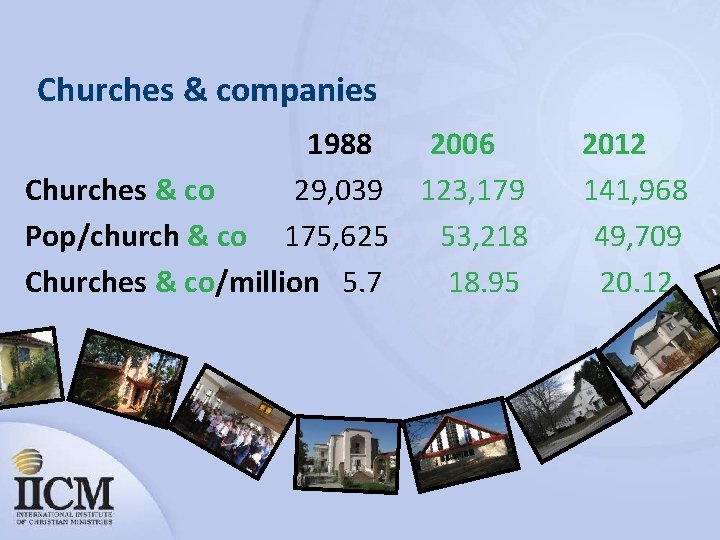
Churches & companies 1988 2006 Churches & co 29, 039 123, 179 Pop/church & co 175, 625 53, 218 Churches & co/million 5. 7 18. 95 2012 141, 968 49, 709 20. 12
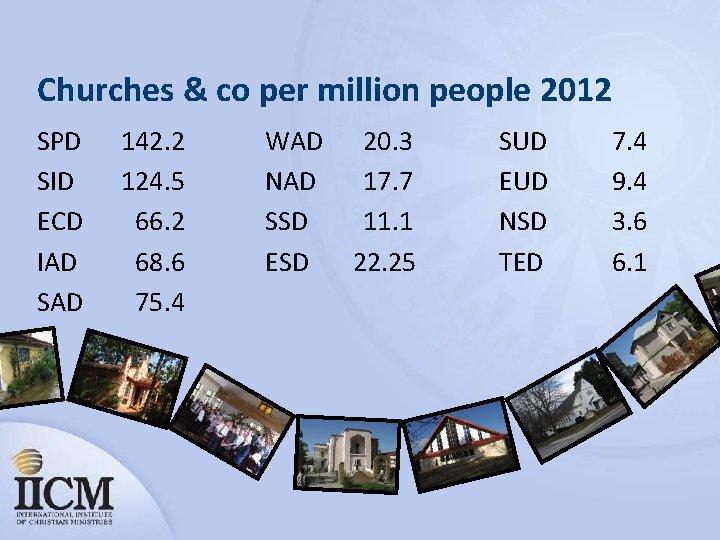
Churches & co per million people 2012 SPD SID ECD IAD SAD 142. 2 124. 5 66. 2 68. 6 75. 4 WAD NAD SSD ESD 20. 3 17. 7 11. 1 22. 25 SUD EUD NSD TED 7. 4 9. 4 3. 6 6. 1
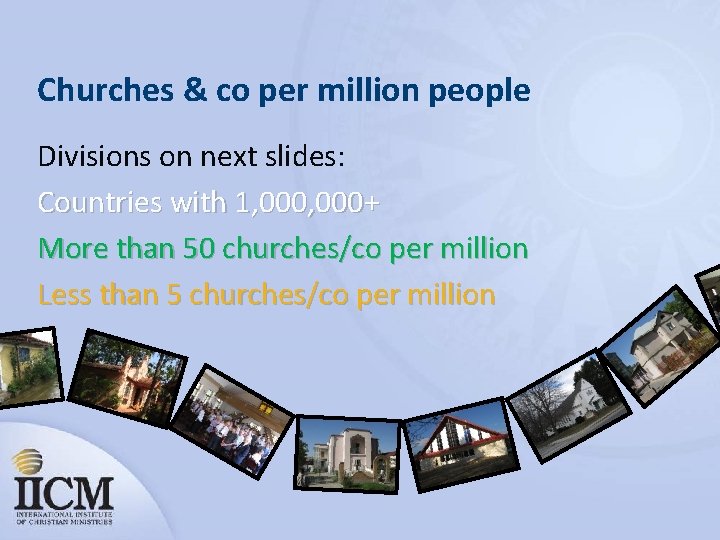
Churches & co per million people Divisions on next slides: Countries with 1, 000+ More than 50 churches/co per million Less than 5 churches/co per million
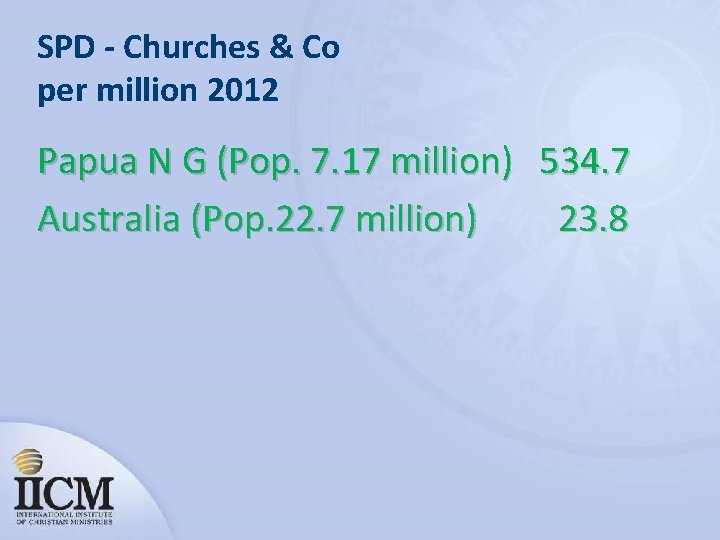
SPD - Churches & Co per million 2012 Papua N G (Pop. 7. 17 million) 534. 7 Australia (Pop. 22. 7 million) 23. 8
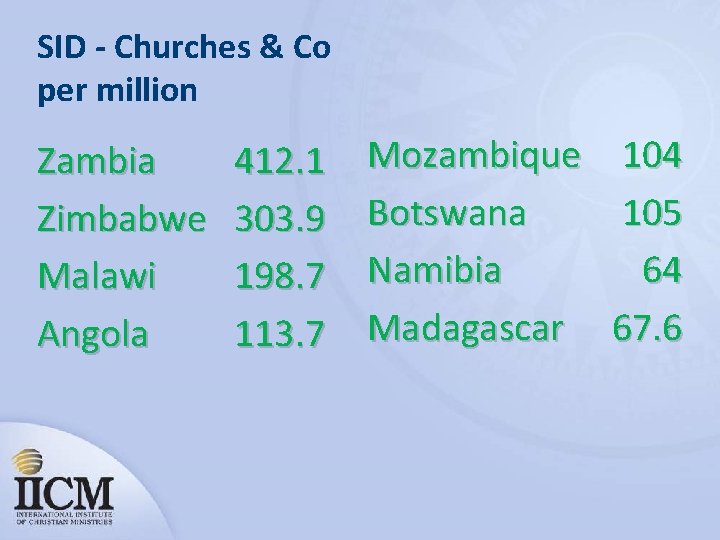
SID - Churches & Co per million Zambia Zimbabwe Malawi Angola 412. 1 303. 9 198. 7 113. 7 Mozambique Botswana Namibia Madagascar 104 105 64 67. 6
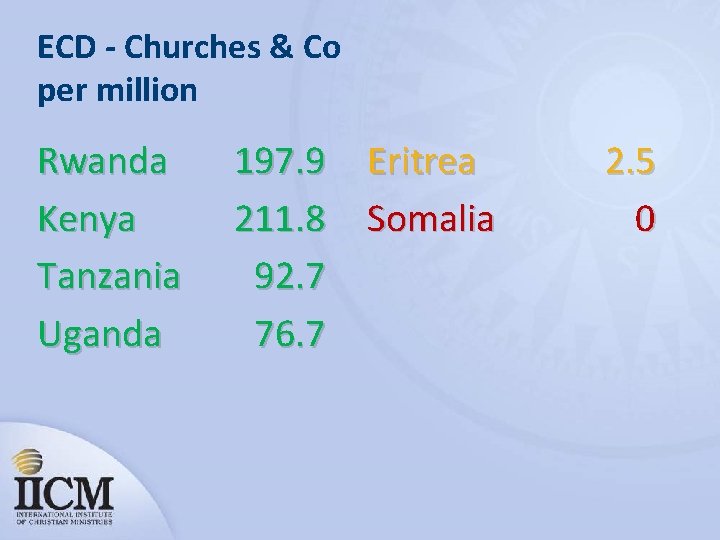
ECD - Churches & Co per million Rwanda Kenya Tanzania Uganda 197. 9 211. 8 92. 7 76. 7 Eritrea Somalia 2. 5 0
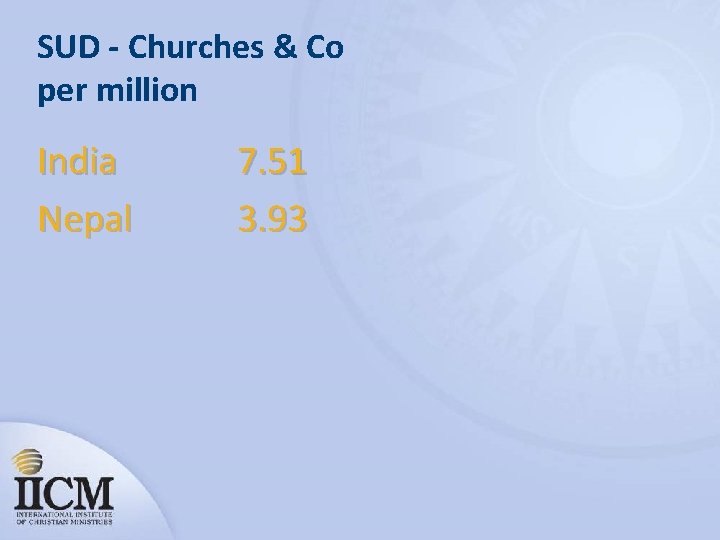
SUD - Churches & Co per million India Nepal 7. 51 3. 93
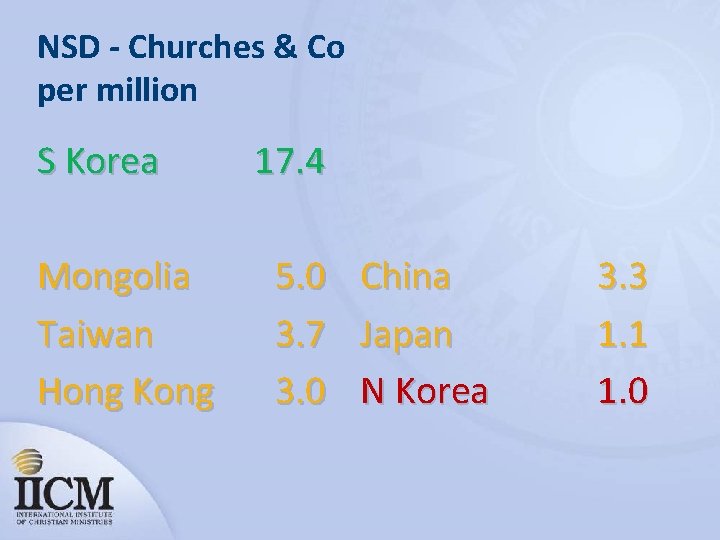
NSD - Churches & Co per million S Korea Mongolia Taiwan Hong Kong 17. 4 5. 0 3. 7 3. 0 China Japan N Korea 3. 3 1. 1 1. 0
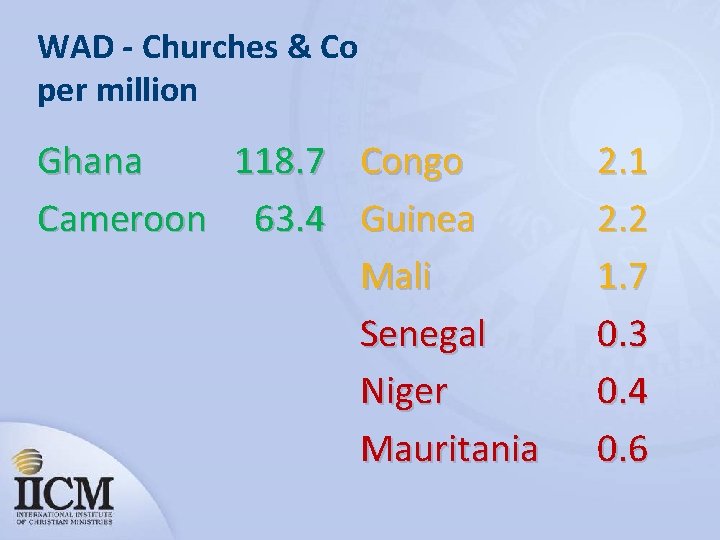
WAD - Churches & Co per million Ghana 118. 7 Congo Cameroon 63. 4 Guinea Mali Senegal Niger Mauritania 2. 1 2. 2 1. 7 0. 3 0. 4 0. 6
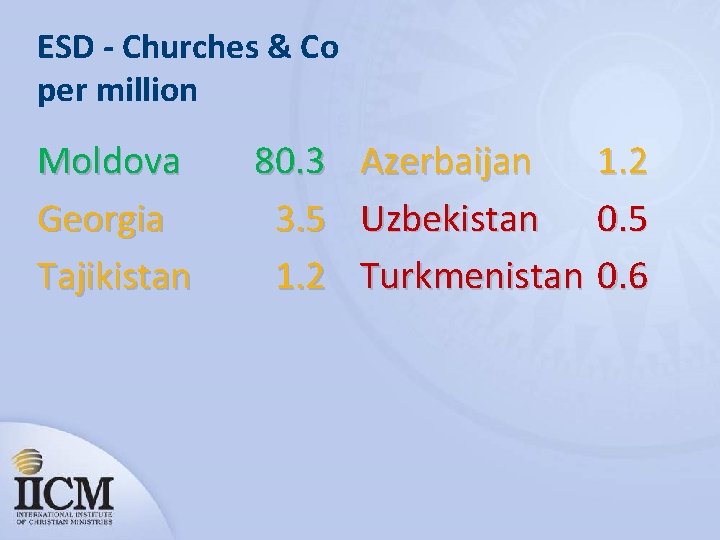
ESD - Churches & Co per million Moldova Georgia Tajikistan 80. 3 3. 5 1. 2 Azerbaijan 1. 2 Uzbekistan 0. 5 Turkmenistan 0. 6
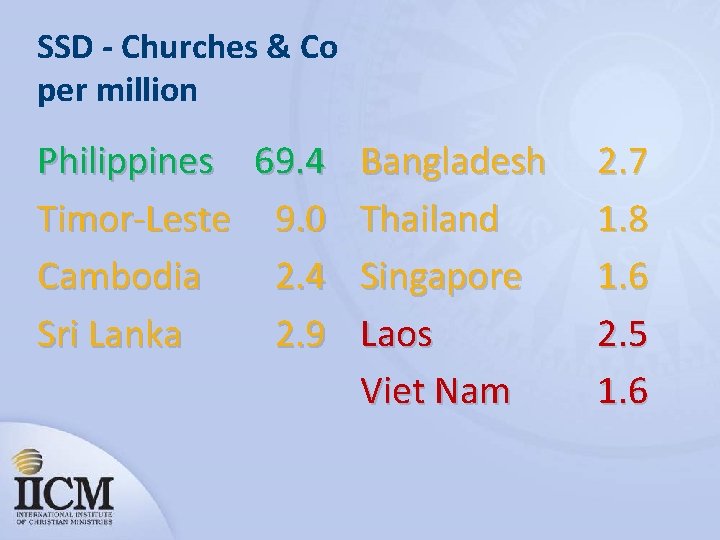
SSD - Churches & Co per million Philippines 69. 4 Bangladesh Timor-Leste 9. 0 Thailand Cambodia 2. 4 Singapore Sri Lanka 2. 9 Laos Viet Nam 2. 7 1. 8 1. 6 2. 5 1. 6
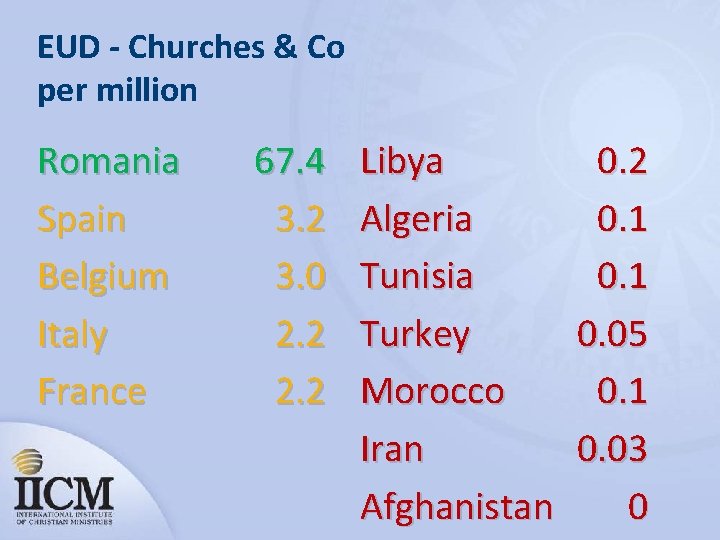
EUD - Churches & Co per million Romania Spain Belgium Italy France 67. 4 3. 2 3. 0 2. 2 Libya 0. 2 Algeria 0. 1 Tunisia 0. 1 Turkey 0. 05 Morocco 0. 1 Iran 0. 03 Afghanistan 0
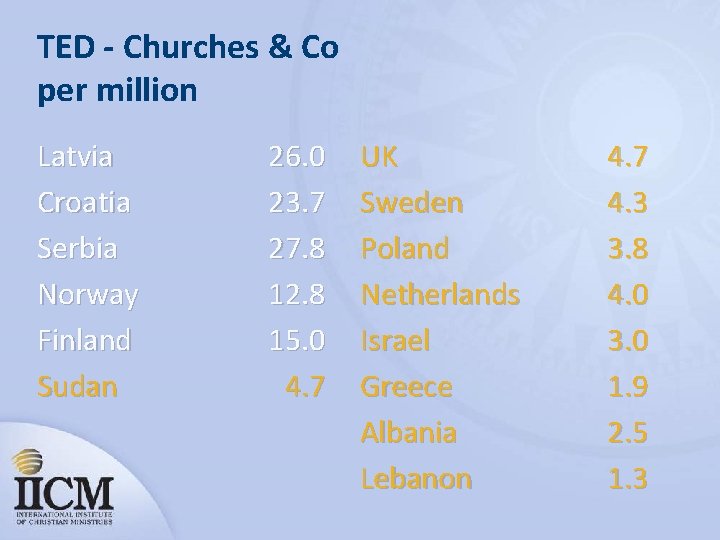
TED - Churches & Co per million Latvia Croatia Serbia Norway Finland Sudan 26. 0 23. 7 27. 8 12. 8 15. 0 4. 7 UK Sweden Poland Netherlands Israel Greece Albania Lebanon 4. 7 4. 3 3. 8 4. 0 3. 0 1. 9 2. 5 1. 3
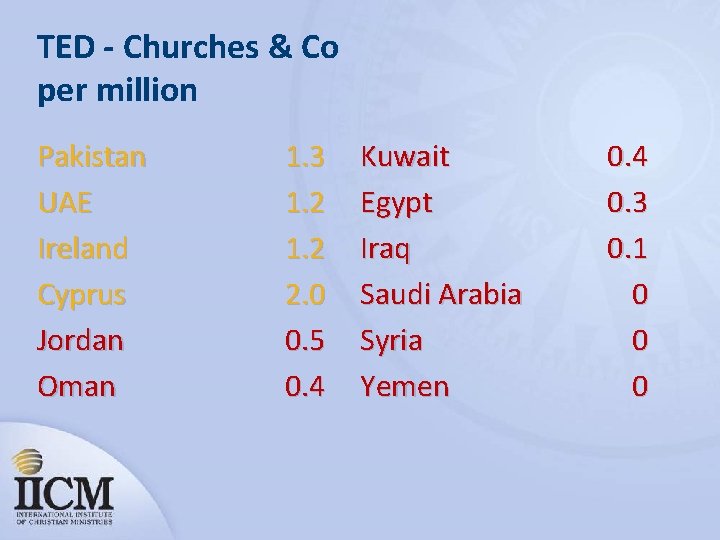
TED - Churches & Co per million Pakistan UAE Ireland Cyprus Jordan Oman 1. 3 1. 2 2. 0 0. 5 0. 4 Kuwait Egypt Iraq Saudi Arabia Syria Yemen 0. 4 0. 3 0. 1 0 0 0
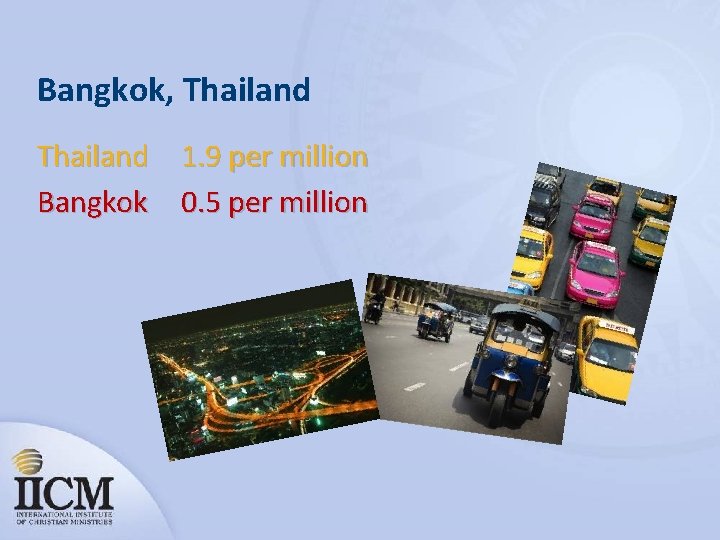
Bangkok, Thailand 1. 9 per million Bangkok 0. 5 per million
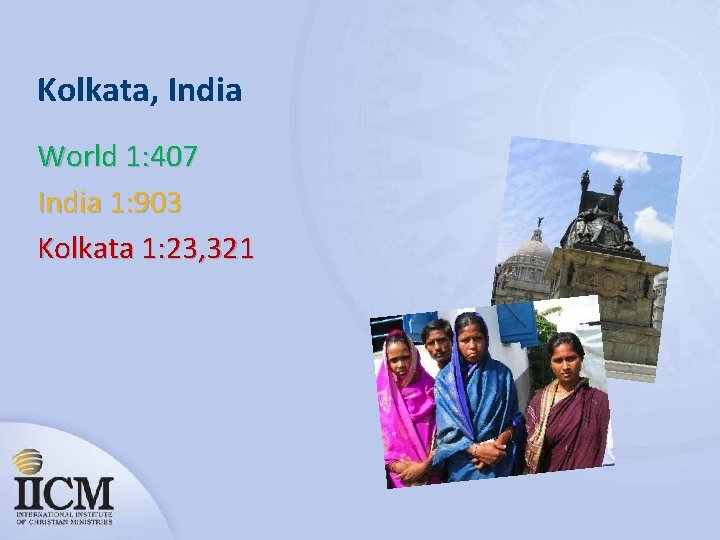
Kolkata, India World 1: 407 India 1: 903 Kolkata 1: 23, 321
People groups 13, 000+ distinct people groups 394 groups of 10, 000+ No known Christians 118 groups of 100, 000+ No known Christians
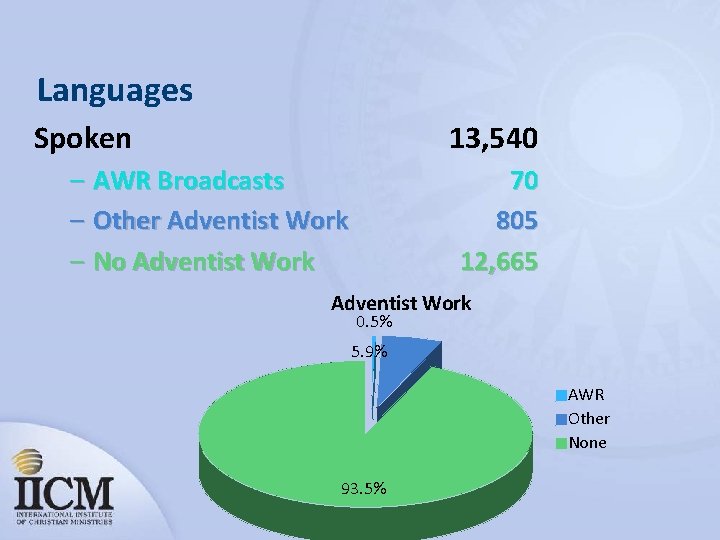
Languages Spoken 13, 540 – AWR Broadcasts – Other Adventist Work – No Adventist Work 70 805 12, 665 Adventist Work 0. 5% 5. 9% AWR Other None 93. 5%
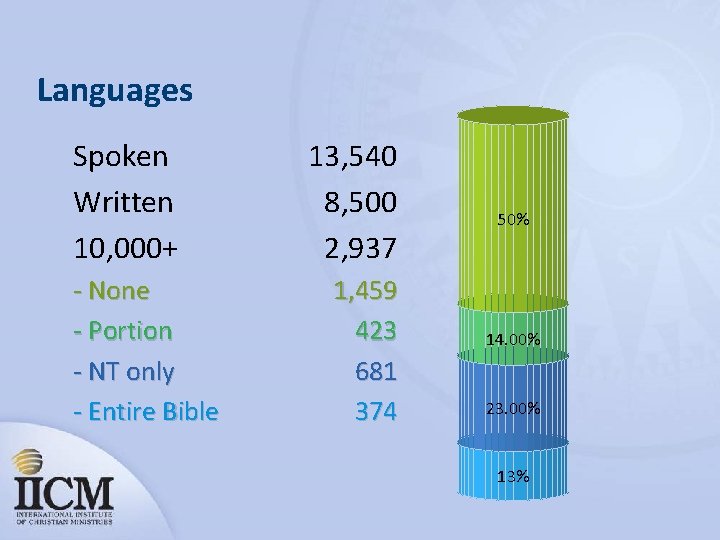
Languages Spoken Written 10, 000+ - None - Portion - NT only - Entire Bible 13, 540 8, 500 2, 937 1, 459 423 681 374 50% 14. 00% 23. 00% 13%
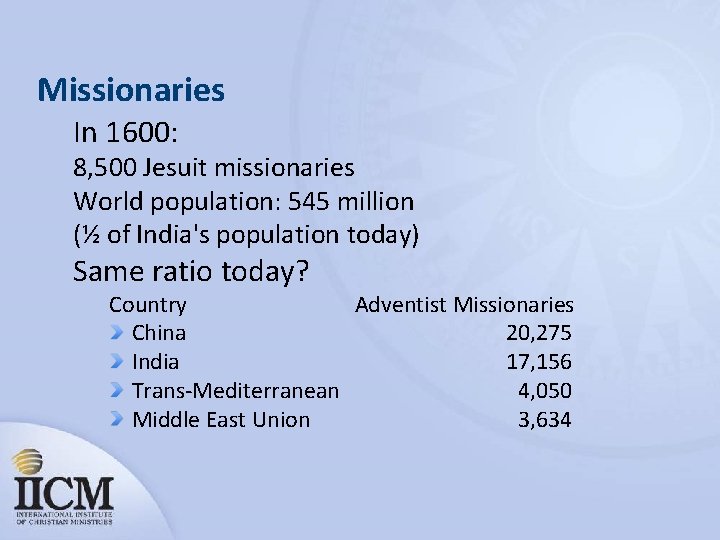
Missionaries In 1600: 8, 500 Jesuit missionaries World population: 545 million (½ of India's population today) Same ratio today? Country Adventist Missionaries China 20, 275 India 17, 156 Trans-Mediterranean 4, 050 Middle East Union 3, 634
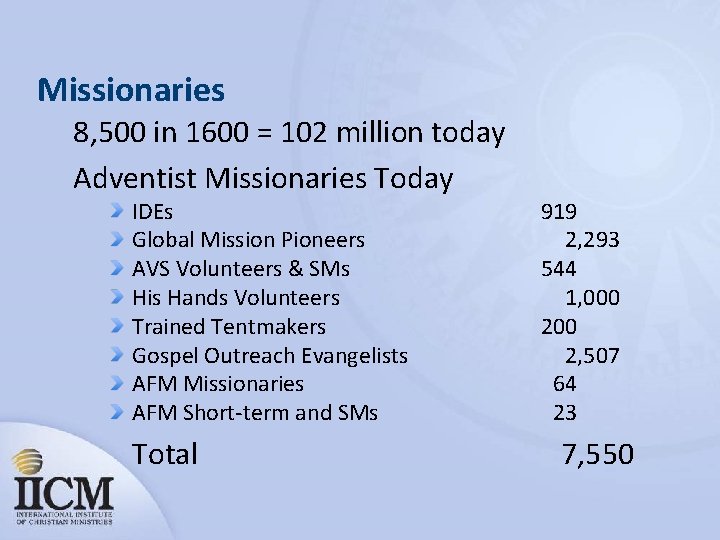
Missionaries 8, 500 in 1600 = 102 million today Adventist Missionaries Today IDEs Global Mission Pioneers AVS Volunteers & SMs His Hands Volunteers Trained Tentmakers Gospel Outreach Evangelists AFM Missionaries AFM Short-term and SMs Total 919 2, 293 544 1, 000 2, 507 64 23 7, 550
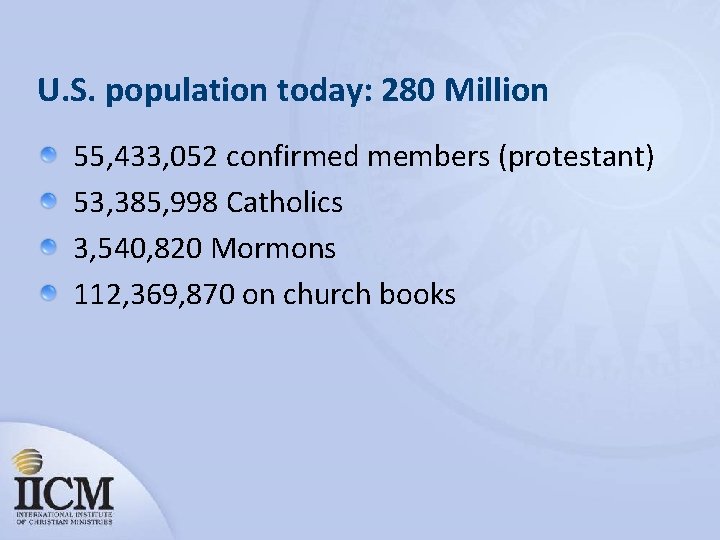
U. S. population today: 280 Million 55, 433, 052 confirmed members (protestant) 53, 385, 998 Catholics 3, 540, 820 Mormons 112, 369, 870 on church books
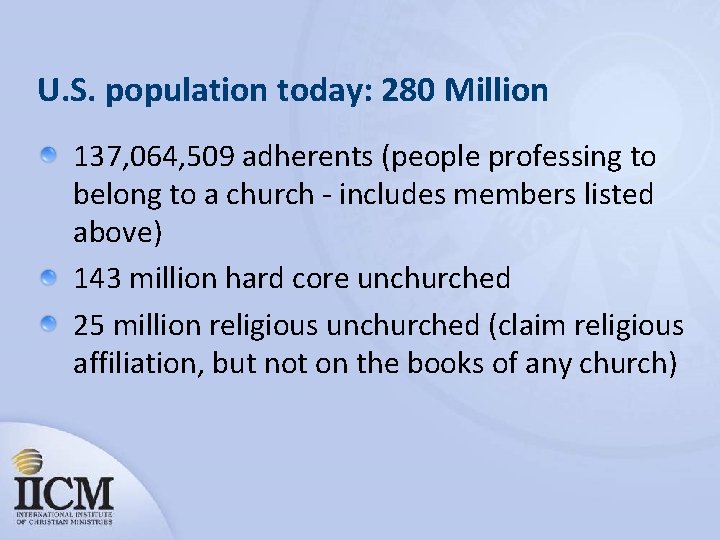
U. S. population today: 280 Million 137, 064, 509 adherents (people professing to belong to a church - includes members listed above) 143 million hard core unchurched 25 million religious unchurched (claim religious affiliation, but not on the books of any church)
U. S. population today: 280 Million 56 million on the books but rarely attend (½ membership) 224 million unchurched people in the U. S. Only two countries in the world have a population larger than 200 million (China and India).
Forty-one percent of Americans (115 million) report attending church on a typical weekend in 1999, compared to 49% in 1991.
Why churched people attend church 1. The theological beliefs and doctrines of the church 2. How much people seem to care about each other 3. The quality of the sermons that are preached
Why churched people attend church 4. How friendly the people in the church are to visitors 5. How involved the church is in helping poor and disadvantaged people 6. The quality of the programs and classes for children
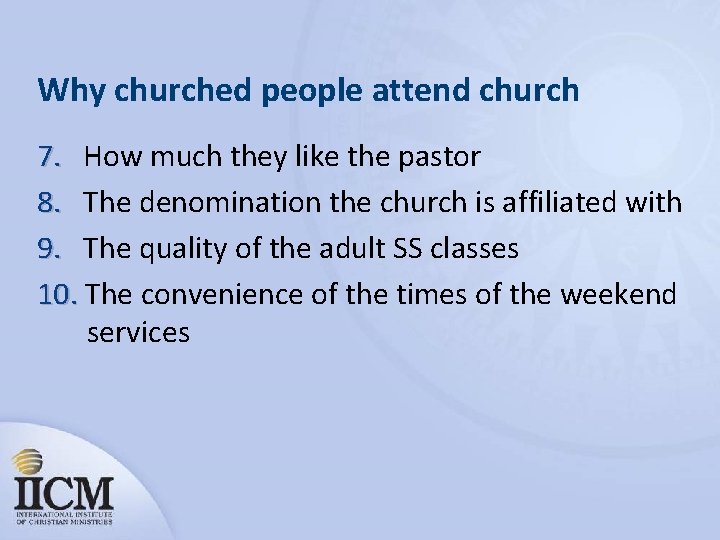
Why churched people attend church 7. How much they like the pastor 8. The denomination the church is affiliated with 9. The quality of the adult SS classes 10. The convenience of the times of the weekend services
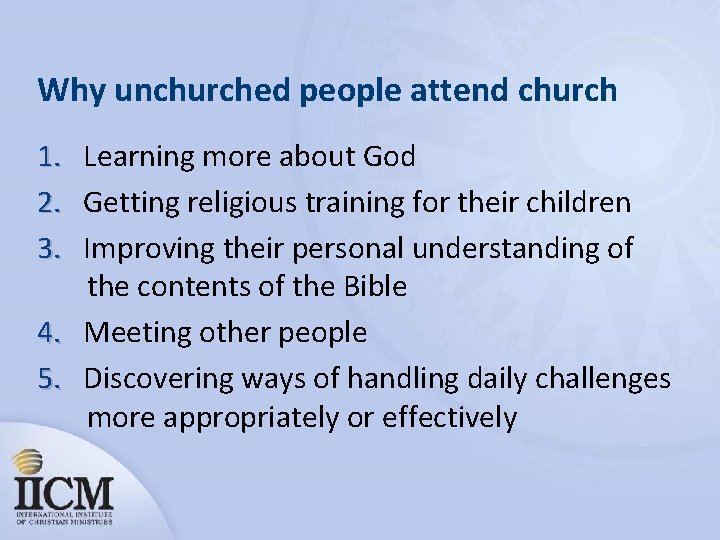
Why unchurched people attend church 1. Learning more about God 2. Getting religious training for their children 3. Improving their personal understanding of the contents of the Bible 4. Meeting other people 5. Discovering ways of handling daily challenges more appropriately or effectively
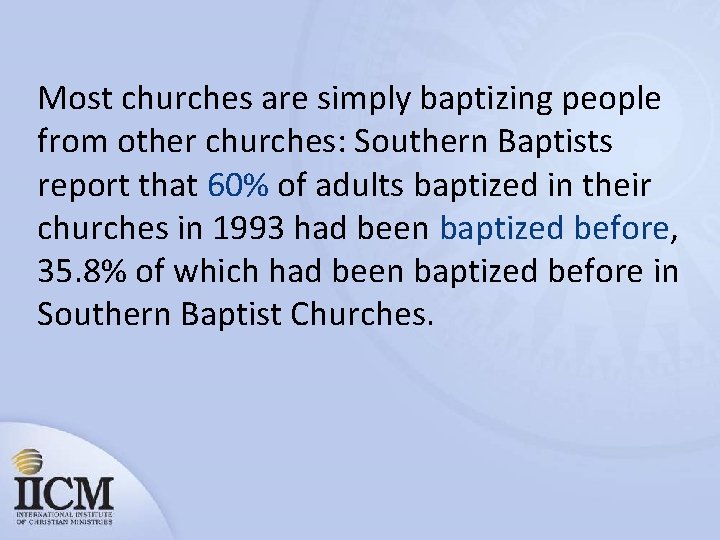
Most churches are simply baptizing people from other churches: Southern Baptists report that 60% of adults baptized in their churches in 1993 had been baptized before, 35. 8% of which had been baptized before in Southern Baptist Churches.
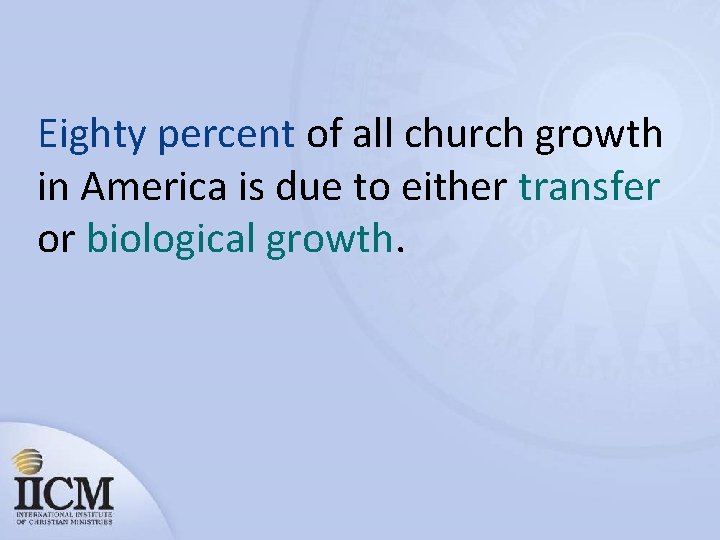
Eighty percent of all church growth in America is due to either transfer or biological growth.
There approximately 324, 000 churches in America. Based on the best estimate and research, we could double the number of churches without over churching America.
PROSPERITY weakens spiritual life
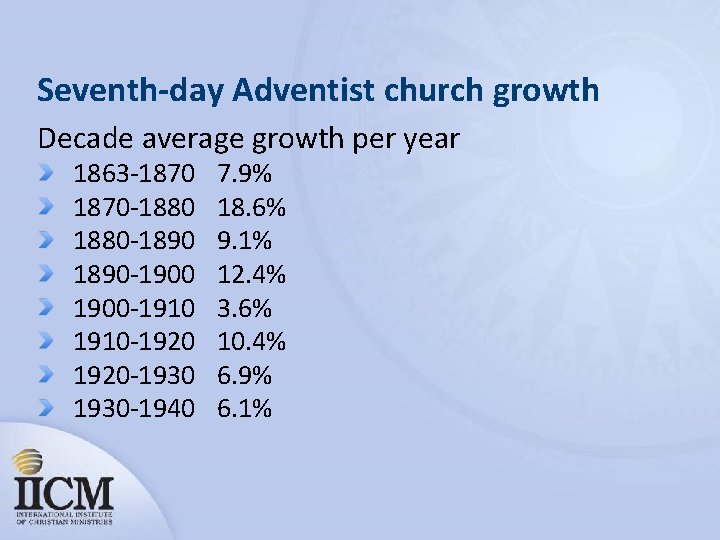
Seventh-day Adventist church growth Decade average growth per year 1863 -1870 -1880 -1890 -1900 -1910 -1920 -1930 -1940 7. 9% 18. 6% 9. 1% 12. 4% 3. 6% 10. 4% 6. 9% 6. 1%
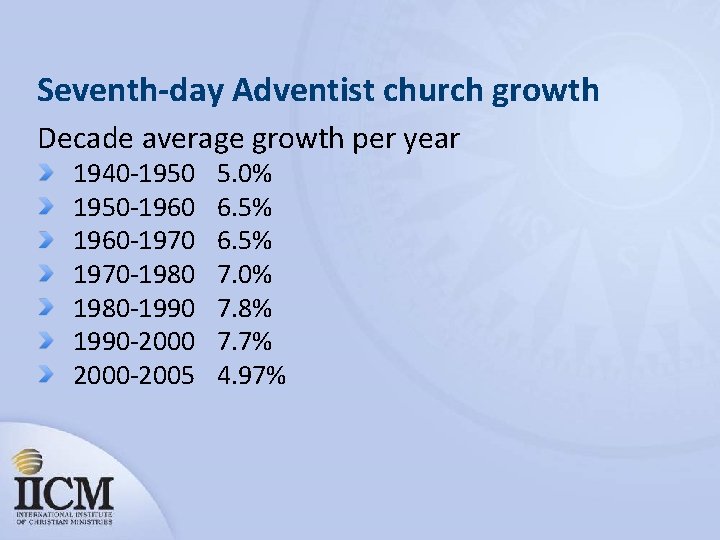
Seventh-day Adventist church growth Decade average growth per year 1940 -1950 -1960 -1970 -1980 -1990 -2000 -2005 5. 0% 6. 5% 7. 0% 7. 8% 7. 7% 4. 97%
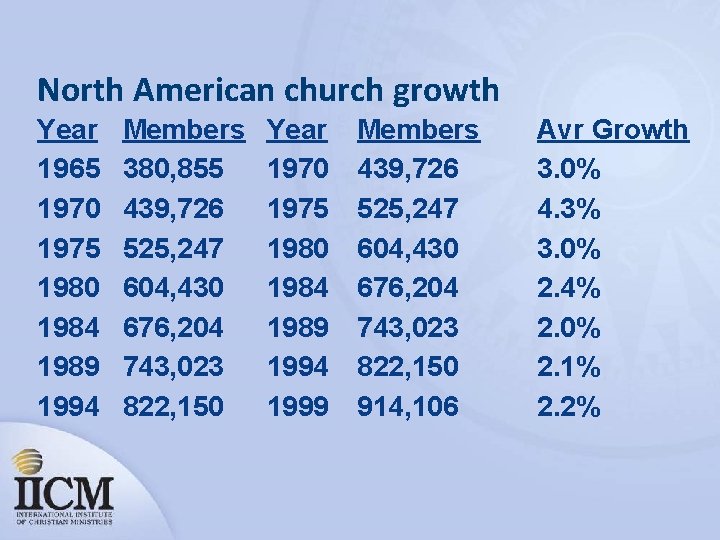
North American church growth Year 1965 1970 1975 1980 1984 1989 1994 Members 380, 855 439, 726 525, 247 604, 430 676, 204 743, 023 822, 150 Year 1970 1975 1980 1984 1989 1994 1999 Members 439, 726 525, 247 604, 430 676, 204 743, 023 822, 150 914, 106 Avr Growth 3. 0% 4. 3% 3. 0% 2. 4% 2. 0% 2. 1% 2. 2%
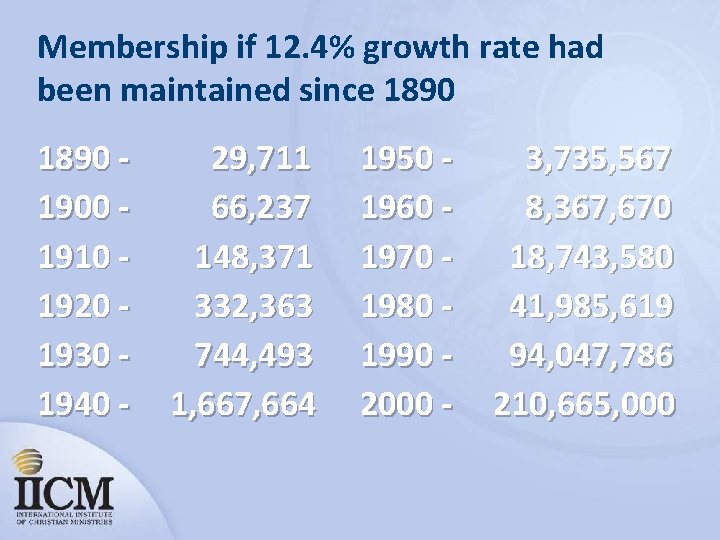
Membership if 12. 4% growth rate had been maintained since 1890 1900 1910 1920 1930 1940 - 29, 711 66, 237 148, 371 332, 363 744, 493 1, 667, 664 1950 1960 1970 1980 1990 2000 - 3, 735, 567 8, 367, 670 18, 743, 580 41, 985, 619 94, 047, 786 210, 665, 000
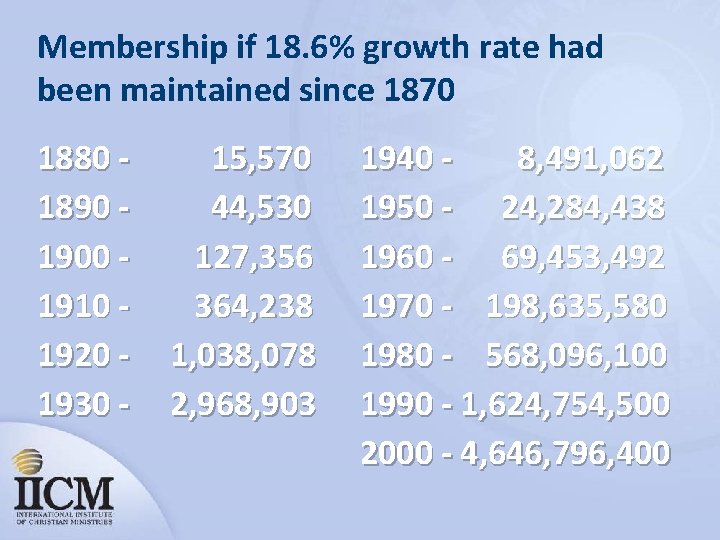
Membership if 18. 6% growth rate had been maintained since 1870 1880 1890 1900 1910 1920 1930 - 15, 570 44, 530 127, 356 364, 238 1, 038, 078 2, 968, 903 1940 8, 491, 062 1950 - 24, 284, 438 1960 - 69, 453, 492 1970 - 198, 635, 580 1980 - 568, 096, 100 1990 - 1, 624, 754, 500 2000 - 4, 646, 796, 400
Global Mission 1990 – 2000 Goal: Put SDA presence in every people group of 1 million or more 2300 groups identified Results: Established SDA church in 2000 groups World population added 600 new groups of 1 million Still need to penetrate 900 groups
Averaged 4 -5 new churches planted per day 1990 – 2000
10/40 window advances Cambodia 1990 – 0 Churches, 0 Members 2000 – 65 Churches, 4, 000 Members India (Haryana State – North India) 1990 – 11 Members 2000 – 400 Members, 100 Churches 5, 000 Attending China Nearly 60, 000 baptisms 1990 – 2000
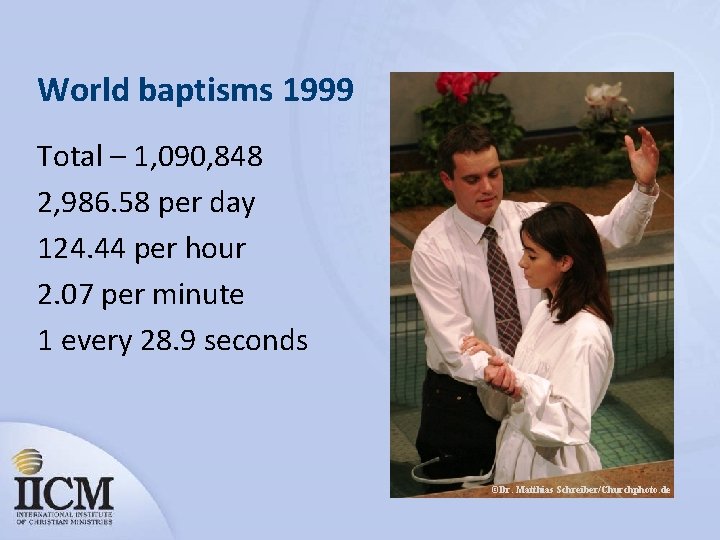
World baptisms 1999 Total – 1, 090, 848 2, 986. 58 per day 124. 44 per hour 2. 07 per minute 1 every 28. 9 seconds ©Dr. Matthias Schreiber/Churchphoto. de
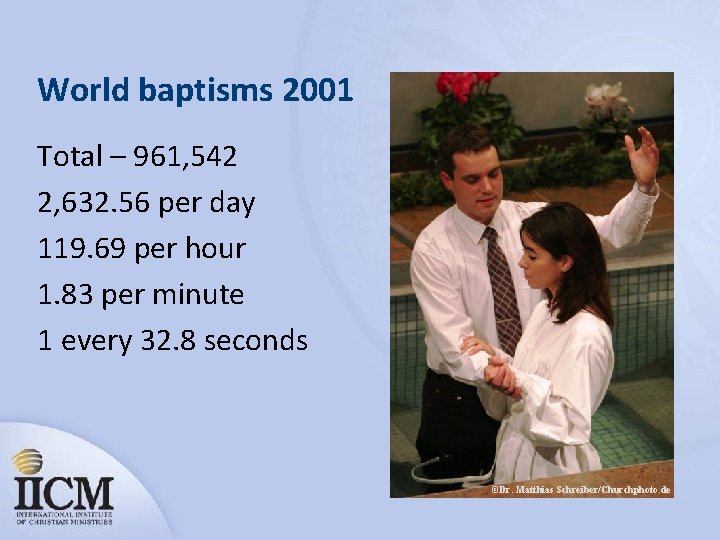
World baptisms 2001 Total – 961, 542 2, 632. 56 per day 119. 69 per hour 1. 83 per minute 1 every 32. 8 seconds ©Dr. Matthias Schreiber/Churchphoto. de
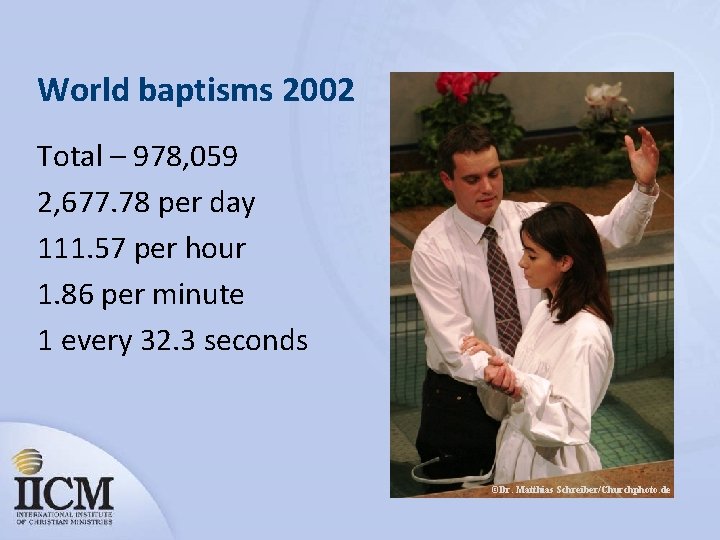
World baptisms 2002 Total – 978, 059 2, 677. 78 per day 111. 57 per hour 1. 86 per minute 1 every 32. 3 seconds ©Dr. Matthias Schreiber/Churchphoto. de
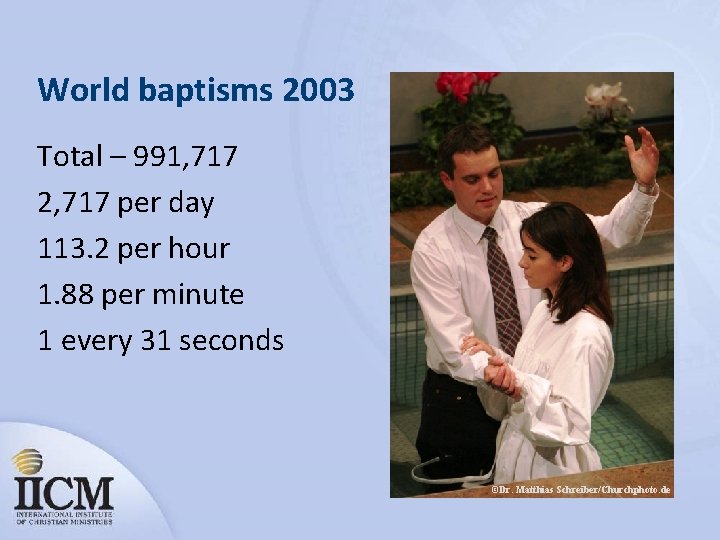
World baptisms 2003 Total – 991, 717 2, 717 per day 113. 2 per hour 1. 88 per minute 1 every 31 seconds ©Dr. Matthias Schreiber/Churchphoto. de
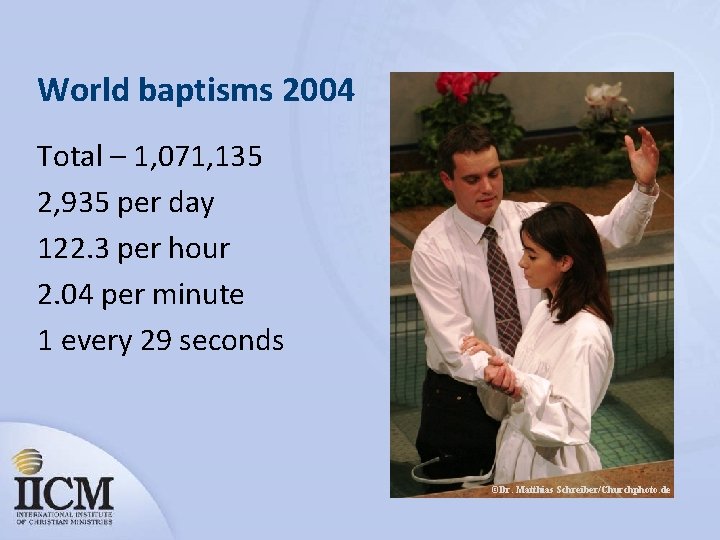
World baptisms 2004 Total – 1, 071, 135 2, 935 per day 122. 3 per hour 2. 04 per minute 1 every 29 seconds ©Dr. Matthias Schreiber/Churchphoto. de
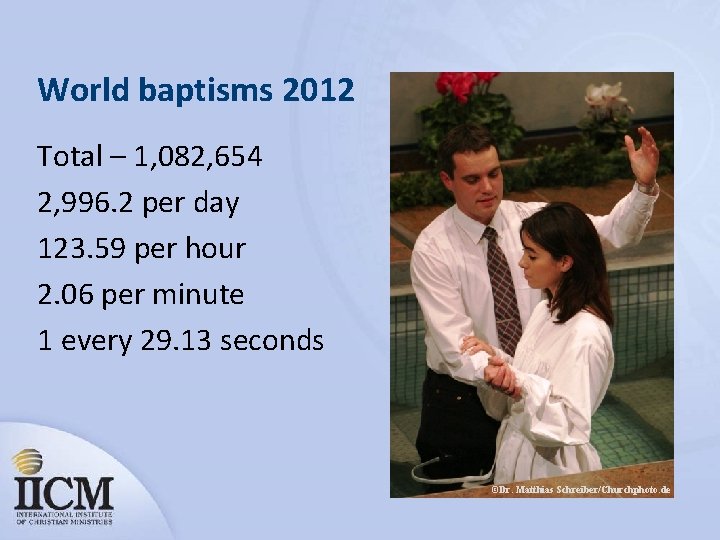
World baptisms 2012 Total – 1, 082, 654 2, 996. 2 per day 123. 59 per hour 2. 06 per minute 1 every 29. 13 seconds ©Dr. Matthias Schreiber/Churchphoto. de
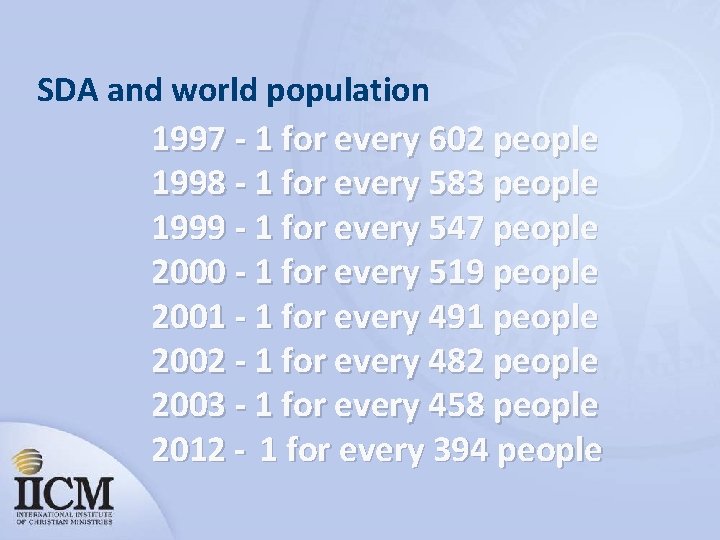
SDA and world population 1997 - 1 for every 602 people 1998 - 1 for every 583 people 1999 - 1 for every 547 people 2000 - 1 for every 519 people 2001 - 1 for every 491 people 2002 - 1 for every 482 people 2003 - 1 for every 458 people 2012 - 1 for every 394 people
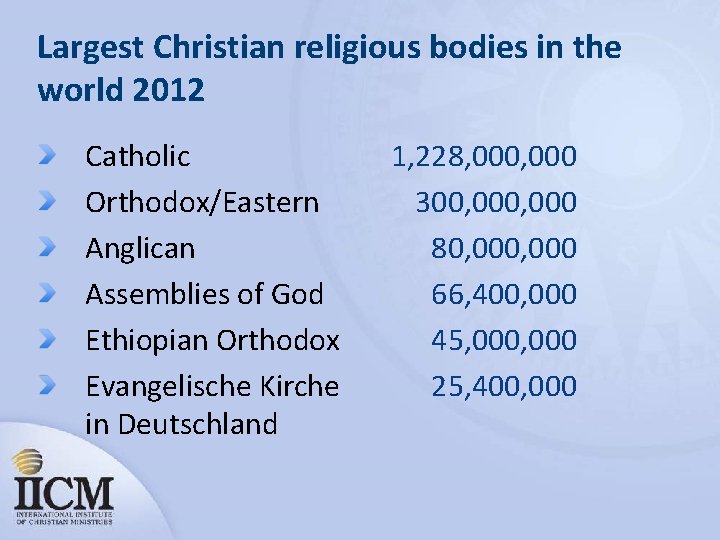
Largest Christian religious bodies in the world 2012 Catholic Orthodox/Eastern Anglican Assemblies of God Ethiopian Orthodox Evangelische Kirche in Deutschland 1, 228, 000 300, 000 80, 000 66, 400, 000 45, 000 25, 400, 000
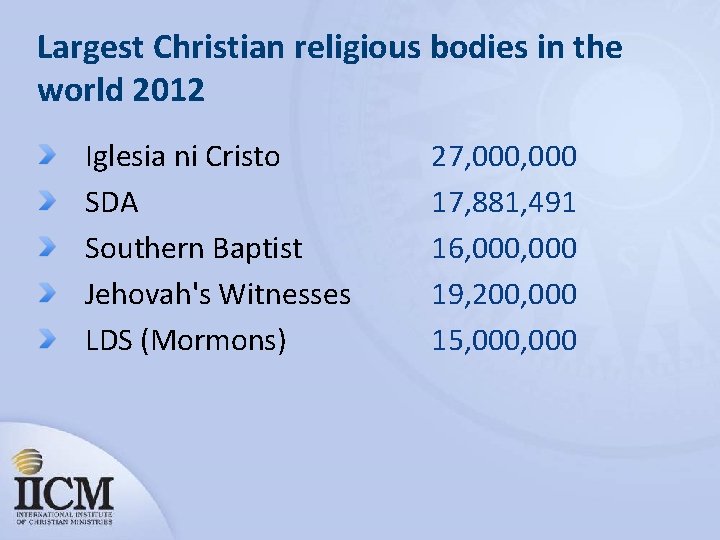
Largest Christian religious bodies in the world 2012 Iglesia ni Cristo SDA Southern Baptist Jehovah's Witnesses LDS (Mormons) 27, 000 17, 881, 491 16, 000 19, 200, 000 15, 000
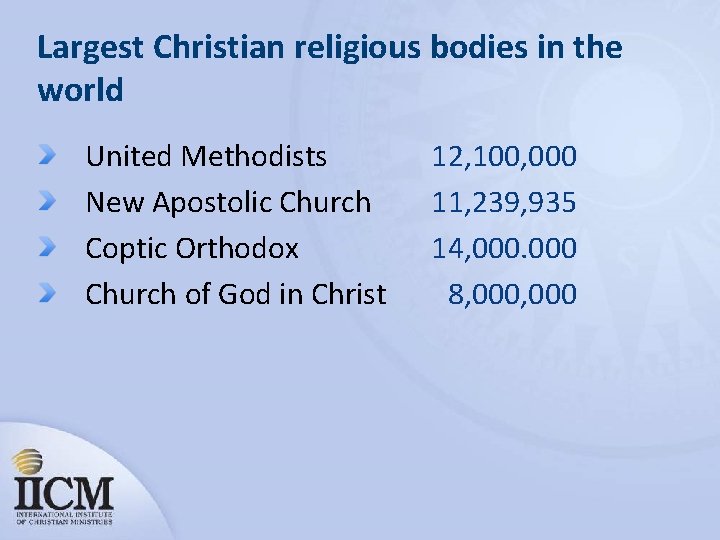
Largest Christian religious bodies in the world United Methodists New Apostolic Church Coptic Orthodox Church of God in Christ 12, 100, 000 11, 239, 935 14, 000 8, 000
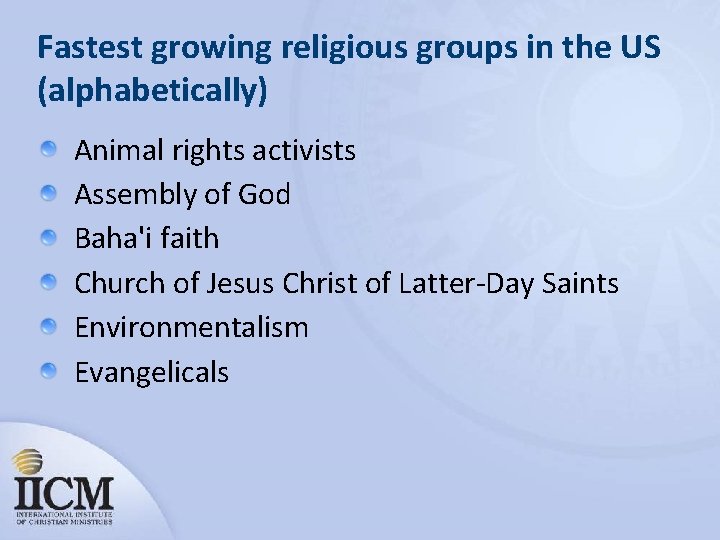
Fastest growing religious groups in the US (alphabetically) Animal rights activists Assembly of God Baha'i faith Church of Jesus Christ of Latter-Day Saints Environmentalism Evangelicals
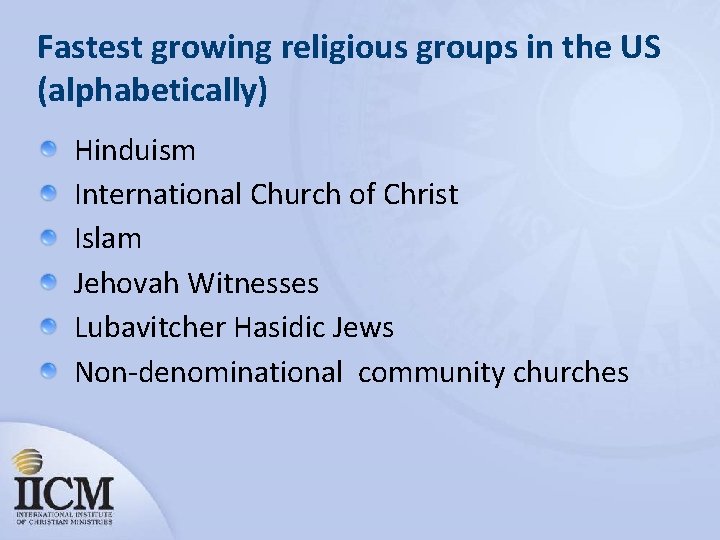
Fastest growing religious groups in the US (alphabetically) Hinduism International Church of Christ Islam Jehovah Witnesses Lubavitcher Hasidic Jews Non-denominational community churches
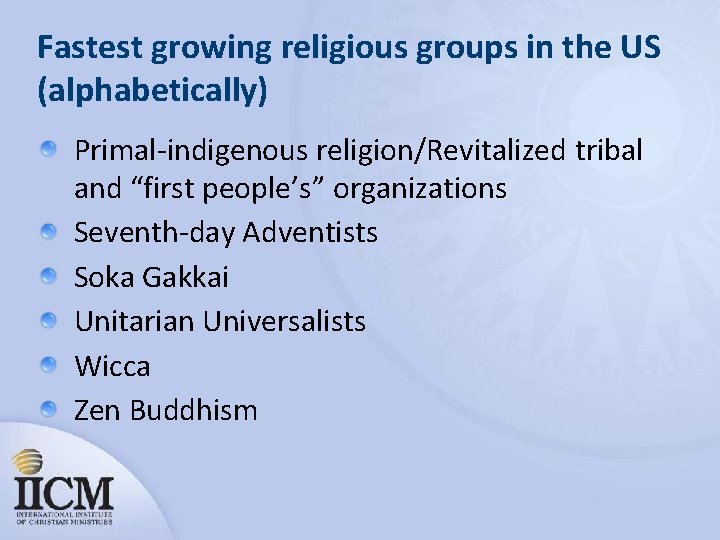
Fastest growing religious groups in the US (alphabetically) Primal-indigenous religion/Revitalized tribal and “first people’s” organizations Seventh-day Adventists Soka Gakkai Unitarian Universalists Wicca Zen Buddhism
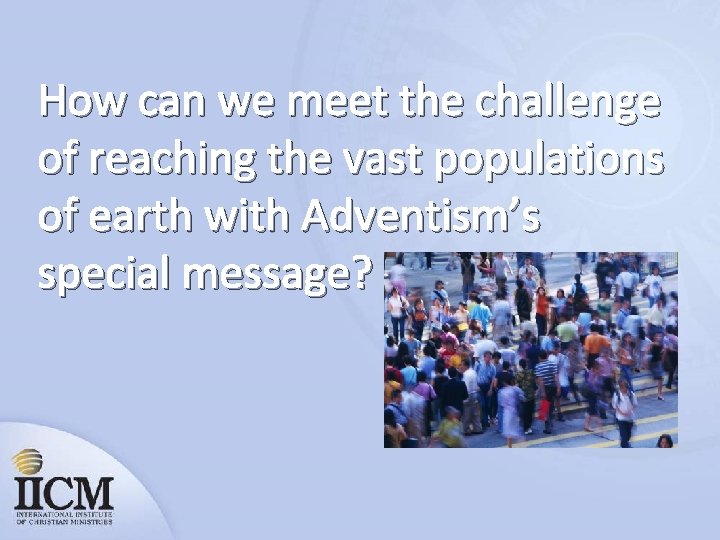
How can we meet the challenge of reaching the vast populations of earth with Adventism’s special message?
A. We must reach people where they are itching. We must understand the concept of meeting the felt needs of the people in the community and not just the religiously-oriented person. Our evangelism must begin to be targeted to unchurched people rather than churched people.
B. There must be increased lay involvement and a full utilization of the spiritual gifts of the laity. C. We must continually be planting new churches in new people groups. D. We must keep the fire burning.
Chapter 3 BASIC PRINCIPLES OF CHURCH GROWTH
Church growth is a DIVINE-HUMAN enterprise The divine dimension: God is at work in our world. Jesus is drawing people to Him. Holy Spirit is working in people's hearts directing the salvation enterprise.
Church growth is a DIVINE-HUMAN enterprise The human dimension: People must have a right relationship with God. Man must have the right vision. Man must have the right goals. Man must have the right tasks. Man must be in the right time and place. Man must reach the right people.
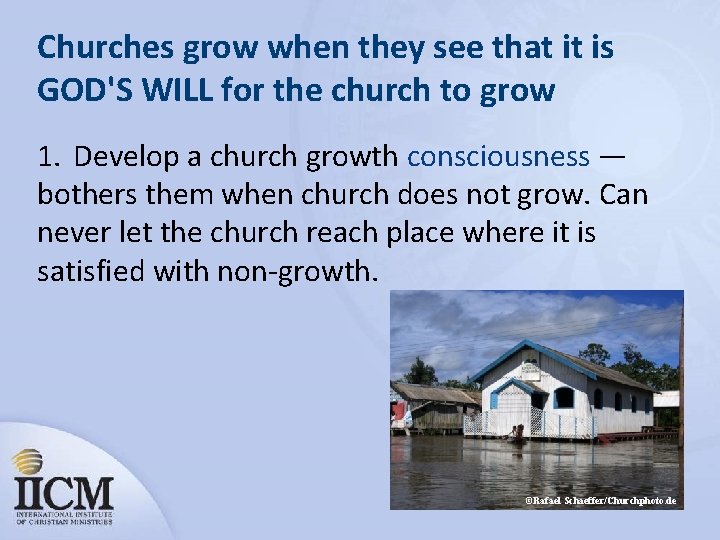
Churches grow when they see that it is GOD'S WILL for the church to grow 1. Develop a church growth consciousness — bothers them when church does not grow. Can never let the church reach place where it is satisfied with non-growth. ©Rafael Schaeffer/Churchphoto. de
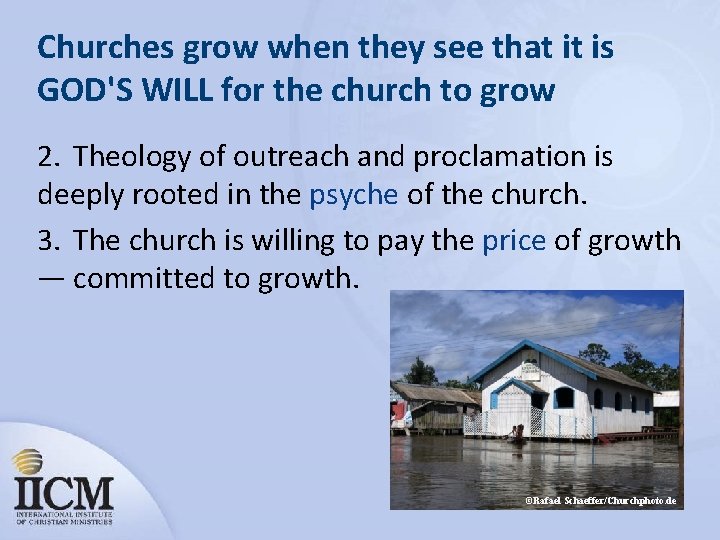
Churches grow when they see that it is GOD'S WILL for the church to grow 2. Theology of outreach and proclamation is deeply rooted in the psyche of the church. 3. The church is willing to pay the price of growth — committed to growth. ©Rafael Schaeffer/Churchphoto. de
Churches grow as they develop “church growth eyes”
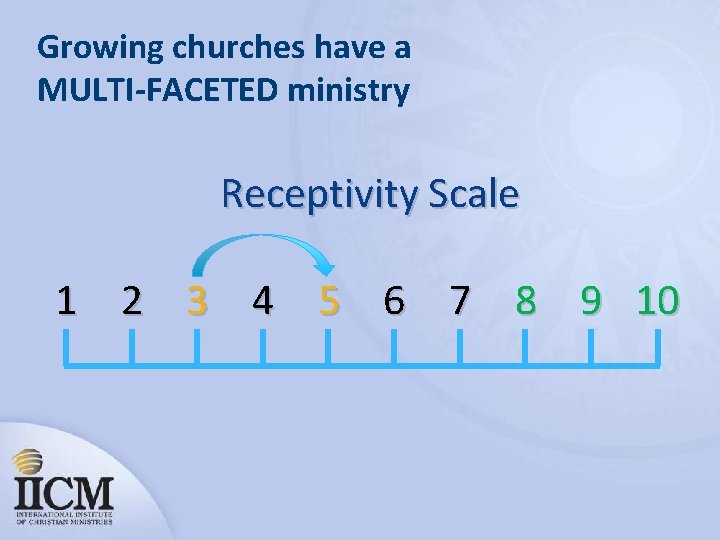
Growing churches have a MULTI-FACETED ministry Receptivity Scale 1 2 3 4 5 6 7 8 9 10
Growing churches have a MULTI-FACETED ministry Receptivity Scale 1 2 3 4 5 6 7 8 9 10
Growing churches have a MULTI-FACETED ministry Receptivity Scale 1 2 3 4 5 6 7 8 9 10
Growing churches have a MULTI-FACETED ministry Receptivity Scale 1 2 3 4 5 6 7 8 9 10
Growing churches are people centered
Growing churches recognize the need to meet the felt needs of the community. “Christ's method alone will give true success in reaching the people. The Saviour mingled with men as one who desired their good. He showed His sympathy for them, ministered to their needs, and won their confidence. Then He bade them, ‘Follow me. ’” —Ministry of Healing, p. 143
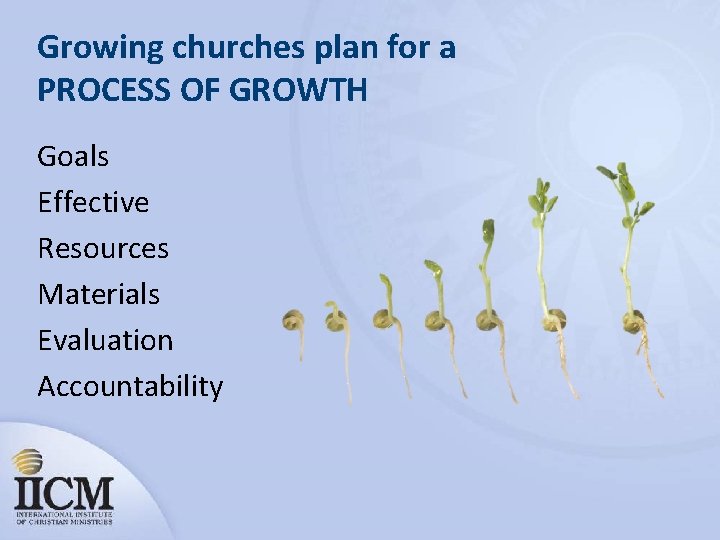
Growing churches plan for a PROCESS OF GROWTH Goals Effective Resources Materials Evaluation Accountability
Process of growth 1. We like “quick fixes. ” 2. It takes 24 -48 months to move a church from plateau to growth. 3. A growth process is more important than a growth event.
Process of growth 4. A growth process is where growth thinking permeates every aspect of the church. 5. Should we have an evangelism committee in the church?
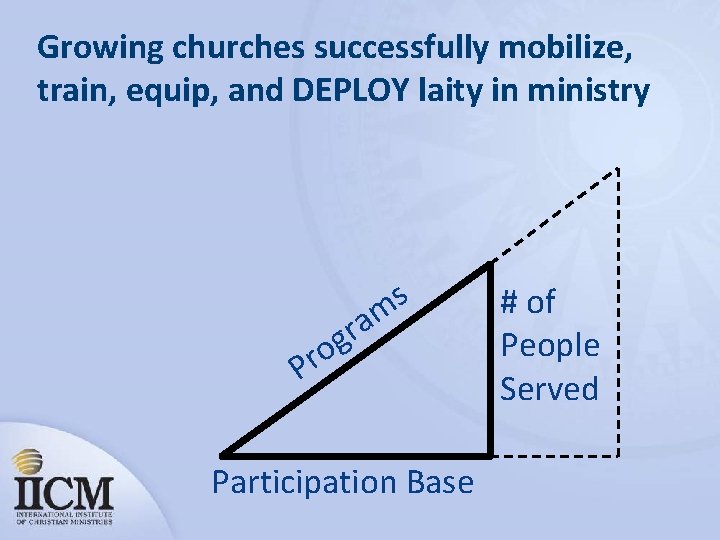
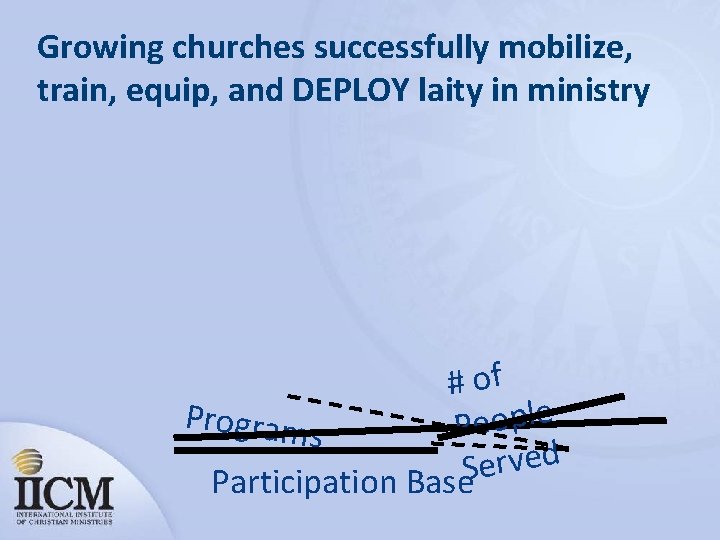
Growing churches successfully mobilize, train, equip, and DEPLOY laity in ministry s m a r g o r P Participation Base # of People Served
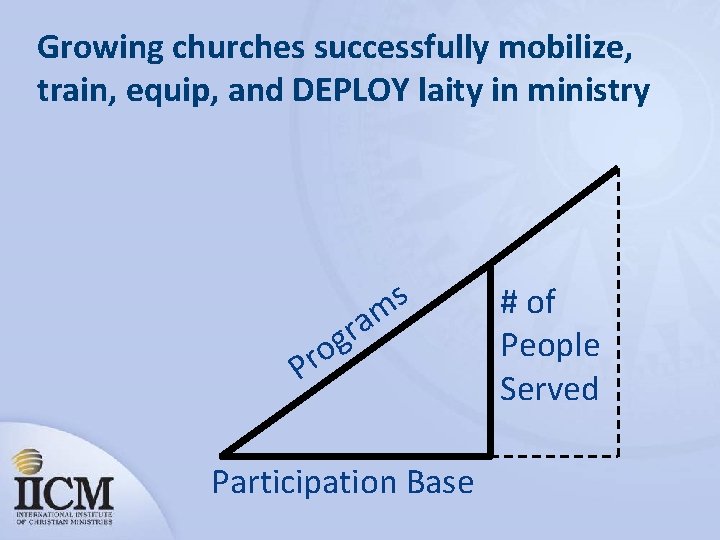
Growing churches successfully mobilize, train, equip, and DEPLOY laity in ministry s m a r g o r P Participation Base # of People Served
Growing churches successfully mobilize, train, equip, and DEPLOY laity in ministry # of e l Program p o e P s d e v r e Participation Base. S
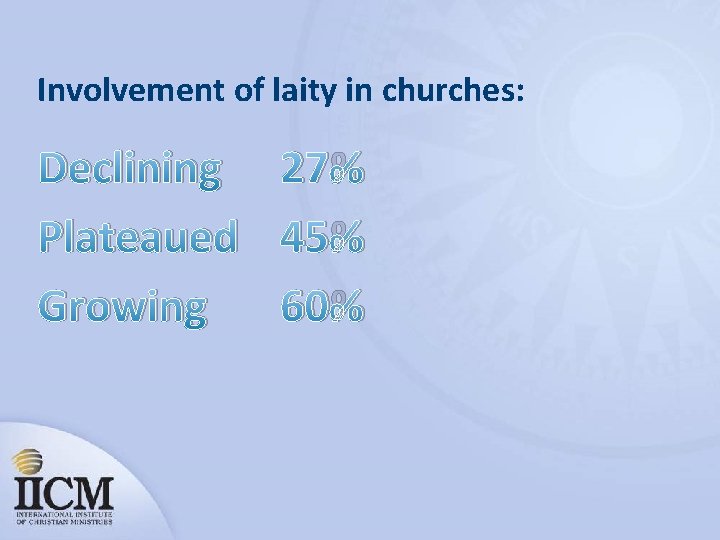
Involvement of laity in churches: Declining 27% Plateaued 45% Growing 60%
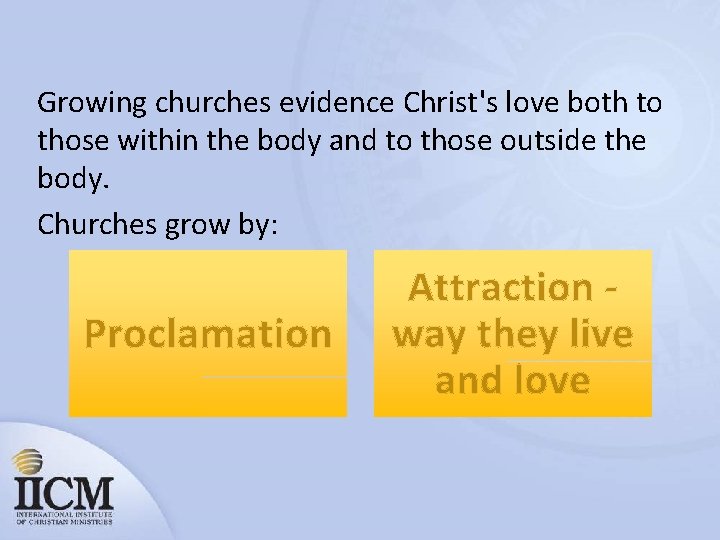
Growing churches evidence Christ's love both to those within the body and to those outside the body. Churches grow by: Proclamation Attraction way they live and love
Growing churches implement appropriate and effective evangelism to new groups and in new ways.
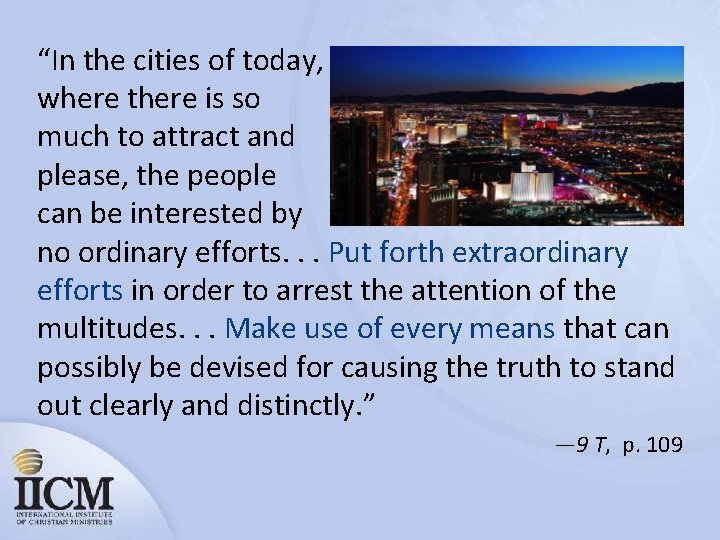
“In the cities of today, where there is so much to attract and please, the people can be interested by no ordinary efforts. . . Put forth extraordinary efforts in order to arrest the attention of the multitudes. . . Make use of every means that can possibly be devised for causing the truth to stand out clearly and distinctly. ” — 9 T, p. 109
“The methods and means by which we reach certain ends are not always the same. [You]. . . must use reason and judgment. . ” —GW, p. 468
“Different methods of labor are to be employed to save different ones. ” —Ev. p. 166 “Different methods of labor are really essential. ” —TM p. 251 “New methods must be introduced. ” —Ev. p. 70
“God would have new and untried methods followed. Break in upon the people—surprise them. ” —Ev. p. 125 “We must do something out of the common course of things. We must arrest the attention. ” —Ev. p. 122 -123 “Your efforts are too tame. ” —Ev. p. 279
“As field after field is entered, new methods and new plans will spring from new circumstances. New thought will come with the new workers who give themselves to the work. As they seek the Lord for help, He will communicate with them. They will receive plans devised by the Lord Himself. ” — 6 T, p. 476
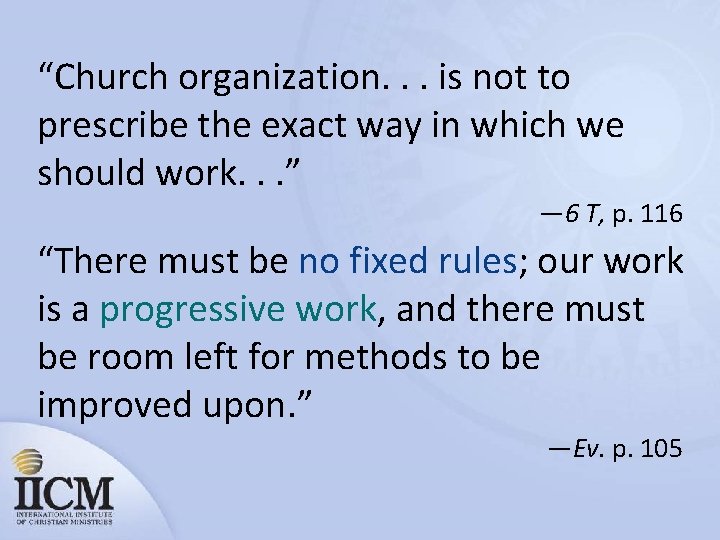
“Church organization. . . is not to prescribe the exact way in which we should work. . . ” — 6 T, p. 116 “There must be no fixed rules; our work is a progressive work, and there must be room left for methods to be improved upon. ” —Ev. p. 105
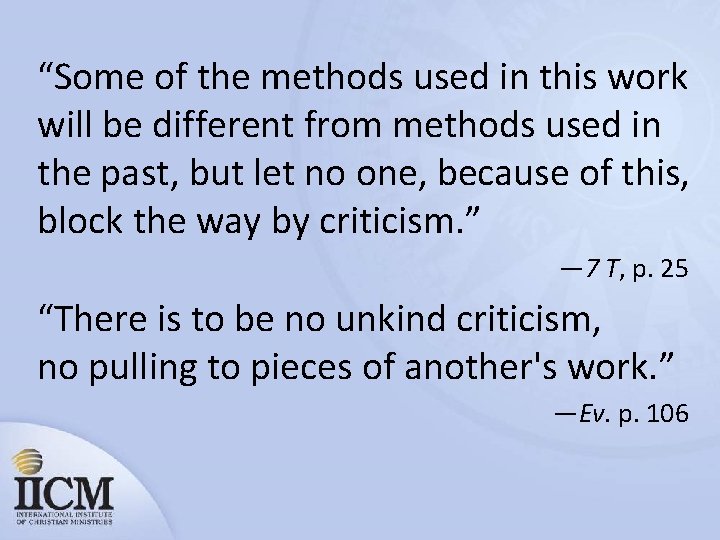
“Some of the methods used in this work will be different from methods used in the past, but let no one, because of this, block the way by criticism. ” — 7 T, p. 25 “There is to be no unkind criticism, no pulling to pieces of another's work. ” —Ev. p. 106
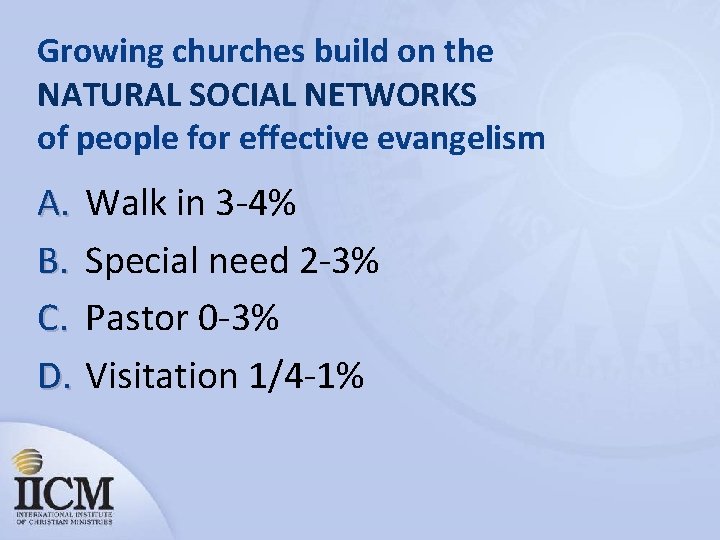
Growing churches build on the NATURAL SOCIAL NETWORKS of people for effective evangelism A. Walk in 3 -4% B. Special need 2 -3% C. Pastor 0 -3% D. Visitation 1/4 -1%
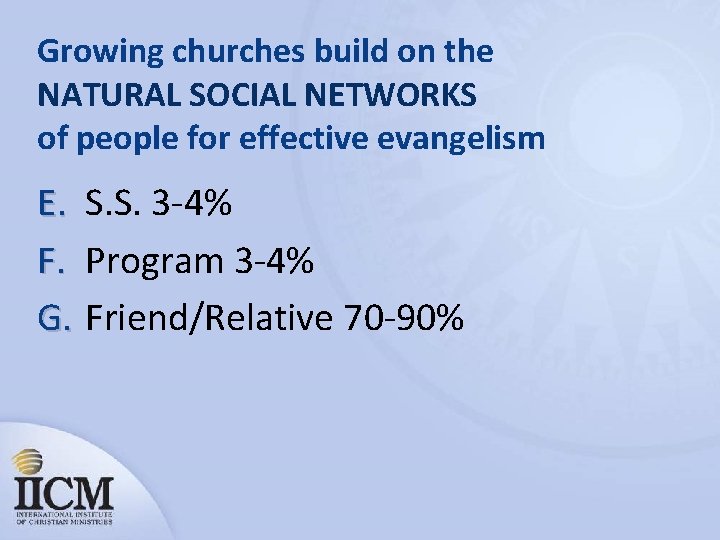
Growing churches build on the NATURAL SOCIAL NETWORKS of people for effective evangelism E. S. S. 3 -4% F. Program 3 -4% G. Friend/Relative 70 -90%
Growing churches develop appropriate and effective infrastructures
Growing churches are successful in incorporating new and older members, thus closing the back door. A typical church loses 5 -11% per year through death, transfer, and reversion An average church also has 30 - 35% of its membership inactive
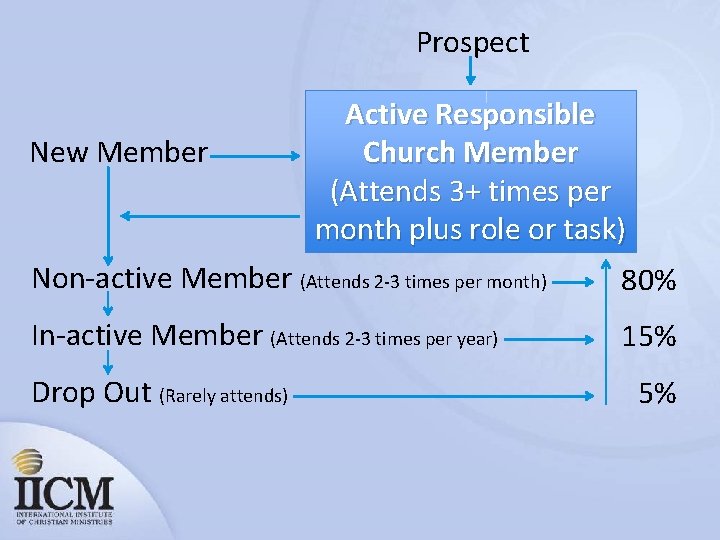
Prospect New Member Active Responsible Church Member (Attends 3+ times per month plus role or task) Non-active Member (Attends 2 -3 times per month) 80% In-active Member (Attends 2 -3 times per year) 15% Drop Out (Rarely attends) 5%
Pastors of growing churches spend 1 ½ hours daily in prayer
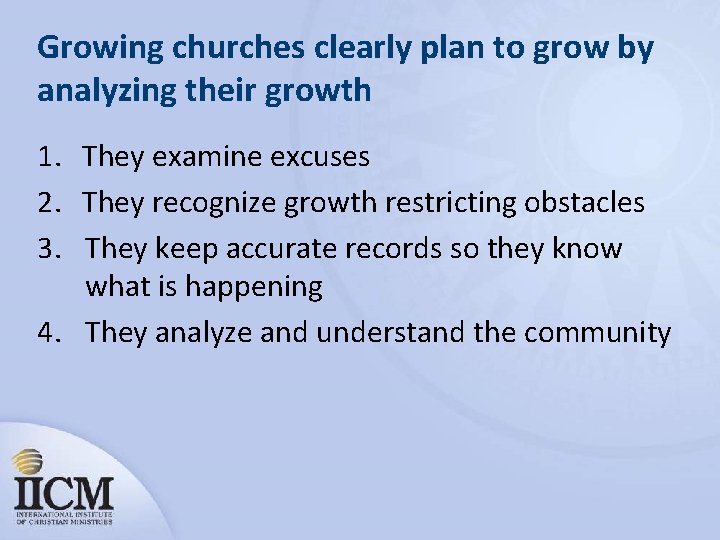
Growing churches clearly plan to grow by analyzing their growth 1. They examine excuses 2. They recognize growth restricting obstacles 3. They keep accurate records so they know what is happening 4. They analyze and understand the community
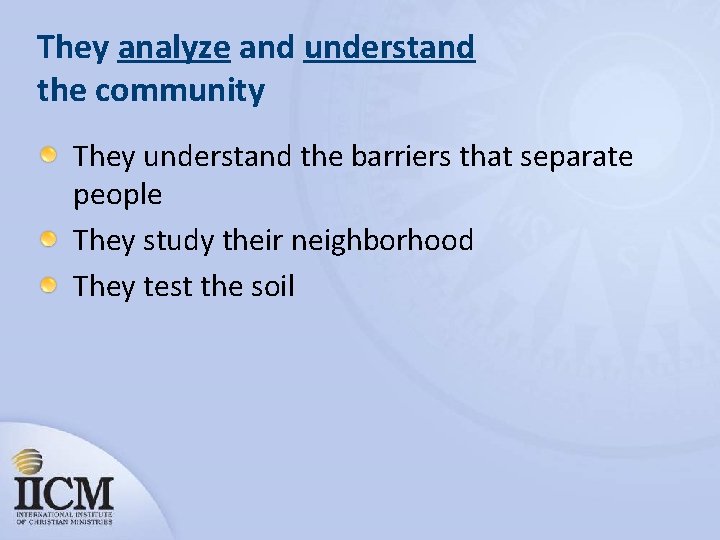
They analyze and understand the community They understand the barriers that separate people They study their neighborhood They test the soil
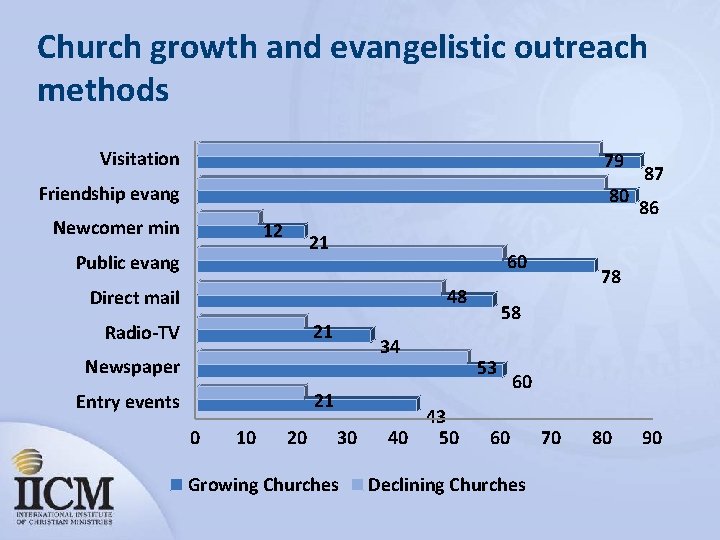
Church growth and evangelistic outreach methods Visitation 79 Friendship evang 80 Newcomer min 12 21 Public evang 60 48 Direct mail 21 Radio-TV 34 Newspaper 21 Entry events 0 10 20 30 Growing Churches 43 40 50 87 86 78 58 53 60 60 Declining Churches 70 80 90
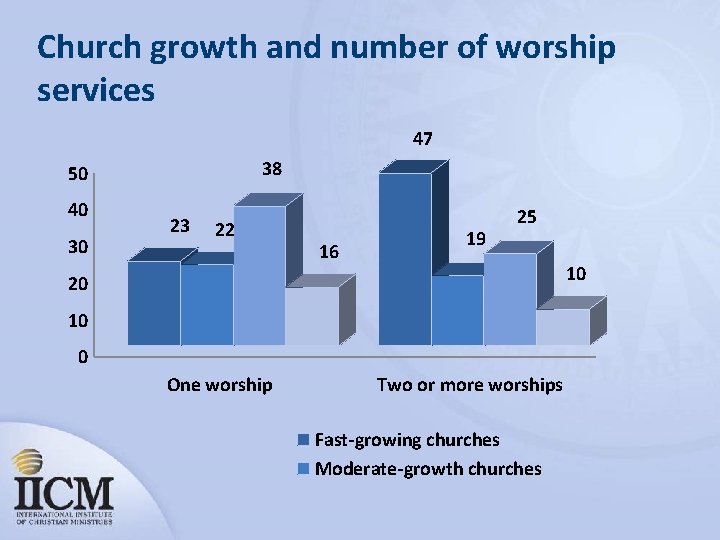
Church growth and number of worship services 47 38 50 40 30 23 22 16 19 25 10 20 10 0 One worship Two or more worships Fast-growing churches Moderate-growth churches
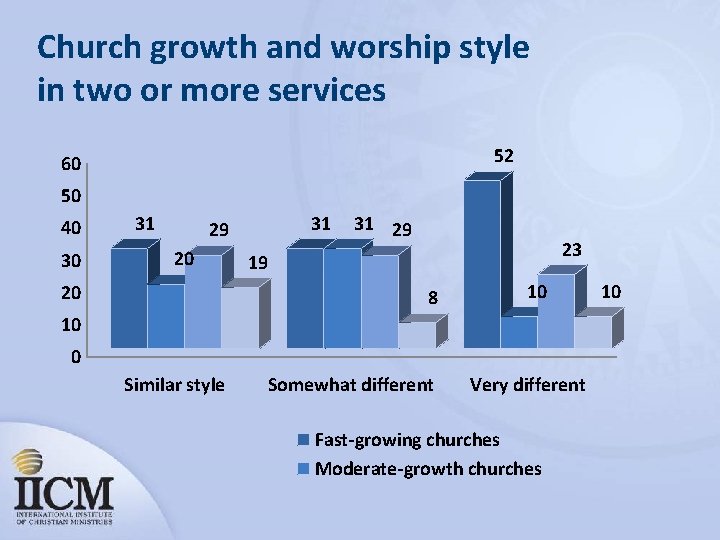
Church growth and worship style in two or more services 52 60 50 40 30 31 31 29 20 20 31 29 23 19 8 10 10 0 Similar style Somewhat different Very different Fast-growing churches Moderate-growth churches 10
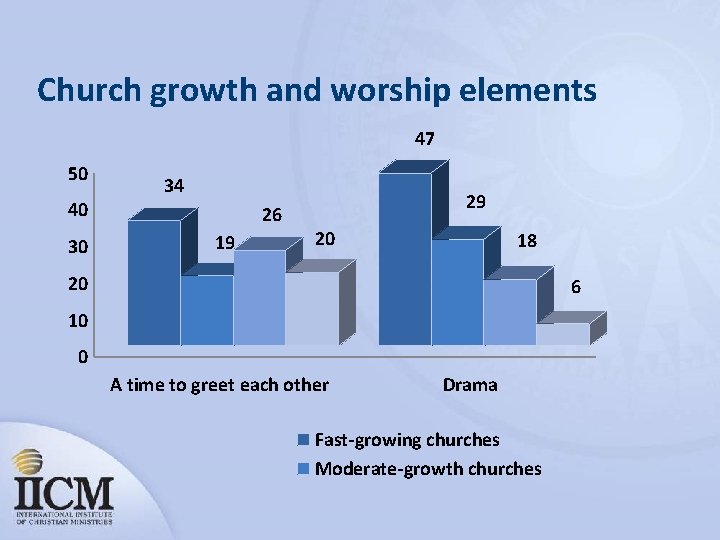
Church growth and worship elements 47 50 40 30 34 26 19 29 20 18 20 6 10 0 A time to greet each other Drama Fast-growing churches Moderate-growth churches
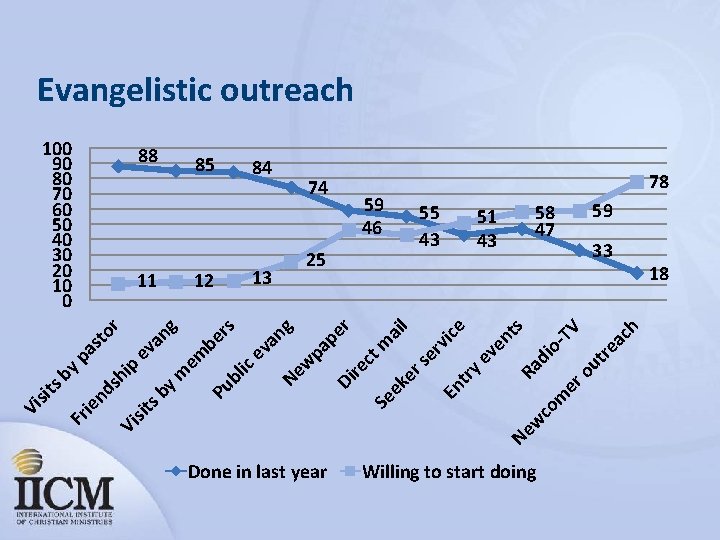
Evangelistic outreach h ac er m co w Ne Willing to start doing 18 tre odi Ra En try 33 TV ts en rv se er ek Se ev ice ai m ct re Vi Done in last year 59 58 47 51 43 ou 55 43 l r pa w Di bl Pu 59 46 pe ng va be em 78 25 sit sb 74 13 rs g ip sh nd ym ev an or st pa by 84 12 11 Fr ie Vi sit s 85 Ne 88 ic e 100 90 80 70 60 50 40 30 20 10 0
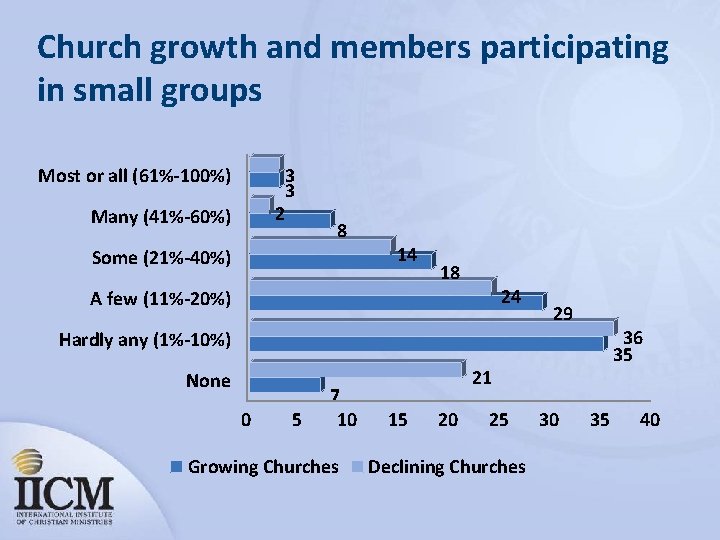
Church growth and members participating in small groups Most or all (61%-100%) 3 3 2 Many (41%-60%) 8 Some (21%-40%) 14 18 24 A few (11%-20%) 29 36 35 Hardly any (1%-10%) None 0 5 7 10 Growing Churches 21 15 20 25 Declining Churches 30 35 40
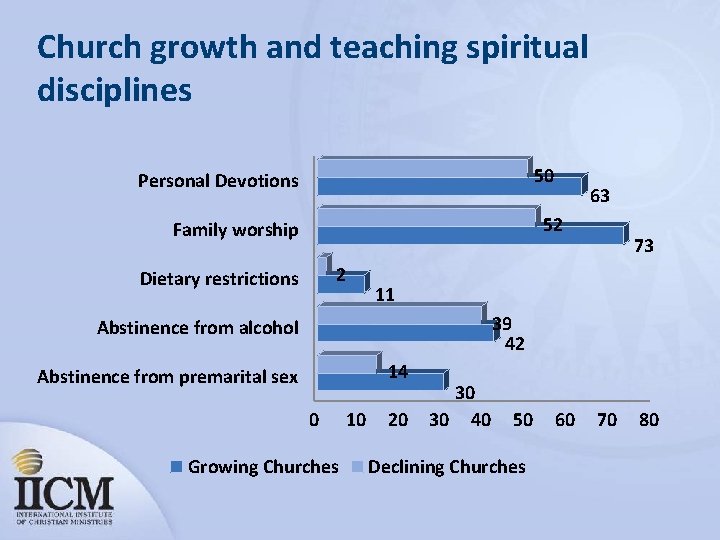
Church growth and teaching spiritual disciplines 50 Personal Devotions 63 52 Family worship 2 Dietary restrictions 73 11 39 42 Abstinence from alcohol 14 Abstinence from premarital sex 0 Growing Churches 10 20 30 30 40 50 Declining Churches 60 70 80
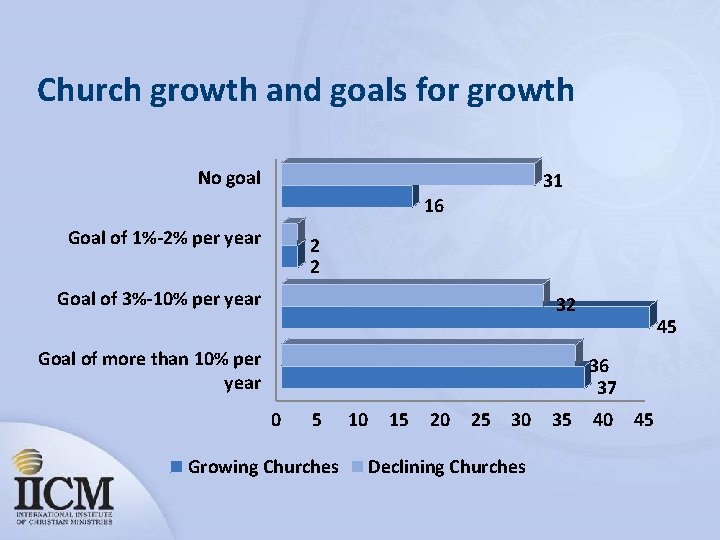
Church growth and goals for growth No goal 31 16 Goal of 1%-2% per year 2 2 Goal of 3%-10% per year 32 Goal of more than 10% per year 45 36 37 0 5 Growing Churches 10 15 20 25 30 Declining Churches 35 40 45
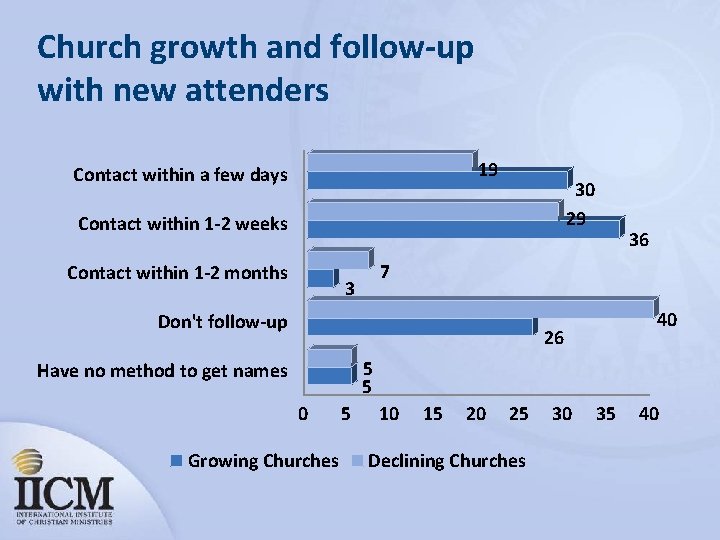
Church growth and follow-up with new attenders 19 Contact within a few days 30 29 Contact within 1 -2 weeks Contact within 1 -2 months 36 7 3 Don't follow-up 40 26 5 5 Have no method to get names 0 Growing Churches 5 10 15 20 25 Declining Churches 30 35 40
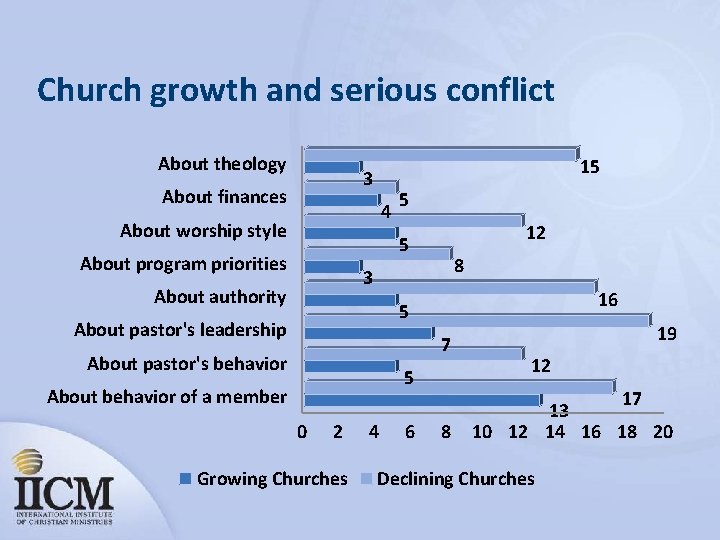
Church growth and serious conflict About theology 15 3 About finances 4 About worship style 5 12 5 About program priorities 8 3 About authority 16 5 About pastor's leadership 7 About pastor's behavior 5 About behavior of a member 0 2 Growing Churches 4 6 8 19 12 17 13 10 12 14 16 18 20 Declining Churches
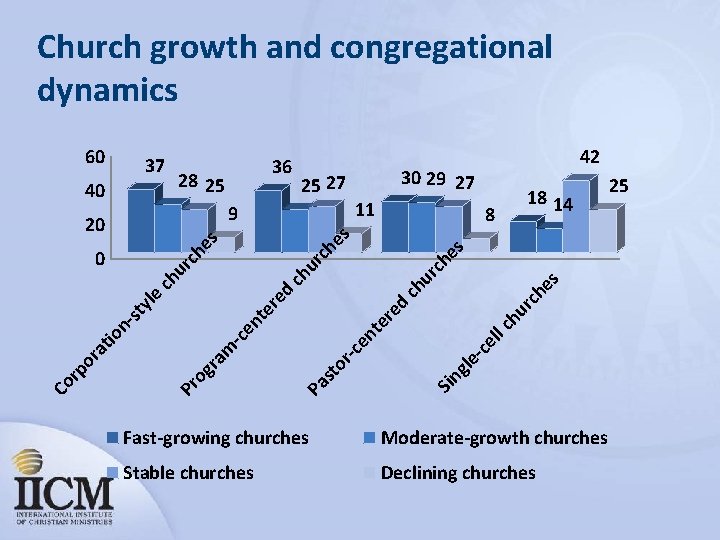
Church growth and congregational dynamics 28 25 9 18 14 8 es ch ur rc he ch d re d -c or st Pa el en lc te hu re te en -c m ra og Pr s ur ch ch u e yl st nat io or rp 11 ch e s he rc 0 30 29 27 s 20 Co 25 27 42 -c 40 36 ng le 37 Si 60 Fast-growing churches Moderate-growth churches Stable churches Declining churches 25
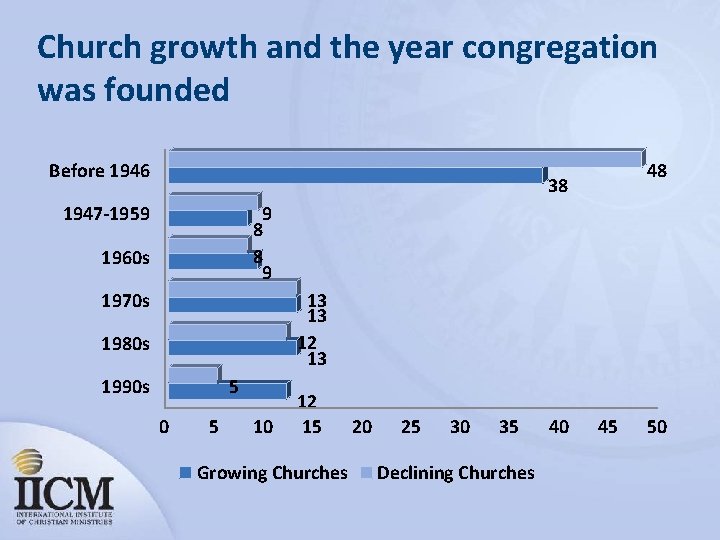
Church growth and the year congregation was founded Before 1946 48 38 1947 -1959 9 8 8 9 1960 s 1970 s 13 13 12 13 1980 s 1990 s 5 0 5 10 12 15 Growing Churches 20 25 30 35 Declining Churches 40 45 50
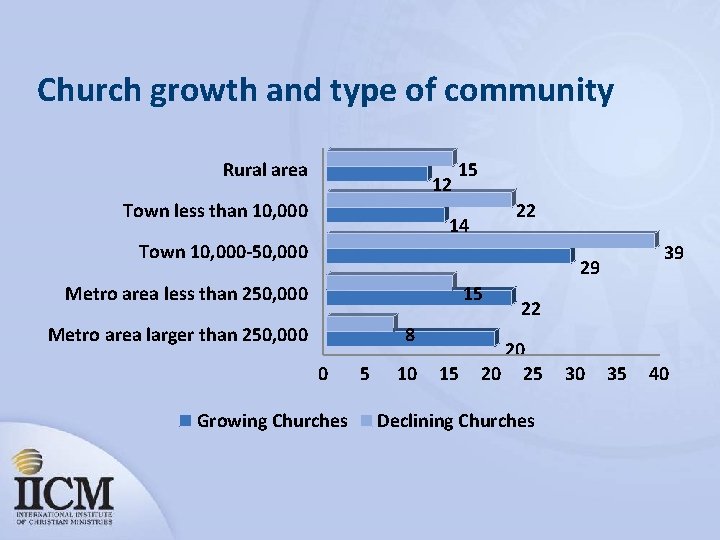
Church growth and type of community Rural area 12 Town less than 10, 000 15 22 14 Town 10, 000 -50, 000 39 29 Metro area less than 250, 000 15 Metro area larger than 250, 000 8 0 Growing Churches 5 10 15 22 20 20 25 Declining Churches 30 35 40
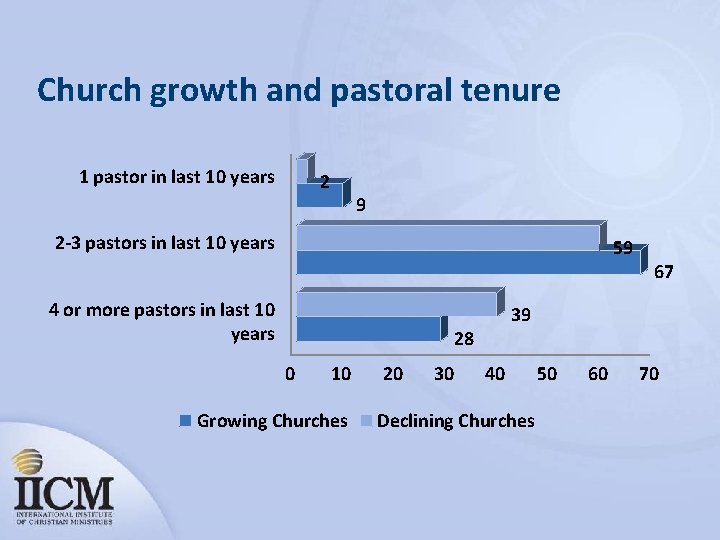
Church growth and pastoral tenure 1 pastor in last 10 years 2 9 2 -3 pastors in last 10 years 59 4 or more pastors in last 10 years 39 28 0 10 Growing Churches 20 30 67 40 Declining Churches 50 60 70
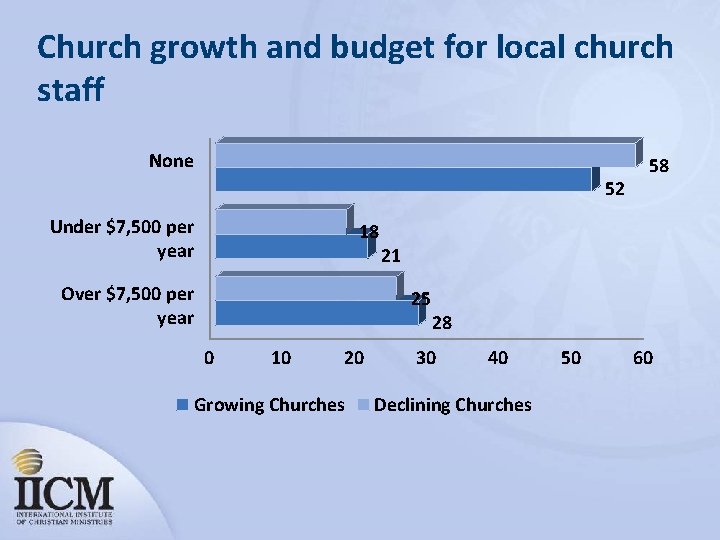
Church growth and budget for local church staff None 52 Under $7, 500 per year 18 Over $7, 500 per year 21 25 0 10 20 Growing Churches 58 28 30 40 Declining Churches 50 60
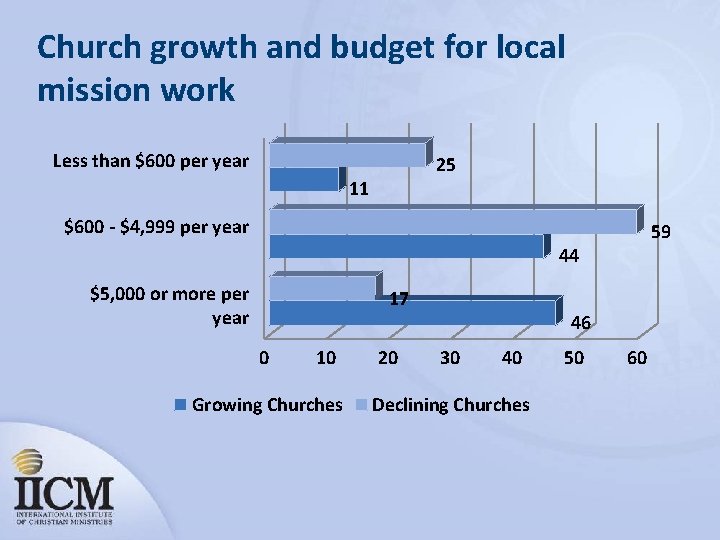
Church growth and budget for local mission work Less than $600 per year 25 11 $600 - $4, 999 per year 59 44 $5, 000 or more per year 17 0 10 Growing Churches 20 46 30 40 Declining Churches 50 60
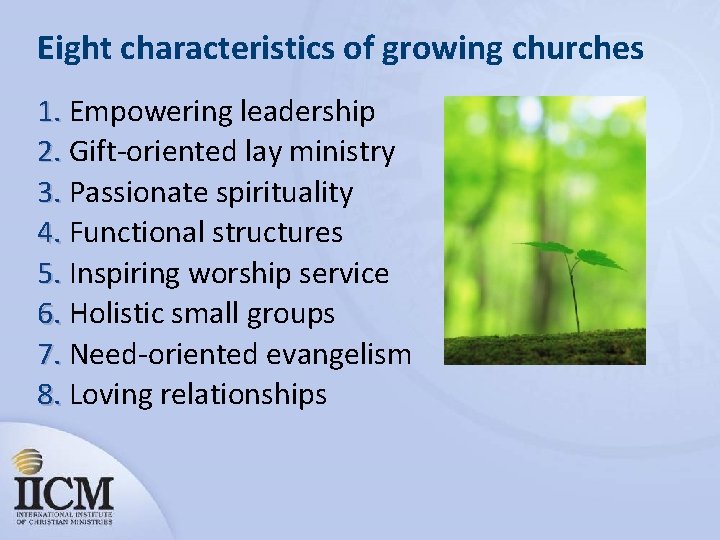
Eight characteristics of growing churches 1. Empowering leadership 2. Gift-oriented lay ministry 3. Passionate spirituality 4. Functional structures 5. Inspiring worship service 6. Holistic small groups 7. Need-oriented evangelism 8. Loving relationships
Principles of Leadership and Church Growth International Institute of Christian Ministries © 2012 General Conference of Seventh-day Adventists®