Monitoring and international agreements Liz Nichols Office of
- Slides: 26
Monitoring and international agreements Liz Nichols Office of Environmental Quality and Transboundary Issues Bureau of Oceans and International Environmental and Scientific Affairs U. S. Department of State
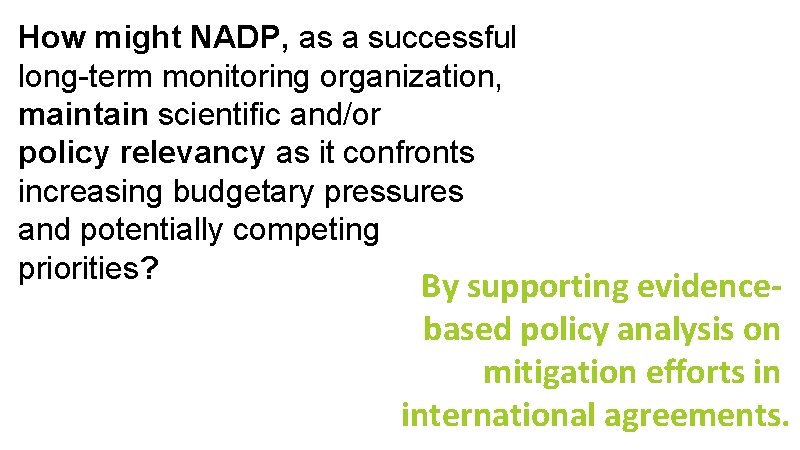
How might NADP, as a successful long-term monitoring organization, maintain scientific and/or policy relevancy as it confronts increasing budgetary pressures and potentially competing priorities?
How might NADP, as a successful long-term monitoring organization, maintain scientific and/or policy relevancy as it confronts increasing budgetary pressures and potentially competing priorities? By supporting evidencebased policy analysis on mitigation efforts in international agreements.
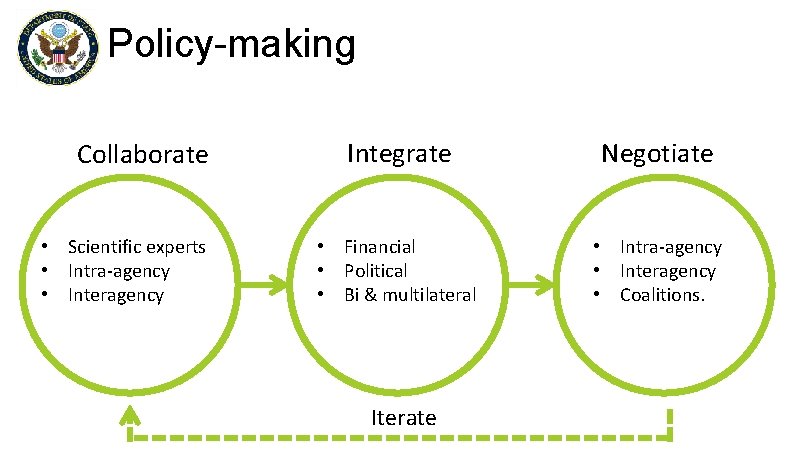
Policy-making Collaborate • Scientific experts • Understand the Intra-agency • Interagency connections Integrate Negotiate • Financial • Understand the Political • Bi & multilateral connections • Intra-agency • Understand the Interagency • connections Coalitions. Iterate
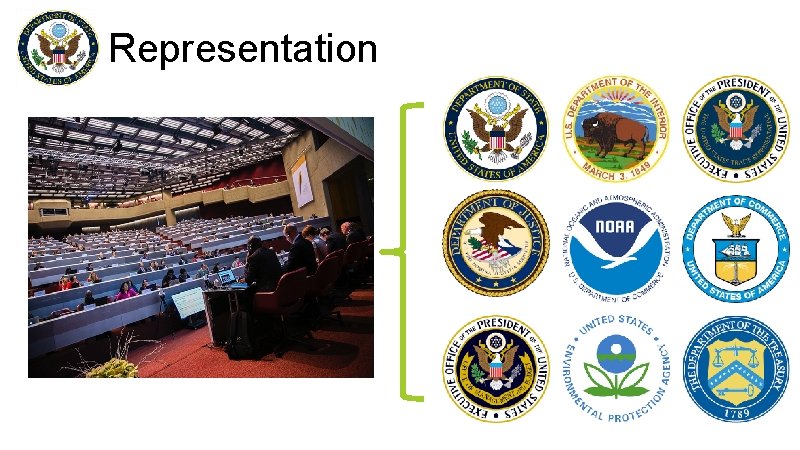
Representation
Monitoring in international agreements * UNEP Minamata Convention on Mercury UNECE Convention on Long-Range Transboundary Air Pollution
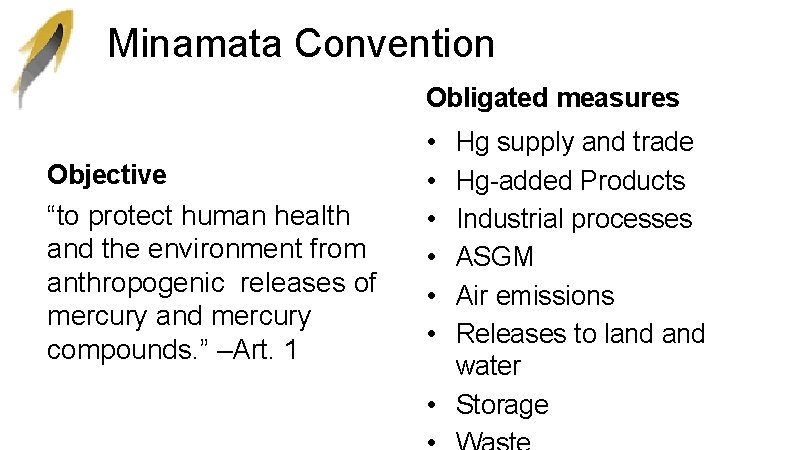
Minamata Convention Obligated measures Objective “to protect human health and the environment from anthropogenic releases of mercury and mercury compounds. ” –Art. 1 • • • Hg supply and trade Hg-added Products Industrial processes ASGM Air emissions Releases to land water • Storage
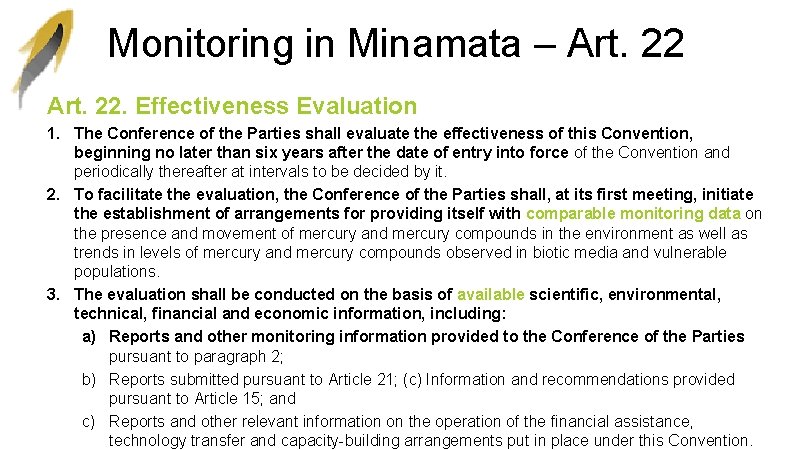
Monitoring in Minamata – Art. 22. Effectiveness Evaluation 1. The Conference of the Parties shall evaluate the effectiveness of this Convention, beginning no later than six years after the date of entry into force of the Convention and periodically thereafter at intervals to be decided by it. 2. To facilitate the evaluation, the Conference of the Parties shall, at its first meeting, initiate the establishment of arrangements for providing itself with comparable monitoring data on the presence and movement of mercury and mercury compounds in the environment as well as trends in levels of mercury and mercury compounds observed in biotic media and vulnerable populations. 3. The evaluation shall be conducted on the basis of available scientific, environmental, technical, financial and economic information, including: a) Reports and other monitoring information provided to the Conference of the Parties pursuant to paragraph 2; b) Reports submitted pursuant to Article 21; (c) Information and recommendations provided pursuant to Article 15; and c) Reports and other relevant information on the operation of the financial assistance, technology transfer and capacity-building arrangements put in place under this Convention.
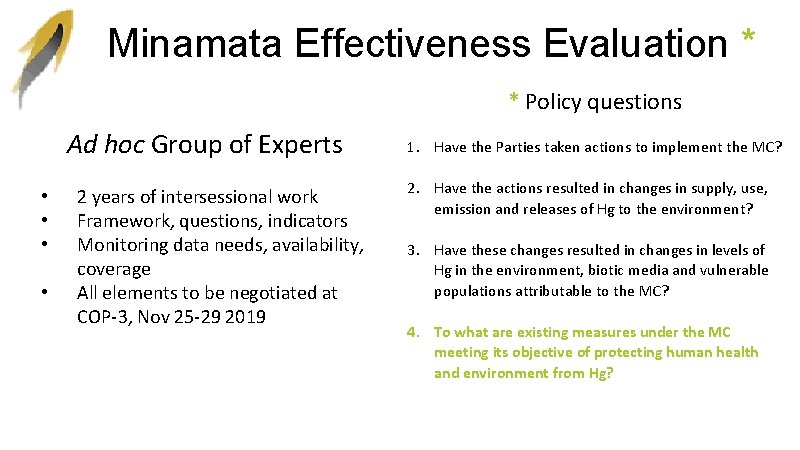
Minamata Effectiveness Evaluation * * Policy questions Ad hoc Group of Experts • • 2 years of intersessional work Framework, questions, indicators Monitoring data needs, availability, coverage All elements to be negotiated at COP-3, Nov 25 -29 2019 1. Have the Parties taken actions to implement the MC? 2. Have the actions resulted in changes in supply, use, emission and releases of Hg to the environment? 3. Have these changes resulted in changes in levels of Hg in the environment, biotic media and vulnerable populations attributable to the MC? 4. To what are existing measures under the MC meeting its objective of protecting human health and environment from Hg?
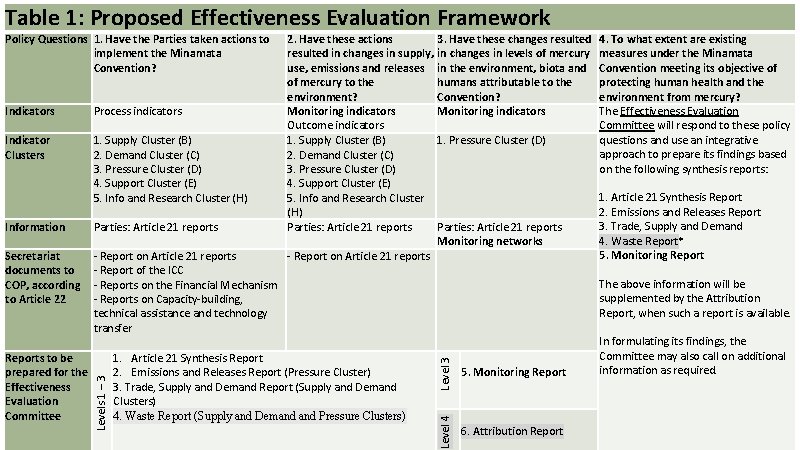
Table 1: Proposed Effectiveness Evaluation Framework Process indicators Information Parties: Article 21 reports Secretariat documents to COP, according to Article 22 - Report on Article 21 reports - Report of the ICC - Reports on the Financial Mechanism - Reports on Capacity-building, technical assistance and technology transfer Levels 1 – 3 Reports to be prepared for the Effectiveness Evaluation Committee 1. Supply Cluster (B) 2. Demand Cluster (C) 3. Pressure Cluster (D) 4. Support Cluster (E) 5. Info and Research Cluster (H) 1. Article 21 Synthesis Report 2. Emissions and Releases Report (Pressure Cluster) 3. Trade, Supply and Demand Report (Supply and Demand Clusters) 4. Waste Report (Supply and Demand Pressure Clusters) Level 3 Indicators Indicator Clusters 2. Have these actions 3. Have these changes resulted in changes in supply, in changes in levels of mercury use, emissions and releases in the environment, biota and of mercury to the humans attributable to the environment? Convention? Monitoring indicators Outcome indicators 1. Supply Cluster (B) 1. Pressure Cluster (D) 2. Demand Cluster (C) 3. Pressure Cluster (D) 4. Support Cluster (E) 5. Info and Research Cluster (H) Parties: Article 21 reports Monitoring networks - Report on Article 21 reports 5. Monitoring Report 6. Attribution Report Level 4 Policy Questions 1. Have the Parties taken actions to implement the Minamata Convention? 4. To what extent are existing measures under the Minamata Convention meeting its objective of protecting human health and the environment from mercury? The Effectiveness Evaluation Committee will respond to these policy questions and use an integrative approach to prepare its findings based on the following synthesis reports: 1. Article 21 Synthesis Report 2. Emissions and Releases Report 3. Trade, Supply and Demand 4. Waste Report* 5. Monitoring Report The above information will be supplemented by the Attribution Report, when such a report is available. In formulating its findings, the Committee may also call on additional information as required.
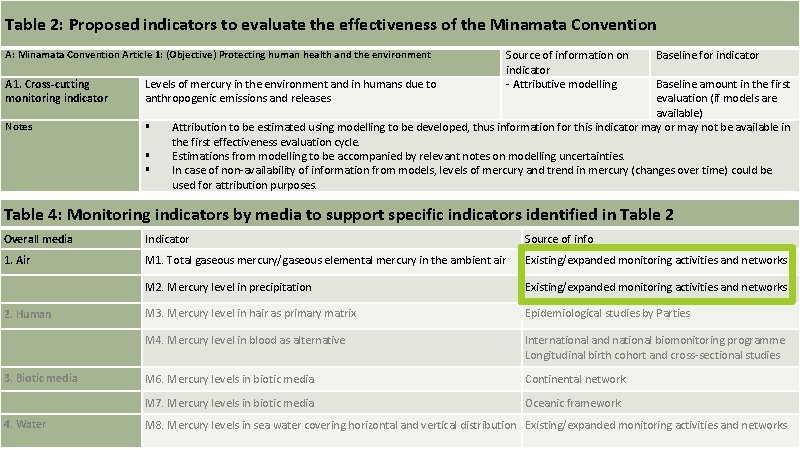
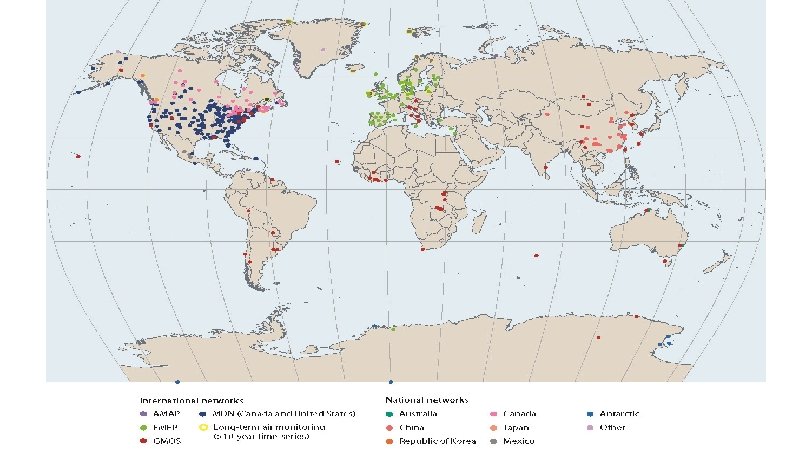
Table 2: Proposed indicators to evaluate the effectiveness of the Minamata Convention A: Minamata Convention Article 1: (Objective) Protecting human health and the environment Source of information on Baseline for indicator Some kind of figure made out of the monitoring networks, and idea about how they come together A 1. Cross-cutting monitoring indicator Levels of mercury in the environment and in humans due to anthropogenic emissions and releases Notes indicator - Attributive modelling Baseline amount in the first evaluation (if models are available) Attribution to be estimated using modelling to be developed, thus information for this indicator may not be available in the first effectiveness evaluation cycle. Estimations from modelling to be accompanied by relevant notes on modelling uncertainties. In case of non-availability of information from models, levels of mercury and trend in mercury (changes over time) could be used for attribution purposes. Table 4: Monitoring indicators by media to support specific indicators identified in Table 2 Overall media Indicator Source of info 1. Air M 1. Total gaseous mercury/gaseous elemental mercury in the ambient air Existing/expanded monitoring activities and networks M 2. Mercury level in precipitation Existing/expanded monitoring activities and networks 2. Human M 3. Mercury level in hair as primary matrix Epidemiological studies by Parties M 4. Mercury level in blood as alternative International and national biomonitoring programme Longitudinal birth cohort and cross-sectional studies 3. Biotic media M 6. Mercury levels in biotic media Continental network M 7. Mercury levels in biotic media Oceanic framework 4. Water M 8. Mercury levels in sea water covering horizontal and vertical distribution Existing/expanded monitoring activities and networks
How might NADP, as a successful long-term monitoring organization, support evidence-based policy analysis on mitigation efforts in international agreements? • Data gaps • Partnerships • Integration
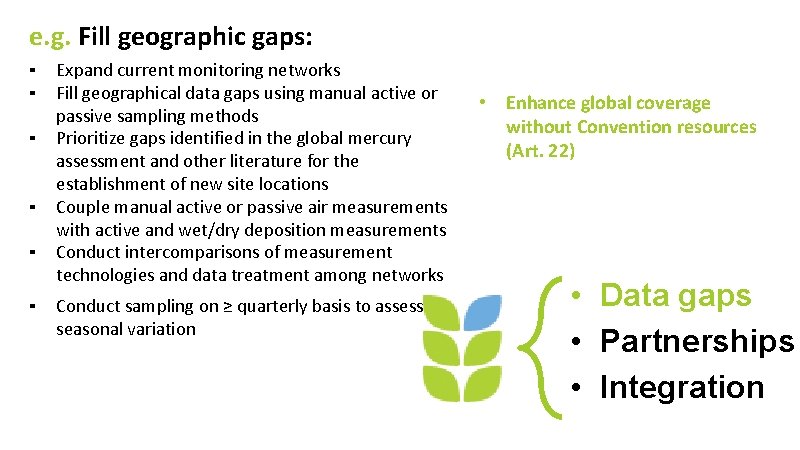
e. g. Fill geographic gaps: ▪ ▪ ▪ Expand current monitoring networks Fill geographical data gaps using manual active or passive sampling methods Prioritize gaps identified in the global mercury assessment and other literature for the establishment of new site locations Couple manual active or passive air measurements with active and wet/dry deposition measurements Conduct intercomparisons of measurement technologies and data treatment among networks Conduct sampling on ≥ quarterly basis to assess seasonal variation • Enhance global coverage without Convention resources (Art. 22) • Data gaps • Partnerships • Integration
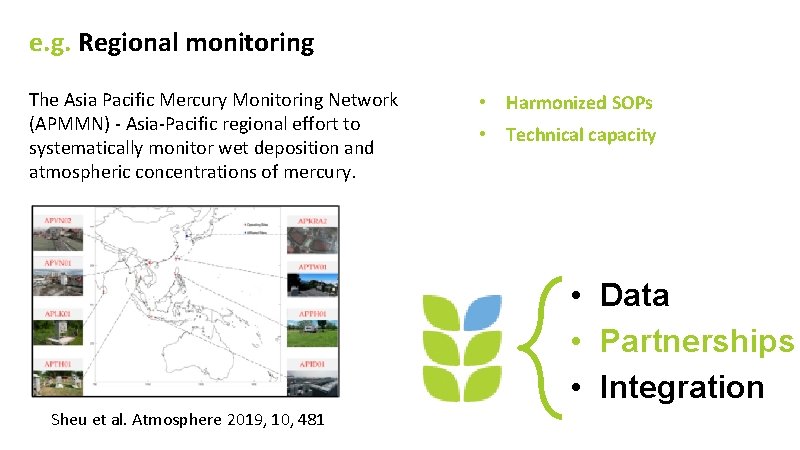
e. g. Regional monitoring The Asia Pacific Mercury Monitoring Network (APMMN) - Asia-Pacific regional effort to systematically monitor wet deposition and atmospheric concentrations of mercury. • Harmonized SOPs • Technical capacity • Data • Partnerships • Integration Sheu et al. Atmosphere 2019, 10, 481
e. g. Regional conventions UNECE Convention on Long Range Transboundary Air Pollution (LRTAP) – Launching of LRTAP Forum to support regional efforts to reduce transboundary air pollution. • International cooperation • Scientific & policy coordination • Data • Partnerships • Integration Yarime and Li. Global Policy 2018, 9: 35 -41
e. g. Global integration The Global Observation System for Mercury (GOS 4 M) – UN effort to promote cooperation between mercury monitoring networks, establishment of new monitoring sites, facilitate access to available data and knowledge on mercury levels. • Enhance global coverage without Convention resources (Art. 22) • Data • Partnerships • Integration
How might NADP, as a successful long-term monitoring organization, maintain scientific and/or policy relevancy as it confronts increasing budgetary pressures and potentially competing priorities? • Data gaps • Partnerships • Integration
Monitoring and international agreements Liz Nichols Office of Environmental Quality and Transboundary Issues Bureau of Oceans and International Environmental and Scientific Affairs U. S. Department of State
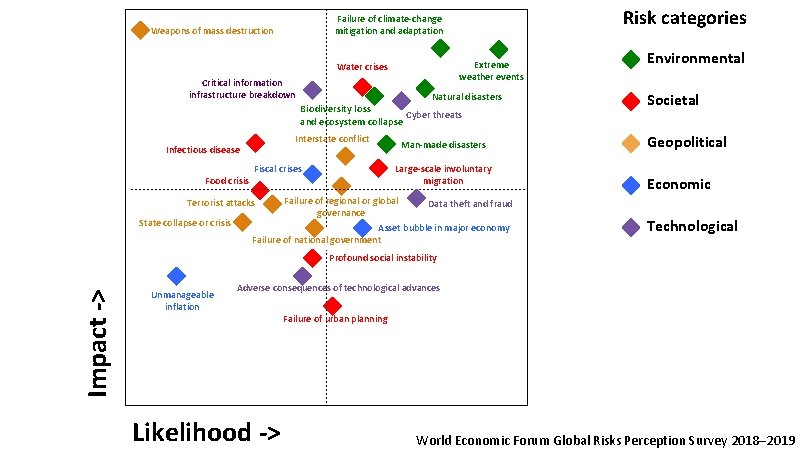
Risk categories Failure of climate-change mitigation and adaptation Weapons of mass destruction Extreme weather events Water crises Critical information infrastructure breakdown Natural disasters Biodiversity loss Cyber threats and ecosystem collapse Interstate conflict Infectious disease Food crisis Fiscal crises Man-made disasters Large-scale involuntary migration Failure of regional or global Terrorist attacks Data theft and fraud governance State collapse or crisis Asset bubble in major economy Failure of national government Environmental Societal Geopolitical Economic Technological Impact -> Profound social instability Unmanageable inflation Adverse consequences of technological advances Likelihood -> Failure of urban planning World Economic Forum Global Risks Perception Survey 2018– 2019
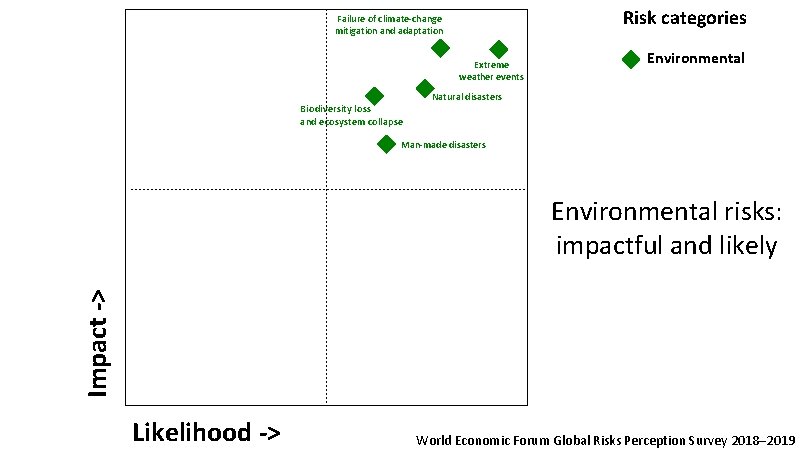
Risk categories Failure of climate-change mitigation and adaptation Extreme weather events Biodiversity loss and ecosystem collapse Environmental Natural disasters Man-made disasters Impact -> Environmental risks: impactful and likely Likelihood -> World Economic Forum Global Risks Perception Survey 2018– 2019
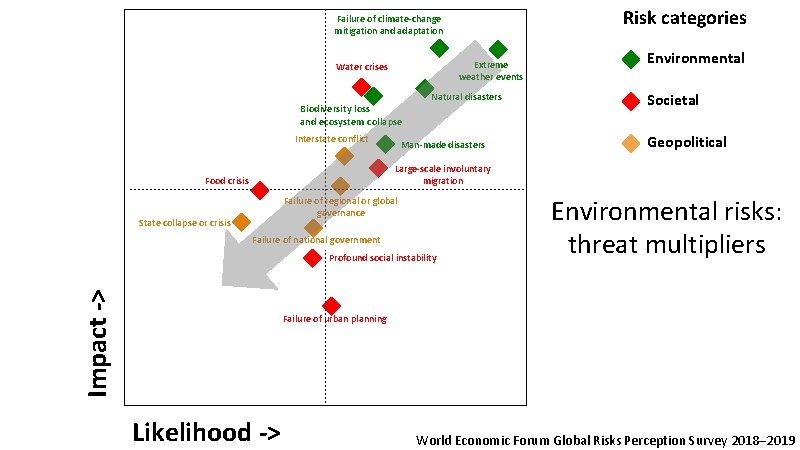
Risk categories Failure of climate-change mitigation and adaptation Extreme weather events Water crises Biodiversity loss and ecosystem collapse Interstate conflict Natural disasters Man-made disasters Environmental Societal Geopolitical Large-scale involuntary migration Food crisis Failure of regional or global governance State collapse or crisis Failure of national government Impact -> Profound social instability Environmental risks: threat multipliers Failure of urban planning Likelihood -> World Economic Forum Global Risks Perception Survey 2018– 2019
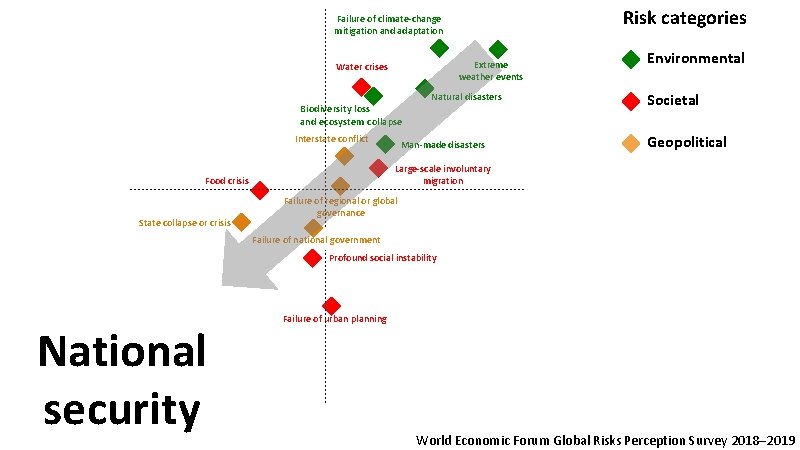
Risk categories Failure of climate-change mitigation and adaptation Extreme weather events Water crises Biodiversity loss and ecosystem collapse Interstate conflict Man-made disasters Societal Geopolitical Large-scale involuntary migration Food crisis State collapse or crisis Natural disasters Environmental Failure of regional or global governance Failure of national government Profound social instability National security Failure of urban planning World Economic Forum Global Risks Perception Survey 2018– 2019
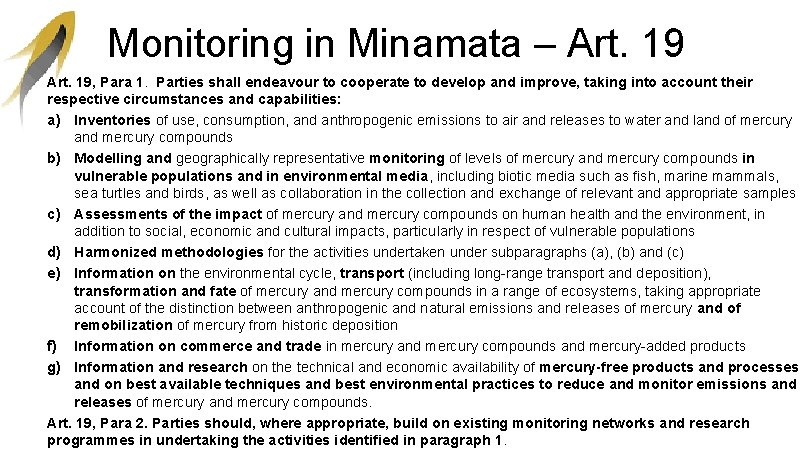
Monitoring in Minamata – Art. 19, Para 1. Parties shall endeavour to cooperate to develop and improve, taking into account their respective circumstances and capabilities: a) Inventories of use, consumption, and anthropogenic emissions to air and releases to water and land of mercury and mercury compounds b) Modelling and geographically representative monitoring of levels of mercury and mercury compounds in vulnerable populations and in environmental media, including biotic media such as fish, marine mammals, sea turtles and birds, as well as collaboration in the collection and exchange of relevant and appropriate samples c) Assessments of the impact of mercury and mercury compounds on human health and the environment, in addition to social, economic and cultural impacts, particularly in respect of vulnerable populations d) Harmonized methodologies for the activities undertaken under subparagraphs (a), (b) and (c) e) Information on the environmental cycle, transport (including long-range transport and deposition), transformation and fate of mercury and mercury compounds in a range of ecosystems, taking appropriate account of the distinction between anthropogenic and natural emissions and releases of mercury and of remobilization of mercury from historic deposition f) Information on commerce and trade in mercury and mercury compounds and mercury-added products g) Information and research on the technical and economic availability of mercury-free products and processes and on best available techniques and best environmental practices to reduce and monitor emissions and releases of mercury and mercury compounds. Art. 19, Para 2. Parties should, where appropriate, build on existing monitoring networks and research programmes in undertaking the activities identified in paragraph 1.
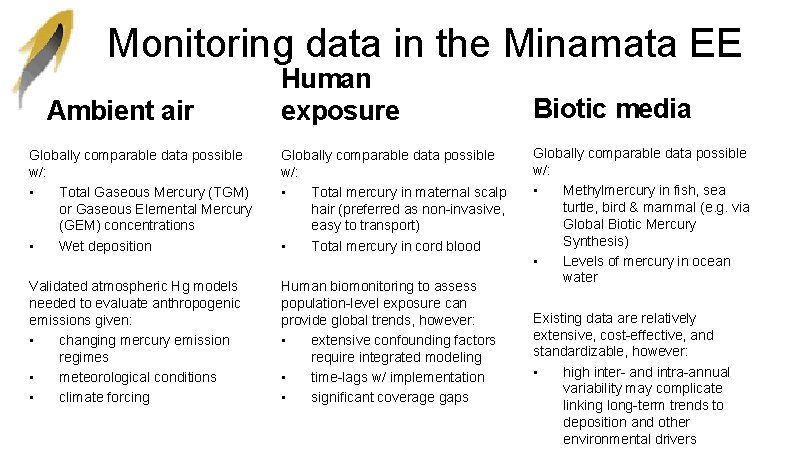
Monitoring data in the Minamata EE Ambient air Human exposure Globally comparable data possible w/: • Total Gaseous Mercury (TGM) or Gaseous Elemental Mercury (GEM) concentrations • Wet deposition Globally comparable data possible w/: • Total mercury in maternal scalp hair (preferred as non-invasive, easy to transport) • Total mercury in cord blood Validated atmospheric Hg models needed to evaluate anthropogenic emissions given: • changing mercury emission regimes • meteorological conditions • climate forcing Human biomonitoring to assess population-level exposure can provide global trends, however: • extensive confounding factors require integrated modeling • time-lags w/ implementation • significant coverage gaps Biotic media Globally comparable data possible w/: • Methylmercury in fish, sea turtle, bird & mammal (e. g. via Global Biotic Mercury Synthesis) • Levels of mercury in ocean water Existing data are relatively extensive, cost-effective, and standardizable, however: • high inter- and intra-annual variability may complicate linking long-term trends to deposition and other environmental drivers