
GENUINE AGREEMENT Defective Agreements When something goes wrong
- Slides: 22
GENUINE AGREEMENT
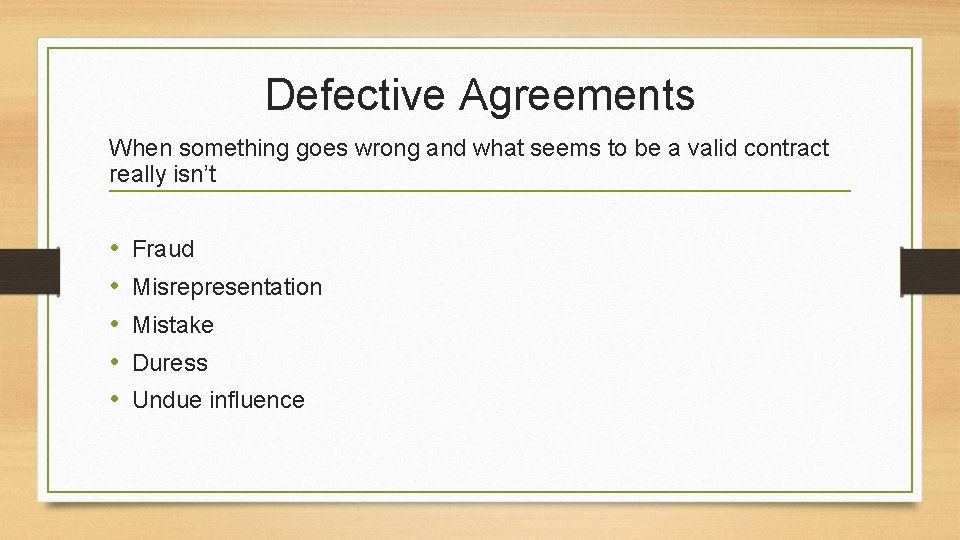
Defective Agreements When something goes wrong and what seems to be a valid contract really isn’t • • • Fraud Misrepresentation Mistake Duress Undue influence
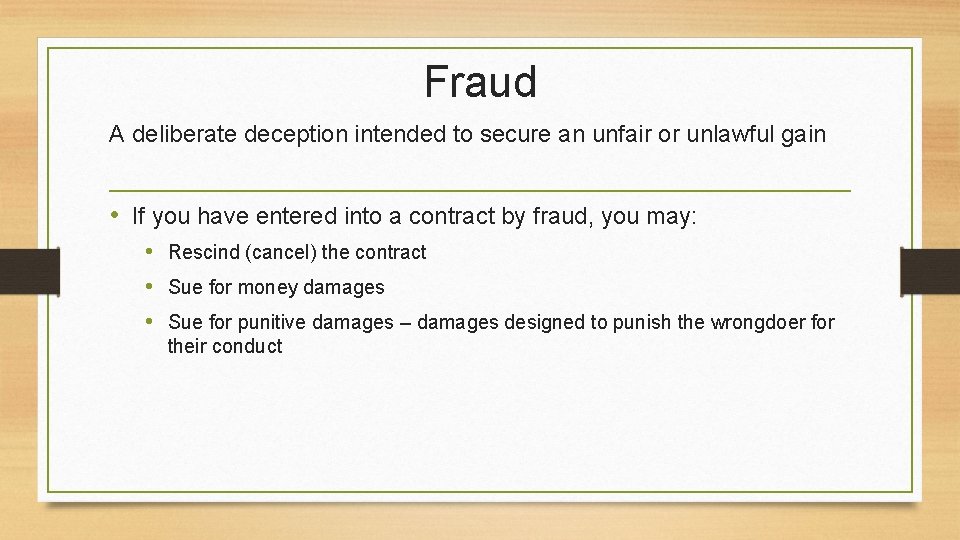
Fraud A deliberate deception intended to secure an unfair or unlawful gain • If you have entered into a contract by fraud, you may: • Rescind (cancel) the contract • Sue for money damages • Sue for punitive damages – damages designed to punish the wrongdoer for their conduct
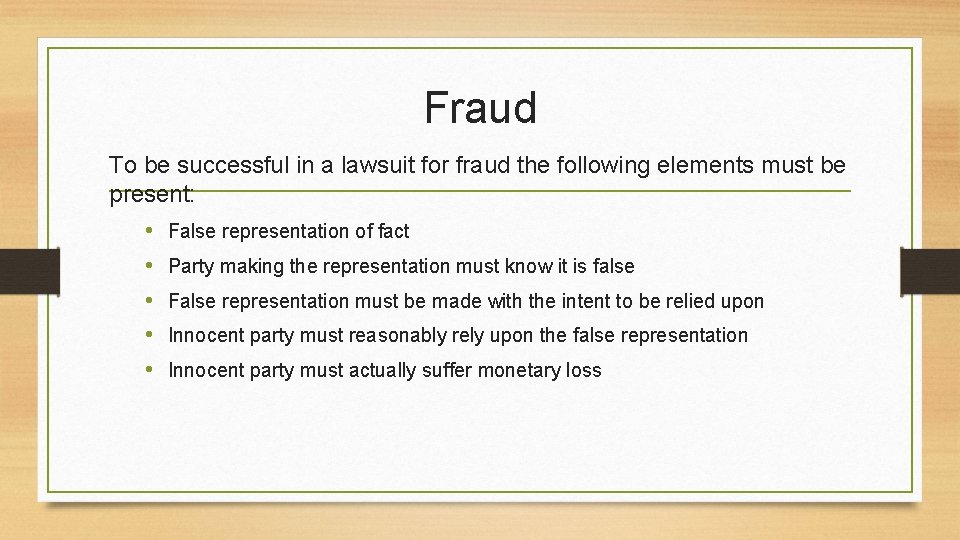
Fraud To be successful in a lawsuit for fraud the following elements must be present: • False representation of fact • Party making the representation must know it is false • False representation must be made with the intent to be relied upon • Innocent party must reasonably rely upon the false representation • Innocent party must actually suffer monetary loss
False Representation of Fact Requires a false representation of a material, existing fact. • Material fact – a fact that’s important, it matters to one of the parties; not an opinion • Can be oral, written, or actions that are deceptive • Concealment – not revealing important information; also called passive fraud or nondisclosure • **Examples…….
Representation Known to be False The party making the false representation must know that it is false • Can be shown to be false • Can be shown that the statement was made recklessly without regard for the truth • **Examples…….
False Representation Intended to Be Relied Upon • Party making the misrepresentation intends for the other party to rely upon the information as part of the contract • **Examples…….
False Representation Actually Relied Upon • False representation is reasonably relied upon by the other party when the agreement is made • Cannot sue for fraud if the party doesn’t actually rely upon the information • **Examples…….
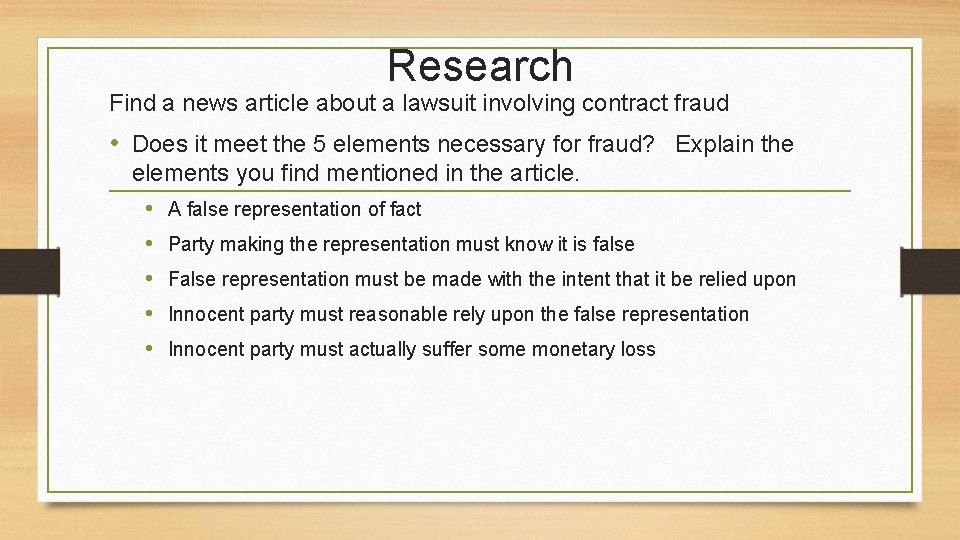
Research Find a news article about a lawsuit involving contract fraud • Does it meet the 5 elements necessary for fraud? Explain the elements you find mentioned in the article. • A false representation of fact • Party making the representation must know it is false • False representation must be made with the intent that it be relied upon • Innocent party must reasonable rely upon the false representation • Innocent party must actually suffer some monetary loss
Resulting Loss • You may choose to enter the contract as the result of false misrepresentation but unless there is loss suffered as a result of false misrepresentation, you cannot win a lawsuit for fraud. • Examples…. .
Innocent Misrepresentation - an untrue statement of facts • Innocent statement that turns out to be false • If the party making the representation honestly believes it was true at the time, you may rescind the contract but not sue for fraud. • Examples…. .
? ? ? Work with a partner and discuss is this situation is a case of potential fraud. • A travel agency calls to offer you a vacation package to Europe for less than $200. To take advantage of the offer, you must send $200 in cash within 24 hours to supply a credit card number at the time of the call. • What do you think? • Remember the elements of fraud.
Mistake • Unilateral mistake – an error on the part of one party to a contract • Usually cannot avoid the contract since the other party has reasonable expectations because of the contract • Examples…. .
Mistake as to the Nature of the Agreement A unilateral mistake • Not an excuse to avoid a contract • If a party signs an agreement, they are bound to it even if they have not read it or are mistaken about what it says. • Signature shows agreement with the terms of the contract. • If someone doesn’t speak English, they are expected to have the contract (agreement) read and explained to them by someone they trust. • Not an excuse to get out of a contract
Mistake as to the Identity of a Party Unilateral mistake • Identity of a party is misunderstood, not clear • May be cause to void a contract • Examples…. .
Bilateral Mistake Both parties to a contract are mistaken about an important fact • Also called a mutual mistake • Either party may avoid the contract
Mistake as to the Possibility of Performance Bilateral Mistake Both parties believe the duties described in the contract can be performed when they cannot • Either party may get out of the contract • Examples…. .
Mistake as to the Subject Matter Bilateral mistake • Both parties are mistaken as to the identity of the subject matter in the contract • Contract may be avoided by either party • Examples…. .
Duress Overcoming a person’s will by use of force or by threat of force or bodily harm • Must enter into a contract voluntarily, not under duress • Agreements made under duress are either void or voidable
Physical Duress • Actual physical violence is used to cause another to enter a contract • Contract is void • Threat of physical force to cause another to enter into a contract • Contract is voidable
Economic Duress • Threats to a person’s business or income that cause them to enter into a contract without real consent • Examples…. . • A threat to exercise one’s legal rights is not duress
Undue Influence When a person uses unfair and improper persuasive pressure to force another person to enter into an agreement; stronger person substitutes their will for the will of the weaker person. • Elements • A dependency relationship – one party is dependent on the other party because of ill health, old age, or mental immaturity • Unfair or improper pressure – independent person uses excessive pressure to force dependent person to enter a contract • Beneficial contract - contract benefits the independent party at the expense of the dependent party • Examples…. .