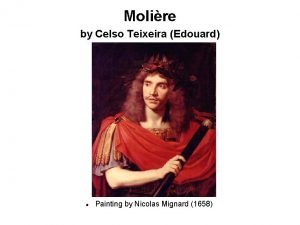
Moliere Tartuffe Introduction Tartuffe first performed in a

- Slides: 27
Moliere Tartuffe
Introduction �Tartuffe first performed in a private production for King Louis XIV of France in 1664. �The play pleased the king. �Play banned from public performance because of strong objections by officials of the Catholic church. Why? �Moliere revised the play, produce it again in 1667 for the king. �Again it was banned.
Introduction �After Moliere's third petition to the king, the ban was lifted in 1669, and the play was performed for the public. �Louis XIV operated as a patron of the arts �The setting is a middle-class home in Paris. The time is the 1660's, when Louis XIV sat on the throne of France.
Preface �How to deal with hypocrisy and religious fanaticism during the age of Enlightenment �Artist as social critic: denunciation of religious hypocrisy and false piety. �Misuse of religion in the avoidance of personal responsibility. �Moliere claimed not to mock faith but to attack its misuse. �Tried to distinguish hypocrites from devout men. �Comedies for the ancients had its origin in religion, constituted part of the ceremonies.
Preface �Function of comedy is to correct men's vices, no one should be exempt. �Men can be reformed by depicting their faults, exposing them to laughter. �Comedy praised by ancient philosophers, Aristotle. �Better to try to correct and moderate men's passion then try to suppress them altogether. You agree? �What relevance do these topics have for our time? �What drives people to religious fanaticism?
Social conventions of the period �The father of a family has absolute power over his daughter's choice of marriage partner. �Husbands and fathers exercised sovereign authority over their dependents (wife, children, servants). �The chastity of the wife is of utmost importance. �A son's economic status is totally dependent on his father's will. �The father of the family is much like the king at this time. �Fathers should run their households like absolute monarchs �Misuse of religious faith.
17 th century comedy �Classic comic devices of plot and character. �Designed to make the audience laugh. �Comment on contemporary social scene. �Dealing with hypocrisy and intolerance. �The plot: restoration of order in a humane and forgiving way. �Beliefs of the Enlightenment: praise of moderation and reason, rejection of passion and excess, women's lesser place, insistence on acceptable behavior and manners
17 th century comedy �Most characters in many comedies are stock types: �The hypocrite �The clever maid �The foolish but tyrannical father �The naive, timid young girl �The voice of wisdom, moderation, common sense, selfcontrol
Acts I-II �We meet Tartuffe only in Act III. Who is he? �Madame Pernelle: �He is a saint. �Practices what he preaches. �Fine man, should be listened to. �He's out to save your soul. �Strives to further God's cause. �He was sent by Heaven to lead you to the true path. �Madame Pernelle totally deluded by Tartuffe.
Acts I-II �Reflected in her behavior in the opening scene. �Complaint about everyone in the family. �She defends Tartuffe and Orgon against the rest. �Do you know anyone like her? �How should one deal with this type of people?
Acts I-II �Orgon: central character of the play and comes entirely under the influence of the hypocrite Tartuffe �Orgon tries to become the epitome of the pious person and goes to absurd extremes both in his words and deeds �Calls him brother, loves him as life, more than his family. �There is no loftier soul since time began. �My family could die, and I would feel no pain. �Scene 2, lines 15 -30. �Exchange between Orgon and Dorine: Scene 4, lines 10 -35.
Acts I-II �What do others think of Tartuffe? �He talks and talks, nothing one can do that is not a crime. �He has usurped the master's place. �He is a fraud. �Rascal. �Behaves as if this house is his, and we his slaves.
Acts I-II �Orgon’s relationship with his family. �Misuse of privilege as father and husband. �Wife (Elmire) �Son (Damis) �Daughter (Mariane) �Servant (Dorine)
Acts I-II �Orgon reveals to Mariane that she must marry Tartuffe. Why? �Reactions: �Mariane �Damis �Dorine to Orgon: � Mariane is unsuitable for Tartuffe (if he's as he says he is). � Tartuffe is socially unsuitable as son-in-law for a man of Orgon's station in life.
Acts I-II � Tartuffe will drive Mariane to infidelity. � The marriage requires breaking the promise to Valere. �Dorine and Mariane exchange. Reverse psychology. �Valere and Mariane exchange. Don’t mean what they say. �Orgon and Cleante exchange: Reason vs. Religious fanaticism. Act I, Scene 5. �How they met and what attracted Orgon to Tartuffe. Lines 23 -50.
Act III �Dorine arranges for Orgon's wife, Elmire, to talk with Tartuffe. �Damis hides in the closet. Theater device: concealed person listening to some type of revelation. �Tartuffe arrives, spouting pious comments: �"Hang up my hairshirt“. �Handkerchief for Dorine to cover her bosom; "the flesh is weak" cannot withstand too many temptations. �Going to the prison to share his money with the prisoners
Act III �Elmire and Tartuffe exchange. �Elmire admonishes Tartuffe for making passes at her. �Tartuffe's reply �"I may be pious, but I am human too; / With your celestial charms before his eyes, / A man has not the power to be wise. " �If passion is part of human nature, is it really possible for man to be pious? Is piety "unnatural" for human beings, as it is unnatural for a tiger to be playing like a pussycat?
Act III �No conflict between piety and love. Elmire as object. How can one not love God’s perfect creation? �Read Lines 55 -82. �“How could I look on you, O flawless creature/ And not adore the Author of all Nature, ” �Vocabulary of the romantic, but from inappropriate person. Elmire’s reply: �don’t you think it’s out of character? �restrain your passion �It ill becomes a pious man like you…
Act III �Elmire also to blame how Tartuffe feels: �And if you blame my passion, you must needs/ Reproach as well the charms upon it feeds. �Tartuffe offers Elmire “love without scandal, pleasure without fear”. He also will want to protect his name. �Should Orgon be informed of the event? �A woman should not run and tattle to her husband every time a man makes an overture to her.
Act III �Orgon arrives and Damis tries to reveal that Tartuffe has been trying to seduce Elmire. �Tartuffe’s reply, adopts religious attitude in which the saintly person over exaggerates his own sins: �Exclaims that he is wicked, depraved, and deserving of being driven from the house. �Suggests that Orgon should believe Damis' story. �Kneels down and tells Orgon to heap upon him all of the abuse in the world. �Offers to leave the house. �Irony: Tartuffe is guilty of all the crimes he confesses to.
Act III �Orgon’s reply: �Completely deceived by Tartuffe's hypocrisy. �Turns on Damis, reproaches him for saying awful things about Tartuffe. �Disinherits Damis and throws him out of the house. �Tartuffe is worth more than his wife, his children, or his relatives. �Read Scene 7, Lines 33 -end.
Act IV �Cléante confronts Tartuffe �Not the act of a religious man to cause such strife in a family. �Tartuffe: agrees to transfer his property so it will not fall into wrong hands and be used for crime and sin.
Act IV �Orgon presents Mariane with the marriage contract. �The more she loathes Tartuffe the more she will be able to mortify one's flesh and make it pure. �Elmire’s plot to reveal Tartuffe's hypocrisy. �Great deal of physical action. �Source of the comedy? Orgon's refusal to be convinced. �Tartuffe confused, wants concrete proof. �Elmire: What if I’m sinning?
Act IV �Not sin when that sin is committed in secret. �Only the scandal of having the sin known can make the act a sin. �Elmire’s delaying tactics. �When does Orgon emerge? Only when Tartuffe insults Orgon personally. �Tartuffe: Orgon is so stupid that even if he saw them he would doubt his sight.
Act IV �Orgon finally convinced of Tartuffe's hypocrisy. �Too late.
Act V �The strongbox. �Orgon vows to hate the entire race of pious men. �Damis, Orgon’s son, wants to end Tartuffe's life. �Cléante advises restraint and moderation, the ideal of the age of Enlightenment. Read Scene 1, 35 -55. �Madame Pernelle unconvinced: the righteous are always maligned. �Orgon and his family are about to be evicted.
Act V �Tartuffe has denounced Orgon as a traitor to the king. �Deus ex machina: Tartuffe arrested. The king knew that Tartuffe was a hypocrite and a liar. �Order is restored. �Orgon's past loyalty to the king is rewarded, and his mistakes are now forgiven. �Orgon then gives his daughter Mariane to Valère to be his wife.