Minimal Spanning Trees Chapter 23 Cormen Leiserson RivestStein

- Slides: 15
Minimal Spanning Trees Chapter 23 Cormen Leiserson Rivest&Stein: Introduction to Algorithms
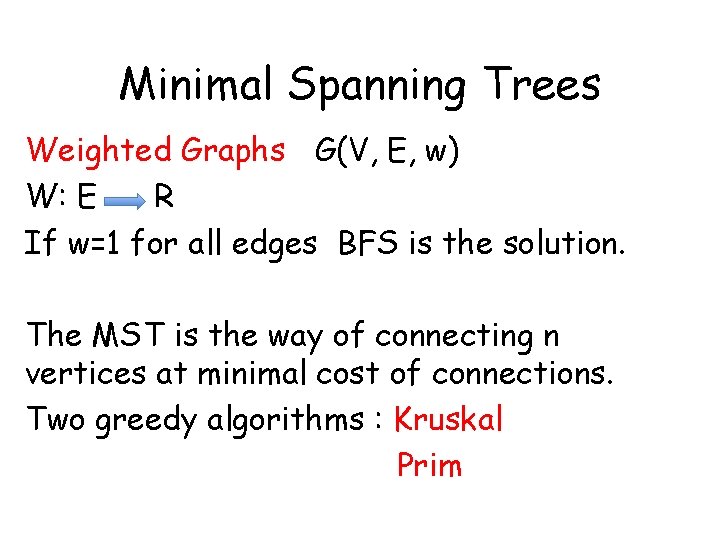
Minimal Spanning Trees Weighted Graphs G(V, E, w) W: E R If w=1 for all edges BFS is the solution. The MST is the way of connecting n vertices at minimal cost of connections. Two greedy algorithms : Kruskal Prim
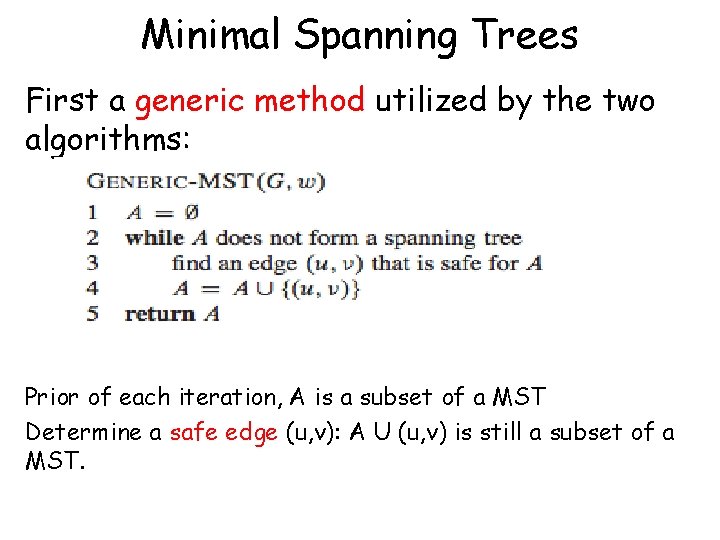
Minimal Spanning Trees First a generic method utilized by the two algorithms: Prior of each iteration, A is a subset of a MST Determine a safe edge (u, v): A U (u, v) is still a subset of a MST.
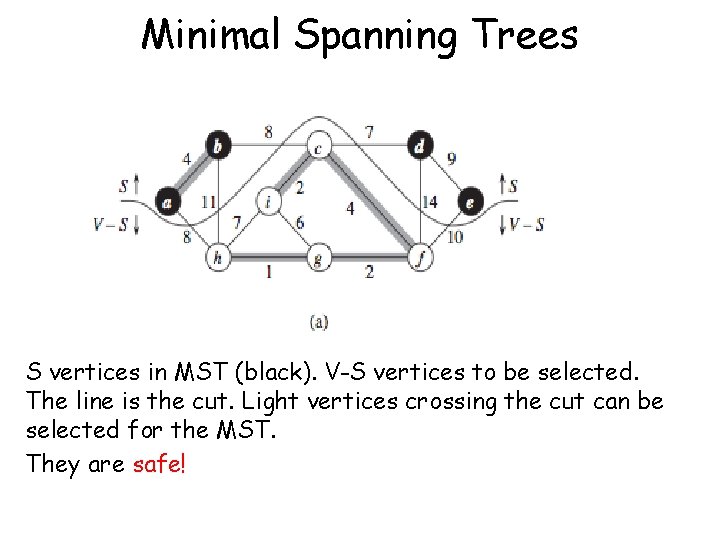
Minimal Spanning Trees S vertices in MST (black). V-S vertices to be selected. The line is the cut. Light vertices crossing the cut can be selected for the MST. They are safe!
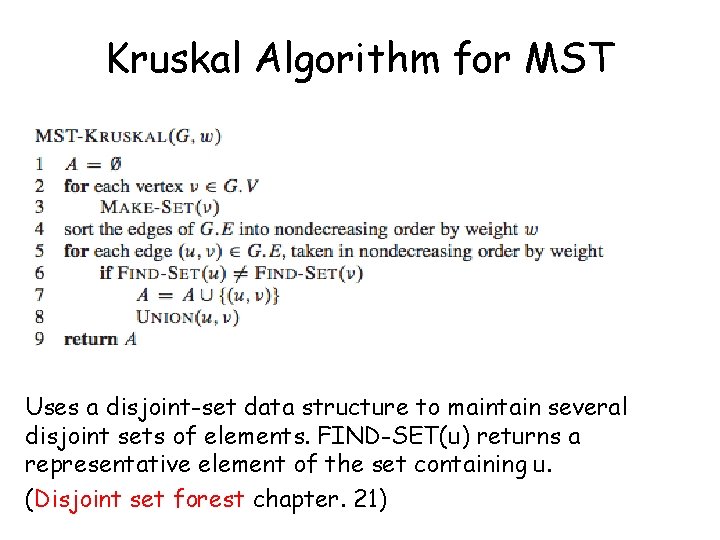
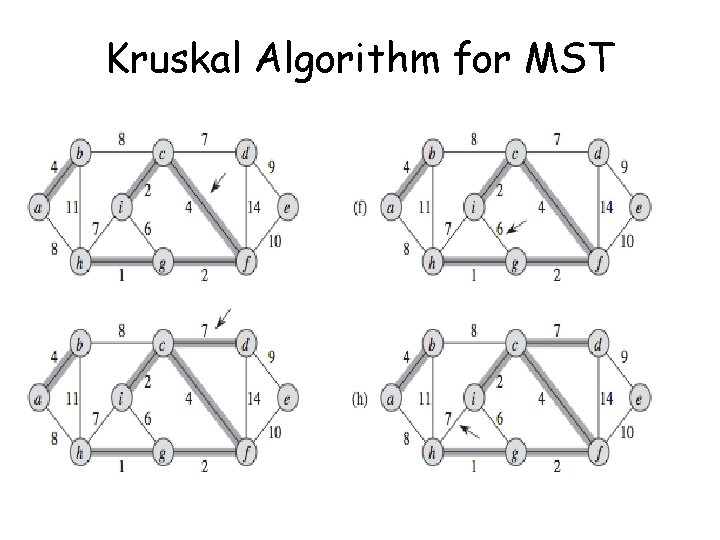
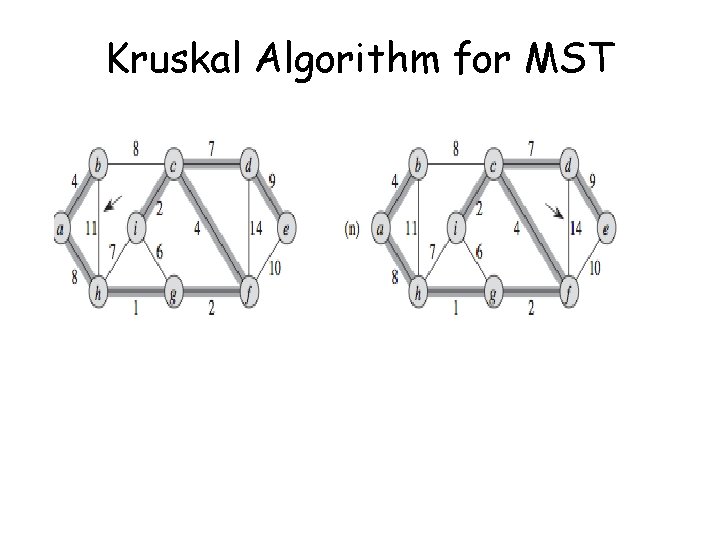
Kruskal Algorithm for MST Uses a disjoint-set data structure to maintain several disjoint sets of elements. FIND-SET(u) returns a representative element of the set containing u. (Disjoint set forest chapter. 21)
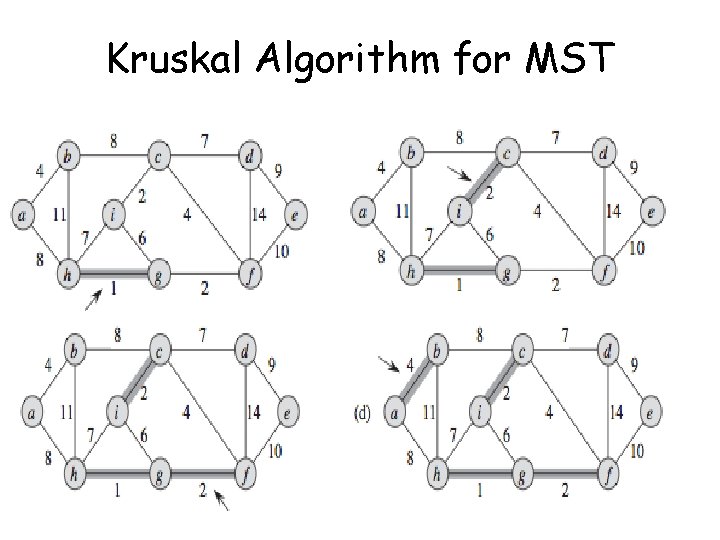
Kruskal Algorithm for MST
Kruskal Algorithm for MST
Kruskal Algorithm for MST
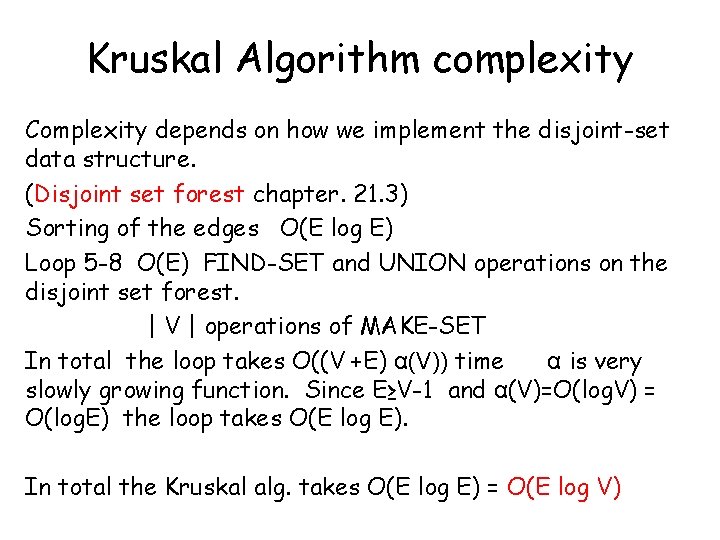
Kruskal Algorithm complexity Complexity depends on how we implement the disjoint-set data structure. (Disjoint set forest chapter. 21. 3) Sorting of the edges O(E log E) Loop 5 -8 O(E) FIND-SET and UNION operations on the disjoint set forest. | V | operations of MAKE-SET In total the loop takes O((V +E) α(V)) time α is very slowly growing function. Since E≥V-1 and α(V)=O(log. V) = O(log. E) the loop takes O(E log E). In total the Kruskal alg. takes O(E log E) = O(E log V)
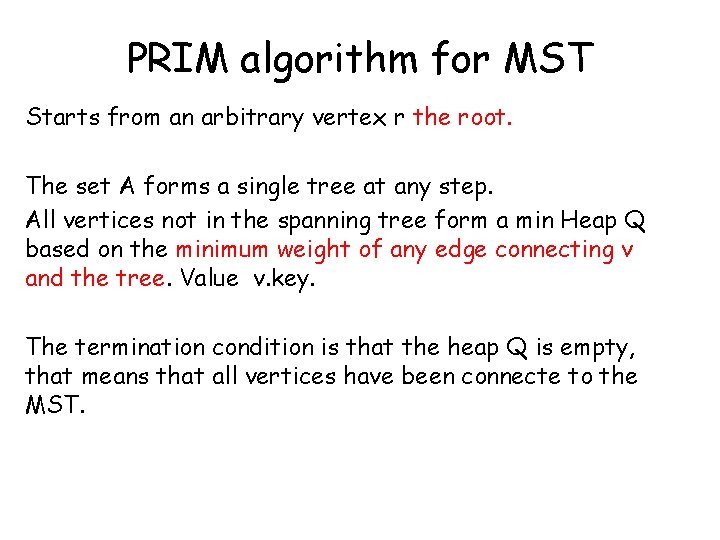
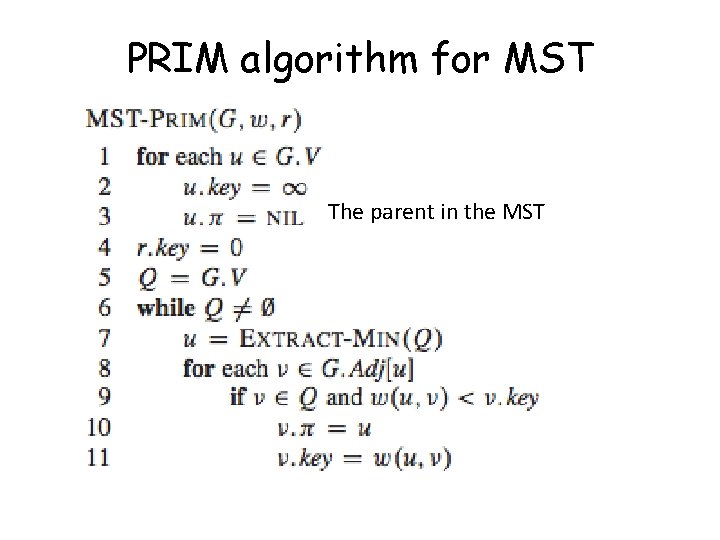
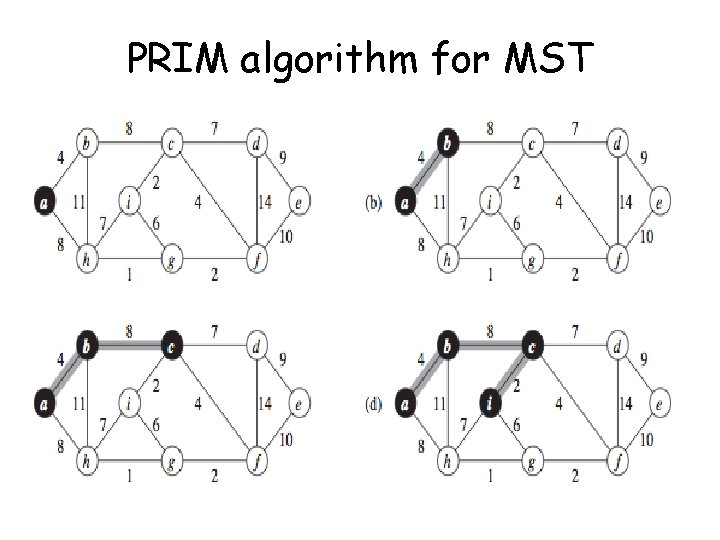
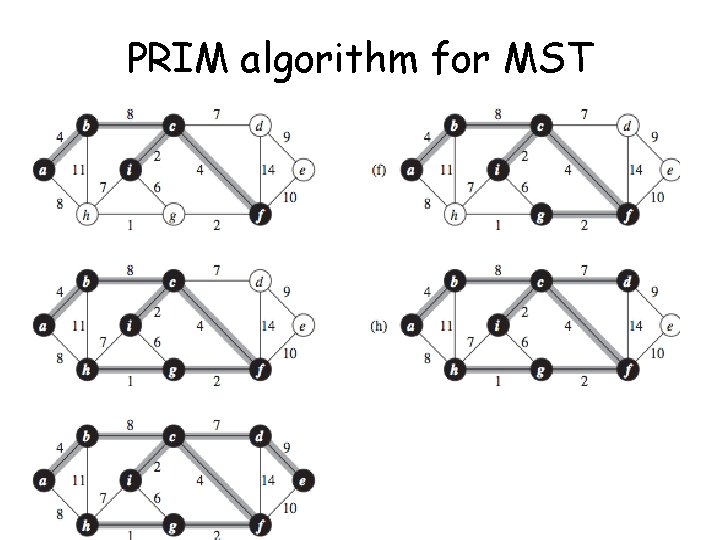
PRIM algorithm for MST Starts from an arbitrary vertex r the root. The set A forms a single tree at any step. All vertices not in the spanning tree form a min Heap Q based on the minimum weight of any edge connecting v and the tree. Value v. key. The termination condition is that the heap Q is empty, that means that all vertices have been connecte to the MST.
PRIM algorithm for MST The parent in the MST
PRIM algorithm for MST
PRIM algorithm for MST
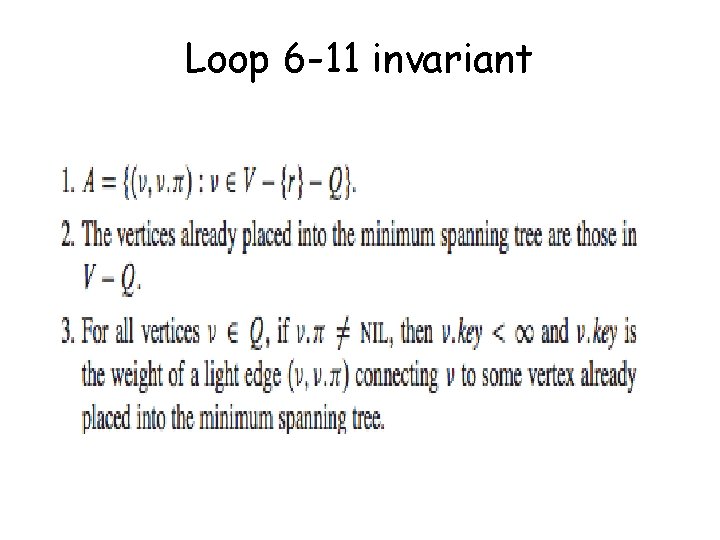
Loop 6 -11 invariant
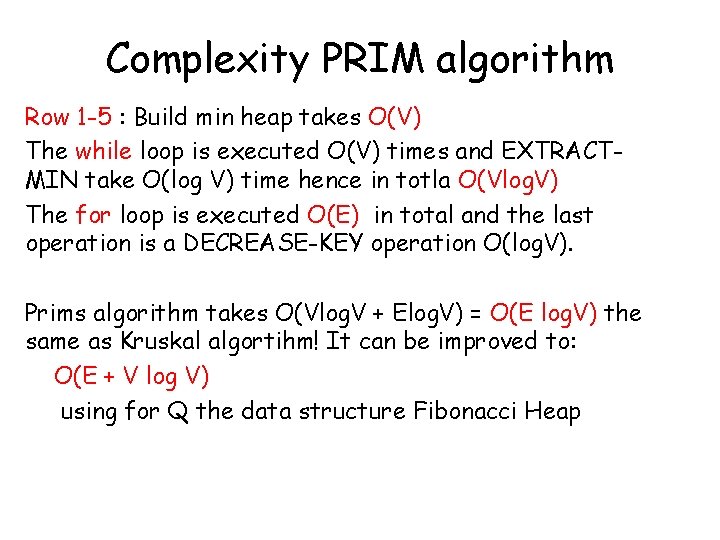
Complexity PRIM algorithm Row 1 -5 : Build min heap takes O(V) The while loop is executed O(V) times and EXTRACTMIN take O(log V) time hence in totla O(Vlog. V) The for loop is executed O(E) in total and the last operation is a DECREASE-KEY operation O(log. V). Prims algorithm takes O(Vlog. V + Elog. V) = O(E log. V) the same as Kruskal algortihm! It can be improved to: O(E + V log V) using for Q the data structure Fibonacci Heap