
MilkovichNewman Compensation Ninth Edition Chapter 8 Mc GrawHillIrwin
- Slides: 40
Milkovich/Newman: Compensation, Ninth Edition Chapter 8 Mc. Graw-Hill/Irwin Designing Pay Levels, Mix, and Pay Structures Copyright © 2008 by The Mc. Graw-Hill Companies, Inc. All rights reserved.
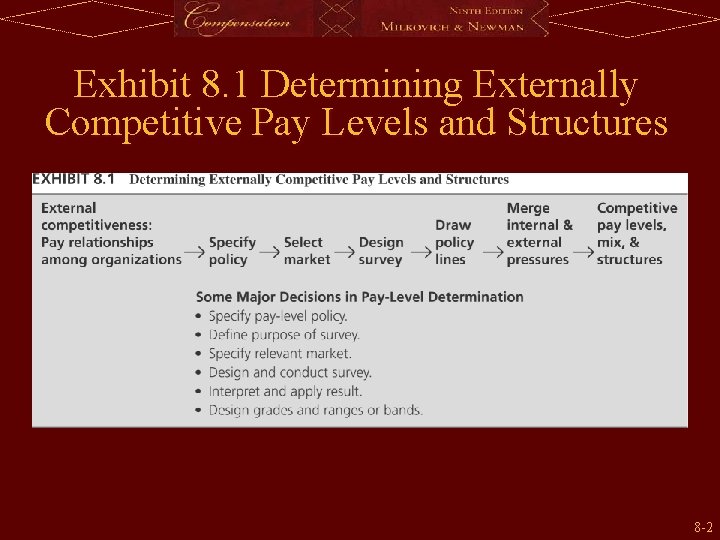
Exhibit 8. 1 Determining Externally Competitive Pay Levels and Structures 8 -2
The Purpose of a Survey Systematic process of collecting and making judgments about compensation paid by other Ers n An employer conducts or participates in a survey for a number of reasons: n – Adjust the pay level in response to changing rates paid by competitors – Set the mix of pay forms relative to that paid by competitors – Establish or price a pay structure – Analyze pay-related problems – Estimate the labor costs of product/service market competitors 8 -3
Select Relevant Market Competitors n Relevant labor market includes employers who compete – For same occupations or skills – For employees in same geographic area – With same products and services 8 -4
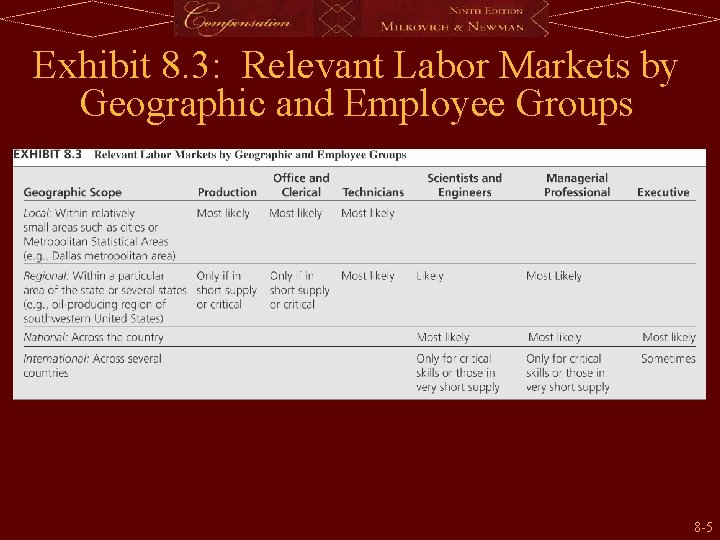
Exhibit 8. 3: Relevant Labor Markets by Geographic and Employee Groups 8 -5
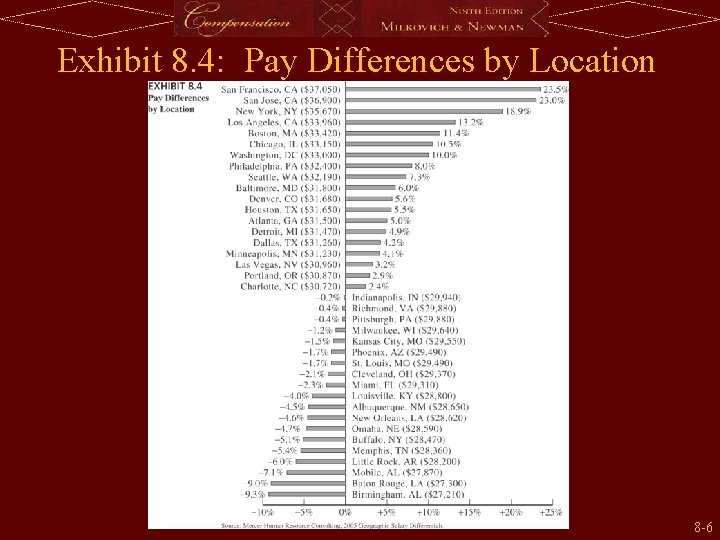
Exhibit 8. 4: Pay Differences by Location 8 -6
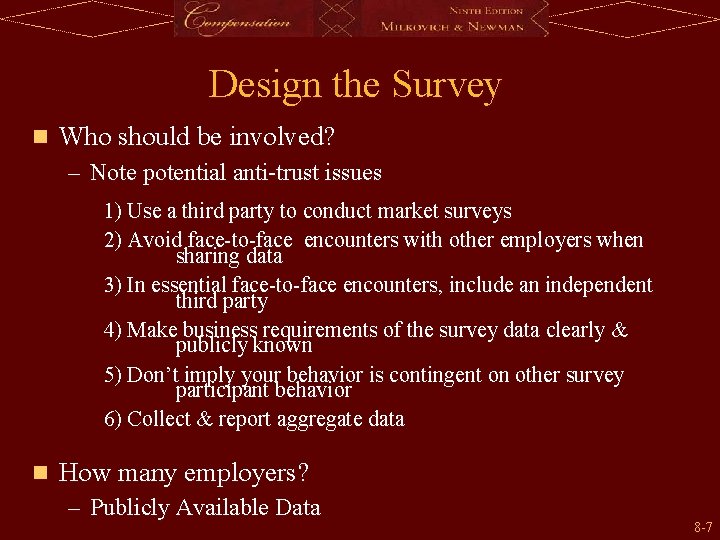
Design the Survey n Who should be involved? – Note potential anti-trust issues 1) Use a third party to conduct market surveys 2) Avoid face-to-face encounters with other employers when sharing data 3) In essential face-to-face encounters, include an independent third party 4) Make business requirements of the survey data clearly & publicly known 5) Don’t imply your behavior is contingent on other survey participant behavior 6) Collect & report aggregate data n How many employers? – Publicly Available Data 8 -7
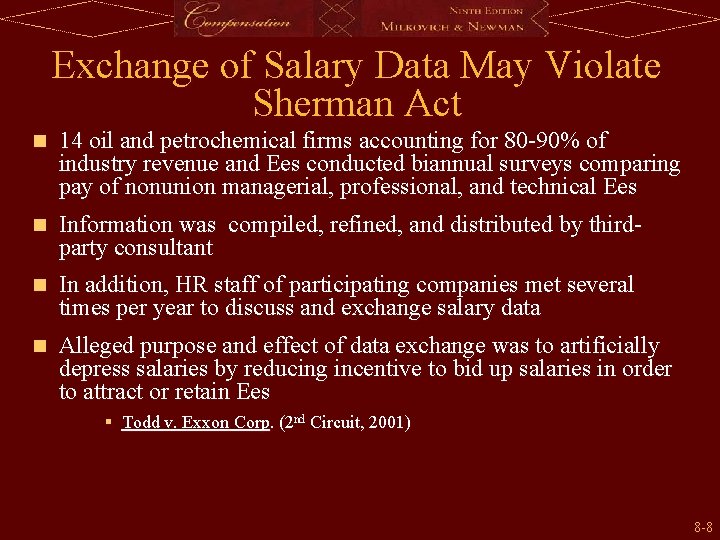
Exchange of Salary Data May Violate Sherman Act n 14 oil and petrochemical firms accounting for 80 -90% of industry revenue and Ees conducted biannual surveys comparing pay of nonunion managerial, professional, and technical Ees n Information was compiled, refined, and distributed by thirdparty consultant n In addition, HR staff of participating companies met several times per year to discuss and exchange salary data n Alleged purpose and effect of data exchange was to artificially depress salaries by reducing incentive to bid up salaries in order to attract or retain Ees § Todd v. Exxon Corp. (2 nd Circuit, 2001) 8 -8
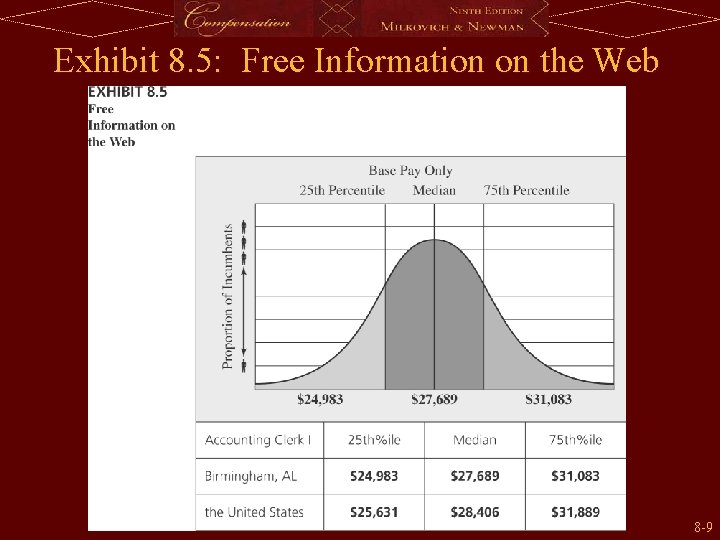
Exhibit 8. 5: Free Information on the Web 8 -9
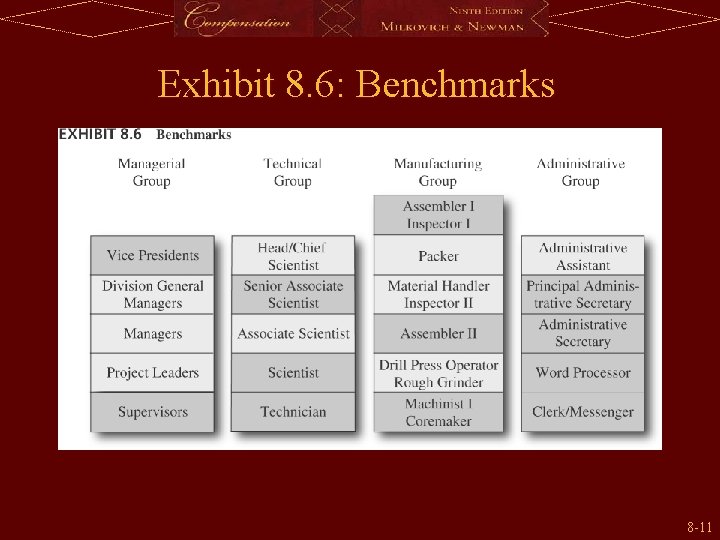
Design the Survey (cont. ) n Which Jobs to include? – Benchmark-job approach § Exhibit 8. 6: Benchmarks 8 -10
Exhibit 8. 6: Benchmarks 8 -11
Design the Survey (cont. ) n What information to collect? – Organization data – Total compensation data 8 -12
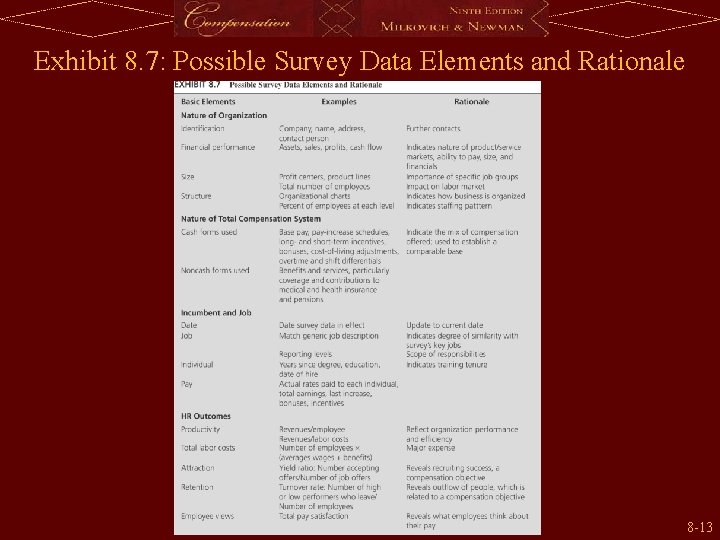
Exhibit 8. 7: Possible Survey Data Elements and Rationale 8 -13
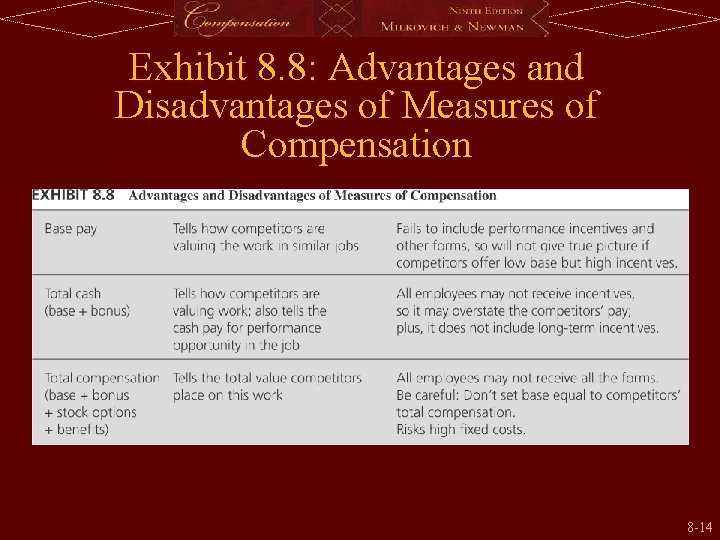
Exhibit 8. 8: Advantages and Disadvantages of Measures of Compensation 8 -14
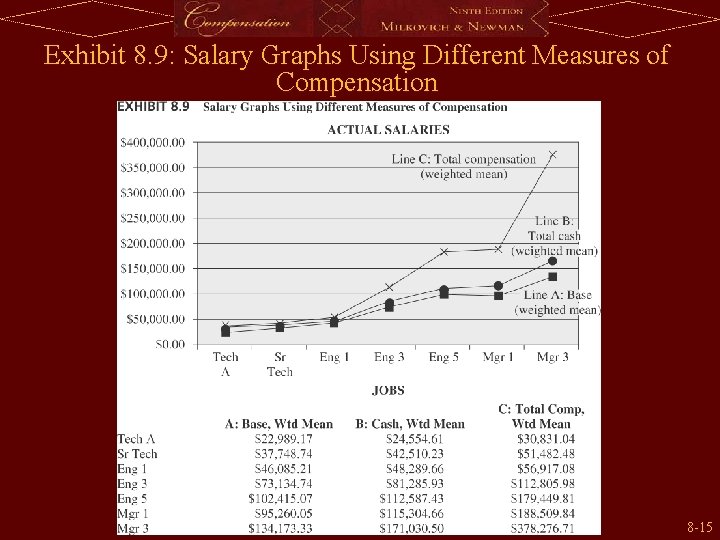
Exhibit 8. 9: Salary Graphs Using Different Measures of Compensation 8 -15
Interpret Survey Results and Construct a Market Line n Verify data – Check accuracy of job matches – Check for anomalies § Does any one company dominate? § Do all employers show similar patterns? § Outliers? 8 -16
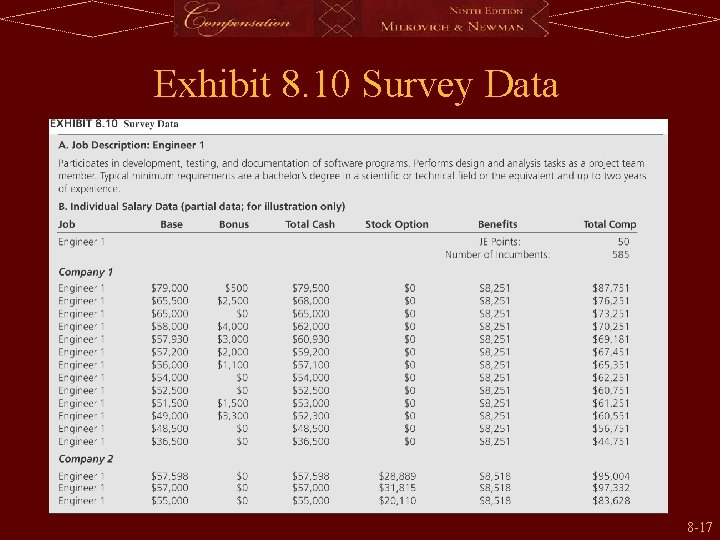
Exhibit 8. 10 Survey Data 8 -17
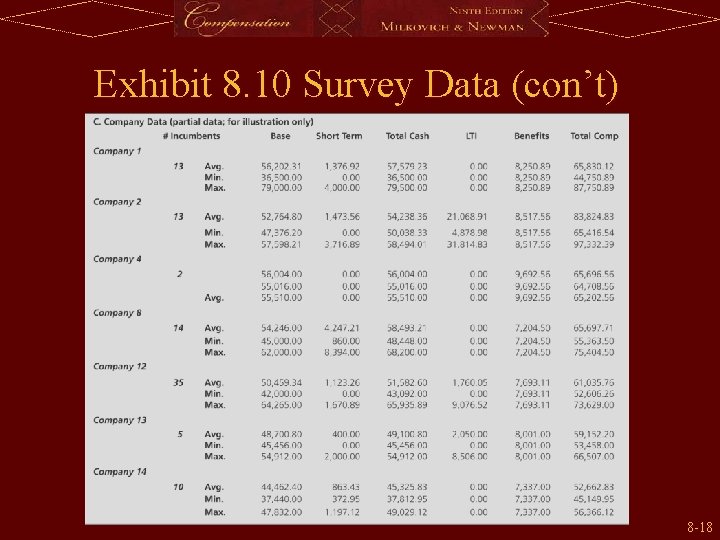
Exhibit 8. 10 Survey Data (con’t) 8 -18
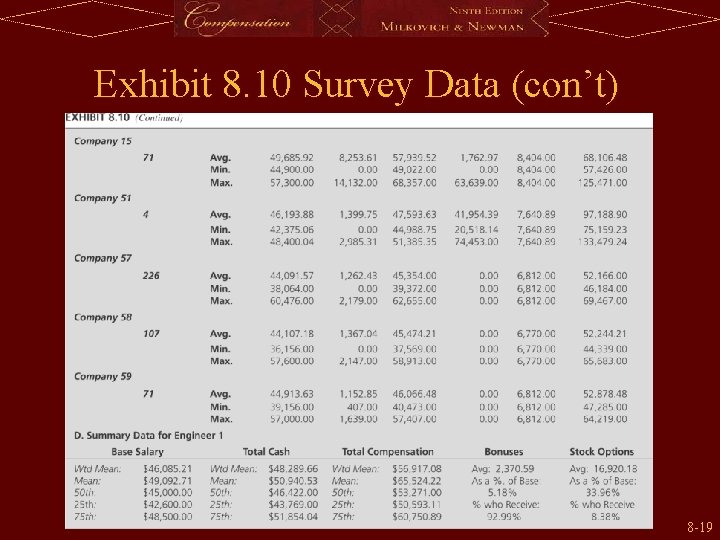
Exhibit 8. 10 Survey Data (con’t) 8 -19
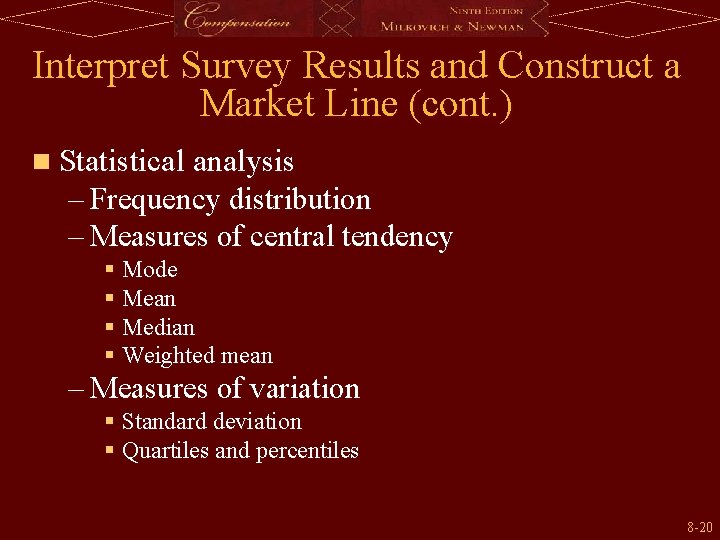
Interpret Survey Results and Construct a Market Line (cont. ) n Statistical analysis – Frequency distribution – Measures of central tendency § Mode § Mean § Median § Weighted mean – Measures of variation § Standard deviation § Quartiles and percentiles 8 -20
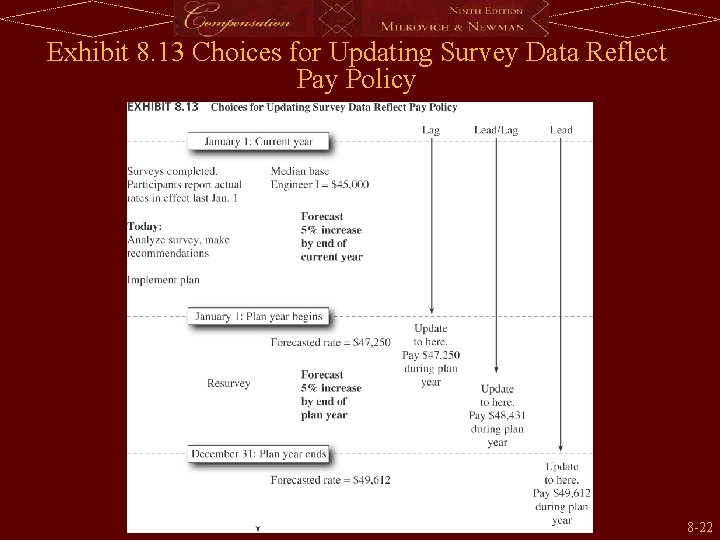
Interpret Survey Results and Construct a Market Line (cont. ) n Update the survey data – Aging or trending : Pay data is updated to forecast the competitive rates for the future date when the pay decisions will be implemented 8 -21
Exhibit 8. 13 Choices for Updating Survey Data Reflect Pay Policy 8 -22
Construct a Market Pay Line n A market line links a company's benchmark jobs on the horizontal axis with market rates paid by competitors on the vertical axis. It summarizes the distribution of going rates paid by competitors in the market n Approaches to constructing a market pay line – Free hand approach – Regression Analysis 8 -23
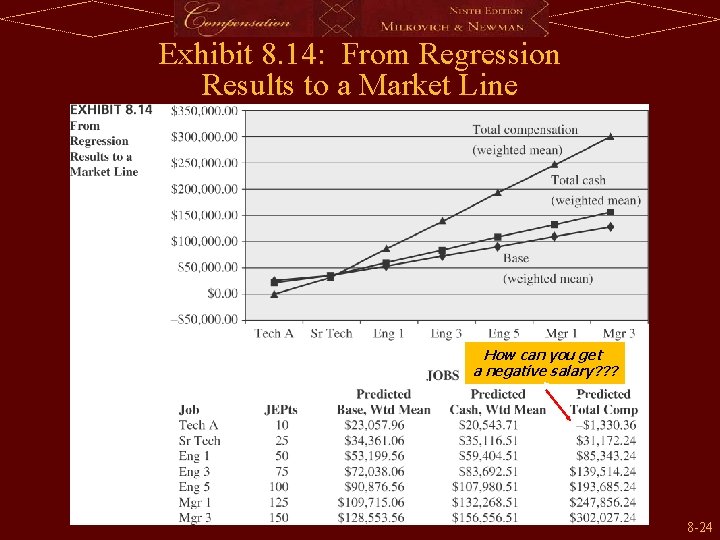
Exhibit 8. 14: From Regression Results to a Market Line How can you get a negative salary? ? ? 8 -24
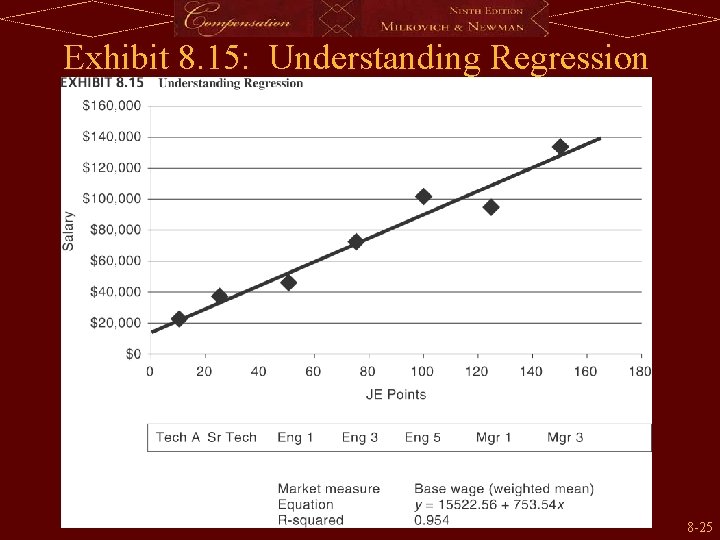
Exhibit 8. 15: Understanding Regression 8 -25
Combine Internal Structure and External Market Rates n Two parts of the total pay model have merged – Internally aligned structure - Horizontal axis – External competitive data - Vertical axis n Two aspects of pay structure – Pay-policy line – Pay ranges 8 -26
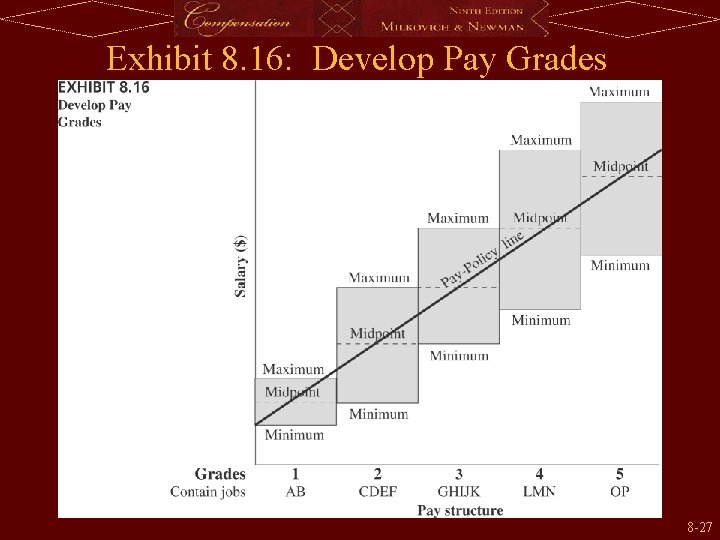
Exhibit 8. 16: Develop Pay Grades 8 -27
From Policy to Practice: The Pay Policy Line n Policy line as percent of market line – Specify a percent above or below market line an employer intends to match – Other options § Lead for some job families and lag for others 8 -28
From Policy to Practice: Grades and Ranges n Why bother with grades and ranges? – Offer flexibility to deal with pressures from external markets and differences among firms n A pay range exists whenever two or more rates are paid to employees in the same job – Recognize individual performance differences with pay – Meet employees' expectations that their pay will increase over time, even in the same job – Encourage employees to remain with the organization 8 -29
From Policy to Practice: Grades and Ranges (cont. ) n Develop grades – Grades enhance an organization's ability to move people among jobs with no change in pay – Each grade will have its own pay range – All the jobs within a single grade will have the same pay range 8 -30
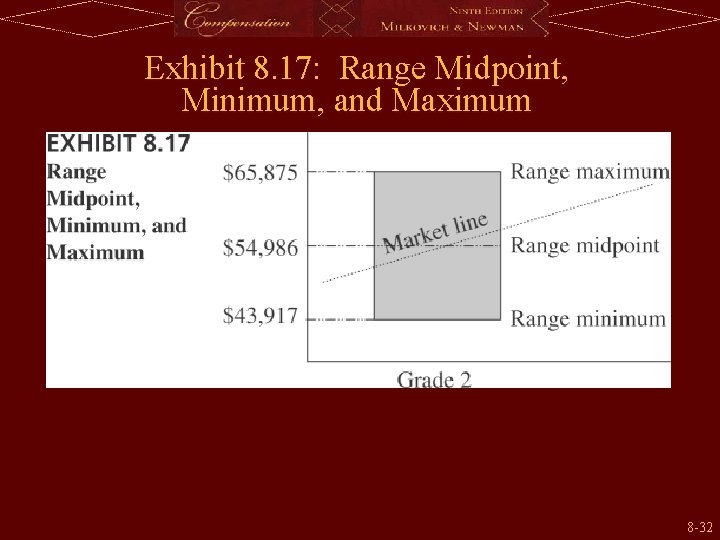
From Policy to Practice: Grades and Ranges (cont. ) n Establish range midpoints, minimums, and maximums – What size should the range be? § Size of range based on judgment about how ranges support – Career paths – Promotions 8 -31
Exhibit 8. 17: Range Midpoint, Minimum, and Maximum 8 -32
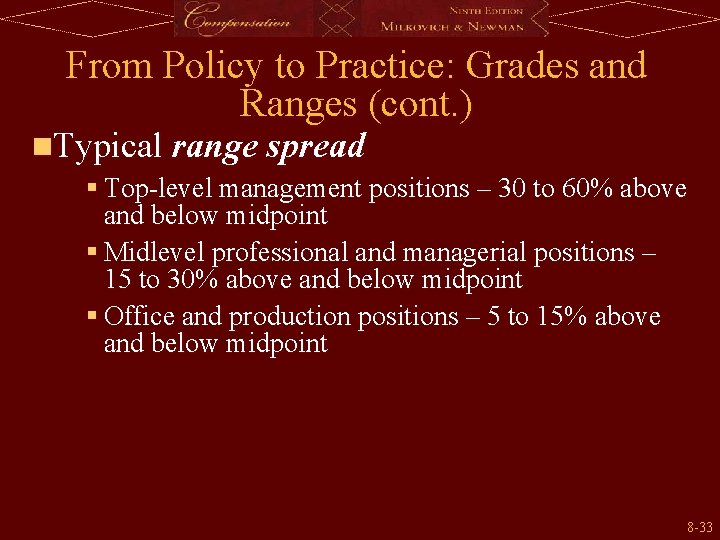
From Policy to Practice: Grades and Ranges (cont. ) n. Typical range spread § Top-level management positions – 30 to 60% above and below midpoint § Midlevel professional and managerial positions – 15 to 30% above and below midpoint § Office and production positions – 5 to 15% above and below midpoint 8 -33
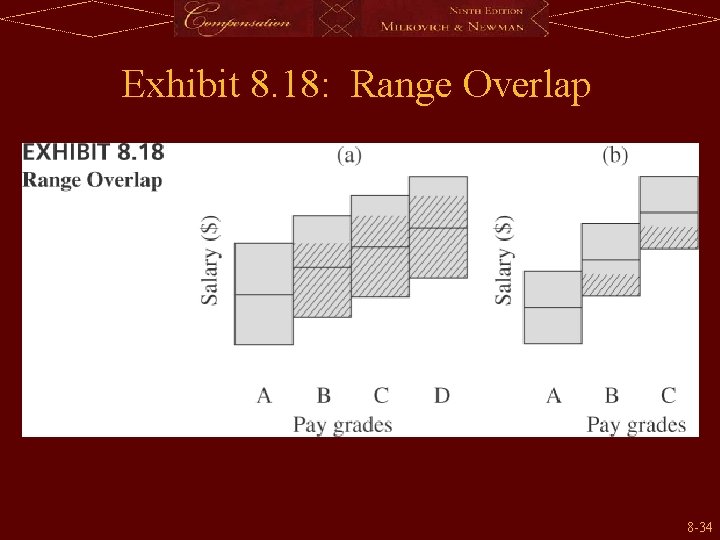
Exhibit 8. 18: Range Overlap 8 -34
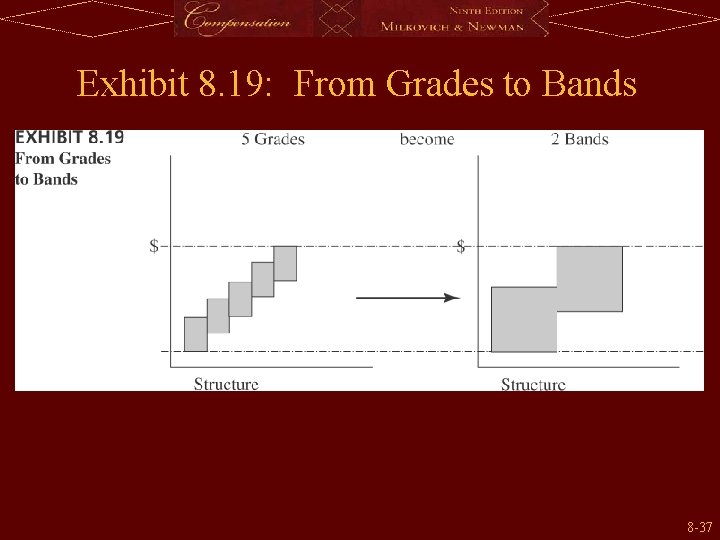
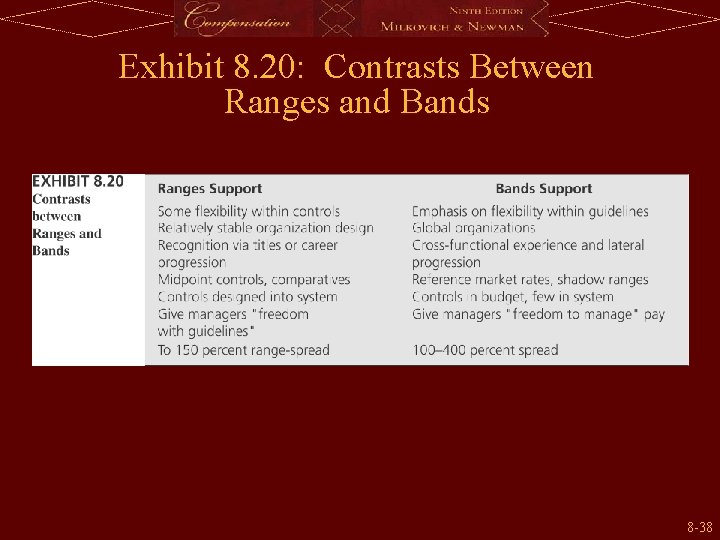
From Policy to Practice: Broad Banding n. Involves collapsing salary grades into a few broad bands, each with a sizable range – One minimum and one maximum – Range midpoint often not used 8 -35
From Policy to Practice: Broad Banding (cont. ) n Purposes – Provide flexibility to define job responsibilities more broadly – Foster cross-functional growth and development – Ease mergers and acquisitions 8 -36
Exhibit 8. 19: From Grades to Bands 8 -37
Exhibit 8. 20: Contrasts Between Ranges and Bands 8 -38
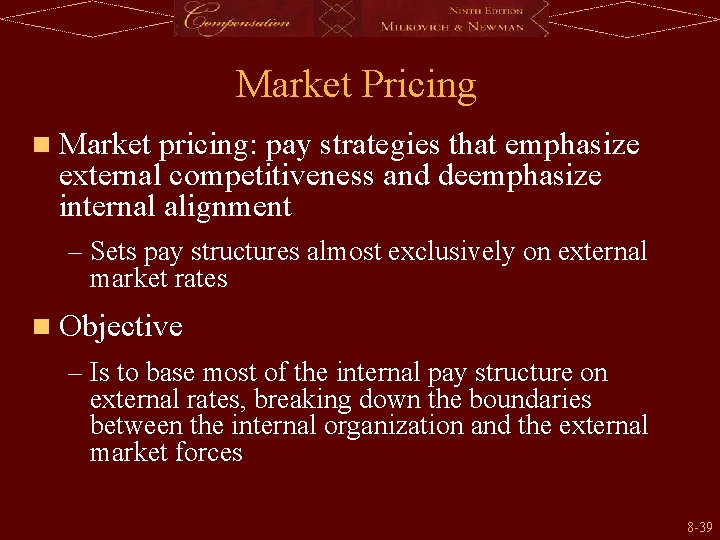
Market Pricing n Market pricing: pay strategies that emphasize external competitiveness and deemphasize internal alignment – Sets pay structures almost exclusively on external market rates n Objective – Is to base most of the internal pay structure on external rates, breaking down the boundaries between the internal organization and the external market forces 8 -39
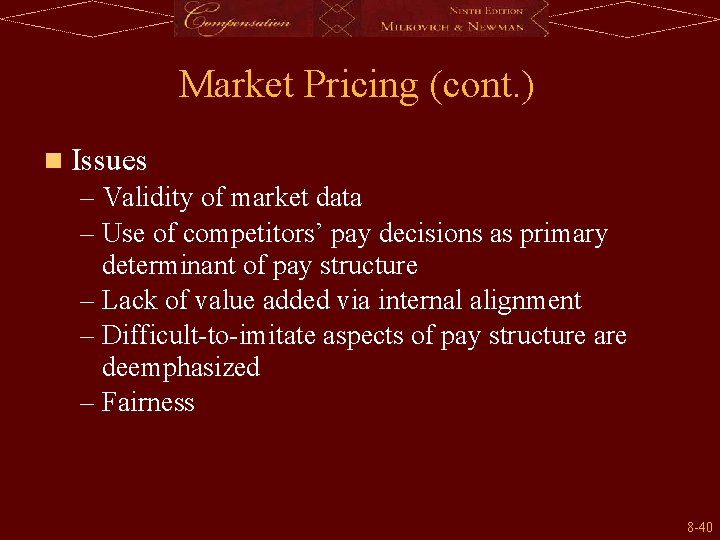
Market Pricing (cont. ) n Issues – Validity of market data – Use of competitors’ pay decisions as primary determinant of pay structure – Lack of value added via internal alignment – Difficult-to-imitate aspects of pay structure are deemphasized – Fairness 8 -40