Metrics for Performance Evaluation Nelson Fonseca State University

- Slides: 22
Metrics for Performance Evaluation Nelson Fonseca State University of Campinas
Metrics • Express how well the systems is operating and achieving its goals, either the system as a whole or specific control mechanisms • Should be measurable • Needs to be relevant to the aimed goals • Can be evaluated either as aggregate or per flow (connection, class) based
Metrics • Most common: – – Delay, jitter Loss rate, loss burst Blocking Probability Troughput, Goodput • Target to specific mechanisms – Response time – Convergence
Delay Retardo, Atraso • Elapsed time between the transmission of the first bit at the source and reception of the last bit of the packet at the destination • Link delay – delay experienced by the packet to go through the link, including queuing delay to have access to the link • End-to-end delay – expresses the delay between two end points that can be between transport level points, IP stations • Round Trip Time (RTT)
Delay Retardo, Atraso • Mean value usually does not express the distribution • Needs to consider index of variation such as percentile
Jitter • Variation between delays experienced • Example the variation in the interarrival times of packet at the destination • Impacts the quality of signal received, specially for real-time applications
Loss Rate Taxa de Perda • Expresses the proportion of packet lost • Most precisely – loss ratio • Loss probability – although used, not exactly correct due to existing correlations in traffic stream
Loss Burst, Gap loss • Number of packet consecutively lost • burst density – fraction of packet in bursts • Duration of burst (mean duration of a burst loss), frequency of burst • Impacts quality of recovered signal • Example: 0. 25 in 100 packets can be distributed one out of four or 25 losses in sequence
Blocking Probability Probabilidade de Bloqueio • Probability of not obtaining what is target at, usually access to a domain • Examples: blocking probability in admission control, in circuit (path) establishment • Can be given in Erlangs
Throughput Vazao • Amount of bits transmitted per unit of time • Includes all bits
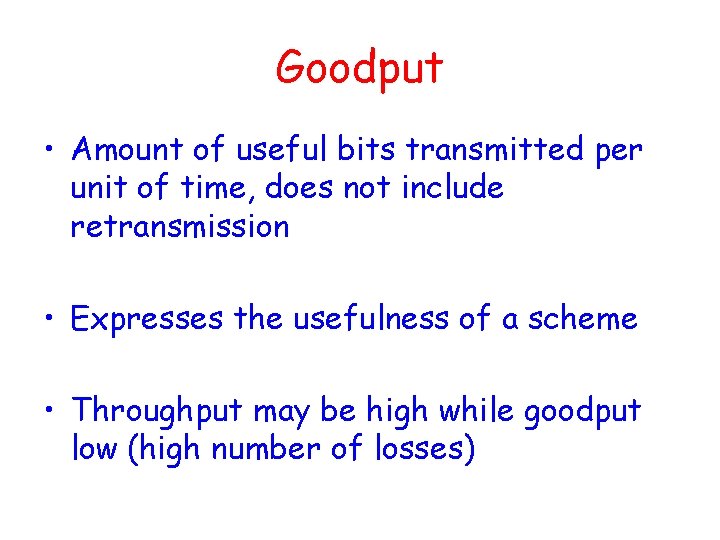
Goodput • Amount of useful bits transmitted per unit of time, does not include retransmission • Expresses the usefulness of a scheme • Throughput may be high while goodput low (high number of losses)
Metrics for evaluation of Congestion Control Mechanisms (currently under definition)
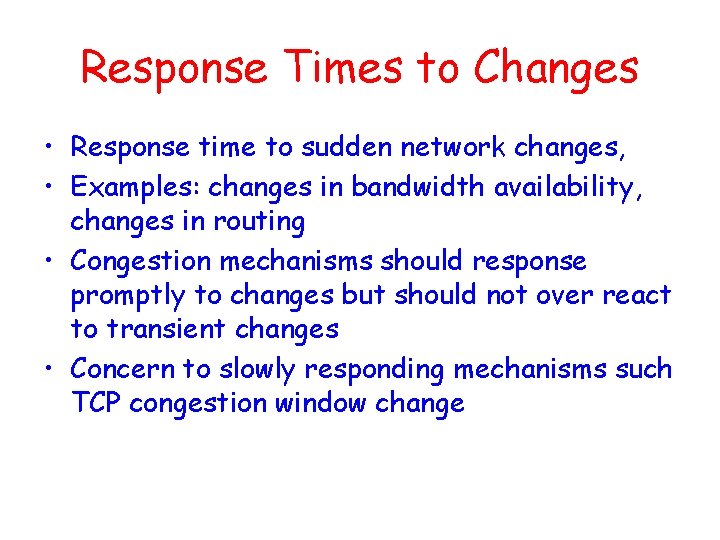
Response Times to Changes • Response time to sudden network changes, • Examples: changes in bandwidth availability, changes in routing • Congestion mechanisms should response promptly to changes but should not over react to transient changes • Concern to slowly responding mechanisms such TCP congestion window change
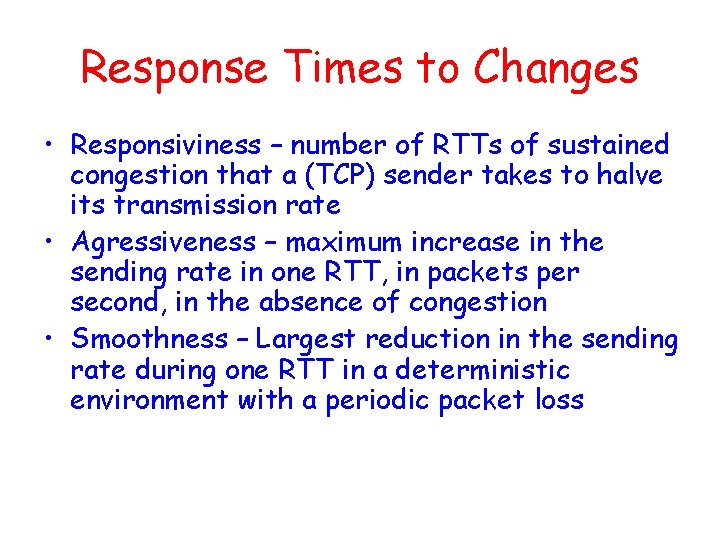
Response Times to Changes • Responsiviness – number of RTTs of sustained congestion that a (TCP) sender takes to halve its transmission rate • Agressiveness – maximum increase in the sending rate in one RTT, in packets per second, in the absence of congestion • Smoothness – Largest reduction in the sending rate during one RTT in a deterministic environment with a periodic packet loss
Oscillation • Stability • Predictibility
Fairness • Among flows of the same protocol and among flows of different protocols – Example: fairness between a novel variant of TCP and TCP Reno • Different indexes of fairness
Fairness • Usually throughput fairness • Flows with different RTT • Flows with different packet size: voice packets and FTP packets
Fairness Index • Max-min fairness: • A network is fair if each node gets the largest possible share that does not impact nodes with lower share. • The smallest throughput should be as large as possible. • Absolute priority to the smallest flows
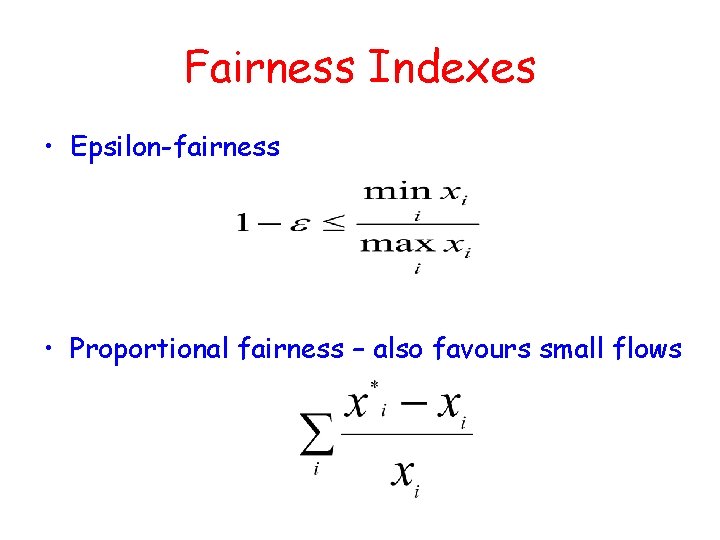
Fairness Indexes • Epsilon-fairness • Proportional fairness – also favours small flows
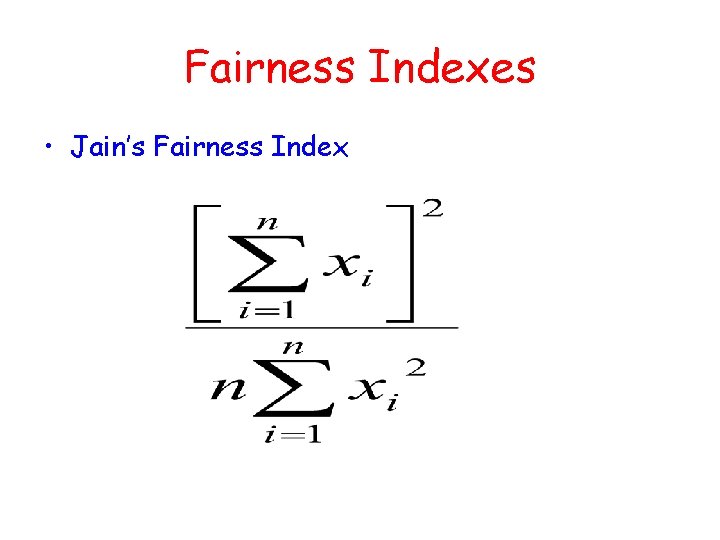
Fairness Indexes • Jain’s Fairness Index
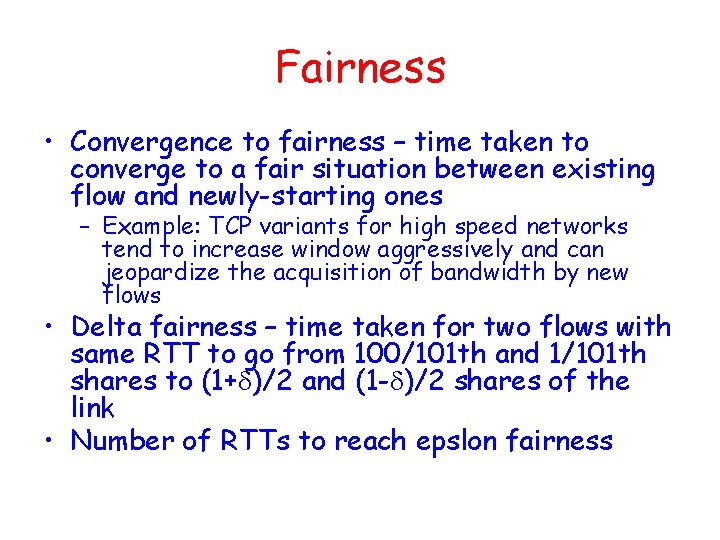
Fairness • Convergence to fairness – time taken to converge to a fair situation between existing flow and newly-starting ones – Example: TCP variants for high speed networks tend to increase window aggressively and can jeopardize the acquisition of bandwidth by new flows • Delta fairness – time taken for two flows with same RTT to go from 100/101 th and 1/101 th shares to (1+d)/2 and (1 -d)/2 shares of the link • Number of RTTs to reach epslon fairness
Deployability • How easy is to deploy a protocol – Overhead in packet header size, – added complexity to routres and endsystems, – complexity of code – Failure diagnosis