Metallic magnetic calorimeters MMC for high resolution xray
- Slides: 9
Metallic magnetic calorimeters (MMC) for high resolution x-ray spectroscopy Loredana GASTALDO, Markus LINCK, Sönke SCHÄFER, Hannes ROTZINGER, Andreas BURCK, Sebastian KEMPF , Jan-Patrick PORST, Andreas FLEISCHMANN, Christian ENSS, George M. SEIDEL
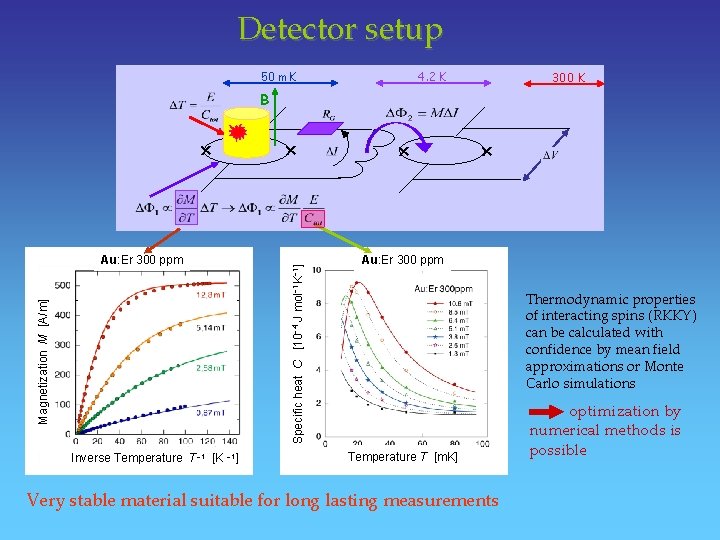
Detector setup 4. 2 K 50 m. K 300 K Magnetization M [A/m] Au: Er 300 ppm Inverse Temperature T 1 [K 1] + + + Specific heat C [10 4 J mol 1 K 1] + B Au: Er 300 ppm Thermodynamic properties of interacting spins (RKKY) can be calculated with confidence by mean field approximations or Monte Carlo simulations Temperature T [m. K] Very stable material suitable for long lasting measurements optimization by numerical methods is possible
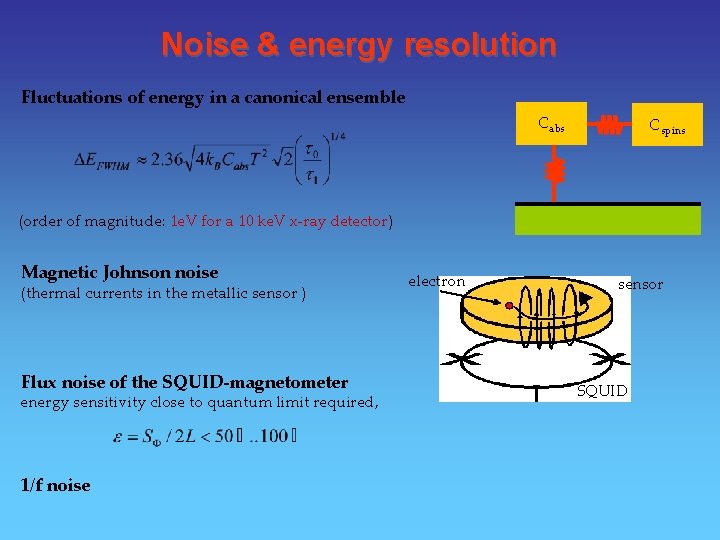
Noise & energy resolution Fluctuations of energy in a canonical ensemble Cabs Cspins (order of magnitude: 1 e. V for a 10 ke. V x-ray detector) Magnetic Johnson noise (thermal currents in the metallic sensor ) Flux noise of the SQUID-magnetometer energy sensitivity close to quantum limit required, 1/f noise electron sensor SQUID
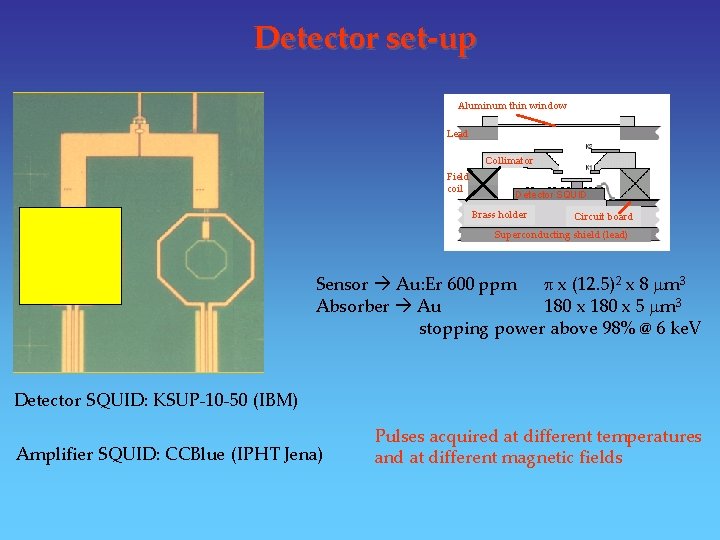
Detector set-up Aluminum thin window Lead Collimator Field coil Detector SQUID Brass holder Circuit board Superconducting shield (lead) Sensor Au: Er 600 ppm x (12. 5)2 x 8 m 3 Absorber Au 180 x 5 m 3 stopping power above 98% @ 6 ke. V Detector SQUID: KSUP-10 -50 (IBM) Amplifier SQUID: CCBlue (IPHT Jena) Pulses acquired at different temperatures and at different magnetic fields
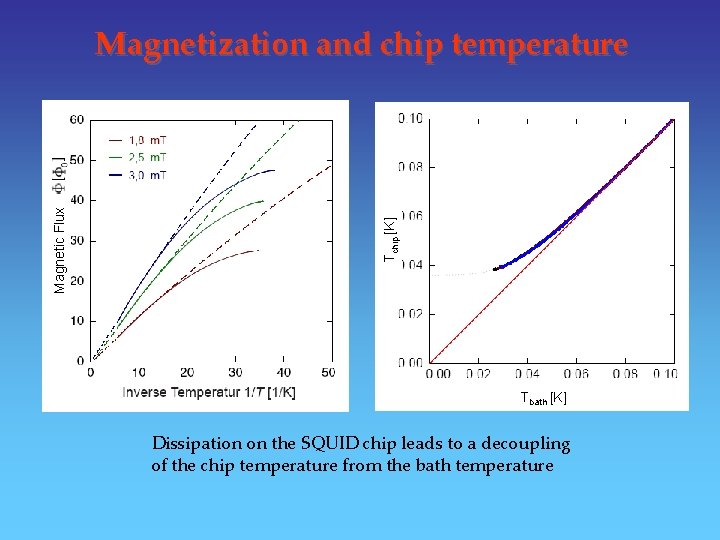
Tchip [K] Magnetic Flux Magnetization and chip temperature Tbath [K] Dissipation on the SQUID chip leads to a decoupling of the chip temperature from the bath temperature
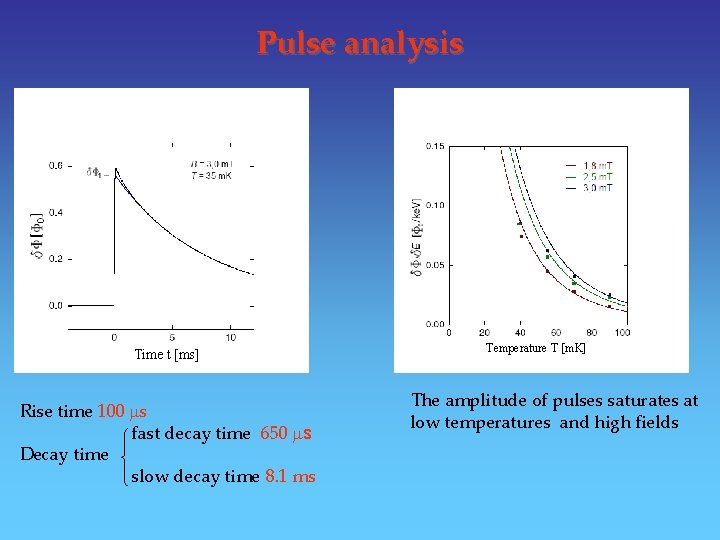
Pulse analysis Time t [ms] Rise time 100 s fast decay time 650 s Decay time slow decay time 8. 1 ms Temperature T [m. K] The amplitude of pulses saturates at low temperatures and high fields
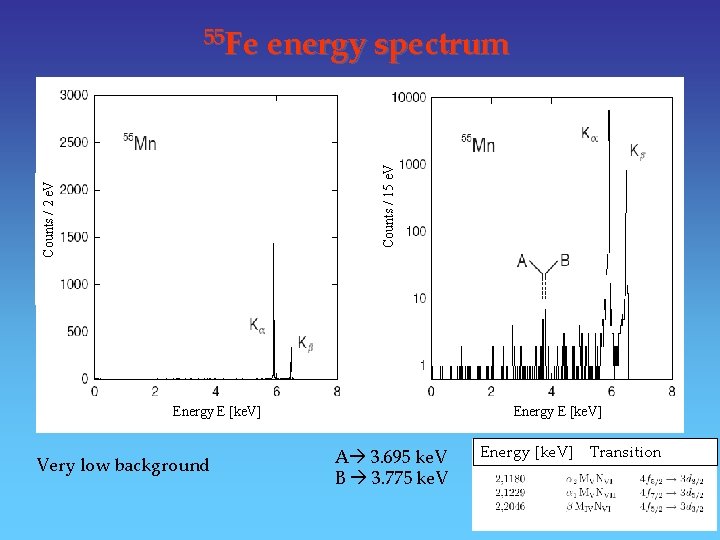
energy spectrum Counts / 2 e. V Counts / 15 e. V 55 Fe Energy E [ke. V] Very low background Energy E [ke. V] A 3. 695 ke. V B 3. 775 ke. V Energy [ke. V] Transition
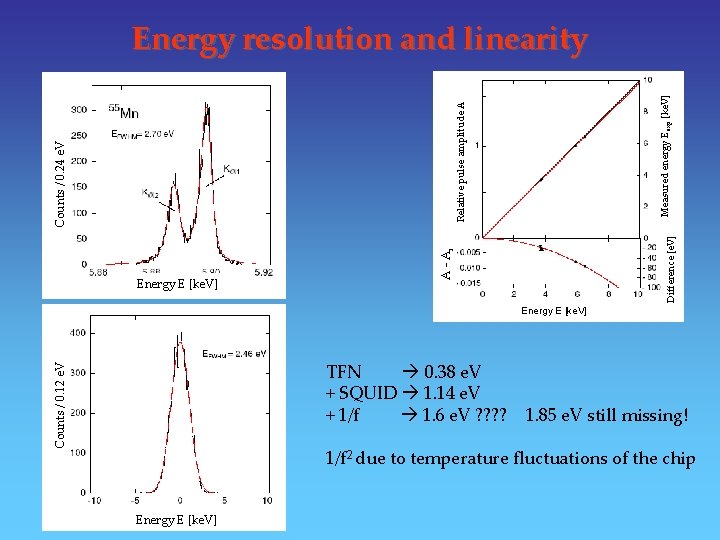
Difference [e. V] Energy E [ke. V] Energy A - Ai Counts / 0. 24 e. V Relative pulse amplitude A Measured energy Eexp [ke. V] Energy resolution and linearity Energy E [ke. V] Counts / 0. 12 e. V TFN 0. 38 e. V + SQUID 1. 14 e. V + 1/f 1. 6 e. V ? ? 1. 85 e. V still missing! 1/f 2 due to temperature fluctuations of the chip Energy E [ke. V]
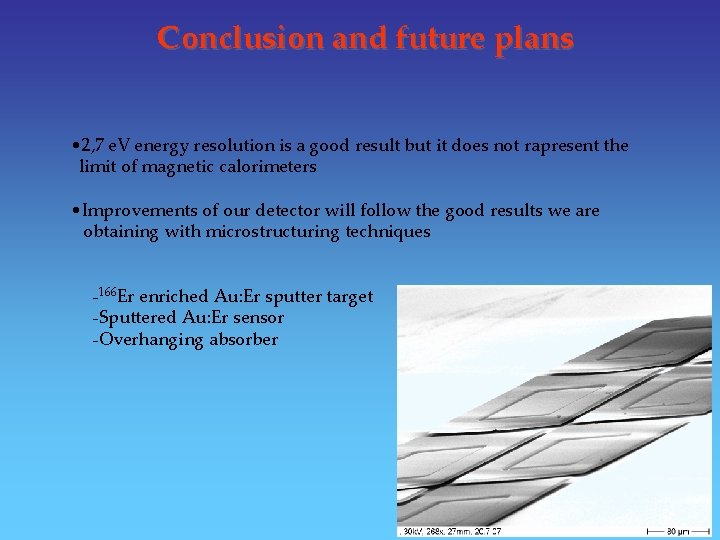
Conclusion and future plans • 2, 7 e. V energy resolution is a good result but it does not rapresent the limit of magnetic calorimeters • Improvements of our detector will follow the good results we are obtaining with microstructuring techniques -166 Er enriched Au: Er sputter target -Sputtered Au: Er sensor -Overhanging absorber