Mercantilism Disclaimer The views expressed are those of
- Slides: 30
Mercantilism Disclaimer: The views expressed are those of the presenters and do not necessarily reflect those of the Federal Reserve Bank of Dallas or the Federal Reserve System.
Feudalism • System of political organization prevailing in Europe from the 9 th to about the 15 th centuries • Relation of lord to vassal • Resulted from isolated areas of control • Inability to create a centralized political or economic structure.
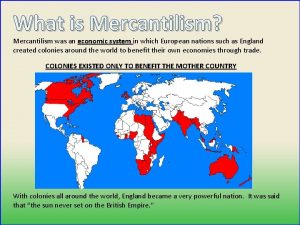
Mercantilism • Economic belief system that served an underlying motivation for military actions Level of gold viewed as fixed Protection of resources/standard of living Zero sum game
Principles of Mercantilism: National Wealth • The economic health or wealth of nation can be measured by the amount of precious metal, gold, or silver it holds. vs. • Productivity and available resources • Investments in – Labor – Infrastructure – Capital goods
Principles of Mercantilism: Trade • A favorable balance of trade is required Purchase of products/resources from external sources allowed specie to leave the country
Principles of Mercantilism: Self-sufficiency • Economic self sufficiency is vital. It demands increasing domestic production, new domestic industry. • Protection for infant industries. – Jefferson vs. Hamilton – North vs. South – Business vs. consumer gains from trade
Principles of Mercantilism: Agriculture • Sufficient agricultural production to support the domestic population. • Agricultural products can be imported but they will be traded for manufactured goods.
Principles of Mercantilism: Tariffs & Subsidies • High on imported manufactured goods. – Republicans from Lincoln forward – Subsidies in the form of land money for infrastructure (railroads) • Low on imported raw materials
Principles of Mercantilism: Ships • Merchant fleet is a necessity to facilitated the flow of goods in and out of a nation. • Naval fleet assures protection of transport. • Focus changes from the protection of resources through military might to protection/ support through regulation
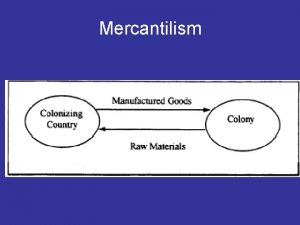
Principles of Mercantilism: Colonization • Provides raw materials necessary to produce manufactured goods. • Provides a constant market for manufactured goods. • Continuing debate on the role of developing nations today
Principles of Mercantilism: Population • Provide a source of labor for domestic production • Provide a source of labor for settlement of colonies • Issue of immigration today
Principles of Mercantilism: Government • Appropriate for the government to be heavily involved in directing economic activity. • change from a military presence to a policy presence which protects economic development
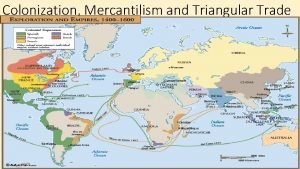
Global Conditions Spain/Portugal 1500’s • • • Portugal rules the high seas Exploration of South America/Mexico Cortes Pizarro Gold/Silver exported to Europe • Elizabeth I – develop navy • Sir Francis Drake • 1580 – Dutch vs. Portugal (trade with Germany)
Characteristics of VOC & East India • Privately held, multinational companies • Guaranteed monopolies in exchange for rights paid to government • Develop trade links – utilized their own ships and military • Development of colonial outposts
Dutch East India Company VCO; Verenigde Oost-indische Compagnie • Took over trade routes from Portugal • Dominated the spice trade throughout the 1600’s and early 1700’s • Sri Lanka (Ceylon), Batavia(Indonesia), Cape Town (Africa) • Sophisticated shipping system • Political and military powers given to companies
Dutch vs. ………. • Anglo-Dutch Wars – 1652 -1654 – 1665 -1667 – 1672 -1674 – 1781 -1784 Dutch had 4, 785 ships East India Company had 2, 690 ships with about 1/5 of the tonnage • Franco-Dutch Wars
Navigation Laws 1600’s • Protect the wealth of the British Empire – profits from shipping – value added to manufactured goods – require all natural/raw resources to be sold to England
Regulating Commerce • Navigation Act 1651 – all crews ½ English, goal to eliminate Dutch competition from colonial trade • Navigation Act 1660 - all colonial trade on English ships, ¾ English • Staple Act 1663 - All goods bound for colonies from Africa, Asia or Europe must first land in England • Plantation Duty Act 1673 – All colonial ship captains to guarantee that they would deliver enumerated goods to England
Regulating Commerce • Navigation Act 1696 – Created admiralty courts to enforce trade regulations and punish smugglers, authority to board ships and search cargo • Woolens Act 1699 – Prohibited colonial export of woolen cloth • Hat Act 1732 – Prohibited export of colonial produced hats • Molasses Act 1733 - All non – English molasses taxed heavily • American Revenue Act (Sugar Act) 1764 – Enforcement of acts to reduce smuggling
Adam Smith 1776 • Corruption inherent in mercantilism was inefficient • To profit from the gains in specialization would require that materials/labor were free to move where they were most effectively utilized
United States • Hamilton Support of policies which would provide the necessary infrastructure to protect industry – Banking, infrastructure, tariffs, subsidies • Jefferson Support of policies which provided for agrarian markets that functioned with minimal government intervention
US Tariffs • 1790’s 15% • 1830’s 60% • 1833 Compromise Tariff of 1833 – Phased out tariffs over 20% over 9 years • 1830 -1860 alliances for legislation – North High tariffs – South Low tariffs – West swing area
England “free trade” • England supported “free trade” beginning in 1840’s • Protection of industry no longer necessary • Gains from “free trade” surpassed those of protectionism
Post Civil War • High tariffs maintained to protect US industry • Mc. Kinley Tariff on tinplate 1890 – No measureable production of tinplate – Tariffs for six years – Domestic production must equal 1/3 of imports – 1910 domestic price of US tinplate were below those produced in UK
Neo-Mercantilism Focus on increasing production, employment, and thus standard of living through trade restrictions and commercial development Significant export industries provide the necessary tools for economic development
International Trade Agreements • GATT -Created in 1948 to promote/ liberalize trade globally • NAFTA – 1994 US/Canada/Mexico – Agricultural support for 10 – 15 years
WTO • Replaced GATT in 1995 as a part of the Marrakesh agreement. • Supported the liberalization of trade and created a forum for enforcement of global trade discussions • Continues the debate over the developmental role of policy to support/detract from growth
Current debate • Developmentalism – Basic unit of the economy is the nation-state – Competition between countries is the central focus – Governments are responsible for facilitating favorable conditions to encourage this.
Current debate • Producerism – Central role of the government is to support the utopia that is created through free trade. – Act to remove barriers to trade and serve as a umpire – Emphasis on protection for small businesses – Creates favoritism and opportunities for political corruption.
Questions ?