Measuring work and economic activity Workshop Title Location



- Slides: 17
Measuring work and economic activity Workshop Title Location and Date WOR
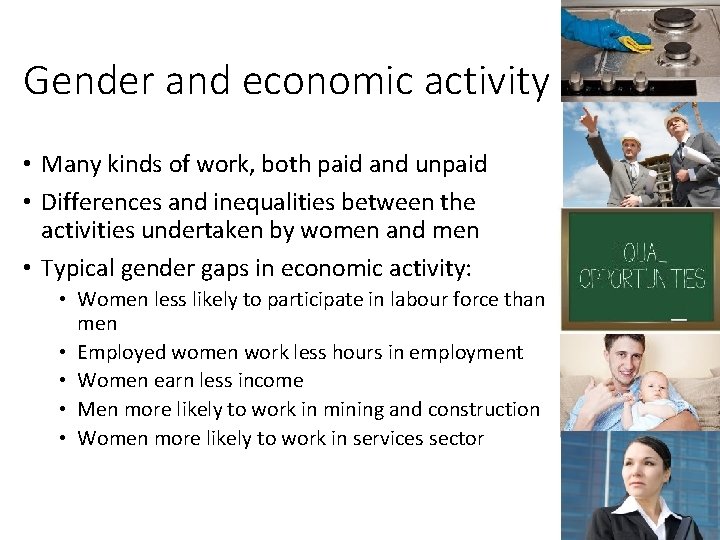
Gender and economic activity • Many kinds of work, both paid and unpaid • Differences and inequalities between the activities undertaken by women and men • Typical gender gaps in economic activity: • Women less likely to participate in labour force than men • Employed women work less hours in employment • Women earn less income • Men more likely to work in mining and construction • Women more likely to work in services sector
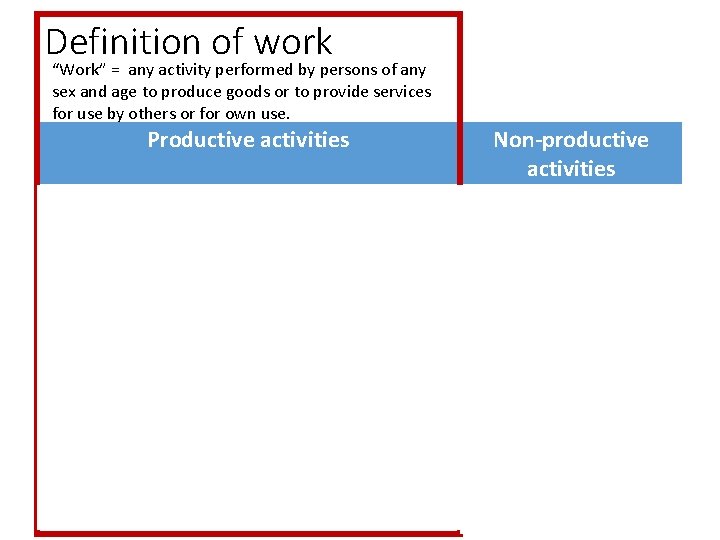
Definition of work “Work” = any activity performed by persons of any sex and age to produce goods or to provide services for use by others or for own use. Productive activities Economic production Non-economic production Producing goods for market Producing services for own -use • e. g. caring for own children, cooking, cleaning, gardening, repairs to house e. g. manufacturing, agriculture, artists Producing services for market government administration, banking, cleaners Producing goods for own-use e. g. growing food for family Non-productive activities For example: • Eating • Sleeping • Watching television • Studying
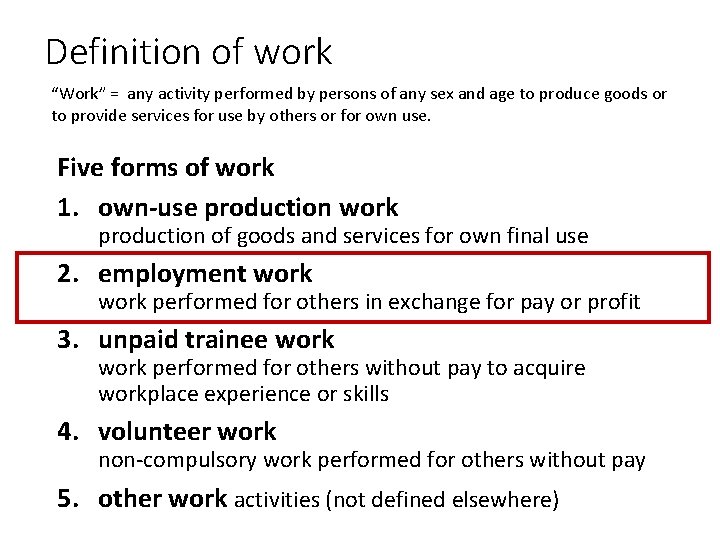
Definition of work “Work” = any activity performed by persons of any sex and age to produce goods or to provide services for use by others or for own use. Five forms of work 1. own-use production work production of goods and services for own final use 2. employment work performed for others in exchange for pay or profit 3. unpaid trainee work performed for others without pay to acquire workplace experience or skills 4. volunteer work non-compulsory work performed for others without pay 5. other work activities (not defined elsewhere)
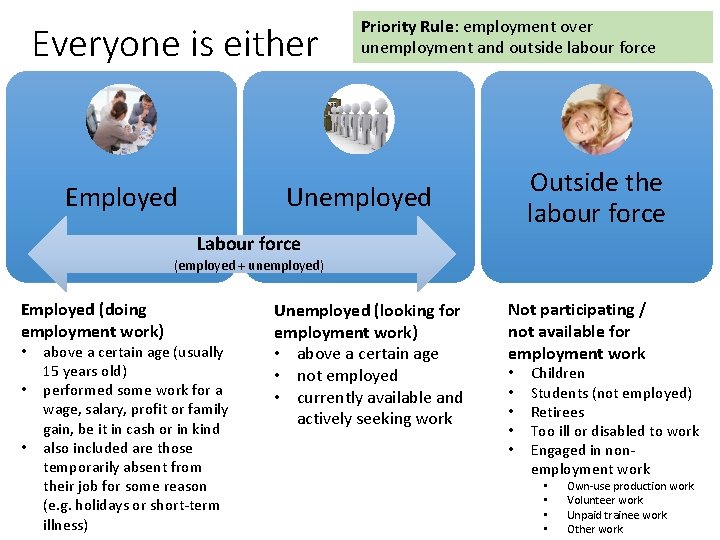
Everyone is either Employed Priority Rule: employment over unemployment and outside labour force Outside the labour force Unemployed Labour force (employed + unemployed) Employed (doing employment work) • • • above a certain age (usually 15 years old) performed some work for a wage, salary, profit or family gain, be it in cash or in kind also included are those temporarily absent from their job for some reason (e. g. holidays or short-term illness) Unemployed (looking for employment work) • above a certain age • not employed • currently available and actively seeking work Not participating / not available for employment work • • • Children Students (not employed) Retirees Too ill or disabled to work Engaged in nonemployment work • • Own-use production work Volunteer work Unpaid trainee work Other work
Employment work Productive activities Economic production Non-economic production Producing goods for market Producing services for own -use • e. g. caring for own children, cooking, cleaning, gardening, repairs to house e. g. manufacturing, agriculture, artists Producing services for market government administration, banking, cleaners Producing goods for own-use e. g. growing food for family Non-productive activities For example: • Eating • Sleeping • Watching television • Studying
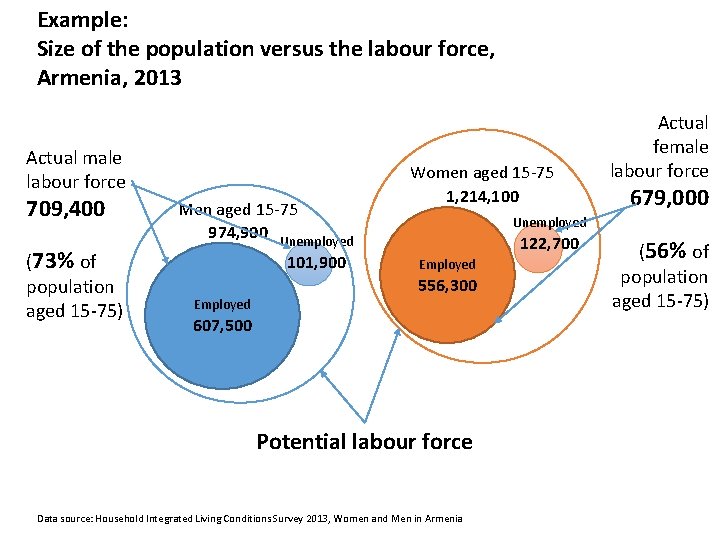
Example: Size of the population versus the labour force, Armenia, 2013 Actual male labour force 709, 400 (73% of population aged 15 -75) Men aged 15 -75 974, 900 Unemployed 101, 900 Women aged 15 -75 1, 214, 100 Actual female labour force 679, 000 Unemployed 122, 700 Employed 556, 300 Employed 607, 500 Potential labour force Data source: Household Integrated Living Conditions Survey 2013, Women and Men in Armenia (56% of population aged 15 -75)
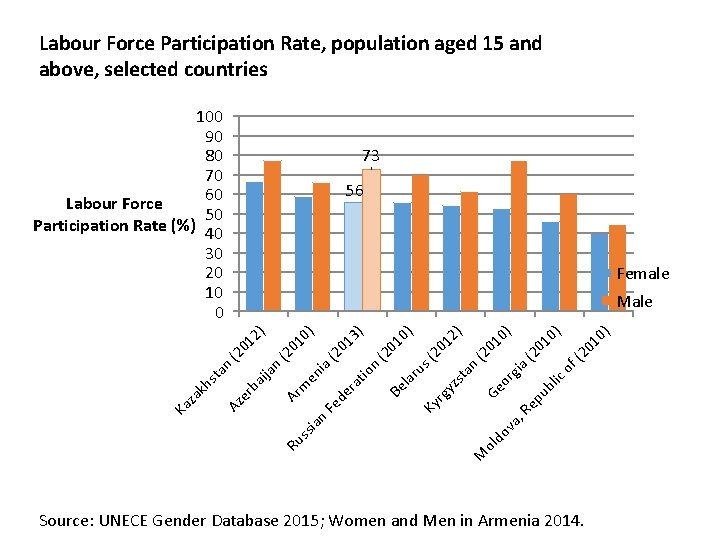
Labour Force Participation Rate, population aged 15 and above, selected countries 100 90 80 70 60 Labour Force 50 Participation Rate (%) 40 30 20 10 0 73 56 Female (2 01 0) 0) 01 ub lic of (2 M ol do va , R ep or gia Ge rg y zs ta n (2 01 0) 01 2) (2 01 0 ru s Ky Fe Ru ss ia n Be la de ra tio n (2 20 ia ( en m Ar ) 13 ) 0) 01 (2 ja n ai er b Az Ka za kh st a n (2 01 2) Male Source: UNECE Gender Database 2015; Women and Men in Armenia 2014.
Everyone is either Employed Priority Rule: employment over unemployment and outside labour force Outside the labour force Unemployed Labour force (employed + unemployed) Employed (doing employment work) • • • above a certain age (usually 15 years old) performed some work for a wage, salary, profit or family gain, be it in cash or in kind also included are those temporarily absent from their job for some reason (e. g. holidays or short-term illness) Unemployed (looking for employment work) • above a certain age • not employed • currently available and actively seeking work Not participating / not available for employment work • • • Children Students (not employed) Retirees Too ill or disabled to work Engaged in nonemployment work • • Own-use production work Volunteer work Unpaid trainee work Other work
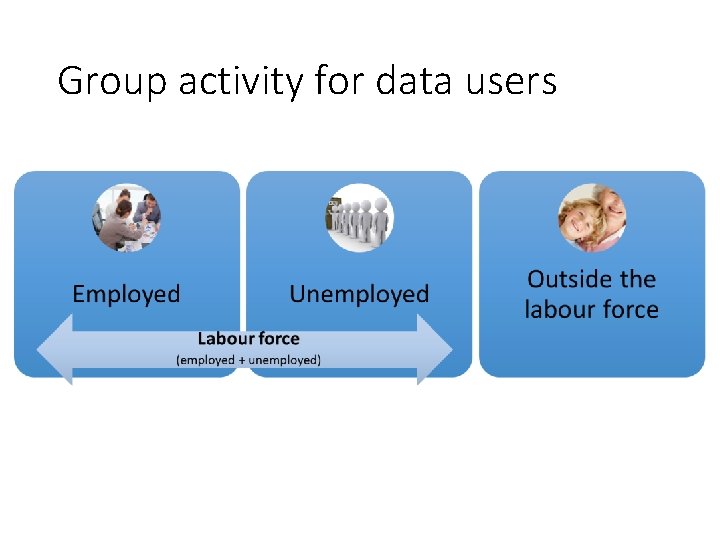
Group activity for data users
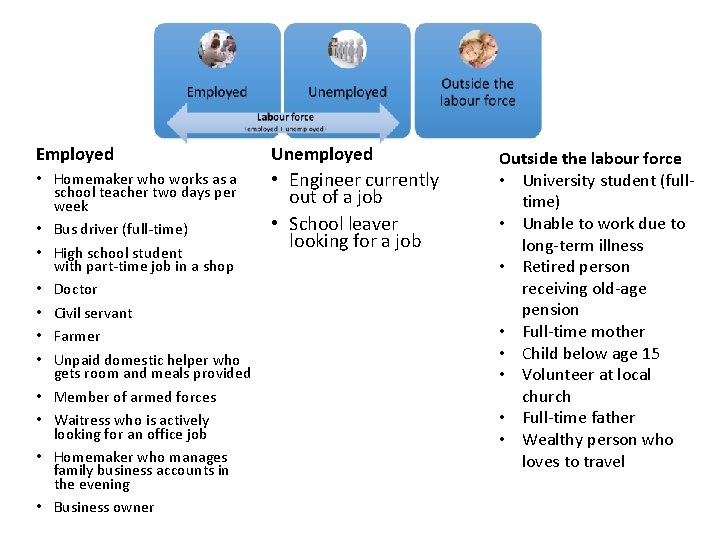
Employed Unemployed • Homemaker who works as a school teacher two days per week • Bus driver (full-time) • High school student with part-time job in a shop • Doctor • Civil servant • Farmer • Unpaid domestic helper who gets room and meals provided • Member of armed forces • Waitress who is actively looking for an office job • Homemaker who manages family business accounts in the evening • Business owner • Engineer currently out of a job • School leaver looking for a job Outside the labour force • University student (fulltime) • Unable to work due to long-term illness • Retired person receiving old-age pension • Full-time mother • Child below age 15 • Volunteer at local church • Full-time father • Wealthy person who loves to travel
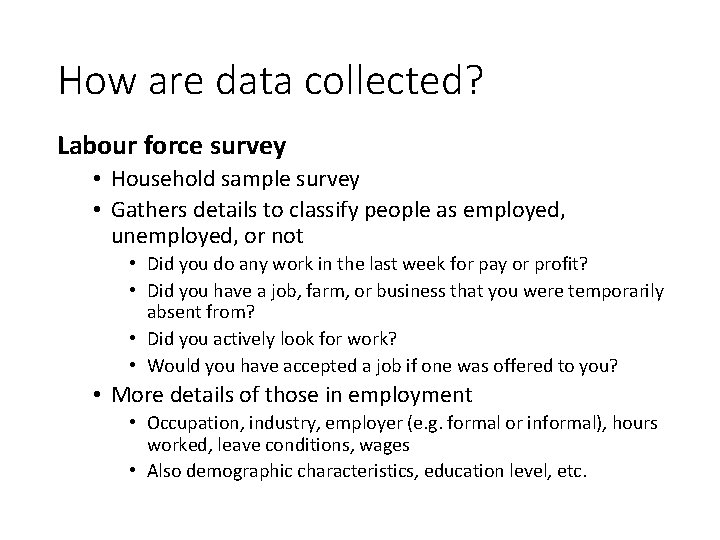
How are data collected? Labour force survey • Household sample survey • Gathers details to classify people as employed, unemployed, or not • Did you do any work in the last week for pay or profit? • Did you have a job, farm, or business that you were temporarily absent from? • Did you actively look for work? • Would you have accepted a job if one was offered to you? • More details of those in employment • Occupation, industry, employer (e. g. formal or informal), hours worked, leave conditions, wages • Also demographic characteristics, education level, etc.
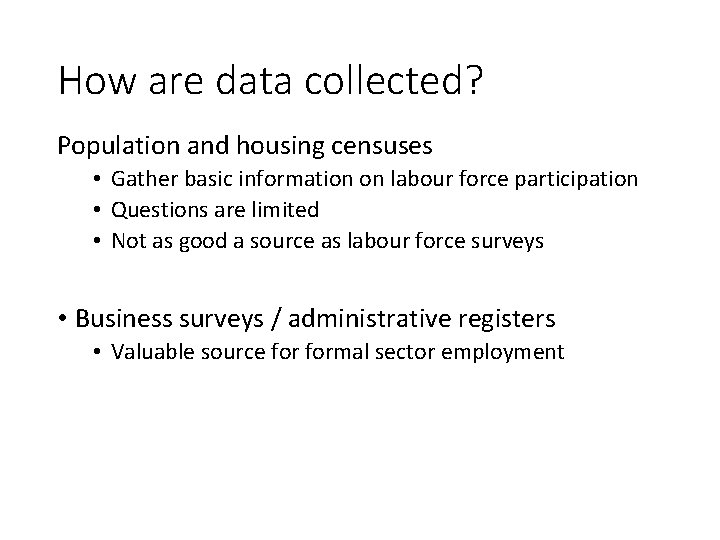
How are data collected? Population and housing censuses • Gather basic information on labour force participation • Questions are limited • Not as good a source as labour force surveys • Business surveys / administrative registers • Valuable source formal sector employment
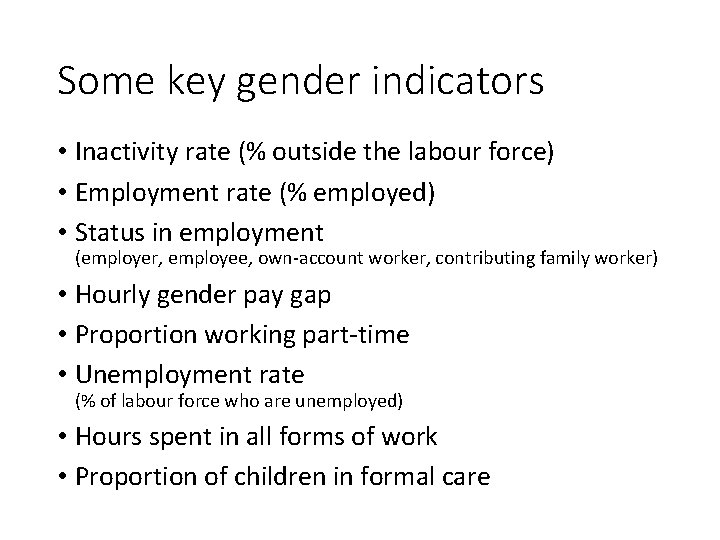
Some key gender indicators • Inactivity rate (% outside the labour force) • Employment rate (% employed) • Status in employment (employer, employee, own-account worker, contributing family worker) • Hourly gender pay gap • Proportion working part-time • Unemployment rate (% of labour force who are unemployed) • Hours spent in all forms of work • Proportion of children in formal care
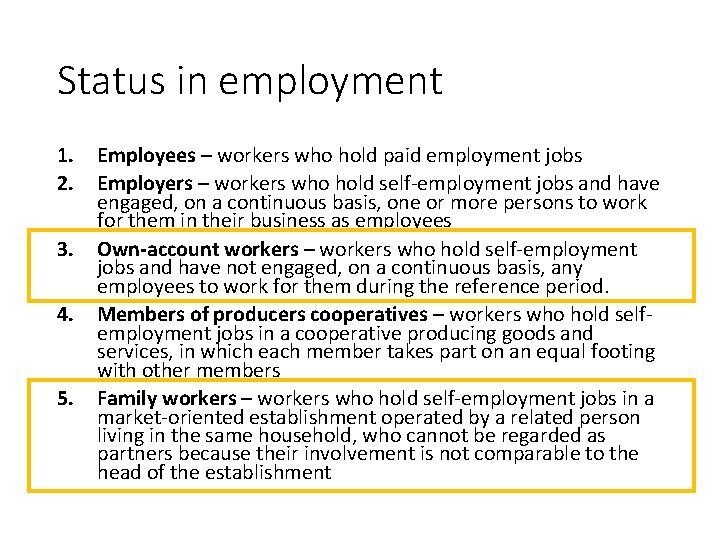
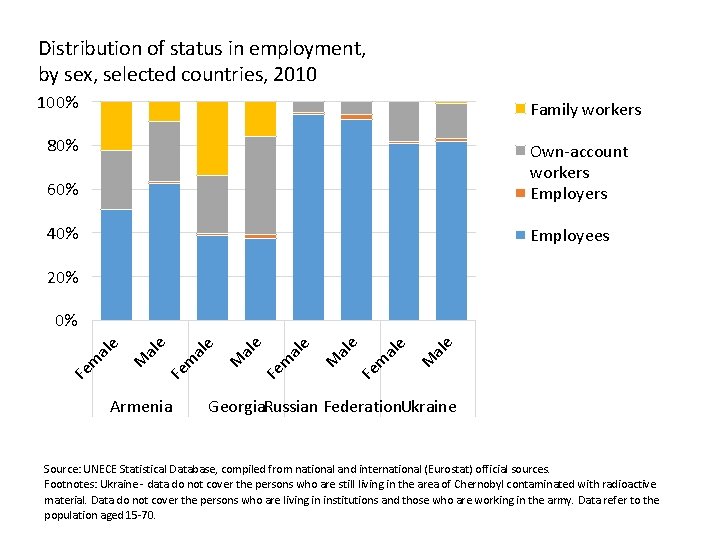
Status in employment 1. 2. 3. 4. 5. Employees – workers who hold paid employment jobs Employers – workers who hold self-employment jobs and have engaged, on a continuous basis, one or more persons to work for them in their business as employees Own-account workers – workers who hold self-employment jobs and have not engaged, on a continuous basis, any employees to work for them during the reference period. Members of producers cooperatives – workers who hold selfemployment jobs in a cooperative producing goods and services, in which each member takes part on an equal footing with other members Family workers – workers who hold self-employment jobs in a market-oriented establishment operated by a related person living in the same household, who cannot be regarded as partners because their involvement is not comparable to the head of the establishment
Distribution of status in employment, by sex, selected countries, 2010 100% Family workers 80% 60% Own-account workers Employers 40% Employees 20% Armenia e M al Fe m al e 0% Georgia. Russian Federation. Ukraine Source: UNECE Statistical Database, compiled from national and international (Eurostat) official sources. Footnotes: Ukraine - data do not cover the persons who are still living in the area of Chernobyl contaminated with radioactive material. Data do not cover the persons who are living in institutions and those who are working in the army. Data refer to the population aged 15 -70.
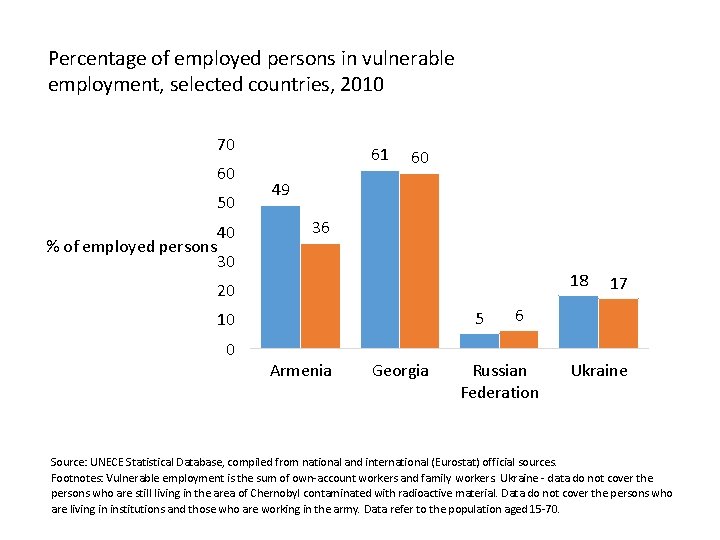
Percentage of employed persons in vulnerable employment, selected countries, 2010 70 60 50 % of employed persons 40 61 60 49 36 30 18 20 5 10 0 Armenia Georgia 17 6 Russian Federation Ukraine Source: UNECE Statistical Database, compiled from national and international (Eurostat) official sources. Footnotes: Vulnerable employment is the sum of own-account workers and family workers. Ukraine - data do not cover the persons who are still living in the area of Chernobyl contaminated with radioactive material. Data do not cover the persons who are living in institutions and those who are working in the army. Data refer to the population aged 15 -70.