Mc Kinsey Co Managing Knowledge and Learning Mckinsey


- Slides: 15
Mc. Kinsey & Co. Managing Knowledge and Learning
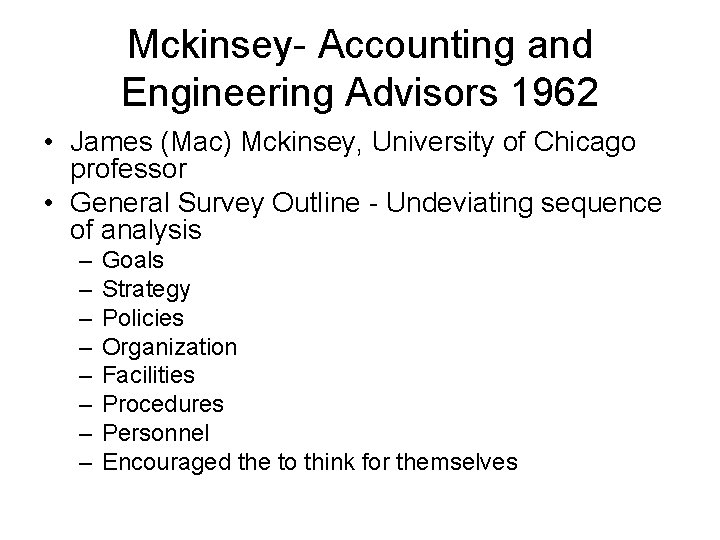
Mckinsey- Accounting and Engineering Advisors 1962 • James (Mac) Mckinsey, University of Chicago professor • General Survey Outline - Undeviating sequence of analysis – – – – Goals Strategy Policies Organization Facilities Procedures Personnel Encouraged the to think for themselves
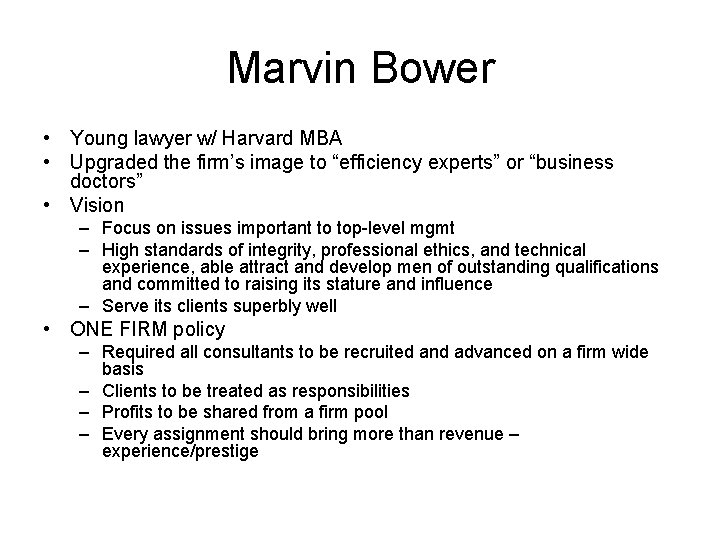
Marvin Bower • Young lawyer w/ Harvard MBA • Upgraded the firm’s image to “efficiency experts” or “business doctors” • Vision – Focus on issues important to top-level mgmt – High standards of integrity, professional ethics, and technical experience, able attract and develop men of outstanding qualifications and committed to raising its stature and influence – Serve its clients superbly well • ONE FIRM policy – Required all consultants to be recruited and advanced on a firm wide basis – Clients to be treated as responsibilities – Profits to be shared from a firm pool – Every assignment should bring more than revenue – experience/prestige
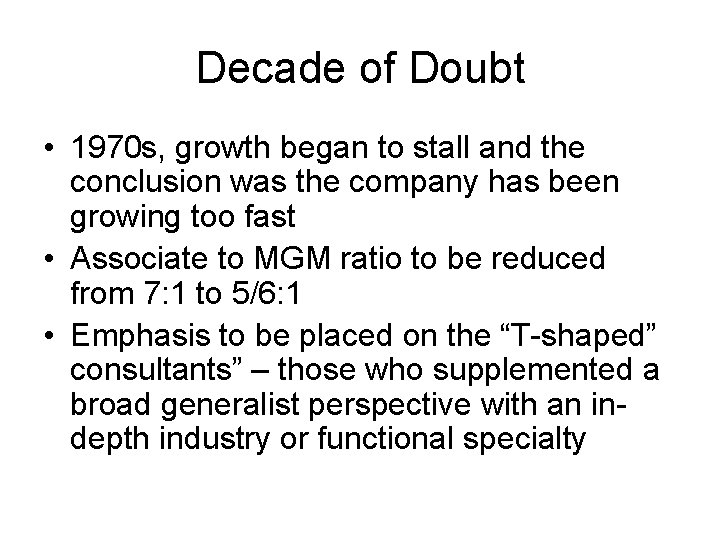
Decade of Doubt • 1970 s, growth began to stall and the conclusion was the company has been growing too fast • Associate to MGM ratio to be reduced from 7: 1 to 5/6: 1 • Emphasis to be placed on the “T-shaped” consultants” – those who supplemented a broad generalist perspective with an indepth industry or functional specialty
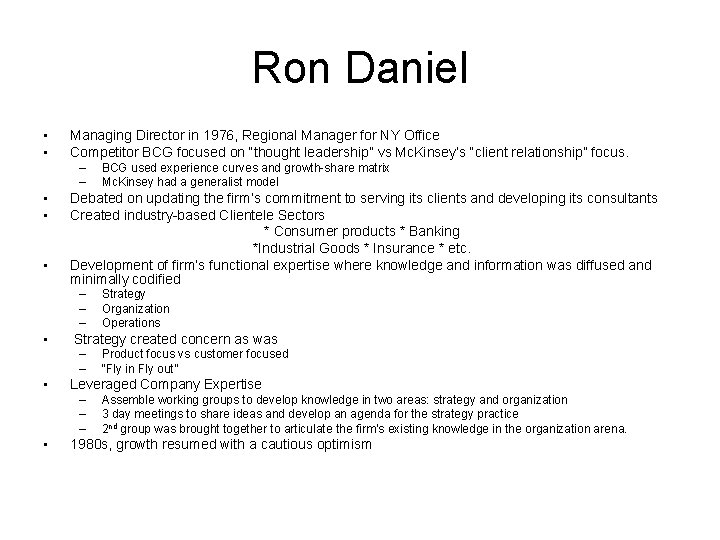
Ron Daniel • • Managing Director in 1976, Regional Manager for NY Office Competitor BCG focused on “thought leadership” vs Mc. Kinsey’s “client relationship” focus. – – • • • Debated on updating the firm’s commitment to serving its clients and developing its consultants Created industry-based Clientele Sectors * Consumer products * Banking *Industrial Goods * Insurance * etc. Development of firm’s functional expertise where knowledge and information was diffused and minimally codified – – – • Product focus vs customer focused “Fly in Fly out” Leveraged Company Expertise – – – • Strategy Organization Operations Strategy created concern as was – – • BCG used experience curves and growth-share matrix Mc. Kinsey had a generalist model Assemble working groups to develop knowledge in two areas: strategy and organization 3 day meetings to share ideas and develop an agenda for the strategy practice 2 nd group was brought together to articulate the firm’s existing knowledge in the organization arena. 1980 s, growth resumed with a cautious optimism
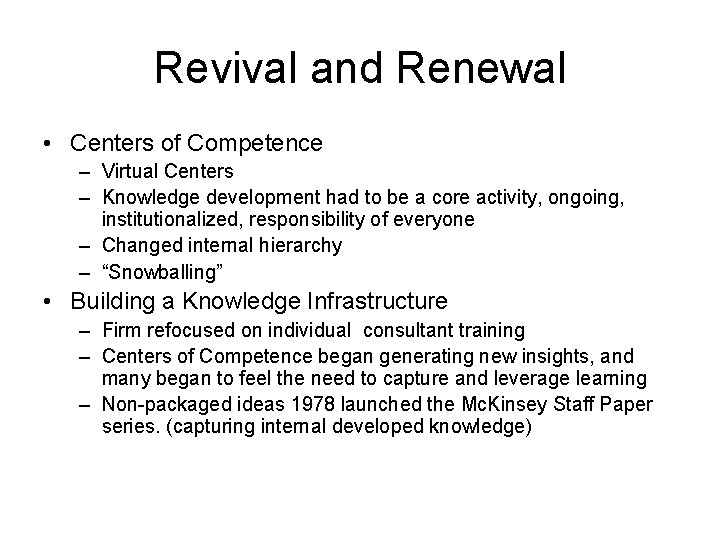
Revival and Renewal • Centers of Competence – Virtual Centers – Knowledge development had to be a core activity, ongoing, institutionalized, responsibility of everyone – Changed internal hierarchy – “Snowballing” • Building a Knowledge Infrastructure – Firm refocused on individual consultant training – Centers of Competence began generating new insights, and many began to feel the need to capture and leverage learning – Non-packaged ideas 1978 launched the Mc. Kinsey Staff Paper series. (capturing internal developed knowledge)
Knowledge Management • 1987, Fred Gluck (managed the super group) launched a Knowledge Management Project. 3 recommendations were made: – Firm had to make a major commitment to build a common database of knowledge accumulated from client work – Ensure databases were maintained and used. Hire fulltime practice coordinator. – Firm expand its hiring practices and promotion policies to create a career path for deep functional specialist “I” vs “T” shaped
Bill Matassoni • Firm’s Director of Communications • Brook Manville, Yale Ph. D teamed to implement Knowledge Management – First focused on FPIS, Firm Practice Information System • Installed new systems and procedures to make data more complete, accurate, and timely, not just an archival record – Practice Development Network(PDNet) – Knowledge Resource Directory (KRD) Assembled a listing of all firm experts and key document titles by practice area and published it in a small book. • Reflection: the infrastructure changes was not to create a new Mc. Kinsey, as to keep the old”one firm” concept as they grew
Managing Success • Clientele and Professional Development Committee – Objective of replacing the leader-driven knowledge creation and dissemination process with a “steward model” of self-governing practices focused on competence building. • Engagement Team – Assembled to deliver a three or four month assignment for a client – Highly efficient and Flexible unit – Focused on immediate task rather than long term need • Client Service Team – Add long term value – Increase the effectiveness of individual engagements • Develop Multiple Career Paths
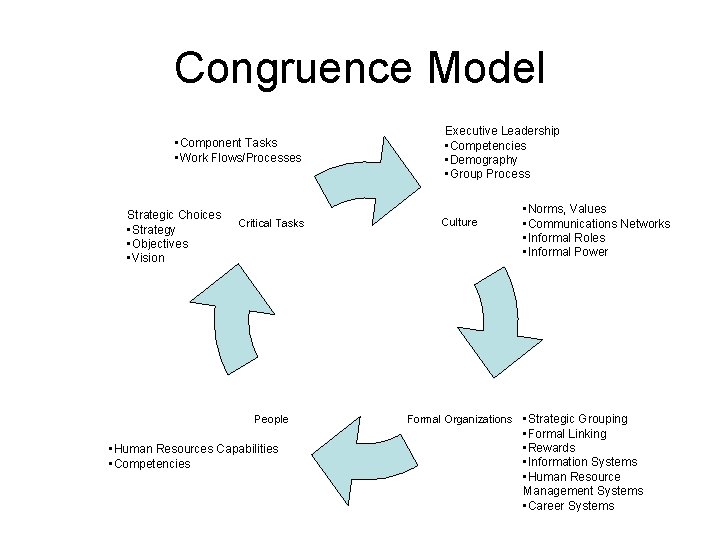
Congruence Model • Component Tasks • Work Flows/Processes Strategic Choices • Strategy • Objectives • Vision Critical Tasks People • Human Resources Capabilities • Competencies Executive Leadership • Competencies • Demography • Group Process Culture • Norms, Values • Communications Networks • Informal Roles • Informal Power Formal Organizations • Strategic Grouping • Formal Linking • Rewards • Information Systems • Human Resource Management Systems • Career Systems
Jeff Peters and Sydney Assignment • Challenges – Industry expertise “conflicted out” – Resources were unavailable due to timing in Australia • Resolved – 20% of consultant hired for project were inter-office loans – Internal specialists were assembled to consult the team – Utilized the KRD, FPIS, and PDNet resources
Warwick Bray and European Telecoms • Warwick Bray was an “I” specialist and was overwhelmed by demands for help • Leveraged the practice coordinator, creating development and growth. • Practice Development documentation is created by individuals associates who would step back after several engagements and write a paper on their new insights. • It was a new generation of practice leadership – Attract the best associates – Developed a consistent pool of specialists
Stephen Dull • Turn that frown upside down • Mckinsey focused on client personal relationships, whereas Dull was more focused on industrial marketing – This led to Dull focusing on a B to B strategy – GDL decided that 20 -25% should be functioning experts • Dull’s new center was successful and had new options available to him – Writing a book – Enhance internal credibility and external visibility
Rajat Gupta • Capitalize on the firm’s long term investment in practice development – FPIS – PDNet • Practice Olympics – Experiment began in German Office – 2 -6 teams from office around the world were encouraged to develop ideas that grew out of recent client engagements and formulize them for presentation at a regional competition • 6 Special Intiatives-led by senior partners, focused on emerging issues – Internal and External Expertise to develop “state of the art” formulations of each key issue. – Focused on the shape and function of the corporation of the future – Creating and managing strategic growth – Capturing global opportunities