
Chapter 12 Managing Knowledge in the Digital Firm
- Slides: 52
Chapter 12 Managing Knowledge in the Digital Firm 12. 1 © 2006 by Prentice Hall
Management Information Systems Chapter 12 Managing Knowledge in the Digital Firm OBJECTIVES • Assess the role of knowledge management and knowledge management programs in business • Define and describe the types of systems used for enterprise-wide knowledge management and demonstrate how they provide value for organizations • Define and describe the major types of knowledge work systems and assess how they provide value for firms 12. 2 © 2006 by Prentice Hall
Management Information Systems Chapter 12 Managing Knowledge in the Digital Firm OBJECTIVES (Continued) • Evaluate the business benefits of using intelligent techniques for knowledge management • Identify the challenges posed by knowledge management systems and management solutions 12. 3 © 2006 by Prentice Hall
Management Information Systems Chapter 12 Managing Knowledge in the Digital Firm Cott Corporation Case • Challenge: Coordinating the flow of unstructured information and documents among multiple product development groups • Solutions: Documentum e. Room software to manage product development documents • Develop new business processes for document routing • Illustrates the role of knowledge and document management systems for coordinating teams and achieving operational excellence 12. 4 © 2006 by Prentice Hall
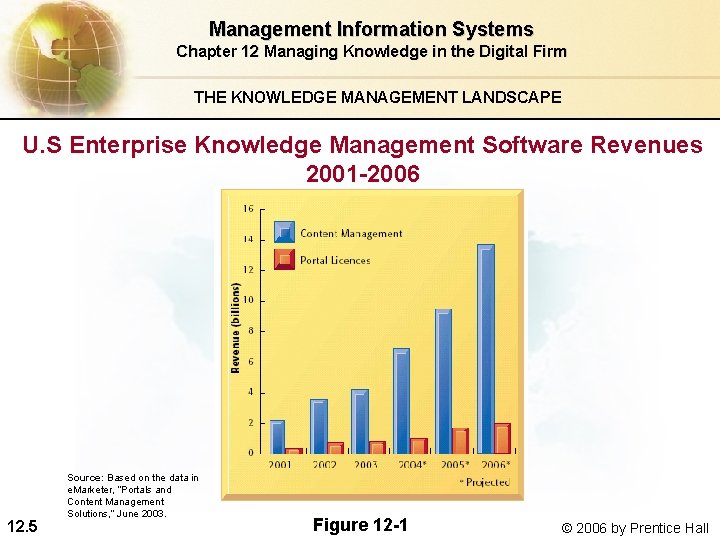
Management Information Systems Chapter 12 Managing Knowledge in the Digital Firm THE KNOWLEDGE MANAGEMENT LANDSCAPE U. S Enterprise Knowledge Management Software Revenues 2001 -2006 12. 5 Source: Based on the data in e. Marketer, “Portals and Content Management Solutions, ” June 2003. Figure 12 -1 © 2006 by Prentice Hall
Management Information Systems Chapter 12 Managing Knowledge in the Digital Firm THE KNOWLEDGE MANAGEMENT LANDSCAPE Important Dimensions of Knowledge • Data: Flow of captured events or transactions • Information: Data organized into categories of understanding • Knowledge: Concepts, experience, and insight that provide a framework for creating, evaluating, and using information. Can be tacit (undocumented) or explicit (documented) 12. 6 © 2006 by Prentice Hall
Management Information Systems Chapter 12 Managing Knowledge in the Digital Firm THE KNOWLEDGE MANAGEMENT LANDSCAPE Important Dimensions of Knowledge (Continued) • Wisdom: The collective and individual experience of applying knowledge to the solution of problem; knowing when, where, and how to apply knowledge Knowledge is a Firm Asset: • Intangible asset • Requires organizational resources • Value increases as more people share it 12. 7 © 2006 by Prentice Hall
Management Information Systems Chapter 12 Managing Knowledge in the Digital Firm THE KNOWLEDGE MANAGEMENT LANDSCAPE Important Dimensions of Knowledge (Continued) Knowledge has Different Forms: • Tacit or explicit • Know-how, craft, and skill • Knowing how to follow procedures; why things happen Knowledge has a Location: • Cognitive event • Social and individual bases of knowledge • Sticky, situated, contextual 12. 8 © 2006 by Prentice Hall
Management Information Systems Chapter 12 Managing Knowledge in the Digital Firm THE KNOWLEDGE MANAGEMENT LANDSCAPE Important Dimensions of Knowledge (Continued) Knowledge is Situational: • Conditional • Contextual 12. 9 © 2006 by Prentice Hall
Management Information Systems Chapter 12 Managing Knowledge in the Digital Firm THE KNOWLEDGE MANAGEMENT LANDSCAPE Organizational Learning and Knowledge Management • Organizational learning: Adjusting business processes and patterns of decision making to reflect knowledge gained through information and experience gathered 12. 10 © 2006 by Prentice Hall
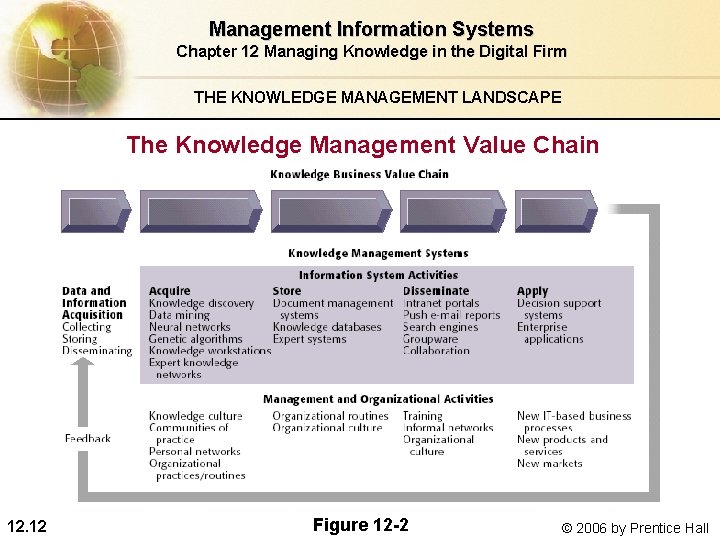
Management Information Systems Chapter 12 Managing Knowledge in the Digital Firm THE KNOWLEDGE MANAGEMENT LANDSCAPE The Knowledge Management Value Chain • Knowledge acquisition • Knowledge storage • Knowledge dissemination • Knowledge application • Building organizational and management capital: collaboration, communities of practice, and office environments 12. 11 © 2006 by Prentice Hall
Management Information Systems Chapter 12 Managing Knowledge in the Digital Firm THE KNOWLEDGE MANAGEMENT LANDSCAPE The Knowledge Management Value Chain 12. 12 Figure 12 -2 © 2006 by Prentice Hall
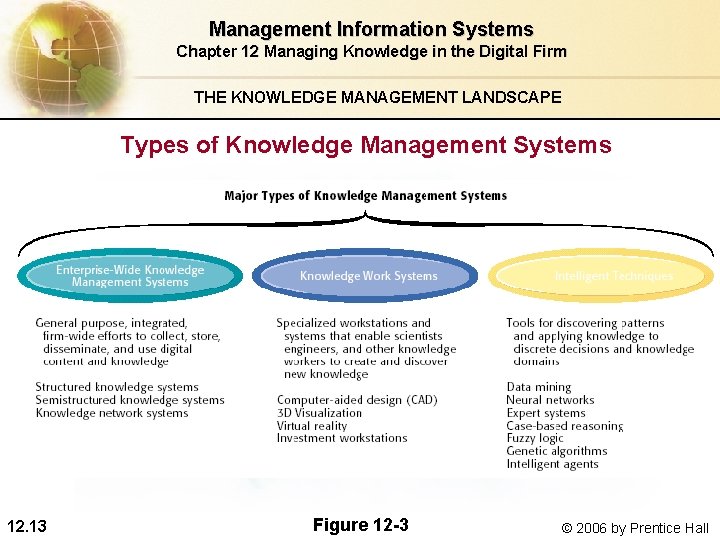
Management Information Systems Chapter 12 Managing Knowledge in the Digital Firm THE KNOWLEDGE MANAGEMENT LANDSCAPE Types of Knowledge Management Systems 12. 13 Figure 12 -3 © 2006 by Prentice Hall
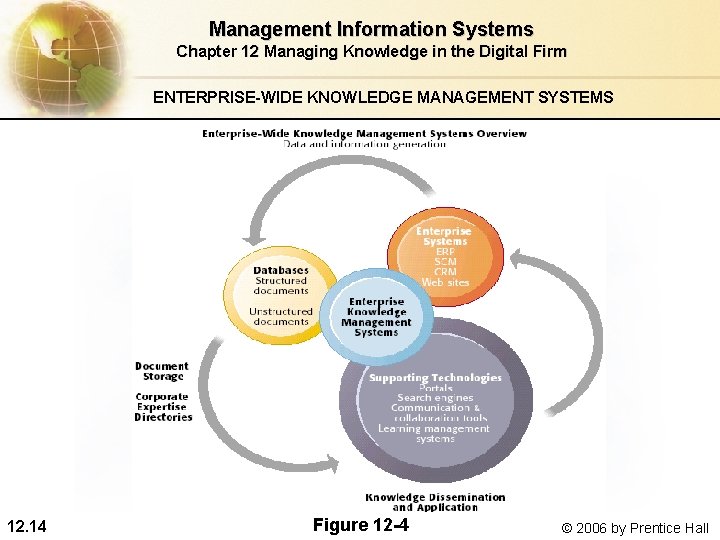
Management Information Systems Chapter 12 Managing Knowledge in the Digital Firm ENTERPRISE-WIDE KNOWLEDGE MANAGEMENT SYSTEMS 12. 14 Figure 12 -4 © 2006 by Prentice Hall
Management Information Systems Chapter 12 Managing Knowledge in the Digital Firm ENTERPRISE-WIDE KNOWLEDGE MANAGEMENT SYSTEMS Structured Knowledge System • Knowledge repository formal, structured text documents and reports or presentations • Also known as content management system • Require appropriate database schema and tagging of documents • Examples: Database of case reports of consulting firms; tax law accounting databases of accounting firms 12. 15 © 2006 by Prentice Hall
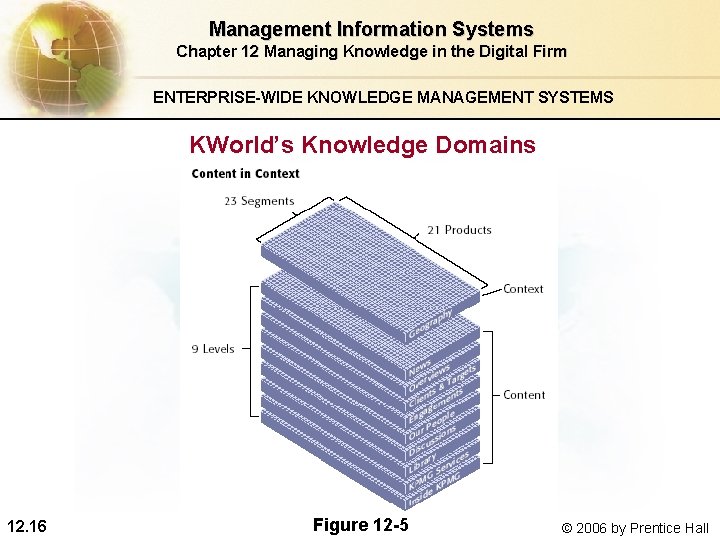
Management Information Systems Chapter 12 Managing Knowledge in the Digital Firm ENTERPRISE-WIDE KNOWLEDGE MANAGEMENT SYSTEMS KWorld’s Knowledge Domains 12. 16 Figure 12 -5 © 2006 by Prentice Hall
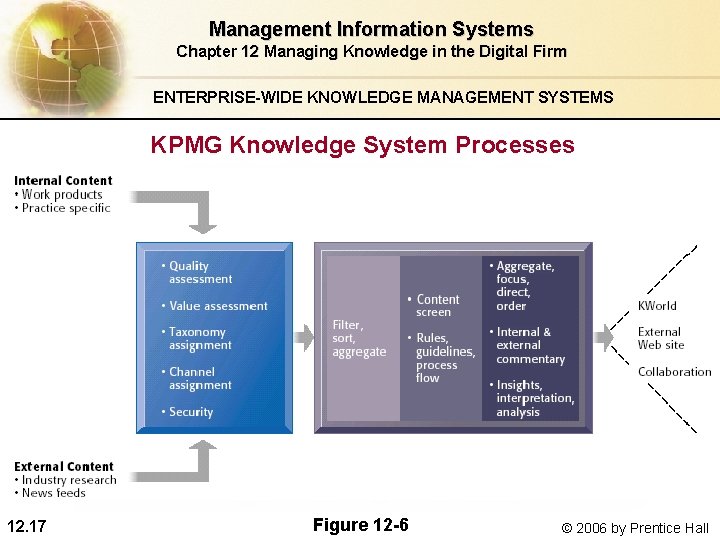
Management Information Systems Chapter 12 Managing Knowledge in the Digital Firm ENTERPRISE-WIDE KNOWLEDGE MANAGEMENT SYSTEMS KPMG Knowledge System Processes 12. 17 Figure 12 -6 © 2006 by Prentice Hall
Management Information Systems Chapter 12 Managing Knowledge in the Digital Firm ENTERPRISE-WIDE KNOWLEDGE MANAGEMENT SYSTEMS Semistructured Knowledge Systems • Knowledge repository for less-structured documents, such as e-mail, voicemail, chat room exchanges, videos, digital images, brochures, bulletin boards • Also known as digital asset management systems • Taxonomy: Scheme of classifying information and knowledge for easy retrieval • Tagging: Marking of documents according to knowledge taxonomy 12. 18 © 2006 by Prentice Hall
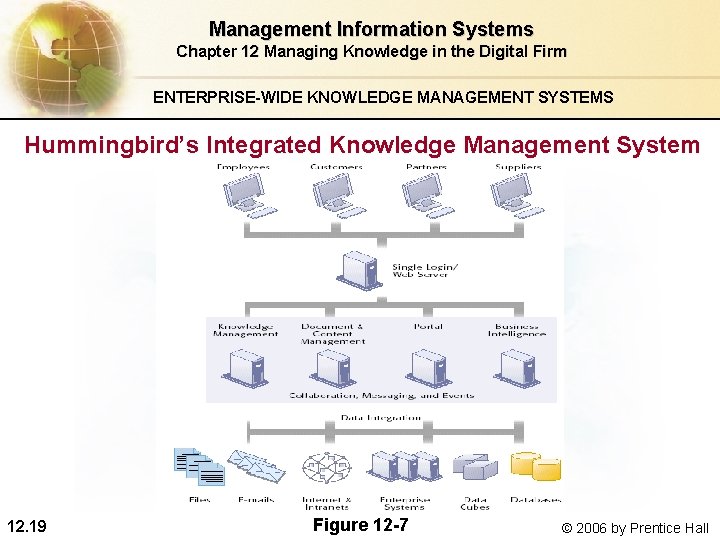
Management Information Systems Chapter 12 Managing Knowledge in the Digital Firm ENTERPRISE-WIDE KNOWLEDGE MANAGEMENT SYSTEMS Hummingbird’s Integrated Knowledge Management System 12. 19 Figure 12 -7 © 2006 by Prentice Hall
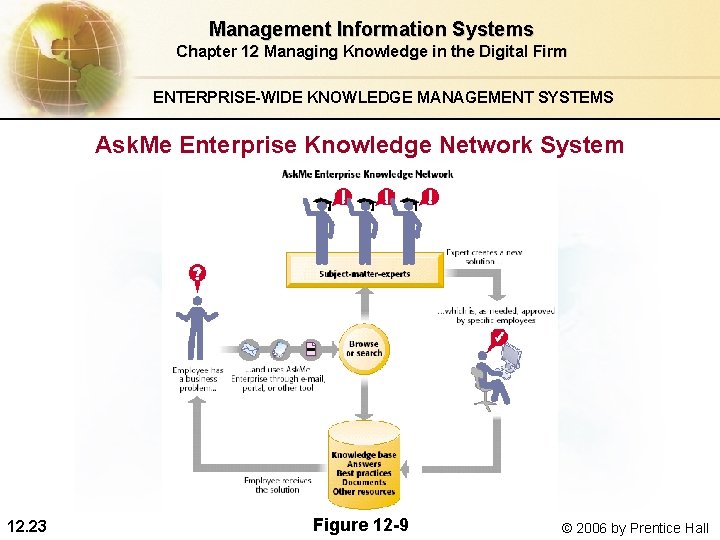
Management Information Systems Chapter 12 Managing Knowledge in the Digital Firm ENTERPRISE-WIDE KNOWLEDGE MANAGEMENT SYSTEMS Knowledge Network Systems • Online directory of corporate experts, solutions developed by in-house experts, best practices, FAQs • Document and organize “tacit” knowledge • Also known as expertise location and management systems 12. 20 © 2006 by Prentice Hall
Management Information Systems Chapter 12 Managing Knowledge in the Digital Firm ENTERPRISE-WIDE KNOWLEDGE MANAGEMENT SYSTEMS Knowledge Network Systems (Continued) Key features can include: • Knowledge exchange services • Community of practice support • Autoproofing capabilities • Knowledge management services 12. 21 © 2006 by Prentice Hall
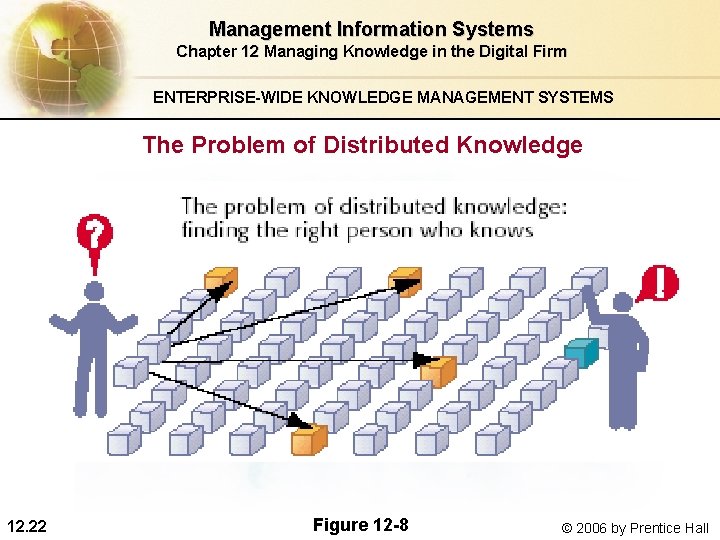
Management Information Systems Chapter 12 Managing Knowledge in the Digital Firm ENTERPRISE-WIDE KNOWLEDGE MANAGEMENT SYSTEMS The Problem of Distributed Knowledge 12. 22 Figure 12 -8 © 2006 by Prentice Hall
Management Information Systems Chapter 12 Managing Knowledge in the Digital Firm ENTERPRISE-WIDE KNOWLEDGE MANAGEMENT SYSTEMS Ask. Me Enterprise Knowledge Network System 12. 23 Figure 12 -9 © 2006 by Prentice Hall
Management Information Systems Chapter 12 Managing Knowledge in the Digital Firm ENTERPRISE-WIDE KNOWLEDGE MANAGEMENT SYSTEMS Supporting Technologies: Portals, Collaboration Tools, and Learning Management Systems Enterprise knowledge portals: • Access to external sources of information • Access to internal knowledge resources • Capabilities for e-mail, chat, discussion groups, videoconferencing 12. 24 © 2006 by Prentice Hall
Management Information Systems Chapter 12 Managing Knowledge in the Digital Firm ENTERPRISE-WIDE KNOWLEDGE MANAGEMENT SYSTEMS Learning Management System (LMS): • Provides tools for the management, delivery, tracking, and assessment of various types of employee learning and training • Integrates systems from human resources, accounting, sales in order to identify and quantify business impact of employee learning programs 12. 25 © 2006 by Prentice Hall
Management Information Systems Chapter 12 Managing Knowledge in the Digital Firm KNOWLEDGE WORK SYSTEMS Knowledge Workers and Knowledge Work Knowledge workers: Create knowledge and information for organization Knowledge workers key roles: • Keeping the organization current in knowledge as it develops in the external world—in technology, science, social thought, and the arts 12. 26 © 2006 by Prentice Hall
Management Information Systems Chapter 12 Managing Knowledge in the Digital Firm KNOWLEDGE WORK SYSTEMS Knowledge Workers and Knowledge Work (Continued) • Serving as internal consultants regarding the areas of their knowledge, the changes taking place, and opportunities • Acting as change agents, evaluating, initiating, and promoting change projects 12. 27 © 2006 by Prentice Hall
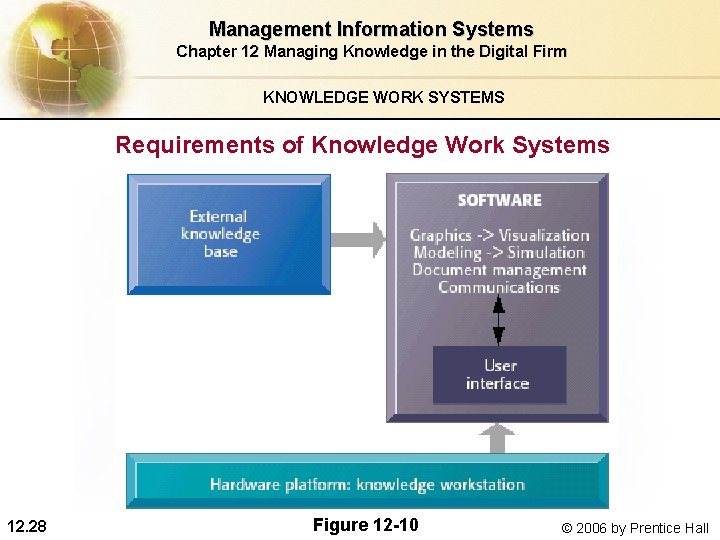
Management Information Systems Chapter 12 Managing Knowledge in the Digital Firm KNOWLEDGE WORK SYSTEMS Requirements of Knowledge Work Systems 12. 28 Figure 12 -10 © 2006 by Prentice Hall
Management Information Systems Chapter 12 Managing Knowledge in the Digital Firm KNOWLEDGE WORK SYSTEMS Examples of Knowledge Work Systems Computer-Aided Design (CAD): • Information system that automates the creation and revision of industrial and manufacturing designs using sophisticated graphics software Virtual Reality Systems: • Interactive graphics software and hardware that create computer-generated simulations that emulate real-world activities or photorealistic simulations 12. 29 © 2006 by Prentice Hall
Management Information Systems Chapter 12 Managing Knowledge in the Digital Firm KNOWLEDGE WORK SYSTEMS Examples of Knowledge Work Systems (Continued) Investment Workstation: • Powerful desktop computer for financial specialists, which is optimized to access and manipulate massive amounts of financial data 12. 30 © 2006 by Prentice Hall
Management Information Systems Chapter 12 Managing Knowledge in the Digital Firm INTELLIGENT TECHNIQUES Knowledge Discovery: • Identification of underlying patterns, categories, and behaviors in large data sets, using techniques such as neural networks and data mining Artificial Intelligence (AI) technology: • Computer-based systems based on human behavior, with the ability to learn languages, accomplish physical tasks, use a perceptual apparatus, and emulate human expertise and decision making 12. 31 © 2006 by Prentice Hall
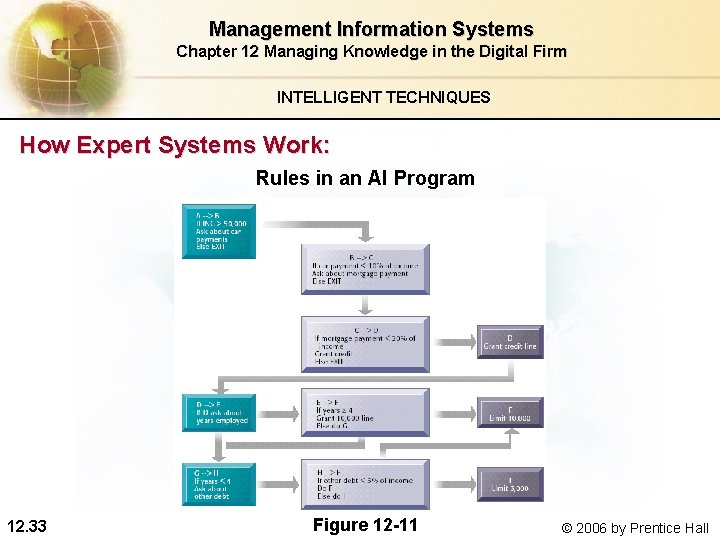
Management Information Systems Chapter 12 Managing Knowledge in the Digital Firm INTELLIGENT TECHNIQUES Capturing Knowledge: Expert Systems Expert system: • An intelligent technique for capturing tacit knowledge in a very specific and limited domain of human expertise Knowledge base: • Model of human knowledge that is used by expert systems • Series of 200 -10, 000 IF-THEN rules to form a rule base AI shell: The programming environment of an expert system 12. 32 © 2006 by Prentice Hall
Management Information Systems Chapter 12 Managing Knowledge in the Digital Firm INTELLIGENT TECHNIQUES How Expert Systems Work: Rules in an AI Program 12. 33 Figure 12 -11 © 2006 by Prentice Hall
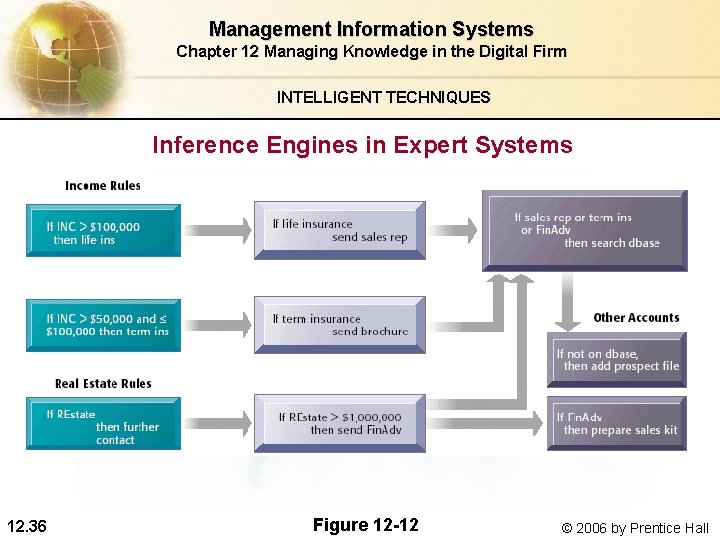
Management Information Systems Chapter 12 Managing Knowledge in the Digital Firm INTELLIGENT TECHNIQUES Inference engine: • The strategy used to search through the rule base in an expert system. Common strategies are forward chaining and backward chaining Forward chaining: • A strategy for searching the rule base in an expert system that begins with the information entered by the user and searches the rule base to arrive at a conclusion 12. 34 © 2006 by Prentice Hall
Management Information Systems Chapter 12 Managing Knowledge in the Digital Firm INTELLIGENT TECHNIQUES Backward chaining: • A strategy for searching the rule base in an expert system that acts like a problem solver by beginning with hypothesis and seeking out more information until the hypothesis is either proved or disproved Knowledge engineer: • A specialist who elicits information and expertise from other professionals and translates it into a set of rules for an expert system 12. 35 © 2006 by Prentice Hall
Management Information Systems Chapter 12 Managing Knowledge in the Digital Firm INTELLIGENT TECHNIQUES Inference Engines in Expert Systems 12. 36 Figure 12 -12 © 2006 by Prentice Hall
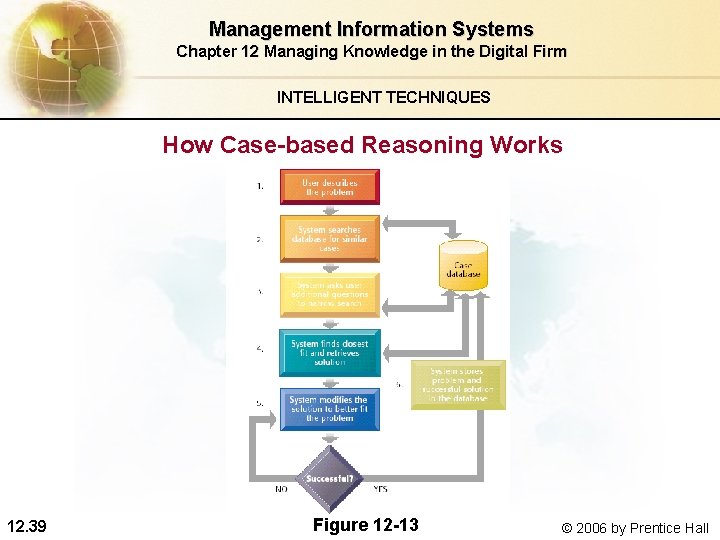
Management Information Systems Chapter 12 Managing Knowledge in the Digital Firm INTELLIGENT TECHNIQUES Organizational Intelligence Case-Based Reasoning (CBR): • Knowledge system that represents knowledge as a database of cases and solutions • Searches for stored cases with problem characteristics similar to the new case and applies solutions of the old case to the new case 12. 37 © 2006 by Prentice Hall
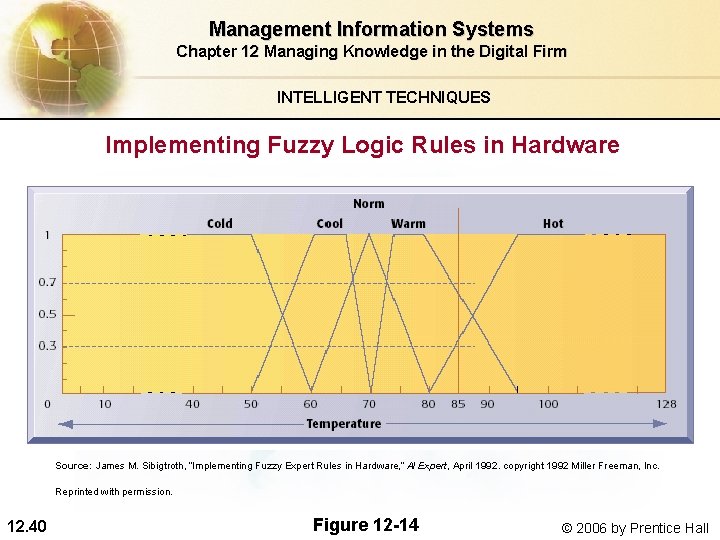
Management Information Systems Chapter 12 Managing Knowledge in the Digital Firm INTELLIGENT TECHNIQUES Fuzzy Logic Systems • Rule-based technology that can represent imprecise values or ranges of values by creating rules that use approximate or subjective values • Used for problems that are difficult to represent by IF-THEN rules 12. 38 © 2006 by Prentice Hall
Management Information Systems Chapter 12 Managing Knowledge in the Digital Firm INTELLIGENT TECHNIQUES How Case-based Reasoning Works 12. 39 Figure 12 -13 © 2006 by Prentice Hall
Management Information Systems Chapter 12 Managing Knowledge in the Digital Firm INTELLIGENT TECHNIQUES Implementing Fuzzy Logic Rules in Hardware Source: James M. Sibigtroth, “Implementing Fuzzy Expert Rules in Hardware, ” Al Expert, April 1992. copyright 1992 Miller Freeman, Inc. Reprinted with permission. 12. 40 Figure 12 -14 © 2006 by Prentice Hall
Management Information Systems Chapter 12 Managing Knowledge in the Digital Firm INTELLIGENT TECHNIQUES Neural Networks Neural Network: • Hardware or software that emulates the processing patterns of the biological brain to discover patterns and relationships in massive amounts of data • Use large numbers of sensing and processing nodes that interact with each other 12. 41 © 2006 by Prentice Hall
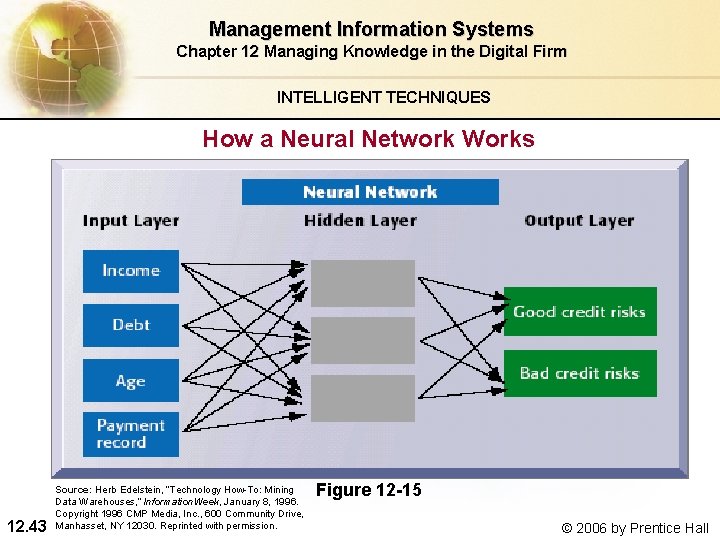
Management Information Systems Chapter 12 Managing Knowledge in the Digital Firm INTELLIGENT TECHNIQUES Neural Networks (Continued) • Uses rules it ‘learns” from patterns in data to construct a hidden layer of logic that can be applied to model new data • Applications are found in medicine, science, and business 12. 42 © 2006 by Prentice Hall
Management Information Systems Chapter 12 Managing Knowledge in the Digital Firm INTELLIGENT TECHNIQUES How a Neural Network Works 12. 43 Source: Herb Edelstein, “Technology How-To: Mining Data Warehouses, ” Information. Week, January 8, 1996. Copyright 1996 CMP Media, Inc. , 600 Community Drive, Manhasset, NY 12030. Reprinted with permission. Figure 12 -15 © 2006 by Prentice Hall
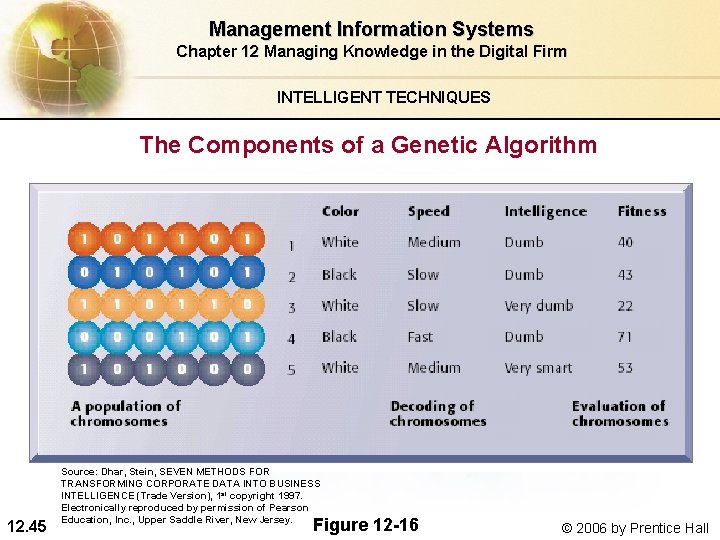
Management Information Systems Chapter 12 Managing Knowledge in the Digital Firm INTELLIGENT TECHNIQUES Genetic Algorithms • Adaptive computation that examines very large number of solutions for a problem to find optimal solution • Programmed to “evolve” by changing and reorganizing component parts using processes such as reproduction, mutation, and natural selection: worst solutions are discarded and better ones survive to produce even better solutions 12. 44 © 2006 by Prentice Hall
Management Information Systems Chapter 12 Managing Knowledge in the Digital Firm INTELLIGENT TECHNIQUES The Components of a Genetic Algorithm 12. 45 Source: Dhar, Stein, SEVEN METHODS FOR TRANSFORMING CORPORATE DATA INTO BUSINESS INTELLIGENCE (Trade Version), 1 st copyright 1997. Electronically reproduced by permission of Pearson Education, Inc. , Upper Saddle River, New Jersey. Figure 12 -16 © 2006 by Prentice Hall
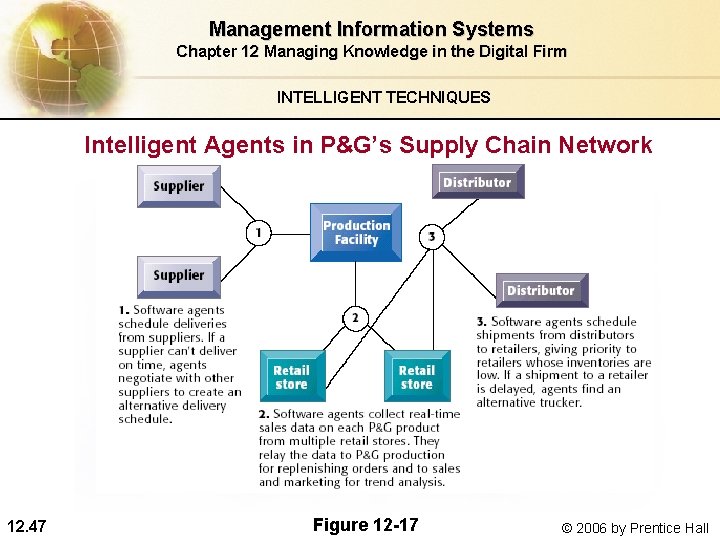
Management Information Systems Chapter 12 Managing Knowledge in the Digital Firm INTELLIGENT TECHNIQUES Hybrid AI system: • Integration of multiple AI technologies (genetic algorithms, fuzzy logic, neural networks) into a single application to take advantage of the best features of these technologies Intelligent Agents: 12. 46 • Software programs that work in the background without direct human intervention to carry out specific, repetitive, and predictable tasks for an individual user, business process, or software application © 2006 by Prentice Hall
Management Information Systems Chapter 12 Managing Knowledge in the Digital Firm INTELLIGENT TECHNIQUES Intelligent Agents in P&G’s Supply Chain Network 12. 47 Figure 12 -17 © 2006 by Prentice Hall
Management Information Systems Chapter 12 Managing Knowledge in the Digital Firm MANAGEMENT OPPORTUNITIES, CHALLENGES AND SOLUTIONS Management Opportunities: • Proprietary knowledge can create an “invisible competitive advantage” 12. 48 © 2006 by Prentice Hall
Management Information Systems Chapter 12 Managing Knowledge in the Digital Firm MANAGEMENT OPPORTUNITIES, CHALLENGES AND SOLUTIONS Management Challenges: • Insufficient resources are available to structure and update the content in repositories. • Poor quality and high variability of content quality results from insufficient validating mechanisms. • Content in repositories lacks context, making documents difficult to understand. 12. 49 © 2006 by Prentice Hall
Management Information Systems Chapter 12 Managing Knowledge in the Digital Firm MANAGEMENT OPPORTUNITIES, CHALLENGES AND SOLUTIONS Management Challenges: (Continued) • Individual employees are not rewarded for contributing content, and many fear sharing knowledge with others on the job. • Search engines return too much information, reflecting lack of knowledge structure or taxonomy. 12. 50 © 2006 by Prentice Hall
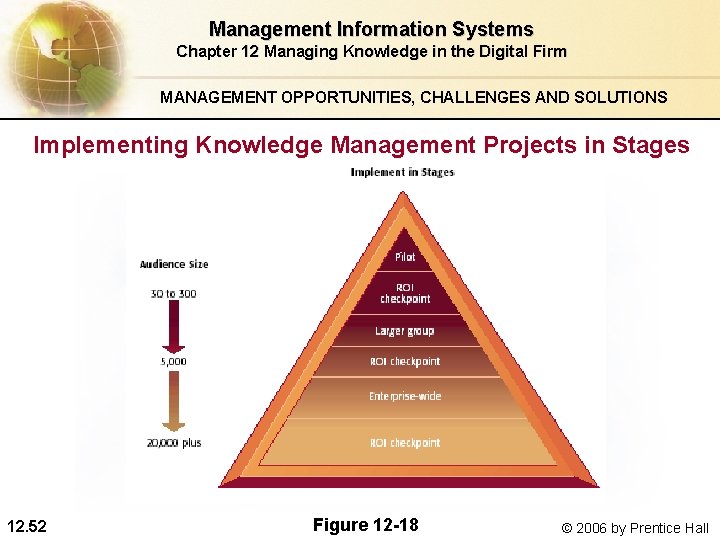
Management Information Systems Chapter 12 Managing Knowledge in the Digital Firm MANAGEMENT OPPORTUNITIES, CHALLENGES AND SOLUTIONS Solution Guidelines: Five important steps in developing a successful knowledge management project: 12. 51 • Develop in stages • Choose a high-value business process • Choose the right audience • Measure ROI during initial implementation • Use the preliminary ROI to project enterprise-wide values © 2006 by Prentice Hall
Management Information Systems Chapter 12 Managing Knowledge in the Digital Firm MANAGEMENT OPPORTUNITIES, CHALLENGES AND SOLUTIONS Implementing Knowledge Management Projects in Stages 12. 52 Figure 12 -18 © 2006 by Prentice Hall