MAXPLANCKINSTITUT FR CHEMISCHE ENERGIE KONVERSION METHANOL SYNTHESIS ON

- Slides: 19
MAX-PLANCK-INSTITUT FÜR CHEMISCHE ENERGIE KONVERSION METHANOL SYNTHESIS ON COPPER-BASED CATALYSTS M. V. Bukhtiyarova
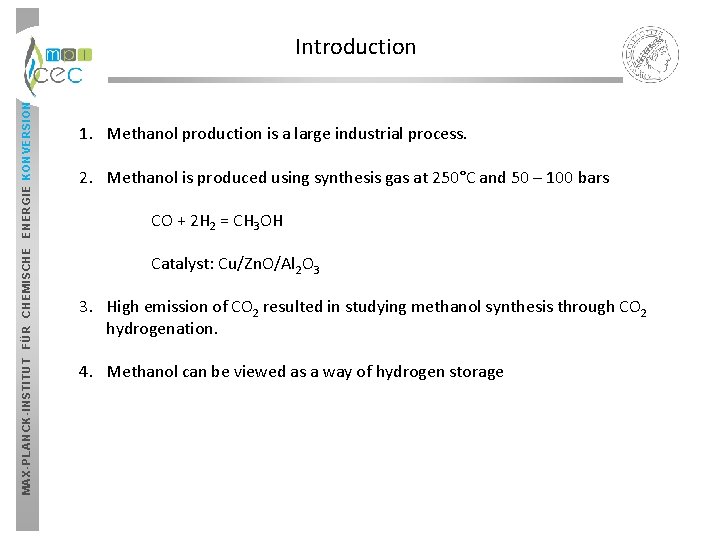
MAX-PLANCK-INSTITUT FÜR CHEMISCHE ENERGIE KONVERSION Introduction 1. Methanol production is a large industrial process. 2. Methanol is produced using synthesis gas at 250°C and 50 – 100 bars CO + 2 H 2 = CH 3 OH Catalyst: Cu/Zn. O/Al 2 O 3 3. High emission of CO 2 resulted in studying methanol synthesis through CO 2 hydrogenation. 4. Methanol can be viewed as a way of hydrogen storage
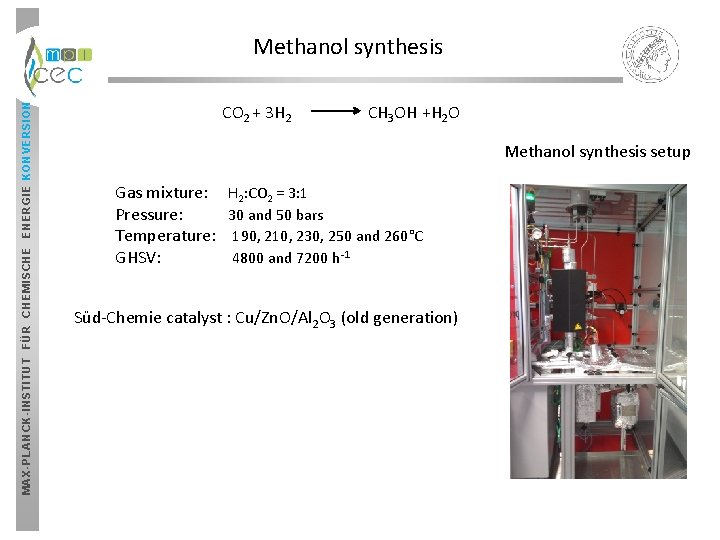
MAX-PLANCK-INSTITUT FÜR CHEMISCHE ENERGIE KONVERSION Methanol synthesis CO 2 + 3 H 2 CH 3 OH +H 2 O Methanol synthesis setup Gas mixture: H 2: CO 2 = 3: 1 Pressure: 30 and 50 bars Temperature: 190, 210, 230, 250 and 260°C GHSV: 4800 and 7200 h-1 Süd-Chemie catalyst : Cu/Zn. O/Al 2 O 3 (old generation)
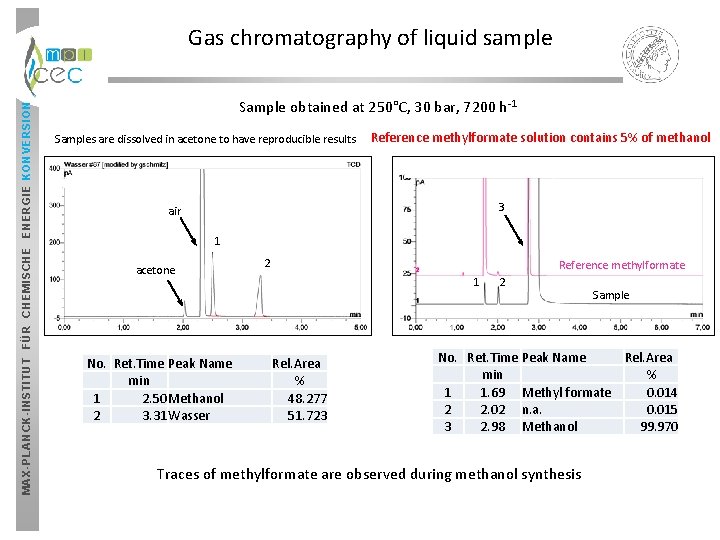
MAX-PLANCK-INSTITUT FÜR CHEMISCHE ENERGIE KONVERSION Gas chromatography of liquid sample Sample obtained at 250°C, 30 bar, 7200 h-1 Samples are dissolved in acetone to have reproducible results Reference methylformate solution contains 5% of methanol 3 air 1 acetone No. Ret. Time Peak Name min 1 2. 50 Methanol 2 3. 31 Wasser 2 Reference methylformate 1 Rel. Area % 48. 277 51. 723 2 Sample No. Ret. Time Peak Name Rel. Area min % 1 1. 69 Methyl formate 0. 014 2 2. 02 n. a. 0. 015 3 2. 98 Methanol 99. 970 Traces of methylformate are observed during methanol synthesis
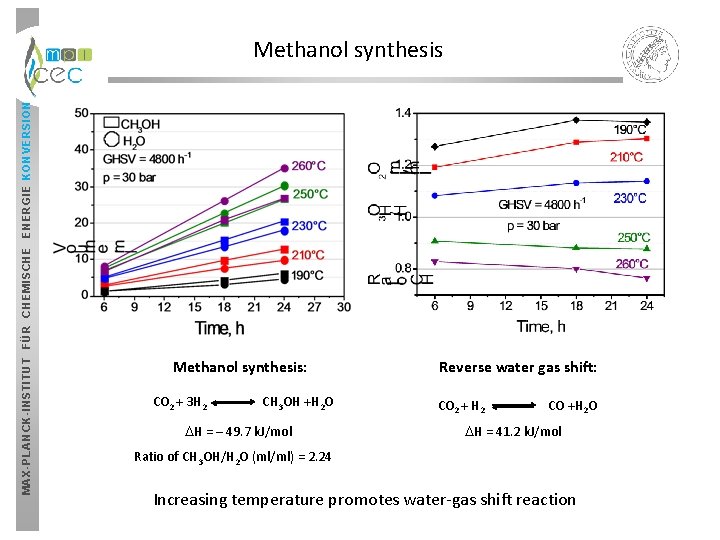
MAX-PLANCK-INSTITUT FÜR CHEMISCHE ENERGIE KONVERSION Methanol synthesis: CO 2 + 3 H 2 CH 3 OH +H 2 O H = – 49. 7 k. J/mol Reverse water gas shift: CO 2 + H 2 CO +H 2 O H = 41. 2 k. J/mol Ratio of CH 3 OH/H 2 O (ml/ml) = 2. 24 Increasing temperature promotes water-gas shift reaction
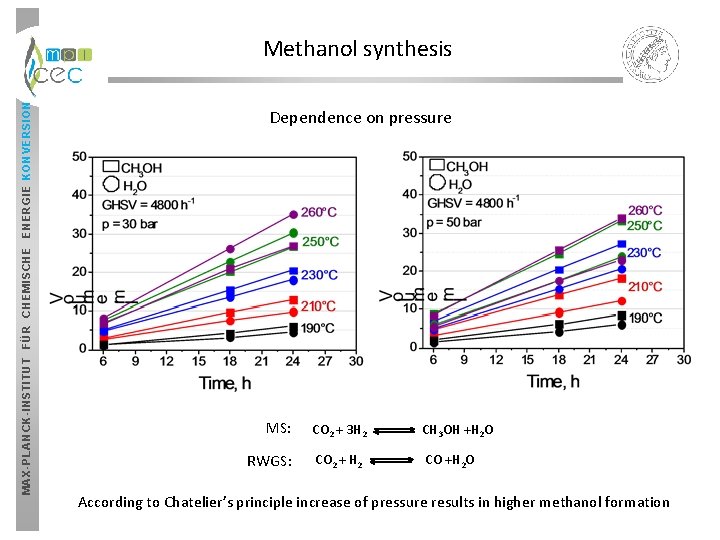
MAX-PLANCK-INSTITUT FÜR CHEMISCHE ENERGIE KONVERSION Methanol synthesis Dependence on pressure MS: RWGS: CO 2 + 3 H 2 CH 3 OH +H 2 O CO 2 + H 2 CO +H 2 O According to Chatelier’s principle increase of pressure results in higher methanol formation
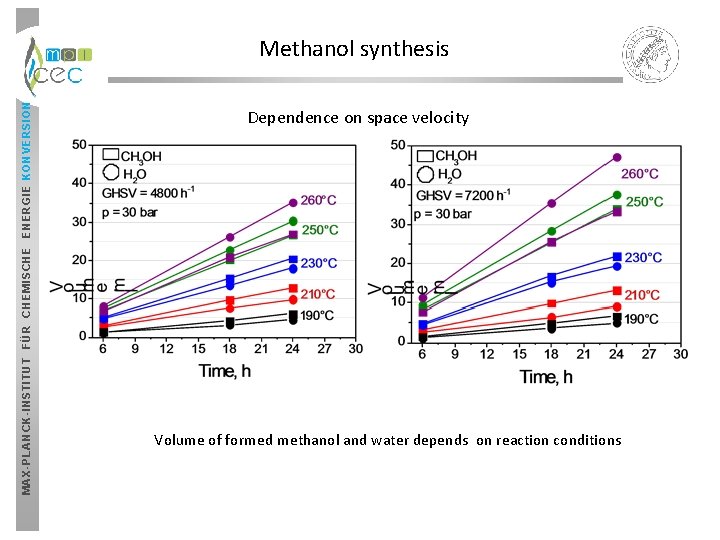
MAX-PLANCK-INSTITUT FÜR CHEMISCHE ENERGIE KONVERSION Methanol synthesis Dependence on space velocity Volume of formed methanol and water depends on reaction conditions
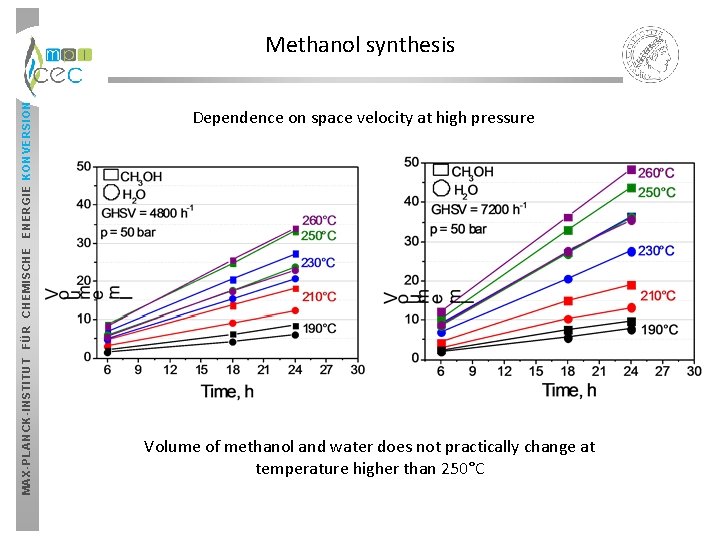
MAX-PLANCK-INSTITUT FÜR CHEMISCHE ENERGIE KONVERSION Methanol synthesis Dependence on space velocity at high pressure Volume of methanol and water does not practically change at temperature higher than 250°C
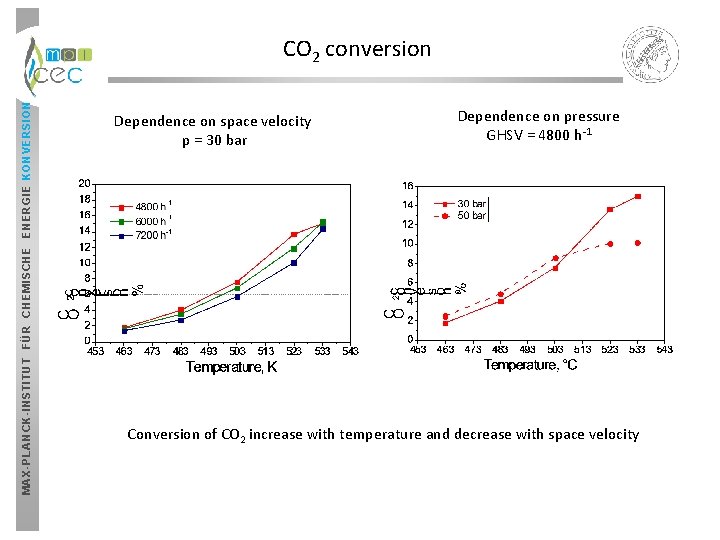
MAX-PLANCK-INSTITUT FÜR CHEMISCHE ENERGIE KONVERSION CO 2 conversion Dependence on space velocity p = 30 bar Dependence on pressure GHSV = 4800 h-1 Conversion of CO 2 increase with temperature and decrease with space velocity
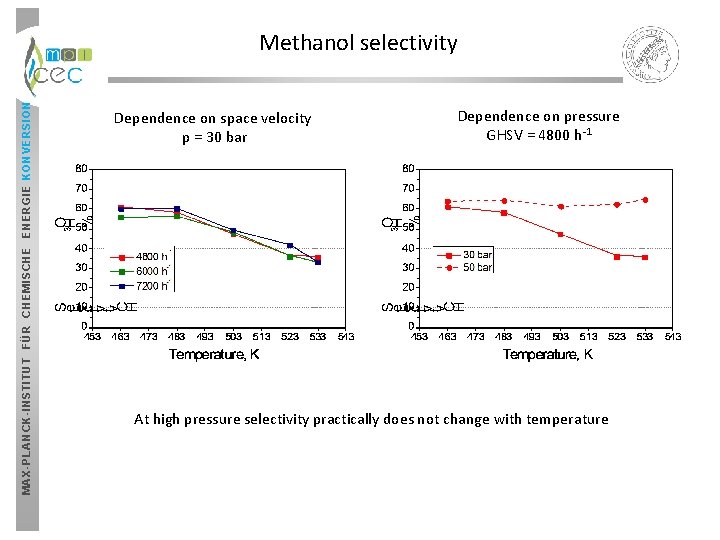
MAX-PLANCK-INSTITUT FÜR CHEMISCHE ENERGIE KONVERSION Methanol selectivity Dependence on space velocity p = 30 bar Dependence on pressure GHSV = 4800 h-1 At high pressure selectivity practically does not change with temperature
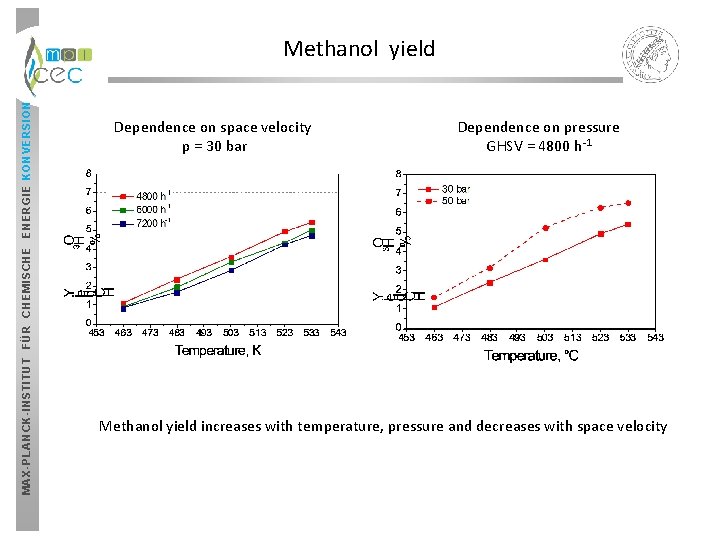
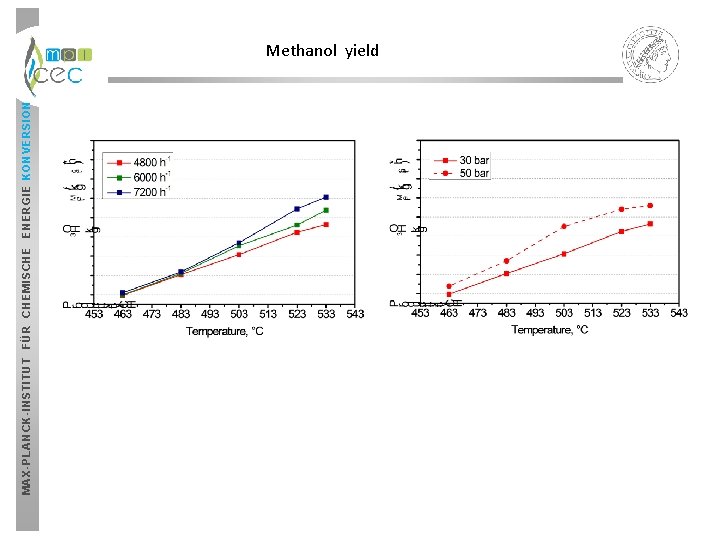
MAX-PLANCK-INSTITUT FÜR CHEMISCHE ENERGIE KONVERSION Methanol yield Dependence on space velocity p = 30 bar Dependence on pressure GHSV = 4800 h-1 Methanol yield increases with temperature, pressure and decreases with space velocity
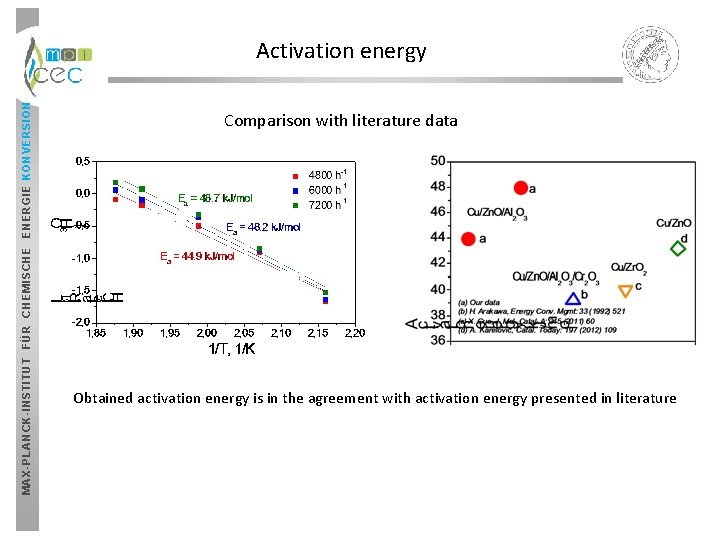
MAX-PLANCK-INSTITUT FÜR CHEMISCHE ENERGIE KONVERSION Activation energy Comparison with literature data Obtained activation energy is in the agreement with activation energy presented in literature
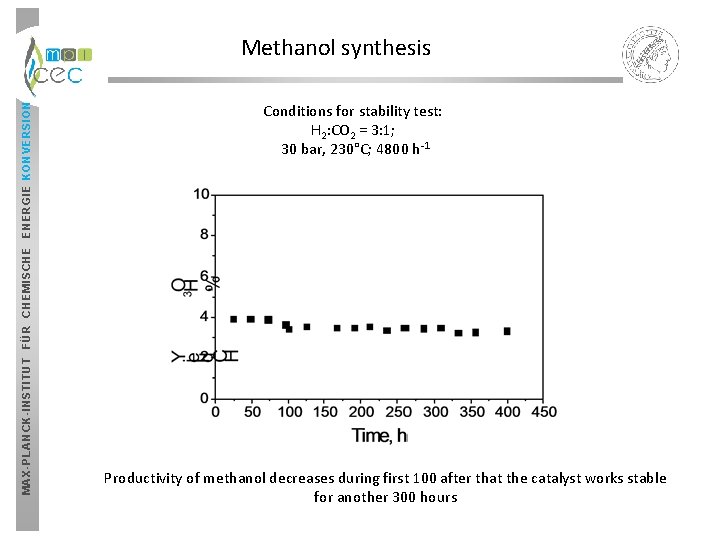
MAX-PLANCK-INSTITUT FÜR CHEMISCHE ENERGIE KONVERSION Methanol synthesis Conditions for stability test: H 2: CO 2 = 3: 1; 30 bar, 230°C; 4800 h-1 Productivity of methanol decreases during first 100 after that the catalyst works stable for another 300 hours
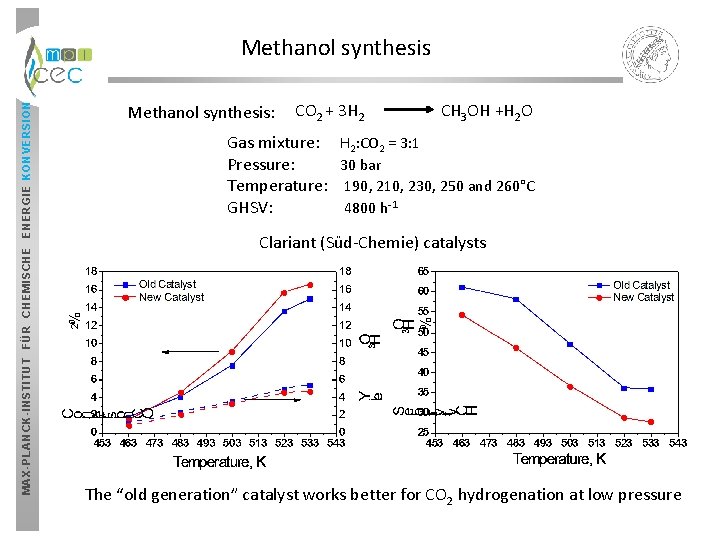
MAX-PLANCK-INSTITUT FÜR CHEMISCHE ENERGIE KONVERSION Methanol synthesis: CO 2 + 3 H 2 CH 3 OH +H 2 O Gas mixture: H 2: CO 2 = 3: 1 Pressure: 30 bar Temperature: 190, 210, 230, 250 and 260°C GHSV: 4800 h-1 Clariant (Süd-Chemie) catalysts The “old generation” catalyst works better for CO 2 hydrogenation at low pressure
MAX-PLANCK-INSTITUT FÜR CHEMISCHE ENERGIE KONVERSION Conclusions 1. Methanol yield depends on reaction conditions: high pressure results in formation of higher amount of methanol 2. Practically pure methanol with trace amount of methylformate is produced 3. Clariant (Süd-Chemie) catalyst for methanol synthesis is stable during longterm experiment for 400 hours 4. Clariant (Süd-Chemie) catalyst of old generation is more suitable for production methanol by CO 2 hydrogenation
MAX-PLANCK-INSTITUT FÜR CHEMISCHE ENERGIE KONVERSION THANK YOU FOR YOUR KIND ATTENTION
MAX-PLANCK-INSTITUT FÜR CHEMISCHE ENERGIE KONVERSION Methanol yield
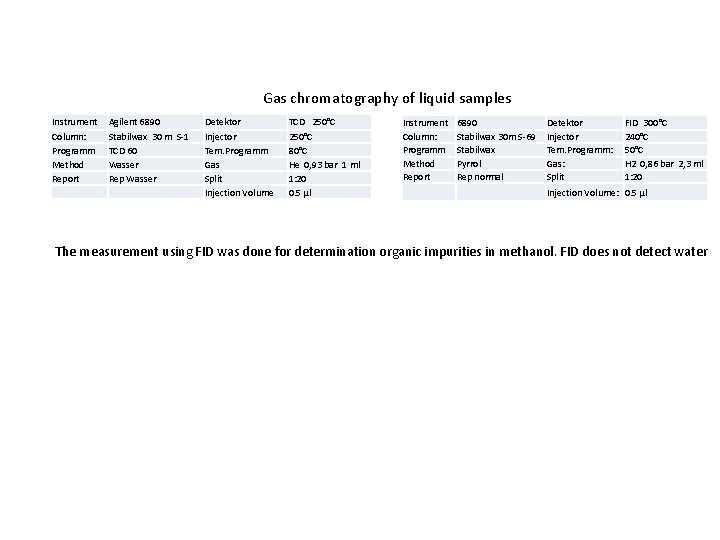
Gas chromatography of liquid samples Instrument Column: Programm Method Report Agilent 6890 Stabilwax 30 m S-1 TCD 60 Wasser Rep Wasser Detektor Injector Tem. Programm Gas Split Injection Volume TCD 250°C 80°C He 0, 93 bar 1 ml 1: 20 0. 5 µl Instrument Column: Programm Method Report 6890 Stabilwax 30 m S-69 Stabilwax Pyrrol Rep normal Detektor Injector Tem. Programm: Gas: Split FID 300°C 240°C 50°C H 2 0, 86 bar 2, 3 ml 1: 20 Injection Volume: 0. 5 µl The measurement using FID was done for determination organic impurities in methanol. FID does not detect water