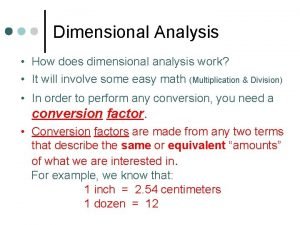
Math Competency Dimensional Analysis DA Patricia Kelliher RN




- Slides: 28
Math Competency Dimensional Analysis (DA) Patricia Kelliher RN, MS NUR 1020 B patricia_kelliher@laboure. edu Office B building
What are the “ 7 rights” of medication administration?
Resources • Cookson, K. (20013). Dimensional analysis: Calculate dosages the easy way. Nursing 2013, (43) 6, 57 -62. www. Nursing 2013. com on e. Learning • Miller Wilson, K. (2013). The nurse’s quick guide to I. V. drug calculations. Nursing made Incredibly Easy, ? , 1 -2 (“online exclusive”) www. Nursing. Made. Incredibly. Easy. com • Koharchik, L. and Hardy, E. (2013). As easy as 1, 2, 3! Dosage calculations. Nursing made Incredibly Easy, ½, 25 -29. on e. Learning
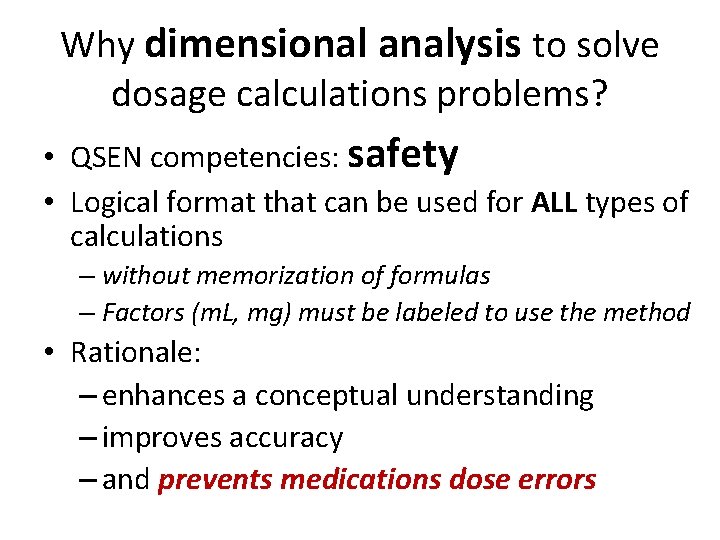
Why dimensional analysis to solve dosage calculations problems? • QSEN competencies: safety • Logical format that can be used for ALL types of calculations – without memorization of formulas – Factors (m. L, mg) must be labeled to use the method • Rationale: – enhances a conceptual understanding – improves accuracy – and prevents medications dose errors
MA Nursing Core Competencies CCP 2013
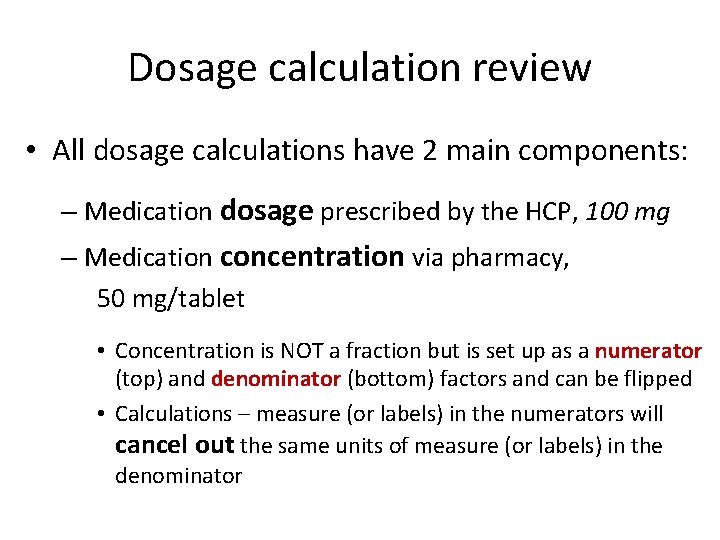
Dosage calculation review • All dosage calculations have 2 main components: – Medication dosage prescribed by the HCP, 100 mg – Medication concentration via pharmacy, 50 mg/tablet • Concentration is NOT a fraction but is set up as a numerator (top) and denominator (bottom) factors and can be flipped • Calculations – measure (or labels) in the numerators will cancel out the same units of measure (or labels) in the denominator
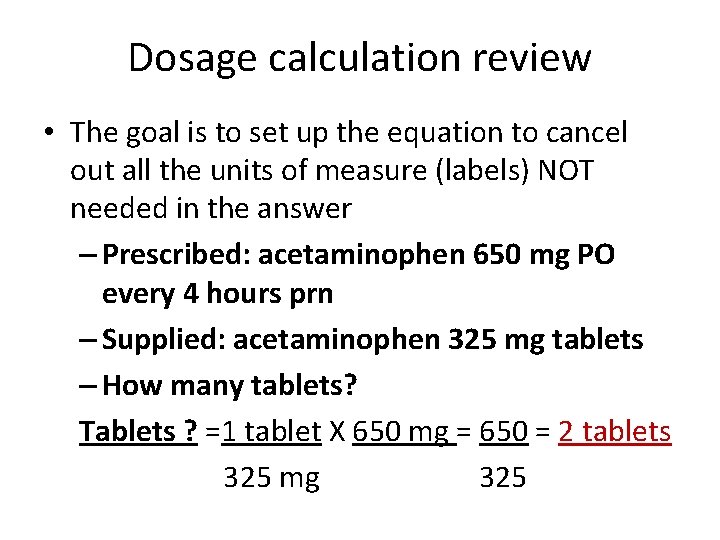
Dosage calculation review • The goal is to set up the equation to cancel out all the units of measure (labels) NOT needed in the answer – Prescribed: acetaminophen 650 mg PO every 4 hours prn – Supplied: acetaminophen 325 mg tablets – How many tablets? Tablets ? =1 tablet X 650 mg = 650 = 2 tablets 325 mg 325
Dosage calculation steps • Determine the unit of measure (label) needed – Tablet ? • Place the information with the same label in the numerator (top) position – Tablet = 1 tablet 325 mg • Place the information with the same label in the preceding denominator into the numerator position – Tablet = 1 tablet X 650 mg 325 mg • Cancel out the label(s) and complete the math (multiply and then divide) Tablet = 1 tablet X 650 mg = 650 = 2 tablets 325 mg 325
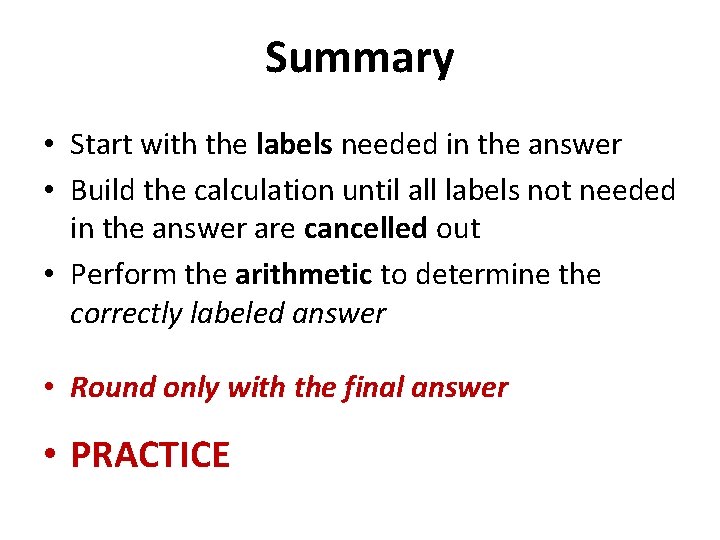
Summary • Start with the labels needed in the answer • Build the calculation until all labels not needed in the answer are cancelled out • Perform the arithmetic to determine the correctly labeled answer • Round only with the final answer • PRACTICE
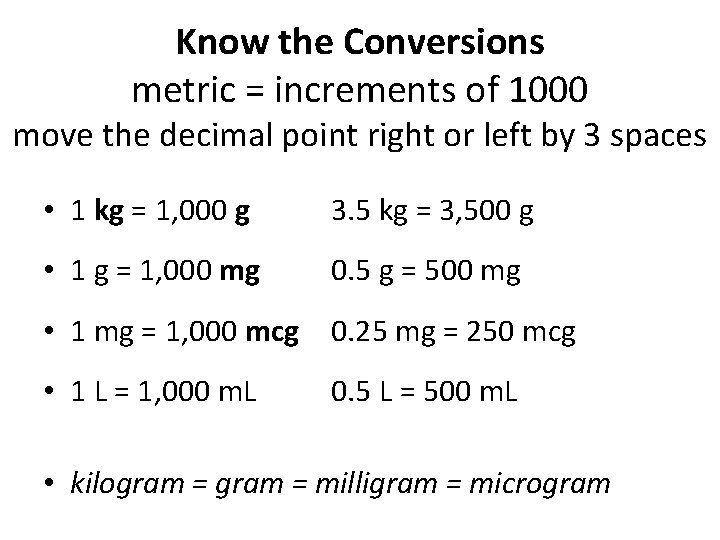
Know the Conversions metric = increments of 1000 move the decimal point right or left by 3 spaces • 1 kg = 1, 000 g 3. 5 kg = 3, 500 g • 1 g = 1, 000 mg 0. 5 g = 500 mg • 1 mg = 1, 000 mcg 0. 25 mg = 250 mcg • 1 L = 1, 000 m. L 0. 5 L = 500 m. L • kilogram = milligram = microgram
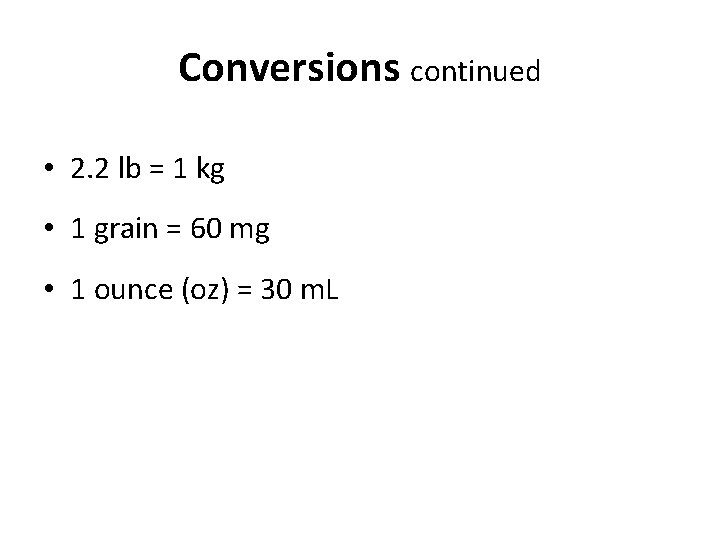
Conversions continued • 2. 2 lb = 1 kg • 1 grain = 60 mg • 1 ounce (oz) = 30 m. L
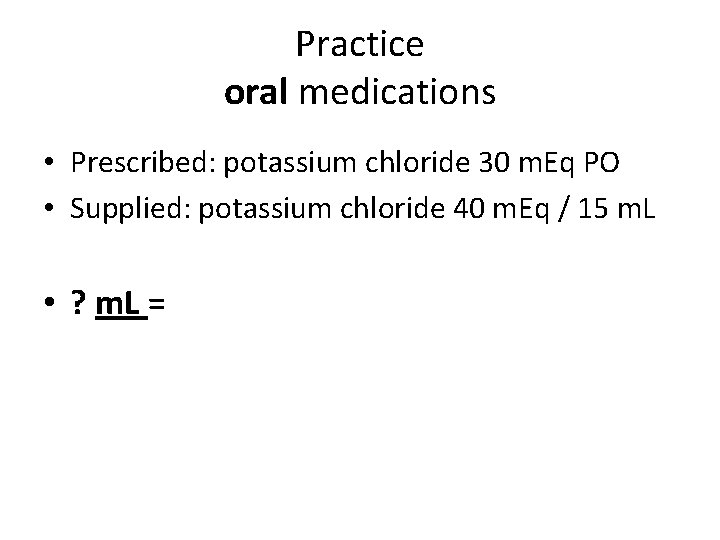
Practice oral medications • Prescribed: potassium chloride 30 m. Eq PO • Supplied: potassium chloride 40 m. Eq / 15 m. L • ? m. L =
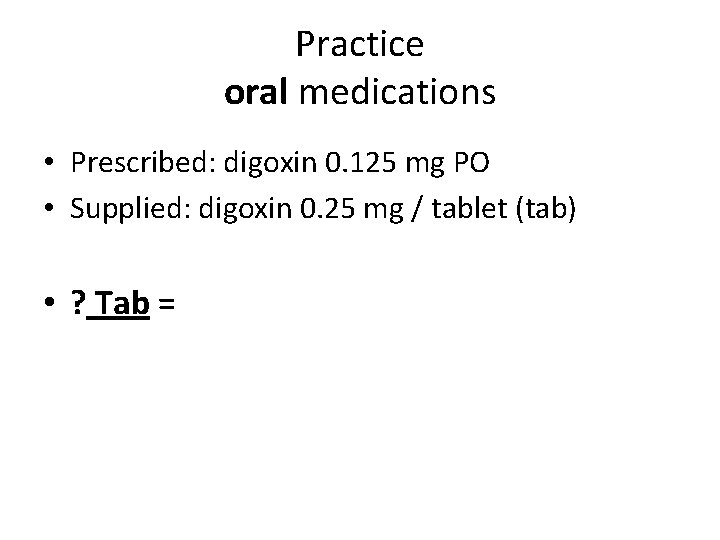
Practice oral medications • Prescribed: digoxin 0. 125 mg PO • Supplied: digoxin 0. 25 mg / tablet (tab) • ? Tab =
Practice injectable medications • Prescribed: nalbuphine 15 mg SC now • Supplied: nalbuphine 20 mg/m. L • ? m. L =
Practice injectable medications • Prescribed: cefazolin sodium 250 mg IM now • Supplied: cefazolin sodium 1 g/3 m. L (OR 1000 mg) • ? =
Practice basic IV calculations • Prescribed: cephalexin 1 gm piggyback every 8 hr • Supplied: cephalexin 1 gm in 50 m. L D 5 W (NS) to infuse over 30 minutes • All IV infusions are m. L/hour • ? m. L = hr
Practice basic IV calculations • Prescribed: regular insulin at 7 units / hr IV • Supplied: regular insulin 100 units in 100 m. L NS • ?
Practice *** basic IV calculations • Prescribed: nitroglycerin 5 mcg/minute IV • Supplied: nitroglycerin 50 mg in 500 m. L NS • ?
Practice complex weight-based IV calculations • Prescribed: heparin 15 units/kg/hour IV • Supplied: heparin 25, 000 units/250 m. L D 5 W = 100 units/ 1 m. L (found on the pharmacy label) • Patient weight: 195 lb = _____ kg • ?
Practice complex weight-based IV calculations • Prescribed: dopamine 3 mcg/kg/minute IV • Supplied: dopamine 800 mg in 250 m. L NS • Patient weight: 167. 5 lb • ? • Conversion move the decimal point
Practice complex weight-based IV calculations • Prescribed: propofol 20 mcg/kg/minute IV • Supplied: propofol 15 mg/m. L • Patient weight: 217 lb • ?
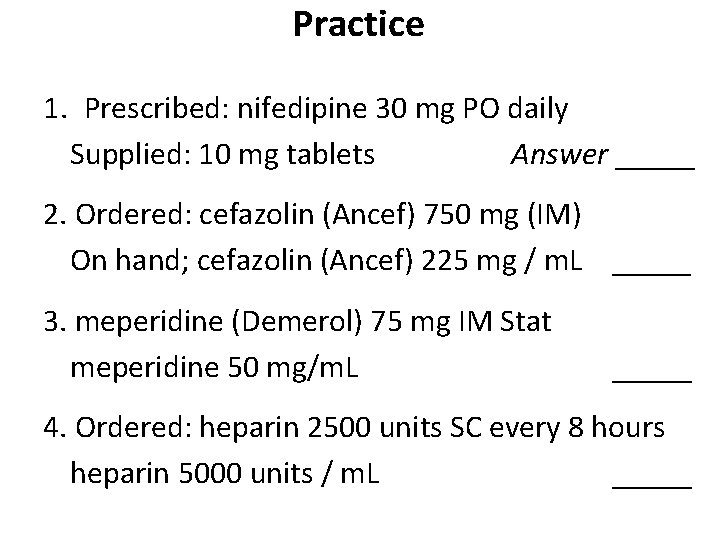
Practice 1. Prescribed: nifedipine 30 mg PO daily Supplied: 10 mg tablets Answer _____ 2. Ordered: cefazolin (Ancef) 750 mg (IM) On hand; cefazolin (Ancef) 225 mg / m. L _____ 3. meperidine (Demerol) 75 mg IM Stat meperidine 50 mg/m. L _____ 4. Ordered: heparin 2500 units SC every 8 hours heparin 5000 units / m. L _____
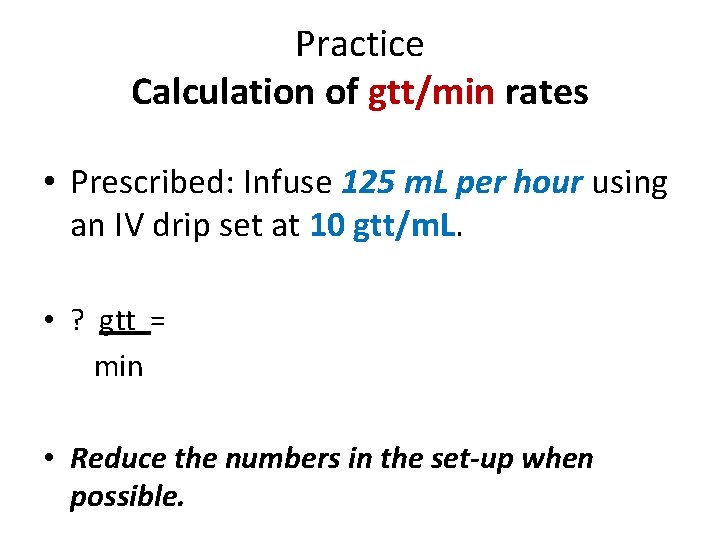
Practice Calculation of gtt/min rates • Prescribed: Infuse 125 m. L per hour using an IV drip set at 10 gtt/m. L. • ? gtt = min • Reduce the numbers in the set-up when possible.
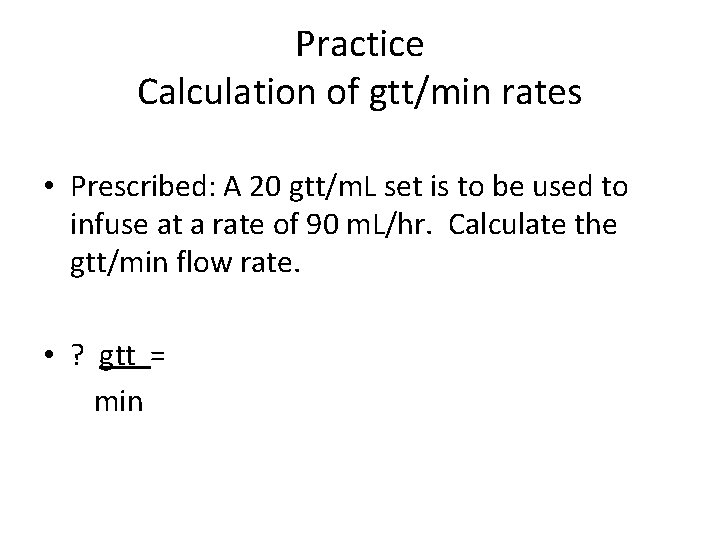
Practice Calculation of gtt/min rates • Prescribed: A 20 gtt/m. L set is to be used to infuse at a rate of 90 m. L/hr. Calculate the gtt/min flow rate. • ? gtt = min
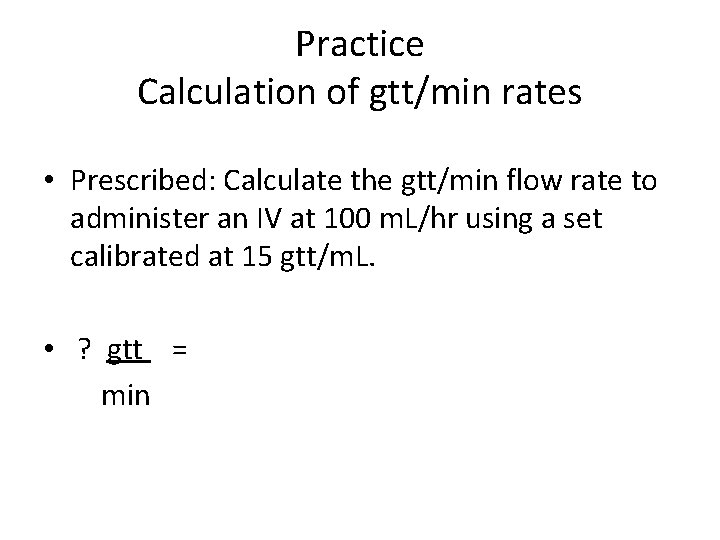
Practice Calculation of gtt/min rates • Prescribed: Calculate the gtt/min flow rate to administer an IV at 100 m. L/hr using a set calibrated at 15 gtt/m. L. • ? gtt = min
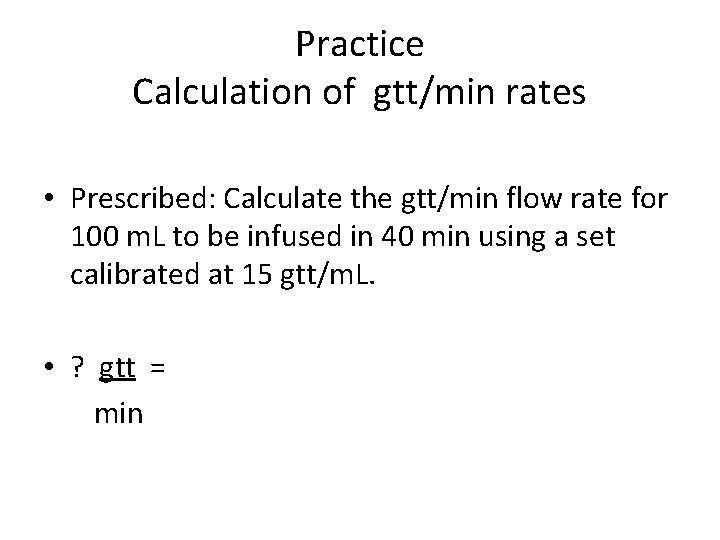
Practice Calculation of gtt/min rates • Prescribed: Calculate the gtt/min flow rate for 100 m. L to be infused in 40 min using a set calibrated at 15 gtt/m. L. • ? gtt = min
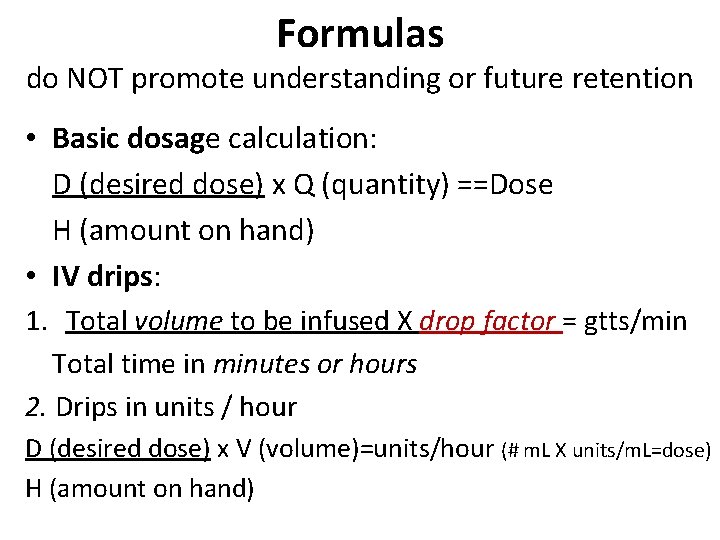
Formulas do NOT promote understanding or future retention • Basic dosage calculation: D (desired dose) x Q (quantity) ==Dose H (amount on hand) • IV drips: 1. Total volume to be infused X drop factor = gtts/min Total time in minutes or hours 2. Drips in units / hour D (desired dose) x V (volume)=units/hour (# m. L X units/m. L=dose) H (amount on hand)
Next class • Continued review of handouts, e. Learning