Market Shares Consumer Ignorance and the Reciprocal Termination



- Slides: 20
Market Shares, Consumer Ignorance and the Reciprocal Termination Charges Yu-Shan Lo Department of Economics and Related Studies University of York Email: yl 500@york. ac. uk Jan 2009 Yu-Shan Lo
Introduction n The aim of this paper is to study the different regulatory effects on termination charges and social welfare. 9/18/2020 Yu-Shan Lo 2
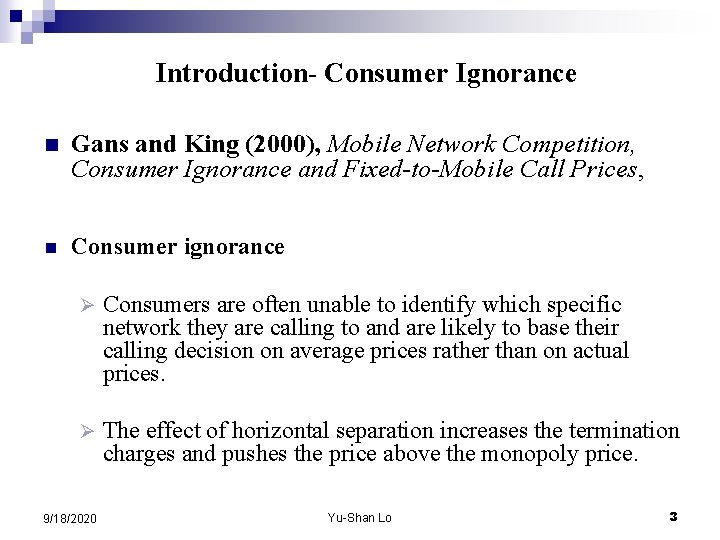
Introduction- Consumer Ignorance n Gans and King (2000), Mobile Network Competition, Consumer Ignorance and Fixed-to-Mobile Call Prices, n Consumer ignorance Ø Consumers are often unable to identify which specific network they are calling to and are likely to base their calling decision on average prices rather than on actual prices. Ø The effect of horizontal separation increases the termination charges and pushes the price above the monopoly price. 9/18/2020 Yu-Shan Lo 3
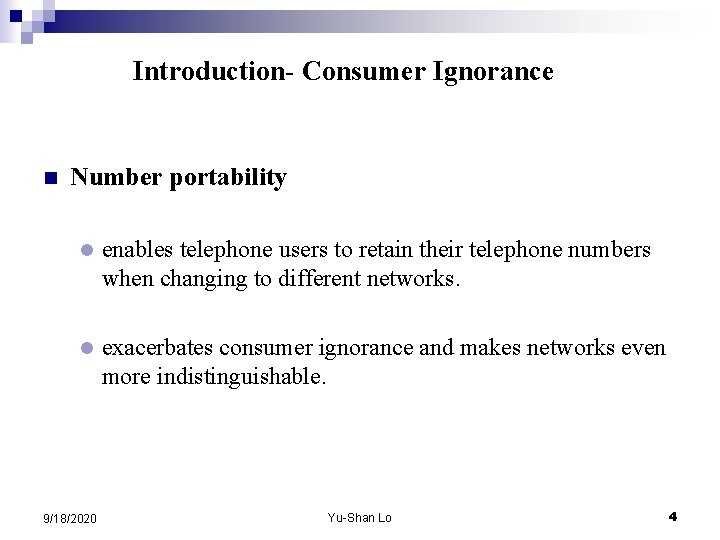
Introduction- Consumer Ignorance n Number portability l enables telephone users to retain their telephone numbers when changing to different networks. l exacerbates consumer ignorance and makes networks even more indistinguishable. 9/18/2020 Yu-Shan Lo 4
Introduction- Reciprocal Termination Charge n Economides, Lopomo and Woroch (2000). l Reciprocal termination charge can eliminate the problem of double marginalisation; ü excludes the possibility of unstable or corner solution. ü n Wright (2002) l 9/18/2020 confirms the excessive termination charges resulted in Gans and King (2000) and suggests that a reciprocal termination charge is a requirement to prevent mobile networks to set a termination charge above the monopoly level. Yu-Shan Lo 5
Introduction: This Paper n Benchmark l Collusive reciprocal termination charge n Possible regulatory regimes l Welfare-maximising termination charge l Uniform termination charge l Asymmetric regulation on the fixed network l Direct calling price regulation 9/18/2020 Yu-Shan Lo 6
Introduction: This Paper n Partial consumer ignorance p Consumers can differentiate the numbers between fixed and mobile networks but cannot recognise the numbers for different mobile networks. ¨ Reflects the current reality. ¨ Allows us to analyse the issues with discriminatory prices n A more complete model ¨ Subscribers call to all networks, including MTM, MTF and FTM calls. 9/18/2020 Yu-Shan Lo 7
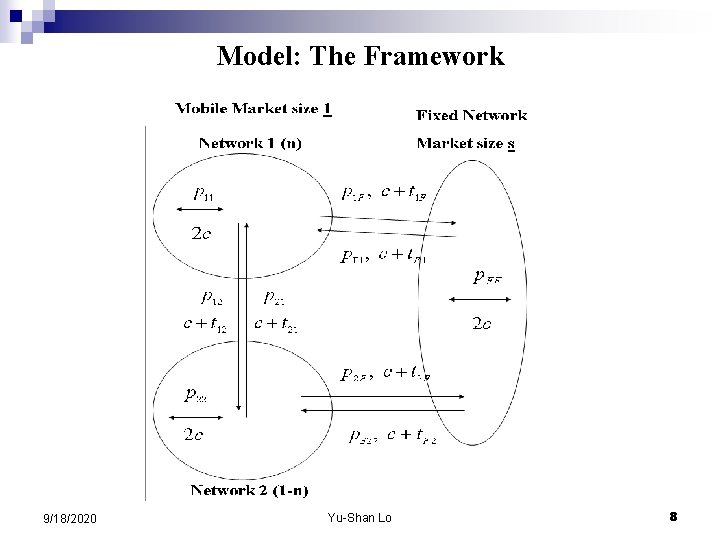
Model: The Framework 9/18/2020 Yu-Shan Lo 8
Model: Network Operator’s Profits 9/18/2020 Yu-Shan Lo 9
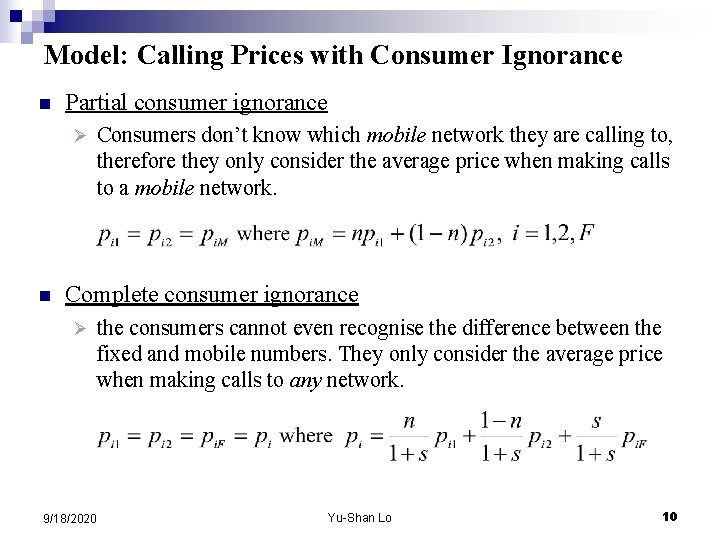
Model: Calling Prices with Consumer Ignorance n Partial consumer ignorance Ø n Consumers don’t know which mobile network they are calling to, therefore they only consider the average price when making calls to a mobile network. Complete consumer ignorance Ø 9/18/2020 the consumers cannot even recognise the difference between the fixed and mobile numbers. They only consider the average price when making calls to any network. Yu-Shan Lo 10
The Timing n Stage 1: networks decide their termination charges n Stage 2: networks choose their calling prices simultaneously. We characterise the subgame perfect Nash equilibrium, and solve the game by backward induction. 9/18/2020 Yu-Shan Lo 11
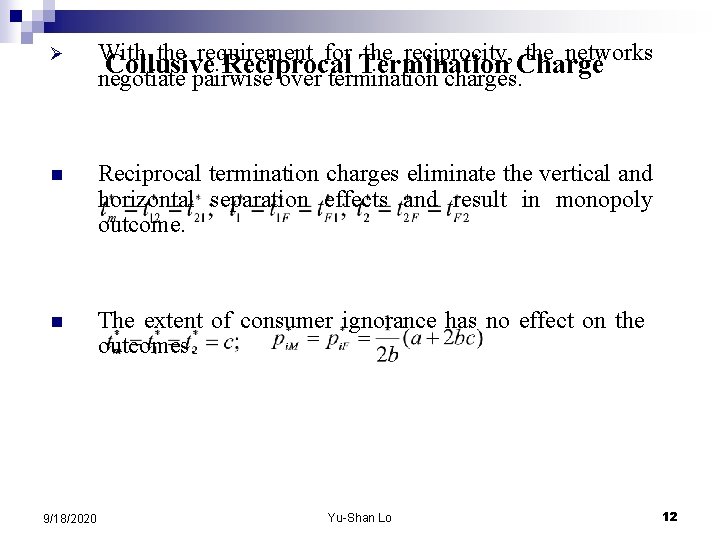
Ø With the requirement for the reciprocity, the networks Collusive Reciprocal Termination Charge negotiate pairwise over termination charges. n Reciprocal termination charges eliminate the vertical and horizontal separation effects and result in monopoly outcome. n The extent of consumer ignorance has no effect on the outcomes. 9/18/2020 Yu-Shan Lo 12
Welfare-maximising Termination Charge n The welfare maximising termination charges are below the marginal costs. n The social welfare improves with complete consumer ignorance. l The regulator cannot influence the fixed on-net price with partial consumer ignorance, but complete consumer ignorance gives the regulator the ability to control all the networks' calling prices through the optimal termination charges to achieve the efficient perfect competition outcome. 9/18/2020 Yu-Shan Lo 13
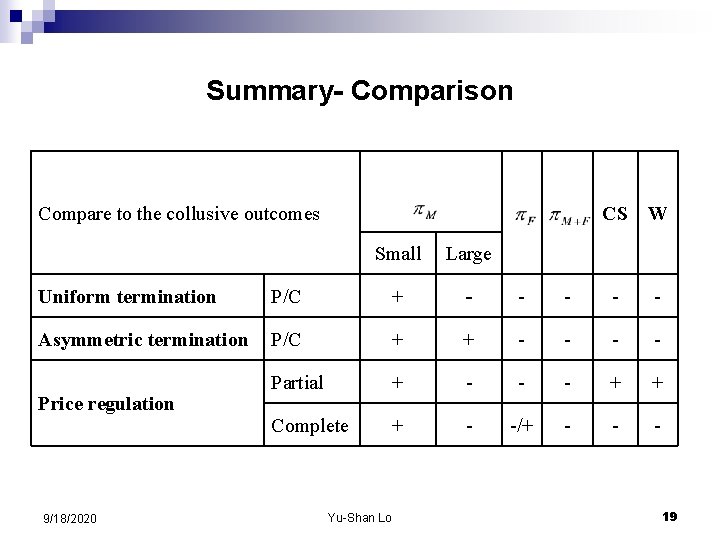
Partial consumer ignorance: compared to the outcomes of the reciprocal termination charge, the uniform termination charge regime yields; n Uniform Termination Charge l l l n 9/18/2020 higher termination charge and higher calling prices except for the fixed on-net calls, which remains the monopoly level as in the reciprocal termination regime; higher profit for small mobile network while lower profit for large mobile network and the fixed network; lower industry profit, consumer surplus and social welfare. The extent of consumer ignorance enhances the horizontal effect and has a negative effect on social welfare. Yu-Shan Lo 14
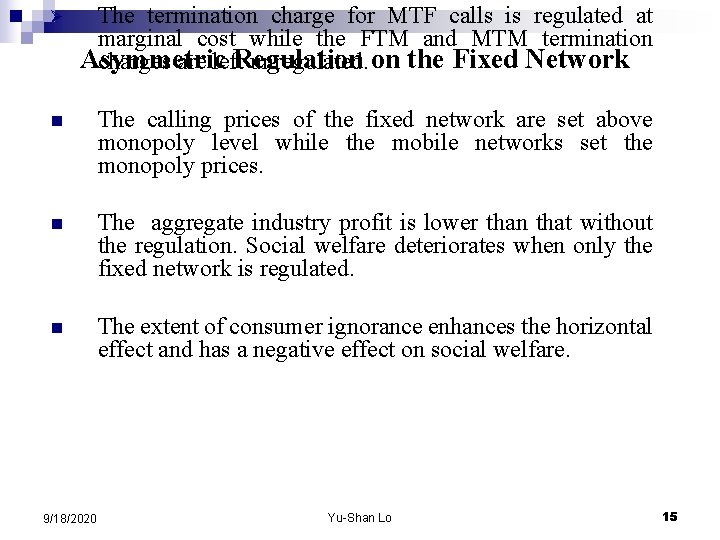
Ø The termination charge for MTF calls is regulated at marginal cost while the FTM and MTM termination Asymmetric charges are left. Regulation unregulated. on the Fixed Network n The calling prices of the fixed network are set above monopoly level while the mobile networks set the monopoly prices. n The aggregate industry profit is lower than that without the regulation. Social welfare deteriorates when only the fixed network is regulated. n The extent of consumer ignorance enhances the horizontal effect and has a negative effect on social welfare. 9/18/2020 Yu-Shan Lo 15
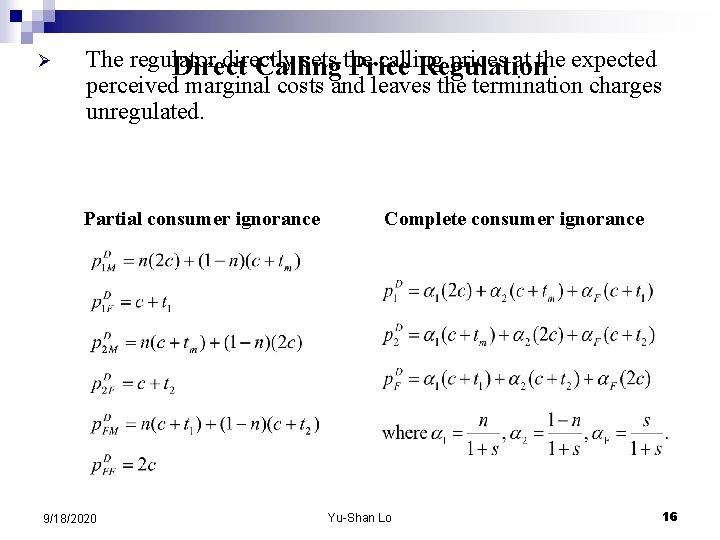
Ø The regulator directly sets the calling prices at the expected Direct Calling Price Regulation perceived marginal costs and leaves the termination charges unregulated. Partial consumer ignorance 9/18/2020 Complete consumer ignorance Yu-Shan Lo 16
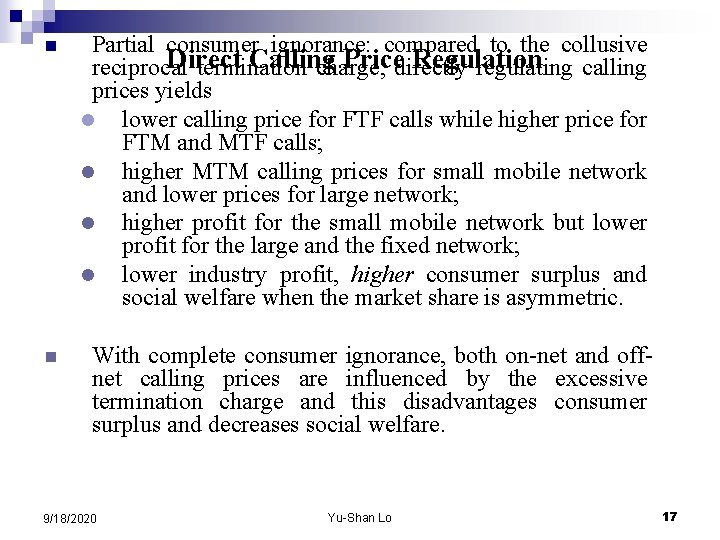
n n Partial consumer ignorance: compared to the collusive Direct Calling Pricedirectly Regulation reciprocal termination charge, regulating calling prices yields l lower calling price for FTF calls while higher price for FTM and MTF calls; l higher MTM calling prices for small mobile network and lower prices for large network; l higher profit for the small mobile network but lower profit for the large and the fixed network; l lower industry profit, higher consumer surplus and social welfare when the market share is asymmetric. With complete consumer ignorance, both on-net and offnet calling prices are influenced by the excessive termination charge and this disadvantages consumer surplus and decreases social welfare. 9/18/2020 Yu-Shan Lo 17
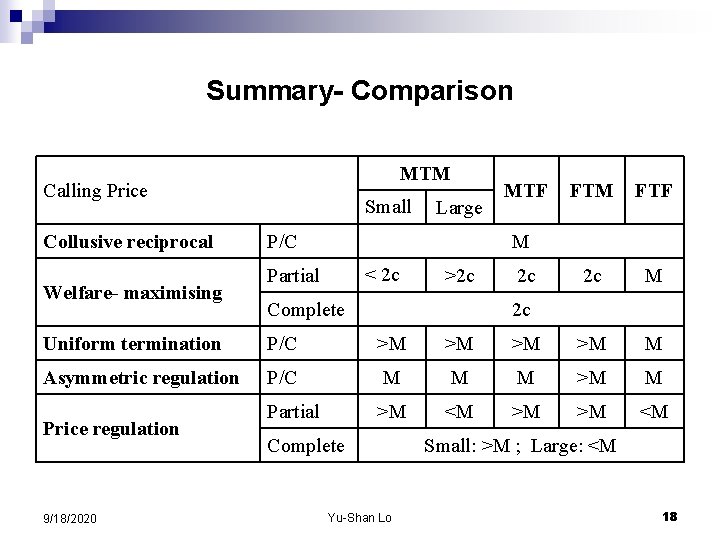
Summary- Comparison MTM Calling Price Collusive reciprocal Welfare- maximising Small Large P/C MTF FTM FTF 2 c M M < 2 c Partial >2 c Complete 2 c 2 c Uniform termination P/C >M >M M Asymmetric regulation P/C M M M >M M Partial >M <M >M >M <M Price regulation 9/18/2020 Complete Yu-Shan Lo Small: >M ; Large: <M 18
Summary- Comparison CS W Compare to the collusive outcomes Small Large Uniform termination P/C + - - - Asymmetric termination P/C + + - - Partial + - - - + + Complete + - -/+ - - - Price regulation 9/18/2020 Yu-Shan Lo 19
Policy Implication n Compared to the uniform termination charge and asymmetric regulation, the regulator can improve social welfare, without too much intervention, by imposing reciprocal termination charges. n Instead of regulating termination charges, direct regulating calling prices may be a welfare-improving alternative. However, the extent of consumer ignorance need to be taken into consideration since it may reverse the regulatory outcome. 9/18/2020 Yu-Shan Lo 20