March 11 2008 QUIZ FRIDAY Architecture Styles QUIZ

- Slides: 29
March 11, 2008 QUIZ FRIDAY – Architecture Styles QUIZ WEDNESDAY – Construction Methods U 2 -L 2
STYLES / VOCAB QUIZ FRIDAY Be able to identify all styles and at least 3 characteristics. Also, be able to match vocabulary with definition or picture. U 2 -L 2
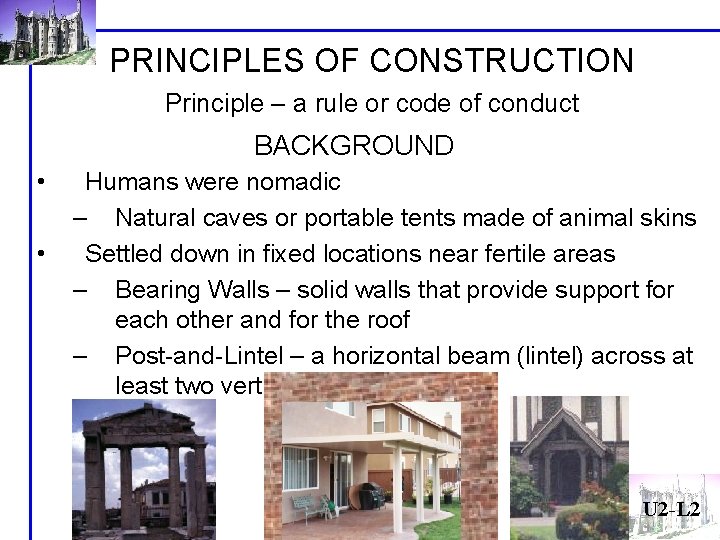
PRINCIPLES OF CONSTRUCTION Principle – a rule or code of conduct BACKGROUND • • Humans were nomadic – Natural caves or portable tents made of animal skins Settled down in fixed locations near fertile areas – Bearing Walls – solid walls that provide support for each other and for the roof – Post-and-Lintel – a horizontal beam (lintel) across at least two vertical posts U 2 -L 2
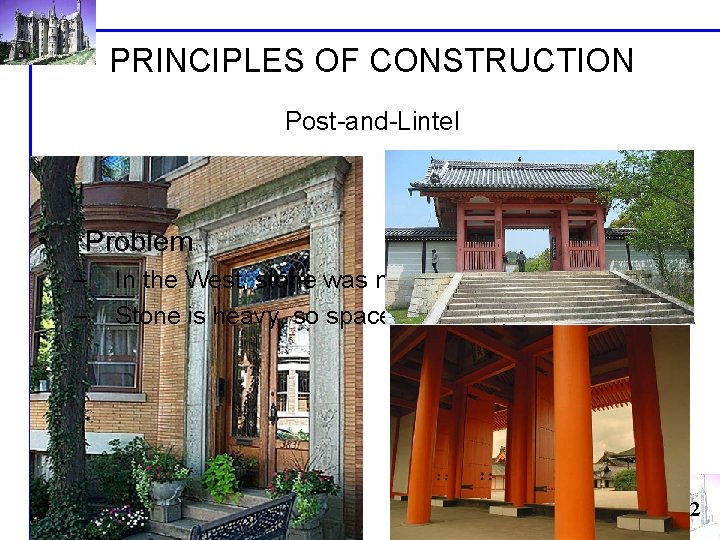
PRINCIPLES OF CONSTRUCTION Post-and-Lintel • Problem – – In the West, stone was material used most often. Stone is heavy, so space between posts was limited. U 2 -L 2
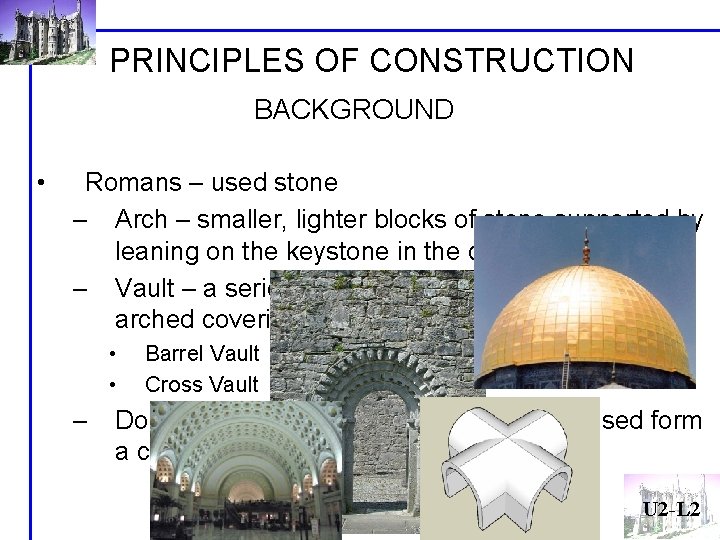
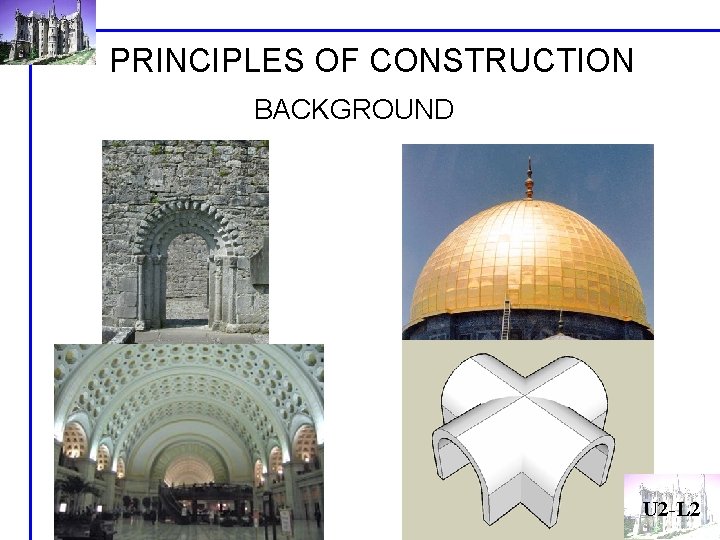
PRINCIPLES OF CONSTRUCTION BACKGROUND • Romans – used stone – Arch – smaller, lighter blocks of stone supported by leaning on the keystone in the center – Vault – a series of arches that forms a continuous arched covering • • – Barrel Vault Cross Vault Dome – many arches arranged so their based form a circle and their tops meet in the center U 2 -L 2
PRINCIPLES OF CONSTRUCTION BACKGROUND U 2 -L 2
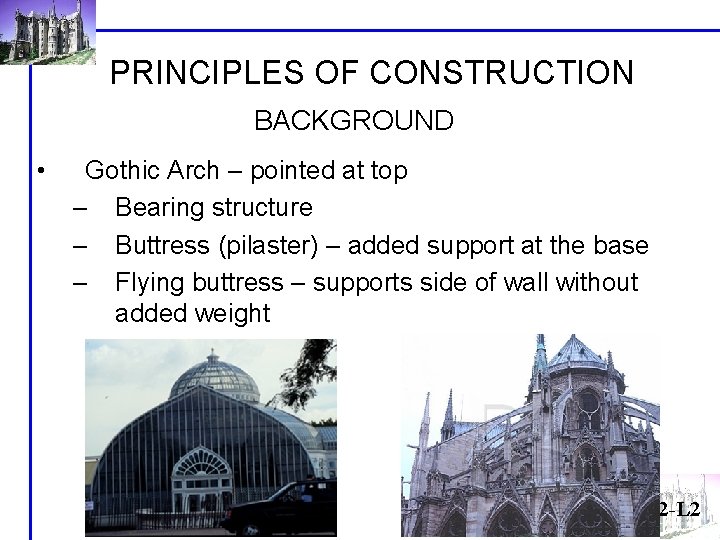
PRINCIPLES OF CONSTRUCTION BACKGROUND • Gothic Arch – pointed at top – Bearing structure – Buttress (pilaster) – added support at the base – Flying buttress – supports side of wall without added weight U 2 -L 2
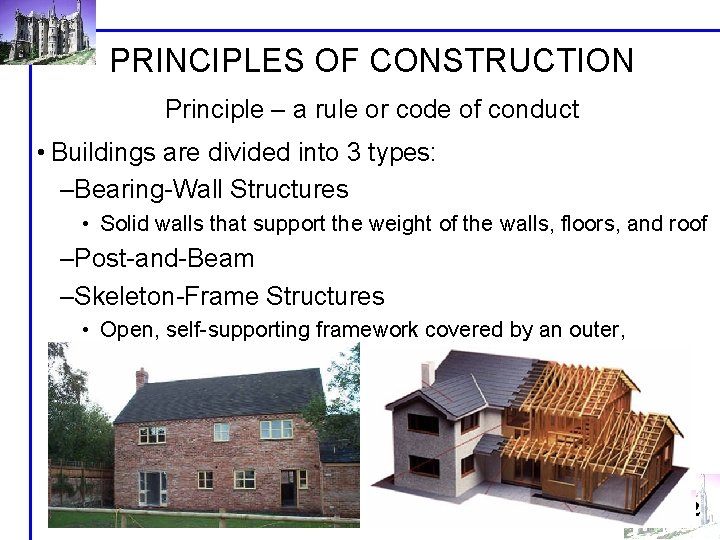
PRINCIPLES OF CONSTRUCTION Principle – a rule or code of conduct • Buildings are divided into 3 types: –Bearing-Wall Structures • Solid walls that support the weight of the walls, floors, and roof –Post-and-Beam –Skeleton-Frame Structures • Open, self-supporting framework covered by an outer, nonbearing surface U 2 -L 2
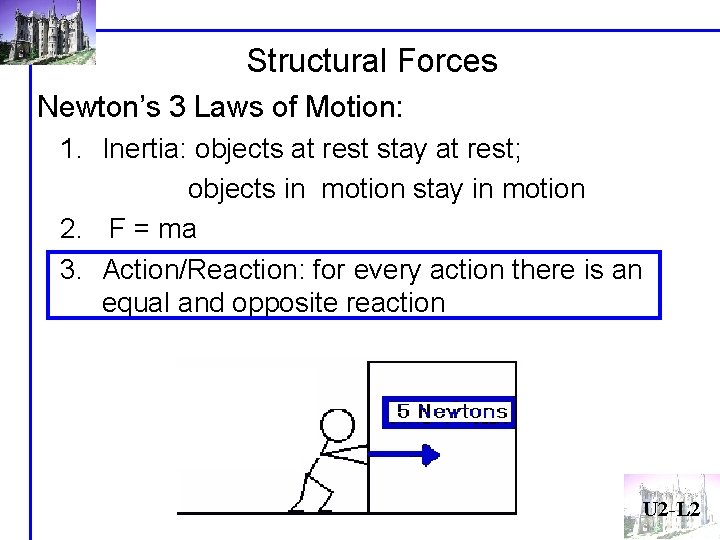
Structural Forces Newton’s 3 Laws of Motion: 1. Inertia: objects at rest stay at rest; objects in motion stay in motion 2. F = ma 3. Action/Reaction: for every action there is an equal and opposite reaction U 2 -L 2
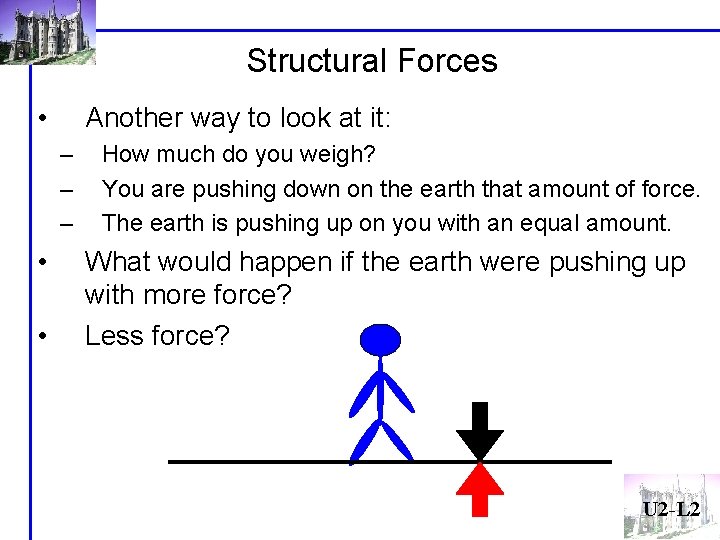
Structural Forces • Another way to look at it: – – – • • How much do you weigh? You are pushing down on the earth that amount of force. The earth is pushing up on you with an equal amount. What would happen if the earth were pushing up with more force? Less force? U 2 -L 2
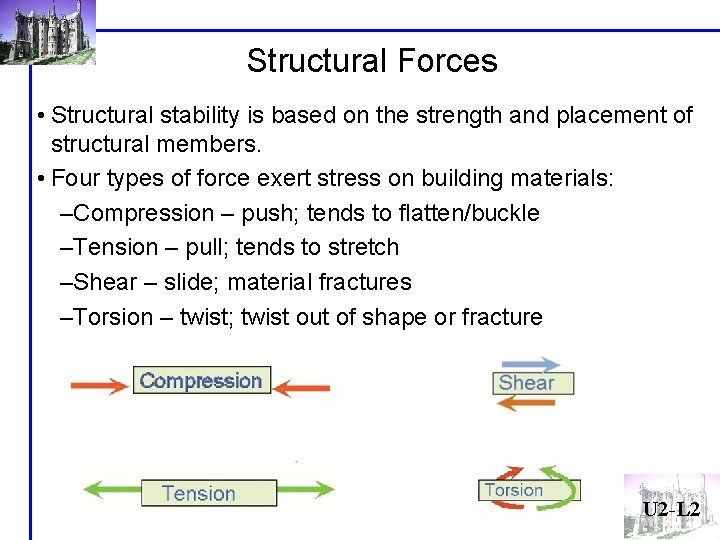
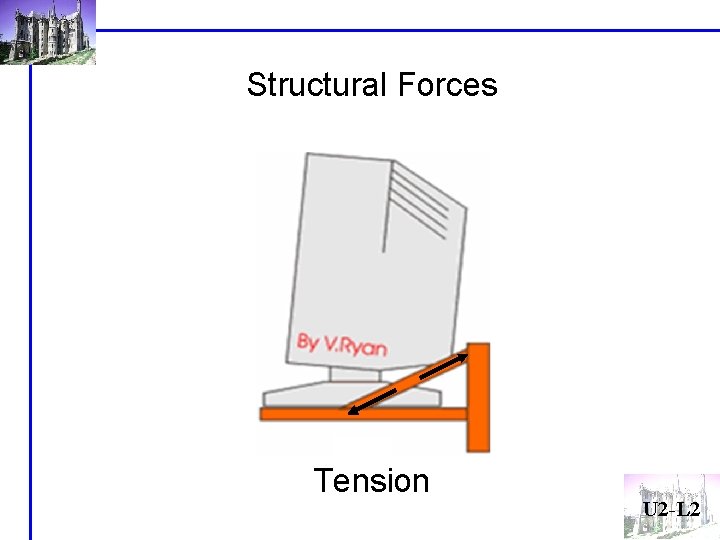
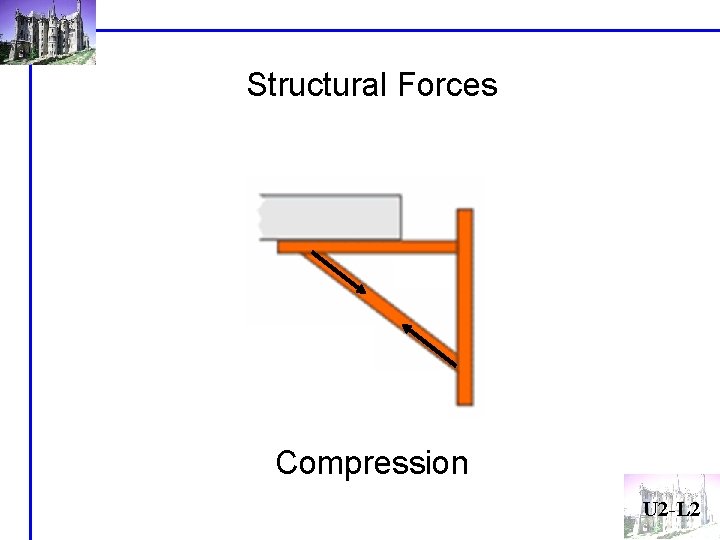
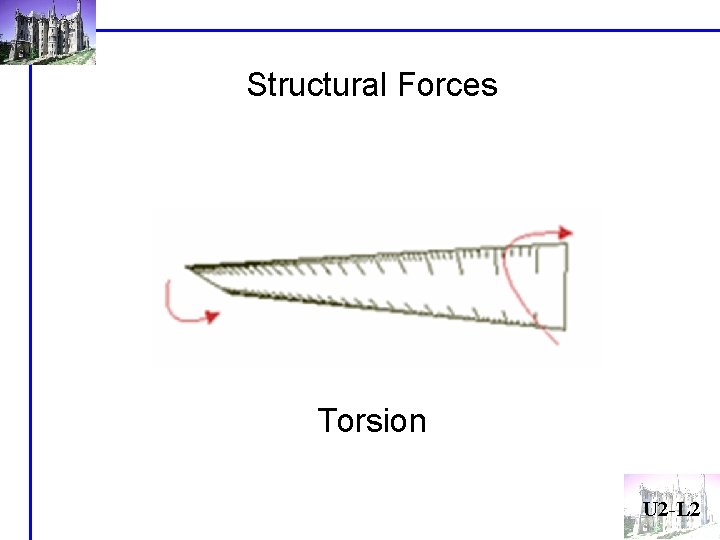
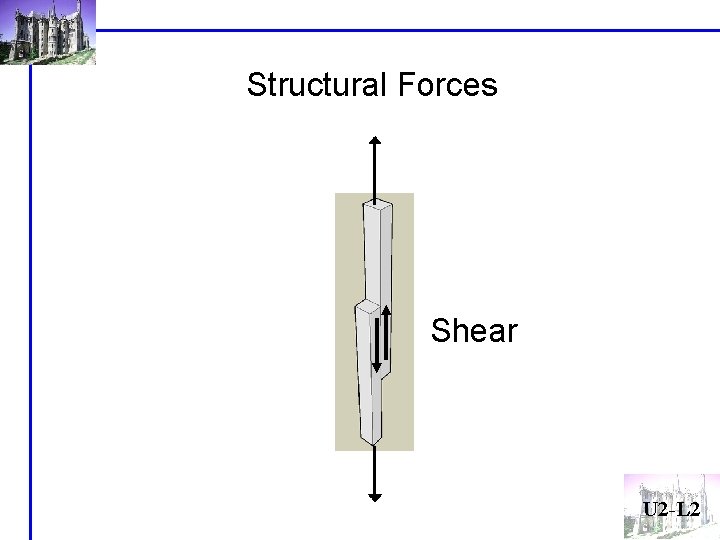
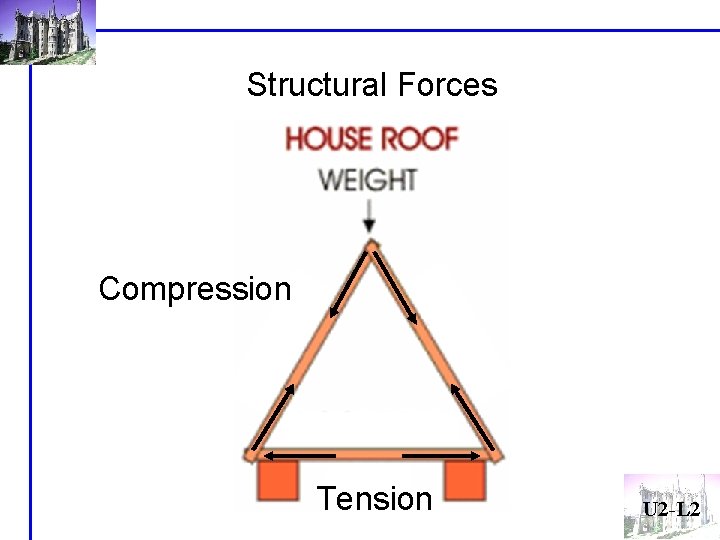
Structural Forces • Structural stability is based on the strength and placement of structural members. • Four types of force exert stress on building materials: –Compression – push; tends to flatten/buckle –Tension – pull; tends to stretch –Shear – slide; material fractures –Torsion – twist; twist out of shape or fracture U 2 -L 2
Structural Forces Tension U 2 -L 2
Structural Forces Compression U 2 -L 2
Structural Forces Torsion U 2 -L 2
Structural Forces Shear U 2 -L 2
Structural Forces Compression Tension U 2 -L 2
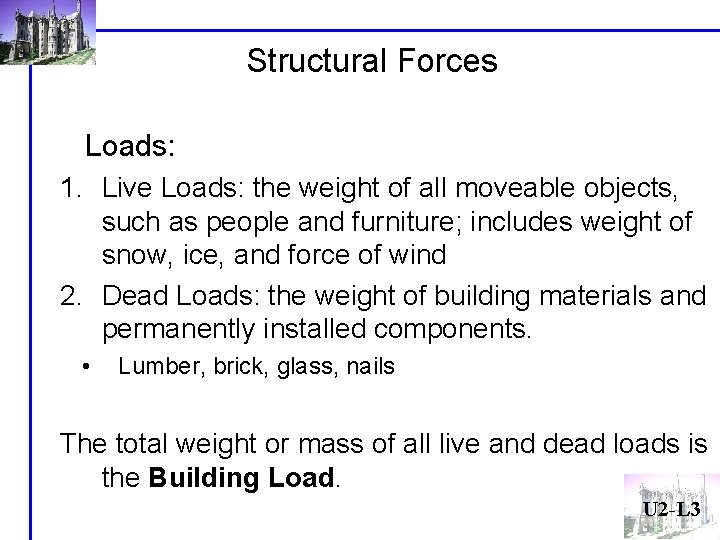
Structural Forces Loads: 1. Live Loads: the weight of all moveable objects, such as people and furniture; includes weight of snow, ice, and force of wind 2. Dead Loads: the weight of building materials and permanently installed components. • Lumber, brick, glass, nails The total weight or mass of all live and dead loads is the Building Load. U 2 -L 3
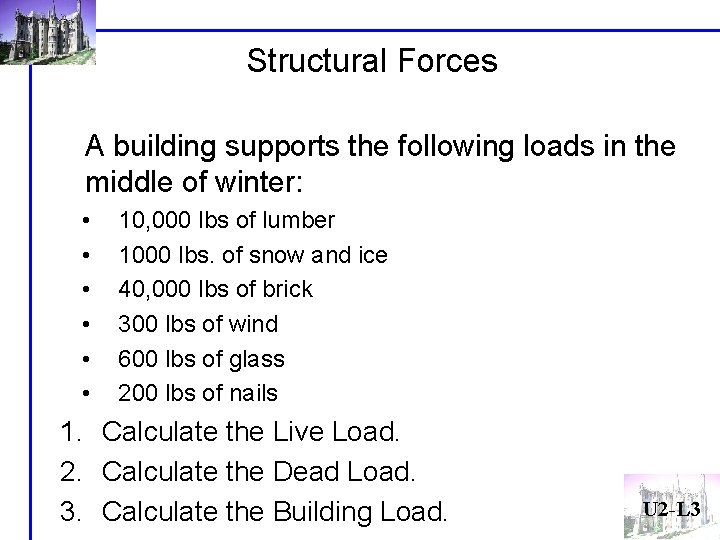
Structural Forces A building supports the following loads in the middle of winter: • • • 10, 000 lbs of lumber 1000 lbs. of snow and ice 40, 000 lbs of brick 300 lbs of wind 600 lbs of glass 200 lbs of nails 1. Calculate the Live Load. 2. Calculate the Dead Load. 3. Calculate the Building Load. U 2 -L 3
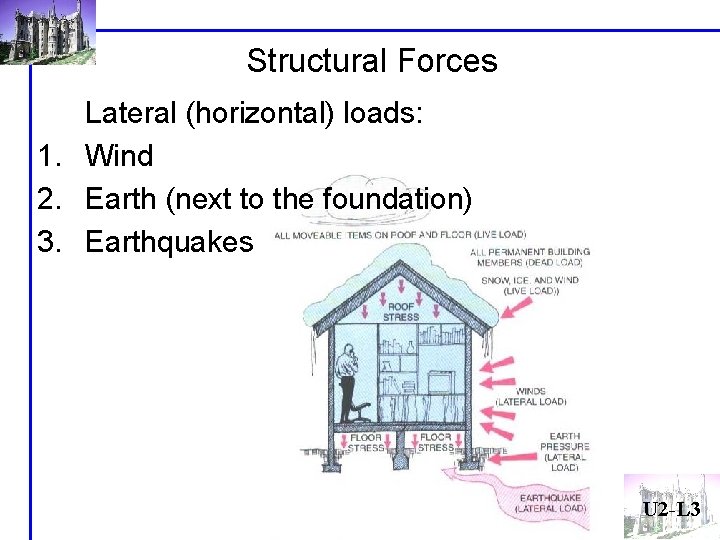
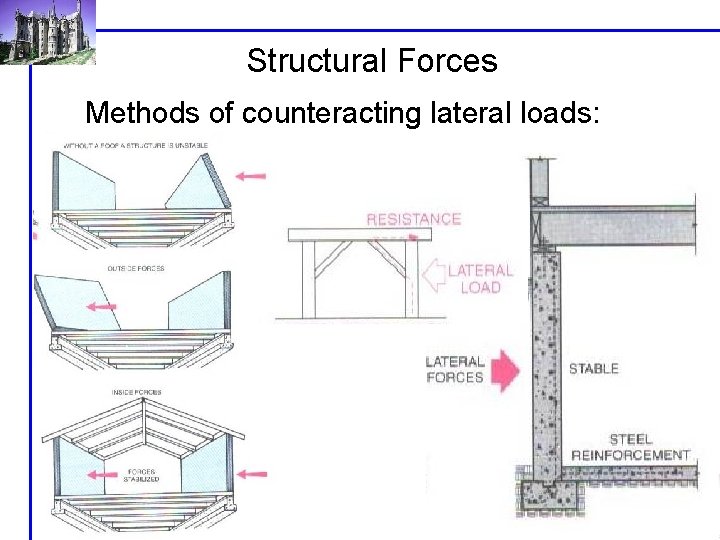
Structural Forces Lateral (horizontal) loads: 1. Wind 2. Earth (next to the foundation) 3. Earthquakes U 2 -L 3
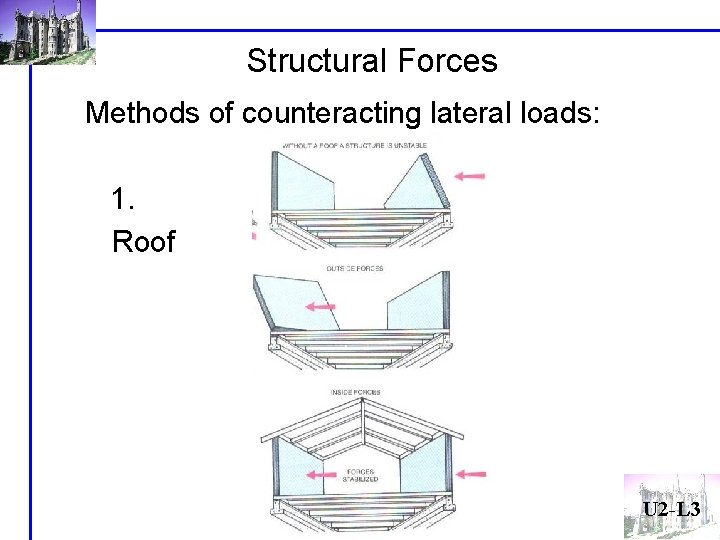
Structural Forces Methods of counteracting lateral loads: 1. Roof U 2 -L 3
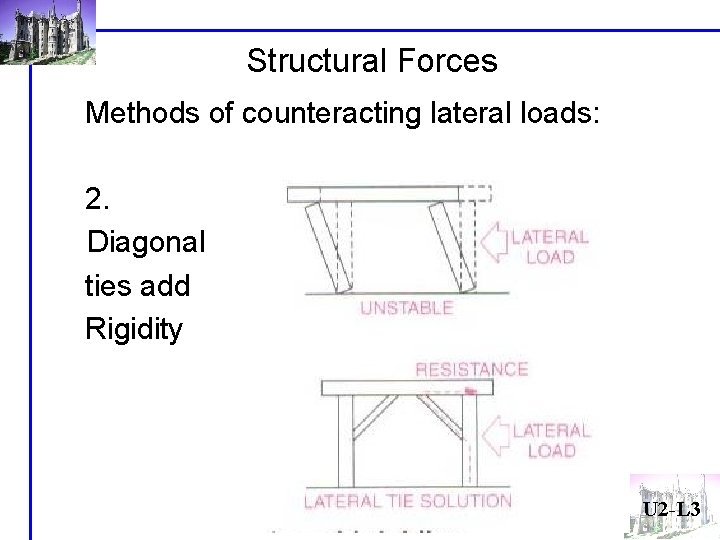
Structural Forces Methods of counteracting lateral loads: 2. Diagonal ties add Rigidity U 2 -L 3
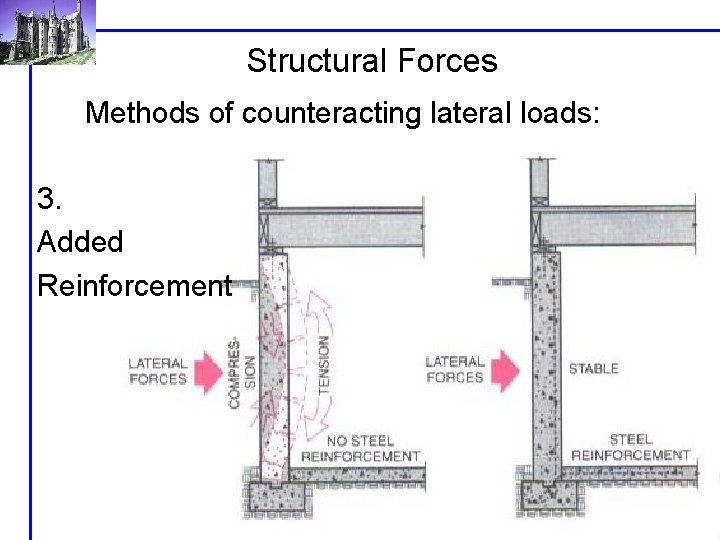
Structural Forces Methods of counteracting lateral loads: 3. Added Reinforcement U 2 -L 3
Structural Forces Methods of counteracting lateral loads: U 2 -L 3
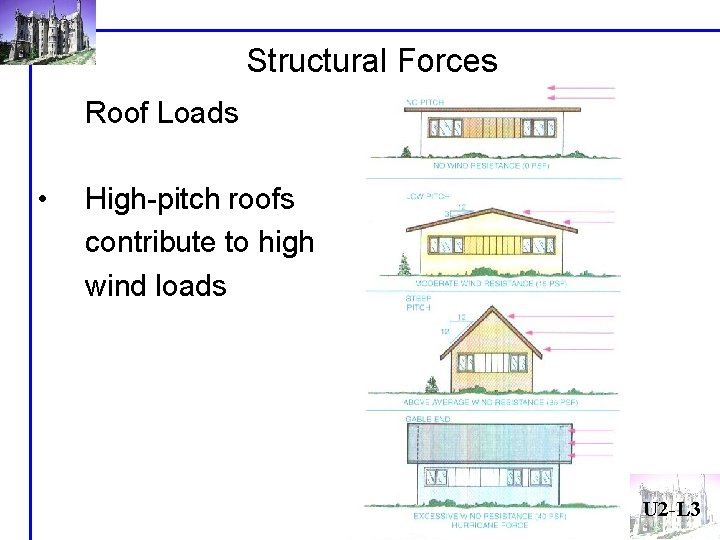
Structural Forces Roof Loads • High-pitch roofs contribute to high wind loads U 2 -L 3
Strength of Materials • Strength of a construction material is the capacity to support loads by resisting the 4 structural forces. Strength depends on material • – – – Type Size Shape U 2 -L 3
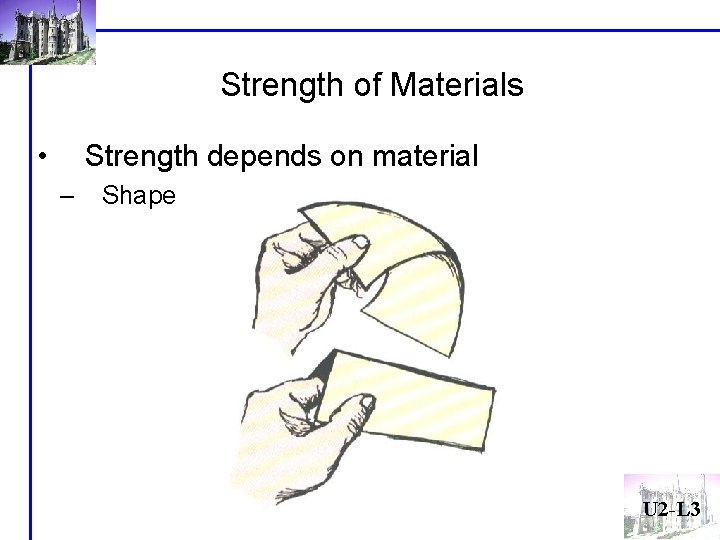
Strength of Materials • Strength depends on material – Shape U 2 -L 3
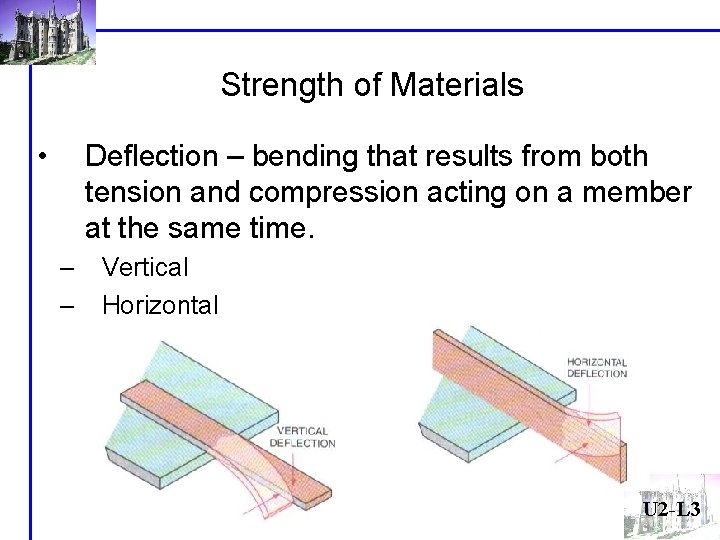
Strength of Materials • Deflection – bending that results from both tension and compression acting on a member at the same time. – – Vertical Horizontal U 2 -L 3
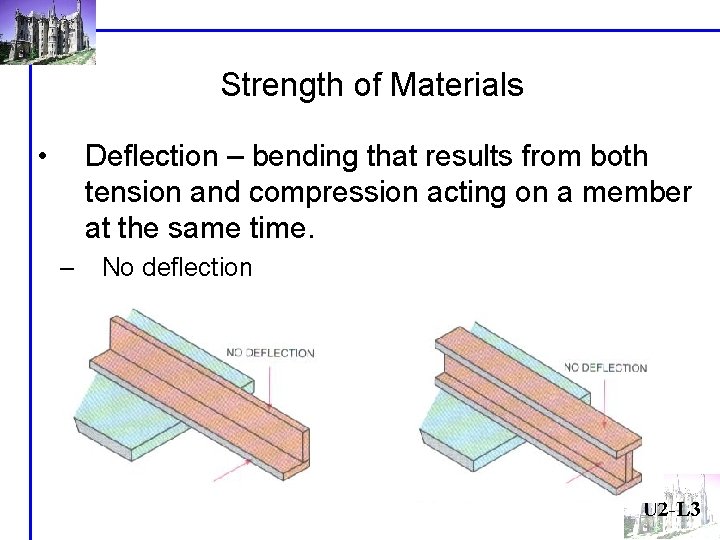
Strength of Materials • Deflection – bending that results from both tension and compression acting on a member at the same time. – No deflection U 2 -L 3
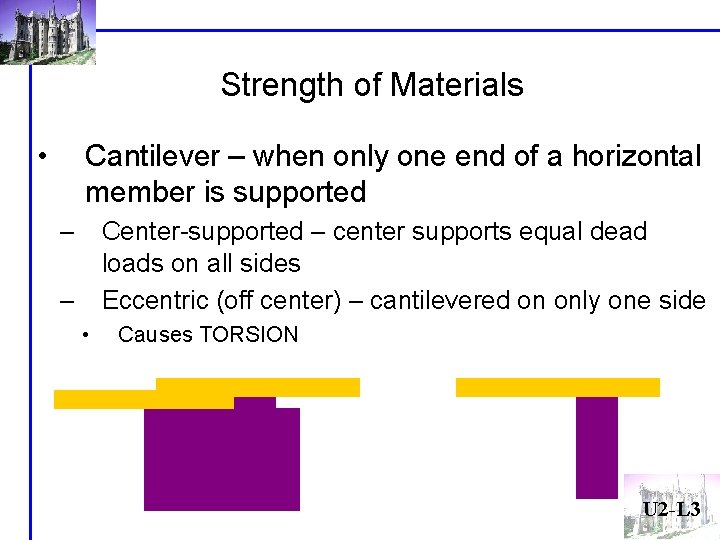
Strength of Materials • Cantilever – when only one end of a horizontal member is supported – Center-supported – center supports equal dead loads on all sides Eccentric (off center) – cantilevered on only one side – • Causes TORSION U 2 -L 3