Literature Review Avian Materials and Structures Cornified and

- Slides: 44
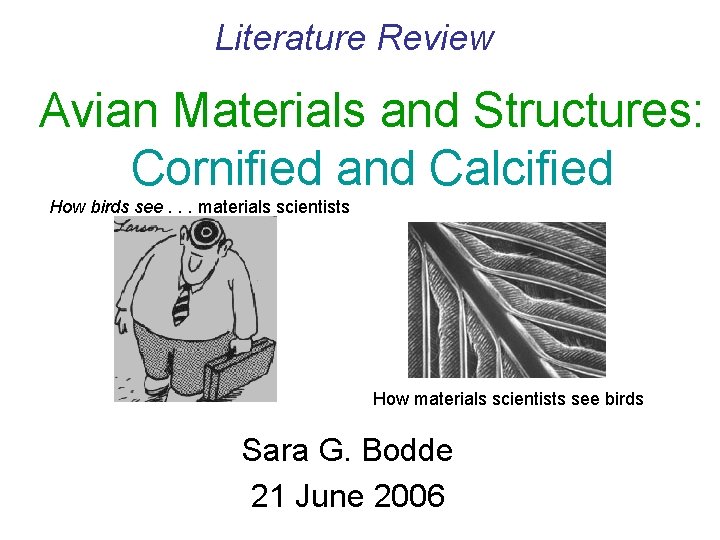
Literature Review Avian Materials and Structures: Cornified and Calcified How birds see. . . materials scientists How materials scientists see birds Sara G. Bodde 21 June 2006
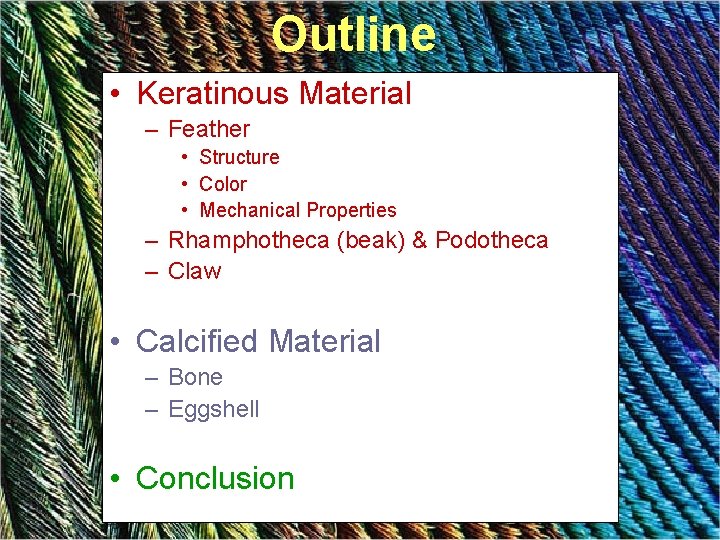
Outline • Keratinous Material – Feather • Structure • Color • Mechanical Properties – Rhamphotheca (beak) & Podotheca – Claw • Calcified Material – Bone – Eggshell • Conclusion
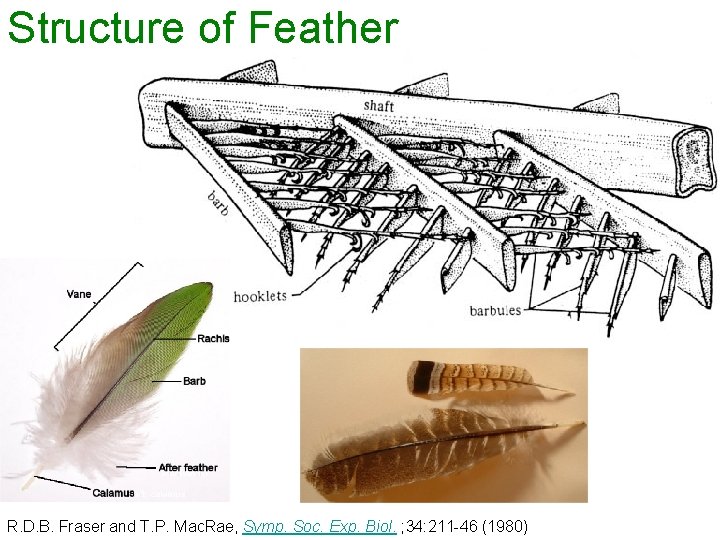
Structure of Feather R. D. B. Fraser and T. P. Mac. Rae, Symp. Soc. Exp. Biol. ; 34: 211 -46 (1980)
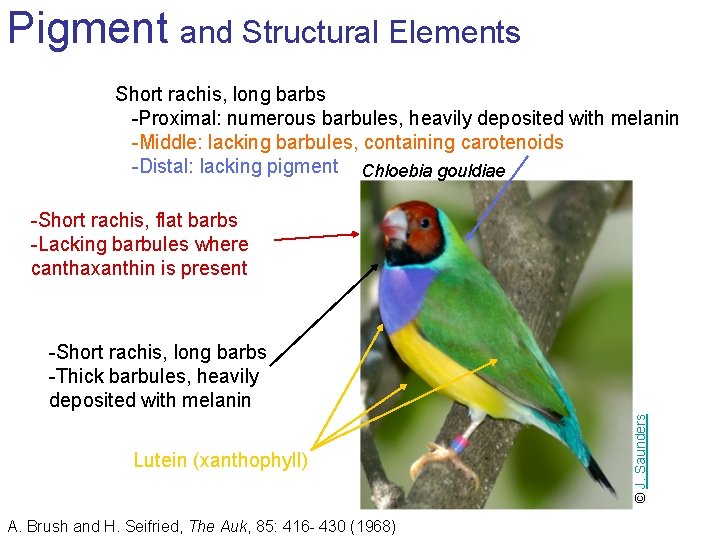
Pigment and Structural Elements Short rachis, long barbs -Proximal: numerous barbules, heavily deposited with melanin -Middle: lacking barbules, containing carotenoids -Distal: lacking pigment Chloebia gouldiae -Short rachis, long barbs -Thick barbules, heavily deposited with melanin Lutein (xanthophyll) A. Brush and H. Seifried, The Auk, 85: 416 - 430 (1968) © J. Saunders -Short rachis, flat barbs -Lacking barbules where canthaxanthin is present
Colors: Pigmentary • Melanin – Eumelanin – Phaeomelanin • Others • Carotenoids – Xanthophylls (oxidized carotenoids) – Turacoverdin unique to Touracos (Musophagidae) – Turacin – Psittacofulvins • Astaxanthin: pheasant wattles • Lutein, zeaxanthin: egg yolk Tauraco persa • β-carotene • Rhodopsin • Fluorescent ? • UV H. M Fox and G. Vevers, The Nature of Animal Colours (1960) © D. Janson – Carotenes:
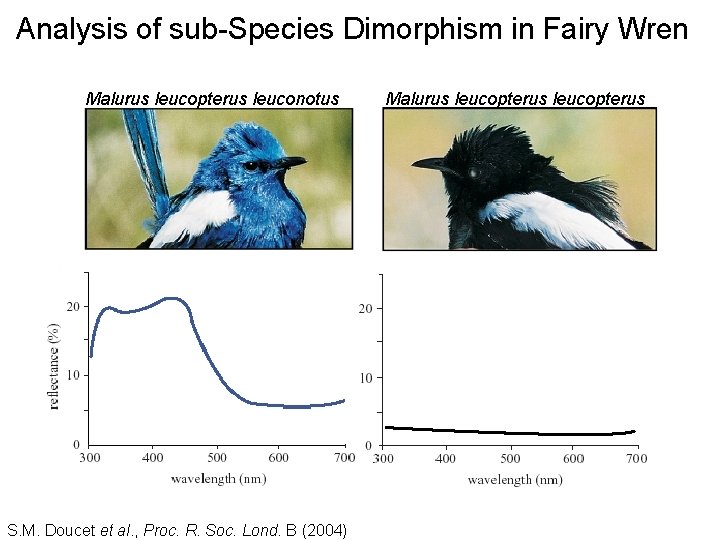
Analysis of sub-Species Dimorphism in Fairy Wren Malurus leucopterus leuconotus S. M. Doucet et al. , Proc. R. Soc. Lond. B (2004) Malurus leucopterus
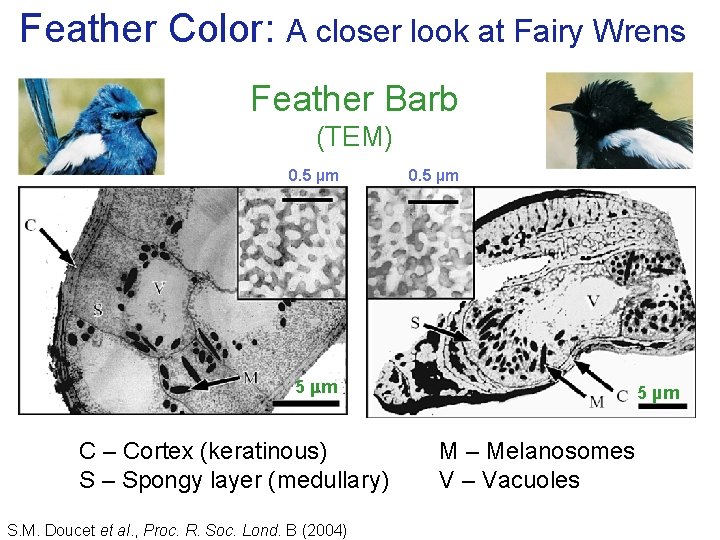
Feather Color: A closer look at Fairy Wrens Feather Barb (TEM) 0. 5 µm C – Cortex (keratinous) S – Spongy layer (medullary) S. M. Doucet et al. , Proc. R. Soc. Lond. B (2004) 5 µm M – Melanosomes V – Vacuoles
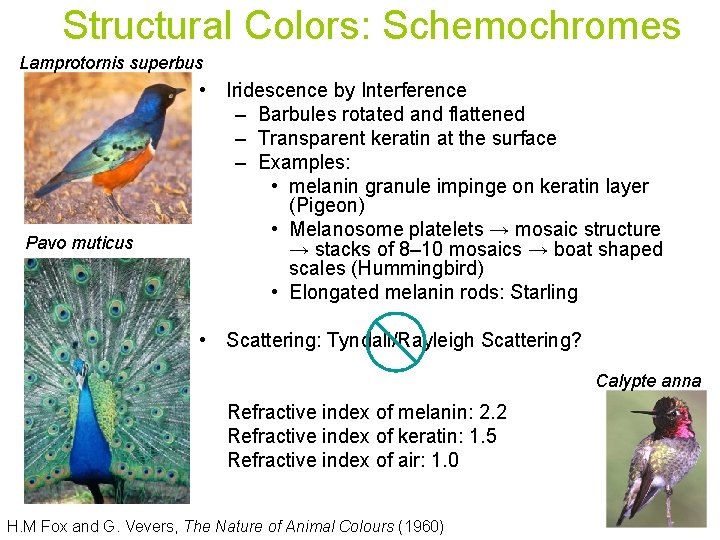
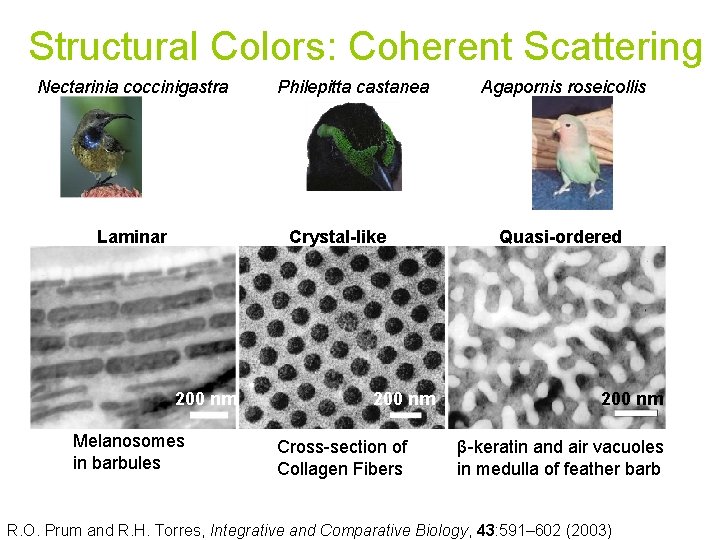
Structural Colors: Schemochromes Lamprotornis superbus Pavo muticus • Iridescence by Interference – Barbules rotated and flattened – Transparent keratin at the surface – Examples: • melanin granule impinge on keratin layer (Pigeon) • Melanosome platelets → mosaic structure → stacks of 8– 10 mosaics → boat shaped scales (Hummingbird) • Elongated melanin rods: Starling • Scattering: Tyndall/Rayleigh Scattering? Calypte anna Refractive index of melanin: 2. 2 Refractive index of keratin: 1. 5 Refractive index of air: 1. 0 H. M Fox and G. Vevers, The Nature of Animal Colours (1960)
Structural Colors: Coherent Scattering Nectarinia coccinigastra Laminar Philepitta castanea Crystal-like 200 nm Melanosomes in barbules 200 nm Cross-section of Collagen Fibers Agapornis roseicollis Quasi-ordered 200 nm β-keratin and air vacuoles in medulla of feather barb R. O. Prum and R. H. Torres, Integrative and Comparative Biology, 43: 591– 602 (2003)
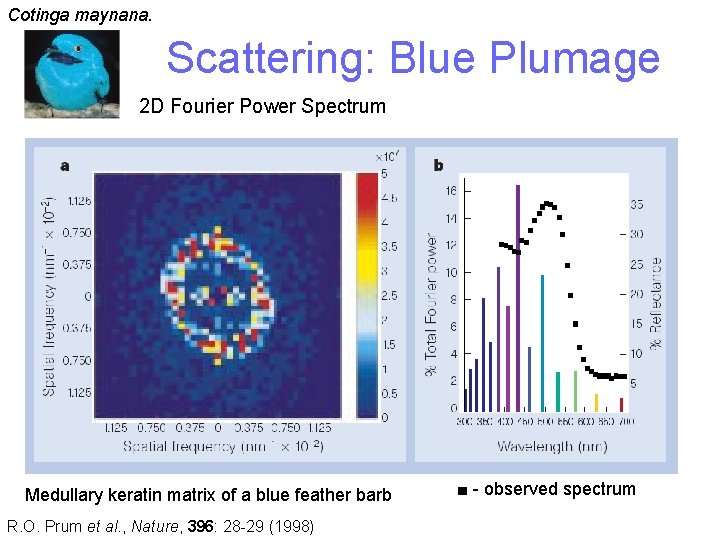
Cotinga maynana. Scattering: Blue Plumage 2 D Fourier Power Spectrum Medullary keratin matrix of a blue feather barb R. O. Prum et al. , Nature, 396: 28 -29 (1998) ■ - observed spectrum
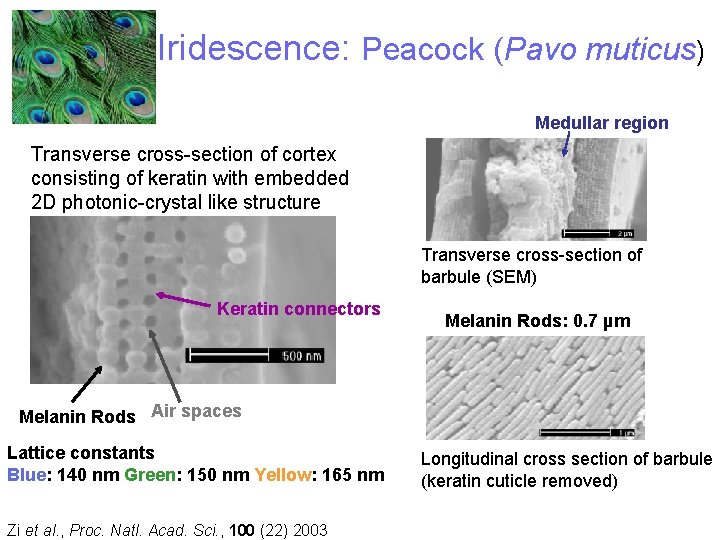
Iridescence: Peacock (Pavo muticus) Medullar region Transverse cross-section of cortex consisting of keratin with embedded 2 D photonic-crystal like structure Transverse cross-section of barbule (SEM) Keratin connectors Melanin Rods: 0. 7 µm Melanin Rods Air spaces Lattice constants Blue: 140 nm Green: 150 nm Yellow: 165 nm Zi et al. , Proc. Natl. Acad. Sci. , 100 (22) 2003 Longitudinal cross section of barbule (keratin cuticle removed)
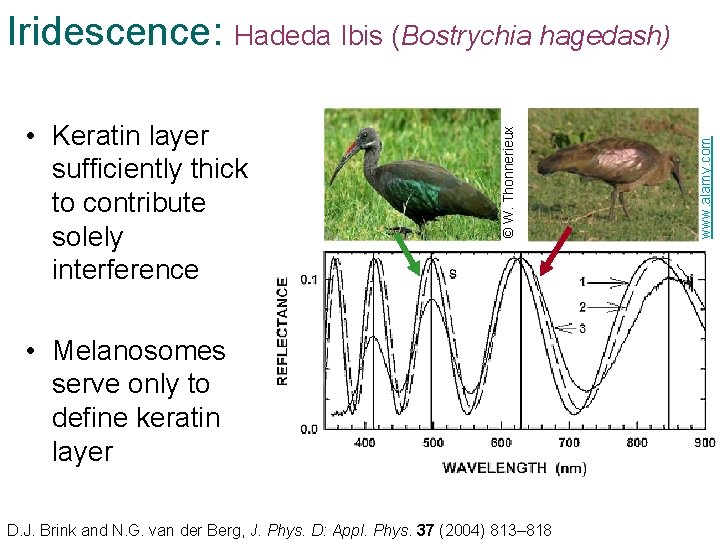
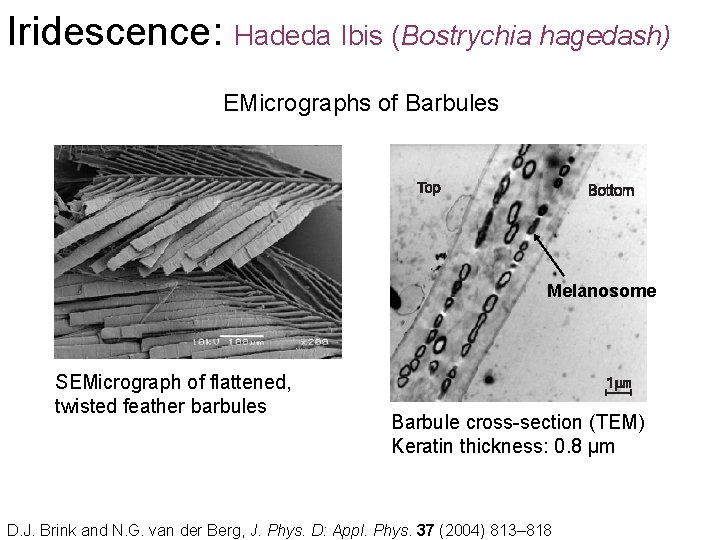
• Melanosomes serve only to define keratin layer D. J. Brink and N. G. van der Berg, J. Phys. D: Appl. Phys. 37 (2004) 813– 818 www. alamy. com • Keratin layer sufficiently thick to contribute solely interference © W. Thonnerieux Iridescence: Hadeda Ibis (Bostrychia hagedash)
Iridescence: Hadeda Ibis (Bostrychia hagedash) EMicrographs of Barbules Melanosome SEMicrograph of flattened, twisted feather barbules Barbule cross-section (TEM) Keratin thickness: 0. 8 µm D. J. Brink and N. G. van der Berg, J. Phys. D: Appl. Phys. 37 (2004) 813– 818
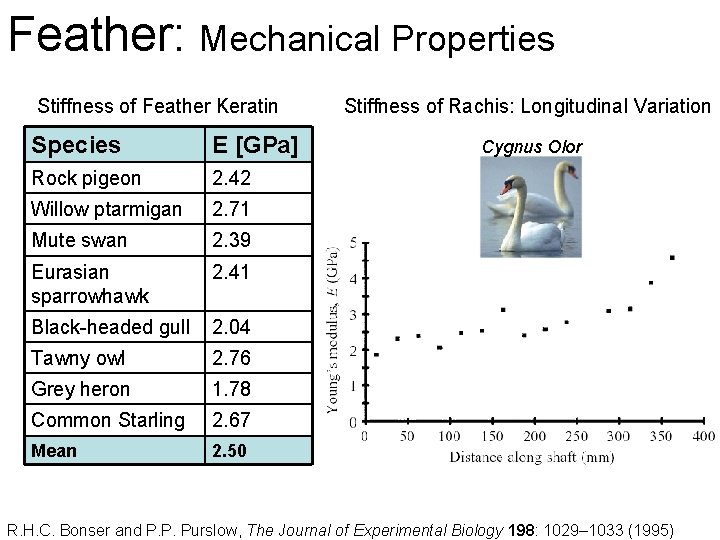
Feather: Mechanical Properties Stiffness of Feather Keratin Species E [GPa] Rock pigeon 2. 42 Willow ptarmigan 2. 71 Mute swan 2. 39 Eurasian sparrowhawk 2. 41 Black-headed gull 2. 04 Tawny owl 2. 76 Grey heron 1. 78 Common Starling 2. 67 Mean 2. 50 Stiffness of Rachis: Longitudinal Variation Cygnus Olor R. H. C. Bonser and P. P. Purslow, The Journal of Experimental Biology 198: 1029– 1033 (1995)
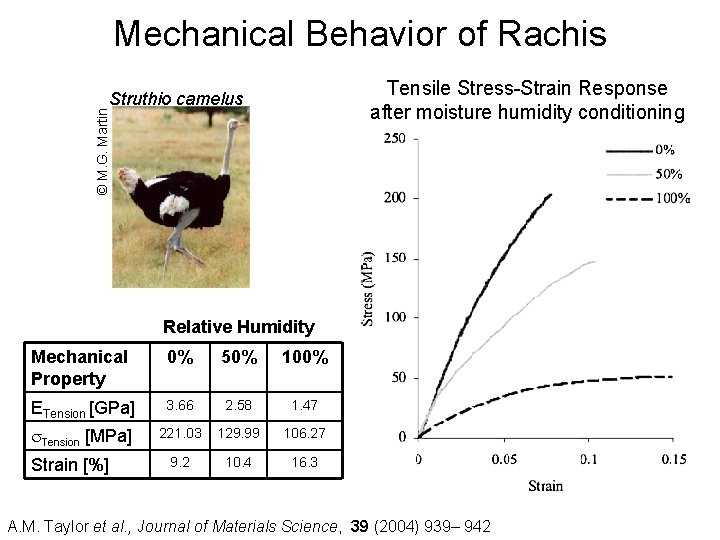
Mechanical Behavior of Rachis Tensile Stress-Strain Response after moisture humidity conditioning © M. G. Martin Struthio camelus Relative Humidity Mechanical Property 0% 50% 100% ETension [GPa] 3. 66 2. 58 1. 47 s. Tension [MPa] 221. 03 129. 99 106. 27 9. 2 10. 4 16. 3 Strain [%] A. M. Taylor et al. , Journal of Materials Science, 39 (2004) 939– 942
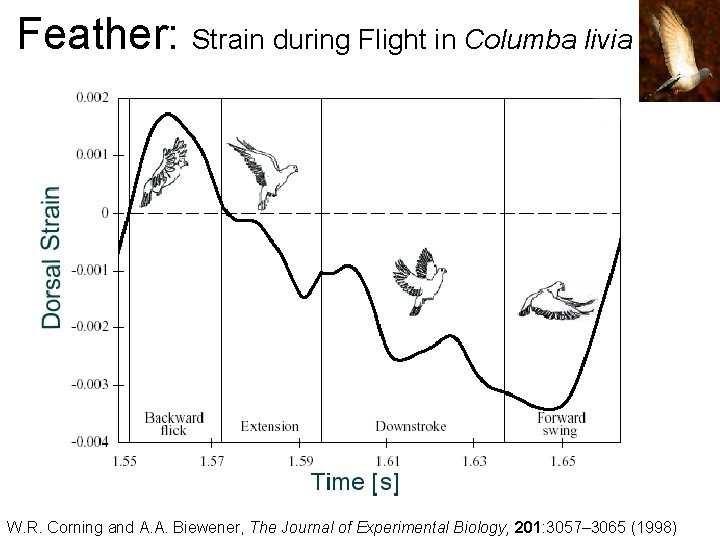
Feather: Strain during Flight in Columba livia W. R. Corning and A. A. Biewener, The Journal of Experimental Biology, 201: 3057– 3065 (1998)
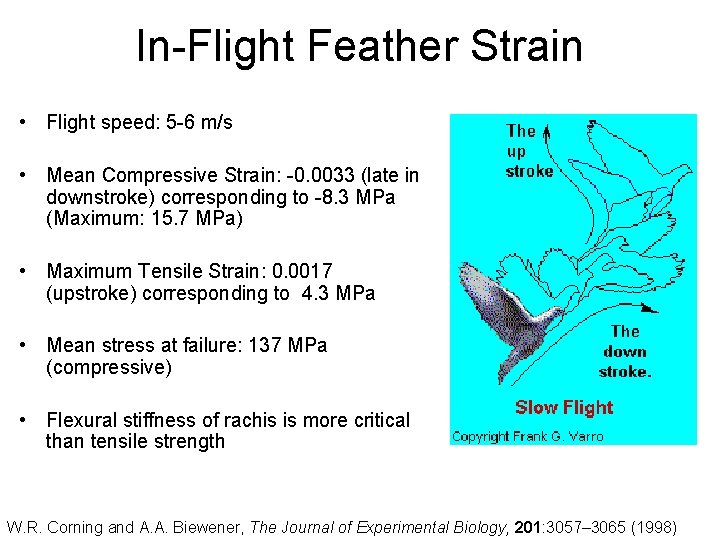
In-Flight Feather Strain • Flight speed: 5 -6 m/s • Mean Compressive Strain: -0. 0033 (late in downstroke) corresponding to -8. 3 MPa (Maximum: 15. 7 MPa) • Maximum Tensile Strain: 0. 0017 (upstroke) corresponding to 4. 3 MPa • Mean stress at failure: 137 MPa (compressive) • Flexural stiffness of rachis is more critical than tensile strength W. R. Corning and A. A. Biewener, The Journal of Experimental Biology, 201: 3057– 3065 (1998)
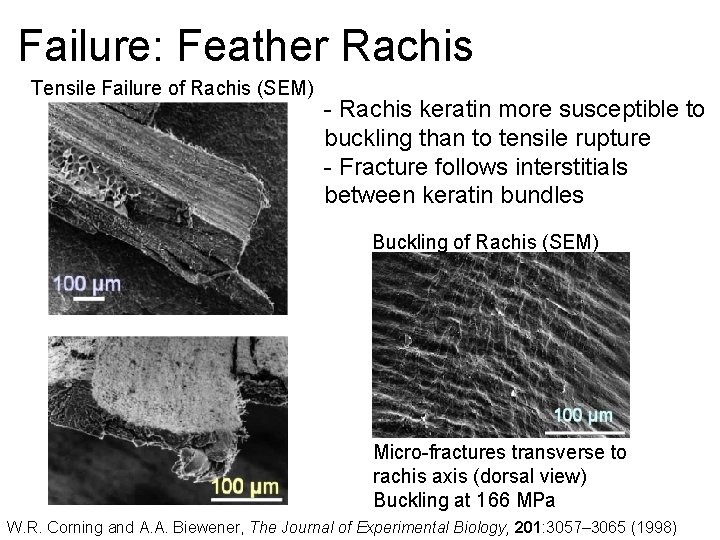
Failure: Feather Rachis Tensile Failure of Rachis (SEM) - Rachis keratin more susceptible to buckling than to tensile rupture - Fracture follows interstitials between keratin bundles Buckling of Rachis (SEM) Micro-fractures transverse to rachis axis (dorsal view) Buckling at 166 MPa W. R. Corning and A. A. Biewener, The Journal of Experimental Biology, 201: 3057– 3065 (1998)
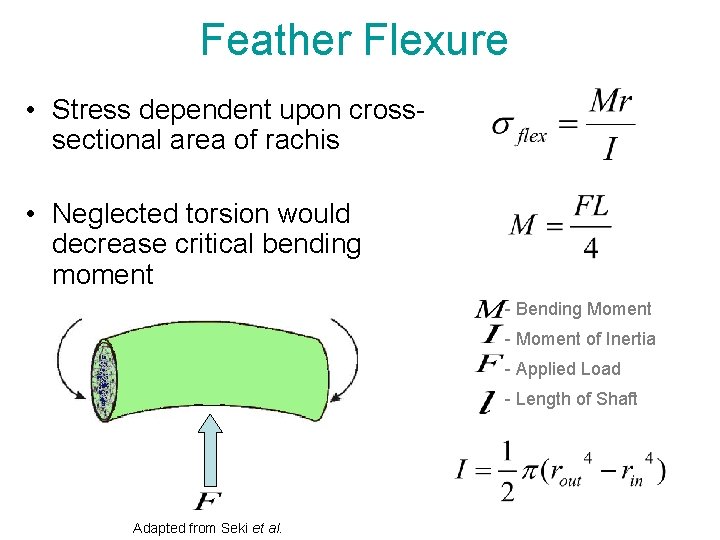
Feather Flexure • Stress dependent upon crosssectional area of rachis • Neglected torsion would decrease critical bending moment - Bending Moment - Moment of Inertia - Applied Load - Length of Shaft Adapted from Seki et al.
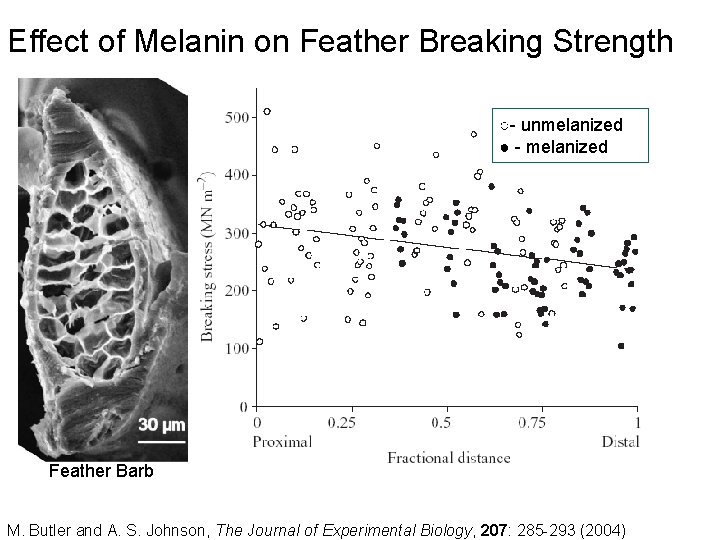
Effect of Melanin on Feather Breaking Strength ○- unmelanized ● - melanized Feather Barb M. Butler and A. S. Johnson, The Journal of Experimental Biology, 207: 285 -293 (2004)
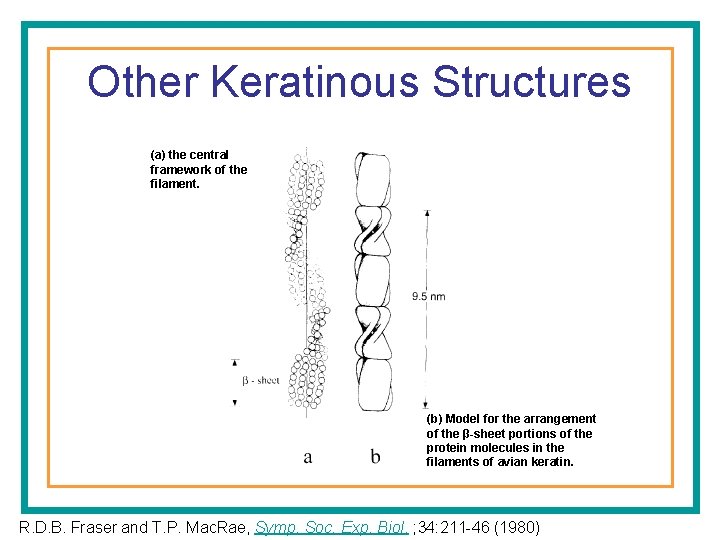
Other Keratinous Structures (a) the central framework of the filament. (b) Model for the arrangement of the β-sheet portions of the protein molecules in the filaments of avian keratin. R. D. B. Fraser and T. P. Mac. Rae, Symp. Soc. Exp. Biol. ; 34: 211 -46 (1980)
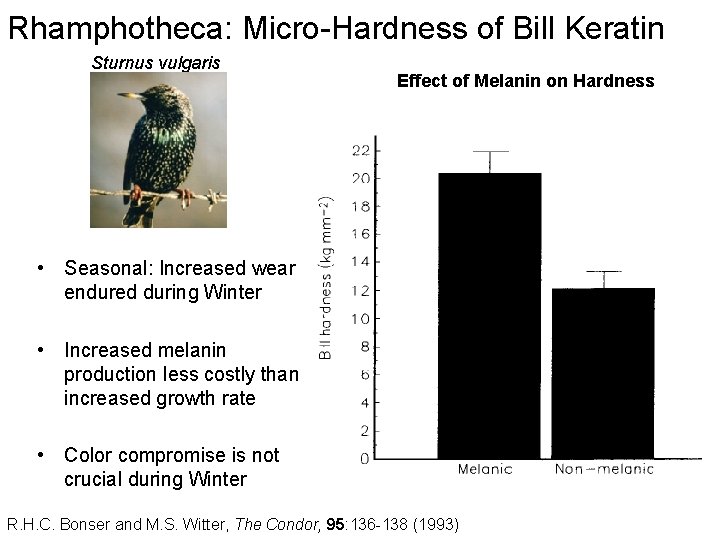
Rhamphotheca: Micro-Hardness of Bill Keratin Sturnus vulgaris Effect of Melanin on Hardness • Seasonal: Increased wear endured during Winter • Increased melanin production less costly than increased growth rate • Color compromise is not crucial during Winter R. H. C. Bonser and M. S. Witter, The Condor, 95: 136 -138 (1993)
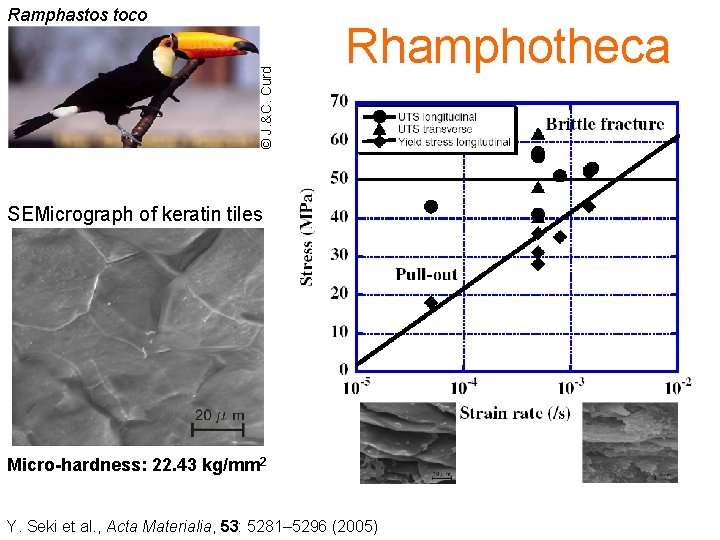
© J. &C. Curd Ramphastos toco Rhamphotheca SEMicrograph of keratin tiles Micro-hardness: 22. 43 kg/mm 2 Y. Seki et al. , Acta Materialia, 53: 5281– 5296 (2005)
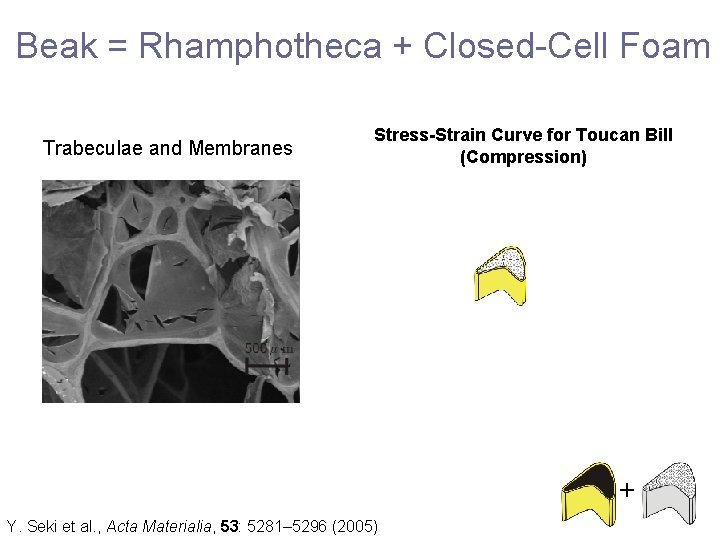
Beak = Rhamphotheca + Closed-Cell Foam Trabeculae and Membranes Stress-Strain Curve for Toucan Bill (Compression) + Y. Seki et al. , Acta Materialia, 53: 5281– 5296 (2005)
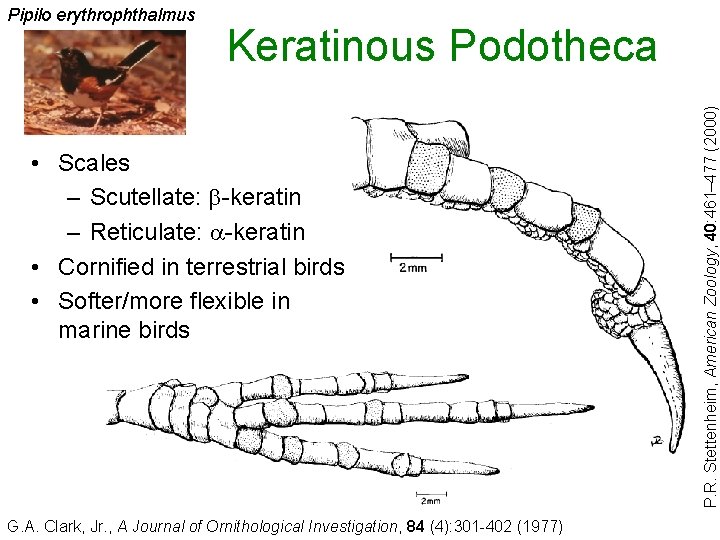
Keratinous Podotheca • Scales – Scutellate: b-keratin – Reticulate: a-keratin • Cornified in terrestrial birds • Softer/more flexible in marine birds G. A. Clark, Jr. , A Journal of Ornithological Investigation, 84 (4): 301 -402 (1977) P. R. Stettenheim, American Zoology, 40: 461– 477 (2000) Pipilo erythrophthalmus
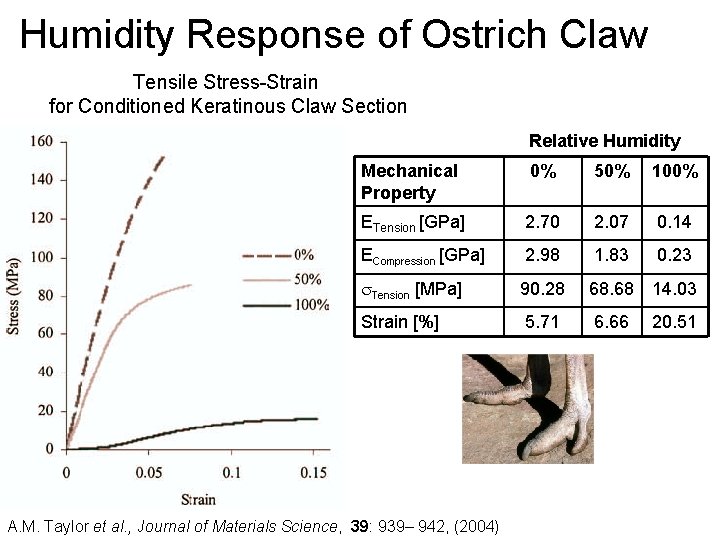
Humidity Response of Ostrich Claw Tensile Stress-Strain for Conditioned Keratinous Claw Section Relative Humidity Mechanical Property 0% 50% 100% ETension [GPa] 2. 70 2. 07 0. 14 ECompression [GPa] 2. 98 1. 83 0. 23 s. Tension [MPa] 90. 28 68. 68 14. 03 Strain [%] 5. 71 6. 66 A. M. Taylor et al. , Journal of Materials Science, 39: 939– 942, (2004) 20. 51
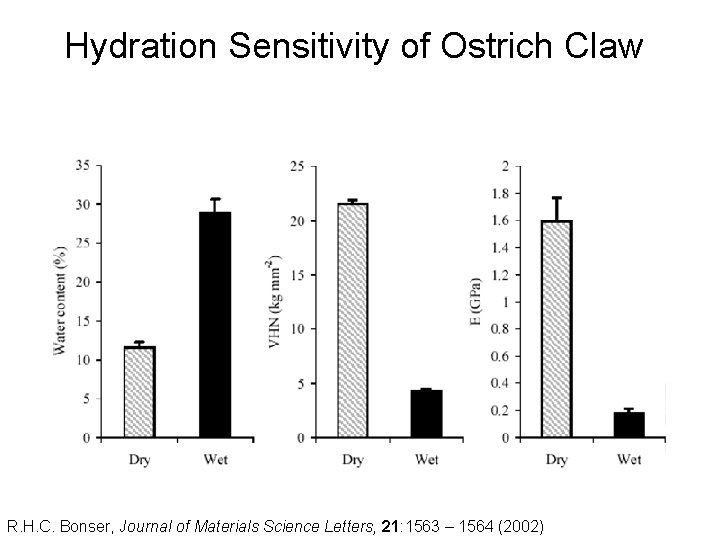
Hydration Sensitivity of Ostrich Claw R. H. C. Bonser, Journal of Materials Science Letters, 21: 1563 – 1564 (2002)
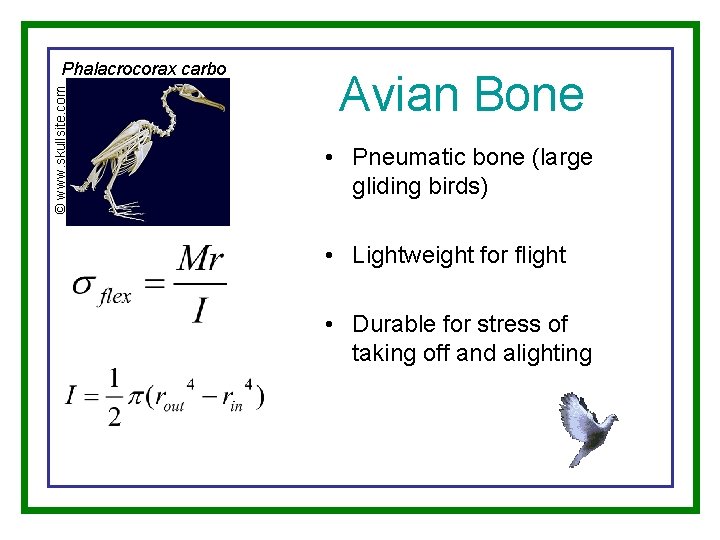
© www. skullsite. com Phalacrocorax carbo Avian Bone • Pneumatic bone (large gliding birds) • Lightweight for flight • Durable for stress of taking off and alighting
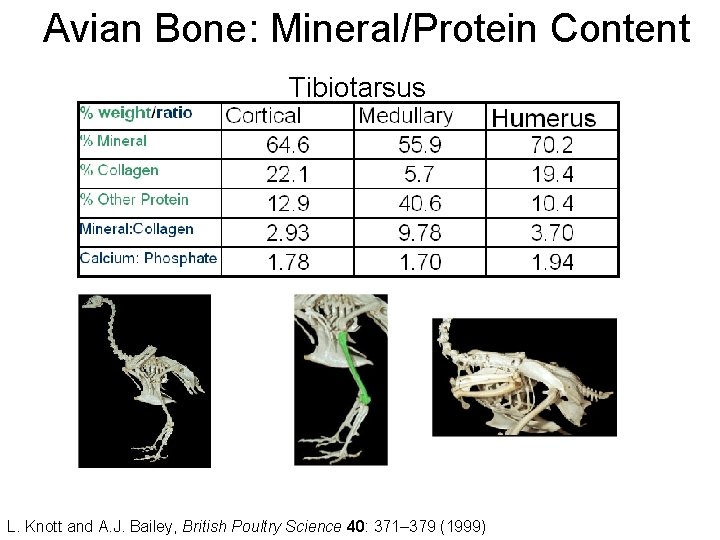
Avian Bone: Mineral/Protein Content Tibiotarsus L. Knott and A. J. Bailey, British Poultry Science 40: 371– 379 (1999)
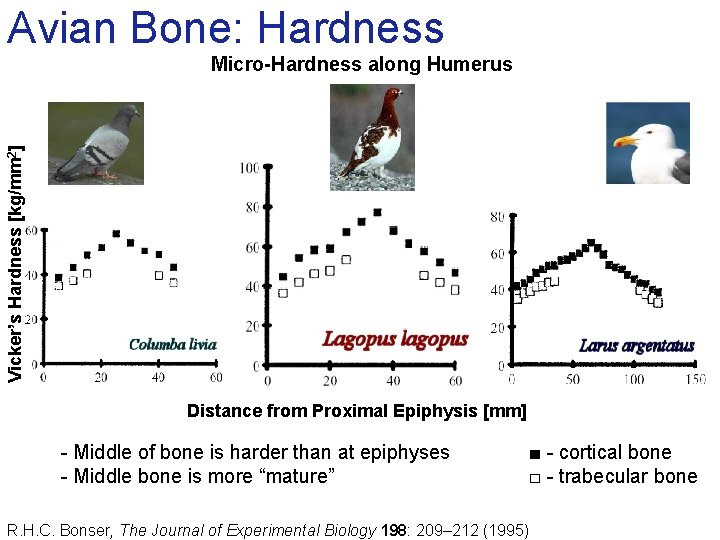
Avian Bone: Hardness Vicker’s Hardness [kg/mm 2] Micro-Hardness along Humerus Distance from Proximal Epiphysis [mm] - Middle of bone is harder than at epiphyses - Middle bone is more “mature” ■ - cortical bone □ - trabecular bone R. H. C. Bonser, The Journal of Experimental Biology 198: 209– 212 (1995)
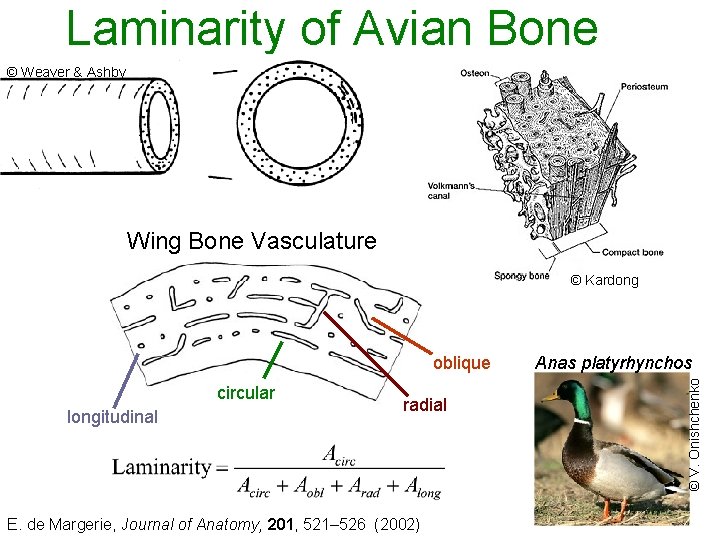
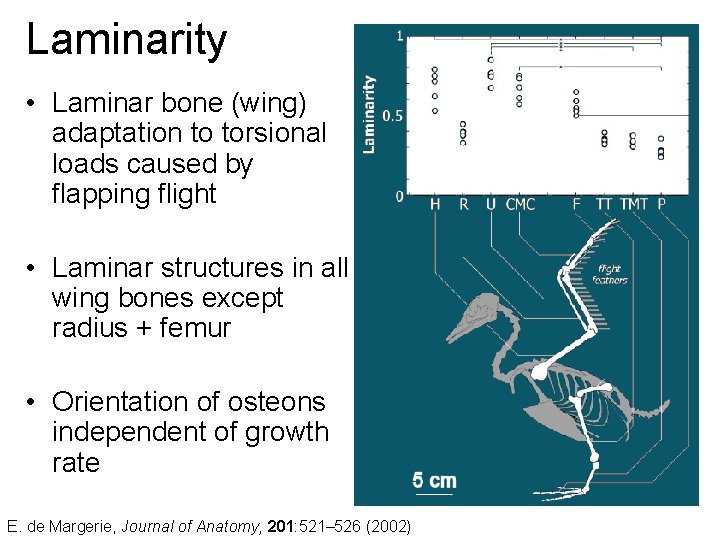
Laminarity of Avian Bone © Weaver & Ashby Wing Bone Vasculature © Kardong circular longitudinal radial E. de Margerie, Journal of Anatomy, 201, 521– 526 (2002) Anas platyrhynchos © V. Onishchenko oblique
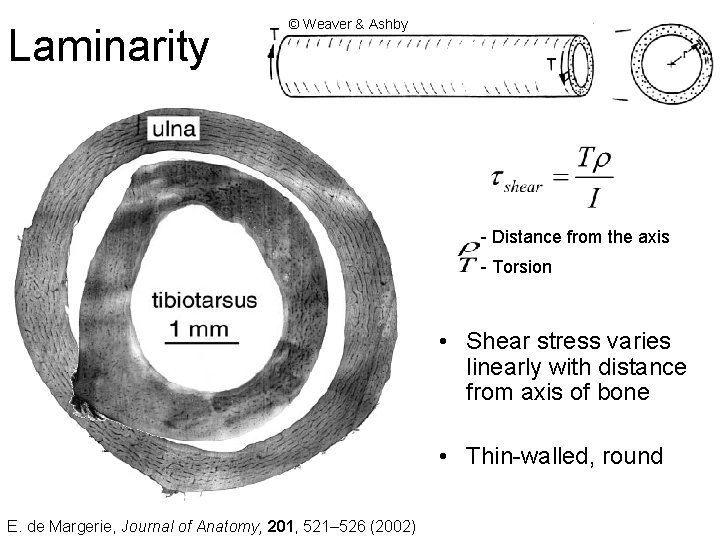
Laminarity © Weaver & Ashby - Distance from the axis - Torsion • Shear stress varies linearly with distance from axis of bone • Thin-walled, round E. de Margerie, Journal of Anatomy, 201, 521– 526 (2002)
Laminarity • Laminar bone (wing) adaptation to torsional loads caused by flapping flight • Laminar structures in all wing bones except radius + femur • Orientation of osteons independent of growth rate E. de Margerie, Journal of Anatomy, 201: 521– 526 (2002)
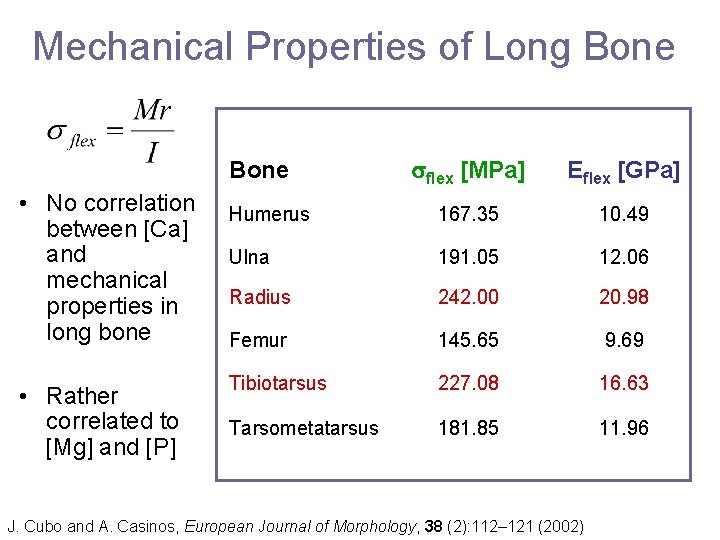
Mechanical Properties of Long Bone sflex [MPa] Eflex [GPa] Humerus 167. 35 10. 49 Ulna 191. 05 12. 06 Radius 242. 00 20. 98 Femur 145. 65 9. 69 Tibiotarsus 227. 08 16. 63 Tarsometatarsus 181. 85 11. 96 Bone • No correlation between [Ca] and mechanical properties in long bone • Rather correlated to [Mg] and [P] J. Cubo and A. Casinos, European Journal of Morphology, 38 (2): 112– 121 (2002)
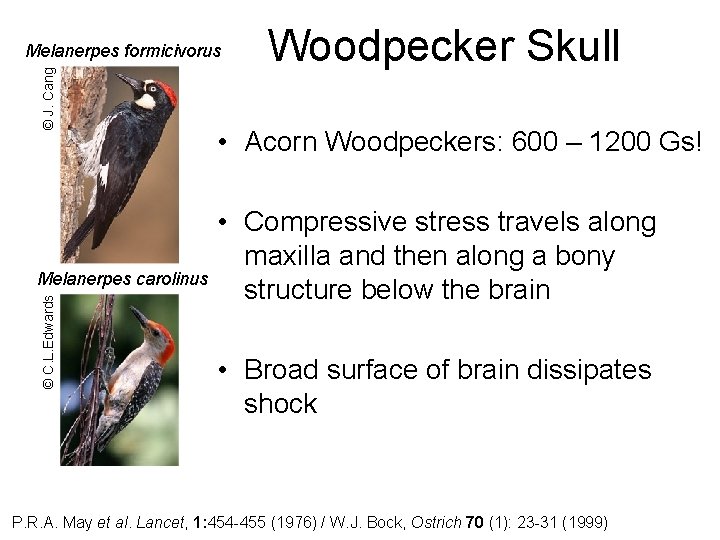
© J. Cang Melanerpes formicivorus © C. L. Edwards Melanerpes carolinus Woodpecker Skull • Acorn Woodpeckers: 600 – 1200 Gs! • Compressive stress travels along maxilla and then along a bony structure below the brain • Broad surface of brain dissipates shock P. R. A. May et al. Lancet, 1: 454 -455 (1976) / W. J. Bock, Ostrich 70 (1): 23 -31 (1999)
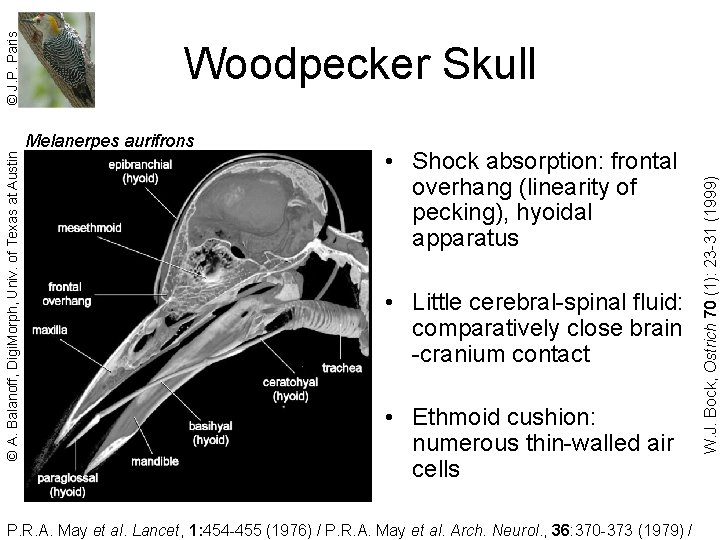
Melanerpes aurifrons • Shock absorption: frontal overhang (linearity of pecking), hyoidal apparatus • Little cerebral-spinal fluid: comparatively close brain -cranium contact • Ethmoid cushion: numerous thin-walled air cells P. R. A. May et al. Lancet, 1: 454 -455 (1976) / P. R. A. May et al. Arch. Neurol. , 36: 370 -373 (1979) / W. J. Bock, Ostrich 70 (1): 23 -31 (1999) © J. P. Paris © A. Balanoff, Digi. Morph, Univ. of Texas at Austin Woodpecker Skull
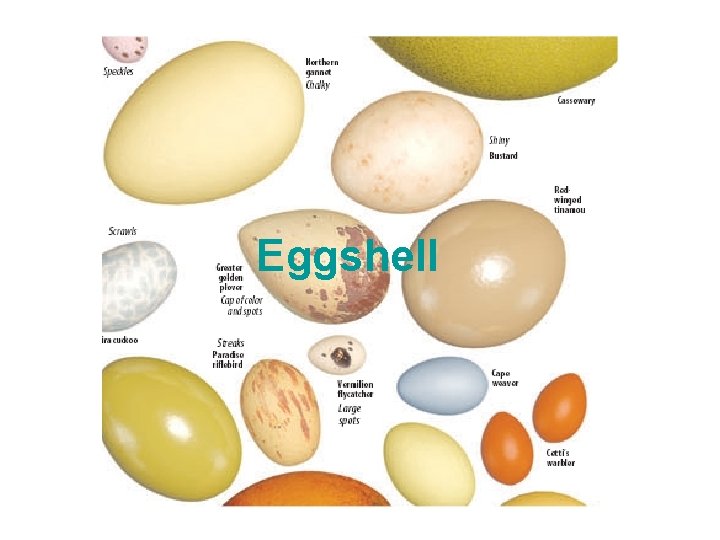
Eggshell
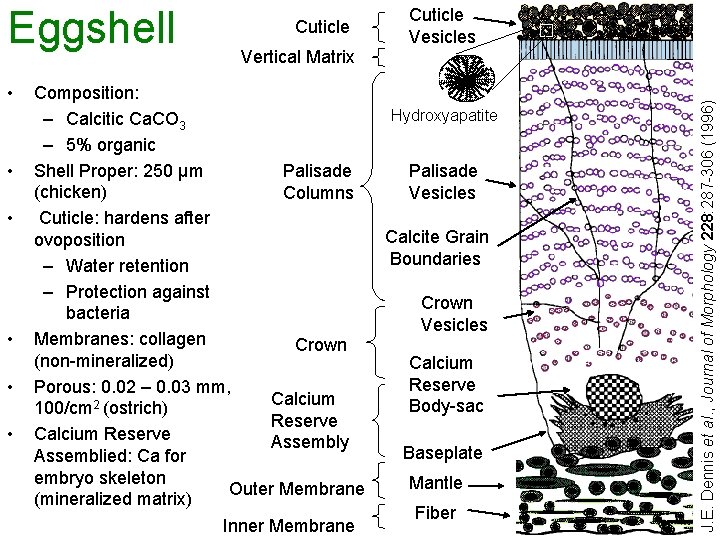
• • • Cuticle Vesicles Vertical Matrix Composition: – Calcitic Ca. CO 3 – 5% organic Shell Proper: 250 µm Palisade (chicken) Columns Cuticle: hardens after ovoposition – Water retention – Protection against bacteria Membranes: collagen Crown (non-mineralized) Porous: 0. 02 – 0. 03 mm, Calcium 100/cm 2 (ostrich) Reserve Calcium Reserve Assembly Assemblied: Ca for embryo skeleton Outer Membrane (mineralized matrix) Inner Membrane Hydroxyapatite Palisade Vesicles Calcite Grain Boundaries Crown Vesicles Calcium Reserve Body-sac Baseplate Mantle Fiber J. E. Dennis et al. , Journal of Morphology 228: 287 -306 (1996) Eggshell Cuticle
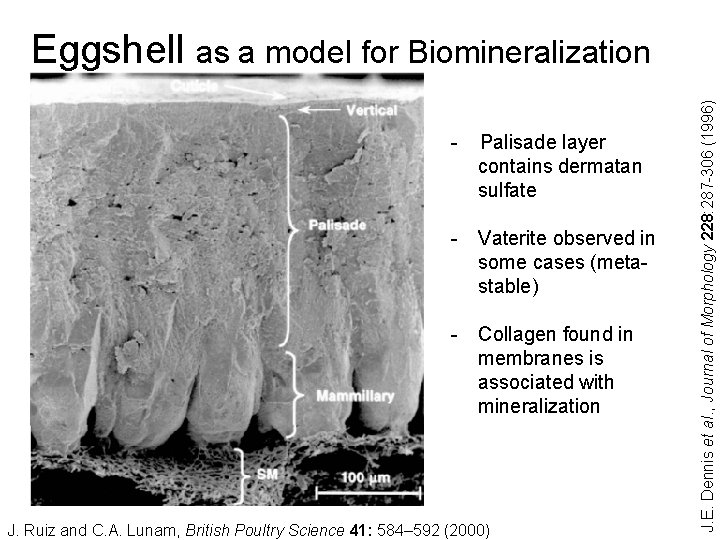
- Palisade layer contains dermatan sulfate - Vaterite observed in some cases (metastable) - Collagen found in membranes is associated with mineralization J. Ruiz and C. A. Lunam, British Poultry Science 41: 584– 592 (2000) J. E. Dennis et al. , Journal of Morphology 228: 287 -306 (1996) Eggshell as a model for Biomineralization
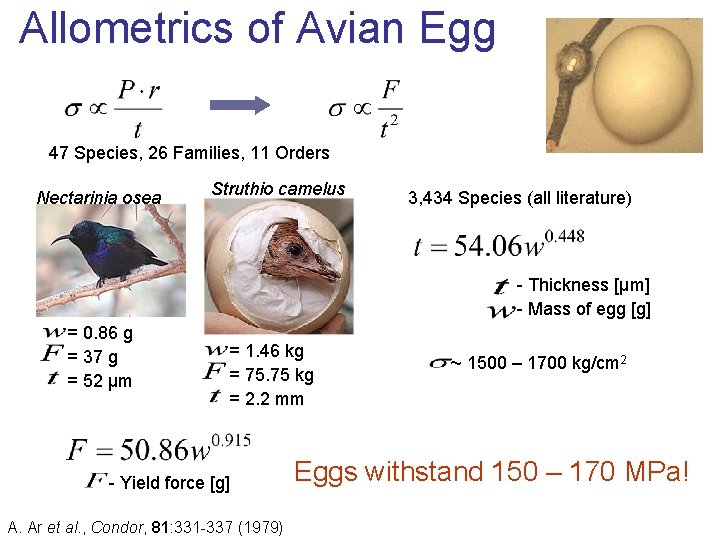
Allometrics of Avian Egg 47 Species, 26 Families, 11 Orders Nectarinia osea Struthio camelus 3, 434 Species (all literature) - Thickness [µm] - Mass of egg [g] = 0. 86 g = 37 g = 52 µm = 1. 46 kg = 75. 75 kg = 2. 2 mm - Yield force [g] A. Ar et al. , Condor, 81: 331 -337 (1979) ~ 1500 – 1700 kg/cm 2 Eggs withstand 150 – 170 MPa!
Summary • Feather colors accomplished by pigment and by structural features of feather (iridescence and scattering) • Mechanical properties of feather dependent upon keratin strength as well as feather structure/geometry • Bill properties are dependent upon both keratinous shell and foam center • Bending strength of avian bone is highest in principal wing bone and the principle leg bone • Laminar bones suited for high torsion forces • Eggshell is a model for biomineralization consisting of an organic matrix which guides deposition of inorganic mineral
Acknowledgements • Advisor: Professor M. A. Meyers • Committee Members: Professor V. Nesterenko and Professor G. Thomas • Group-mates: Buyang Cao, Po-Yu Cheng, Hussam Jarmakani, Albert Lin, Anuj Mishra, Yasuaki Seki, Glaucio Serra*, Liliane Serra de Morais* * Photo credit
Thank you for listening!