Linear System Theory and Design Control theory and



- Slides: 17
Linear System Theory and Design Control theory and control engineering Group 5:Song Danyi Li Xin Yu Zesheng Cheng Ping
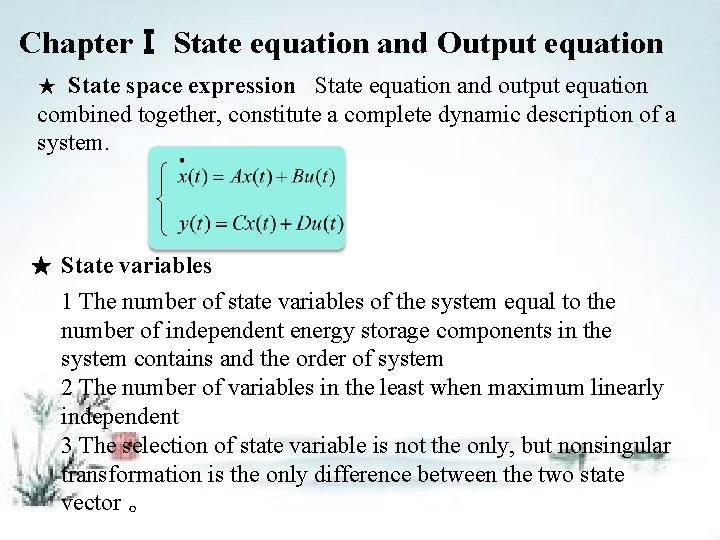
ChapterⅠ State equation and Output equation State space expression State equation and output equation combined together, constitute a complete dynamic description of a system. ★ ★ State variables 1 The number of state variables of the system equal to the number of independent energy storage components in the system contains and the order of system 2 The number of variables in the least when maximum linearly independent 3 The selection of state variable is not the only, but nonsingular transformation is the only difference between the two state vector 。
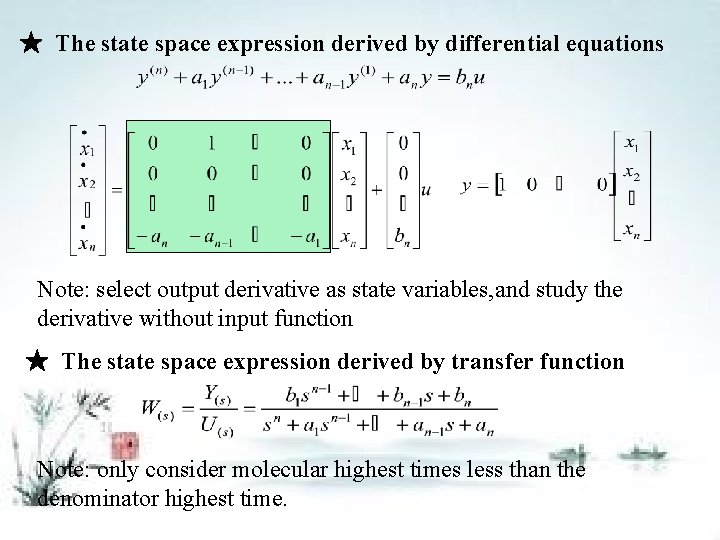
★ The state space expression derived by differential equations Note: select output derivative as state variables, and study the derivative without input function ★ The state space expression derived by transfer function Note: only consider molecular highest times less than the denominator highest time.
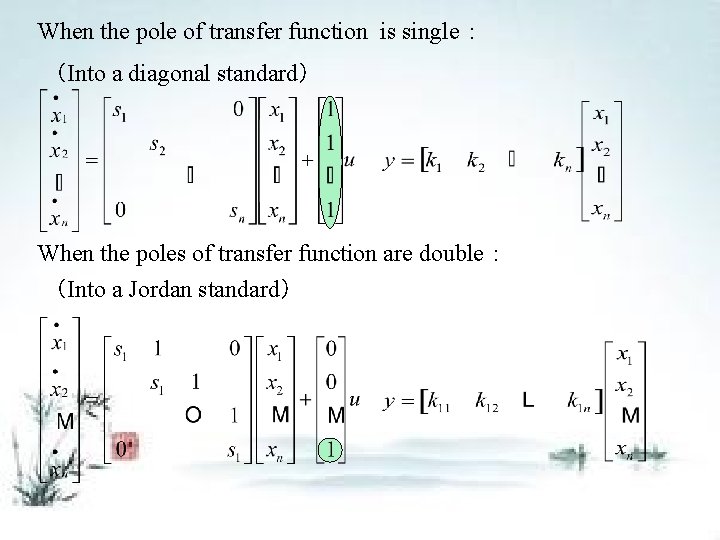
When the pole of transfer function is single: (Into a diagonal standard) When the poles of transfer function are double: (Into a Jordan standard)
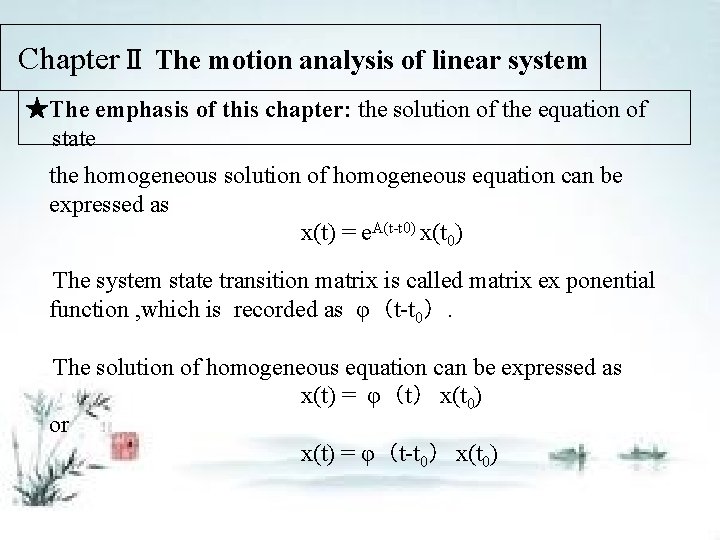
ChapterⅡ The motion analysis of linear system ★The emphasis of this chapter: the solution of the equation of state the homogeneous solution of homogeneous equation can be expressed as x(t) = e. A(t-t 0) x(t 0) The system state transition matrix is called matrix ex ponential function , which is recorded as φ(t-t 0). The solution of homogeneous equation can be expressed as x(t) = φ(t) x(t 0) or x(t) = φ(t-t 0) x(t 0)
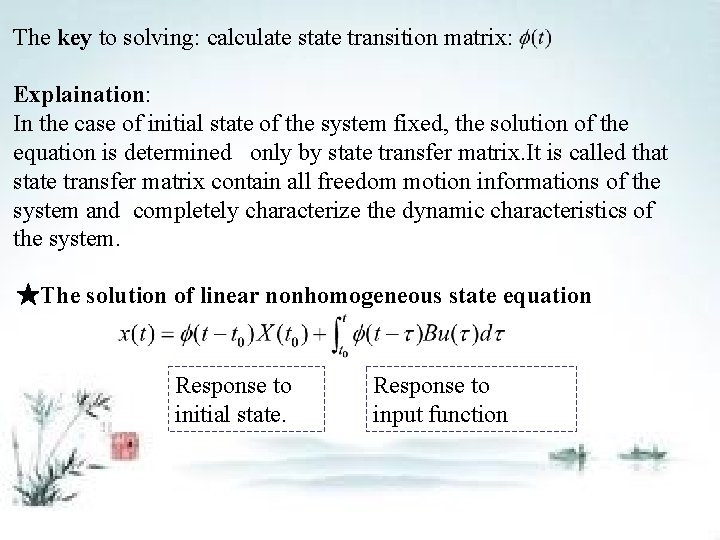
The key to solving: calculate state transition matrix: Explaination: In the case of initial state of the system fixed, the solution of the equation is determined only by state transfer matrix. It is called that state transfer matrix contain all freedom motion informations of the system and completely characterize the dynamic characteristics of the system. ★The solution of linear nonhomogeneous state equation Response to initial state. Response to input function
Explaination: 1 The solution of nonhomogeneous state equation is composed by two parts : First part is transfer items of initial states of the system , freedom motion of the system. Second part is controlled under the control signal, forced motion items of the system. 2 Two parts of the solution inform that response of the nonhomo-geneous equation satisfies the superposition principle of linear systems. To choose appropriate input u(t), can acquire best state trajectory in state space which meet the requirements.
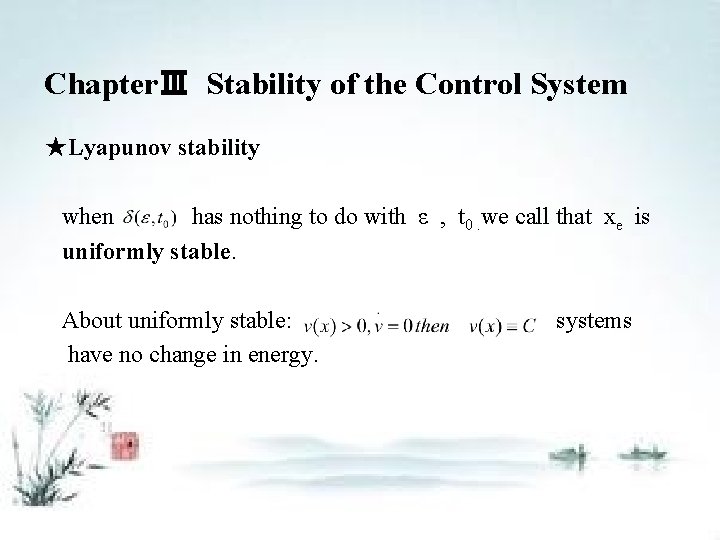
ChapterⅢ Stability of the Control System ★Lyapunov stability when has nothing to do with ε , t 0. we call that xe is uniformly stable. About uniformly stable: systems have no change in energy.
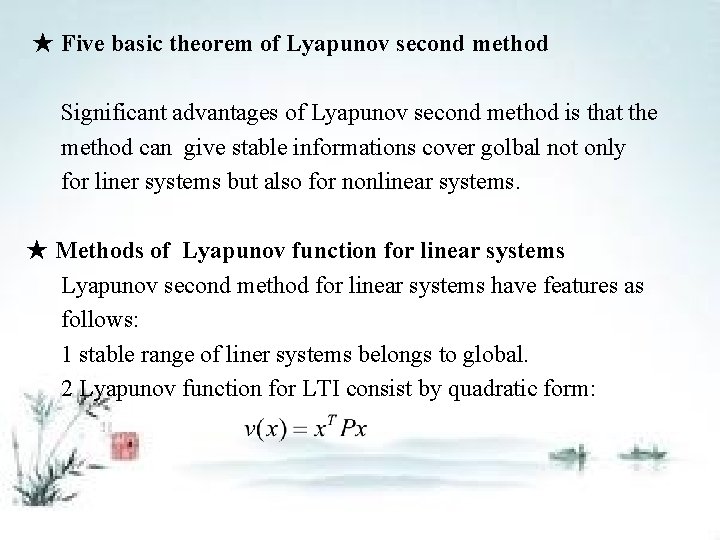
★ Five basic theorem of Lyapunov second method Significant advantages of Lyapunov second method is that the method can give stable informations cover golbal not only for liner systems but also for nonlinear systems. ★ Methods of Lyapunov function for linear systems Lyapunov second method for linear systems have features as follows: 1 stable range of liner systems belongs to global. 2 Lyapunov function for LTI consist by quadratic form:
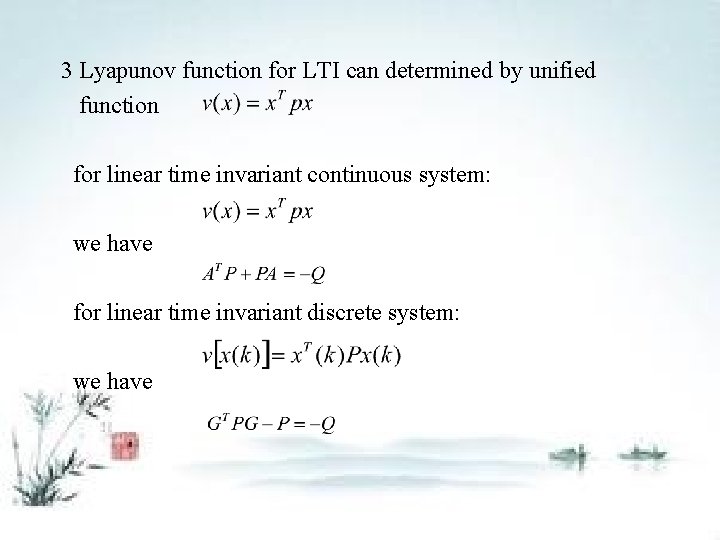
3 Lyapunov function for LTI can determined by unified function for linear time invariant continuous system: we have for linear time invariant discrete system: we have
ChapterⅣ Controllability and Observability of Linear Systems ★ Controllability and Observability State completely controllable: The system is said to be completely controllable or state completely contro-llable if all state variables of the system can be influenced and controled by input that can drive states to any final state at a final time. State completely observable: The system is said to be state completely observable if all state variables of the system can be totally reflected by the output.
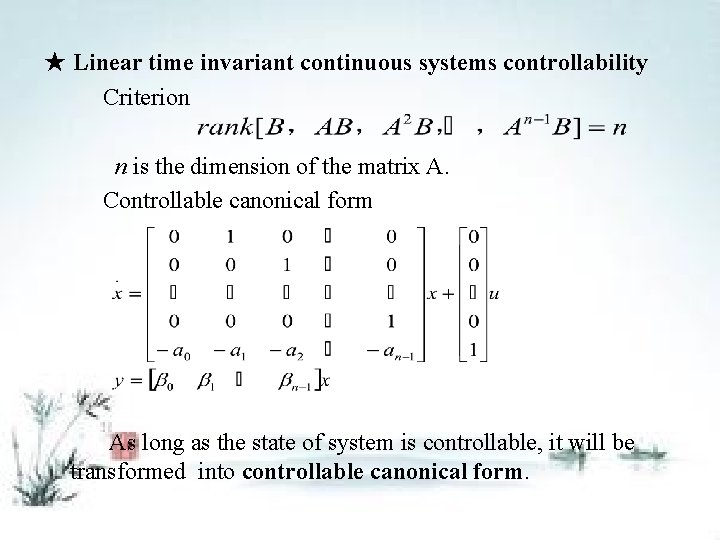
★ Linear time invariant continuous systems controllability Criterion n is the dimension of the matrix A. Controllable canonical form As long as the state of system is controllable, it will be transformed into controllable canonical form.
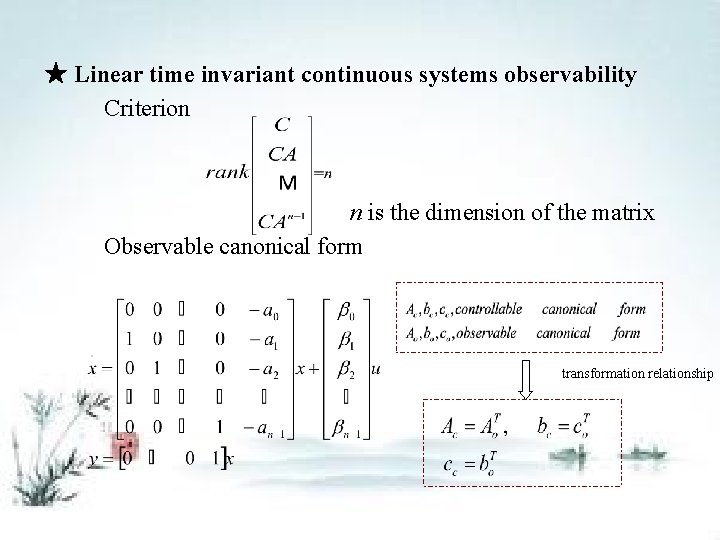
★ Linear time invariant continuous systems observability Criterion n is the dimension of the matrix Observable canonical form transformation relationship
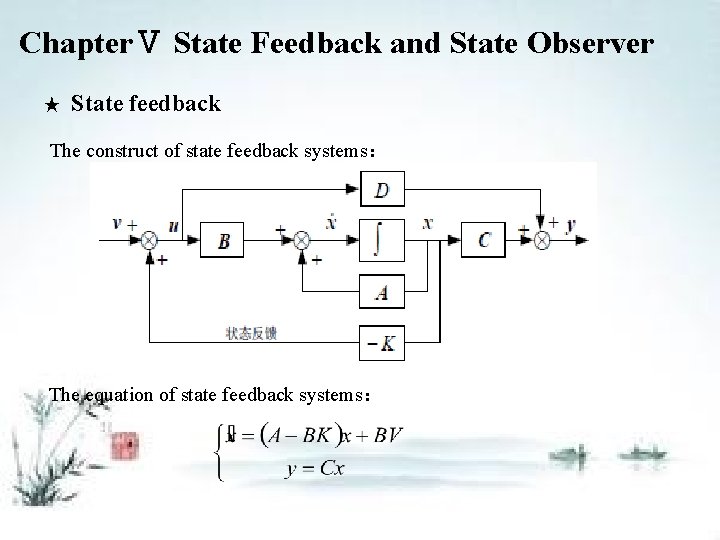
ChapterⅤ State Feedback and State Observer ★ State feedback The construct of state feedback systems: The equation of state feedback systems:
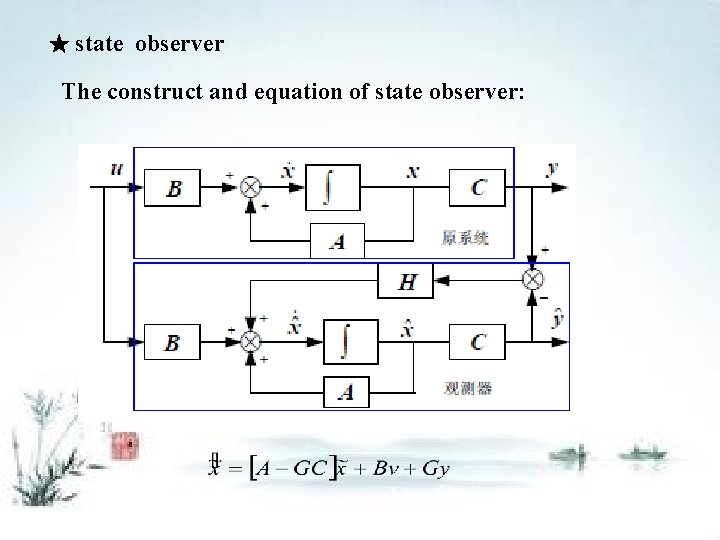
★ state observer The construct and equation of state observer:
★ The state feedback system with state observer is a combination of systems, the equation is The transfer function Gk(s) of state feedback closed-loop system with state observer can be determined by the type Conclusion: state feedback closed-loop system with a state observer and state feedback closed-loop system directly have the same transfer function.