LEVEL 2 WORKSHOP ORIGINS Workshop Goals To strengthen


- Slides: 57
LEVEL 2 WORKSHOP © ORIGINS
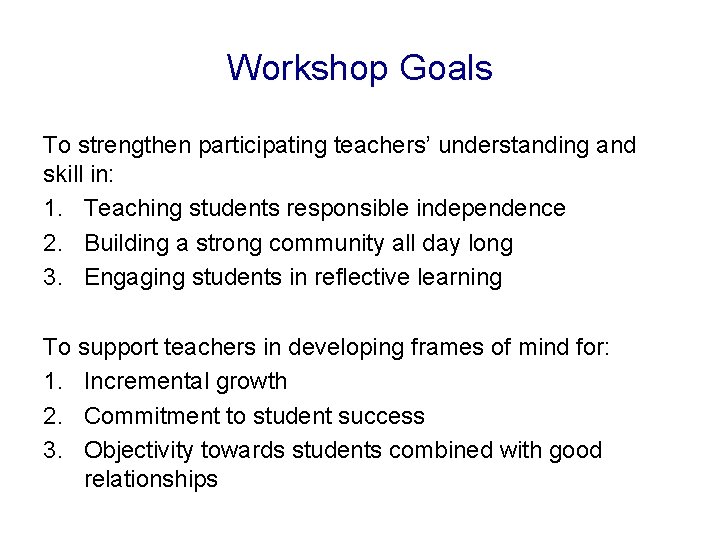
Workshop Goals To strengthen participating teachers’ understanding and skill in: 1. Teaching students responsible independence 2. Building a strong community all day long 3. Engaging students in reflective learning To support teachers in developing frames of mind for: 1. Incremental growth 2. Commitment to student success 3. Objectivity towards students combined with good relationships
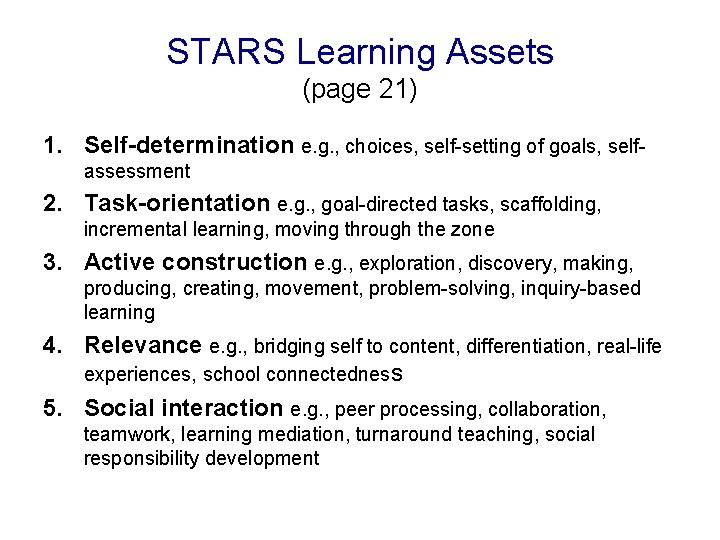
STARS Learning Assets (page 21) 1. Self-determination e. g. , choices, self-setting of goals, selfassessment 2. Task-orientation e. g. , goal-directed tasks, scaffolding, incremental learning, moving through the zone 3. Active construction e. g. , exploration, discovery, making, producing, creating, movement, problem-solving, inquiry-based learning 4. Relevance e. g. , bridging self to content, differentiation, real-life experiences, school connectedness 5. Social interaction e. g. , peer processing, collaboration, teamwork, learning mediation, turnaround teaching, social responsibility development
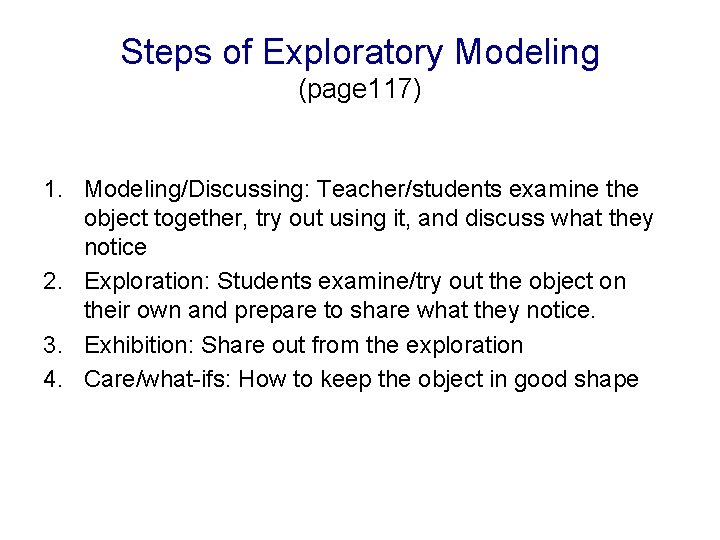
Steps of Exploratory Modeling (page 117) 1. Modeling/Discussing: Teacher/students examine the object together, try out using it, and discuss what they notice 2. Exploration: Students examine/try out the object on their own and prepare to share what they notice. 3. Exhibition: Share out from the exploration 4. Care/what-ifs: How to keep the object in good shape
DD Strategies Review (page 152) Learning Target: To be able to assess the status of your current implementation of DD practices. 1. Complete the Developmental Designs Implementation Review on page 189. 2. Be sure to fill out the bottom of the survey
Declarations Learning Target: To be able to state a goal for the week that guides your learning and declares your stake in the community. Must-do’s: • Choose at least one goal for the week • Transform your goal into declarations which begin with I will. . . • List payoffs and hurdles to achieving and implementing the declaration • Use a foldable to display your declarations • Hang it up on the bulletin board May-do’s: • Chose more than one goal • Draw an icon to remind yourself of your goal • Add color
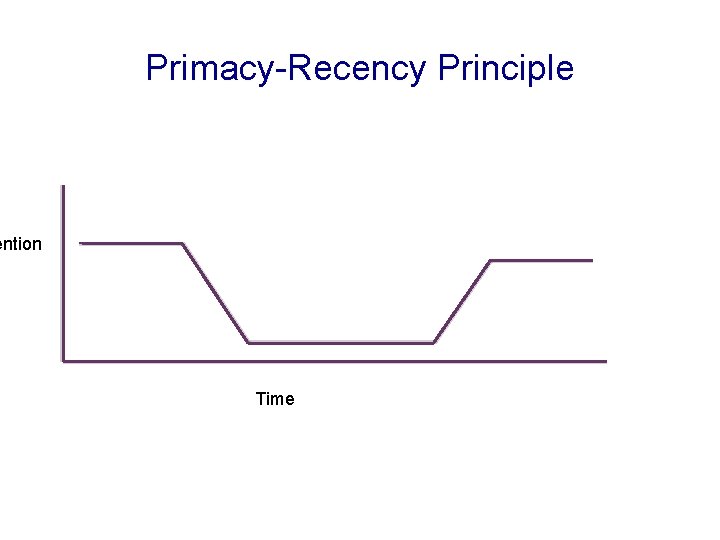
Primacy-Recency Principle ention Time
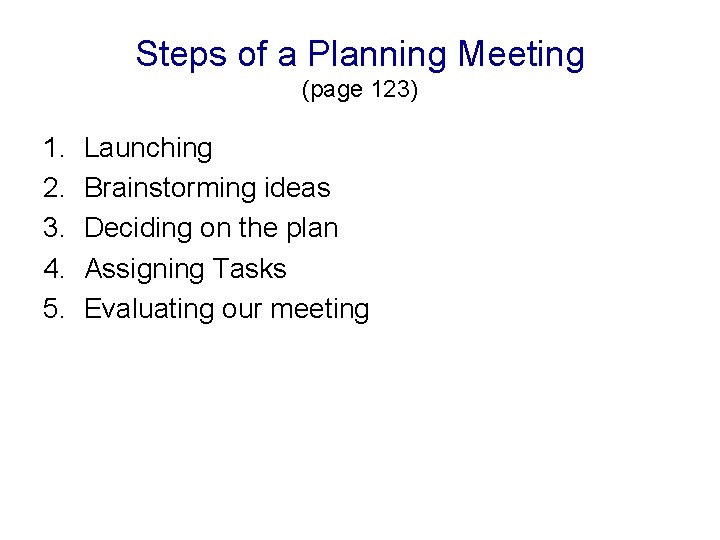
Steps of a Planning Meeting (page 123) 1. 2. 3. 4. 5. Launching Brainstorming ideas Deciding on the plan Assigning Tasks Evaluating our meeting
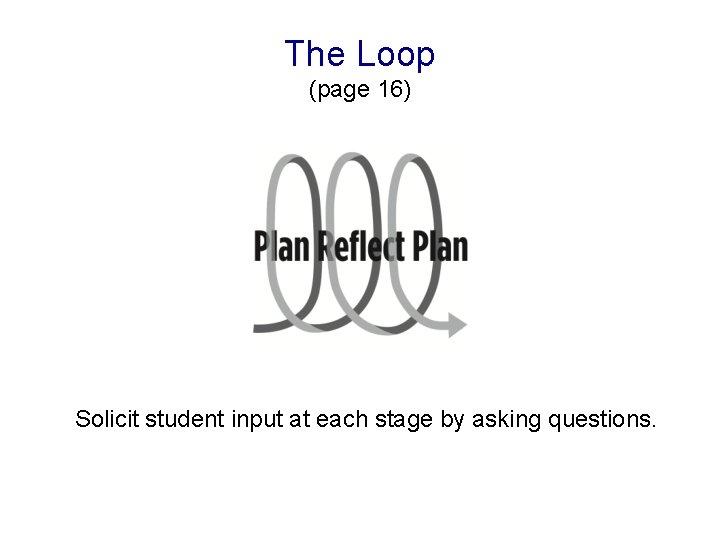
The Loop (page 16) Solicit student input at each stage by asking questions.
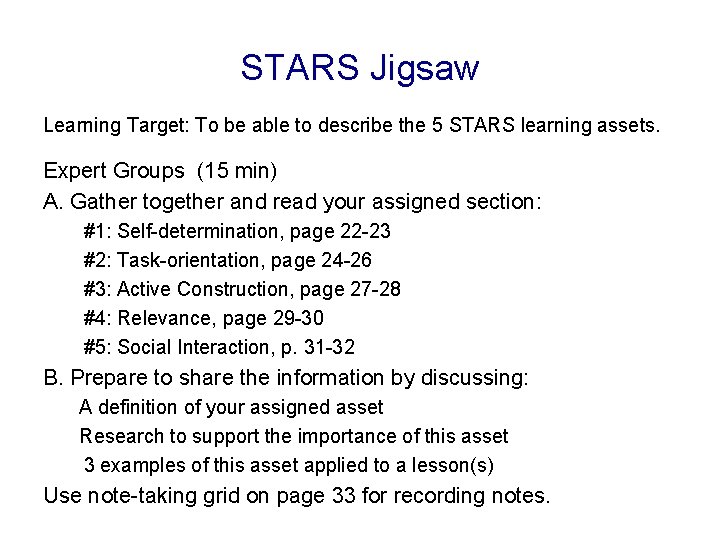
STARS Jigsaw Learning Target: To be able to describe the 5 STARS learning assets. Expert Groups (15 min) A. Gather together and read your assigned section: #1: Self-determination, page 22 -23 #2: Task-orientation, page 24 -26 #3: Active Construction, page 27 -28 #4: Relevance, page 29 -30 #5: Social Interaction, p. 31 -32 B. Prepare to share the information by discussing: A definition of your assigned asset Research to support the importance of this asset 3 examples of this asset applied to a lesson(s) Use note-taking grid on page 33 for recording notes.
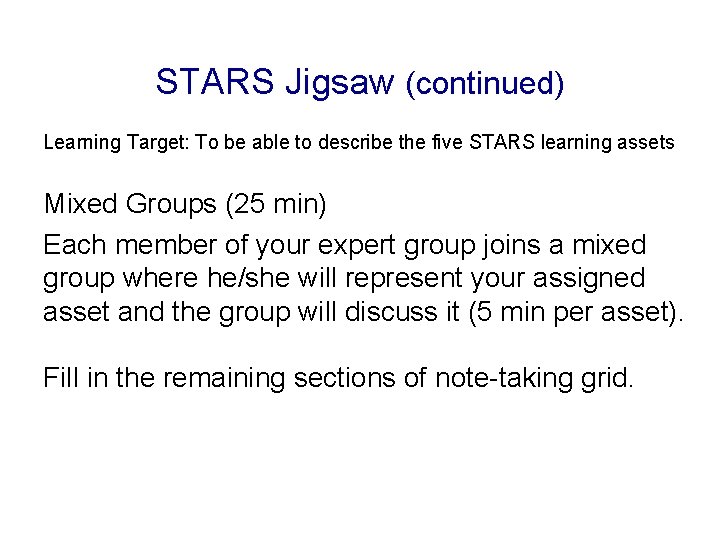
STARS Jigsaw (continued) Learning Target: To be able to describe the five STARS learning assets Mixed Groups (25 min) Each member of your expert group joins a mixed group where he/she will represent your assigned asset and the group will discuss it (5 min per asset). Fill in the remaining sections of note-taking grid.
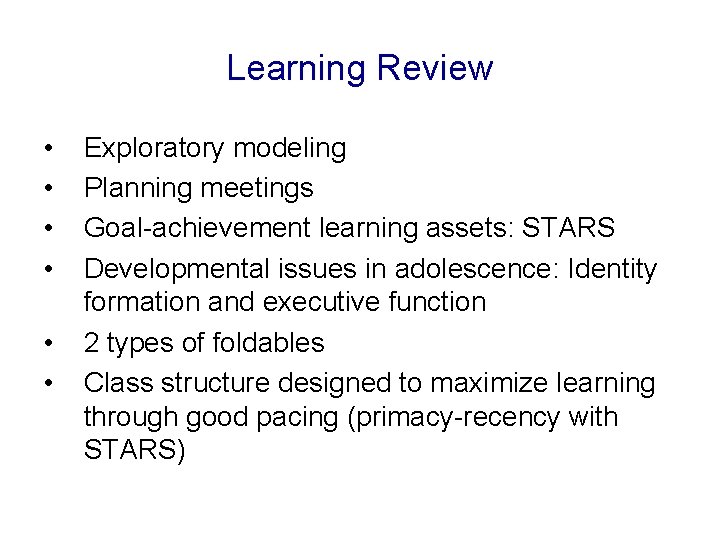
Learning Review • • • Exploratory modeling Planning meetings Goal-achievement learning assets: STARS Developmental issues in adolescence: Identity formation and executive function 2 types of foldables Class structure designed to maximize learning through good pacing (primacy-recency with STARS)
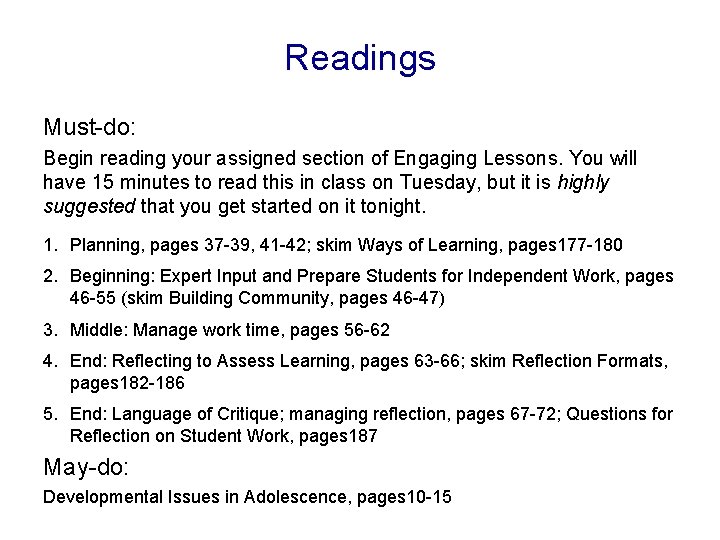
Readings Must-do: Begin reading your assigned section of Engaging Lessons. You will have 15 minutes to read this in class on Tuesday, but it is highly suggested that you get started on it tonight. 1. Planning, pages 37 -39, 41 -42; skim Ways of Learning, pages 177 -180 2. Beginning: Expert Input and Prepare Students for Independent Work, pages 46 -55 (skim Building Community, pages 46 -47) 3. Middle: Manage work time, pages 56 -62 4. End: Reflecting to Assess Learning, pages 63 -66; skim Reflection Formats, pages 182 -186 5. End: Language of Critique; managing reflection, pages 67 -72; Questions for Reflection on Student Work, pages 187 May-do: Developmental Issues in Adolescence, pages 10 -15
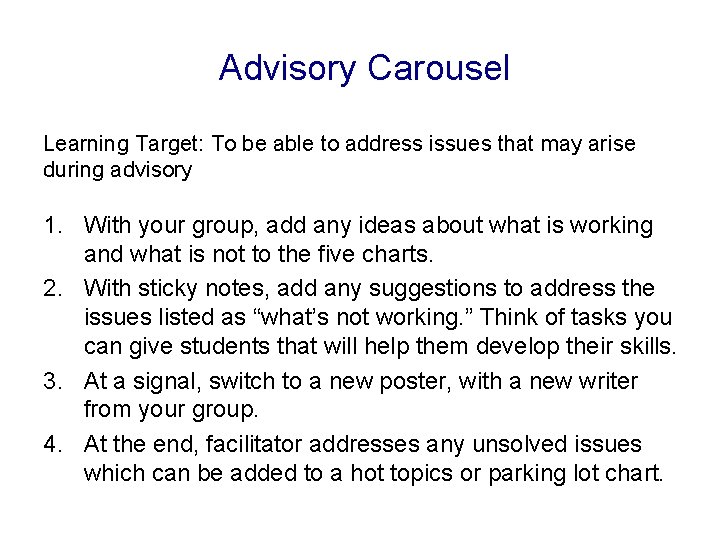
Advisory Carousel Learning Target: To be able to address issues that may arise during advisory 1. With your group, add any ideas about what is working and what is not to the five charts. 2. With sticky notes, add any suggestions to address the issues listed as “what’s not working. ” Think of tasks you can give students that will help them develop their skills. 3. At a signal, switch to a new poster, with a new writer from your group. 4. At the end, facilitator addresses any unsolved issues which can be added to a hot topics or parking lot chart.
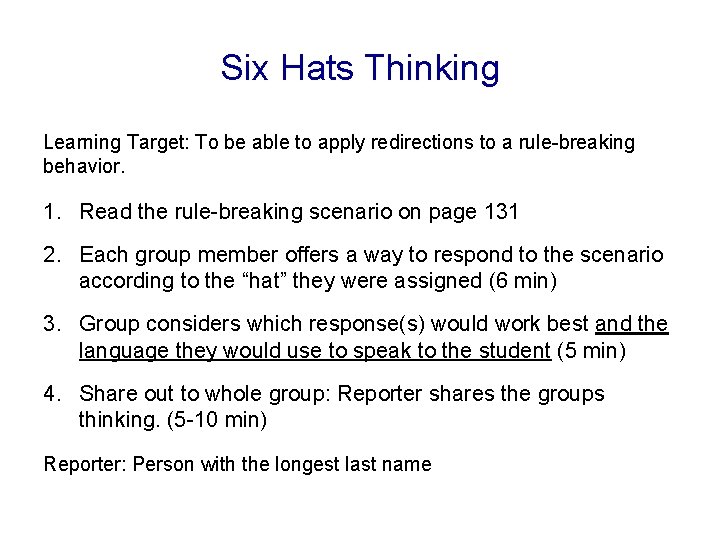
Six Hats Thinking Learning Target: To be able to apply redirections to a rule-breaking behavior. 1. Read the rule-breaking scenario on page 131 2. Each group member offers a way to respond to the scenario according to the “hat” they were assigned (6 min) 3. Group considers which response(s) would work best and the language they would use to speak to the student (5 min) 4. Share out to whole group: Reporter shares the groups thinking. (5 -10 min) Reporter: Person with the longest last name
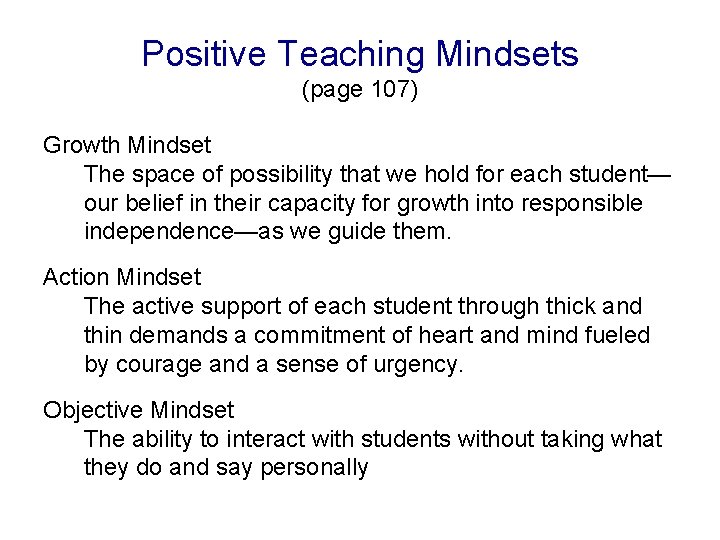
Positive Teaching Mindsets (page 107) Growth Mindset The space of possibility that we hold for each student— our belief in their capacity for growth into responsible independence—as we guide them. Action Mindset The active support of each student through thick and thin demands a commitment of heart and mind fueled by courage and a sense of urgency. Objective Mindset The ability to interact with students without taking what they do and say personally
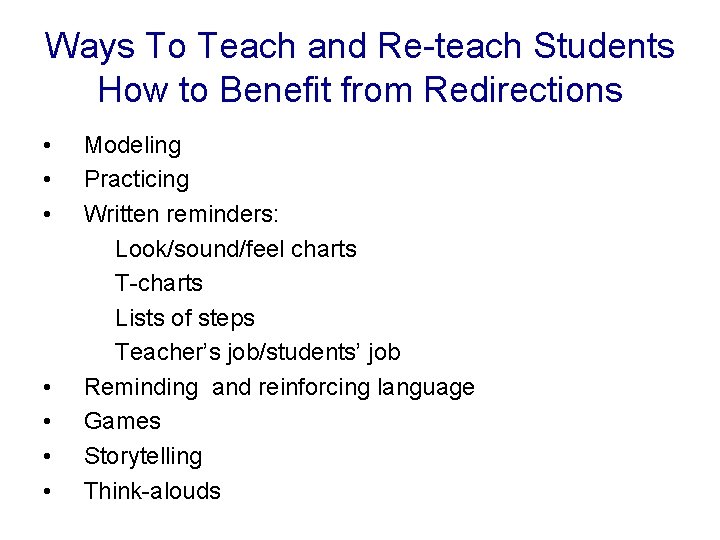
Ways To Teach and Re-teach Students How to Benefit from Redirections • • Modeling Practicing Written reminders: Look/sound/feel charts T-charts Lists of steps Teacher’s job/students’ job Reminding and reinforcing language Games Storytelling Think-alouds
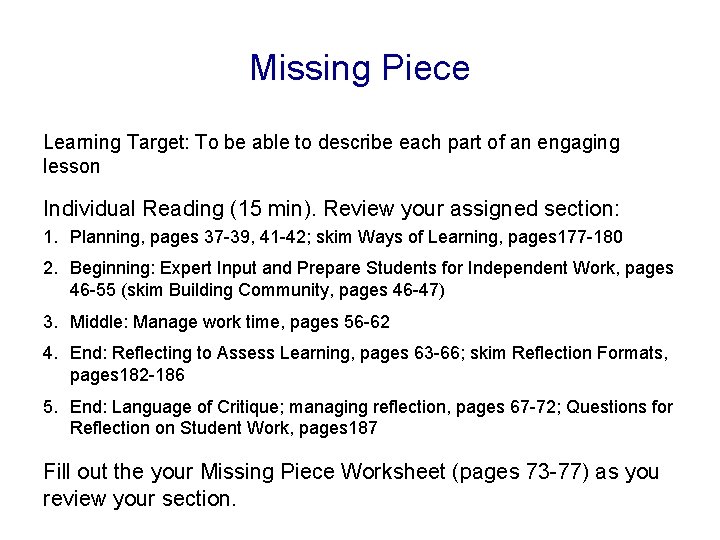
Missing Piece Learning Target: To be able to describe each part of an engaging lesson Individual Reading (15 min). Review your assigned section: 1. Planning, pages 37 -39, 41 -42; skim Ways of Learning, pages 177 -180 2. Beginning: Expert Input and Prepare Students for Independent Work, pages 46 -55 (skim Building Community, pages 46 -47) 3. Middle: Manage work time, pages 56 -62 4. End: Reflecting to Assess Learning, pages 63 -66; skim Reflection Formats, pages 182 -186 5. End: Language of Critique; managing reflection, pages 67 -72; Questions for Reflection on Student Work, pages 187 Fill out the your Missing Piece Worksheet (pages 73 -77) as you review your section.
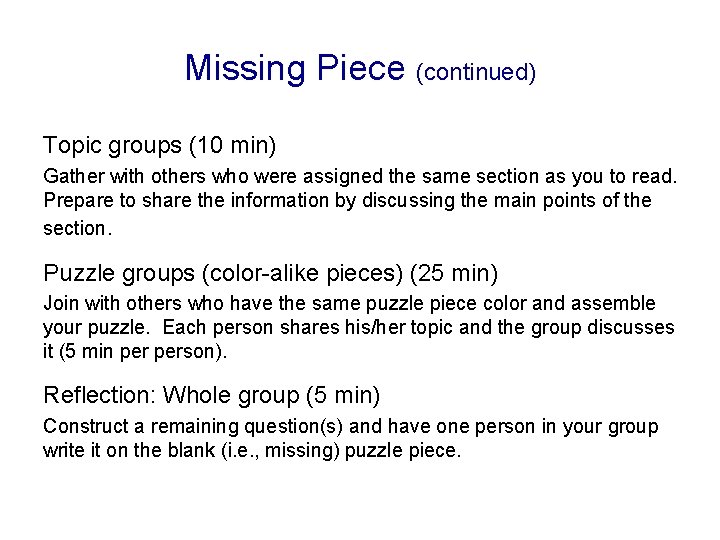
Missing Piece (continued) Topic groups (10 min) Gather with others who were assigned the same section as you to read. Prepare to share the information by discussing the main points of the section. Puzzle groups (color-alike pieces) (25 min) Join with others who have the same puzzle piece color and assemble your puzzle. Each person shares his/her topic and the group discusses it (5 min person). Reflection: Whole group (5 min) Construct a remaining question(s) and have one person in your group write it on the blank (i. e. , missing) puzzle piece.
Adding STARS Question 1 What choices and other forms of self-direction might the teacher give in this lesson? Self-determination
Adding STARS Question 2 How can students show that they have reached the target? Task-orientation
Adding STARS Question 3 How can we make this lesson more active, so our students will experience it more fully? Active construction
Adding STARS Question 4 How can the teacher help students see the relevancy of the words in this lesson or of the task of learning vocabulary? How can we get students to endorse this vocabulary lesson? Relevance
Adding STARS Question 5 How can we make this lesson more socially interactive? Social interaction
Learning Review • • • CPR Pathways to Self-control Teaching pathways through scaffolding Learning targets Engaging lessons: Beginning, middle, end Lesson planning with STARS
Readings 1. The section of Engaging Lessons that most interested you, but you did not read, pages 3772 2. Teacher Mindsets, pages 107 -108 3. Introducing Redirections, page 132
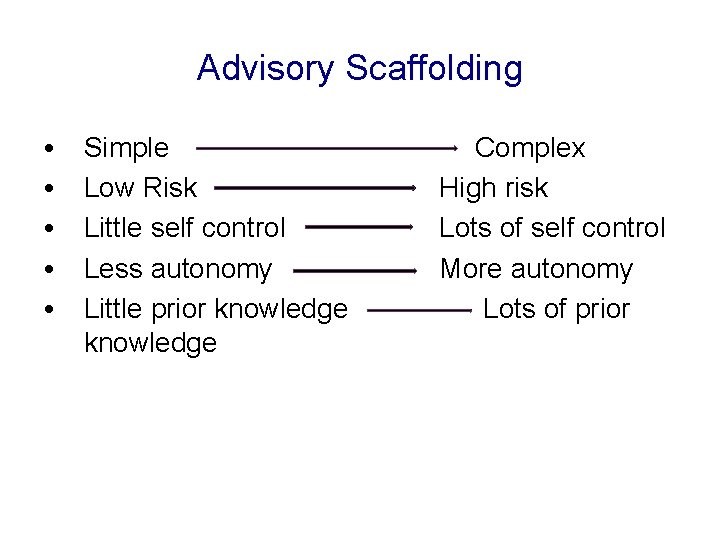
Advisory Scaffolding • • • Simple Low Risk Little self control Less autonomy Little prior knowledge Complex High risk Lots of self control More autonomy Lots of prior
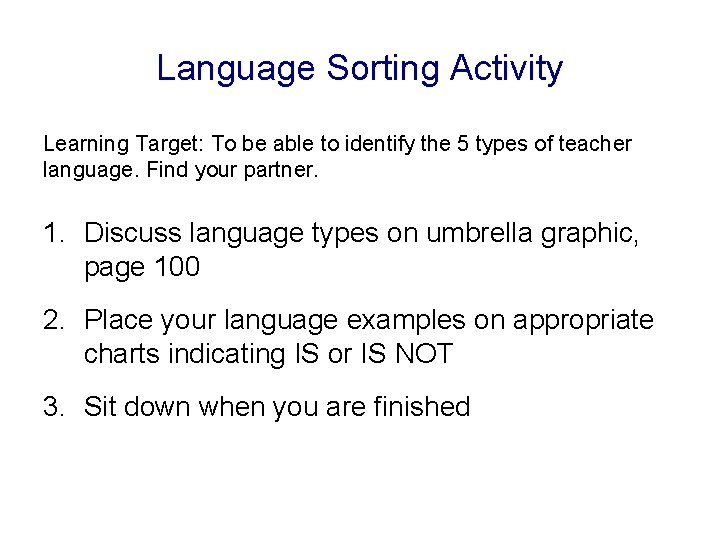
Language Sorting Activity Learning Target: To be able to identify the 5 types of teacher language. Find your partner. 1. Discuss language types on umbrella graphic, page 100 2. Place your language examples on appropriate charts indicating IS or IS NOT 3. Sit down when you are finished
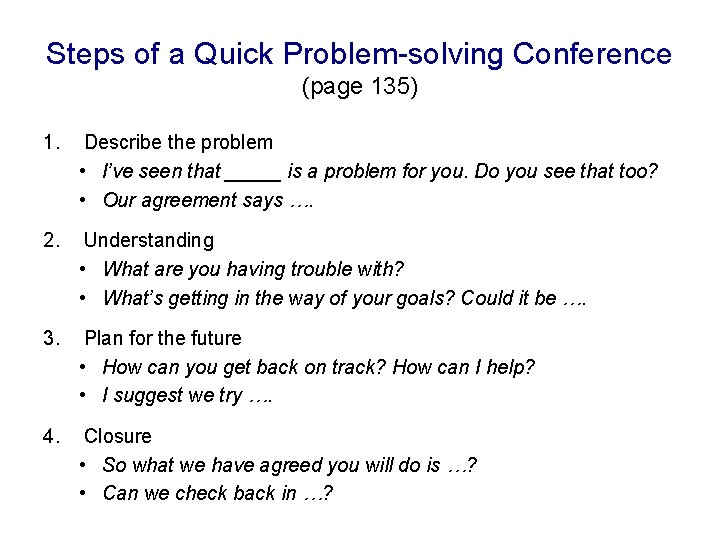
Steps of a Quick Problem-solving Conference (page 135) 1. Describe the problem • I’ve seen that _____ is a problem for you. Do you see that too? • Our agreement says …. 2. Understanding • What are you having trouble with? • What’s getting in the way of your goals? Could it be …. 3. Plan for the future • How can you get back on track? How can I help? • I suggest we try …. 4. Closure • So what we have agreed you will do is …? • Can we check back in …?
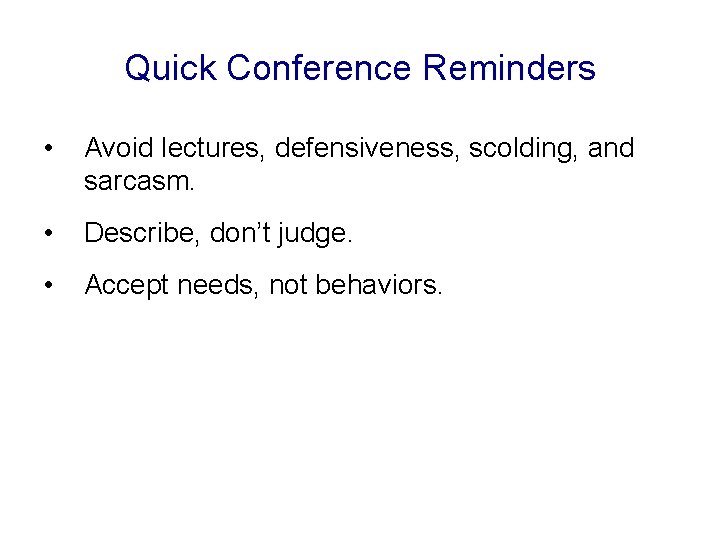
Quick Conference Reminders • Avoid lectures, defensiveness, scolding, and sarcasm. • Describe, don’t judge. • Accept needs, not behaviors.
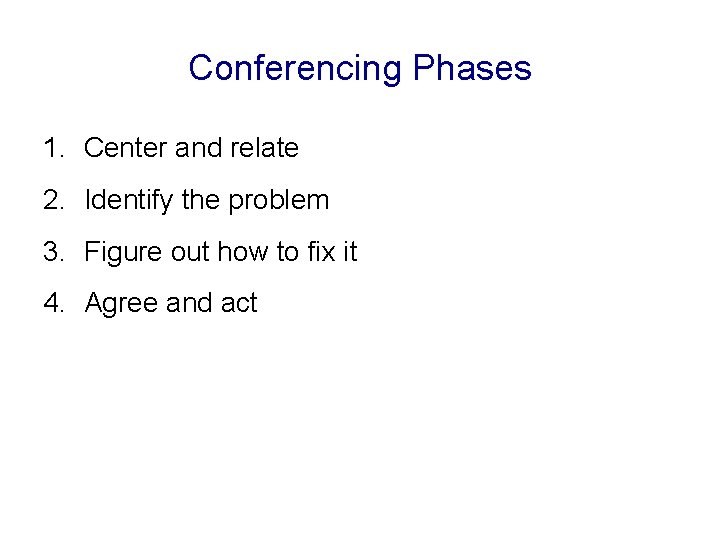
Conferencing Phases 1. Center and relate 2. Identify the problem 3. Figure out how to fix it 4. Agree and act
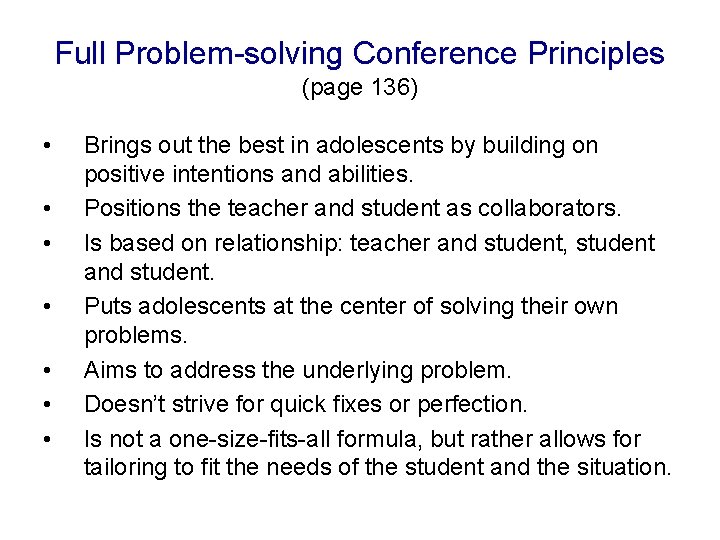
Full Problem-solving Conference Principles (page 136) • • Brings out the best in adolescents by building on positive intentions and abilities. Positions the teacher and student as collaborators. Is based on relationship: teacher and student, student and student. Puts adolescents at the center of solving their own problems. Aims to address the underlying problem. Doesn’t strive for quick fixes or perfection. Is not a one-size-fits-all formula, but rather allows for tailoring to fit the needs of the student and the situation.
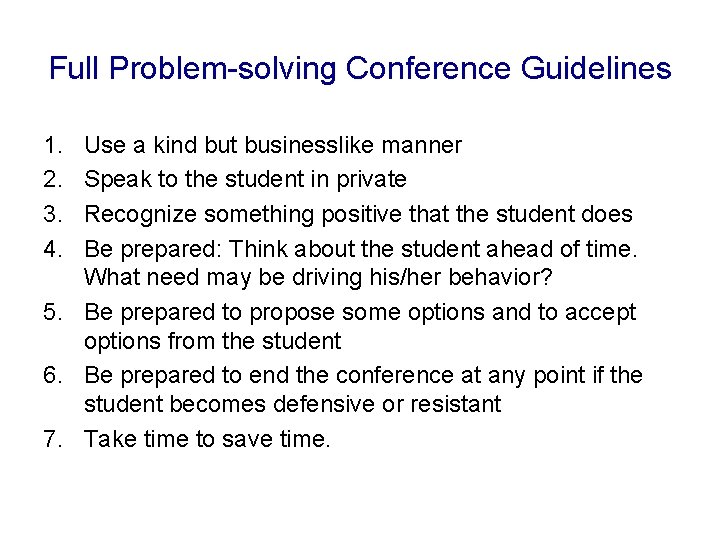
Full Problem-solving Conference Guidelines 1. 2. 3. 4. Use a kind but businesslike manner Speak to the student in private Recognize something positive that the student does Be prepared: Think about the student ahead of time. What need may be driving his/her behavior? 5. Be prepared to propose some options and to accept options from the student 6. Be prepared to end the conference at any point if the student becomes defensive or resistant 7. Take time to save time.
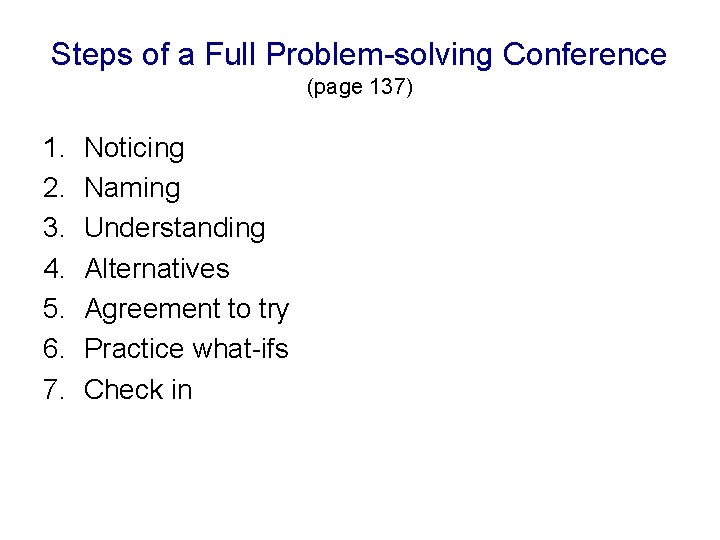
Steps of a Full Problem-solving Conference (page 137) 1. 2. 3. 4. 5. 6. 7. Noticing Naming Understanding Alternatives Agreement to try Practice what-ifs Check in
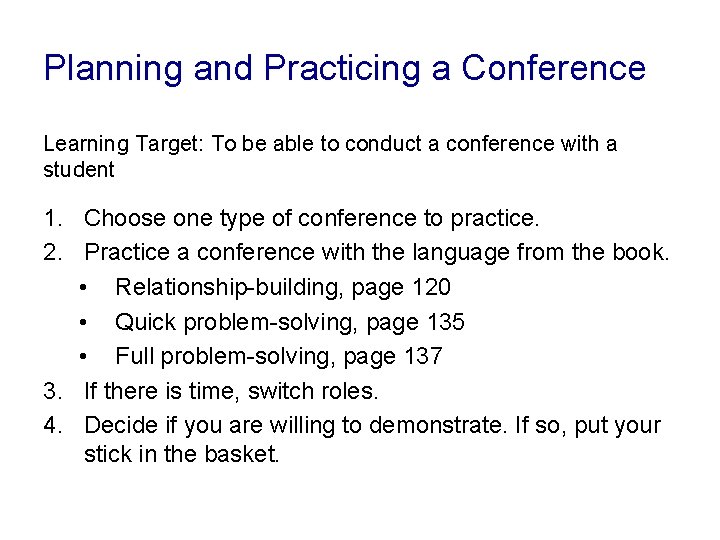
Planning and Practicing a Conference Learning Target: To be able to conduct a conference with a student 1. Choose one type of conference to practice. 2. Practice a conference with the language from the book. • Relationship-building, page 120 • Quick problem-solving, page 135 • Full problem-solving, page 137 3. If there is time, switch roles. 4. Decide if you are willing to demonstrate. If so, put your stick in the basket.
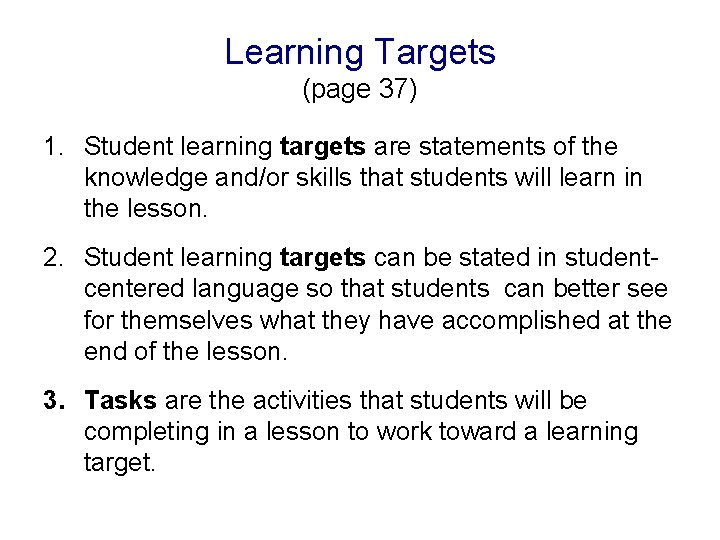
Learning Targets (page 37) 1. Student learning targets are statements of the knowledge and/or skills that students will learn in the lesson. 2. Student learning targets can be stated in studentcentered language so that students can better see for themselves what they have accomplished at the end of the lesson. 3. Tasks are the activities that students will be completing in a lesson to work toward a learning target.
Learning Review • • • Teacher language Relationship-building conference Quick problem-solving conference Full problem-solving conference Lesson planning using STARS
Readings Teacher Language, pages 100 -105 Problem-solve, pages 133 -137
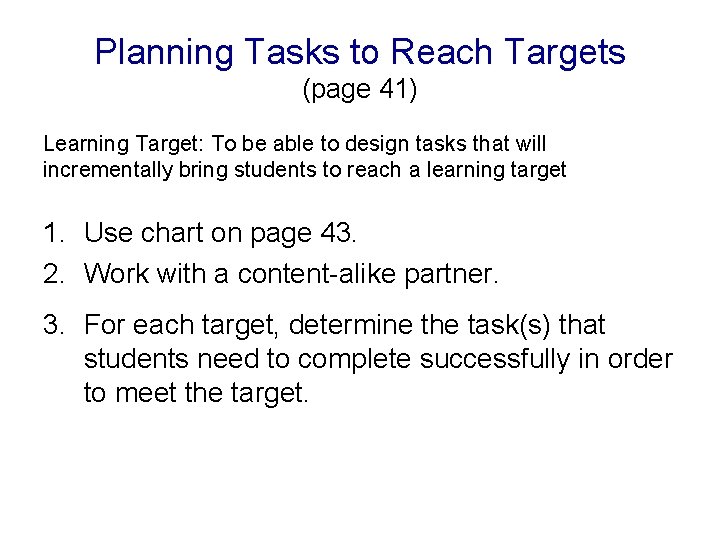
Planning Tasks to Reach Targets (page 41) Learning Target: To be able to design tasks that will incrementally bring students to reach a learning target 1. Use chart on page 43. 2. Work with a content-alike partner. 3. For each target, determine the task(s) that students need to complete successfully in order to meet the target.
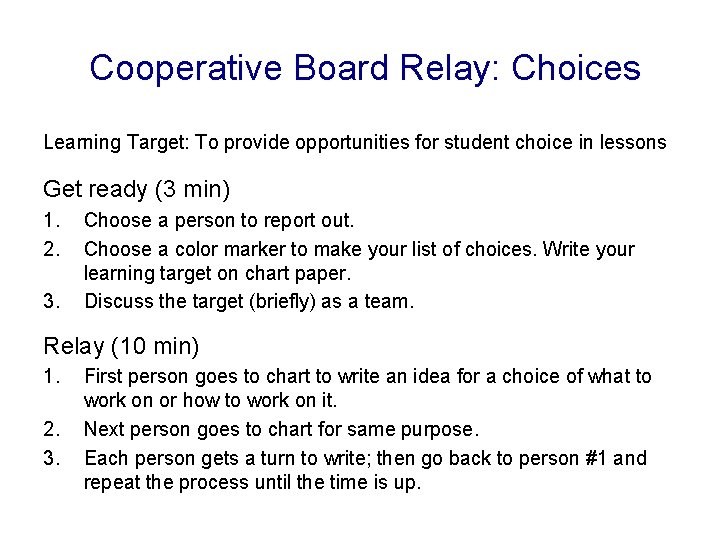
Cooperative Board Relay: Choices Learning Target: To provide opportunities for student choice in lessons Get ready (3 min) 1. 2. 3. Choose a person to report out. Choose a color marker to make your list of choices. Write your learning target on chart paper. Discuss the target (briefly) as a team. Relay (10 min) 1. 2. 3. First person goes to chart to write an idea for a choice of what to work on or how to work on it. Next person goes to chart for same purpose. Each person gets a turn to write; then go back to person #1 and repeat the process until the time is up.
Cooperative Board Relay (continued) Report out (and additional options ideas) (5 min) Reporter reads group‘s options to whole group. Then anyone (from any team) can suggest another option. If the team accepts the suggestion, the person who suggested it goes up and adds it to the chart.
Cooperative Board Relay (continued) Reflection (5 min) The Zones (regarding providing choices for students) Comfort zone (what are you sure about) Learning zone (what do you not know well) Twilight zone (What do you not understand well)
Ways to Share Work and Reflect Content Groups (15 min) 1. Review the reflection section at the end of your Wednesday lesson (page 78). 2. Look through structures for reflection (pages 182 -186). 3. Groups plan 3 other ways that student could reflect at the end of the same lesson. 4. Partner Share: Find a partner from a different content group. Each briefly describes the lesson. Discuss why his/her group decided on the reflection formats they chose for the lesson and different ways that students could reflect at the end.
Make and Take Reflection Questions Read Questions for Reflecting on Student Work (page 187). As you read, put a check next to any questions you have used before with your students. Put a star next to questions you will try using. Write each question you would like to use with your students on a separate index card and secure your cards together with a ring loop. (15 min)
Scaffolding Social Interaction (page 83) Learning Target: To be able to scaffold social interaction 1. Examine the social interaction opportunities you have offered students in your sample lesson 2. Indicate whether you would prepare students with: Written reminders about the interaction Modeling Reminding language Fishbowl demonstration 3. Add to your lesson the method you‘ll use to prepare students to be successful at the social interaction (15 min)
Swap Meet 1. Open your DD 2 Resource Book to your group’s completed lesson plan. 2. When prompted, partner with someone from another group. 3. Share with your partner how you will do “due diligence” in preventing disruption during social interaction in your lessons (2 min person). Be prepared for two rounds.
Strategies for Fixing: Fix it on the spot (page 141) • • Done right at that moment (e. g. , after a spill, coming late, minor rule breaking) For small mistakes Requires a repair or redo or reform Clean slate when it is done Approaches • • • Do over: students race up the stairs; you ask them to do it again as they practiced. Clean it up: a student knocks over another‘s tray at lunch; she cleans it up. Fulfill obligation: a student didn’t stack chairs as assigned; he stacks chairs properly.
Strategies for Fixing: Fix it later (page 141) • • Requires more thought and conversation Most likely a more damaging mistake (e. g. , an injury to feelings, disrupting class, disrespect to teacher) Requires some form of repair or redo or reform Clean slate when it done Approaches • Action apology: A memorable way to say “I‘m sorry” (page 142) • A written reflection on the mistake • Conference: Establish a strategy for building self-control
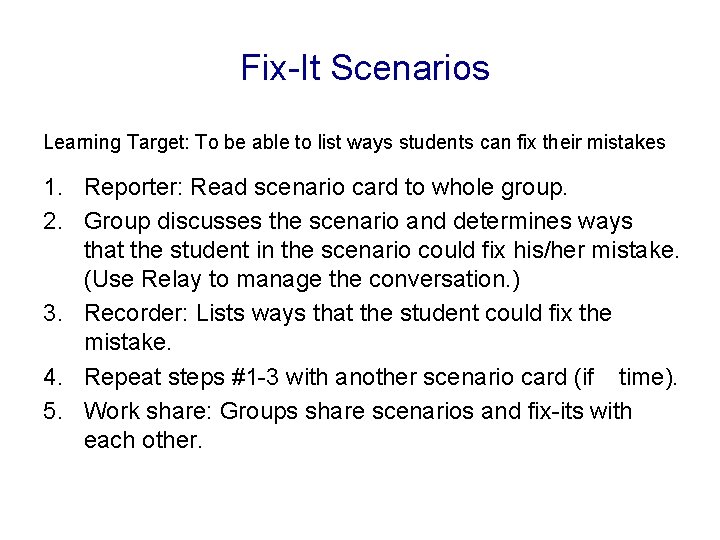
Fix-It Scenarios Learning Target: To be able to list ways students can fix their mistakes 1. Reporter: Read scenario card to whole group. 2. Group discusses the scenario and determines ways that the student in the scenario could fix his/her mistake. (Use Relay to manage the conversation. ) 3. Recorder: Lists ways that the student could fix the mistake. 4. Repeat steps #1 -3 with another scenario card (if time). 5. Work share: Groups share scenarios and fix-its with each other.
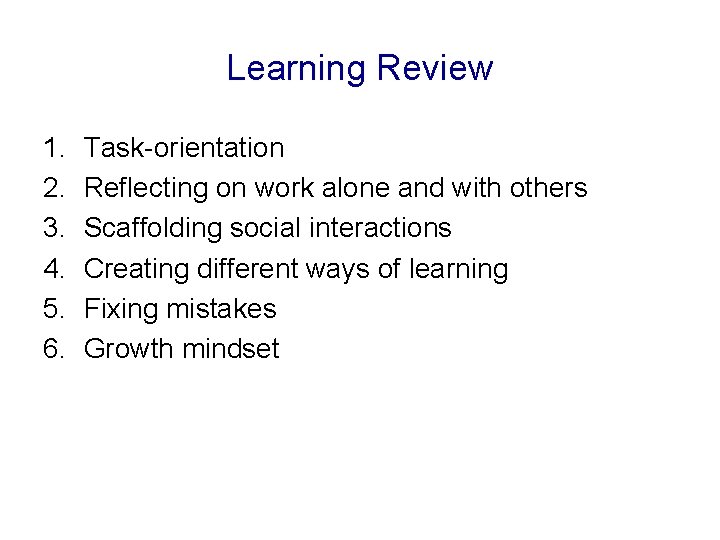
Learning Review 1. 2. 3. 4. 5. 6. Task-orientation Reflecting on work alone and with others Scaffolding social interactions Creating different ways of learning Fixing mistakes Growth mindset
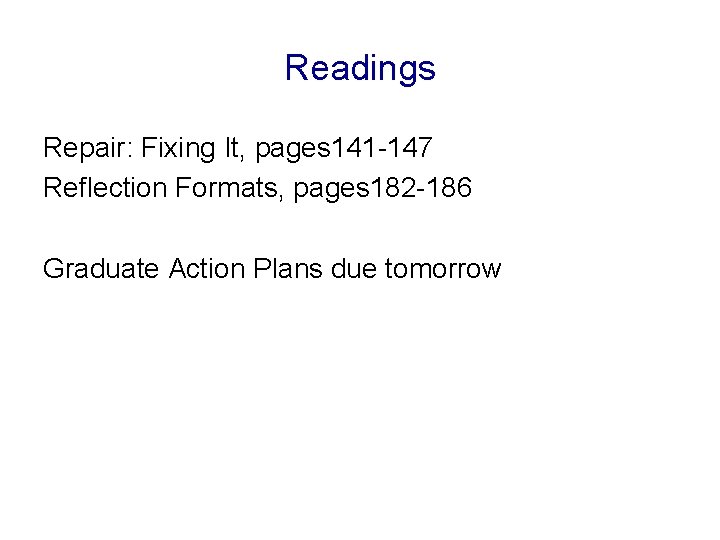
Readings Repair: Fixing It, pages 141 -147 Reflection Formats, pages 182 -186 Graduate Action Plans due tomorrow
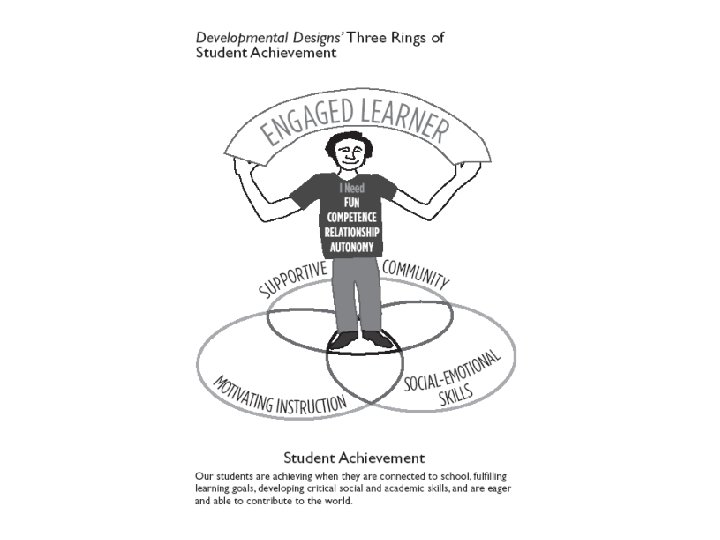
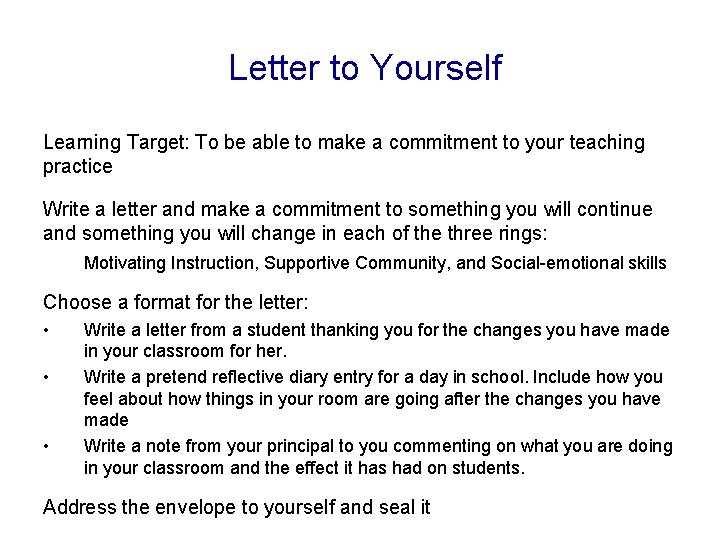
Letter to Yourself Learning Target: To be able to make a commitment to your teaching practice Write a letter and make a commitment to something you will continue and something you will change in each of the three rings: Motivating Instruction, Supportive Community, and Social-emotional skills Choose a format for the letter: • • • Write a letter from a student thanking you for the changes you have made in your classroom for her. Write a pretend reflective diary entry for a day in school. Include how you feel about how things in your room are going after the changes you have made Write a note from your principal to you commenting on what you are doing in your classroom and the effect it has had on students. Address the envelope to yourself and seal it
A+ Compared to CPR How is the Advisory + (A+) different from the CPR format? 1. Short greeting (so we can spend the majority of time on the activity). 2. It may or may not be in a circle depending on what you are doing. 3. No interactive portion on the chart. Chart is brief. 4. Reflection happens at the end of the period.
Conspiracy of Caring Meeting (page 143) 1. Presenting Teacher describes the student. 2. Group asks clarifying questions. (Monitor to eliminate leading questions. ) 3. Group offers suggestions if the Presenting Teacher invites them. 4. Acknowledge each other. (20 min)
Conspiracy of Caring: Benefits 1. Provides a non-judgmental way to think together about how to help a student 2. Deepens thinking about a student 3. Creates equal problem-solving status among adults; no one is the expert—all are inquiring 4. Stimulates thinking about and gives insights into all students 5. Process is respectful to student, presenting teacher, and questioners Turn and Talk: How might you use this process in your practice/your school?
Ways to Use Partner Interaction Formats Learning Target: To be able to list ways to use partner interaction formats in your lessons 1. Look through partner interaction formats on pages 8998. 2. List ways that you can use partner interactions more often in your teaching, either in a specific lesson or more broadly throughout the day.