LEISURE AND MEDIA Chapter 13 A Sociology of
- Slides: 17
LEISURE AND MEDIA Chapter 13
A Sociology of Leisure • Leisure refers to time that can be spent relaxing, engaging in recreation, or otherwise indulging in freely chosen activities. • Recreation includes any pleasurable activity that is refreshing and renewing for the body, mind, and spirit.
A Sociology of Leisure (cont'd) • Changes to modern leisure-time activities: 1. A shift from the public to the private sphere: people spend more time at home, especially with new technologies. 2. Commodities; while people used to make their own fun, they now purchase it as goods and services. 3. Formal organization; many recreational activities that were once spontaneous and unsupervised are now formally organized.
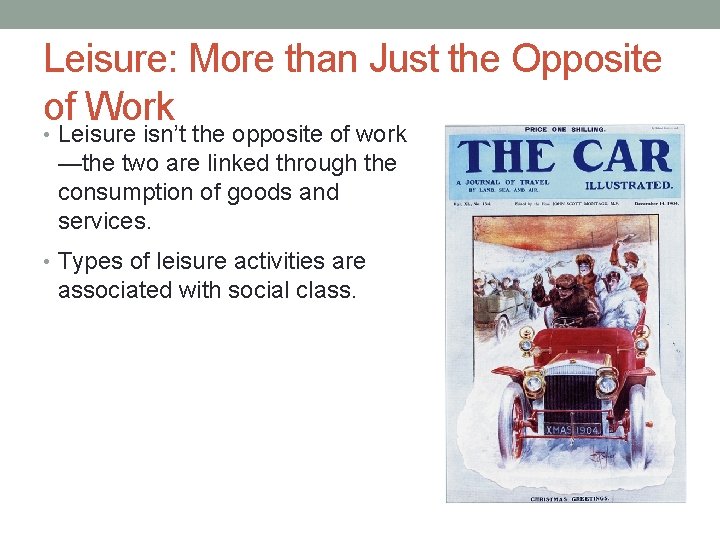
Leisure: More than Just the Opposite of Work • Leisure isn’t the opposite of work —the two are linked through the consumption of goods and services. • Types of leisure activities are associated with social class.
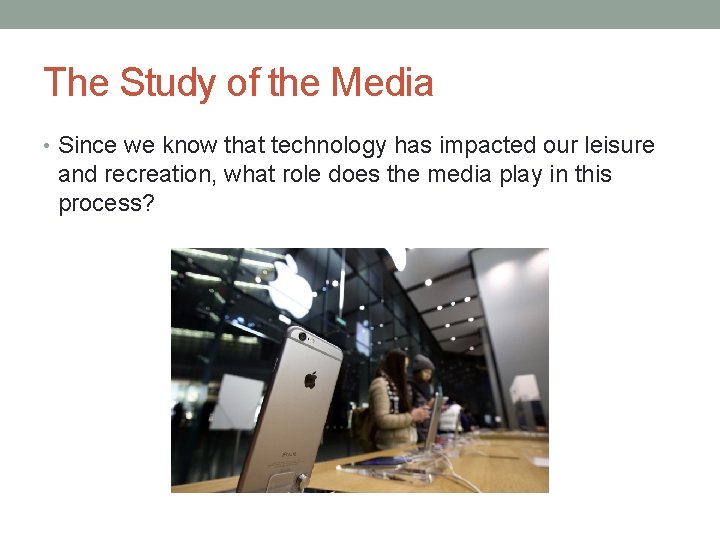
The Study of the Media • Since we know that technology has impacted our leisure and recreation, what role does the media play in this process?
The Media and Democracy • The media is a major social institution, with increasing power and importance. • Fourth estate: the media are considered like a fourth branch of government (after the executive, legislative, and judiciary) and thus serve as another of the checks and balances on power.
The Structure of Media Industries • Conglomeration: the process by which a single corporation acquires ownership of a variety of otherwise unrelated businesses • Mergers: the legal combination of two companies, usually in order to maximize efficiency and profits by eliminating redundant infrastructure and personnel
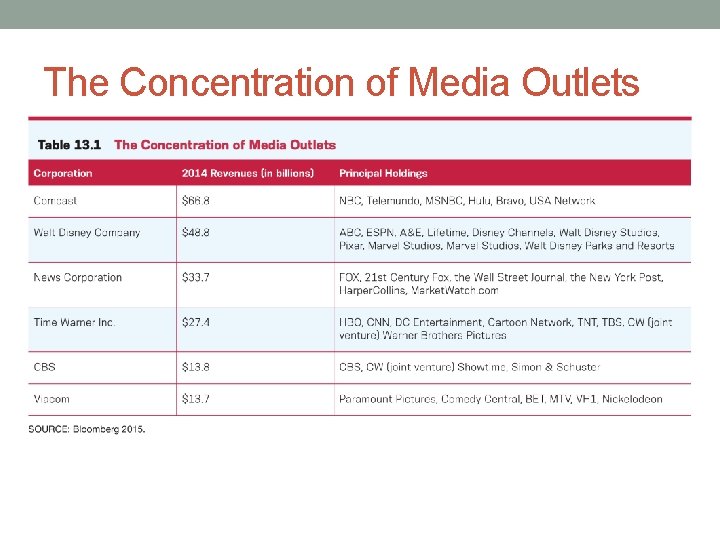
The Concentration of Media Outlets
The Structure of Media Industries (cont’d) • Monopoly: a situation in which there is only one individual or organization, without competitors, providing a particular good or service • To avoid a monopoly in any one media market, the Federal Communications Commission (FCC) has established restrictions on media-outlet ownership.
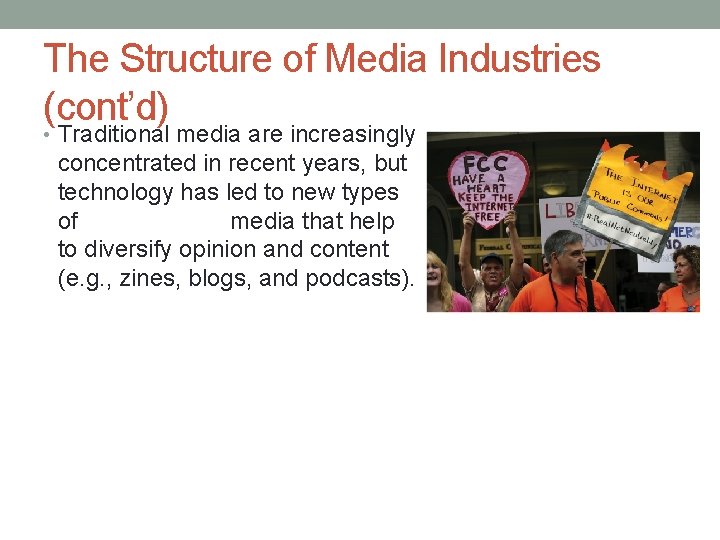
The Structure of Media Industries (cont’d) • Traditional media are increasingly concentrated in recent years, but technology has led to new types of media that help to diversify opinion and content (e. g. , zines, blogs, and podcasts).
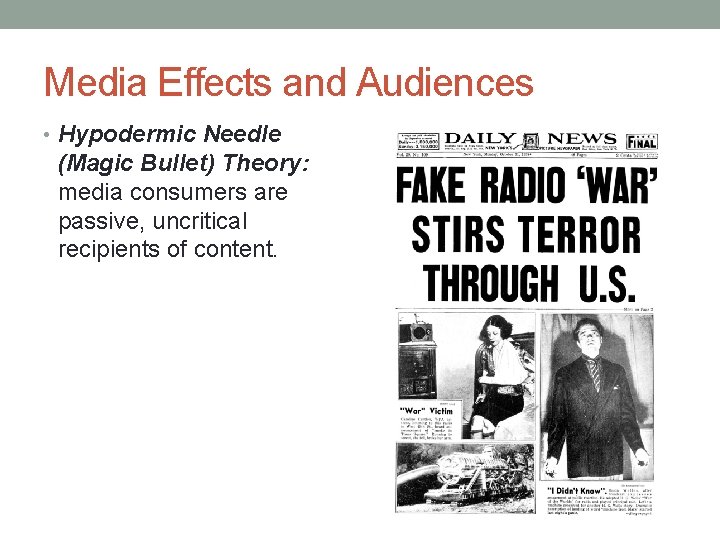
Media Effects and Audiences • Hypodermic Needle (Magic Bullet) Theory: media consumers are passive, uncritical recipients of content.
Media Effects and Audiences (cont’d) • Active Audience Theory: explains the effects of media through the interpretive activity of the audience members. • Uses and Gratification Paradigm: approaches that focus on the psychological or social needs that various media fulfill.
Media Effects and Audiences (cont’d) • Interpretive Strategies: suggests that audience members have ideas and theories that they bring to bear on a particular media text to understand its meaning • Encoding/Decoding Model: combines models to recognize that media texts are created to deliver specific messages and that individuals actively interpret these messages
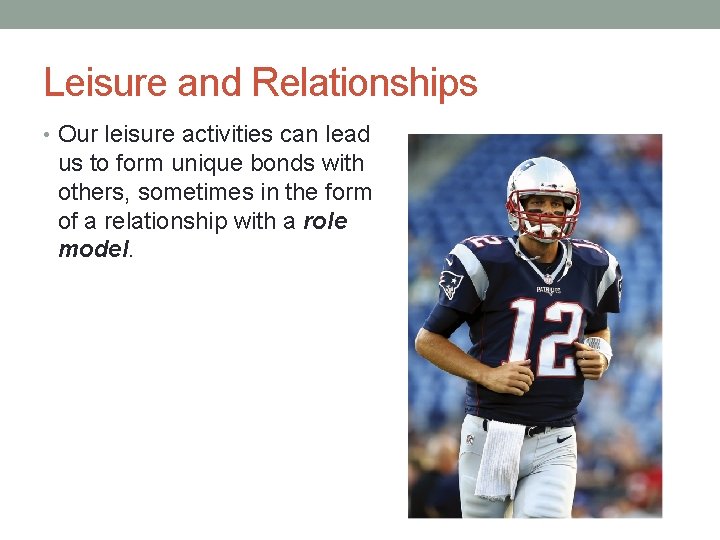
Leisure and Relationships • Our leisure activities can lead us to form unique bonds with others, sometimes in the form of a relationship with a role model.
Leisure and Relationships (cont’d) • Third place: • After home (first) and work (second) • Any informal public place where people come together regularly for conversation and camaraderie when not at work or home
Leisure and Relationships (cont’d) • Civil society: organizations, institutions, and interactions —outside of government, family, and work—that promote social bonds and smooth the functioning of society
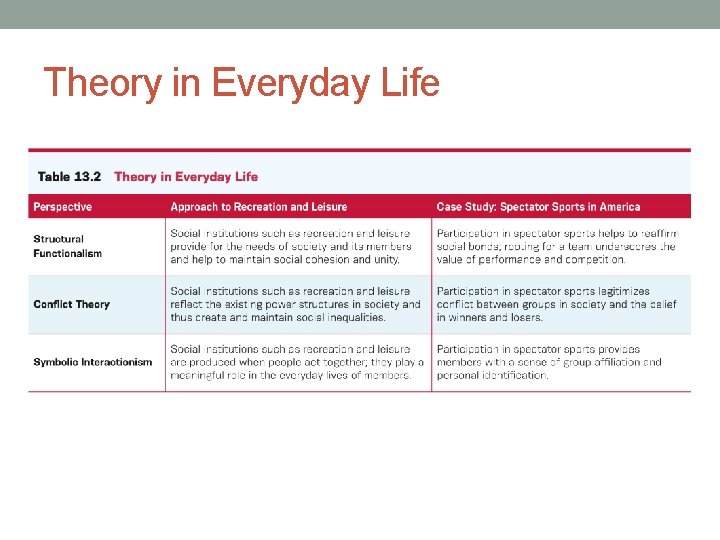
Theory in Everyday Life