Lecture 9 Term 2 Penis Envy Castration Anxiety
- Slides: 27
Lecture 9 Term 2 ‘Penis Envy’, ‘Castration Anxiety’, ‘Oedipus Complex’ and ‘Sexual Perversion’: Invention of an Unconscious Human Nature
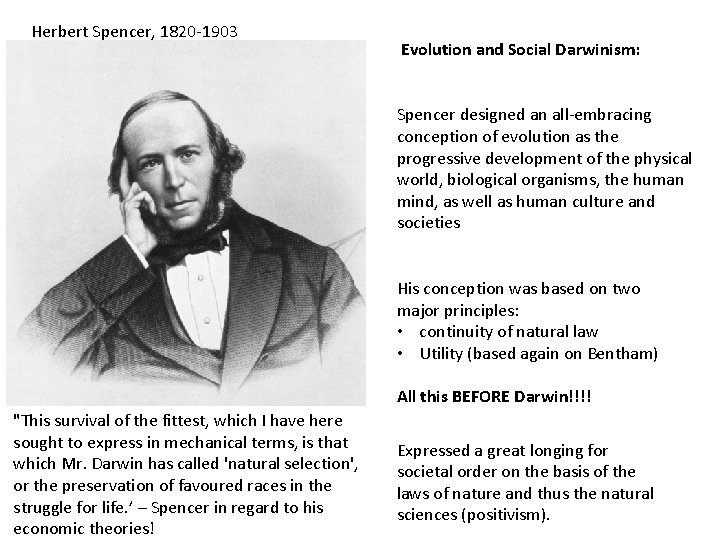
Herbert Spencer, 1820 -1903 Evolution and Social Darwinism: Spencer designed an all-embracing conception of evolution as the progressive development of the physical world, biological organisms, the human mind, as well as human culture and societies His conception was based on two major principles: • continuity of natural law • Utility (based again on Bentham) All this BEFORE Darwin!!!! "This survival of the fittest, which I have here sought to express in mechanical terms, is that which Mr. Darwin has called 'natural selection', or the preservation of favoured races in the struggle for life. ’ – Spencer in regard to his economic theories! Expressed a great longing for societal order on the basis of the laws of nature and thus the natural sciences (positivism).
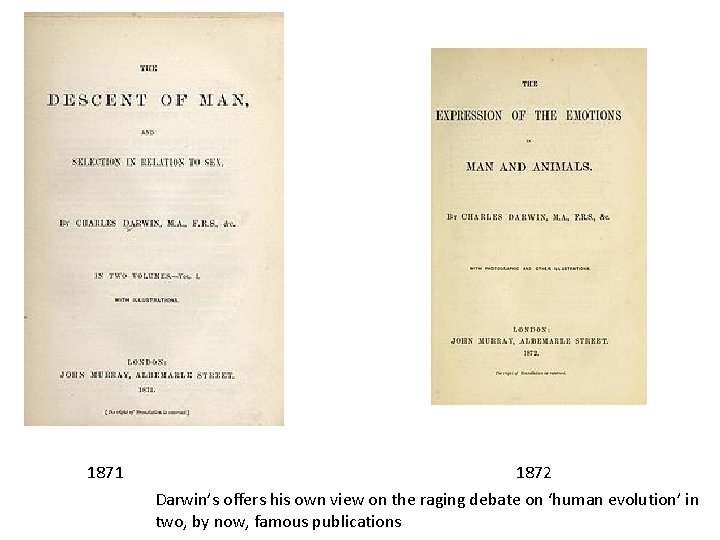
1871 1872 Darwin’s offers his own view on the raging debate on ‘human evolution’ in two, by now, famous publications
A different philosophical setting in which we have to see Freud’s ideas about the mind Idealism/Romanicism: emphasizes the "ideal" character of all phenomena and is very strong during the 18 th and 19 th century in the German speaking world. Opposites are ‘materialism’, or ‘realism’ and philosophies such as positivism. Philosophers of German idealism are Kant, Fichte, Schelling, Hegel. Historicism: a mode of thinking that assigns a central and basic significance to a specific context, such as historical period, geographical place and local culture. As such it is in contrast to individualist theories of knowledge such as empiricism and rationalism (positivism), which neglect the role of traditions.
Freud’s philosophical approach in a nutshell: Freud’s as we shall see had a firm belief idealism, historicism and Enlightenment ‘reason’ as man’s instrument to understand the world around him. His whole therapy rested on this faith in human reason: According to the basic principle of Freud’s theory he who understands that which is unconscious frees himself in this very process and can overcome his symptom
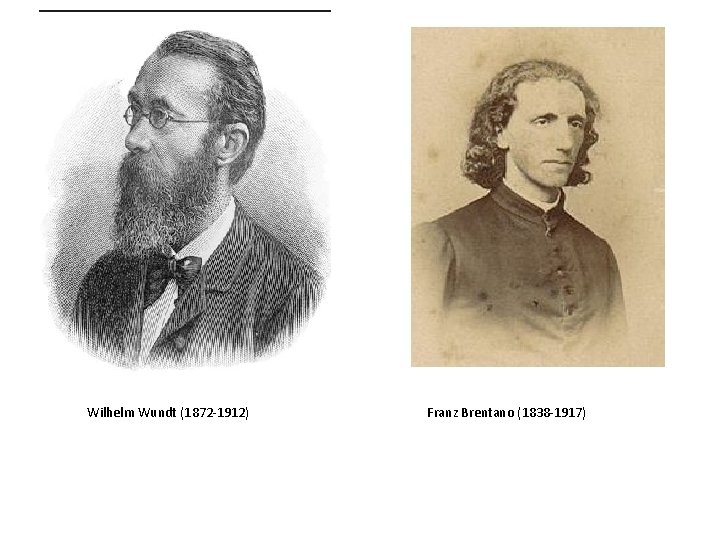
Wilhelm Wundt (1872 -1912) Franz Brentano (1838 -1917)
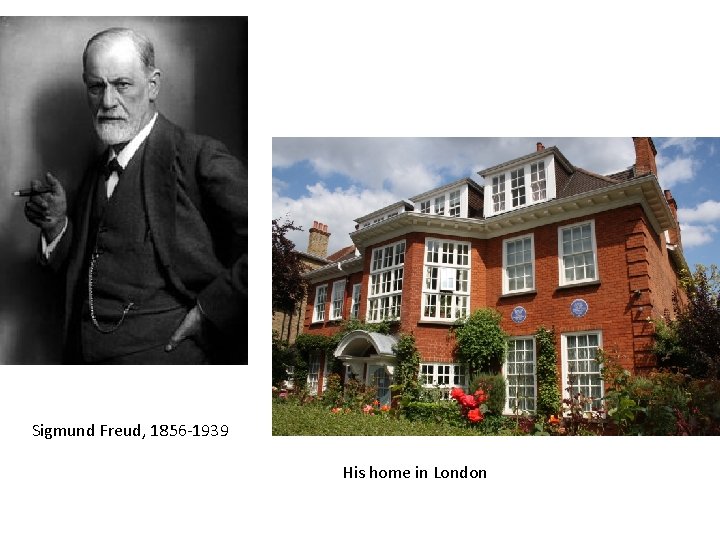
Sigmund Freud, 1856 -1939 His home in London
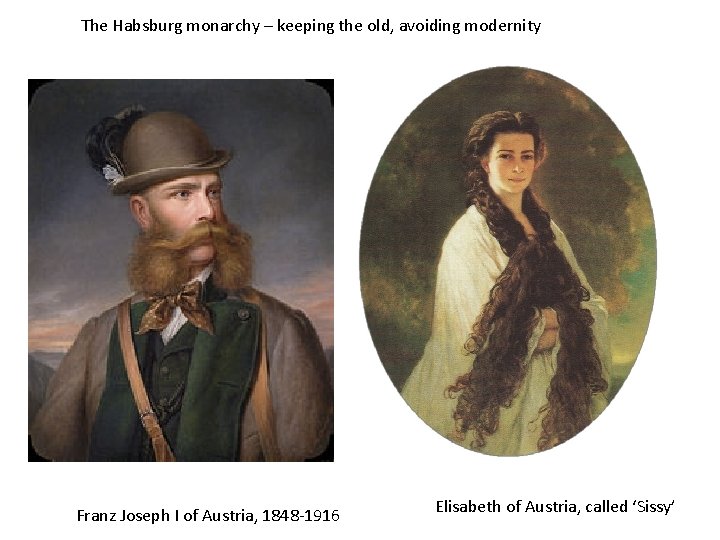
The Habsburg monarchy – keeping the old, avoiding modernity Franz Joseph I of Austria, 1848 -1916 Elisabeth of Austria, called ‘Sissy’
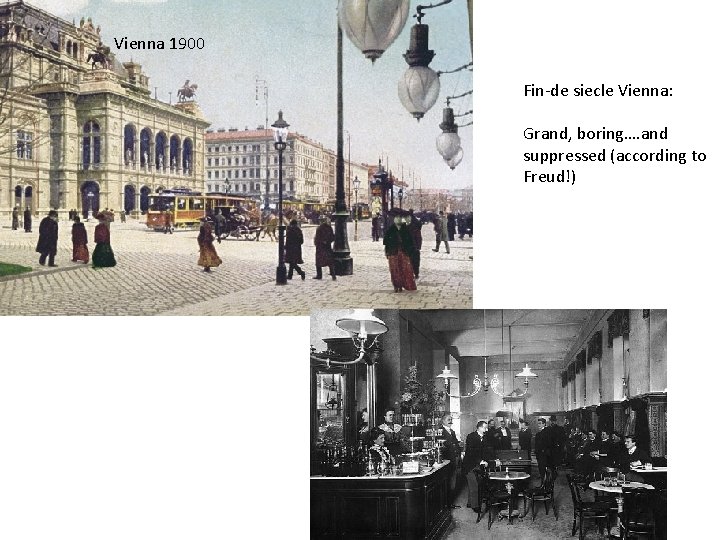
Vienna 1900 Fin-de siecle Vienna: Grand, boring…. and suppressed (according to Freud!)
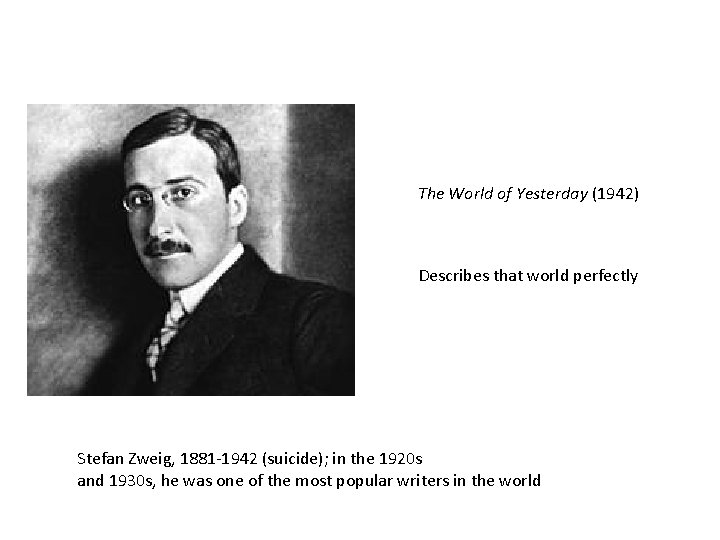
The World of Yesterday (1942) Describes that world perfectly Stefan Zweig, 1881 -1942 (suicide); in the 1920 s and 1930 s, he was one of the most popular writers in the world
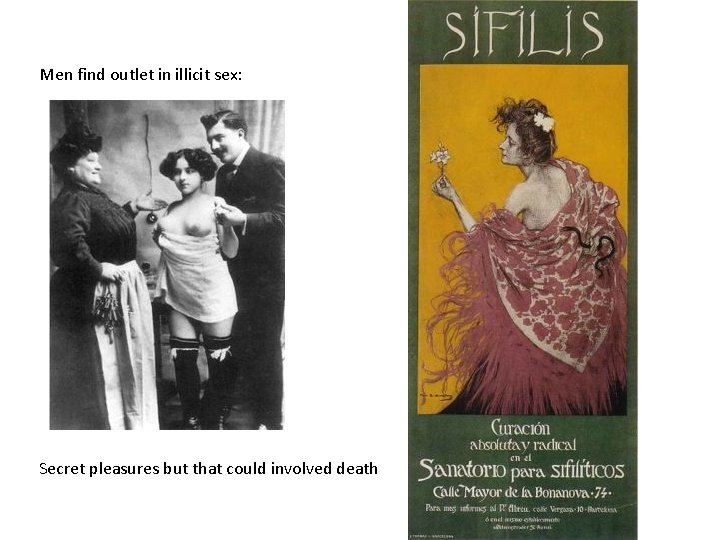
Suppression of sexual expression leads to: 1. an overt inhibition and ignorance of sexual matters 2. a covert emphasis on sex (prostitution etc. )
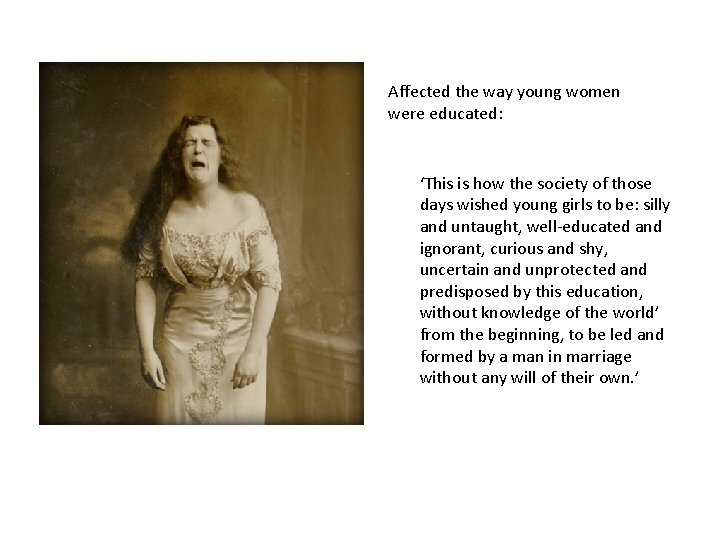
Affected the way young women were educated: ‘This is how the society of those days wished young girls to be: silly and untaught, well-educated and ignorant, curious and shy, uncertain and unprotected and predisposed by this education, without knowledge of the world’ from the beginning, to be led and formed by a man in marriage without any will of their own. ’
Men find outlet in illicit sex: Secret pleasures but that could involved death
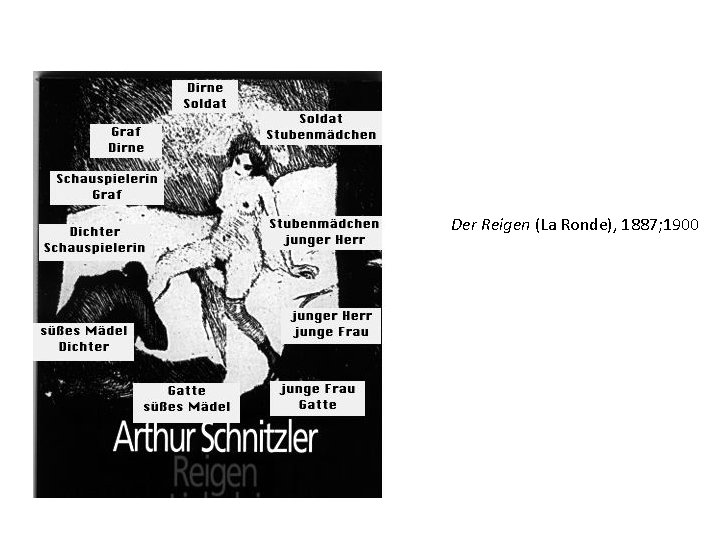
Der Reigen (La Ronde), 1887; 1900
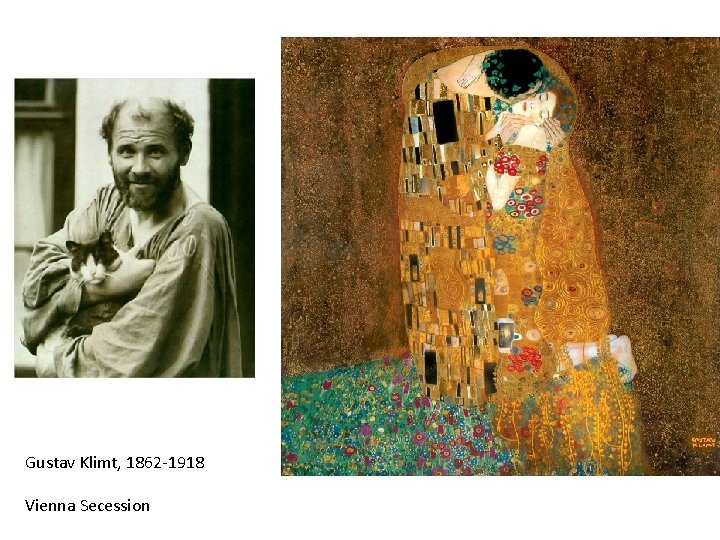
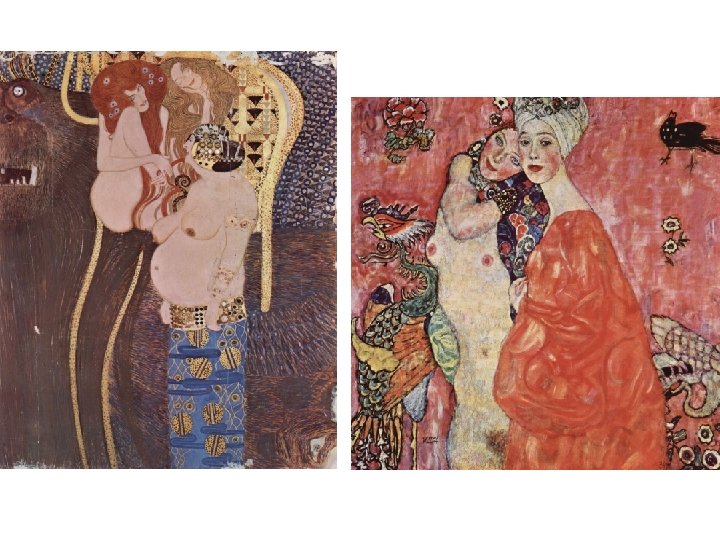
Gustav Klimt, 1862 -1918 Vienna Secession
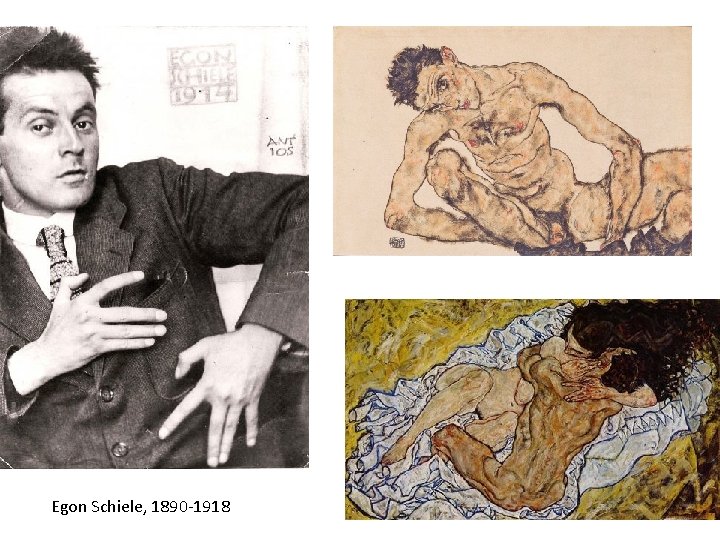
Egon Schiele, 1890 -1918
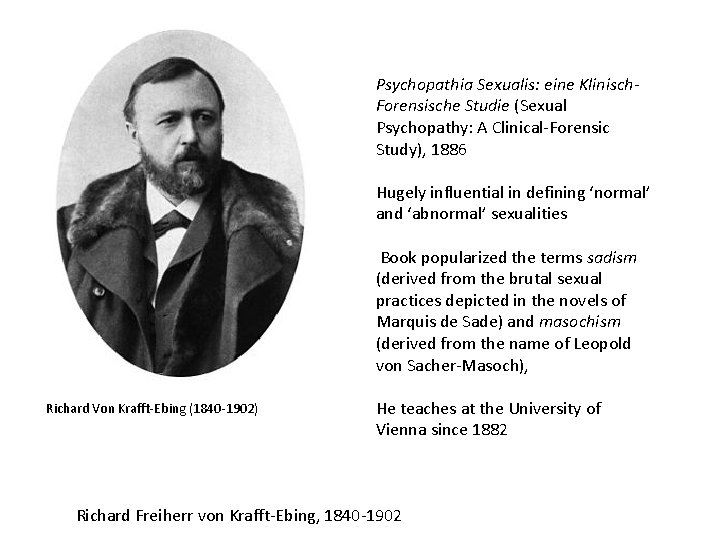
Psychopathia Sexualis: eine Klinisch. Forensische Studie (Sexual Psychopathy: A Clinical-Forensic Study), 1886 Hugely influential in defining ‘normal’ and ‘abnormal’ sexualities Book popularized the terms sadism (derived from the brutal sexual practices depicted in the novels of Marquis de Sade) and masochism (derived from the name of Leopold von Sacher-Masoch), Richard Von Krafft-Ebing (1840 -1902) He teaches at the University of Vienna since 1882 Richard Freiherr von Krafft-Ebing, 1840 -1902
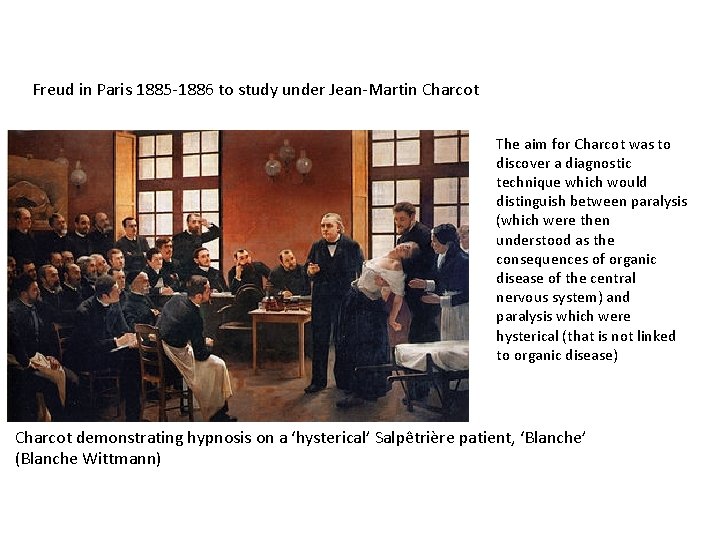
Freud in Paris 1885 -1886 to study under Jean-Martin Charcot The aim for Charcot was to discover a diagnostic technique which would distinguish between paralysis (which were then understood as the consequences of organic disease of the central nervous system) and paralysis which were hysterical (that is not linked to organic disease) Charcot demonstrating hypnosis on a ‘hysterical’ Salpêtrière patient, ‘Blanche’ (Blanche Wittmann)
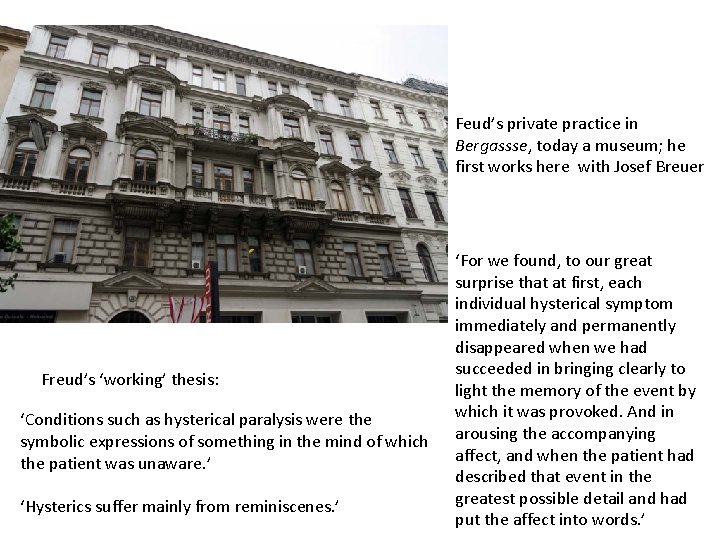
Feud’s private practice in Bergassse, today a museum; he first works here with Josef Breuer Freud’s ‘working’ thesis: ‘Conditions such as hysterical paralysis were the symbolic expressions of something in the mind of which the patient was unaware. ’ ‘Hysterics suffer mainly from reminiscenes. ’ ‘For we found, to our great surprise that at first, each individual hysterical symptom immediately and permanently disappeared when we had succeeded in bringing clearly to light the memory of the event by which it was provoked. And in arousing the accompanying affect, and when the patient had described that event in the greatest possible detail and had put the affect into words. ’
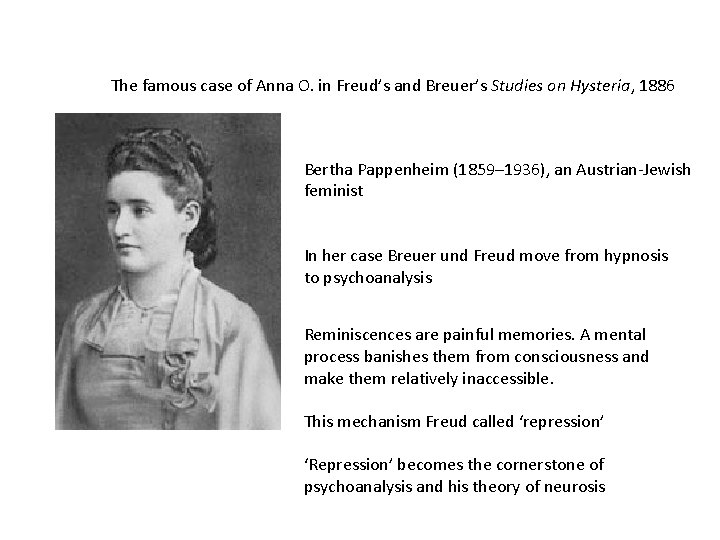
The famous case of Anna O. in Freud’s and Breuer’s Studies on Hysteria, 1886 Bertha Pappenheim (1859– 1936), an Austrian-Jewish feminist In her case Breuer und Freud move from hypnosis to psychoanalysis Reminiscences are painful memories. A mental process banishes them from consciousness and make them relatively inaccessible. This mechanism Freud called ‘repression’ ‘Repression’ becomes the cornerstone of psychoanalysis and his theory of neurosis
To Freud sexuality is the key to repression and neurosis (surprise, surprise!) ‘The neurotic symptoms were not related directly to actual events but to wishful phantasies, and that as far as the neurosis was concerned psychical reality was of more importance than material reality. ’ From then onwards, Freud’ investigation was directed from: • being an attempt to disclose a causal series of events culminating in the outbreak of a neurosis to • an exploration of the patient’s imaginary world, especially as that world manifested itself in the early years of childhood. He somehow left the medical physiological model of neurosis behind. Diagnostic and therapeutic technique: Free-Association and dream interpretation - ‘The interpretation of dreams is the royal road to knowledge of the unconscious activities of the mind’ (Freud, The Interpretation of Dreams, 1900)
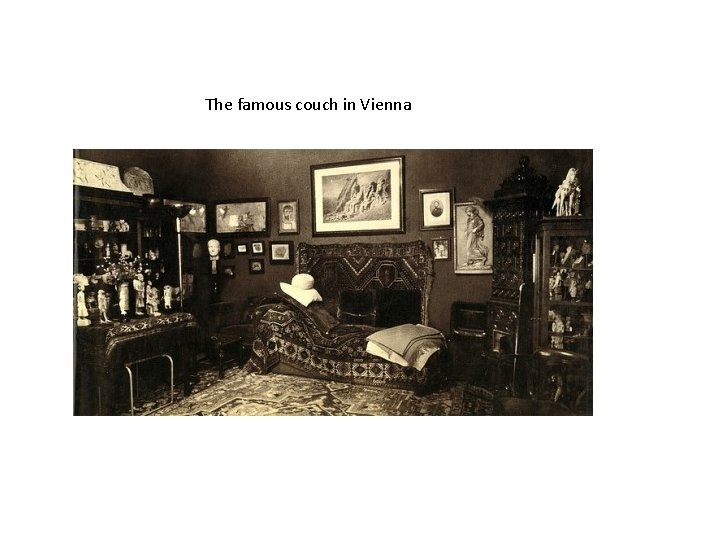
The famous couch in Vienna
Famous claims: • infantile sexual development: neurosis is connected with disturbances of the sexual function, originating in the early years of childhood. • There are 5 psychosexual development stages: (i) the oral, (ii) the anal, (iii) the phallic, (iv) the latent, and (v) the genital — in which the source of libidinal pleasure is in a different erogenous zone of the infant's body. • Freud pictured the infant’s sexuality as ‘polymorphously perverse’, and suggested that neurotic symptoms were the consequences of the repression of perverse sexual impulses dating from the earliest years. • Oedipus Complex (or the Electra complex coined by his follower C. G. Jung); result in castration angst (boys) and penis envy (girls)
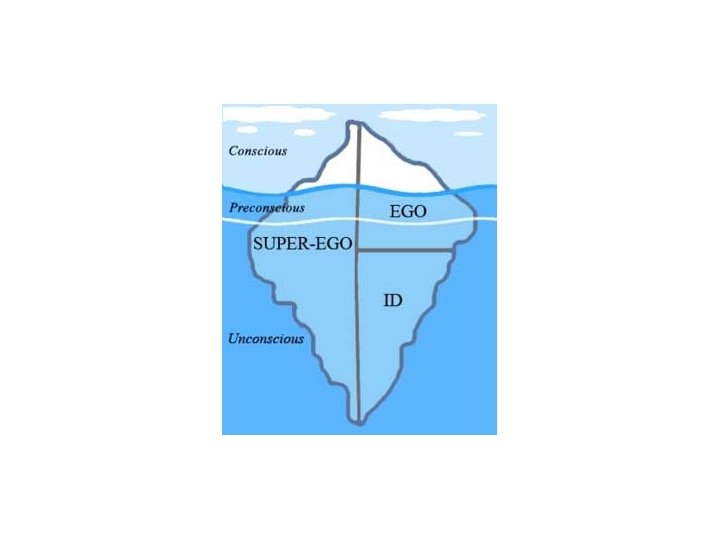
mental apparatus is divided into: id, ego (or I), super-ego (or super-I) – moves away from earlier division into conscious, preconscious, and unconscious which was common at the time Id (Latin for ‘it’): is the set of uncoordinated instinctual trends. It is primitive, unorganised, emotional, illogical. “It is the dark, inaccessible part of our personality” ego ((Latin for ‘I) is the organized, realistic part of the brain which presents consciousness. It employs secondary processes of reason, common sense, and the power to delay immediate responses to external stimuli or to internal instinctive prompting. The ego mediates between the unstructured desires of the id and the moral super-ego: plays the critical and moralizing role; reflects the internalization of cultural rules, mainly taught by parents applying their guidance and influence. It forms the organized part of the personality structure. "The Super-ego can be thought of as a type of conscience that punishes misbehavior with feelings of guilt. The super-ego works in contradiction to the id, striving to act in a socially appropriate manner
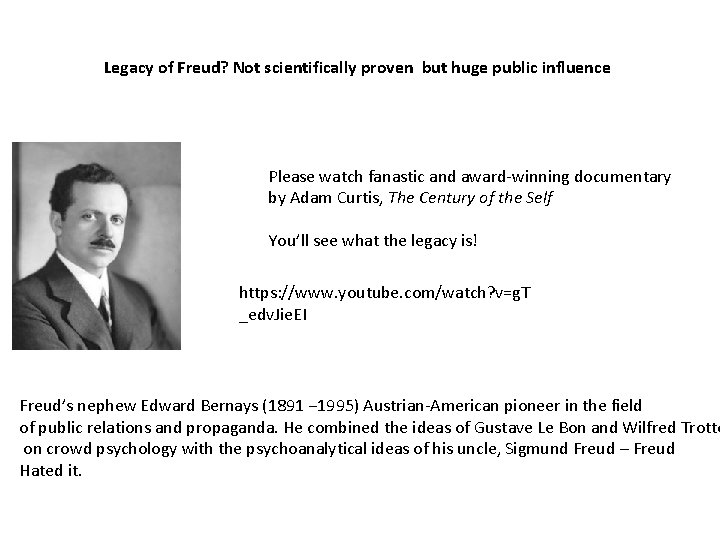
Legacy of Freud? Not scientifically proven but huge public influence Please watch fanastic and award-winning documentary by Adam Curtis, The Century of the Self You’ll see what the legacy is! https: //www. youtube. com/watch? v=g. T _edv. Jie. EI Freud’s nephew Edward Bernays (1891 − 1995) Austrian-American pioneer in the field of public relations and propaganda. He combined the ideas of Gustave Le Bon and Wilfred Trotte on crowd psychology with the psychoanalytical ideas of his uncle, Sigmund Freud – Freud Hated it.