Lecture 6 LONG ISLAND NATURAL HISTORY LONG ISLAND








- Slides: 43
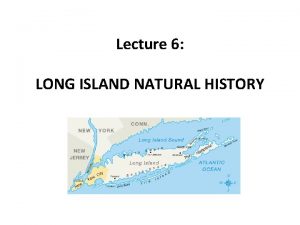
Lecture 6: LONG ISLAND NATURAL HISTORY
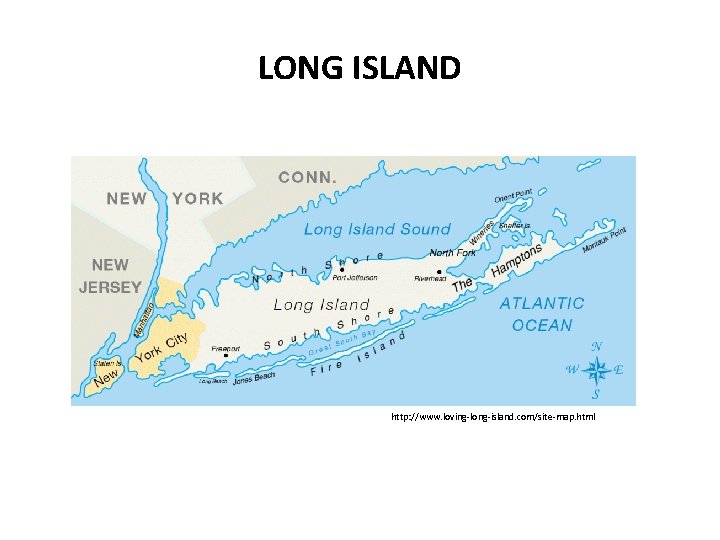
LONG ISLAND http: //www. loving-long-island. com/site-map. html
LONG ISLAND FACTS • 4 counties, 2 of which are NYC boroughs • • 118 miles long, 12 – 23 miles wide Largest island in contiguous U. S. 11 th largest island in U. S. A 149 th largest island in the world • Highest point 120 m above sea level (Jayne’s Hill, West Hills County Park, Melville) • Population estimated around 8 million
Make-up of sand on North Shore and South Shore beaches reflective of glacial origin and the depositional environment
WHEN DID LONG ISLAND FORM? • Formed during the last glaciation causing the surface of Long Island to be covered by a thick layer of sediment (glacial debris) • 21, 000 years ago, geologically very young
PRE-GLACIAL FORMATION • Bedrock formed over 400 million years ago – metamorphic rock (transformation of existing rock due to heat and pressure) • Sands and clays deposited on bedrock 70 million years ago • Advance and retreat of glacier formed Long Island outline
GLACIATION • Last ice advance (Wisconsinan) started in Canada 85, 000 years ago • Reached Connecticut 26, 000 years ago • Ended on Long Island 21, 000 years ago • 20, 000 years ago – ice receded due to melting, paused several times leaving piles of glacial debris • Southern-most extent marked on middle of Long Island • 15, 000 years ago glacier retreated out-of-state , sea level rose and isostatic rebound caused Long Island Sound to be formed • At glacial maxima sea level was 91 m lower than today, shoreline 80 -110 km south of Long Island
http: //3 dparks. wr. usgs. gov/nyc/morraines/quaternary. htm
ADVANCING GLACIER • As glacier advances it scrapes off sediment and rock • Carried with advancing glacier
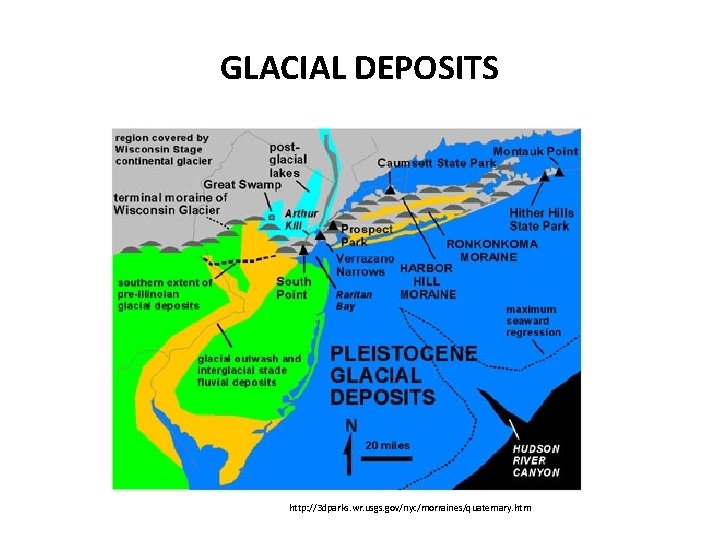
GLACIAL DEPOSITS http: //3 dparks. wr. usgs. gov/nyc/morraines/quaternary. htm
TYPES OF MORAINE • Moraine – unconsolidated glacial debris (soil and rock) • Terminal moraine – debris marking the end or furthest advance of the glacier • Recessional moraine – formed when glacier stalled while retreating
LONG ISLAND MORAINE • Terminal moraine = Ronkonkoma moraine - Central Long Island South Fork - ‘backbone of Long Island’, coincides with LIE • Recessional moraine = Harbor Hill moraine - North Shore and North Fork
LONG ISLAND MAKE-UP • 2 spines of glacial moraine and sandy outwash plains • Land south of Ronkonkoma moraine is the outwash plain from the last glacier - Hempstead Plains • Outwash – sediments deposited by melt water at the end of the glacier • North Shore – rocky from remaining debris • South Shore – outwash sand
http: //www. eserc. stonybrook. edu/maps/Mashomack. Kayak. Trip/General/Long. Islan d. Geologic. Features. html
SOUTH SHORE FORMATION http: //www. garviespointmuseum. com/geology. php
LONG ISLAND FORMATION http: //www. garviespointmuseum. com/geology. php
GLACIAL ERRATICS • Large boulders, most abundant in terminal moraine • Remain where dropped, not enough energy to move them • North Shore beach boulders eroded by wave action • Represent wide variety of rock types transported from the north • Trace rocks to origin – show direction of ice flow
KETTLE LAKES • Shallow sediment-filled lake or body of water • Formed by retreating glacier • e. g. Lake Ronkonkoma
POST-GLACIAL • Coastlines evolved through action of wind and waves • Away from coastline – less changes occurred as little erosive power in small streams and rivers
SOUTH SHORE • Well sorted • Sediment left by 1 st retreat of Wisconsinan glacier • Finest sediment washed out of glacier forming flat outwash plain = South Shore • High energy wave action from open ocean creates small sand size particles • Replenished with sediment eroded from Montauk Point and migrated along shoreline, plus sand washed in from open ocean
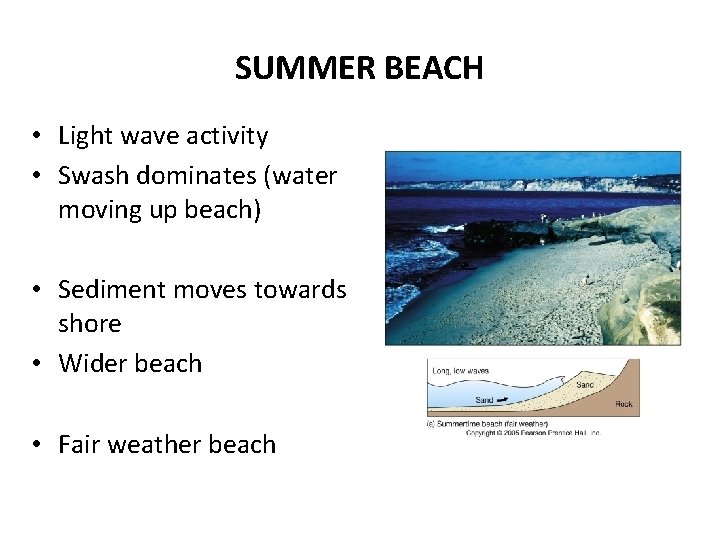
SUMMER BEACH • Light wave activity • Swash dominates (water moving up beach) • Sediment moves towards shore • Wider beach • Fair weather beach
WINTER/STORM BEACH • Heavy wave activity • Backwash dominates (returning water) • Sediment moved away from shore • Narrower beach (sometimes steeper) • Stormy weather
FIRE ISLAND BEACH COMPOSITION • Mostly Quartz: - clear grains, common mineral found in local rocks - relatively insoluble in water - resistant to chemical weathering • No Feldspar: - abundant in cobbles/boulders on beaches - non-existent in sand as weathers rapidly in water
FIRE ISLAND BEACH COMPOSITION • Garnet and Magnetite - heavy mineral found in high amounts on beach after heavy surf - resistant to chemical weathering - lower abundance than quartz due to lower occurrence in rocks - higher density than quartz – high wind/water velocity needed to move it - quartz can be transported in rough weather
MINERALS Garnet Quartz Magnetite
NORTH SHORE • Poorly sorted • Somewhat rounded due to wave action • Not enough energy for erosion
NORTH SHORE • More hilly, shoreline cliffs • Formed during 2 nd retreat of Wisconsinan glacier • Left heaviest and largest sediment including rocks and large boulders • Protected from open ocean – little wave action, area not modified much, changed little since glaciation • Replenished by sediment eroded from Orient Point westwards • Salt marshes common – a lot of mud and low energy
LONG ISLAND MARINE LIFE • Very diversified due to different marine environments • Numerous phyla • Depends on energy level
THE GULF STREAM http: //naturendanger. canalblog. com/archives/p 275 -5. html
SESSILE ORGANISMS Red Beard Sponge Spiral-tufted bryozoan
JELLYFISH Moon Jellyfish Lion’s Mane
WORMS Clam worm/Sandworm Lugworm
ECHINODERMS Forbes Sea Star Sea Urchin
MOLLUSCS Clams Blue Mussels Knobbed Whelk Eastern Oyster
ARTHROPODS Horseshoe Crab Fiddler Crab
ARTHROPODS Northern Lobster
FISH Atlantic Silverside Northern Pipefish Mummichog
FISH Bluefish Striped Bass Black Sea Bass Winter Flounder
SKATES Clearnose Skate
SHARKS Sand Tiger Shark Dogfish Blue Shark Great White Shark? ? ?
MARINE MAMMALS Harbor Seal Fin Whale Right Whale
TURTLES Leatherback Turtle Green Turtle
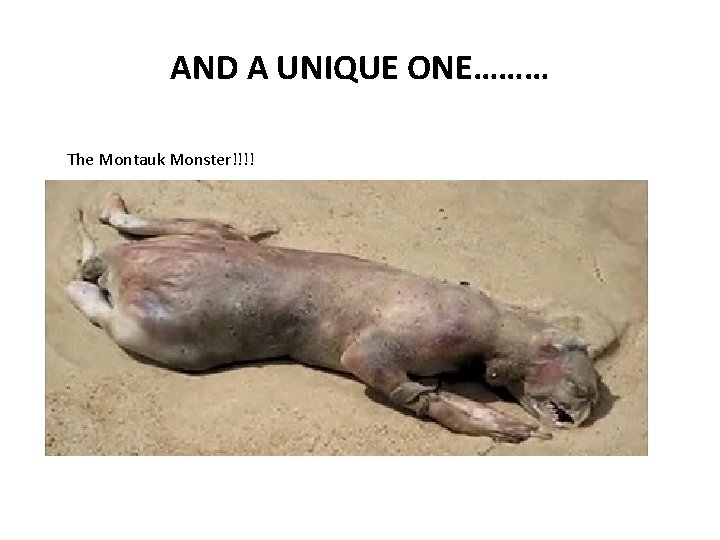
AND A UNIQUE ONE……… The Montauk Monster!!!!