Learning to Navigate for Finegrained Classification Ze Yang

- Slides: 16
Learning to Navigate for Fine-grained Classification Ze Yang, Peking University
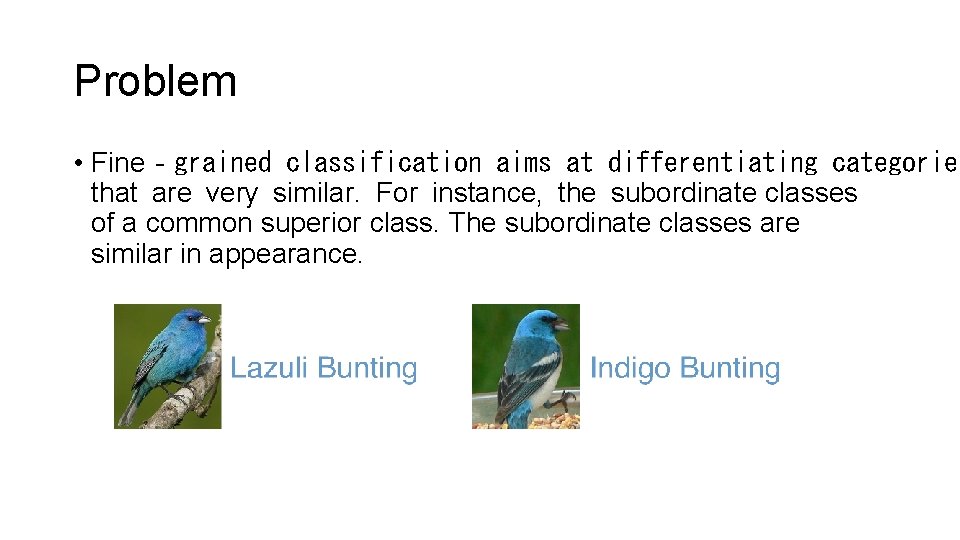
Problem • Fine‐grained classification aims at differentiating categories that are very similar. For instance, the subordinate classes of a common superior class. The subordinate classes are similar in appearance.
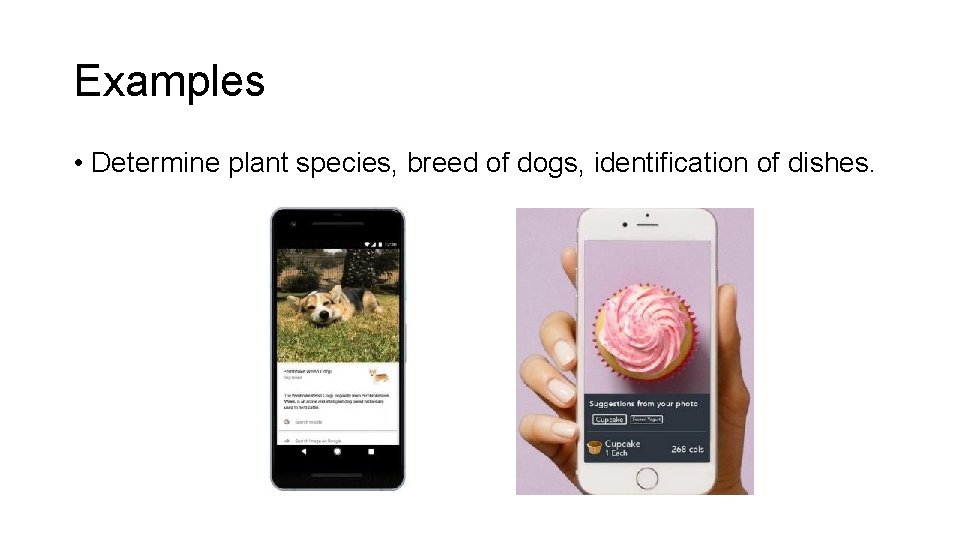
Examples • Determine plant species, breed of dogs, identification of dishes.
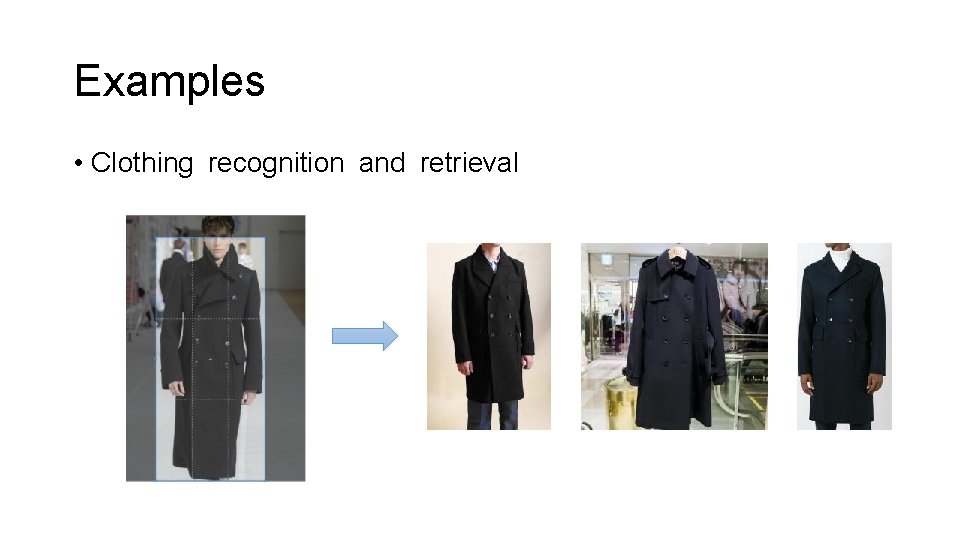
Examples • Clothing recognition and retrieval
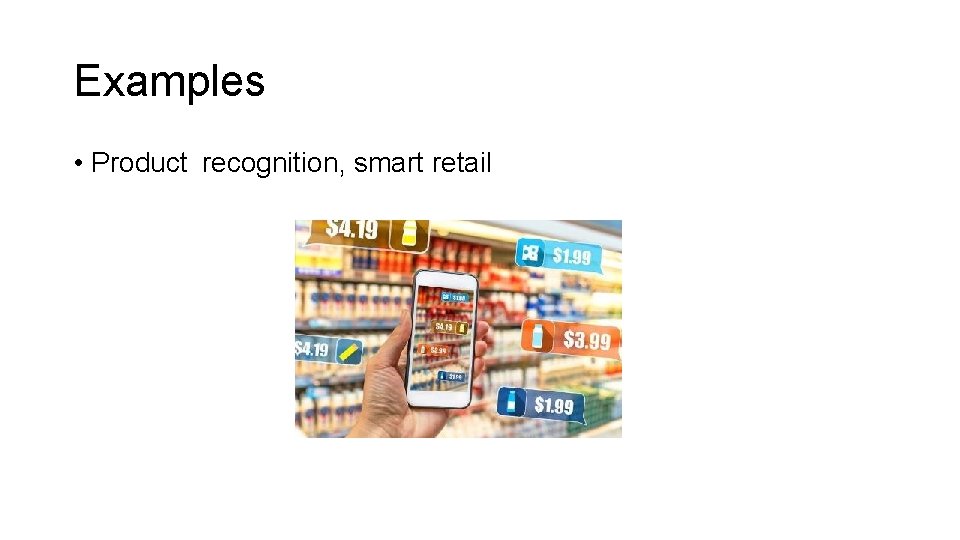
Examples • Product recognition, smart retail
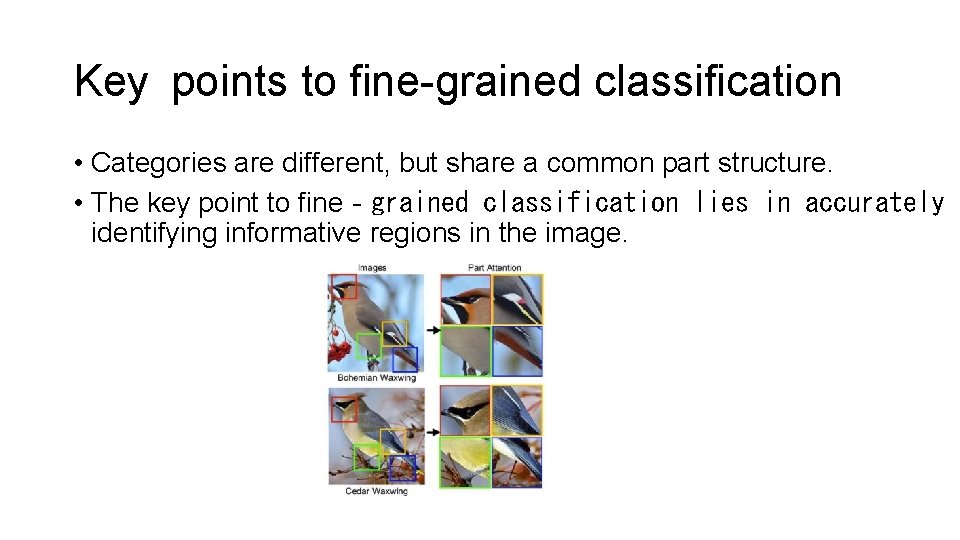
Key points to fine-grained classification • Categories are different, but share a common part structure. • The key point to fine‐grained classification lies in accurately identifying informative regions in the image.
Our works Learning to Navigate for fine-grained classification ECCV 2018
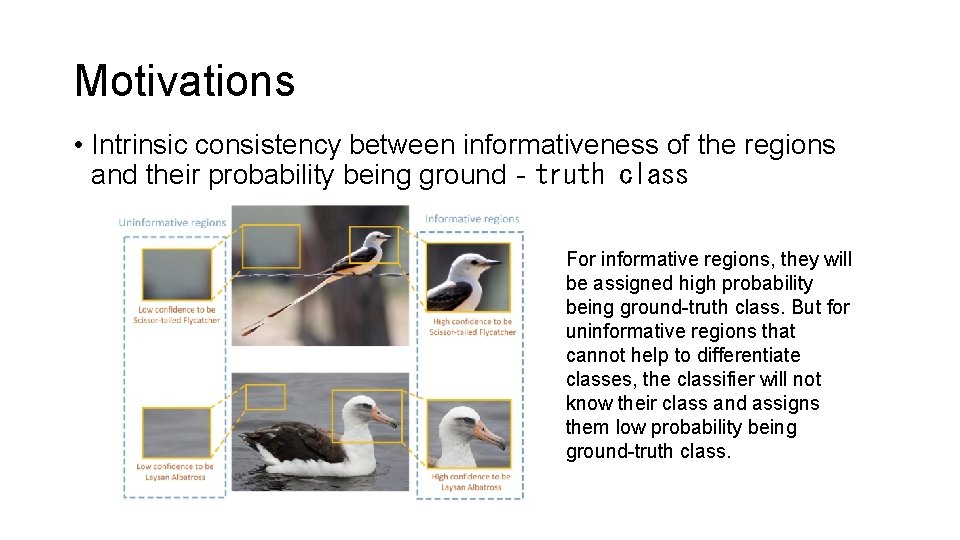
Motivations • Intrinsic consistency between informativeness of the regions and their probability being ground‐truth class For informative regions, they will be assigned high probability being ground-truth class. But for uninformative regions that cannot help to differentiate classes, the classifier will not know their class and assigns them low probability being ground-truth class.
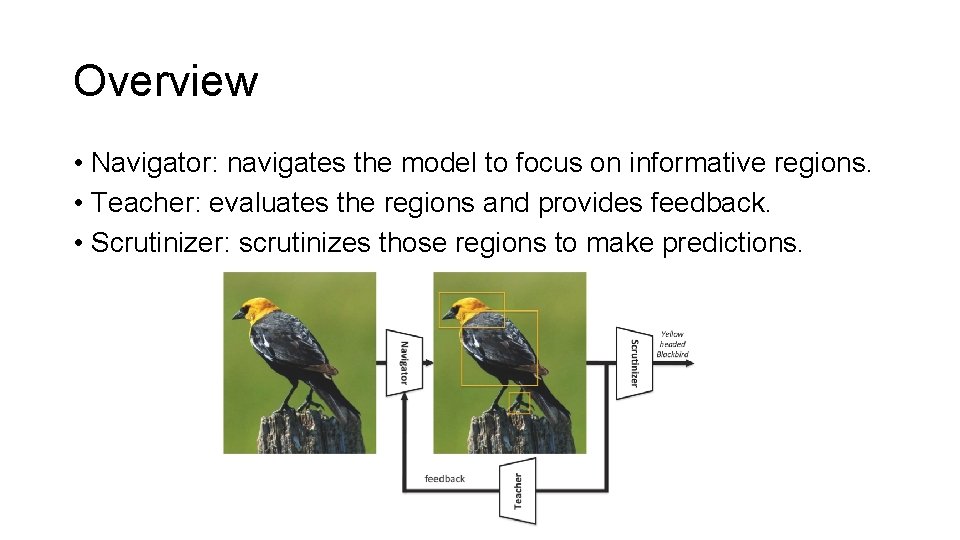
Overview • Navigator: navigates the model to focus on informative regions. • Teacher: evaluates the regions and provides feedback. • Scrutinizer: scrutinizes those regions to make predictions.
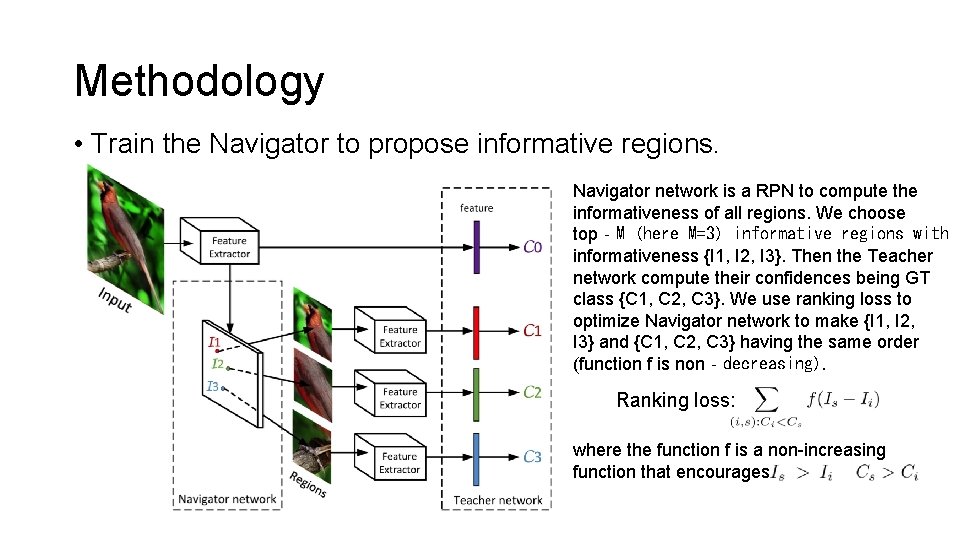
Methodology • Train the Navigator to propose informative regions. Navigator network is a RPN to compute the informativeness of all regions. We choose top‐M (here M=3) informative regions with informativeness {I 1, I 2, I 3}. Then the Teacher network compute their confidences being GT class {C 1, C 2, C 3}. We use ranking loss to optimize Navigator network to make {I 1, I 2, I 3} and {C 1, C 2, C 3} having the same order (function f is non‐decreasing). Ranking loss: where the function f is a non-increasing function that encourages if
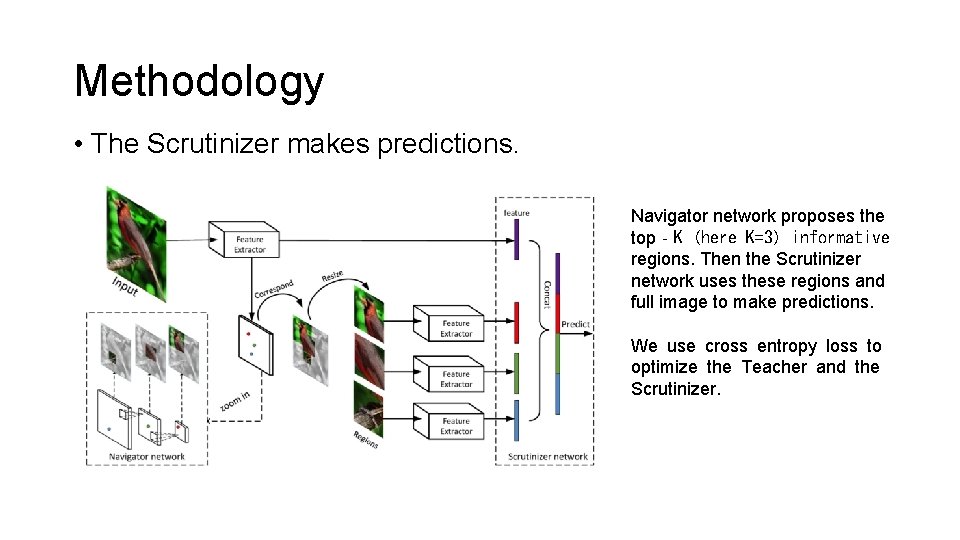
Methodology • The Scrutinizer makes predictions. Navigator network proposes the top‐K (here K=3) informative regions. Then the Scrutinizer network uses these regions and full image to make predictions. We use cross entropy loss to optimize the Teacher and the Scrutinizer.
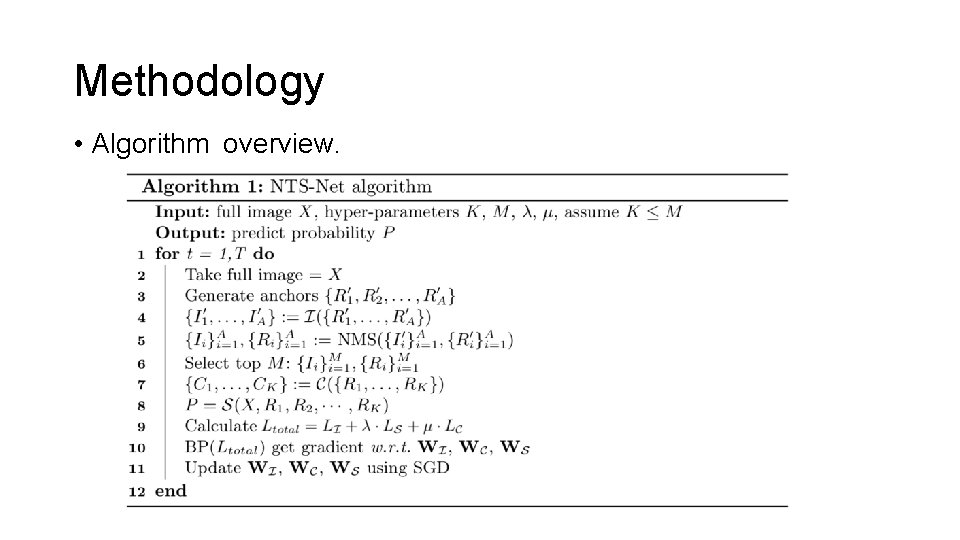
Methodology • Algorithm overview.
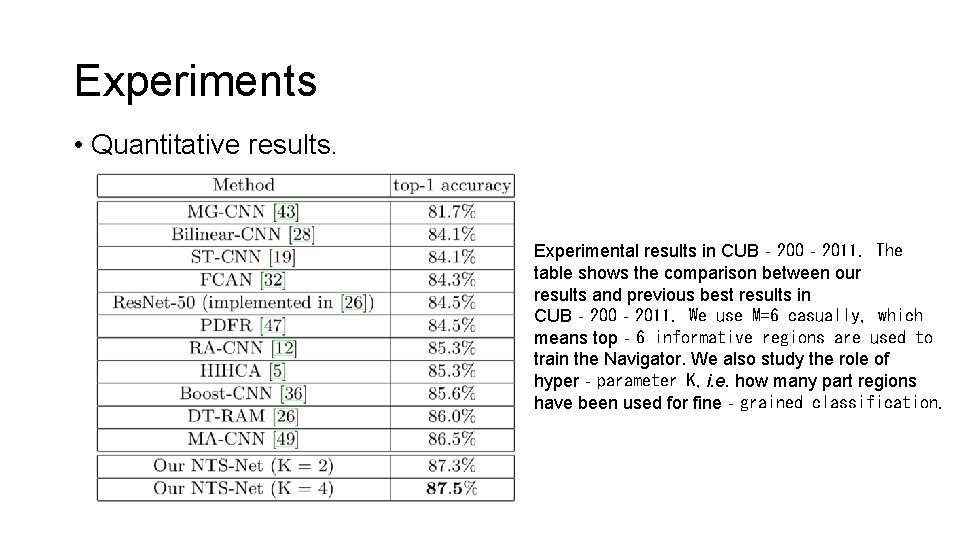
Experiments • Quantitative results. Experimental results in CUB‐ 200‐ 2011. The table shows the comparison between our results and previous best results in CUB‐ 200‐ 2011. We use M=6 casually, which means top‐ 6 informative regions are used to train the Navigator. We also study the role of hyper‐parameter K, i. e. how many part regions have been used for fine‐grained classification.
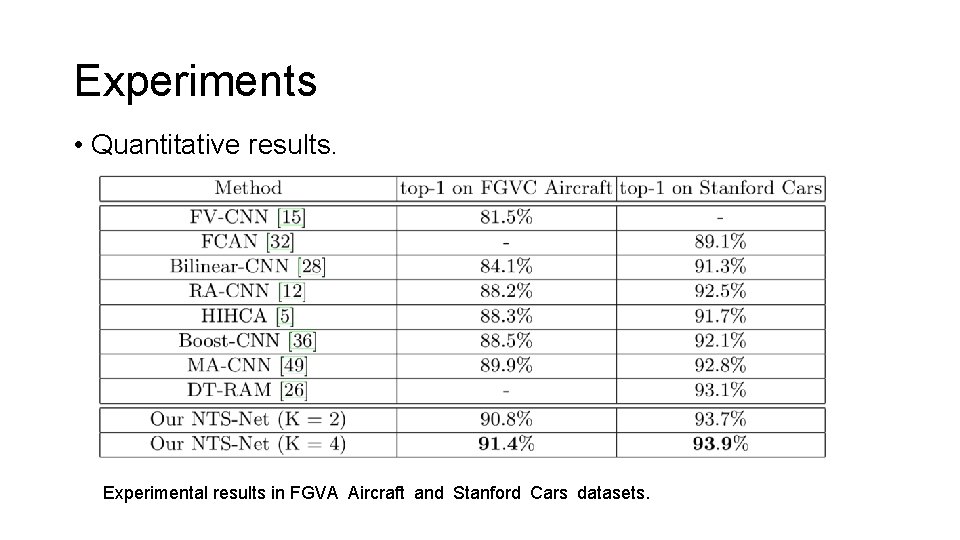
Experiments • Quantitative results. Experimental results in FGVA Aircraft and Stanford Cars datasets.
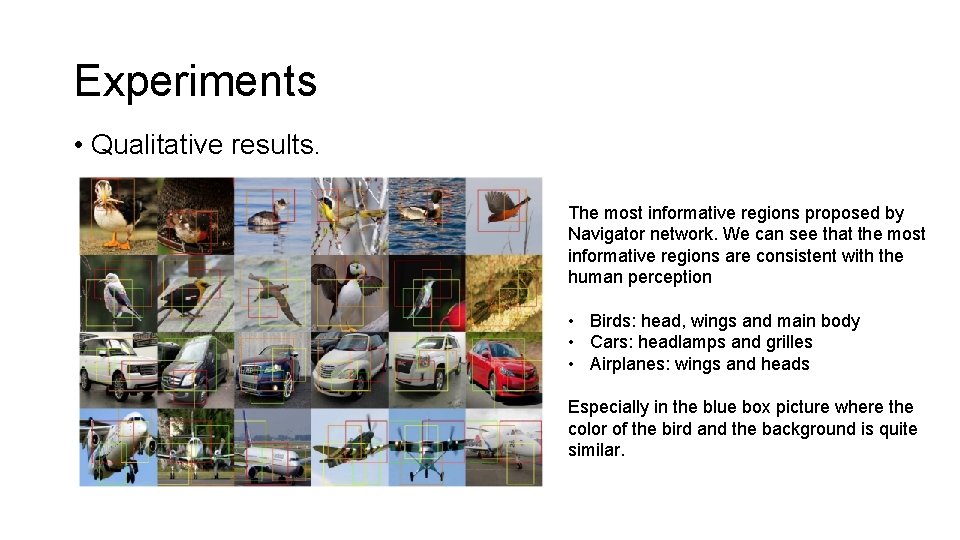
Experiments • Qualitative results. The most informative regions proposed by Navigator network. We can see that the most informative regions are consistent with the human perception • Birds: head, wings and main body • Cars: headlamps and grilles • Airplanes: wings and heads Especially in the blue box picture where the color of the bird and the background is quite similar.
Thank you