Latin paenitet me miseret me pudet me and
- Slides: 22
Latin paenitet me, miseret me, pudet me and the active clause alignment in PIE RANKO MATASOVIĆ UNIVERSITY OF ZAGREB
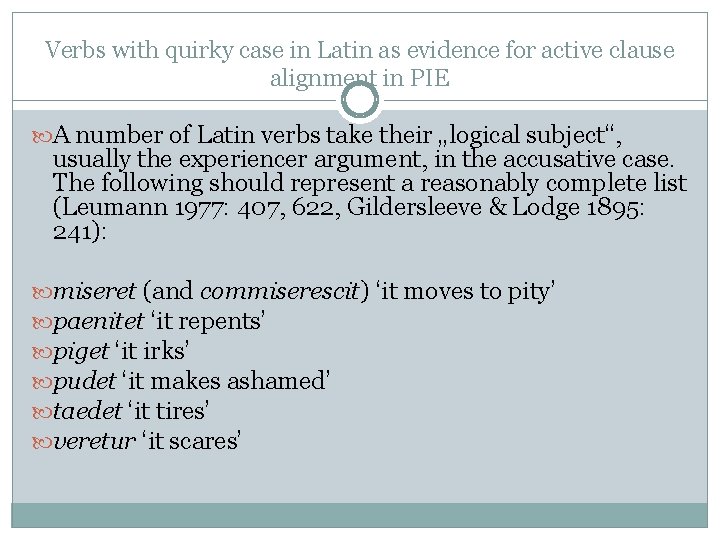
Verbs with quirky case in Latin as evidence for active clause alignment in PIE A number of Latin verbs take their „logical subject“, usually the experiencer argument, in the accusative case. The following should represent a reasonably complete list (Leumann 1977: 407, 622, Gildersleeve & Lodge 1895: 241): miseret (and commiserescit) ‘it moves to pity’ paenitet ‘it repents’ piget ‘it irks’ pudet ‘it makes ashamed’ taedet ‘it tires’ veretur ‘it scares’
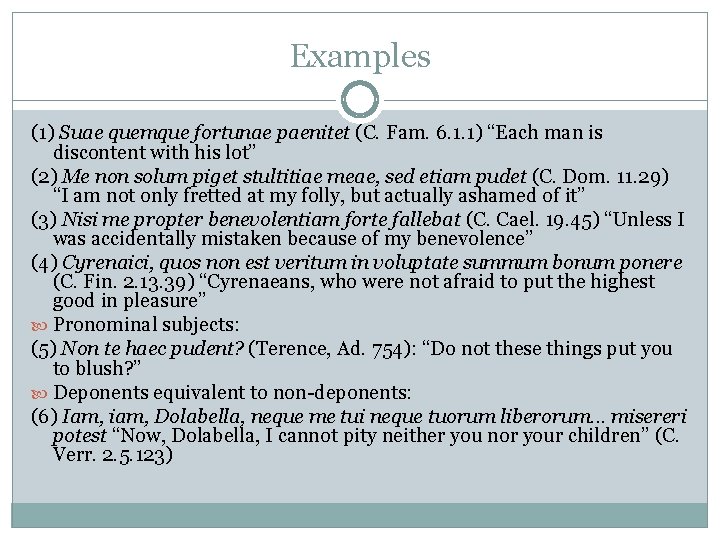
Examples (1) Suae quemque fortunae paenitet (C. Fam. 6. 1. 1) “Each man is discontent with his lot” (2) Me non solum piget stultitiae meae, sed etiam pudet (C. Dom. 11. 29) “I am not only fretted at my folly, but actually ashamed of it” (3) Nisi me propter benevolentiam forte fallebat (C. Cael. 19. 45) “Unless I was accidentally mistaken because of my benevolence” (4) Cyrenaici, quos non est veritum in voluptate summum bonum ponere (C. Fin. 2. 13. 39) “Cyrenaeans, who were not afraid to put the highest good in pleasure” Pronominal subjects: (5) Non te haec pudent? (Terence, Ad. 754): “Do not these things put you to blush? ” Deponents equivalent to non-deponents: (6) Iam, iam, Dolabella, neque me tui neque tuorum liberorum. . . misereri potest “Now, Dolabella, I cannot pity neither you nor your children” (C. Verr. 2. 5. 123)
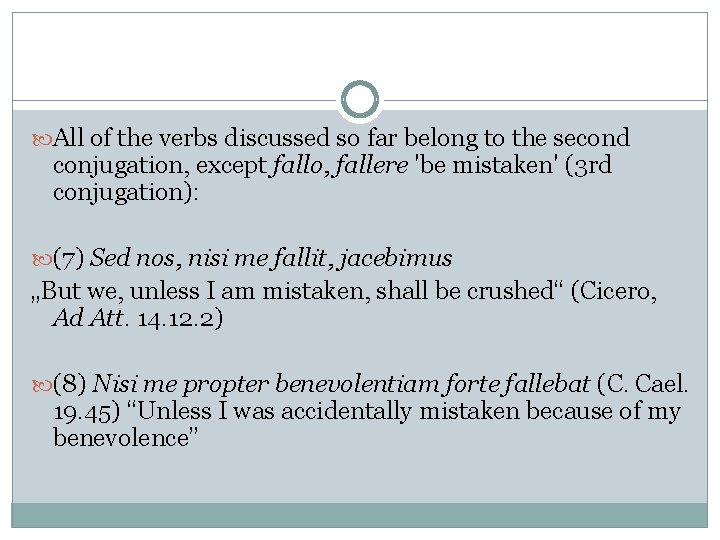
All of the verbs discussed so far belong to the second conjugation, except fallo, fallere 'be mistaken' (3 rd conjugation): (7) Sed nos, nisi me fallit, jacebimus „But we, unless I am mistaken, shall be crushed“ (Cicero, Ad Att. 14. 12. 2) (8) Nisi me propter benevolentiam forte fallebat (C. Cael. 19. 45) “Unless I was accidentally mistaken because of my benevolence”
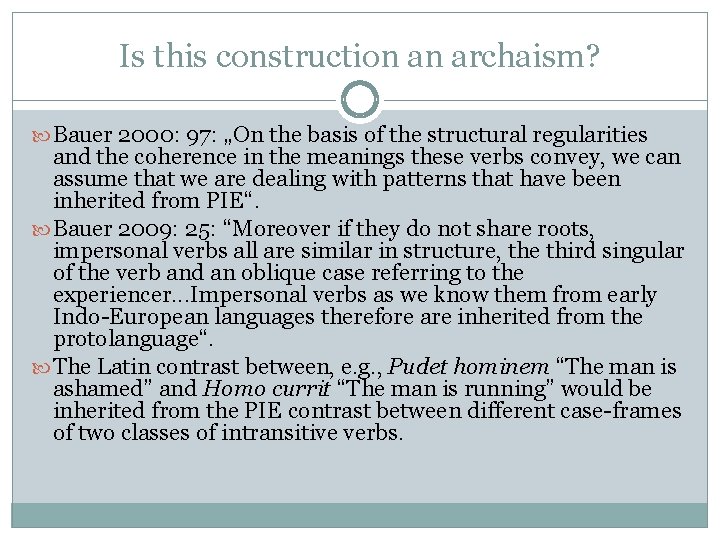
Is this construction an archaism? Bauer 2000: 97: „On the basis of the structural regularities and the coherence in the meanings these verbs convey, we can assume that we are dealing with patterns that have been inherited from PIE“. Bauer 2009: 25: “Moreover if they do not share roots, impersonal verbs all are similar in structure, the third singular of the verb and an oblique case referring to the experiencer. . . Impersonal verbs as we know them from early Indo-European languages therefore are inherited from the protolanguage“. The Latin contrast between, e. g. , Pudet hominem “The man is ashamed” and Homo currit “The man is running” would be inherited from the PIE contrast between different case-frames of two classes of intransitive verbs.
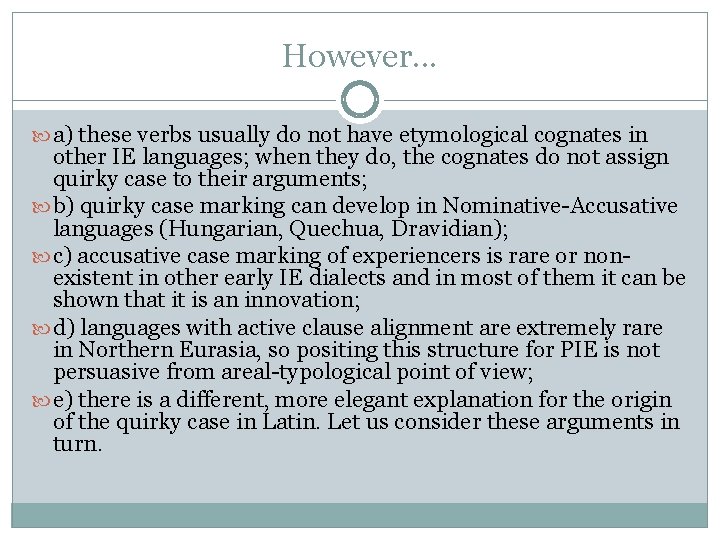
However. . . a) these verbs usually do not have etymological cognates in other IE languages; when they do, the cognates do not assign quirky case to their arguments; b) quirky case marking can develop in Nominative-Accusative languages (Hungarian, Quechua, Dravidian); c) accusative case marking of experiencers is rare or nonexistent in other early IE dialects and in most of them it can be shown that it is an innovation; d) languages with active clause alignment are extremely rare in Northern Eurasia, so positing this structure for PIE is not persuasive from areal-typological point of view; e) there is a different, more elegant explanation for the origin of the quirky case in Latin. Let us consider these arguments in turn.
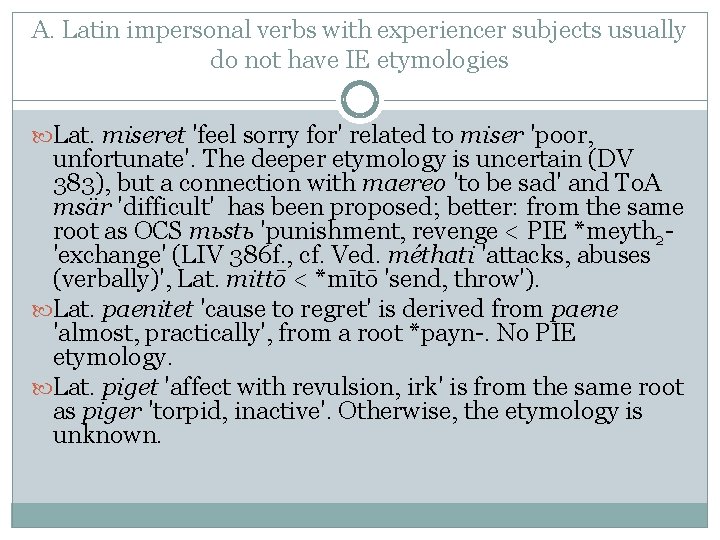
A. Latin impersonal verbs with experiencer subjects usually do not have IE etymologies Lat. miseret 'feel sorry for' related to miser 'poor, unfortunate'. The deeper etymology is uncertain (DV 383), but a connection with maereo 'to be sad' and To. A msär 'difficult' has been proposed; better: from the same root as OCS mьstь 'punishment, revenge < PIE *meyth 2 - 'exchange' (LIV 386 f. , cf. Ved. méthati 'attacks, abuses (verbally)', Lat. mittō < *mītō 'send, throw'). Lat. paenitet 'cause to regret' is derived from paene 'almost, practically', from a root *payn-. No PIE etymology. Lat. piget 'affect with revulsion, irk' is from the same root as piger 'torpid, inactive'. Otherwise, the etymology is unknown.
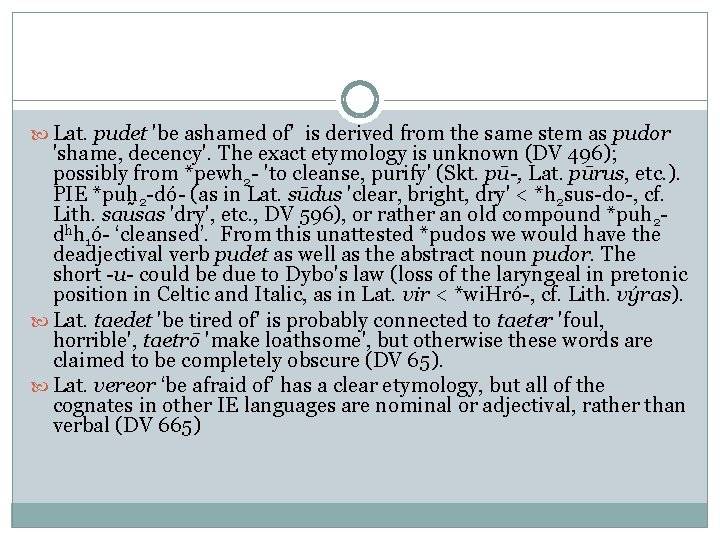
Lat. pudet 'be ashamed of' is derived from the same stem as pudor 'shame, decency'. The exact etymology is unknown (DV 496); possibly from *pewh 2 - 'to cleanse, purify' (Skt. pū-, Lat. pūrus, etc. ). PIE *puh 2 -dó- (as in Lat. sūdus 'clear, bright, dry' < *h 2 sus-do-, cf. Lith. sau sas 'dry', etc. , DV 596), or rather an old compound *puh 2 dhh 1ó- ‘cleansed’. From this unattested *pudos we would have the deadjectival verb pudet as well as the abstract noun pudor. The short -u- could be due to Dybo's law (loss of the laryngeal in pretonic position in Celtic and Italic, as in Lat. vir < *wi. Hró-, cf. Lith. výras). Lat. taedet 'be tired of' is probably connected to taeter 'foul, horrible', taetrō 'make loathsome', but otherwise these words are claimed to be completely obscure (DV 65). Lat. vereor ‘be afraid of’ has a clear etymology, but all of the cognates in other IE languages are nominal or adjectival, rather than verbal (DV 665)
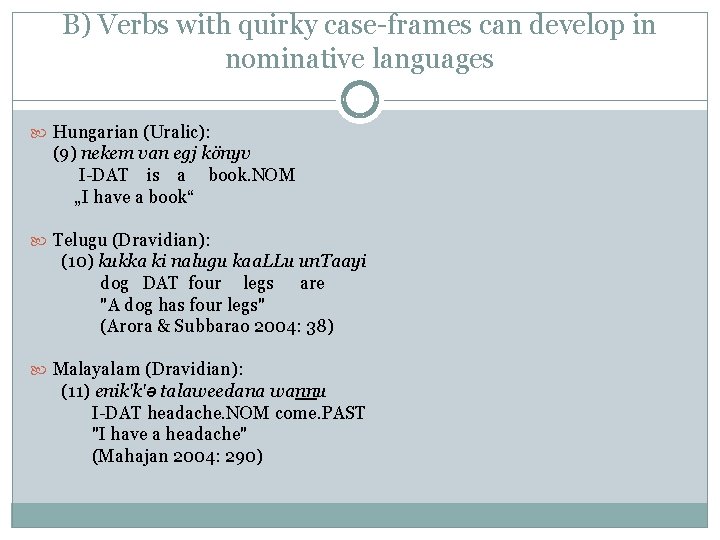
B) Verbs with quirky case-frames can develop in nominative languages Hungarian (Uralic): (9) nekem van egj könyv I-DAT is a book. NOM „I have a book“ Telugu (Dravidian): (10) kukka ki nalugu kaa. LLu un. Taayi dog DAT four legs are "A dog has four legs" (Arora & Subbarao 2004: 38) Malayalam (Dravidian): (11) enik'k'ə talaweedana wannu I-DAT headache. NOM come. PAST "I have a headache" (Mahajan 2004: 290)
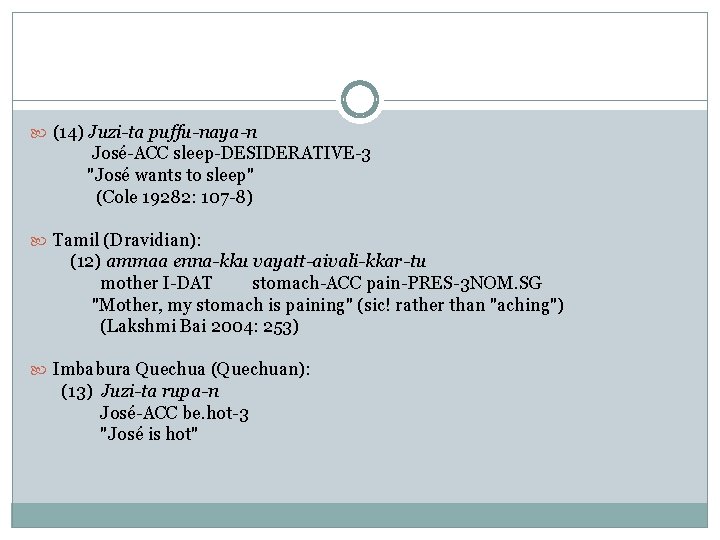
(14) Juzi-ta puffu-naya-n José-ACC sleep-DESIDERATIVE-3 "José wants to sleep" (Cole 19282: 107 -8) Tamil (Dravidian): (12) ammaa enna-kku vayatt-aivali-kkar-tu mother I-DAT stomach-ACC pain-PRES-3 NOM. SG "Mother, my stomach is paining" (sic! rather than "aching") (Lakshmi Bai 2004: 253) Imbabura Quechua (Quechuan): (13) Juzi-ta rupa-n José-ACC be. hot-3 "José is hot"
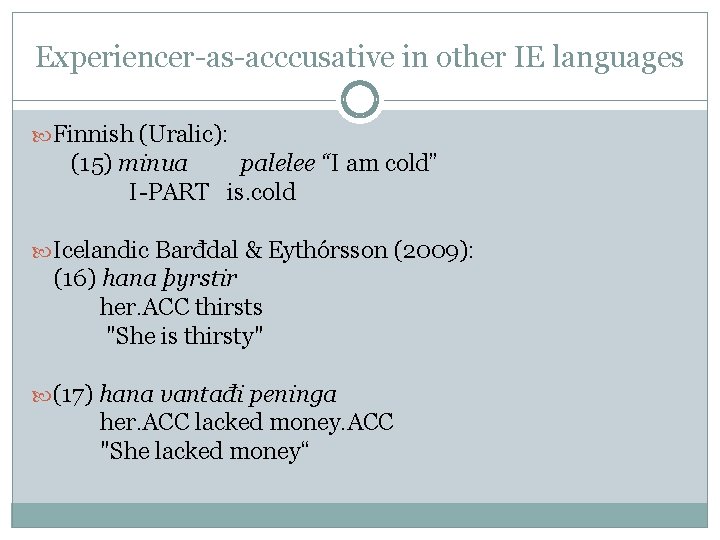
Experiencer-as-acccusative in other IE languages Finnish (Uralic): (15) minua palelee “I am cold” I-PART is. cold Icelandic Barđdal & Eythórsson (2009): (16) hana þyrstir her. ACC thirsts "She is thirsty" (17) hana vantađi peninga her. ACC lacked money. ACC "She lacked money“
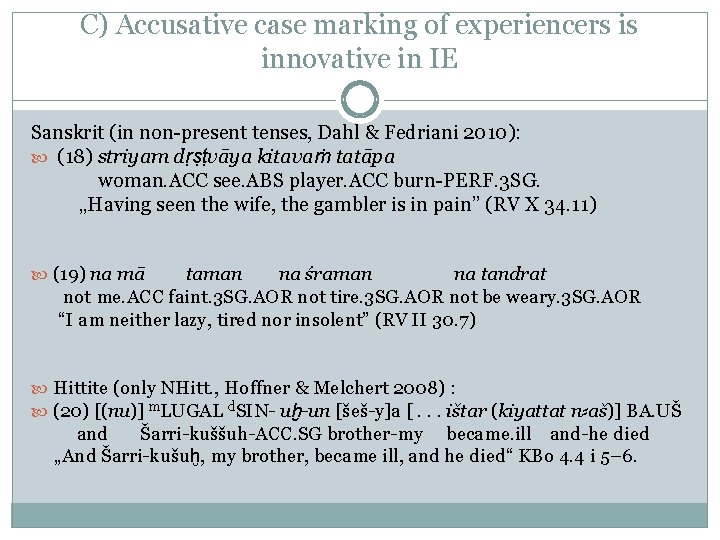
C) Accusative case marking of experiencers is innovative in IE Sanskrit (in non-present tenses, Dahl & Fedriani 2010): (18) striyam dṛṣṭvāya kitavaṁ tatāpa woman. ACC see. ABS player. ACC burn-PERF. 3 SG. „Having seen the wife, the gambler is in pain” (RV X 34. 11) (19) na mā taman na śraman na tandrat not me. ACC faint. 3 SG. AOR not tire. 3 SG. AOR not be weary. 3 SG. AOR “I am neither lazy, tired nor insolent” (RV II 30. 7) Hittite (only NHitt. , Hoffner & Melchert 2008) : (20) [(nu)] m. LUGAL d. SIN- uḫ-un [šeš-y]a [. . . ištar (kiyattat n⸗aš)] BA. UŠ and Šarri-kuššuh-ACC. SG brother-my became. ill and-he died „And Šarri-kušuḫ, my brother, became ill, and he died“ KBo 4. 4 i 5– 6.
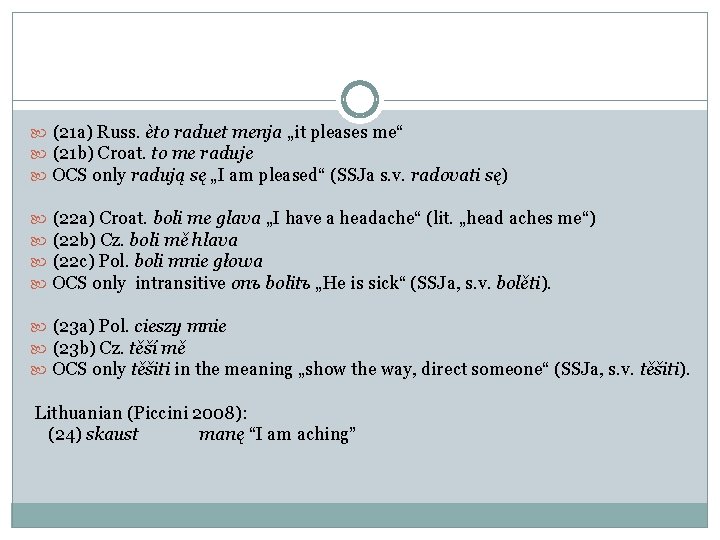
(21 a) Russ. èto raduet menja „it pleases me“ (21 b) Croat. to me raduje OCS only radują sę „I am pleased“ (SSJa s. v. radovati sę) (22 a) Croat. boli me glava „I have a headache“ (lit. „head aches me“) (22 b) Cz. boli mě hlava (22 c) Pol. boli mnie głowa OCS only intransitive onъ bolitъ „He is sick“ (SSJa, s. v. bolěti). (23 a) Pol. cieszy mnie (23 b) Cz. těší mě OCS only těšiti in the meaning „show the way, direct someone“ (SSJa, s. v. těšiti). Lithuanian (Piccini 2008): (24) skaust manę “I am aching”
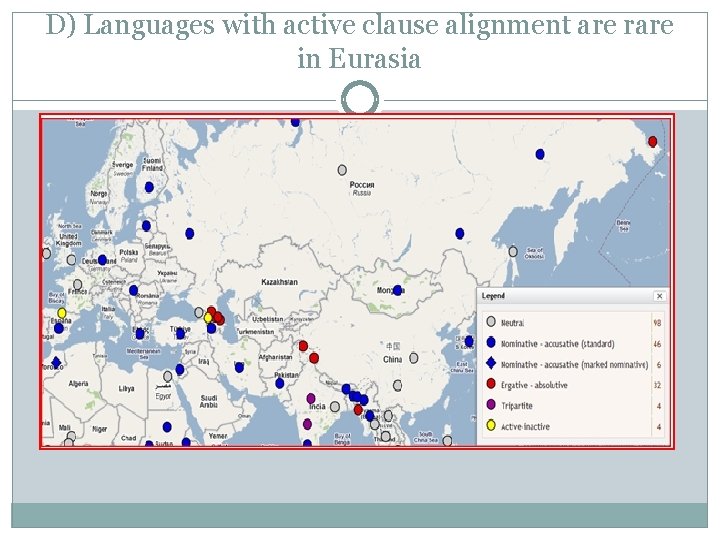
D) Languages with active clause alignment are rare in Eurasia
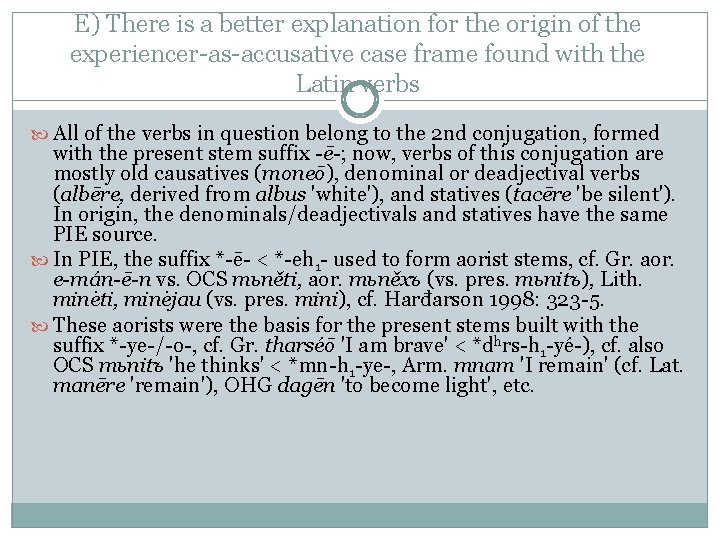
E) There is a better explanation for the origin of the experiencer-as-accusative case frame found with the Latin verbs All of the verbs in question belong to the 2 nd conjugation, formed with the present stem suffix -ē-; now, verbs of this conjugation are mostly old causatives (moneō), denominal or deadjectival verbs (albēre, derived from albus 'white'), and statives (tacēre 'be silent'). In origin, the denominals/deadjectivals and statives have the same PIE source. In PIE, the suffix *-ē- < *-eh 1 - used to form aorist stems, cf. Gr. aor. e-mán-ē-n vs. OCS mьněti, aor. mьněxъ (vs. pres. mьnitъ), Lith. minėti, minėjau (vs. pres. mini), cf. Harđarson 1998: 323 -5. These aorists were the basis for the present stems built with the suffix *-ye-/-o-, cf. Gr. tharséō 'I am brave' < *dhrs-h 1 -yé-), cf. also OCS mьnitъ 'he thinks' < *mn-h 1 -ye-, Arm. mnam 'I remain' (cf. Lat. manēre 'remain'), OHG dagēn 'to become light', etc.
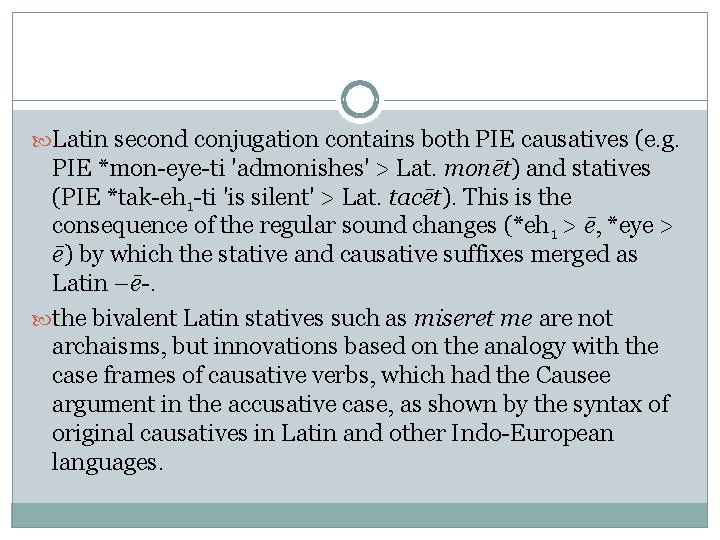
Latin second conjugation contains both PIE causatives (e. g. PIE *mon-eye-ti 'admonishes' > Lat. monēt) and statives (PIE *tak-eh 1 -ti 'is silent' > Lat. tacēt). This is the consequence of the regular sound changes (*eh 1 > ē, *eye > ē) by which the stative and causative suffixes merged as Latin –ē-. the bivalent Latin statives such as miseret me are not archaisms, but innovations based on the analogy with the case frames of causative verbs, which had the Causee argument in the accusative case, as shown by the syntax of original causatives in Latin and other Indo-European languages.
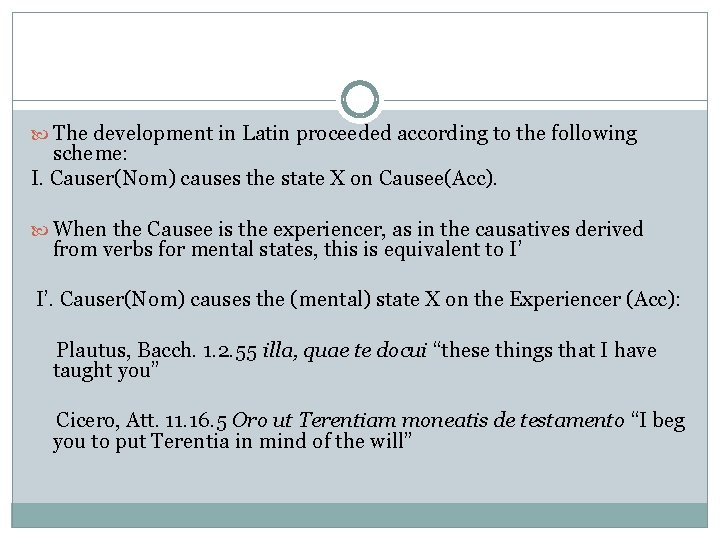
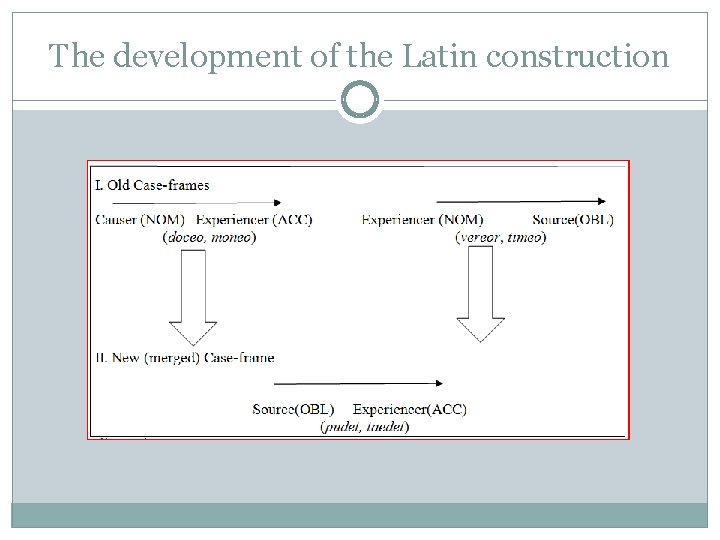
The development in Latin proceeded according to the following scheme: I. Causer(Nom) causes the state X on Causee(Acc). When the Causee is the experiencer, as in the causatives derived from verbs for mental states, this is equivalent to I’ I’. Causer(Nom) causes the (mental) state X on the Experiencer (Acc): Plautus, Bacch. 1. 2. 55 illa, quae te docui “these things that I have taught you” Cicero, Att. 11. 16. 5 Oro ut Terentiam moneatis de testamento “I beg you to put Terentia in mind of the will”
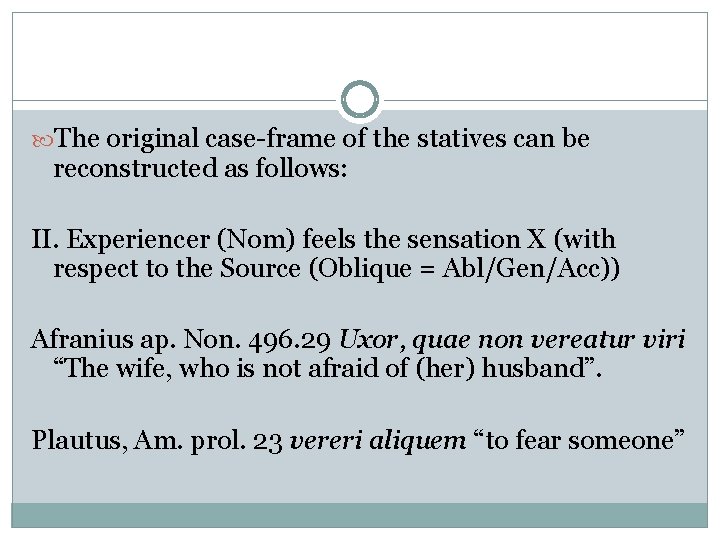
The original case-frame of the statives can be reconstructed as follows: II. Experiencer (Nom) feels the sensation X (with respect to the Source (Oblique = Abl/Gen/Acc)) Afranius ap. Non. 496. 29 Uxor, quae non vereatur viri “The wife, who is not afraid of (her) husband”. Plautus, Am. prol. 23 vereri aliquem “to fear someone”
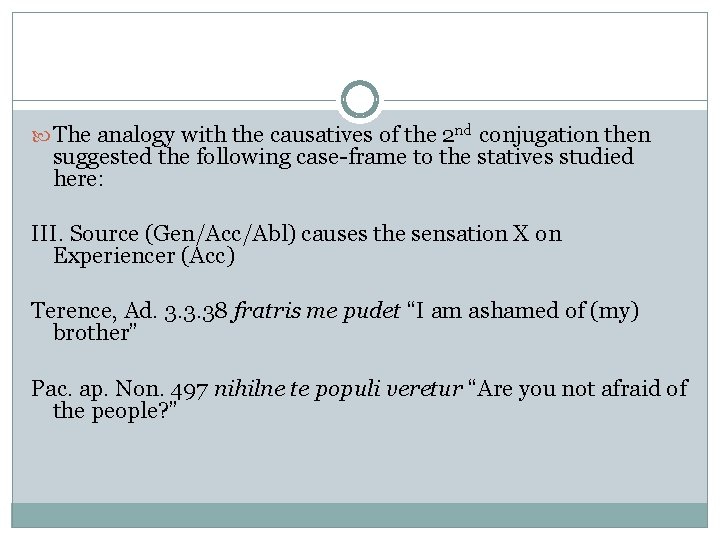
The analogy with the causatives of the 2 nd conjugation then suggested the following case-frame to the statives studied here: III. Source (Gen/Acc/Abl) causes the sensation X on Experiencer (Acc) Terence, Ad. 3. 3. 38 fratris me pudet “I am ashamed of (my) brother” Pac. ap. Non. 497 nihilne te populi veretur “Are you not afraid of the people? ”
The development of the Latin construction
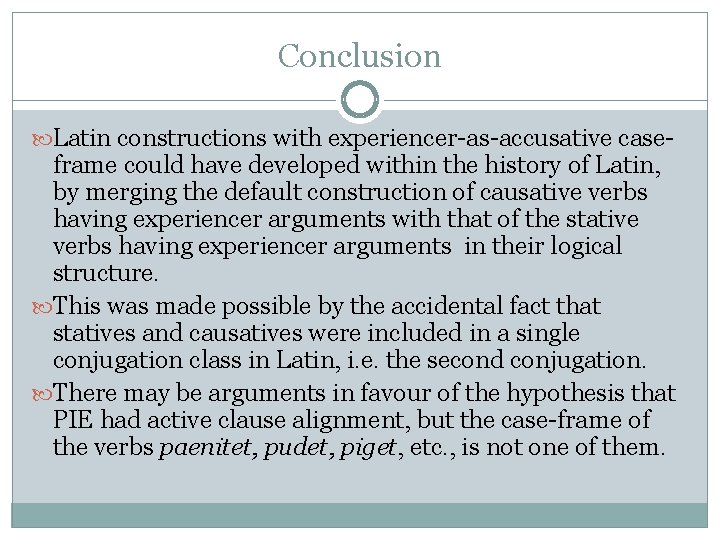
Conclusion Latin constructions with experiencer-as-accusative case- frame could have developed within the history of Latin, by merging the default construction of causative verbs having experiencer arguments with that of the stative verbs having experiencer arguments in their logical structure. This was made possible by the accidental fact that statives and causatives were included in a single conjugation class in Latin, i. e. the second conjugation. There may be arguments in favour of the hypothesis that PIE had active clause alignment, but the case-frame of the verbs paenitet, pudet, piget, etc. , is not one of them.
Thank you for your attention! Ranko Matasović University of Zagreb E-mail: rmatasov@ffzg. hr Homepage: www. ffzg. hr/~rmatasov