Language in use 1 Rewrite the sentences using

- Slides: 18
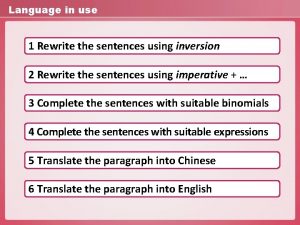
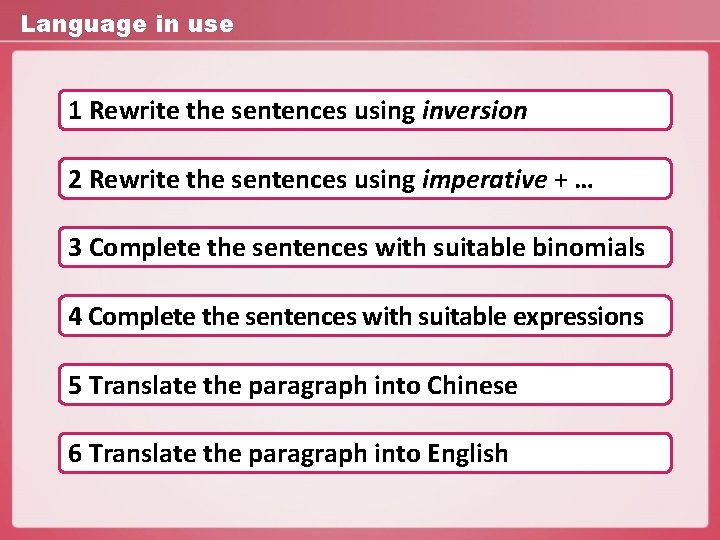
Language in use 1 Rewrite the sentences using inversion 2 Rewrite the sentences using imperative + … 3 Complete the sentences with suitable binomials 4 Complete the sentences with suitable expressions 5 Translate the paragraph into Chinese 6 Translate the paragraph into English
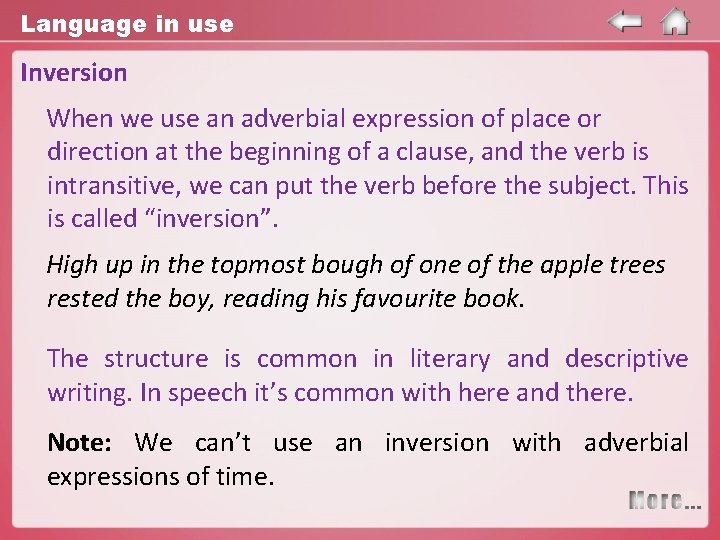
Language in use Inversion When we use an adverbial expression of place or direction at the beginning of a clause, and the verb is intransitive, we can put the verb before the subject. This is called “inversion”. High up in the topmost bough of one of the apple trees rested the boy, reading his favourite book. The structure is common in literary and descriptive writing. In speech it’s common with here and there. Note: We can’t use an inversion with adverbial expressions of time.
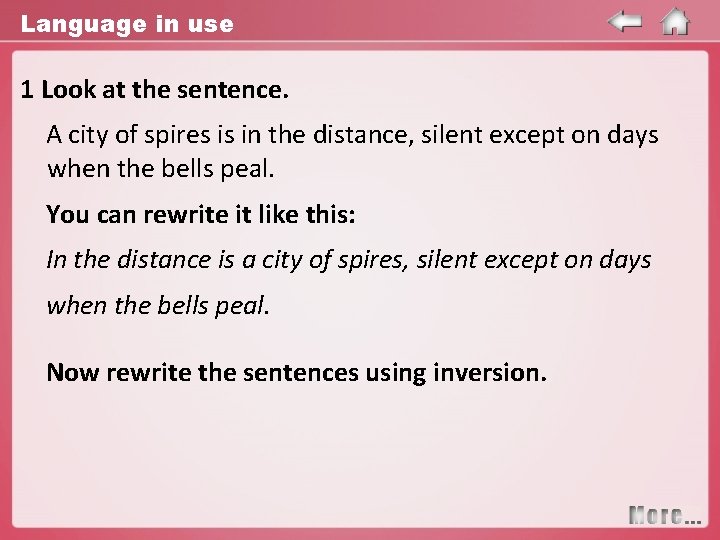
Language in use 1 Look at the sentence. A city of spires is in the distance, silent except on days when the bells peal. You can rewrite it like this: In the distance is a city of spires, silent except on days when the bells peal. Now rewrite the sentences using inversion.
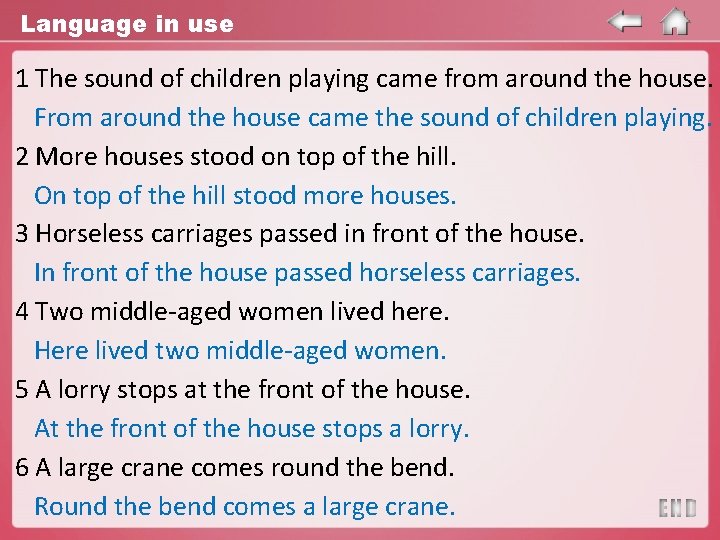
Language in use 1 The sound of children playing came from around the house. From around the house came the sound of children playing. 2 More houses stood on top of the hill. On top of the hill stood more houses. 3 Horseless carriages passed in front of the house. In front of the house passed horseless carriages. 4 Two middle-aged women lived here. Here lived two middle-aged women. 5 A lorry stops at the front of the house. At the front of the house stops a lorry. 6 A large crane comes round the bend. Round the bend comes a large crane.
Language in use Imperative + and + simple sentence 2 Look at the sentence. If you ask any frequent flyer in their forties or fifties … they’ll probably sigh … You can rewrite it like this: Ask any frequent flyer in their forties or fifties … and they’ll probably sigh … Now rewrite the sentences using imperative + and + simple sentence.
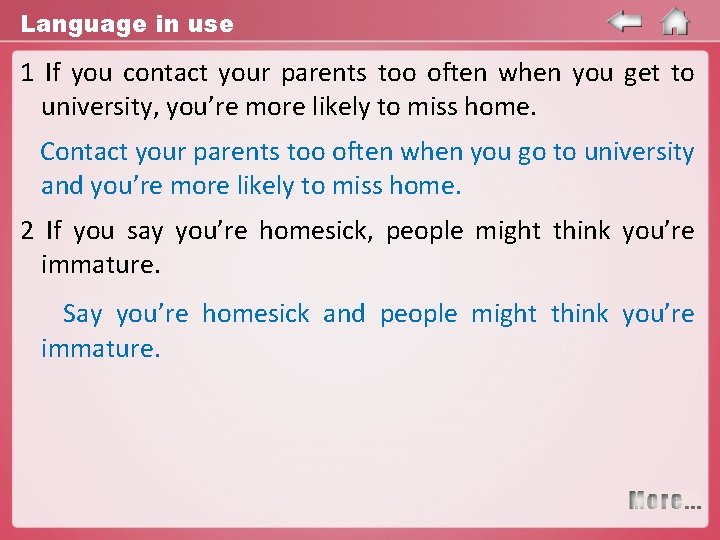
Language in use 1 If you contact your parents too often when you get to university, you’re more likely to miss home. Contact your parents too often when you go to university and you’re more likely to miss home. 2 If you say you’re homesick, people might think you’re immature. Say you’re homesick and people might think you’re immature.
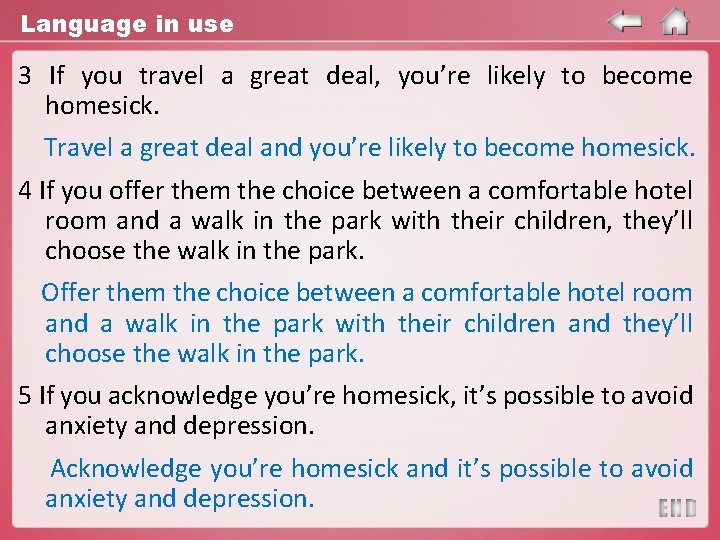
Language in use 3 If you travel a great deal, you’re likely to become homesick. Travel a great deal and you’re likely to become homesick. 4 If you offer them the choice between a comfortable hotel room and a walk in the park with their children, they’ll choose the walk in the park. Offer them the choice between a comfortable hotel room and a walk in the park with their children and they’ll choose the walk in the park. 5 If you acknowledge you’re homesick, it’s possible to avoid anxiety and depression. Acknowledge you’re homesick and it’s possible to avoid anxiety and depression.
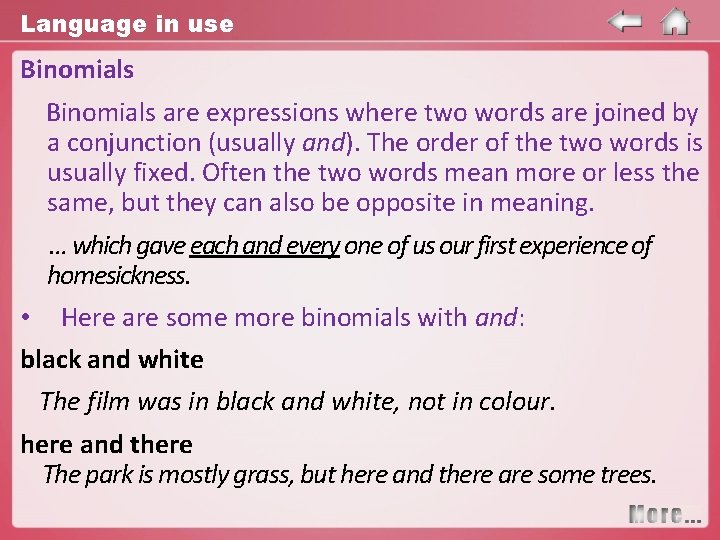
Language in use Binomials are expressions where two words are joined by a conjunction (usually and). The order of the two words is usually fixed. Often the two words mean more or less the same, but they can also be opposite in meaning. … which gave each and every one of us our first experience of homesickness. • Here are some more binomials with and: black and white The film was in black and white, not in colour. here and there The park is mostly grass, but here and there are some trees.
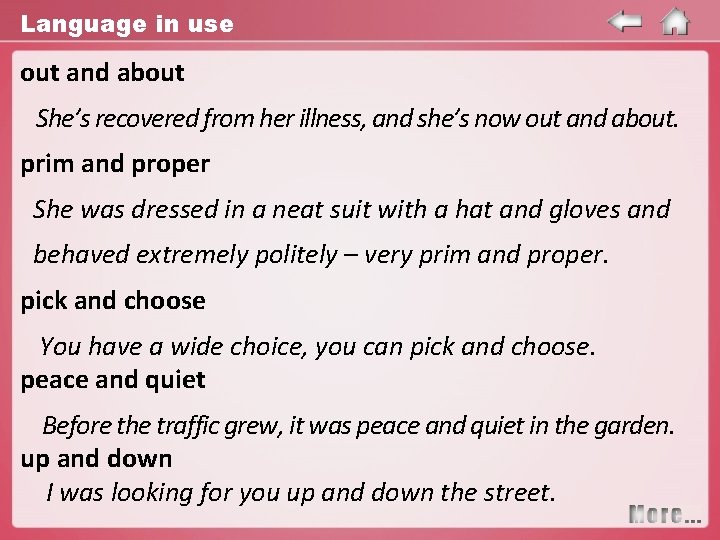
Language in use out and about She’s recovered from her illness, and she’s now out and about. prim and proper She was dressed in a neat suit with a hat and gloves and behaved extremely politely – very prim and proper. pick and choose You have a wide choice, you can pick and choose. peace and quiet Before the traffic grew, it was peace and quiet in the garden. up and down I was looking for you up and down the street.
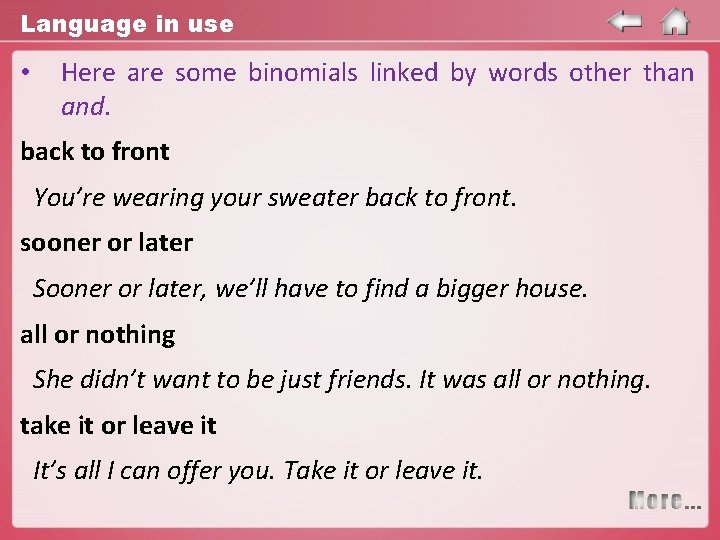
Language in use • Here are some binomials linked by words other than and. back to front You’re wearing your sweater back to front. sooner or later Sooner or later, we’ll have to find a bigger house. all or nothing She didn’t want to be just friends. It was all or nothing. take it or leave it It’s all I can offer you. Take it or leave it.
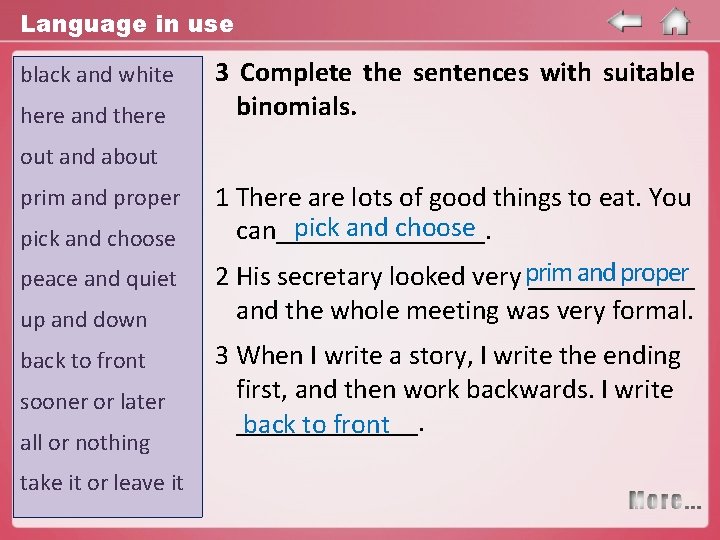
Language in use black and white here and there 3 Complete the sentences with suitable binomials. out and about prim and proper pick and choose peace and quiet up and down back to front sooner or later all or nothing take it or leave it 1 There are lots of good things to eat. You pick and choose can________. and proper 2 His secretary looked very prim ______ and the whole meeting was very formal. 3 When I write a story, I write the ending first, and then work backwards. I write _______. back to front
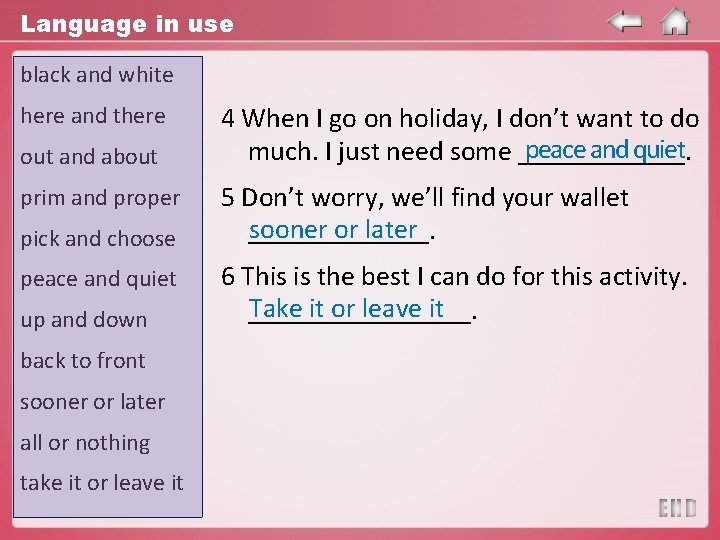
Language in use black and white here and there out and about prim and proper pick and choose peace and quiet up and down back to front sooner or later all or nothing take it or leave it 4 When I go on holiday, I don’t want to do peace and quiet much. I just need some ______. 5 Don’t worry, we’ll find your wallet sooner or later _______. 6 This is the best I can do for this activity. Take it or leave it ________.
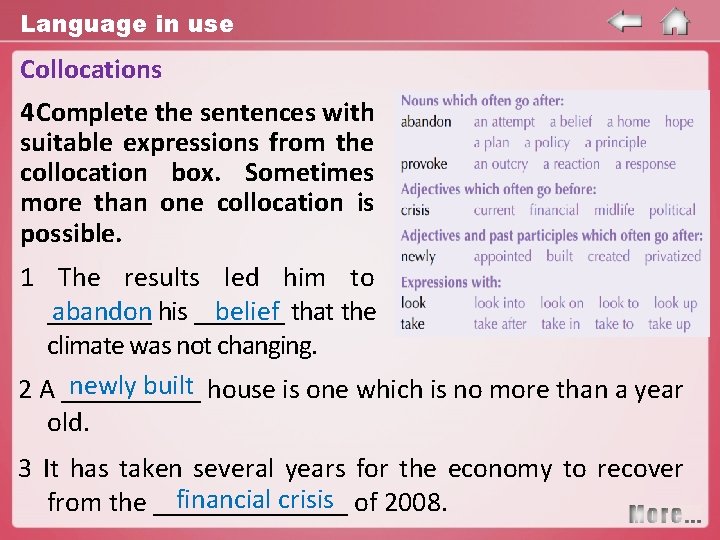
Language in use Collocations 4 Complete the sentences with suitable expressions from the collocation box. Sometimes more than one collocation is possible. 1 The results led him to ____ abandon his _______ belief that the climate was not changing. newly built house is one which is no more than a year 2 A _____ old. 3 It has taken several years for the economy to recover financial crisis of 2008. from the _______
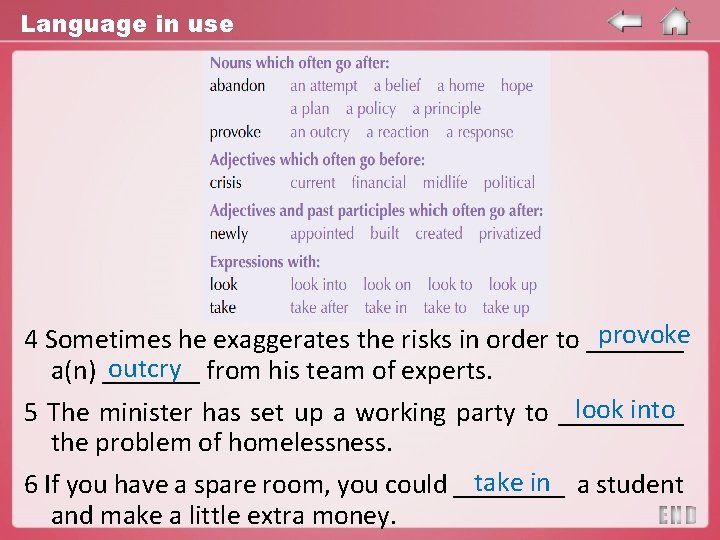
Language in use provoke 4 Sometimes he exaggerates the risks in order to _______ outcry from his team of experts. a(n) _______ look into 5 The minister has set up a working party to _____ the problem of homelessness. take in a student 6 If you have a spare room, you could ____ and make a little extra money.
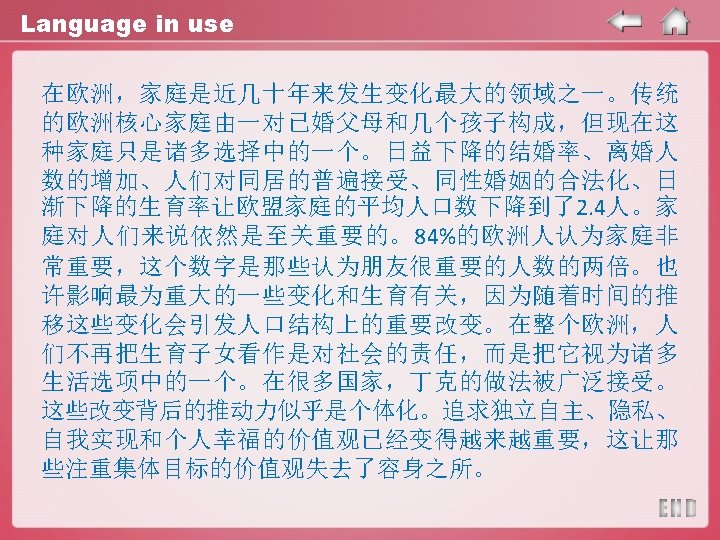
Language in use Translation 5 Translate the paragraph into Chinese. Over recent decades in Europe, the family is one of the domains where the greatest changes have taken place. The traditional European nuclear family consisted of a married father and mother with several children, but today this is only one option among many. Declining marriage rates, an increased number of divorces, the wide acceptance of co-habitation, the legalization of same-sex marriage and dropping fertility rates have caused the size of the average household within the European Union to drop to 2. 4 people. Yet family remains of the utmost importance to people. Eighty-four percent of Europeans say that family is very important, almost twice as many as those who find friends very important. Perhaps the most significant changes relate to childbearing, since these result in important demographic changes over time. Throughout Europe, having children is no longer considered a duty towards society, but rather just one of life’s options. The choice to stay childless is well accepted in many countries. The driving force behind these changes appears to be individualization. Values oriented towards autonomy, privacy, self-actualization and personal happiness have become more important, and have ousted values that point at collective goals.
Language in use China, with the largest population of elderly people in the world, has become an ageing society. Meanwhile, China is also a country undergoing social transition. It will be a long time before a sound social welfare system can be established, which means that China is in a unique situation when it comes to care of its ageing population. It is predicted that in the next 50 years, family care for the aged will still be the dominant practice in China. Filial piety has always been a significant part of traditional Chinese ethics. In today’s ageing society, it will be all the more important to promote the virtue of filial piety, as it will continue to play a crucial role in encouraging people to take good care of their elderly family members by providing daily care and emotional support.