Lane v Franks First Amendment and Qualified Immunity
- Slides: 10
Lane v. Franks First Amendment and Qualified Immunity
Summary of Facts
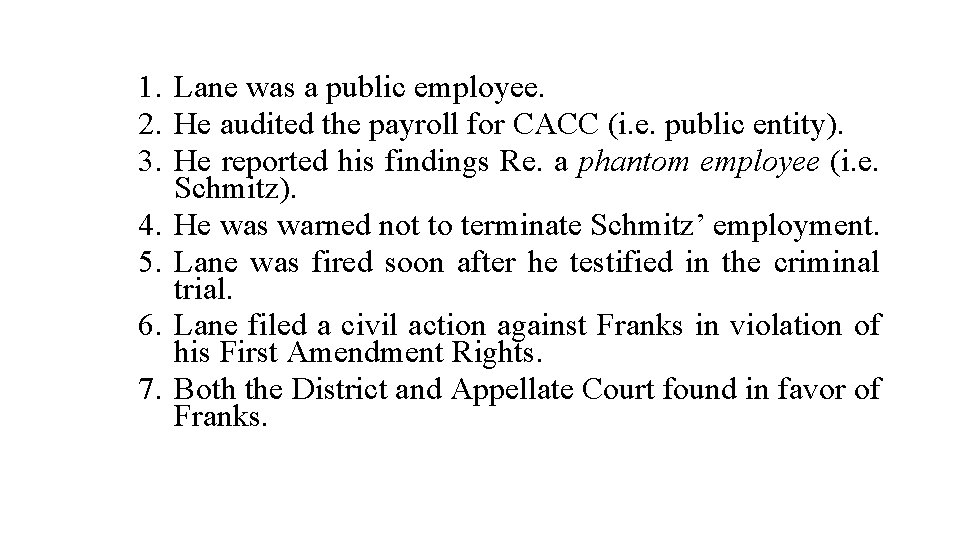
1. Lane was a public employee. 2. He audited the payroll for CACC (i. e. public entity). 3. He reported his findings Re. a phantom employee (i. e. Schmitz). 4. He was warned not to terminate Schmitz’ employment. 5. Lane was fired soon after he testified in the criminal trial. 6. Lane filed a civil action against Franks in violation of his First Amendment Rights. 7. Both the District and Appellate Court found in favor of Franks.
Legal Findings
• Lane was recognized in his capacity as a public employee. • Lane’s speech was NOT considered as a speech of a citizen on a matter of a public concern. • Lane failed to establish a prima facie case of retaliation.
Legal Analysis
• Based on both Garcetti v. Ceballos, 126 S. Ct. 1951, 1958 (2006) and Morris v. Crow 142 F. 3 d 1379 (11 th Cir. 1998) Lane’s statements were pursuant to his position as a public employee, rather than as a private citizen, therefore his speech had no First Amendment protection. • Franks would be protected under the qualified immunity if he is able to prove that he did not violate any laws by firing Lane.
“Expert” Opinion
Next Step • In deciding to hear the Lane case, the U. S. Supreme Court has apparently decided to resolve this split among the circuits on the issue of First Amendment protection for testimony. • http: //www. calpublicagencylaboremploymentblo g. com/employment/us-supreme-court-will-hearnew-case-on-public-employee-free-speech-rights/
TO BE CONTINUED! Special Thanks to District Courts of Alabama The 11 th Circuit The USSC