KING COTTON AND THE PEOPLE OF THE SOUTH



- Slides: 22
KING COTTON AND THE PEOPLE OF THE SOUTH
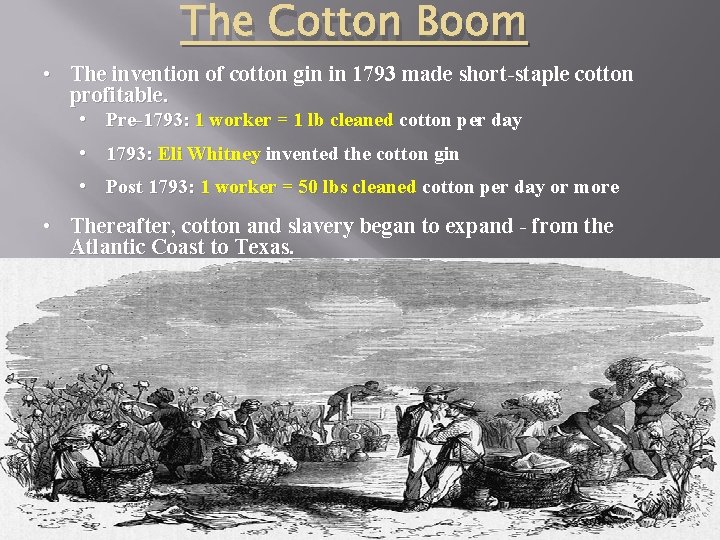
The Cotton Boom • The invention of cotton gin in 1793 made short-staple cotton profitable. • Pre-1793: 1 worker = 1 lb cleaned cotton per day • 1793: Eli Whitney invented the cotton gin • Post 1793: 1 worker = 50 lbs cleaned cotton per day or more • Thereafter, cotton and slavery began to expand - from the Atlantic Coast to Texas.
The Effects of the Cotton Gin
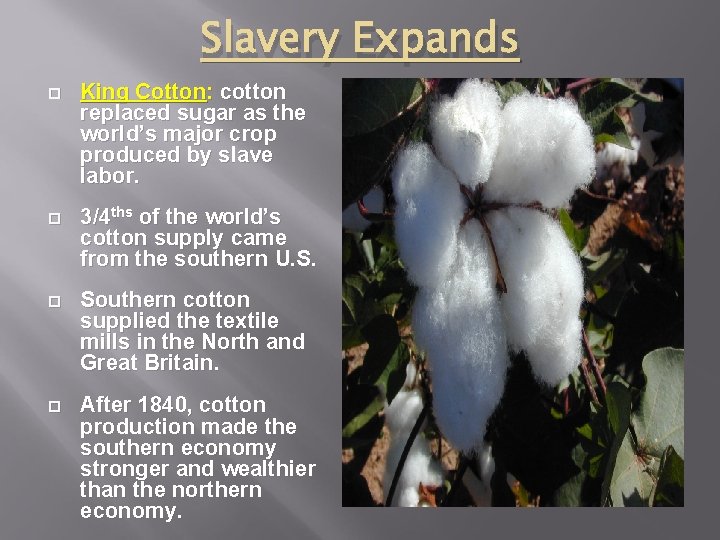
Slavery Expands King Cotton: cotton replaced sugar as the world’s major crop produced by slave labor. 3/4 ths of the world’s cotton supply came from the southern U. S. Southern cotton supplied the textile mills in the North and Great Britain. After 1840, cotton production made the southern economy stronger and wealthier than the northern economy.
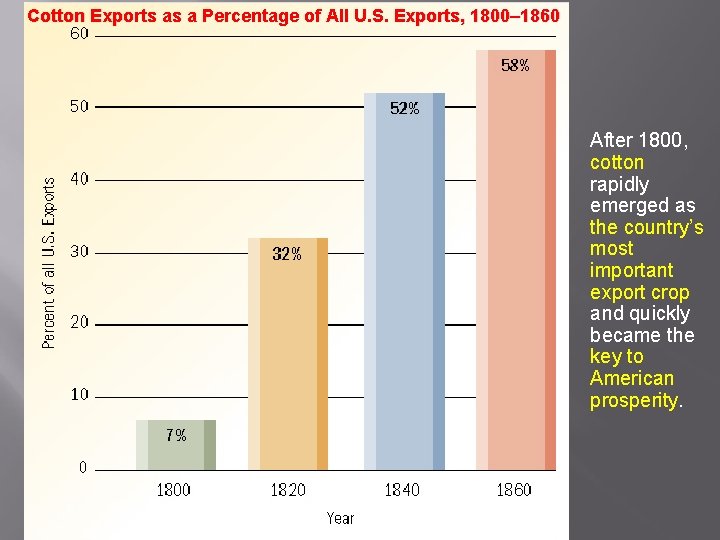
Cotton Exports as a Percentage of All U. S. Exports, 1800– 1860 After 1800, cotton rapidly emerged as the country’s most important export crop and quickly became the key to American prosperity.
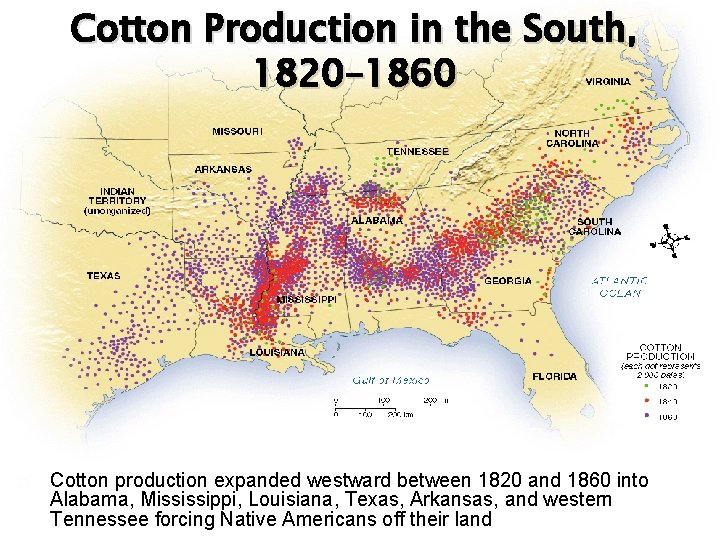
Cotton Production in the South, 1820– 1860 Cotton production expanded westward between 1820 and 1860 into Alabama, Mississippi, Louisiana, Texas, Arkansas, and western Tennessee forcing Native Americans off their land
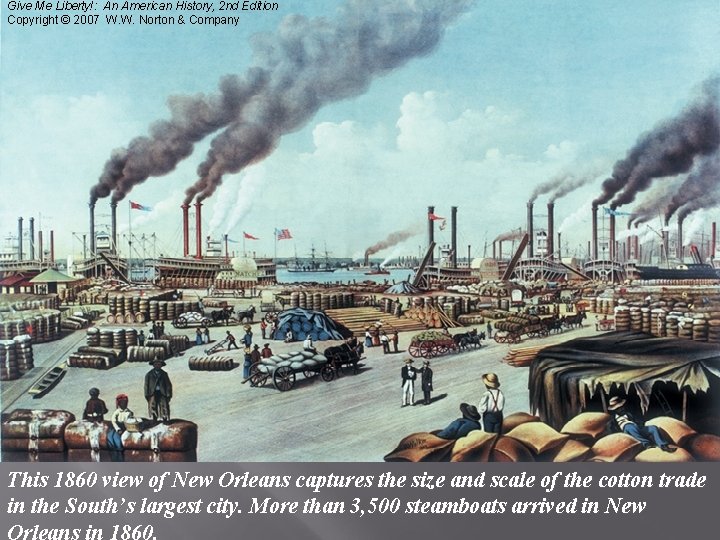
Give Me Liberty!: An American History, 2 nd Edition Copyright © 2007 W. W. Norton & Company This 1860 view of New Orleans captures the size and scale of the cotton trade in the South’s largest city. More than 3, 500 steamboats arrived in New Orleans in 1860.
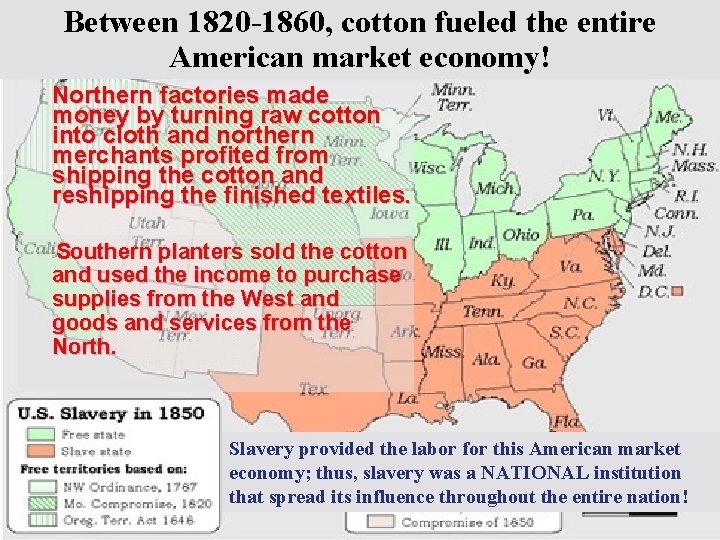
Between 1820 -1860, cotton fueled the entire American market economy! Northern factories made money by turning raw cotton into cloth and northern merchants profited from shipping the cotton and reshipping the finished textiles. Southern planters sold the cotton and used the income to purchase supplies from the West and goods and services from the North. Slavery provided the labor for this American market economy; thus, slavery was a NATIONAL institution that spread its influence throughout the entire nation!
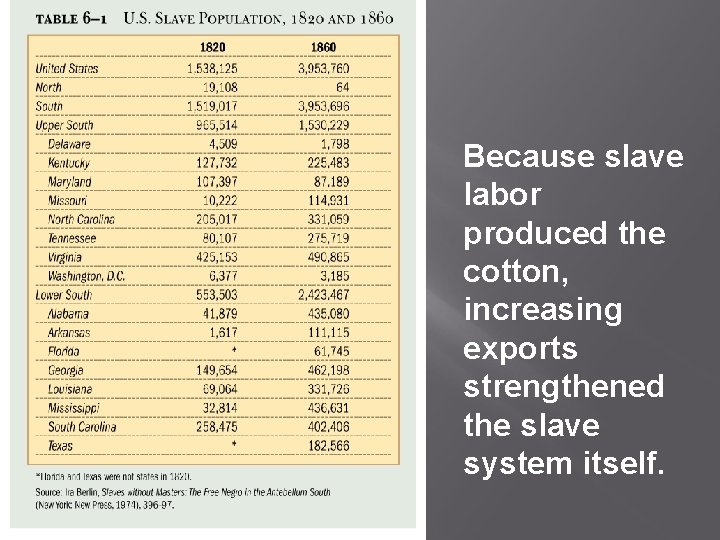
Because slave labor produced the cotton, increasing exports strengthened the slave system itself.
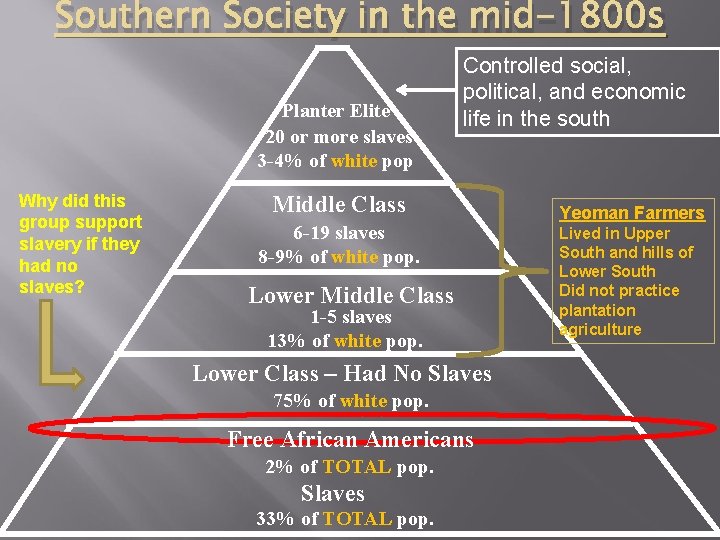
Southern Society in the mid-1800 s Planter Elite 20 or more slaves 3 -4% of white pop Why did this group support slavery if they had no slaves? Controlled social, political, and economic life in the south Middle Class 6 -19 slaves 8 -9% of white pop. Lower Middle Class 1 -5 slaves 13% of white pop. Lower Class – Had No Slaves 75% of white pop. Free African Americans 2% of TOTAL pop. Slaves 33% of TOTAL pop. Yeoman Farmers Lived in Upper South and hills of Lower South Did not practice plantation agriculture
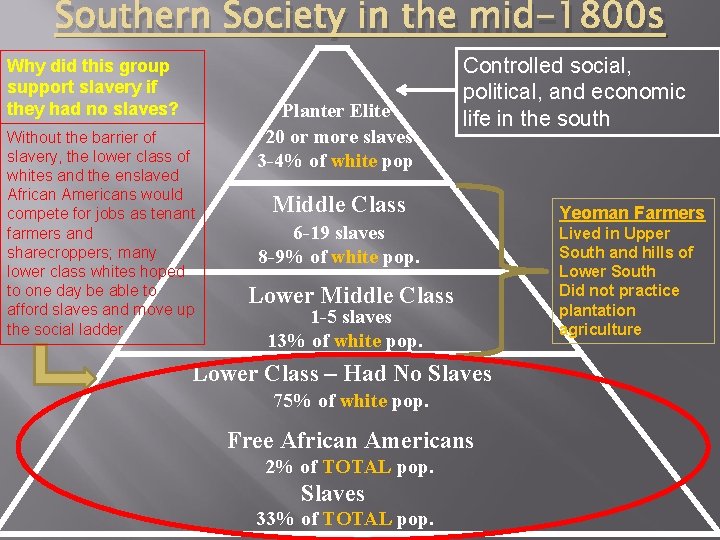
Southern Society in the mid-1800 s Why did this group support slavery if they had no slaves? Without the barrier of slavery, the lower class of whites and the enslaved African Americans would compete for jobs as tenant farmers and sharecroppers; many lower class whites hoped to one day be able to afford slaves and move up the social ladder Planter Elite 20 or more slaves 3 -4% of white pop Controlled social, political, and economic life in the south Middle Class 6 -19 slaves 8 -9% of white pop. Lower Middle Class 1 -5 slaves 13% of white pop. Lower Class – Had No Slaves 75% of white pop. Free African Americans 2% of TOTAL pop. Slaves 33% of TOTAL pop. Yeoman Farmers Lived in Upper South and hills of Lower South Did not practice plantation agriculture
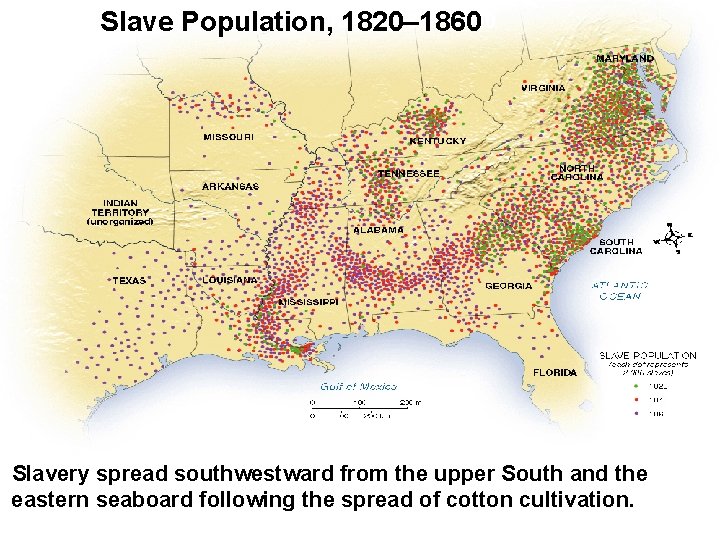
Slave Population, 1820– 1860 Slavery spread southwestward from the upper South and the eastern seaboard following the spread of cotton cultivation.
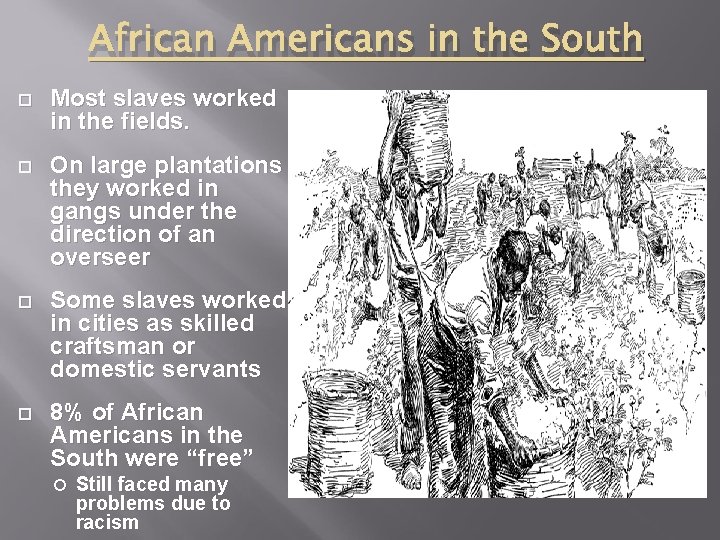
African Americans in the South Most slaves worked in the fields. On large plantations they worked in gangs under the direction of an overseer Some slaves worked in cities as skilled craftsman or domestic servants 8% of African Americans in the South were “free” Still faced many problems due to racism
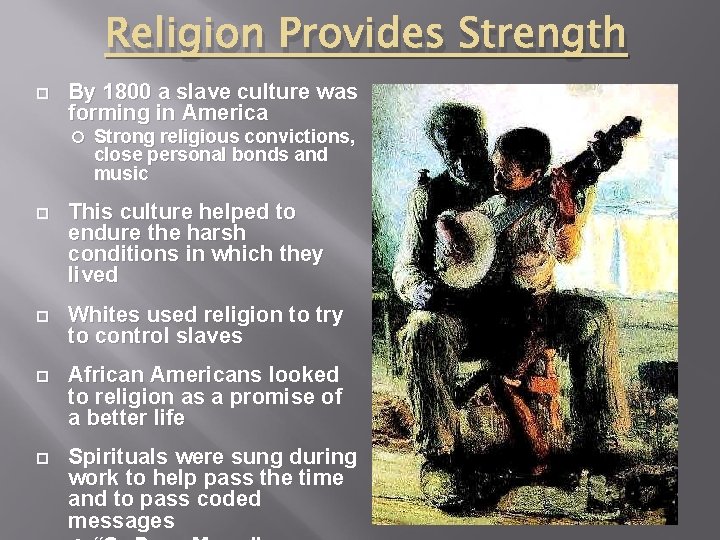
Religion Provides Strength By 1800 a slave culture was forming in America Strong religious convictions, close personal bonds and music This culture helped to endure the harsh conditions in which they lived Whites used religion to try to control slaves African Americans looked to religion as a promise of a better life Spirituals were sung during work to help pass the time and to pass coded messages
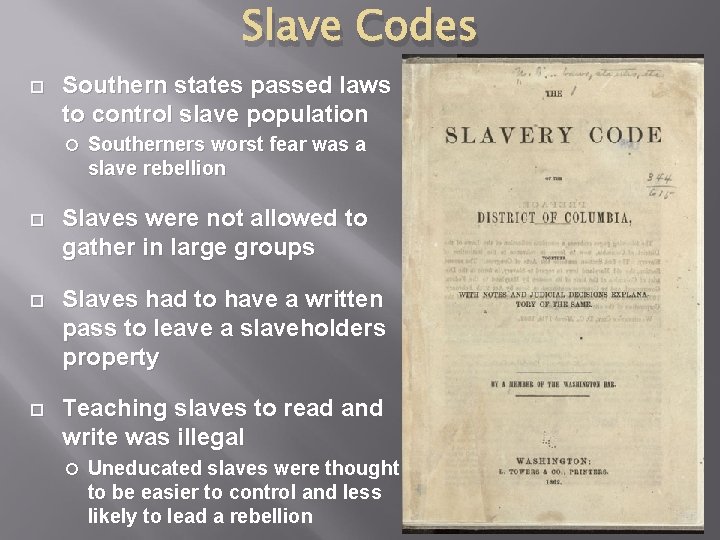
Slave Codes Southern states passed laws to control slave population Southerners worst fear was a slave rebellion Slaves were not allowed to gather in large groups Slaves had to have a written pass to leave a slaveholders property Teaching slaves to read and write was illegal Uneducated slaves were thought to be easier to control and less likely to lead a rebellion
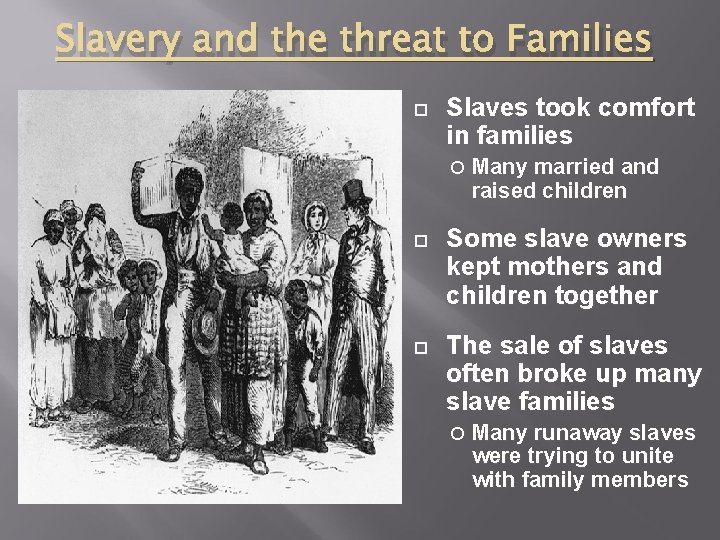
Slavery and the threat to Families Slaves took comfort in families Many married and raised children Some slave owners kept mothers and children together The sale of slaves often broke up many slave families Many runaway slaves were trying to unite with family members
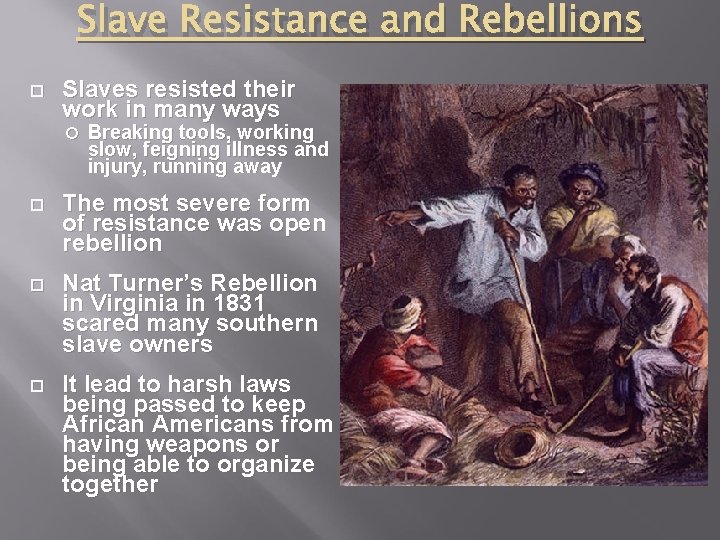
Slave Resistance and Rebellions Slaves resisted their work in many ways Breaking tools, working slow, feigning illness and injury, running away The most severe form of resistance was open rebellion Nat Turner’s Rebellion in Virginia in 1831 scared many southern slave owners It lead to harsh laws being passed to keep African Americans from having weapons or being able to organize together
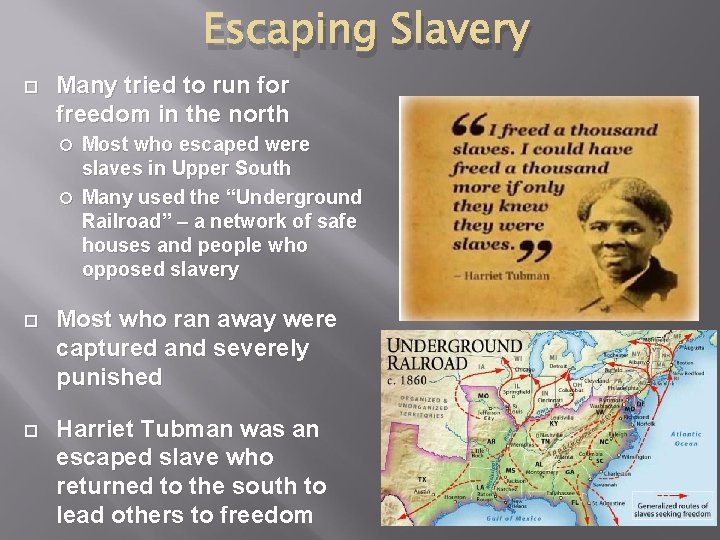
Escaping Slavery Many tried to run for freedom in the north Most who escaped were slaves in Upper South Many used the “Underground Railroad” – a network of safe houses and people who opposed slavery Most who ran away were captured and severely punished Harriet Tubman was an escaped slave who returned to the south to lead others to freedom
Harriet Tubman and the Underground Railroad
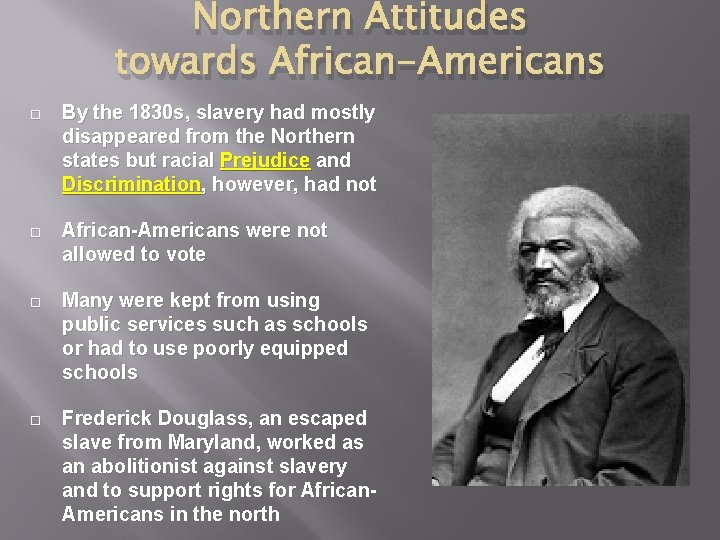
Northern Attitudes towards African-Americans By the 1830 s, slavery had mostly disappeared from the Northern states but racial Prejudice and Discrimination, however, had not African-Americans were not allowed to vote Many were kept from using public services such as schools or had to use poorly equipped schools Frederick Douglass, an escaped slave from Maryland, worked as an abolitionist against slavery and to support rights for African. Americans in the north
Frederick Douglass Video
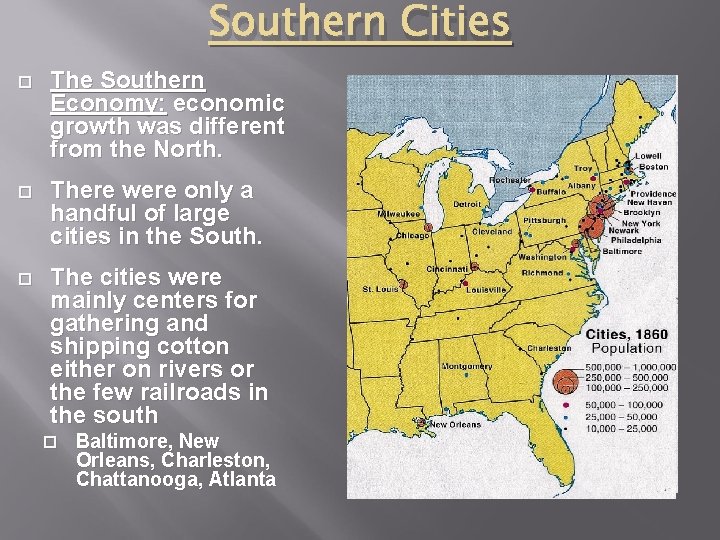
Southern Cities The Southern Economy: economic growth was different from the North. There were only a handful of large cities in the South. The cities were mainly centers for gathering and shipping cotton either on rivers or the few railroads in the south Baltimore, New Orleans, Charleston, Chattanooga, Atlanta