Kinetics Part III Integrated Rate Laws Jespersen Chap


- Slides: 24
Kinetics Part III: Integrated Rate Laws Jespersen Chap. 14 Sec 4 Dr. C. Yau Fall 2014 1
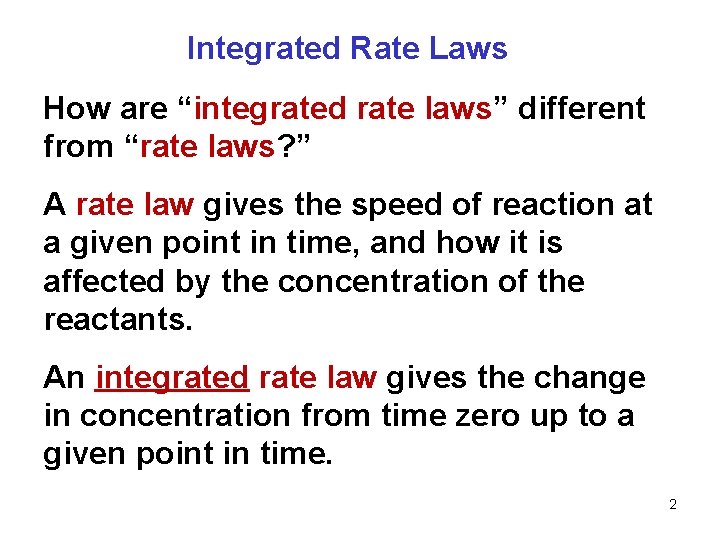
Integrated Rate Laws How are “integrated rate laws” different from “rate laws? ” A rate law gives the speed of reaction at a given point in time, and how it is affected by the concentration of the reactants. An integrated rate law gives the change in concentration from time zero up to a given point in time. 2
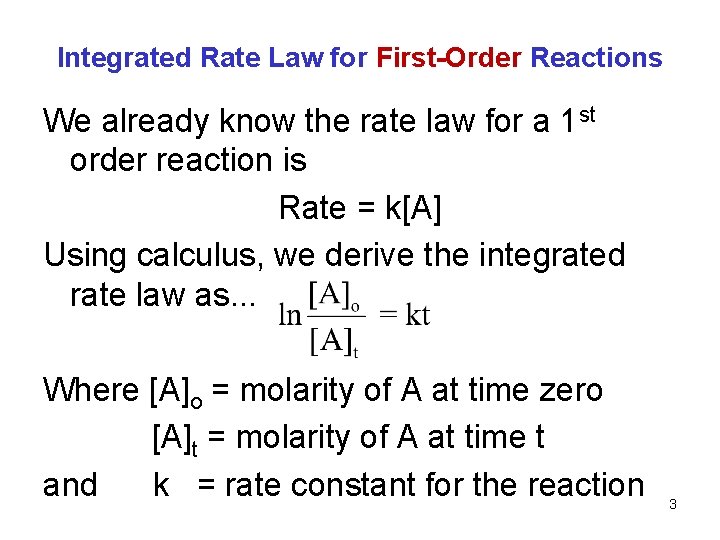
Integrated Rate Law for First-Order Reactions We already know the rate law for a 1 st order reaction is Rate = k[A] Using calculus, we derive the integrated rate law as. . . Where [A]o = molarity of A at time zero [A]t = molarity of A at time t and k = rate constant for the reaction 3
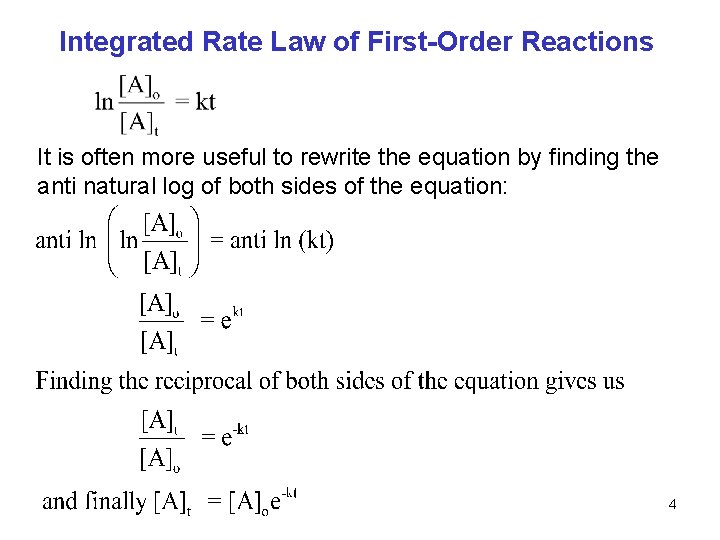
Integrated Rate Law of First-Order Reactions It is often more useful to rewrite the equation by finding the anti natural log of both sides of the equation: 4
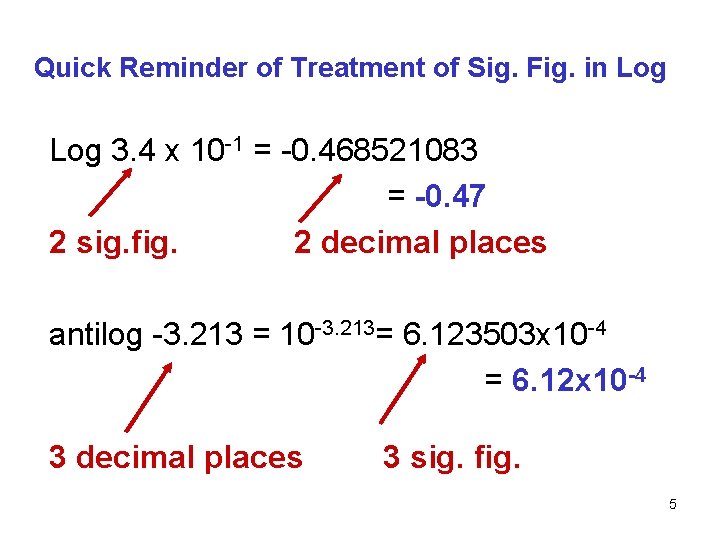
Quick Reminder of Treatment of Sig. Fig. in Log 3. 4 x 10 -1 = -0. 468521083 = -0. 47 2 sig. fig. 2 decimal places antilog -3. 213 = 10 -3. 213= 6. 123503 x 10 -4 = 6. 12 x 10 -4 3 decimal places 3 sig. fig. 5
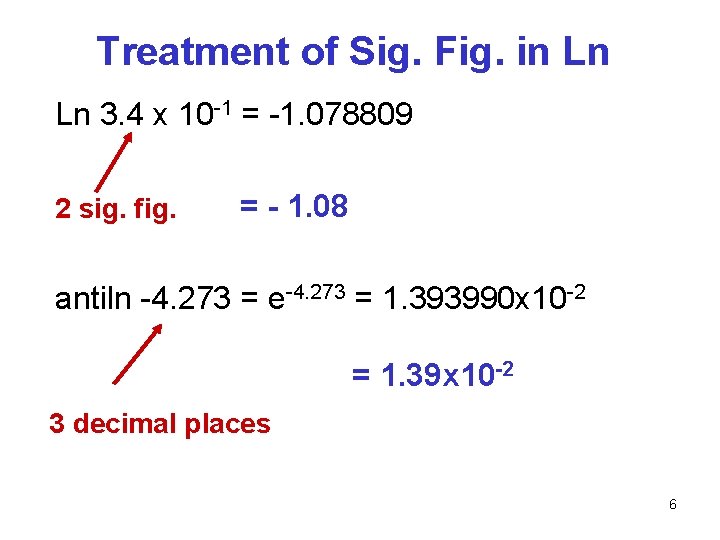
Treatment of Sig. Fig. in Ln Ln 3. 4 x 10 -1 = -1. 078809 2 sig. fig. = - 1. 08 antiln -4. 273 = e-4. 273 = 1. 393990 x 10 -2 = 1. 39 x 10 -2 3 decimal places 6
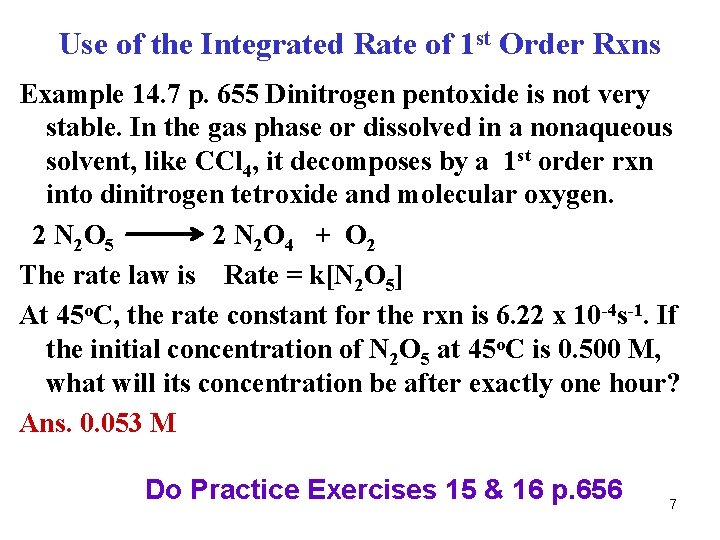
Use of the Integrated Rate of 1 st Order Rxns Example 14. 7 p. 655 Dinitrogen pentoxide is not very stable. In the gas phase or dissolved in a nonaqueous solvent, like CCl 4, it decomposes by a 1 st order rxn into dinitrogen tetroxide and molecular oxygen. 2 N 2 O 5 2 N 2 O 4 + O 2 The rate law is Rate = k[N 2 O 5] At 45 o. C, the rate constant for the rxn is 6. 22 x 10 -4 s-1. If the initial concentration of N 2 O 5 at 45 o. C is 0. 500 M, what will its concentration be after exactly one hour? Ans. 0. 053 M Do Practice Exercises 15 & 16 p. 656 7
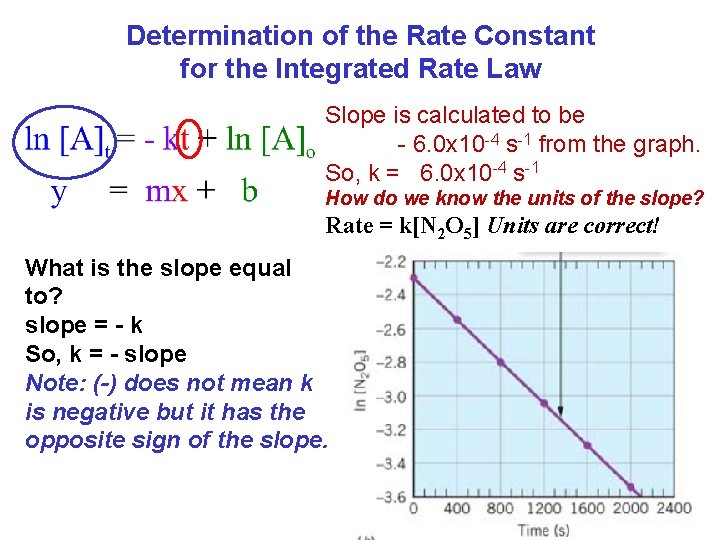
Determination of the Rate Constant for the Integrated Rate Law The rate constant can be determined graphically. Again we manipulate the rate law to allow us to obtain a linear graph: Variables are [A]t and t How does this allow us to determine the rate constant, k, graphically? First determine which are variable & which are constants. 8
Determination of the Rate Constant for the Integrated Rate Law Slope is calculated to be - 6. 0 x 10 -4 s-1 from the graph. So, k = 6. 0 x 10 -4 s-1 How do we know the units of the slope? Rate = k[N 2 O 5] Units are correct! What is the slope equal to? slope = - k So, k = - slope Note: (-) does not mean k is negative but it has the opposite sign of the slope. 9
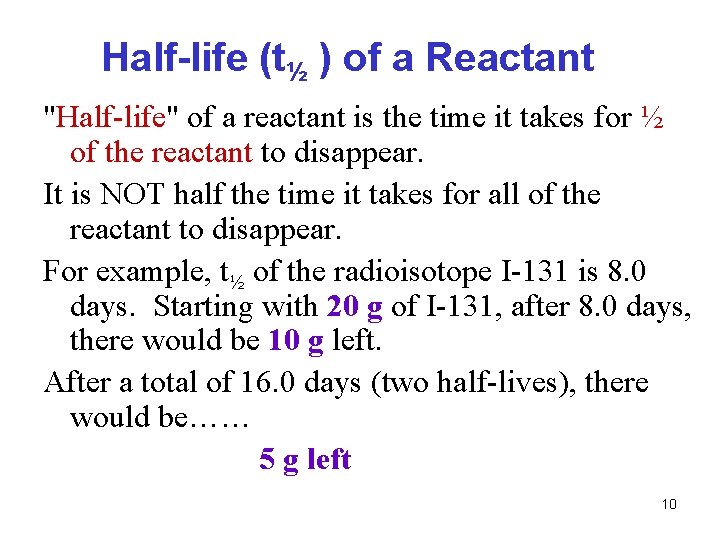
Half-life (t½ ) of a Reactant "Half-life" of a reactant is the time it takes for ½ of the reactant to disappear. It is NOT half the time it takes for all of the reactant to disappear. For example, t½ of the radioisotope I-131 is 8. 0 days. Starting with 20 g of I-131, after 8. 0 days, there would be 10 g left. After a total of 16. 0 days (two half-lives), there would be…… 5 g left 10
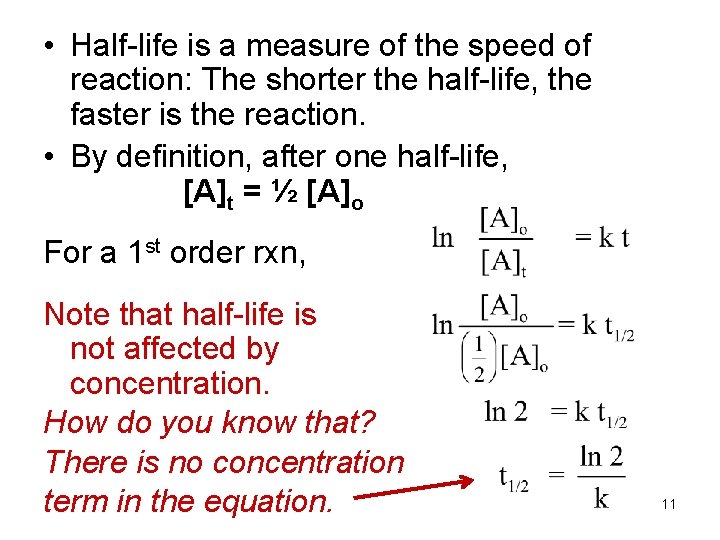
• Half-life is a measure of the speed of reaction: The shorter the half-life, the faster is the reaction. • By definition, after one half-life, [A]t = ½ [A]o For a 1 st order rxn, Note that half-life is not affected by concentration. How do you know that? There is no concentration term in the equation. 11
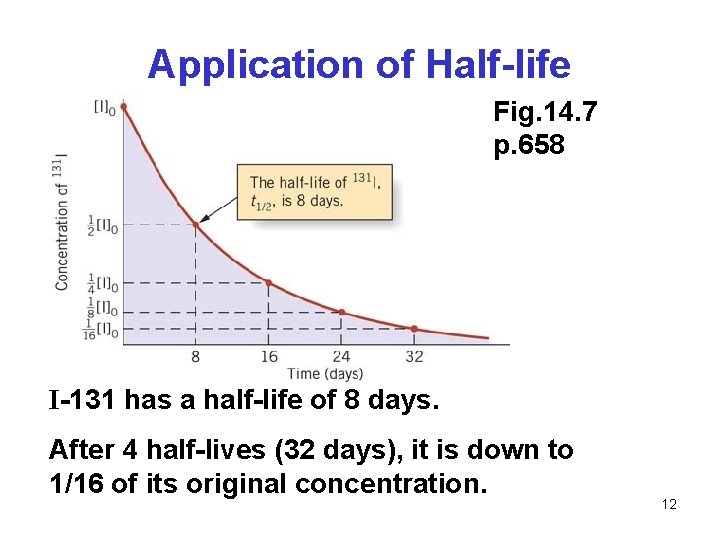
Application of Half-life Fig. 14. 7 p. 658 I-131 has a half-life of 8 days. After 4 half-lives (32 days), it is down to 1/16 of its original concentration. 12
If we start with 20. 0 g of I-131, after 40 days, how much of I-131 is still there? (Half-life of I-131 = 8 days. ) What percent of I-131 remains after 24 days? What fraction of I-131 remains after 48 days? 13
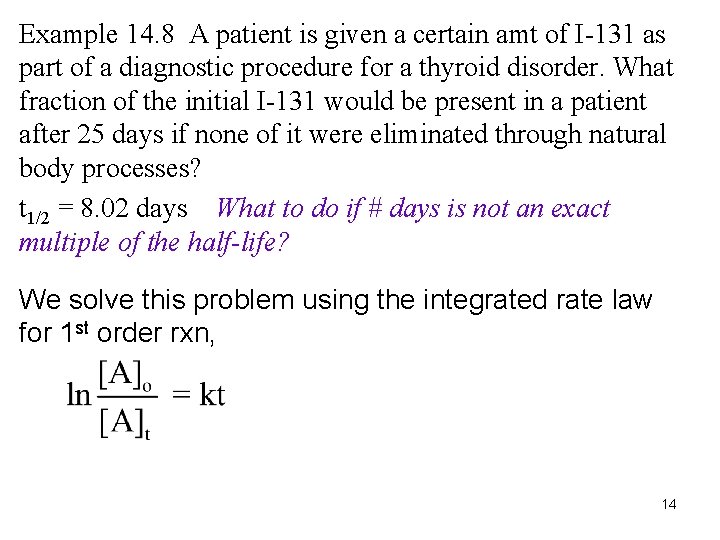
Example 14. 8 A patient is given a certain amt of I-131 as part of a diagnostic procedure for a thyroid disorder. What fraction of the initial I-131 would be present in a patient after 25 days if none of it were eliminated through natural body processes? t 1/2 = 8. 02 days What to do if # days is not an exact multiple of the half-life? We solve this problem using the integrated rate law for 1 st order rxn, 14
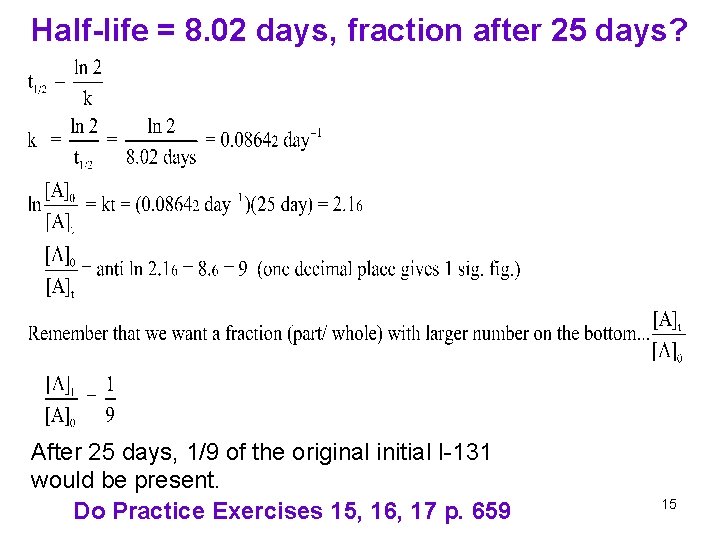
Half-life = 8. 02 days, fraction after 25 days? After 25 days, 1/9 of the original initial I-131 would be present. Do Practice Exercises 15, 16, 17 p. 659 15
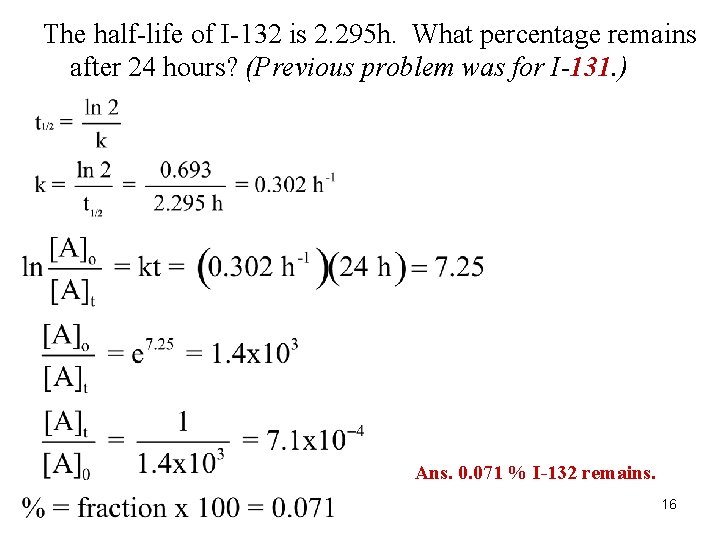
The half-life of I-132 is 2. 295 h. What percentage remains after 24 hours? (Previous problem was for I-131. ) Ans. 0. 071 % I-132 remains. 16
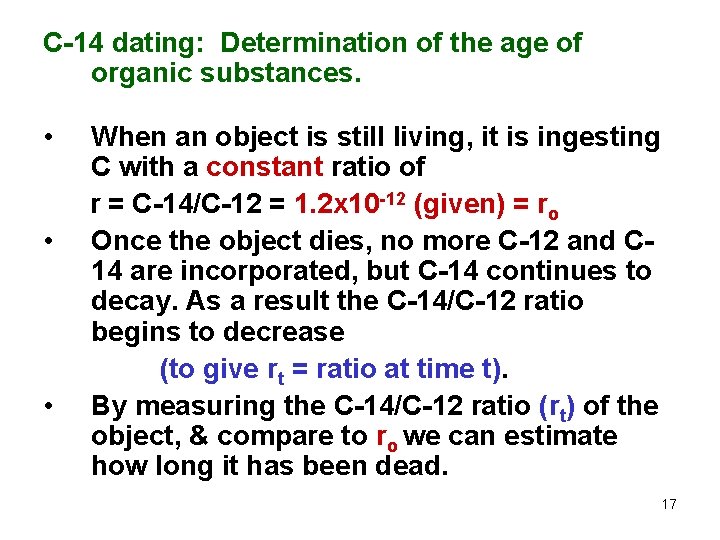
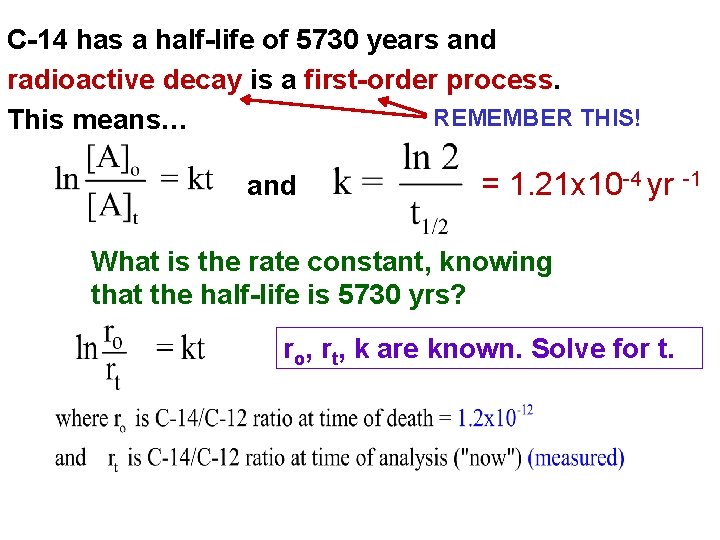
C-14 dating: Determination of the age of organic substances. • • • When an object is still living, it is ingesting C with a constant ratio of r = C-14/C-12 = 1. 2 x 10 -12 (given) = ro Once the object dies, no more C-12 and C 14 are incorporated, but C-14 continues to decay. As a result the C-14/C-12 ratio begins to decrease (to give rt = ratio at time t). By measuring the C-14/C-12 ratio (rt) of the object, & compare to ro we can estimate how long it has been dead. 17
C-14 has a half-life of 5730 years and radioactive decay is a first-order process. REMEMBER THIS! This means… and = 1. 21 x 10 -4 yr -1 What is the rate constant, knowing that the half-life is 5730 yrs? ro, rt, k are known. Solve for t.
Example 14. 9 p. 660 A sample of an ancient wooden object was found to have ratio of 14 C to 12 C equal to 3. 3 x 10 -13 as compared to a contemporary biological sample, which has a ratio of 1. 2 x 10 -12. What is the age of the object? Calculate k from t 1/2 for C-14 = 1. 21 x 10 -4 yr-1 Find t. Ans. 1. 07 x 104 years Do Pract Exer 20, 21 p. 661 19
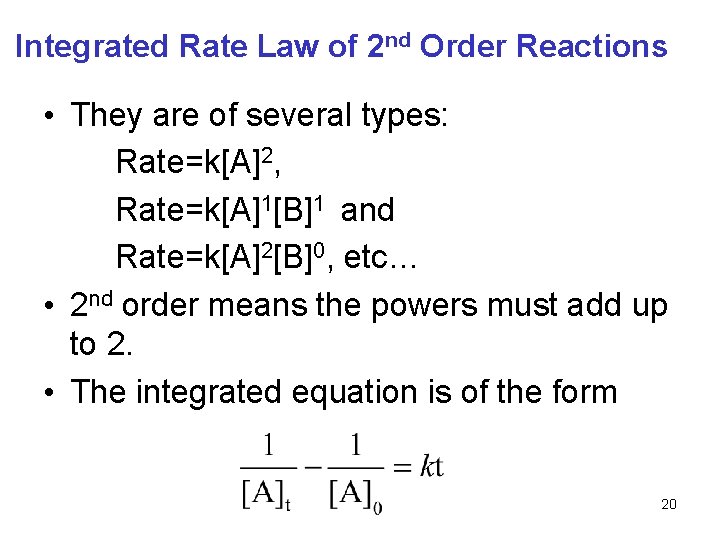
Integrated Rate Law of 2 nd Order Reactions • They are of several types: Rate=k[A]2, Rate=k[A]1[B]1 and Rate=k[A]2[B]0, etc… • 2 nd order means the powers must add up to 2. • The integrated equation is of the form 20
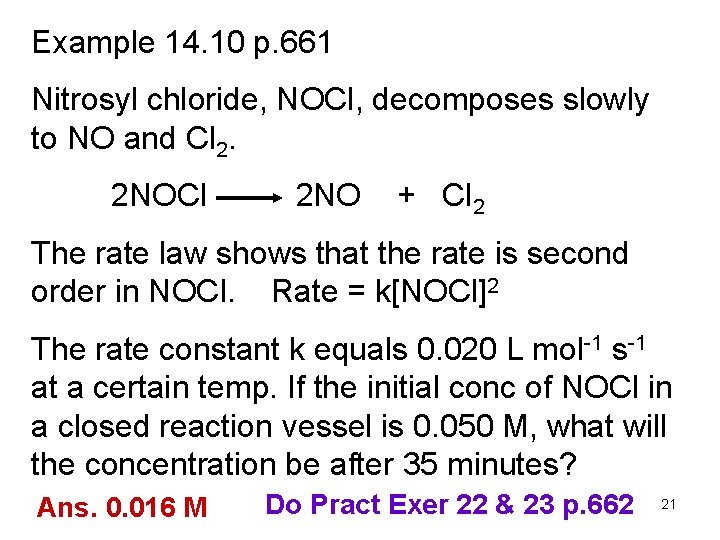
Example 14. 10 p. 661 Nitrosyl chloride, NOCl, decomposes slowly to NO and Cl 2. 2 NOCl 2 NO + Cl 2 The rate law shows that the rate is second order in NOCl. Rate = k[NOCl]2 The rate constant k equals 0. 020 L mol-1 s-1 at a certain temp. If the initial conc of NOCl in a closed reaction vessel is 0. 050 M, what will the concentration be after 35 minutes? Ans. 0. 016 M Do Pract Exer 22 & 23 p. 662 21
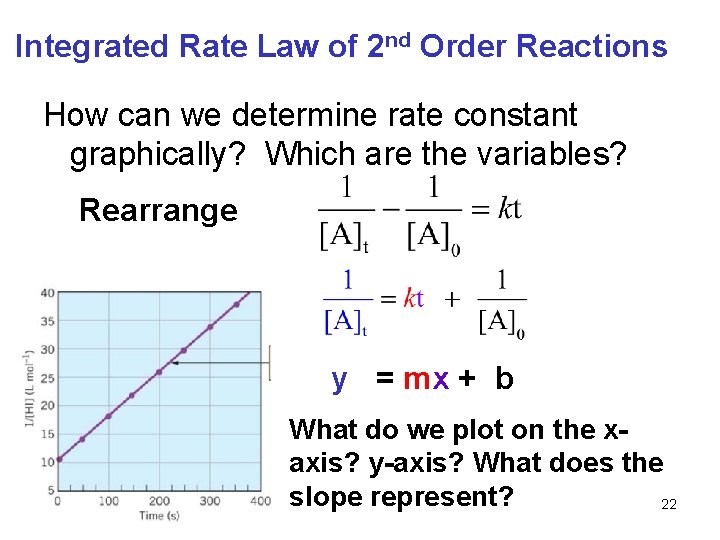
Integrated Rate Law of 2 nd Order Reactions How can we determine rate constant graphically? Which are the variables? Rearrange y = mx + b What do we plot on the xaxis? y-axis? What does the slope represent? 22
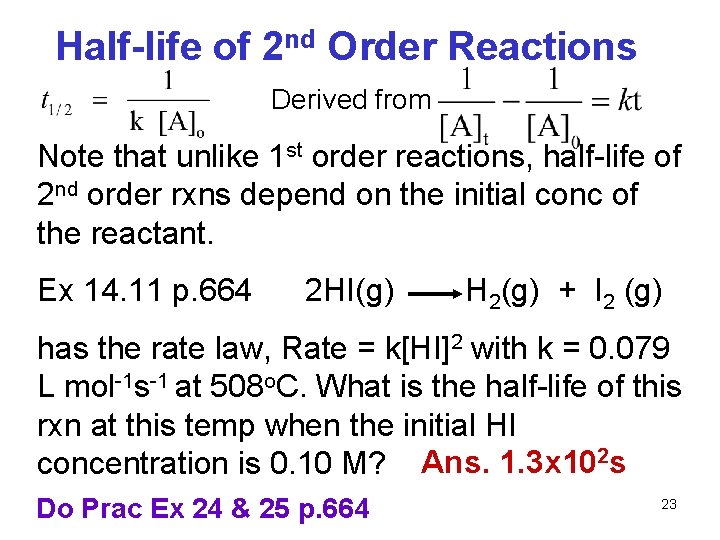
Half-life of 2 nd Order Reactions Derived from Note that unlike 1 st order reactions, half-life of 2 nd order rxns depend on the initial conc of the reactant. Ex 14. 11 p. 664 2 HI(g) H 2(g) + I 2 (g) has the rate law, Rate = k[HI]2 with k = 0. 079 L mol-1 s-1 at 508 o. C. What is the half-life of this rxn at this temp when the initial HI concentration is 0. 10 M? Ans. 1. 3 x 10² s Do Prac Ex 24 & 25 p. 664 23
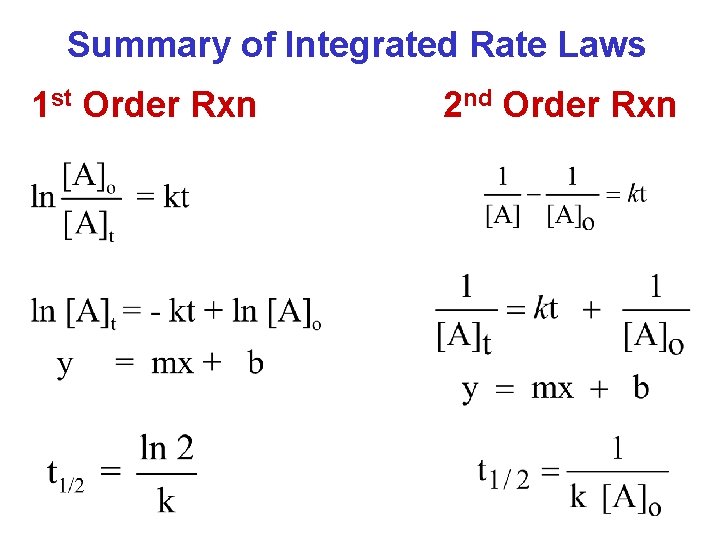
Summary of Integrated Rate Laws 1 st Order Rxn 2 nd Order Rxn